
Also available in
 Čeština (Czech)
There’s hardly been a worse follow-up to a club managerial legend’s departure — the second biggest Czech city might offer up the only real contender. Josef Masopust, not often thought of that way, is actually Zbrojovka Brno’s most celebrated coach; the man who brought the only title to town in 1978 and signed off with two more Top 3 finishes. Once he left, Zbrojovka promptly collapsed from 2nd to 12th and, within three years, dropped out of the top flight altogether for six mournful seasons. Are Slovácko on a similar trajectory after making such an unsure first step into the post-Martin Svědík darkness?
When Svatopluk Habanec — at the time Slovácko’s most seasoned boss, the only one before Svědík to hit 100 games in charge — departed after 2015/16, the club slipped from 12 wins to 6 and from 8th to 12th. This time, the fall wasn’t quite as steep on paper (12 wins to 9, with the same 15 losses and 56 conceded), but tumbling straight from the Top 6 to the brink of the relegation play-offs is a whole different beast compared to trading the upper mushy middle for the lower end of it, like Slovácko did without the current Ústí nad Labem coach in 2017.
It’s also a whole different ballgame losing a larger-than-club personality like Svědík. When Sigma parted ways with Petr “John” Uličný in 2006, a comfortable 9th place gave way to a worrying 14th, just five points clear of the drop. Tomáš Pospíchal, Masopust’s silver-winning teammate from Chile ’62, left a similar void at Ďolíček: after largely presiding over a nine-year stretch inside the Top 5 — capped by a title in 1983 — Bohemians sank to 12th and 14th.
In Slovácko’s case, of course, this downfall was to be expected to a certain extent. Cracks were already appearing in Svědík’s farewell run, further accentuated by back-to-back hires whose longest stays elsewhere barely amounted to a third of Svědík’s time at Slovácko.
Enter Jan Kameník: the man who took a second-tier club to three straight promotion play-offs — a remarkable case of sustained defiance of the odds, especially given the club itself never even aimed for promotion in the first place. While the dressing room might have been a problem for Roman West and Ondřej Smetana before him, the fact he specifically wanted Milan Petržela back is a good initial sign after the latter literally chased him and Stanislav Hofmann away. Repeating West’s mistake of not relying on video whatsoever shouldn’t be an issue, either, though Richard Dostálek is hardly the most progressive assistant coach. Svědík’s Slovácko famously punched way above its weight; and so did Kameník’s Vyškov.
The fact Slovácko even bet on Kameník instead of Petr Rada is, by the way, a sign of a major shift at the top of the club. Zdeněk Zemek, Rada’s proponent who’s mostly credited for establishing Slovácko in the top flight, has now firmly taken the back seat to co-owner Vítězslav Skopal, who then nearly succeeded in completely ousting the club’s director Petr Pojezný (who survived but lost his chair on the board). The third co-owner, only recently introduced, will be represented on the board by a certain ‘Bomber’. The jury is out on which vision will prevail — or whether it’s even the right one — but things aren’t exactly standing still in Uherské Hradiště, which can only be a positive after the season they’ve just endured.
Looking back on 2024/25
What went (particularly) right
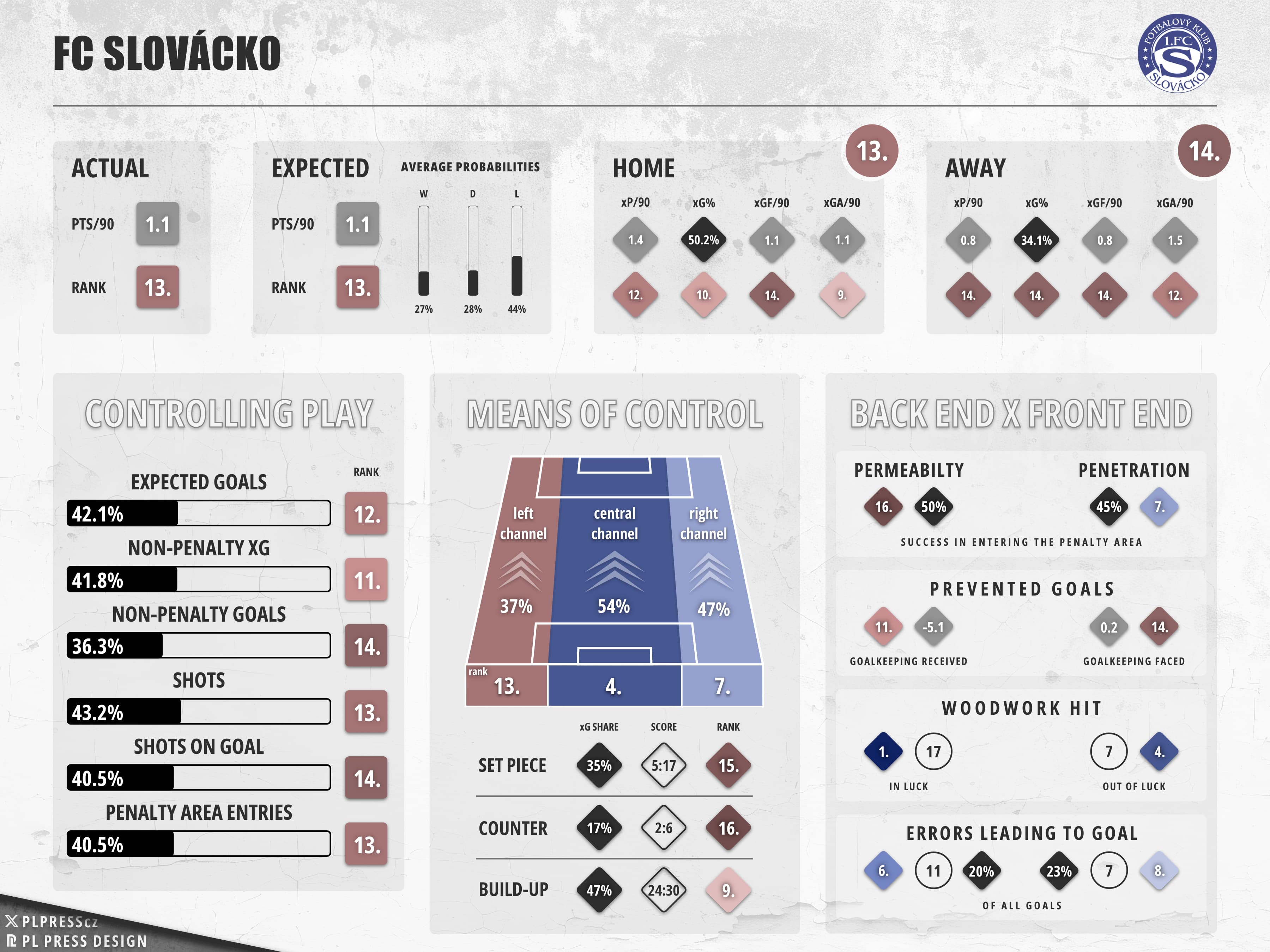
Some small bits and pieces which normally didn’t leave a lasting impact. Where Svědík went 0-1-2 against the Top 3 in his last autumn at Slovácko, with 8 goals conceded in the process, West remarkably didn’t lose to Slavia and Sparta in his first tries, overseeing a clean sheet against the champions (only three other clubs did) and bowing out just before his assistants completed an unbeaten hat trick via the 1:0 win vs Plzeň in R13. Bittersweet to say the least.
Getting saved by the woodwork a league-leading 17 times in a season sounds great, until you realize that you were denied by the very same thing three times inside one first half that saw you trailing by an unprecedented four goals at home, with fans leaving the stands in protest.
In hindsight, the first 10 matchdays were as good as it got for Slovácko. To start, West’s outfit earned 16 points to the tune of a 1.6 point-per-game average, collecting six shutouts over the period. In the second third of the regular season, they added 9 points and one shutout; in the last one, it got somehow even worse with 5 points (the average dropping by 1.1 points per game!) to go with a sole clean sheet. Indeed, it wouldn’t be all too crazy to claim that firing West on the back of one unlucky loss (Teplice 0:2) and one lopsided loss allowed by an early red card (Liberec 0:4) — 11th and 12th game of the season — was an error of judgment.
What went (especially) wrong
While I did mention above that Slovácko didn’t technically take a step back in terms of conceded goals (56 on the season for both 23/24 and 24/25), it’s obviously a big difference to be part of the relegation group (5 extra GAGoals allowed, including penalties) rather than the championship group like Slovácko still was in Svědík’s last season (a historic 16 goals added to their total!). Regardless, the offensive production was a much greater issue; Slovácko went from averaging a decent 1.30 goals inside the regular season to 0.83 — the club’s third-worst rate in the entire history. After 5 rounds, Slovácko boasted just one goal scored by themselves, nearly opening through 4 straight goalless efforts. At the end of the day, their fans had every right to be pissed.
The juxtaposition to the (already underwhelming) tail end of Svědík’s era is generally damning. They exchanged a home xGFExpected Goals For (xGF) estimates how many goals a team should have scored based on shot quality, location, and context. average of 1.62 (5th best) for 1.09 (3rd worst), being responsible for a substantially less shot attempts now (9% down in shot share). Even more crucially, instead of having the set pieces largely figured out through a Top 4 xG share of 56.6%, they were now second-most clueless to the tune of 35% and as many as 17 goals leaked (only Dynamo did worse on both counts). They fouled a lot more deep down, too.
Most valuable player (still on board)
Per my MVP model (traditional stats): Michal Trávník (ranked 31st league-wide)
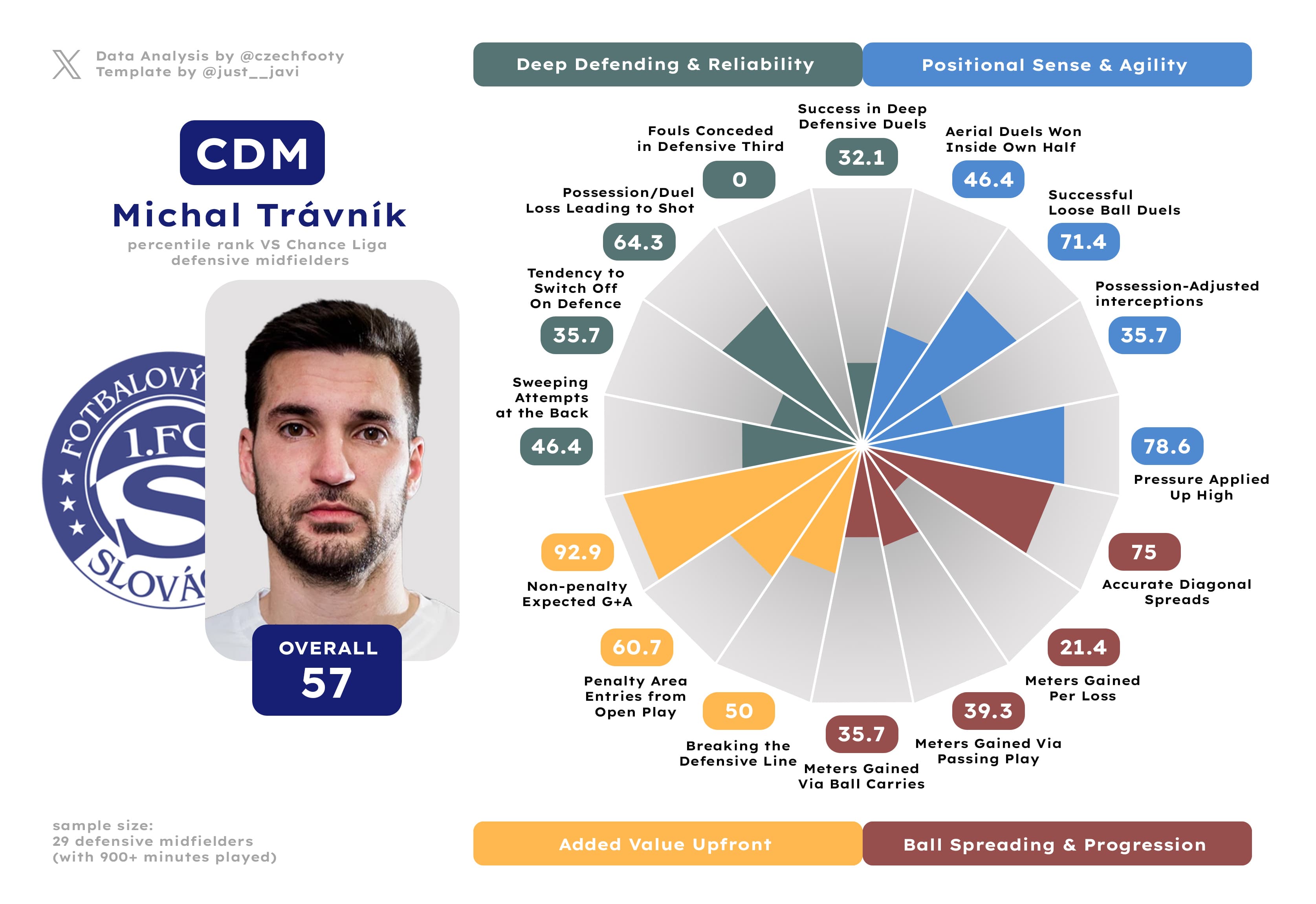
Per my positional models (advanced stats): Michal Trávník (57th overall percentile at CDM)
Per Statsbomb’s On-Ball Value (OBV) metric: Gigli Ndefe
On the face of it, this is one of the weakest MVPs of this summer. In Slovácko’s (broken) reality, Michal Trávník actually makes for a surprisingly solid pick. In terms of wasted chances created, he led the team by 9. In terms of contributions showing up on the scoresheet, 6 of his 8 were provided to equalizers or go-ahead goals, including the eventual winner (to go with an assist) in what was both his 300th league appearance and Slovácko’s biggest game of 24/25 by far. He did much of this while wearing the captain’s armband (which he now does full-time), overseeing 9 clean sheets across his 24 full, 90-minute shifts.
Indeed, gone are the days of Trávník operating in the hole for Jablonec in 18/19. With Vlastimil Daníček out for most of the season, he was now easily the deepest-lying midfielder on most afternoons and didn’t look too out of place. He brought a decent amount of edge on the ball, and arguably too much of it off the ball (13 fouls in the defensive third, plus two causing a penalty, while picking up a concerning 9 yellow cards in the process). You would definitely expect more progression from a playmaker who’s often in possession of the ball, but some of the valuable dynamic qualities were still there past his 30th birthday.
Chip on the shoulder
carried by the player who’s got something to prove — be it to himself, fans or the coach
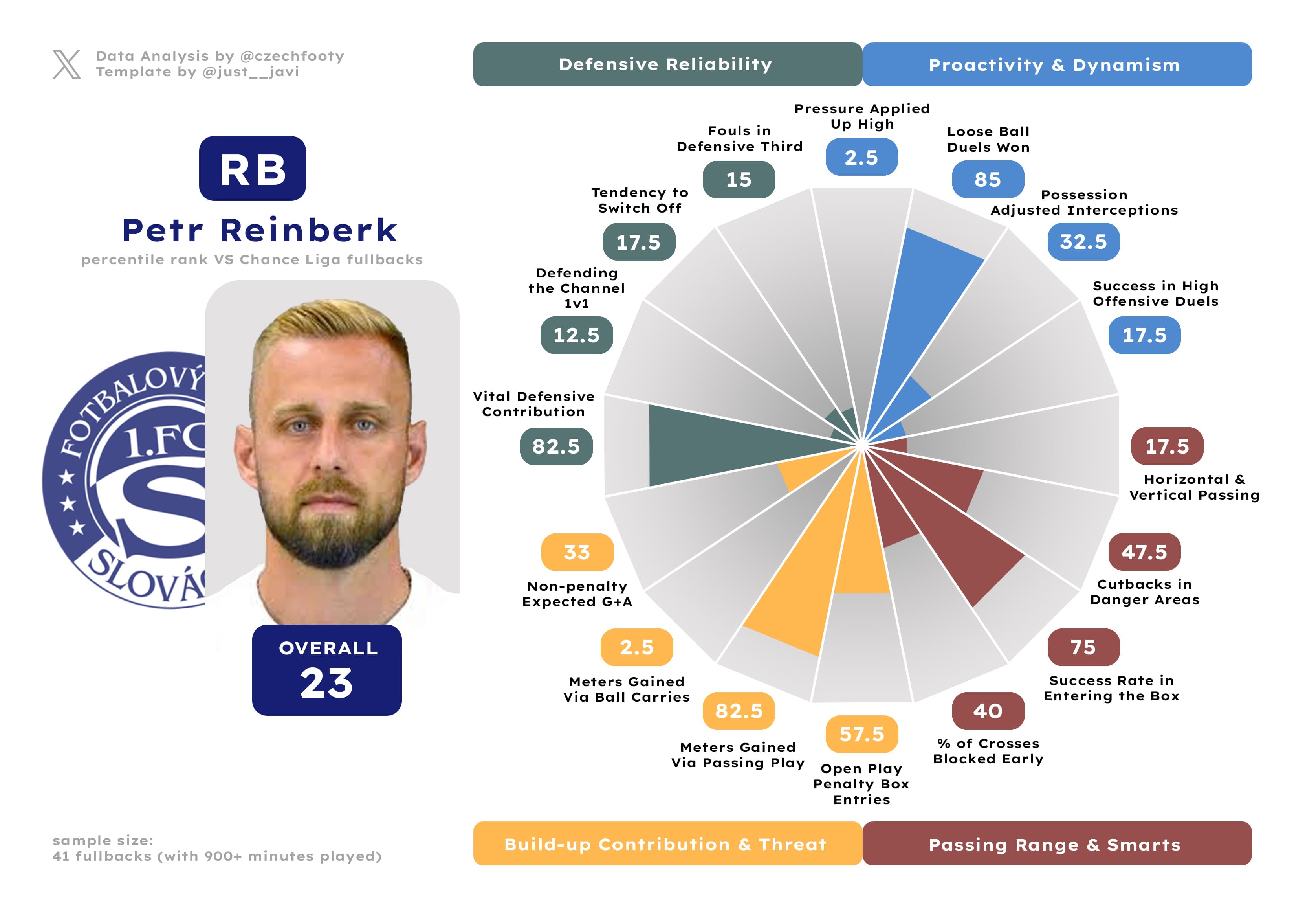
Last summer, he was a back-to-back MVP richly deserving his long-awaited extension, whereas this section was dedicated to all the other veterans and modern-day legends of football in Uherské Hradiště. This year, with Hofmann gone, Daníček hoping to bounce back from a 352-minute campaign and Petr Reinberk hoping to not look too out of depth on his off side, it’s finally his turn. Two years on from wondering whether he’ll go down as one of the most underappreciated stars of all time, I find myself wondering if we are now doing proper justice to Marek Havlík‘s rather dramatic decline, for a change. He already wasn’t great in 23/24, but now he looked like a tired guy who’d been forced to sign the new two year-contract. Slovácko most definitely don’t regret that decision (they can’t afford to be picky, after all); Havlík might have. He’s entering another contract year with a tougher call to make.
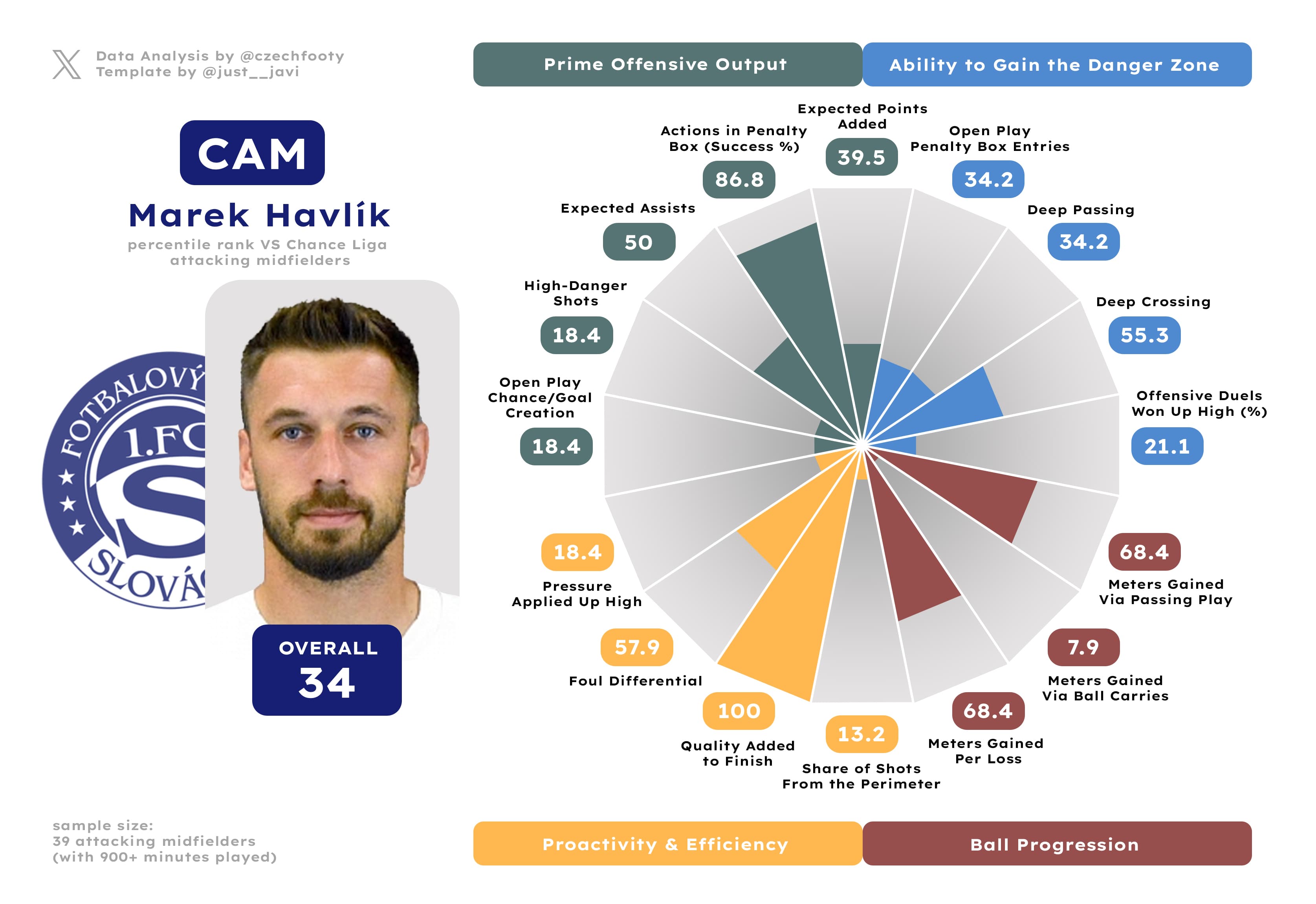
There are a number of disappointing trends. In terms of depressing stagnation, it’s the rate of penalty area entries from open play — improving from 1.06 to 1.08 per game as he fully lost the grip on his 22/23 rate of 1.38. In terms of continued decline, his xA rate dropping from 0.17 to 0.11 is of major concern, much like his chance/goal creation rate being sandwiched by Dominique Simon and David Krch. His mid- to long-range shot was as accurate and precise as ever, but his tangible final third contribution has effectively shrunk to merely that, with 61 ball recoveries up high (3 dangerous situations forced that way) giving way to just 43 (no such situation) in a smaller sample. Indeed, his legs looked as good as gone for the most part.
Inside the off-season
special thanks for guiding me through the motions of 1. FC Slovácko’s off-season go out to @Jiri_Stockmann & @slovackonafurt
Squad turnover
In my five years of doing this, Slovácko had consistently been a Top 6 club in terms of carrying over playing time from season to season, even reaching as high as 91.5% retained between 20/21 and 21/22. Against this backdrop, they are in more of a flux this summer, but not exactly going overboard with 72.1%. This places them 11th in the entire league, and joint-third in terms of losing members of the most used XI (4). While four seems like a high number, it’s important to note that two of those left in winter already (Michal Kohút, Merchas Doski) which, in turn, represents something of bad news: the fact nobody pushed them aside the rest of the way speaks to how much Slovácko have struggled to replace them.
Oh right. Speaking of which…
Biggest upgrade
… Slovácko do register an actual left back, yay! First it was Daniel Kosek arriving to follow-up on his tough 20/21 shift split between Liberec (1 start) and Bohemians (1 start, 9 cameos). Then it was Jonathan Mulder driving the upgrade home. Without knowing how he’ll settle in, Mulder is a big fella for a fullback (1.89 m per Transfermarkt) who can deputize in the heart of defence and is coming in sharp, completing a full 90 for a Top 3 side in Lithuania’s A Lyga as recently as on 5 July; an enticing mix to begin with. While they are not the most telling stats, he made for a recovery and accurate cross machine in the Dutch second tier in 23/24.
He could be fun to watch, and a lot to handle — if Reinberk even lets him get a sniff, that is…
Biggest downgrade
It’s been a long time since Filip Vecheta or Rigino Cicilia departed (leaving no mark on Slovácko’s 24/25 whatsoever), and it’s not like Jiří Klíma — let alone Matyáš Kozák — particularly hurt, either, but what you’re left with in the centre forward department are Marko Kvasina and Michael Krmenčík. And that won’t ever cut it. Even though Kozák and Klíma combined for an unspectacular 7 goal contributions, they all the same cut the collective contribution of all Slovácko CFs in half due to sheer ineptness of the two survivors.
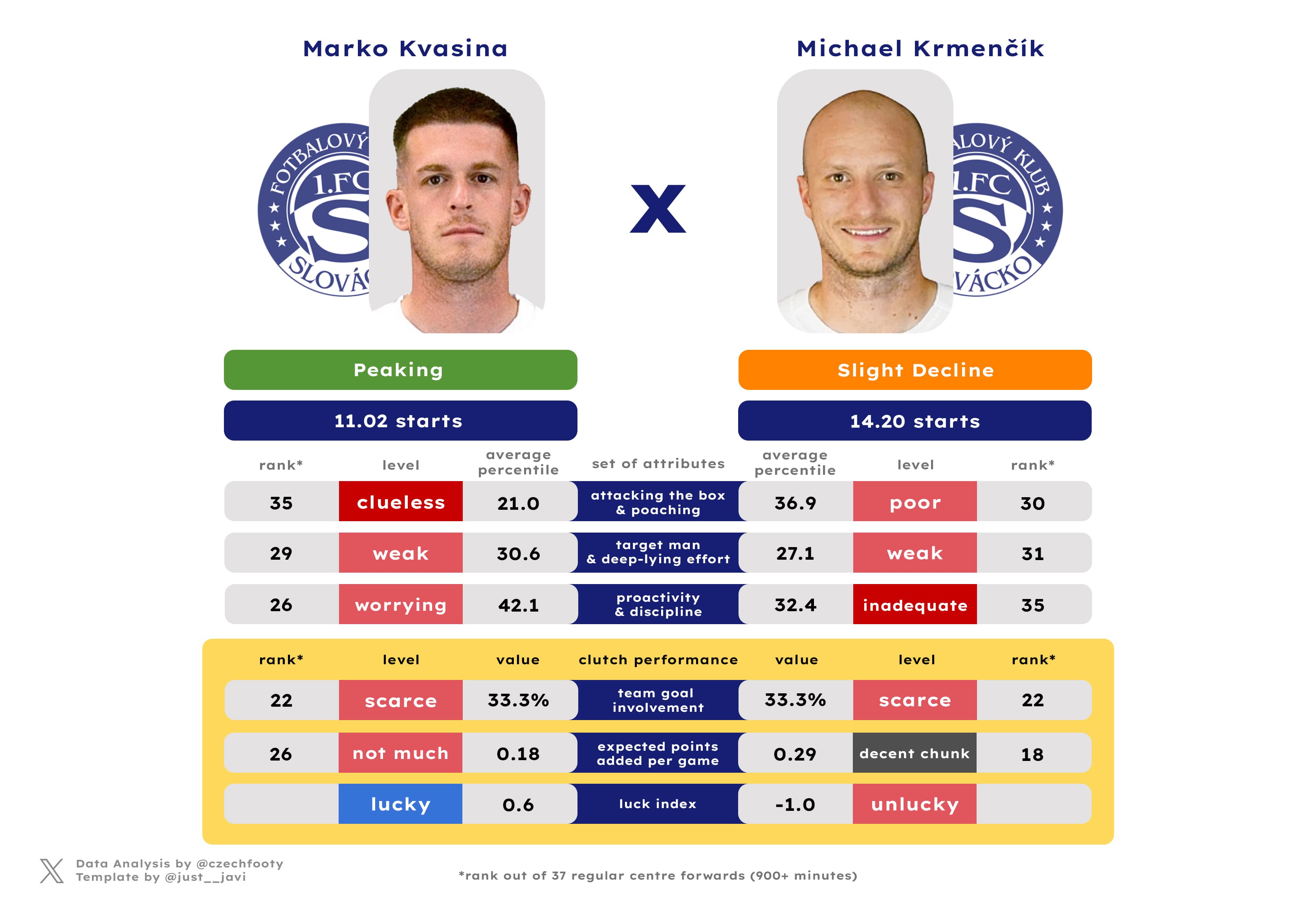
Kvasina doesn’t have the strength to prevail in 1-on-1 situations (won 7 of 35 high offensive duels), can’t use his big body effectively apart from rising to an aerial challenge (minus-10 foul differential) and he just never seems to search for a teammate. Krmenčík offers more of the same (especially the latter), only costing the team more with his numerous offsides and slacking on defence, while bringing more in terms of added value (though nearly half of it dates back to his first full start against Sparta where his G+A fetched an impressive 1.81 EPAExpected Points Added (EPA) estimate the value of one's goals and assists based on game state (late game winners = top).!).
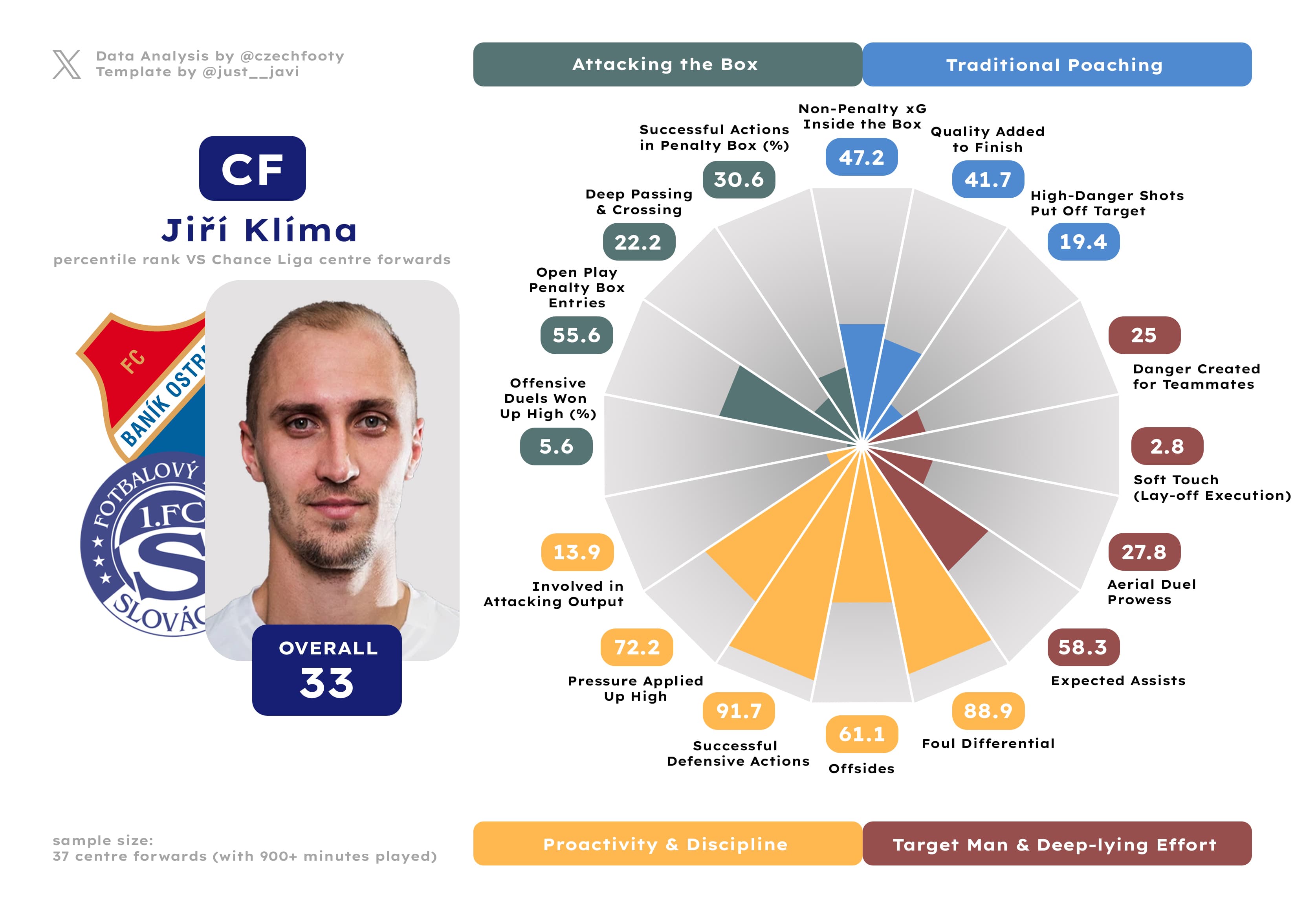
Klíma, meanwhile, wasn’t anything special but certainly didn’t appear clueless in so many areas. He isn’t a passenger in build-up, and makes for a much more proactive and disciplined presence off the ball. Where Krmenčík and Kvasina ranked 26th and 35th respectively with their average percentiles for that particular grouping of metrics, Klíma was a Top 6 striker.
Need left to be addressed
That you’re spending much of the summer patiently waiting for a 38-year-old homegrown talent is never a good sign, but it’s even worse when you’re beaten to his eventual signature by second-tier Viktoria Žižkov he’s got no emotional ties to. Nevertheless, without Ondřej Kúdela and with Daníček back to patrolling the midfield, there’s a gaping hole at centre back.
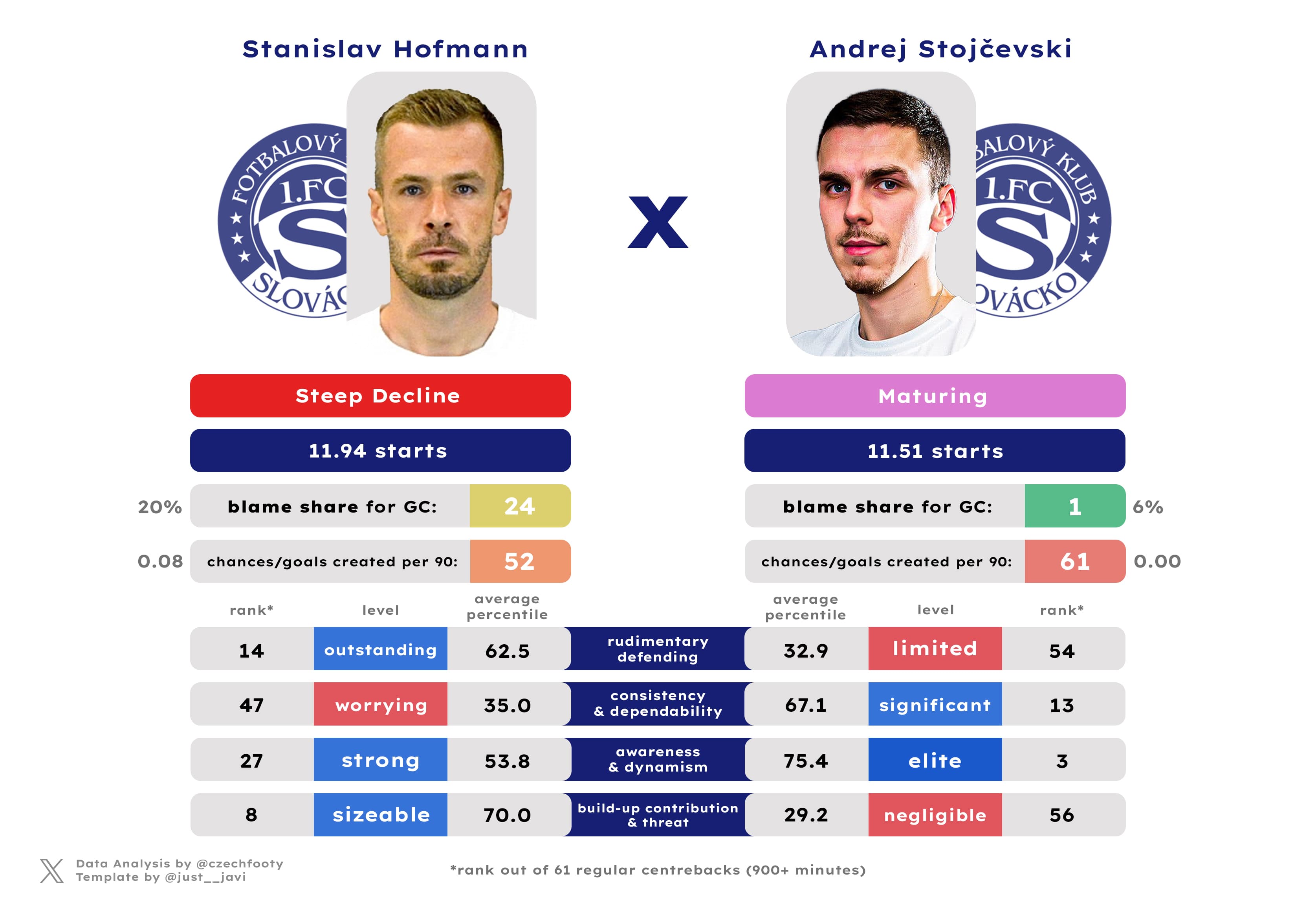
The situation wouldn’t have looked as bad coming out of the November international break. Back then, Filip Vaško was fresh off owning Plzeň and Mladá Boleslav — two UEFA participants at the time — and net positive in preventing danger (21 backstopping actions) compared to actively allowing it (13 times). He was implicated in just two goals conceded, or 16.7% of all with him on the pitch. Since then, there had been no game he concluded net positive (9 net negative ones), while he’d participated on 30% of all goals conceded with him around. He’s got one serious injury behind him, and a rough load-carrying campaign ahead of him. It was still true at the season’s end that the team was far worse without him (conceding a whopping 2.5 times per game!), but that shouldn’t be a signal to lean more heavily on Vaško while exercising the option to buy Andrej Stojčevski; instead, it should mean bringing an extra warm body to truly offset the losses of Hofmann and breakout star Ondřej Kukučka.
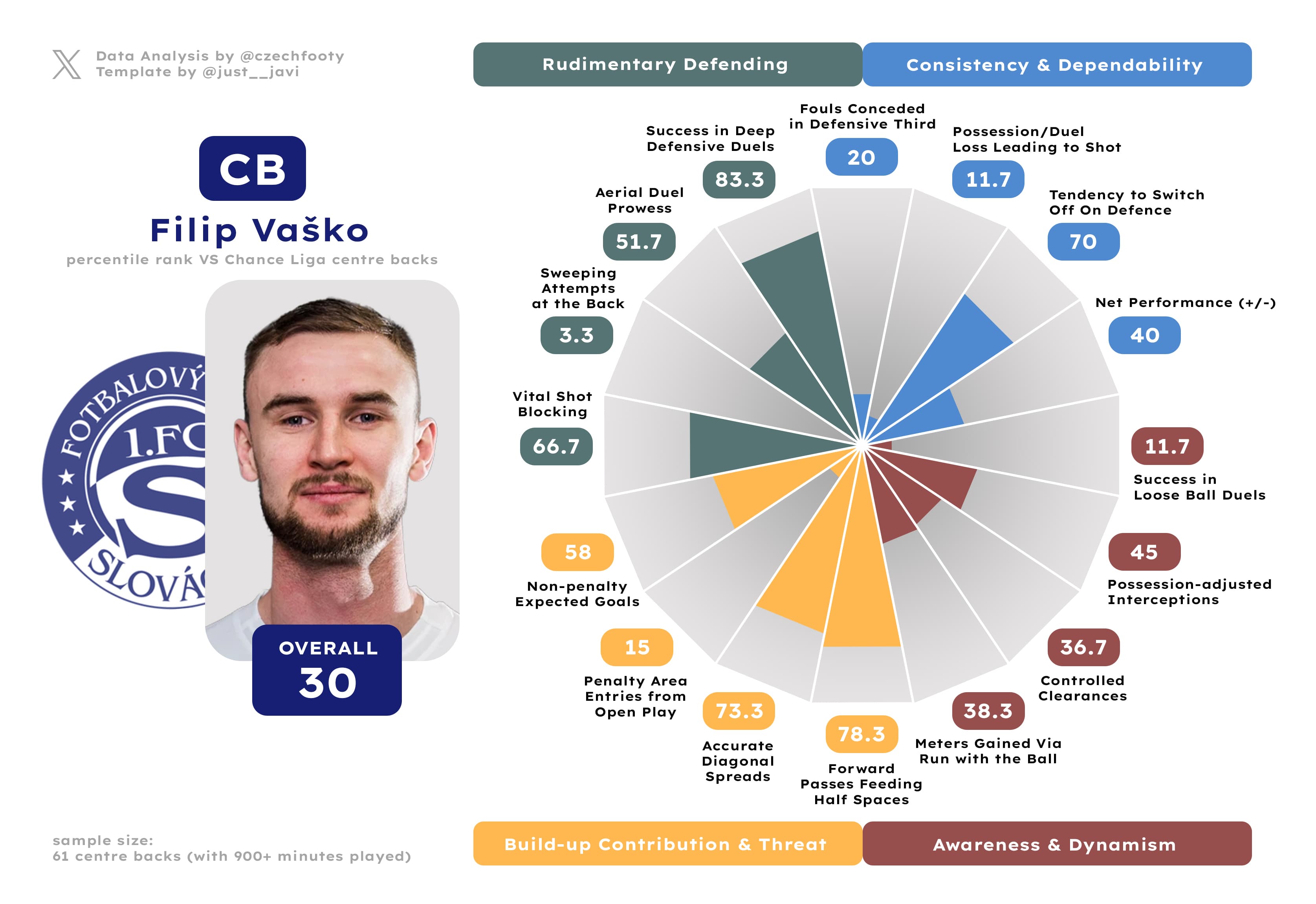
Maybe Vaško rediscovers his swagger in defensive duels, appearing elegant and agile at all times, and the rest of the defence ends up not mattering much. Maybe Jiří Hamza proves to be a centre back at this level (like he was in 24/25 Chance Národní Liga) rather than a holding midfielder he’d mostly been while rising through the Zbrojovka ranks. Maybe Stojčevski puts it all together in a record time and doesn’t get bullied in ground duels any longer…
For Slovácko to avoid missing another CB, too many maybes need to break just right.
New kid on the block
Let’s start with something of an inventory:
In 2021, my first stab in the dark went to 22-year-old Marko Merdović. He’s now back in Montenegro after only featuring for Slovácko’s third-tier reserves. In 2022, I did much better with Merchas Doski, calling him a “(potential) stunning find”. He was 21 at the time; though no teenager. In 2023 and 2024, then, I finally went after some, with Abuchi Onuoha moving full-time to the 3rd tier this month (Blansko) and former U-19 team captain and U-18 international Lukáš Novotný effectively doing the same, kicking off this summer preparation officially relegated to Slovácko’s B-team. One hit, three rather wild mishits. Not great.
This year, it feels like I can’t go wrong. First of all, there’s only really one candidate. Second of all, Daniel Barát (b. 2006) is about as solid a pick as they come. He’s listed on the A-team page, has only just extended his contract till 2028, and was due for promotion after starring for the club’s U-19s since he was 16. He’s not exactly taking it slow, mind, having only spent five 24/25 games with the reserves — but between those five performances (2 goals) and his showings this summer (one assist while mostly deployed on the left wing), the coaches have seen enough. Kameník even specifically lauded Barát earlier and played him for a bit in R1.
Looking ahead to 2025/26
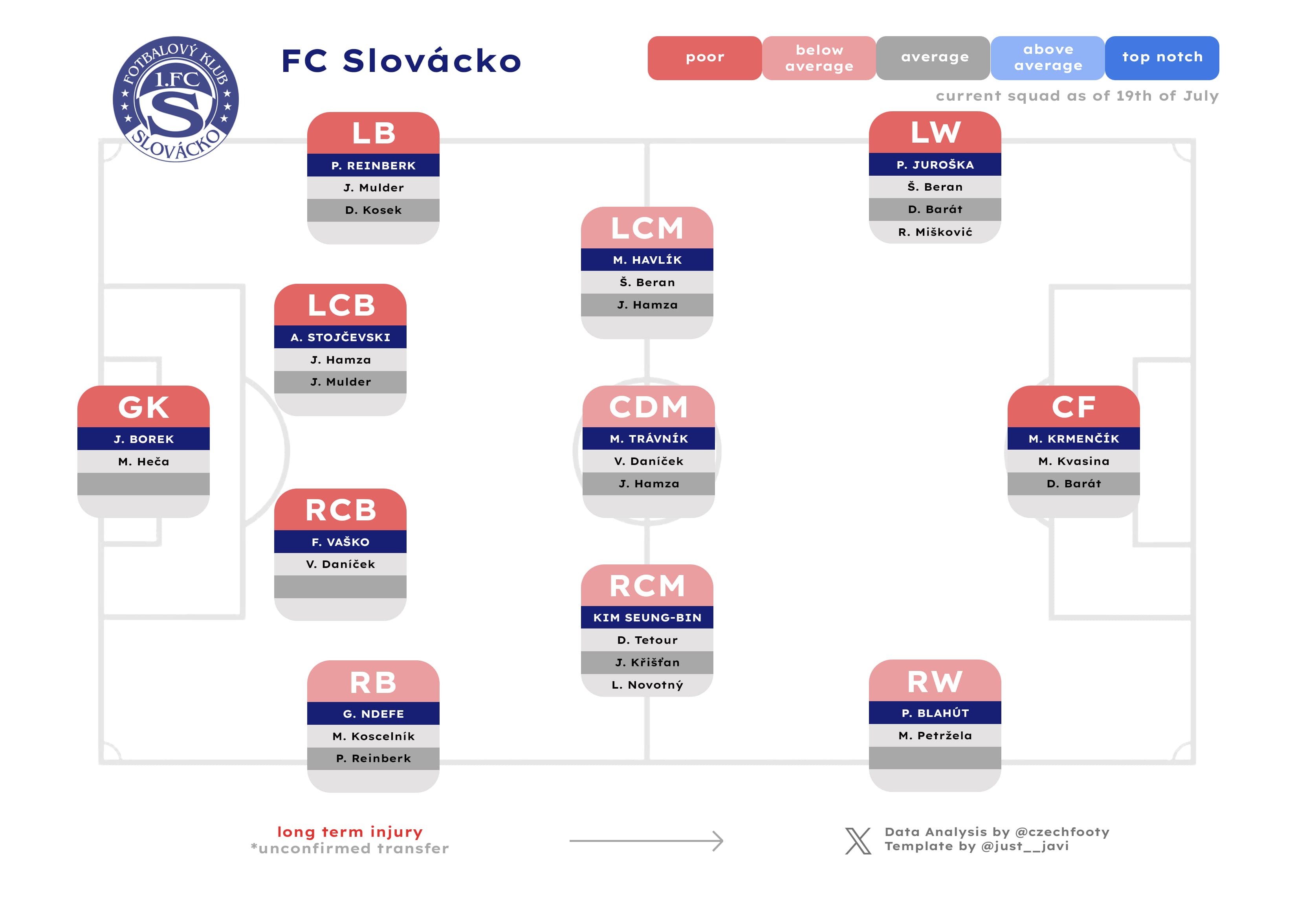
Below is the team’s current(ish) depth chart with a maximum of 4 alternatives for one position. The colourful ratings are a static snapshot of the league-wide situation on 5 July, and they are just a playful bit to add flavour to it; the names featured should be relevant to this day. To learn more about my approach to constructing depth charts, with all its limitations, head here.
Primary formation
It’s more of the same formation-wise, with Kameník’s track record as well as summer preparation pointing to 4-3-3 / 4-5-1, but there should be subtle differences to the previous campaign. That will involve increased tempo coupled with more short and first-time passes, and it may also include some flirting with inverted wingers — e.g. Patrik Blahút coming from the left onto his stronger foot, and Pavel Juroška attacking from the right like vs Shakhtar.
Notes on the depth chart
Last summer, buoyed by his spirited finish to 23/24, I also pegged Kim Seung-bin as a starting RCM… only for him to have to wait until R9 for his first proper start — cut short in the 23rd minute. His first point arrived a whole 8 rounds later, with him not contributing to a single goal beyond R21. It wasn’t just about goals, either; Kim was only a primary chance creator 0.67 times per game, shining brightly(ish) in exactly four games of the campaign — two of them against České Budějovice. It was yet another story of endless inefficiency.
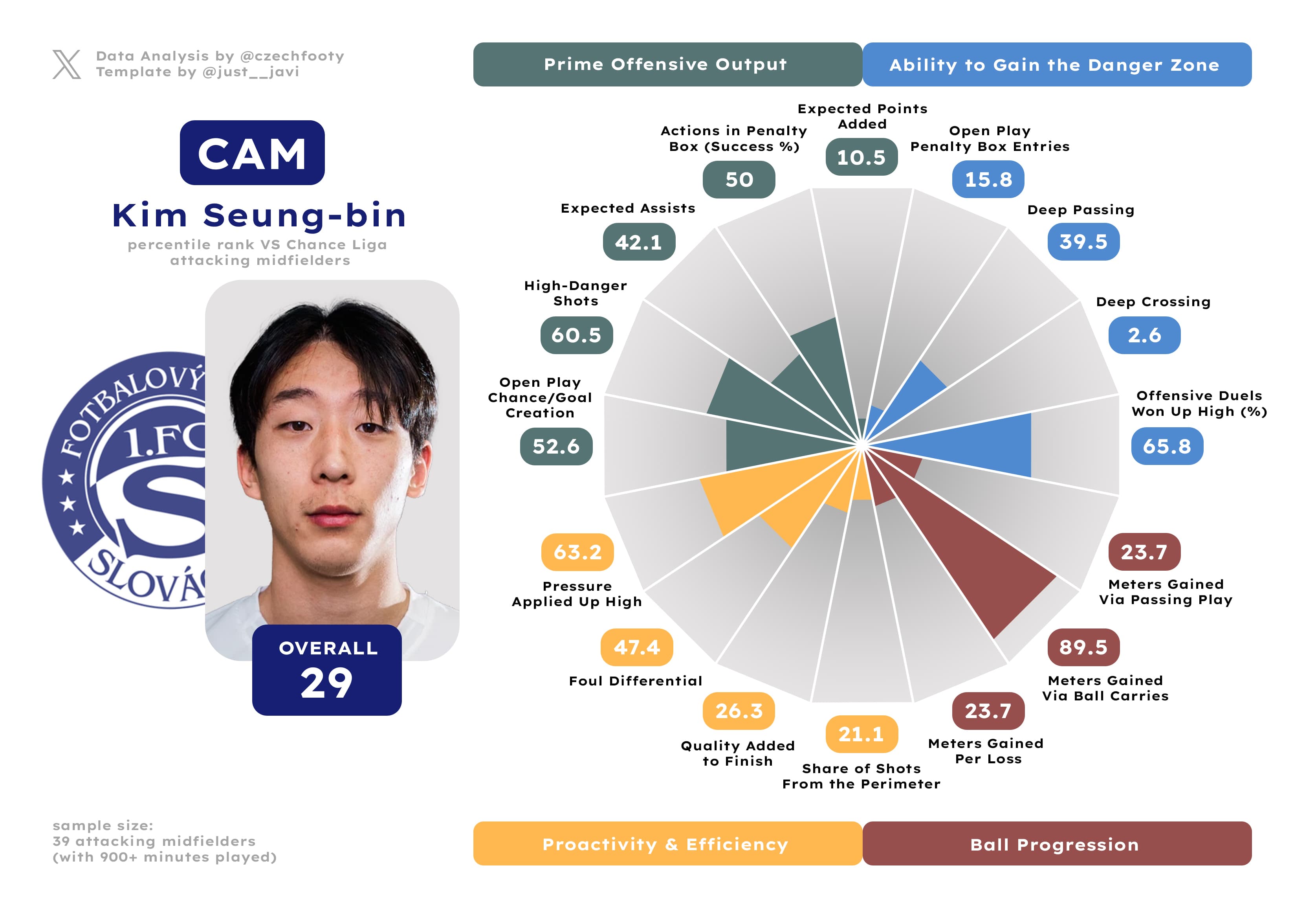
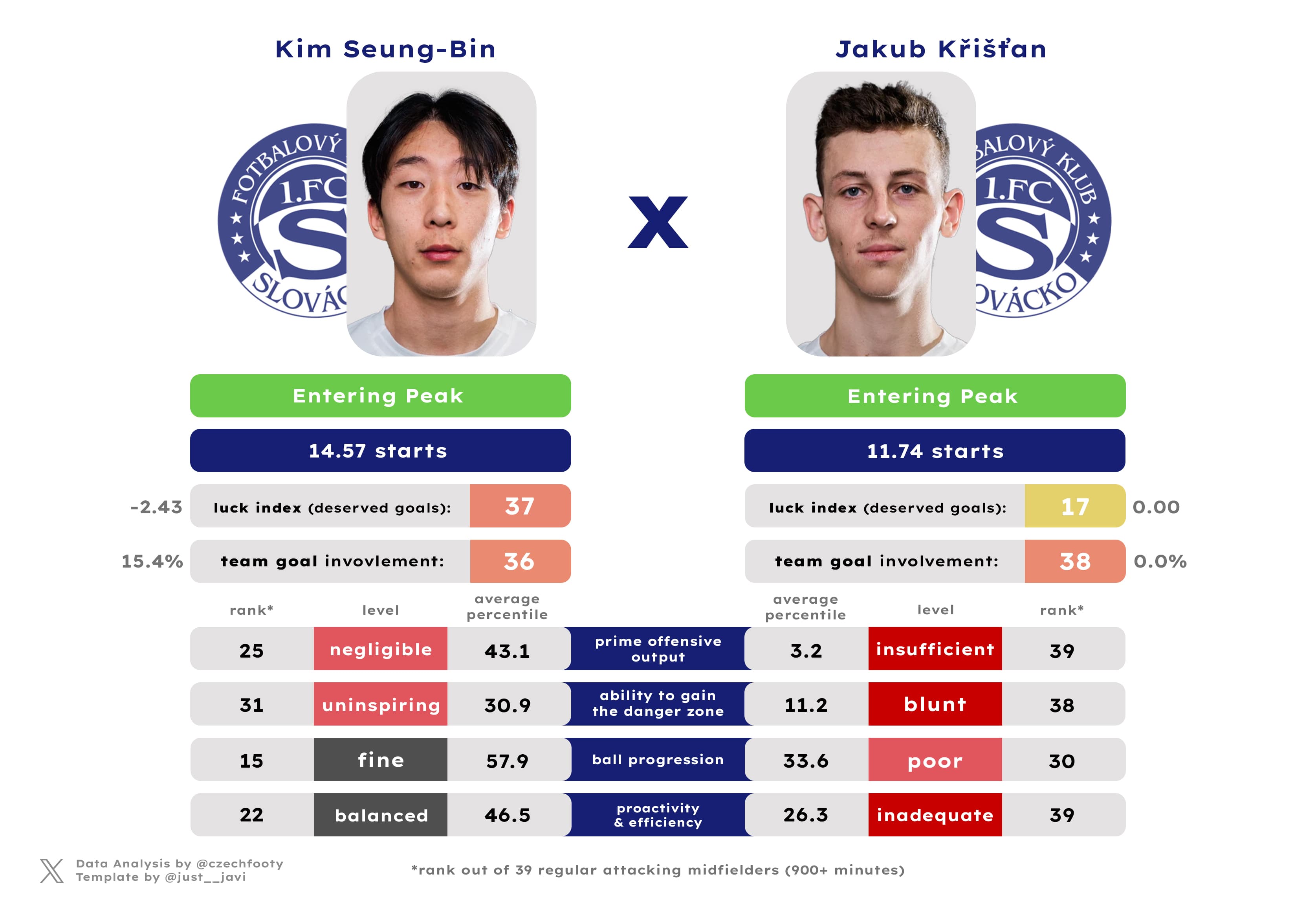
That being said, if Kim is mostly rivalled for playing time by Robert Mišković (skipped the entire summer camp), Daniel Tetour (skipped much of the summer due to persistent back issues; could well be past it) and Jakub Křišťan, he may do just fine. Slovácko… not so much.
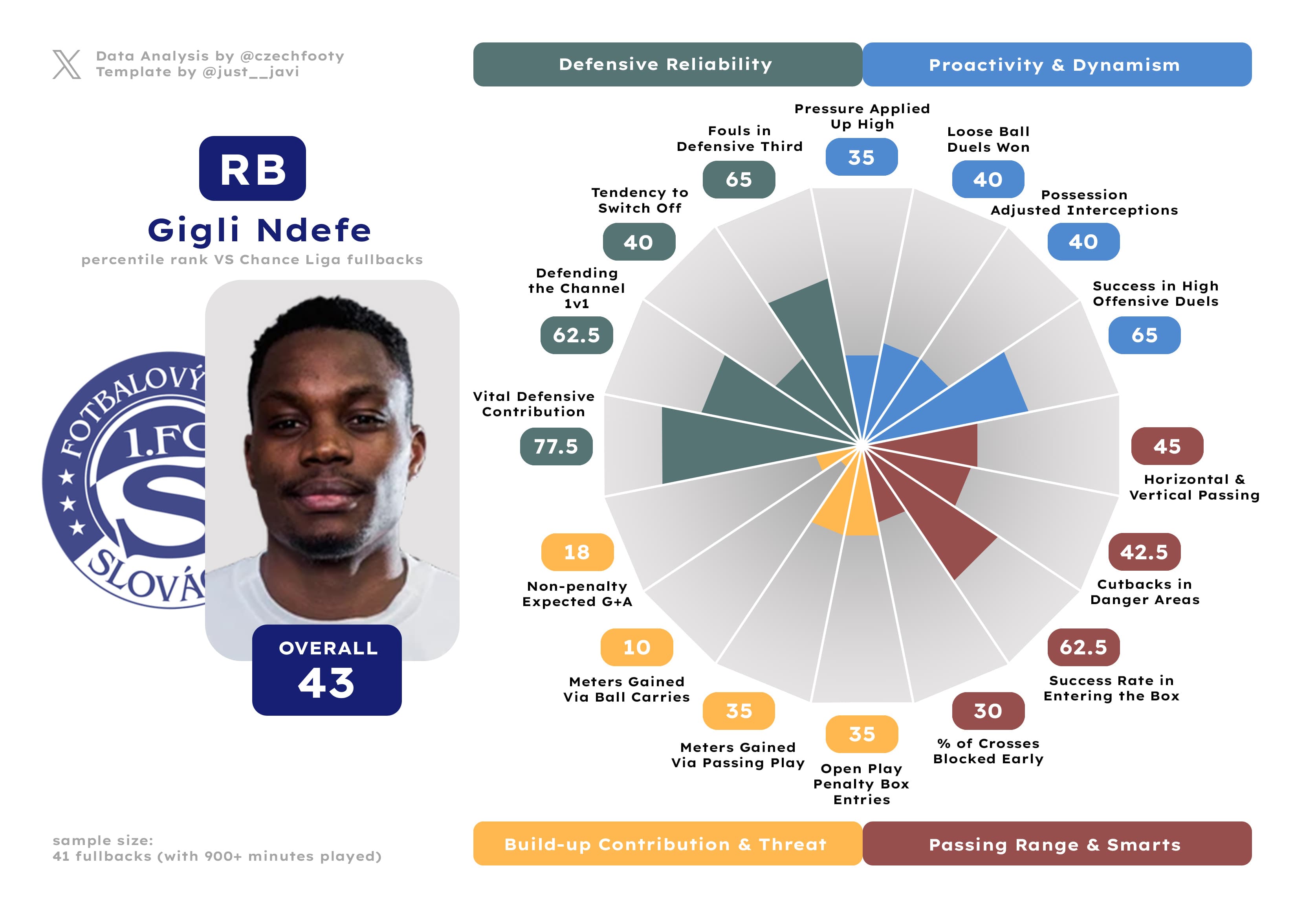
Gigli Ndefe, now firmly into the “slight decline” territory at 31, was the definition of a mediocre addition last year — which still wasn’t nearly bad enough when compared to the likes of Mišković or Azevedo. Ndefe is far removed from the player he used to be at Karviná, basically doing fuck all up front (no fullback, not even Tomáš Vondrášek, created less danger per 90 — 0.20), but he at least does the job reliably in the defensive third. Compared to the so-called offensive specialist Martin Koscelník (who joined Breda the same summer Janošek did, only to come out a different, much worse player), it’s still more or less fair value.
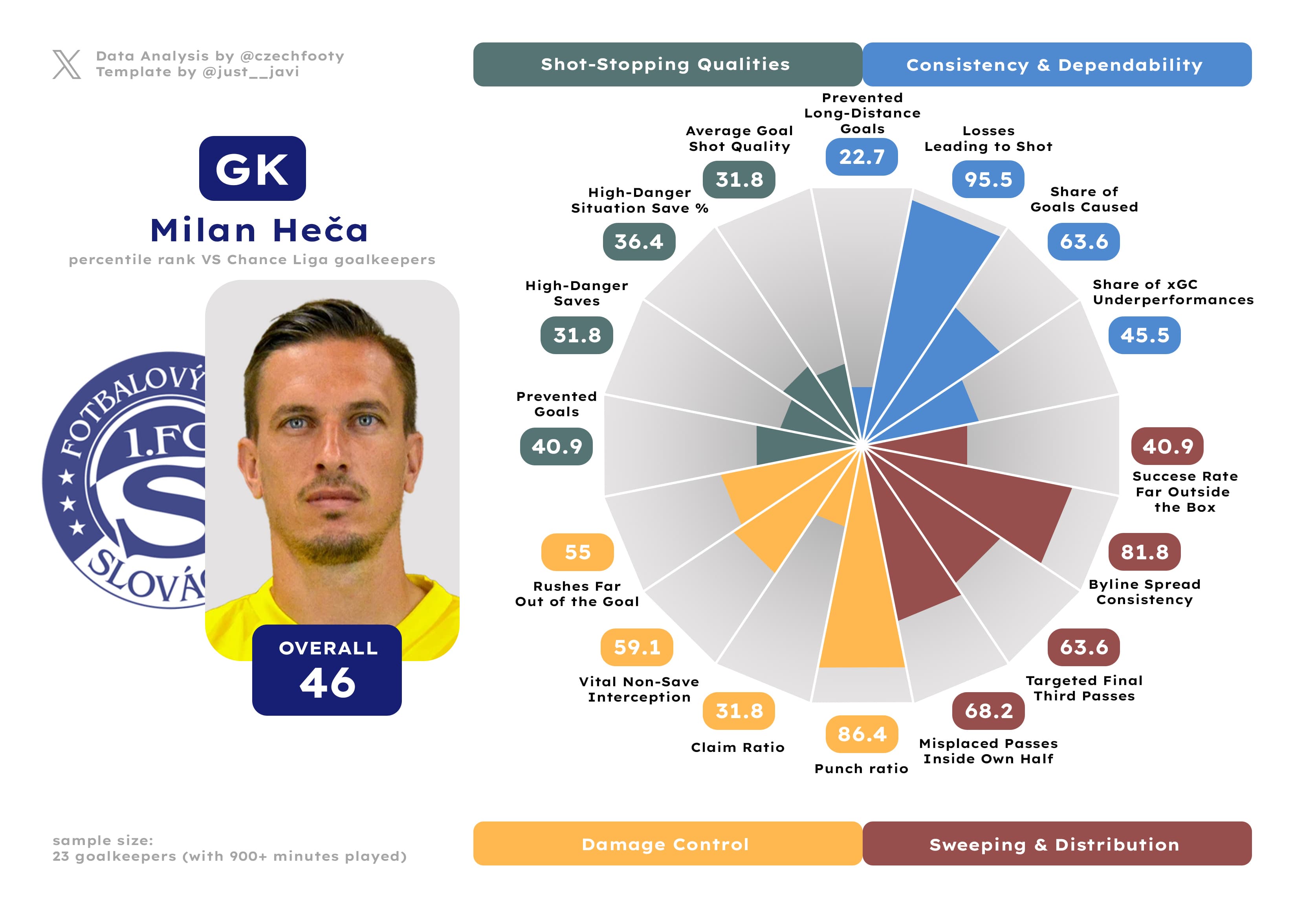
We’ll see how the situation in goal shakes out after Jiří Borek catches up following a prolonged vacation due to the U-21 Euro, but for now it’s Milan Heča back between the pipes, and it’s likely not good news for Slovácko. The club did well to commit to their younger homegrown talent amidst a sub-par run in goal, and they’d do well to re-instate him at the earliest opportunity. For someone who conceded six goals from the first 9 shots he faced, Borek recovered pretty well the rest of the way and ultimately allowed just 0.91 goals above expectations. Heča potentially makes for a top notch no. 2, but not much more these days.
Roster battle to follow
Last year, I had no choice but to run Patrik Blahút through my FB model after he arrived to Uherské Hradiště primarily as a winger. This time around, he was deployed right where he should be… only to provide much of the same. Run, dribble, bump into the wall or draw a foul. Rinse and repeat. That’s what Blahút is all about, and while it’s not completely without its value, it’s also arguably not enough. Similar to Ndefe, only one winger was less involved in goals scored with him on the pitch (Dominik Pleštil) and it’s ultimately no surprise only two teams managed less xGF per 90 down the right from positional attacks than Slovácko.
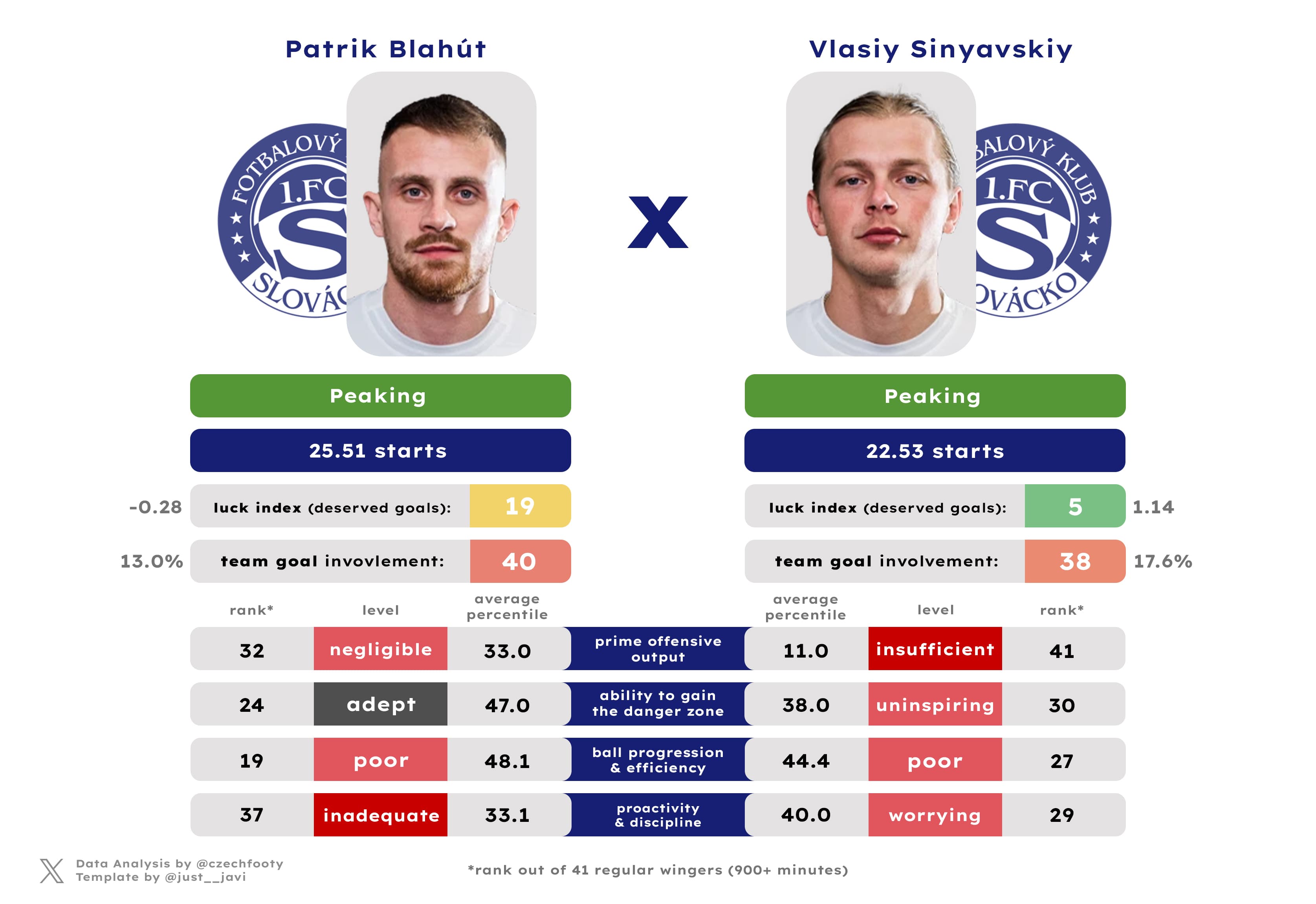
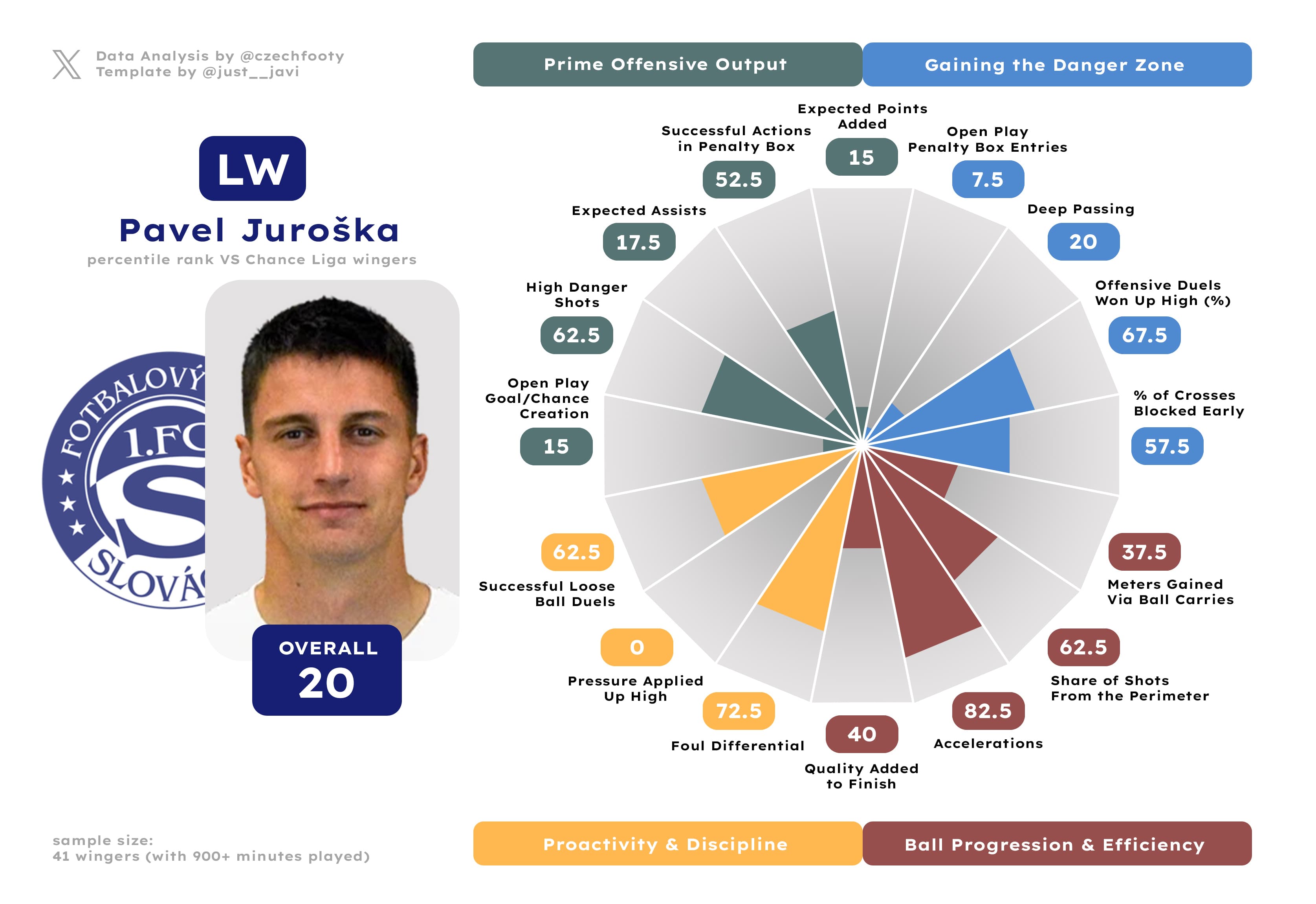
For someone who does a lot of running, Blahút is surprisingly inefficient in racing to loose balls and pressing up high, and that might be why it wasn’t both him and Pavel Juroška starting on Day 1. Juroška is notably lazy off the ball and one of the most aggressively stagnating players in the league himself. If he doesn’t want to sit behind a hard-working 42-year-old, he’ll have to up his game both on and off the ball. Otherwise, I wouldn’t be shocked if a second-tier reset comes for him sooner than Plzeň, rumoured to be interested in 2024.
Season forecast
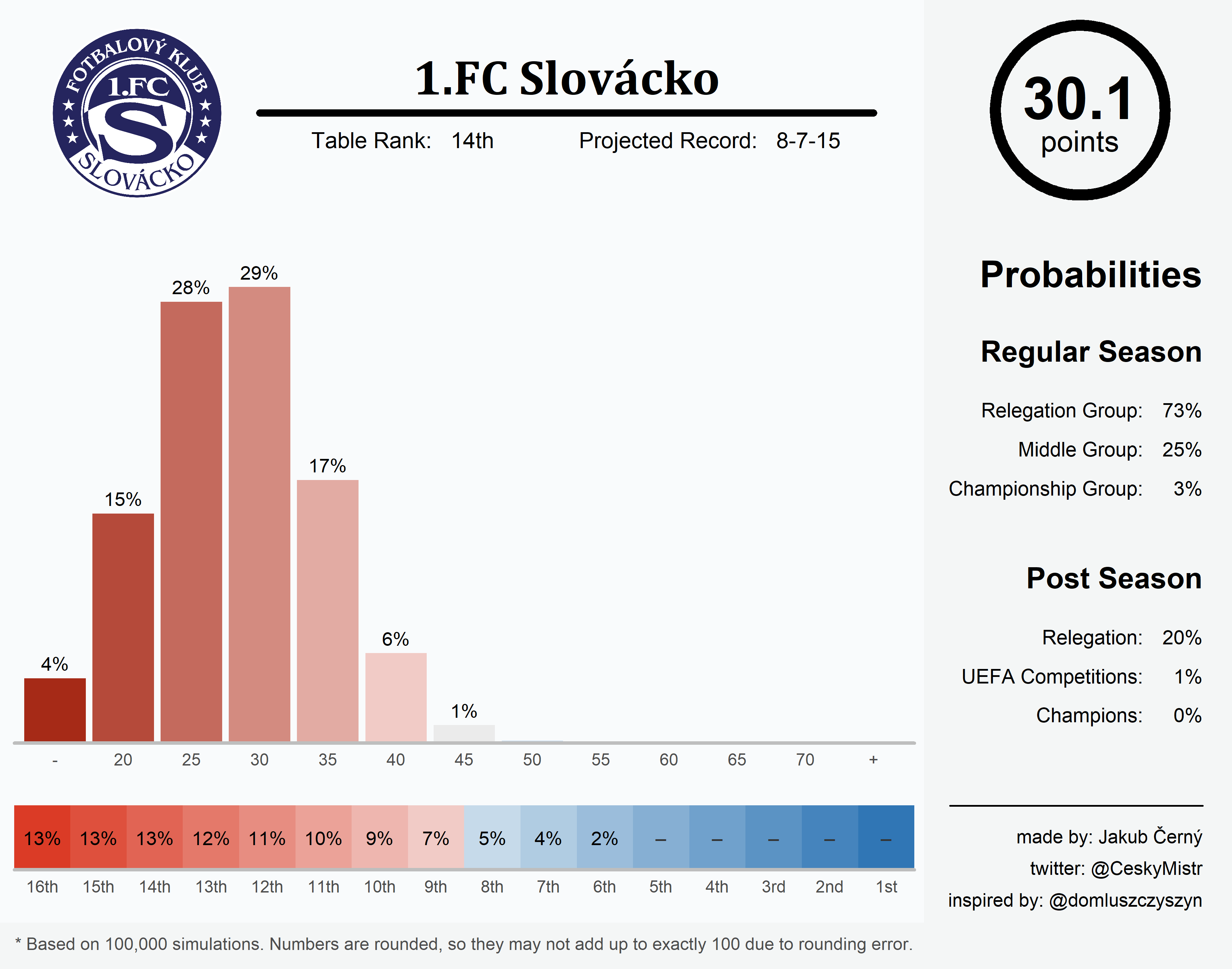
The fall has been every bit as rapid as it has been brutal. In summer 2023, Slovácko reached the lofty heights of a projected 49 regular-season points. Now, only two years later, they are pegged for 30. Even when their forecast came down to earth last summer (40 points), they were hardly considered relegation-threatened (1%) or even particularly likely to land in the relegation group (21%). Then both projections more or less came to pass, and here we have Slovácko as the third most likely team to go down and a near certainty to get stuck in the relegation battle. It’s funny to think back to January and recall the ever so slightly increased threat of forming the bottom six (27%) along with the substantially increased chance of falling into the calm middle (from 45% to 60%). Are we witnessing the model overcorrecting?
Bold prediction
The track record: 0/4. Petržela didn’t score as Slovácko earned 900th point. No one did
The prediction: Kameník delivers Slovácko’s biggest win of 25/26 vs Zlín
The rationale: What’s peculiar to note is that out of 13 coaches Jan Kameník faced on the top level before taking charge of Slovácko last Sunday, only one (David Horejš) is still in the league. Well, kind of — Stanislav Hejkal (assistant at Bohemians) or Pavel Hoftych (sporting manager at nearby Zlín) at least partially count. And that’s great, because we’ve absolutely got to root this bold prediction in Kameník’s strong regional ties (from his birth place Otrokovice — better at floorball these days but once a top-flight football town, too — to his first taste of top-tier football as a Zlín caretaker at various points of 2019 and 2020) as well as his personal history with Hoftych who gave him the worst beating yet while in charge of Liberec (5:0).
We love a sweet revenge at Czech Footy HQ — and Kameník is about to deliver one, alright!
Specifically, we are cheering for him to produce Slovácko’s biggest win of the campaign against their arch rivals. I don’t care if it’s this Saturday or the post season, I don’t care if it’s by 2 or 7 goals… as long as it’s the biggest, it counts. Svědík enjoyed marvelous success in Zlínský kraj derbies — taking 72.7% of all points on offer with an 8-1-3 record and a 17:6 goal difference — but never pushed it beyond 3:0, managing that twice in 2021 and 2023. I say Slovácko will find his heir apparent in this one special discipline; at the very least.

Enjoyed the text or the visuals, but don’t care for 🇨🇿 translations and dashboards? No worries, you can still support us by inviting us for a symbolic pint at the old BuyMeACoffeeBeer page.
