Also available in
 Čeština (Czech)
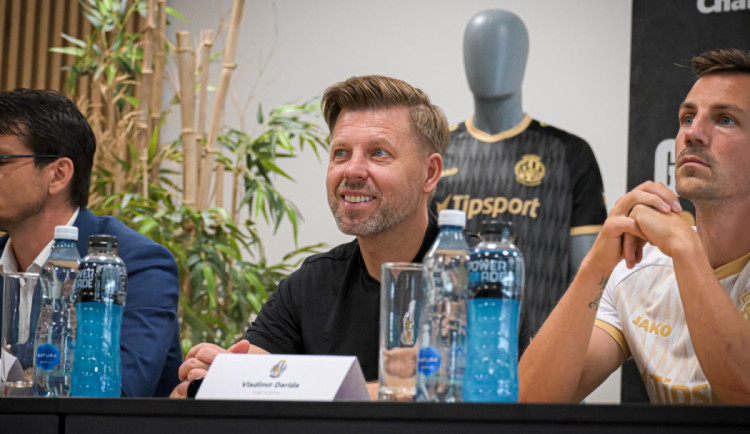
‘Votroci’ are officially gunning for Europe. After coming within an inch in 2024 — to the shock of many — they now want to make it the norm. New ownership should be in place by the end of September, and they look set to doggedly hold onto all of their key players until then; furiously adding high-end, foreign battle-tested quality in Vladimír Darida, Mick van Buren or earlier Tomáš Petrášek to the misfit core built around Adam Zadražil, Daniel Horák and Filip Čihák. The city is celebrating 800 years since its first recorded mention; the club is turning 120 with a fancy new stadium still gleaming, fresh money coming their way, and the potential fifth UEFA spot very much up for grabs. If not now, then when?
FC Hradec Králové have done it again.
Last year, they charmed us with a cute season ticket set. This year, they took it up a notch — and then some. The jersey design is so fabulous I’m seriously considering buying the home kit for the symbolic price of 1905 CZK as a pyjama. The merchandise collection is great, too. The new website looks the part, as well. There will be a Club of Legends set up, as well as the club’s 120-year chronicle published, in due course. As neutrals, we are being spoilt; now imagine what the fans must be feeling. It’s rare enough for a non-Prague club to have an actual marketing director and strategy in place; it might be even rarer to lay it on top of some clear sporting ambition exactly three decades on from the last piece of silverware.
It’s often forgotten how deeply rooted top-flight football is in Hradec Králové. The club will soon earn its 1000th top-tier point, with only four steps remaining after the draw with Slavia. It’s also often taken for granted how consistently good ‘Votroci’ have been since their promotion four years ago. They have yet to fall out of the Top 8; a stretch only bettered by their famous team from the early 1960s, when Hradec followed up on their sole title-winning campaign — the first team outside of Prague and Bratislava to do it; the first and so far the last promoted team to do it — with a series of 8th-, 6th- and 5th-place finishes.
In other words, you’d have to reach all the way back to an era when it was acceptable for Hradec to play their home games on a cinder pitch (“škvára”) to find a suitable comparable for its modern-day version. Want to hold some insipid performances against coach David Horejš? Pause for a moment and think of the aforementioned; or think of how the neighbouring Pardubice are doing five years removed from their own promotion.
This is not automatic.
Even after broadcasting pre-season games for the first time, there remain some kinks to iron out — despite a regular questionnaire asking fans what to improve, communication is far from ideal (players sometimes sign “multi-year” contracts, no one knows anything about injuries…) and Sportbar Pod Lízátky hasn’t quite caught on — but unless the takeover negotiations don’t take the necessary steps forwards at the next 28 July meeting (with specific business arrangements on agenda), the future is bright for the ‘Salon of the Republic’.
Looking back on 2024/25
What went (particularly) right
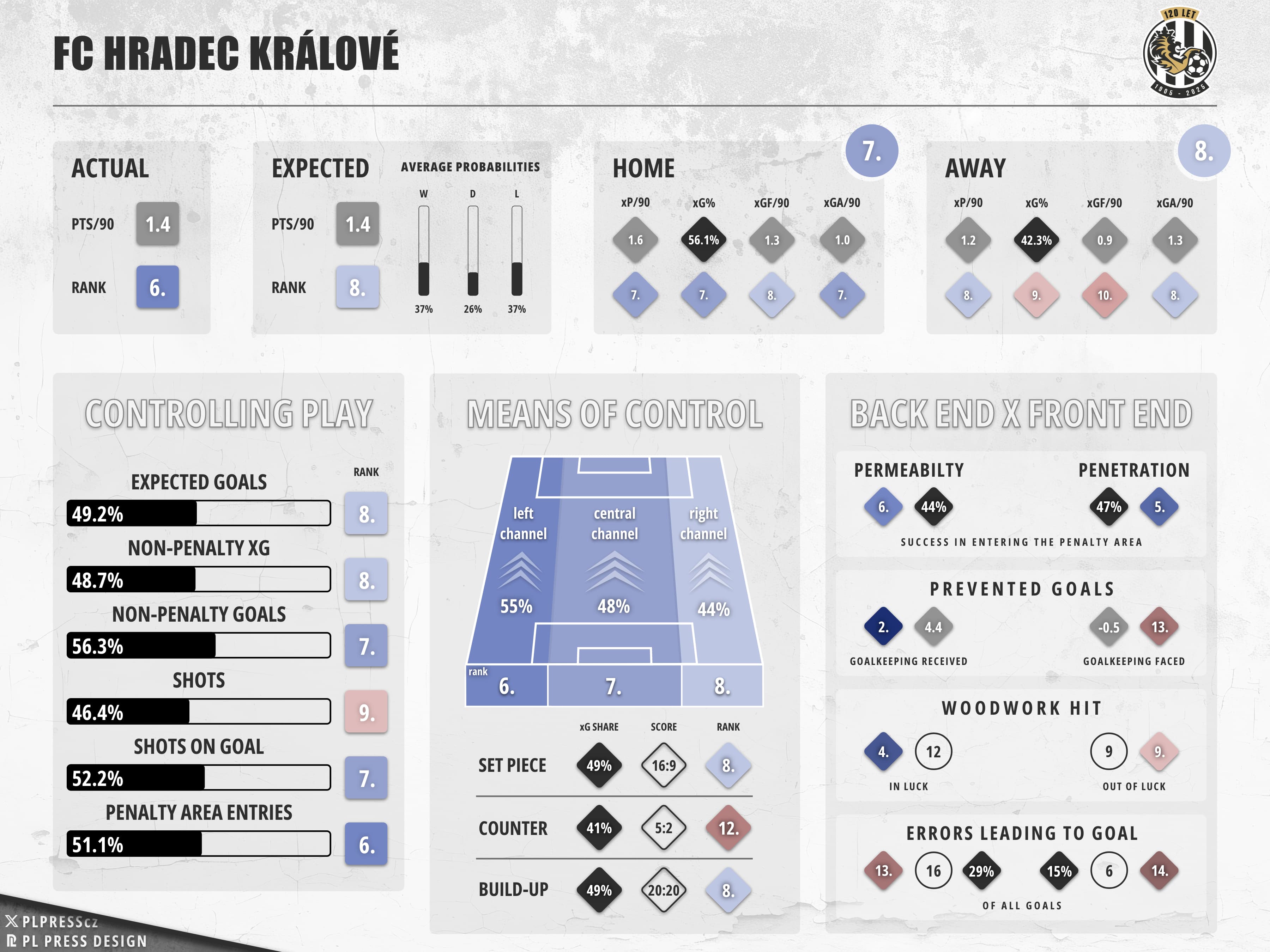
Soon after the start of the season, Hradec were up to 7-2-1 home record in the last 10, with the sole loss inflicted by Slavia. At the end of the day, it was still only three members of Top 4 (curiously not Slavia this time around) plus Liberec who took all three points from Malšovická arena. That’s where ‘Votroci’ also laid the foundation of winning the middle group play-off for no prize whatsoever, seeing Adam Zadražil keep his 6th and 7th clean sheet in front of his own fans on the season. Vindahl or Jedlička would only reach 5. This has a lot to do with Hradec’s defence doing a marvelous job of pushing shooters to the perimeter, leading to their opponents registering the second-lowest xGAExpected Goals Against (xGA) estimates how many goals a team should have conceded based on shot quality, location, and context. value per shot and pulling the trigger at the second-furthest average distance from Zadražil’s goal (19.06 meters; third Sparta 18.69).
But the biggest part of Hradec’s success was definitely the attacking corner kicks. As late as at the beginning of February, it was true that (excluding penalties) ‘Votroci’ scored exactly half of their goals from set pieces, with five of their eight goals following corner kicks also standing as winners. Adam Vlkanova notched four of his assists from set pieces; Daniel Horák five of his seven. In the end, isolating corner kicks, they led the league with 12 goals; an incredible 30% of their season total. (If only they didn’t also concede 7 goals that way…).
What went (especially) wrong
Even though they eventually fixed it, we have to start with the red cards, doing something of a refresher of my mid-season review. After 10 rounds, Hradec spent more than a quarter of all playing time down a man. Five of their autumn games were affected that way and they lost 4 of them, somehow managing to beat Mladá Boleslav in spite of the predicament (outshot 5:22 in the process). It wasn’t just any red cards, too: Hradec’s short-handed situations were, on average, 57.2 minutes long midway through the season, robbing them of some crucial early-generated momentum in both Baník instances and against Jablonec. Know what these two clubs have in common? They are, at least broadly, Hradec’s rivals in a race for Europe. It wasn’t all that close in 24/25, of course, but this above is at least a small part of the reason.
A lot of what (else) went wrong for ‘Votroci’ had an element of “weird” or “unusual” to it, too. Goalkeepers facing them collectively allowed 0.54 goals above expectations, which doesn’t sound like a handicap until you realize that only three teams enjoyed less of luck and the team just above Hradec already benefitted from 2.37 goals allowed above expectations — a truly wild jump from 13th to 12th. One peculiar, albeit insignificant contributor to this: all three penalties, all taken by a different player (Vlkanova, Mihálik, even Petr bloody Kodeš), saved by the goalkeeper. This sort of a 100% failure rate has only been posted by one other club (Jablonec of 19/20; also 0-for-3) in recent memory, and only RH Brno of 57/58 went one further in the entire post-war history. If the next penalty follows suit, it’ll set a club record.
Most valuable player (still on board)
Per my MVP model (traditional stats): Adam Zadražil (ranked 4th league-wide)
Per my positional models (advanced stats): Adam Zadražil (100th overall percentile at GK)
Per Statsbomb’s On-Ball Value (OBV) metric: Adam Zadražil
While we all feel for Adam Zadražil on the personal level, and I personally don’t see this ending too well for Hradec (unless they have a new contract in place come 30 June 2026 when he’s set to become a free agent), the purely sporting and potentially even financial side of the things is quite straightforward: Zadražil was the single biggest difference-maker among goalkeepers in 24/25, and he was close to the same in 23/24, too (only behind Kinský per my model). If Letáček cost Getafe a reported 2 million EUR, it doesn’t make any sense for Hradec Králové to let go off their unanimous MVP for any less. Transfermarkt had Zadražil’s value at €1.20m back in December when no one was showing interest; Letáček easily tripled his value via the Top 4 league deal, as is the common practice with TM evaluations after all.
In 23/24, the highest a goalkeeper managed to climb on my MVP leaderboard was 22nd (Antonín Kinský). The year before, Staněk made it all the way to 18th. Zadražil was now part of the runaway Top 4 — a mere seven points behind 3rd Provod and 385 points ahead of 5th Ladra — on the strength of a remarkable average Deník Sport mark (6.1) and five Man of the Match honours from writers of the same newspaper. Had he been up for the official Team of the Week more often (8x; as often as Jedlička, which doesn’t feel right) or had he not suffered that lapse in concentration in the middle group play-offs, he would’ve been certified Top 3.
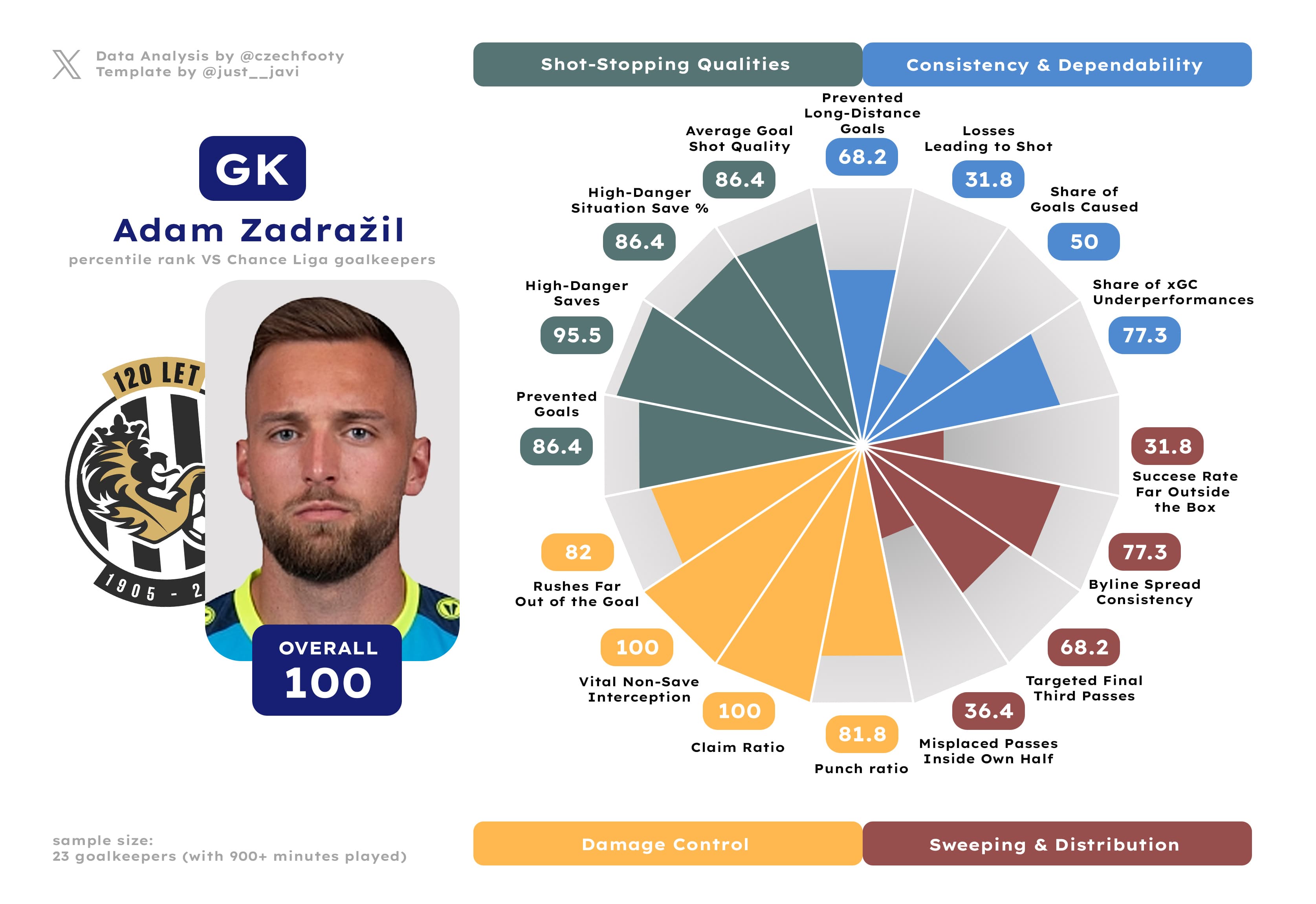
The entire two-season body of Zadražil’s work, amounting to roughly 54.5 full starts, is nothing short of spectacular. Over the period, he’s prevented an unrivalled total of 12.73 goals. Ten of his performances have ranked inside the league’s Top 100 on the season; only one landed at the opposite end of the spectrum. In the face of shots carrying at least 0.4 xCGExpected Conceded Goals (xCG) form the basis of the prevented goals metric and express how many goals the goalkeeper would have been expected to concede based on the quality of shots faced. value, he’s pulled off 20 high-danger saves, just this year dealing with seven high-stake 1-on-1 situations and preventing an extra 6 goals via non-save interventions. Zadražil is now a stunning 19-for-19 in high-pressure situations where he’s tried to claim the ball up high, as if his gloves were covered in glue; successfully navigating 14 of those this past season. His punches or rushes out of goal are not as dependable, but he’s still comfortably net positive.
Ultimately, his shot-stopping ranked best overall, with an average percentile of 88.2 — seven points clear of his closest rival. He was Top 10 in all four aspects of goalkeeping; only three other custodians could say the same over the past two seasons. One is Holec, the other two are Kinský (twice) and Letáček. Can Zadražil nab that sweet Top 4 deal for himself, too?
Chip on the shoulder
carried by the player who’s got something to prove — be it to himself, fans or the coach
Another case of deflected interest from other clubs, with Hradec doubling down by extending him for another three years, Daniel Horák isn’t quite in the same boat with his MVP-worthy colleague. While he nearly reached the 10-point bar and was remarkably the second-most frequent goal contributor on the team (13) after Vlkanova (15), the former Sparta player still kinda needs to prove he belongs. It’s weird to say it about someone who would nonetheless constitute a statement signing for, say, Baník Ostrava, but… well…
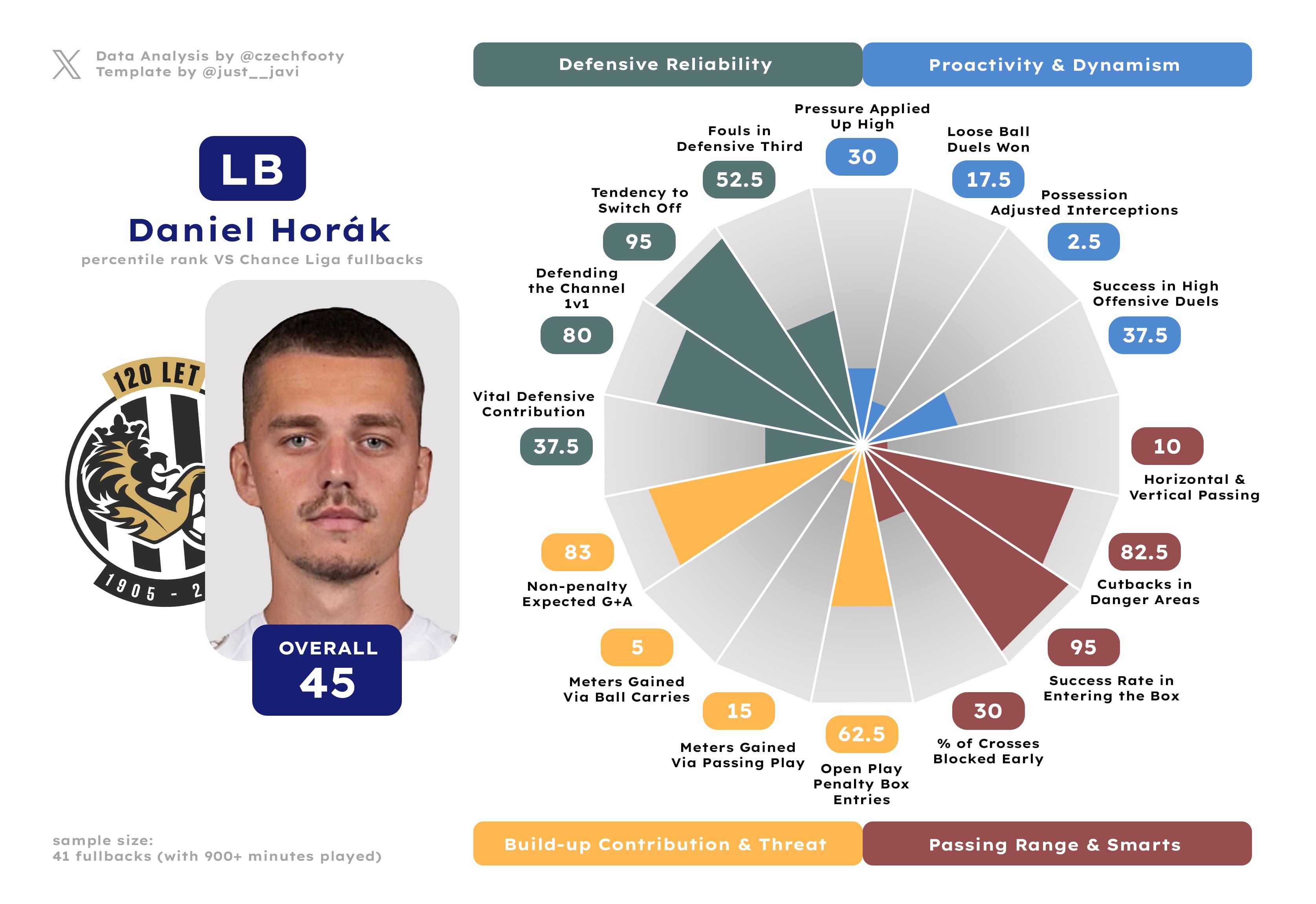
Now, is it necessarily a problem that Horák clearly isn’t a dynamic force or a particularly consequential passer? No, and no. Some things are, after all, by design — like the relative lack of high pressures, no doubt owing to Horejš’s passive setup. Other things are simply more important for Hradec: high-percentile 1-on-1 defending, the third-best success rate in entering the box from open play, his smart (if not progressive) passing, especially cutbacks.
But too much of his value still comes from set pieces, which gives me pause. Hradec owned the sixth-best left channel by positional attack xG flow, with a solid 55% share and fifth-best offence — a big step up from the previous Top 10 share of 43%, which owed plenty to suspect defending. Yet, until Horák separates himself more clearly from the vastly limited David Ludvíček, I’m stopping short of calling him a Top 5 left (wing)back. I’m sorry.
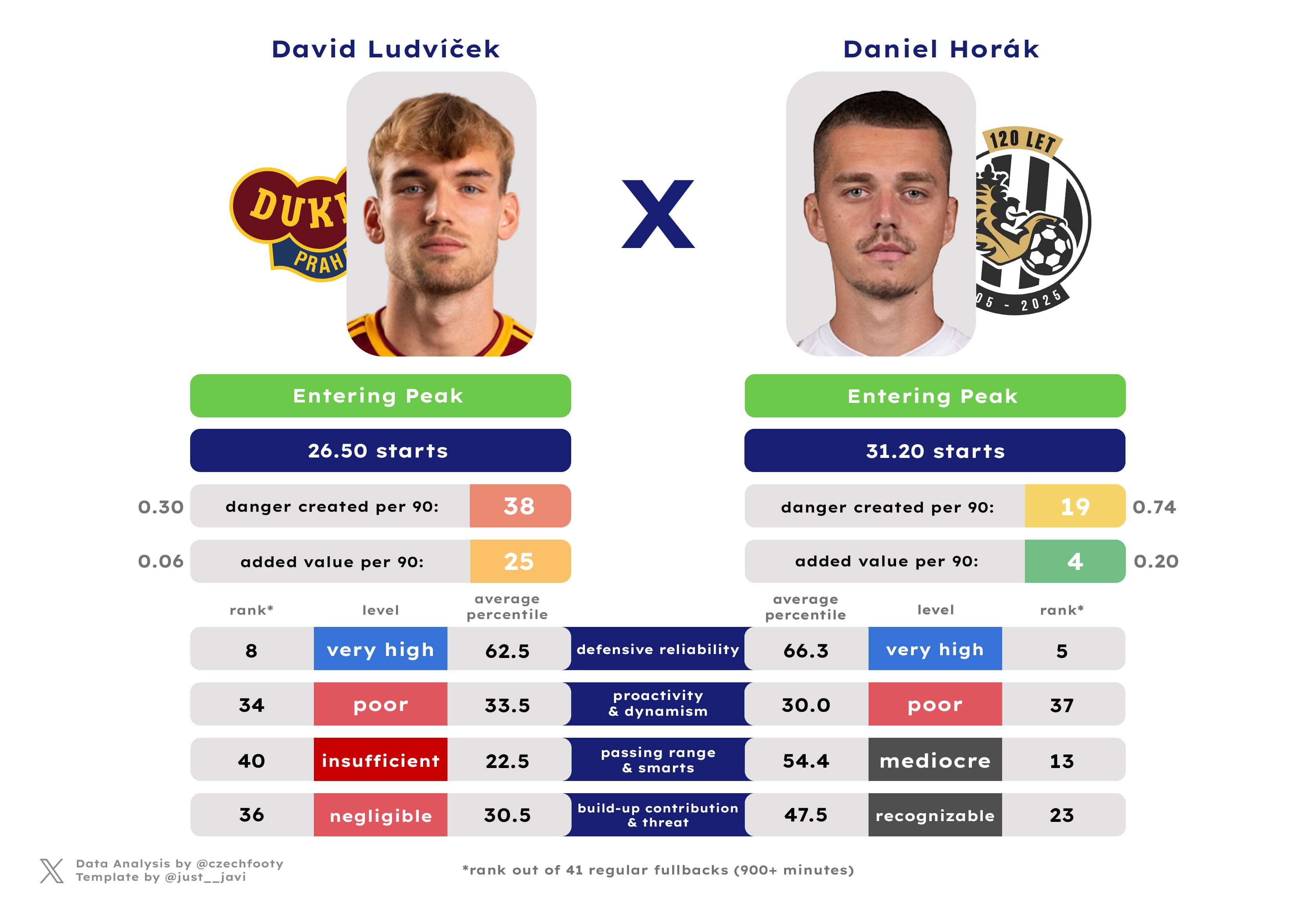
Ludvíček himself, by the way, also makes for an intriguing case study. I can easily imagine Dukla being a huge part of the reason why he doesn’t grade out well, but I can just as easily imagine him making for the second coming of Jakub Klíma — solid if ordinary fullback; miscast at wingback. Ludvíček was interesting when driving forward with the ball at his feet.
But that was about it.
Inside the off-season
special thanks for guiding me through the motions of FC Hradec Králové’s off-season go out to @OndejSouek2, @votrok11 & @vitsvoboda16
Squad turnover
Somewhat quietly, Hradec Králové had as many as nine players lurking around the Top 50 of the most utilized Chance Liga footballers. Six of them fit right inside, while all of Samuel Dancák (52nd), Jakub Klíma (53rd) and Tomáš Petrášek (56th) came close enough, especially when you consider the latter’s delayed arrival and suspensions. He most certainly fits the Top 50 mould in spirit. Sorting through the league rankings to get to Petrášek, you’d only pass by six Plzeň or Baník players and seven Jablonec guys. In a way, there was no team as rigid as ‘Votroci’, and holding onto 7 of those borderline Top 50 blokes must be a big deal for them.
Additionally, it’s funny to note that while the defensive and attacking department both saw an equal amount of minute disappearance (just north of one quarter), the club is barely hurt in the goal contribution department. In absolute terms, they are keeping the sixth-most strikes on board (33), and only three teams have done better in relative terms (82.5% goals retained). This is despite accounting for a pair of goals by Tom Slončík who may yet return. Otherwise, Petr Juliš is a non-factor in this exercise, while Karel Spáčil hurts the most (3).
Biggest upgrade
It’s always a fool’s errand trying to guess the exact level of performance to reasonably expect of 30-somethings who’ve been away from the league forever, but Hradec have arguably earned our trust by how seamlessly Tomáš Petrášek — making his Czech top flight debut at 32 — has slotted in. That’s basically the category Vladimír Darida now falls in, having left the league as a 23-year-old in a very different era. His second debut against Slavia was, effectively, a debut proper. Mick van Buren, meanwhile, hadn’t been with us for only a year (?!), yet his return still carries a peculiar feeling of the unknown. He’d arrived to Poland to fill the role of a mentor to his younger teammates, and his spring was marked by some physically weak performances as he struggled to regain form post-injury. It had been safe to assume his Czech chapter was closed. Yet here he is, aiming to pick up where he left off with David Horejš specifically a full three years ago. He was peaking then; he isn’t anymore now.
While it’s very plausible both these veterans are romanticized by many, it’s also easy to see the appeal. Van Buren has always been a committed hard worker who makes his presence felt, something that was also apparent on his Ekstraklasa stint. Adam Griger, who he’s coming to rival for playing time first and foremost, was often completely lost and couldn’t bring himself to create anything for teammates. If nothing else, Van Buren should be more capable (Griger) and more consistent (Ondřej Mihálik) in connecting with the likes of Vlkanova, Václav Pilař or (if it comes to it) Slončík. He led all centre forwards in expected assists and deep completed passes/crosses only a year ago (?!?!); two metrics Griger was third-worst and the absolute worst in the league this season. Compared to Mihálik, MvB has got a track record that makes him likely to be more proactive in forcing turnovers up high and more of a presence in the box. MvB has always had a knack for putting himself as well as others in a position to score. It might be different at 33 (in August), but probably not that different.
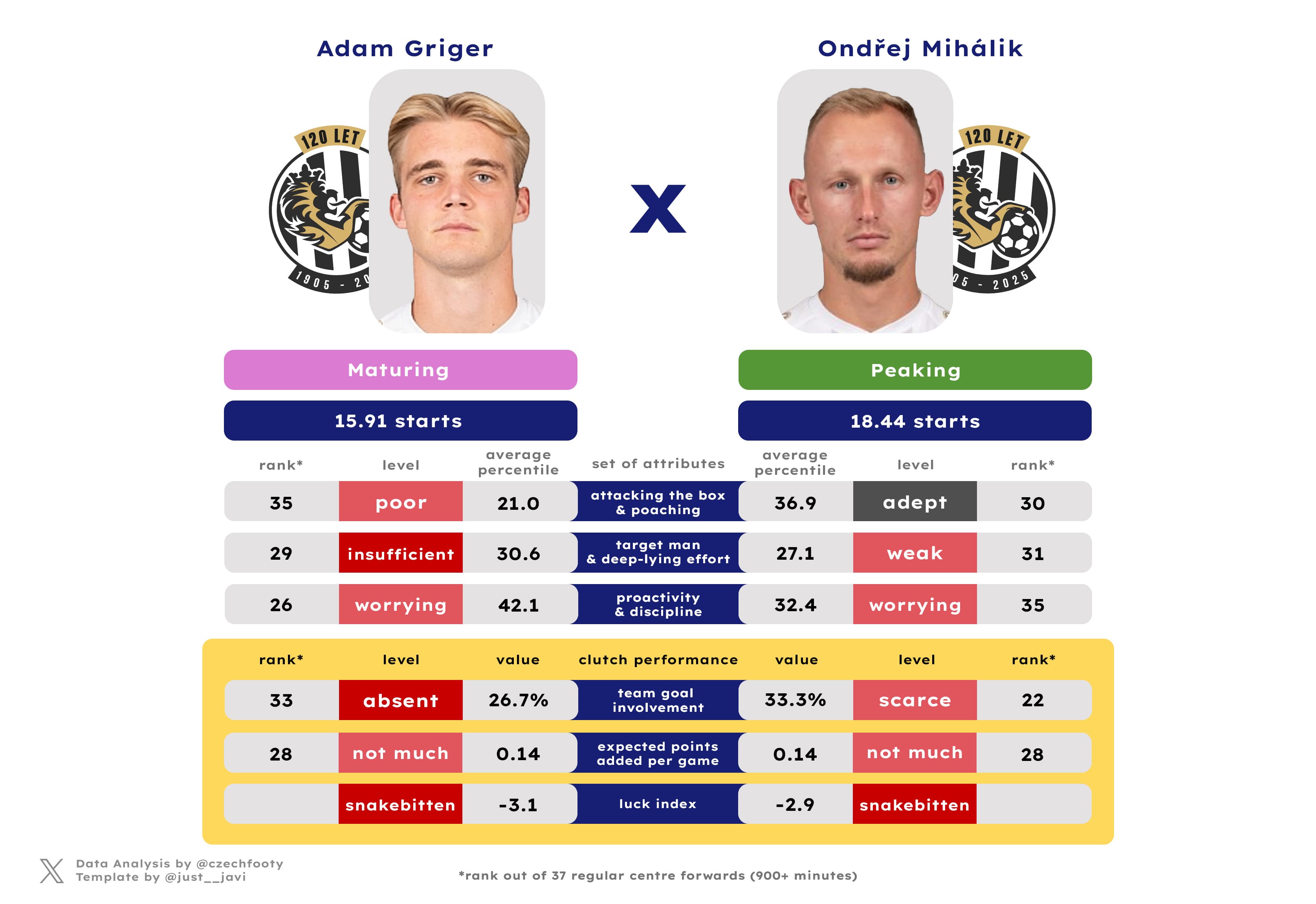
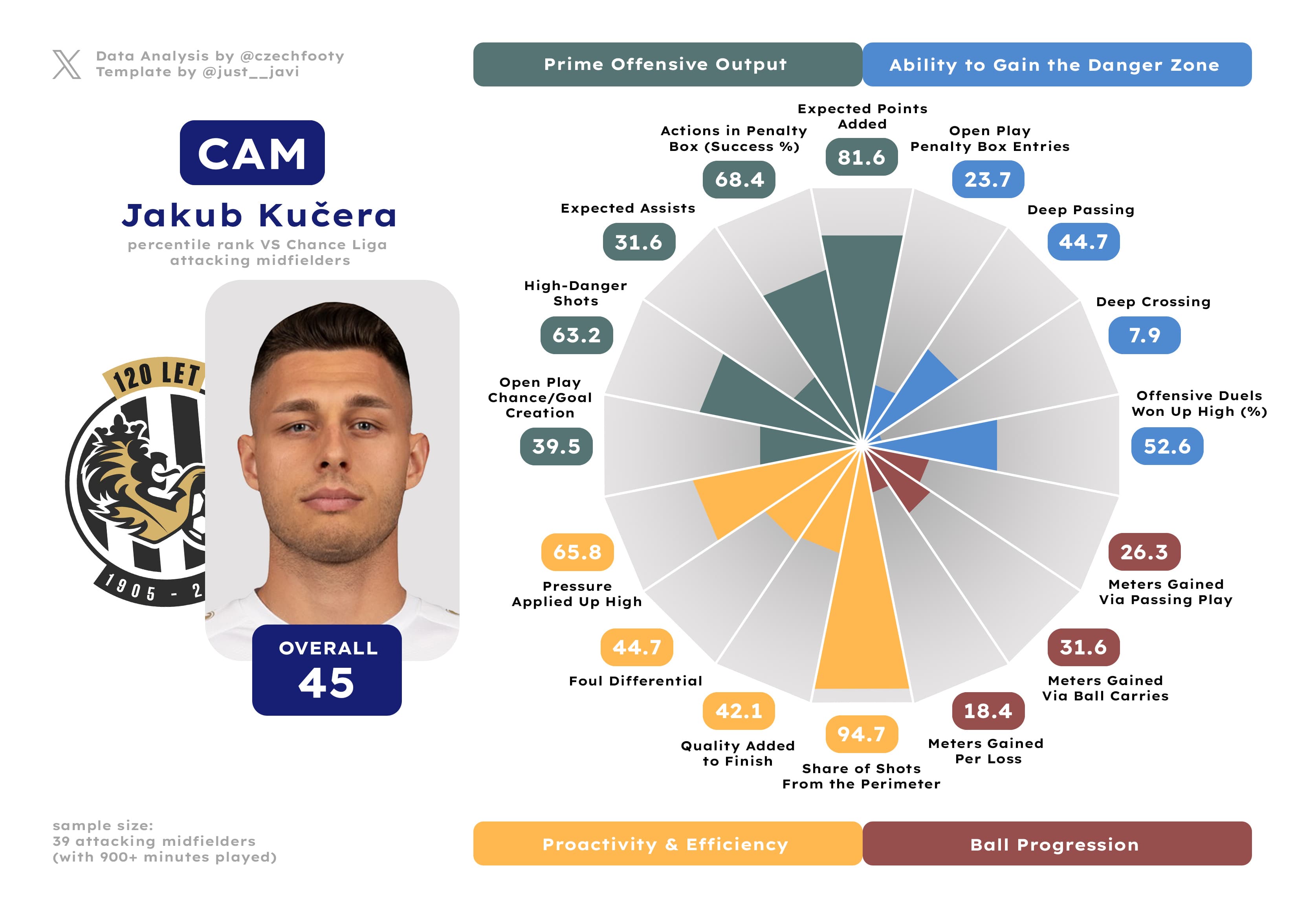
As for Darida, it was a mild surprise for me to see him line up next to Alexandr Sojka instead of Dancák, but it clearly worked and it does reinforce my assumption that Jakub Kučera’s playing time may seriously dwindle. He continues to be a guy who’d run through the wall for you, and who keeps popping up in interesting positions inside the box to finish from, but it shouldn’t be hard for Darida to bring more substance. Even as he soon, somehow, turns 35.
Biggest downgrade
As long as he’s fighting for his place at Plzeň, Tom Slončík will be dearly missed for one simple reason: he’s not a one-trick pony in keeping opponents on their toes. Slončík landed in at least 73th percentile for his ability to enter the penalty area in control, create goalscoring opportunities for teammates both per my notes and per Wyscout’s xA, and shoot from 0.15+ xG positions himself (though five of his 11 high-danger shots were still for Viktoria’s benefit). He’s one sweet finisher, a dribbler with a progressive edge, and a surprisingly effective disruptor in applying pressure up high, which basically makes him a complete package as far as the final third is concerned. Make no mistake, he’s 100% a passenger anywhere else on the pitch; but if this is the niche you are buying hoping to bring back on loan, it’s possibly the most valuable niche in football — worth every single penny.
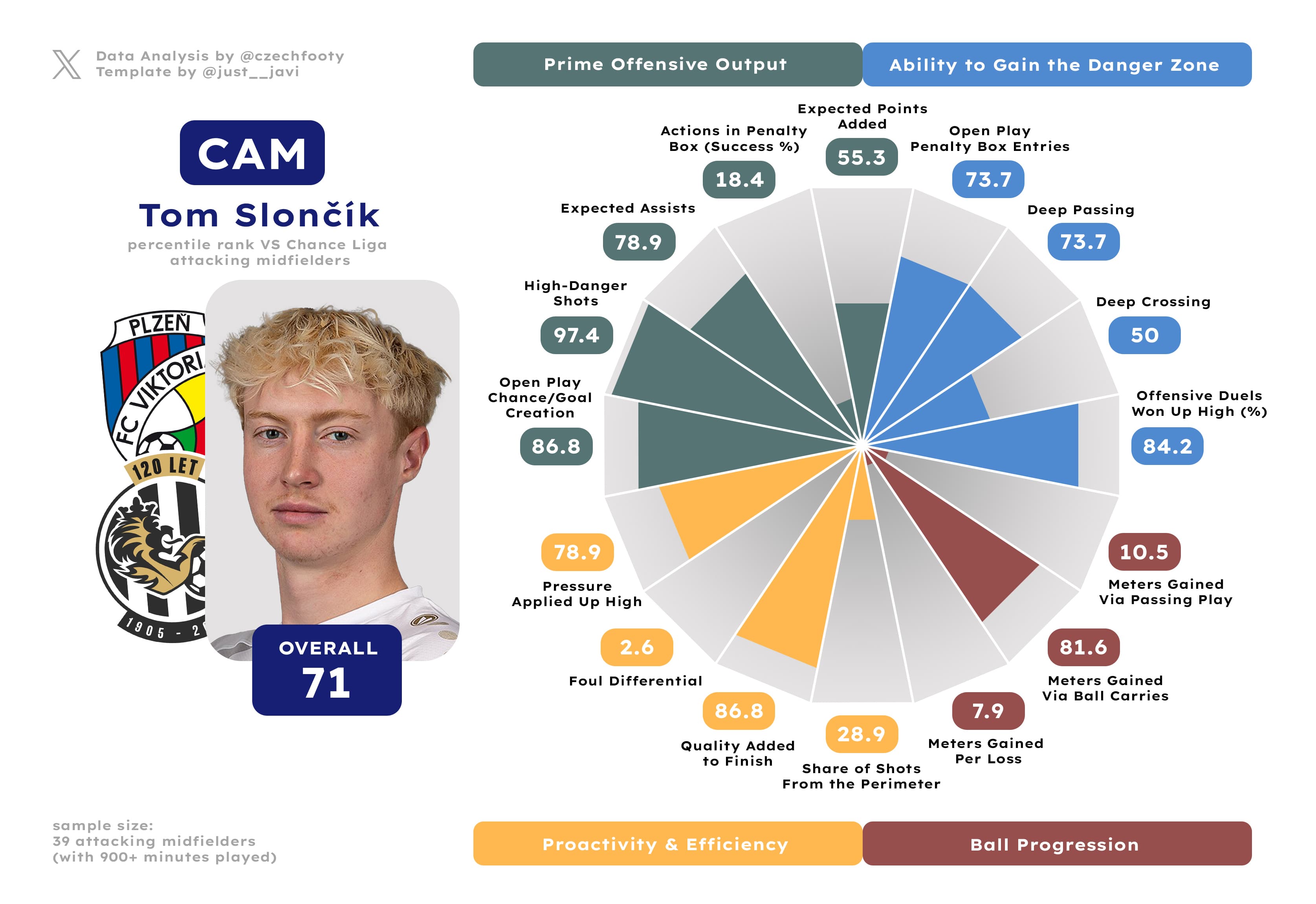
This isn’t to say Hradec lack alternatives that could make the Slončík loss more palatable, but that hinges on a couple of wild cards: A) Sojka operating at a high level in an advanced role he’d rarely filled for Koubek at Plzeň; B) Pilař staying healthy for a majority of the season; C) Mihálik hitting his stride deeper down the pitch with a more convincing reference point above him in Van Buren. Which one do you trust the most? Pilař still has got some serious game, but he reminds me a bit of Milan Petržela who had also sustained it for long long time until he suddenly fell off the cliff. Turning 37 in October, Pilař is very much in that territory.
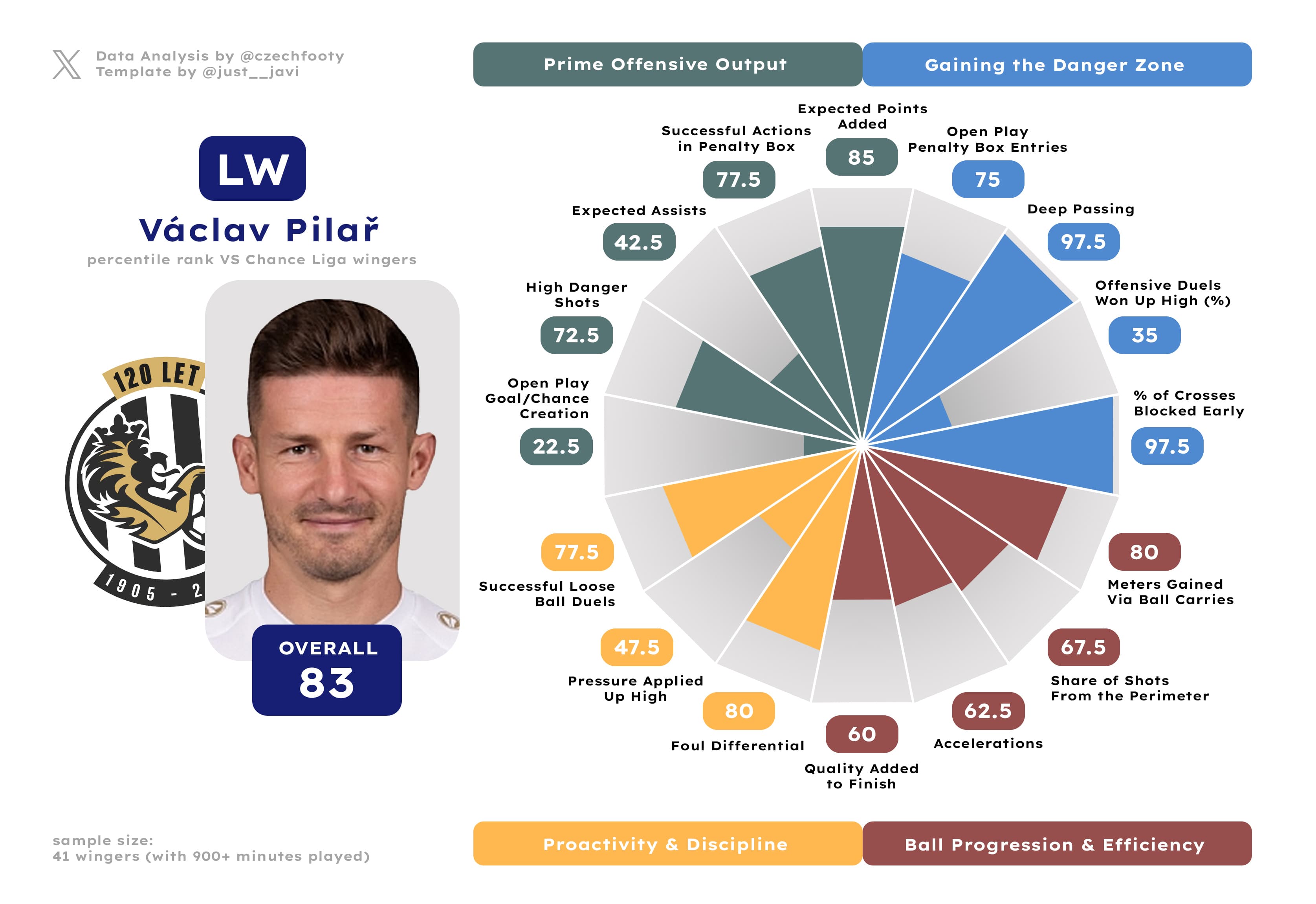
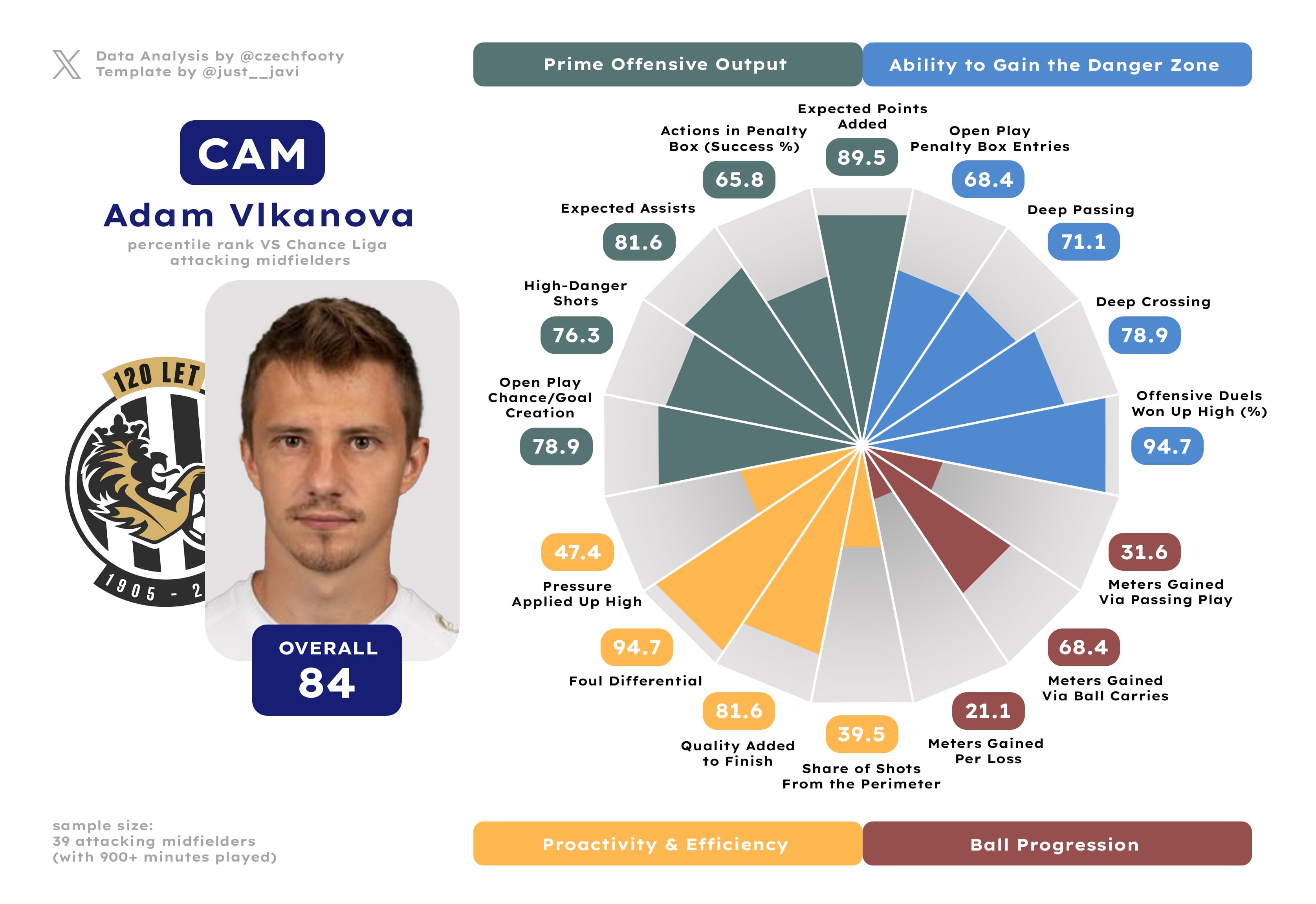
A player theoretically beginning his own decline, Vlkanova’s 24/25 was actually a bit underrated for my liking. He was effectively an older Slončík, just with far less fouling and more EPAExpected Points Added (EPA) estimate the value of one's goals and assists based on game state (late game winners = top). or crosses delivered. But the age could start factoring in, too, with the popular ‘Vlčák’ spending the majority of the season as a 31-year-old. In general, FCHK are potentially betting on too many veterans to come through for them at the most dynamic of positions.
Need left to be addressed
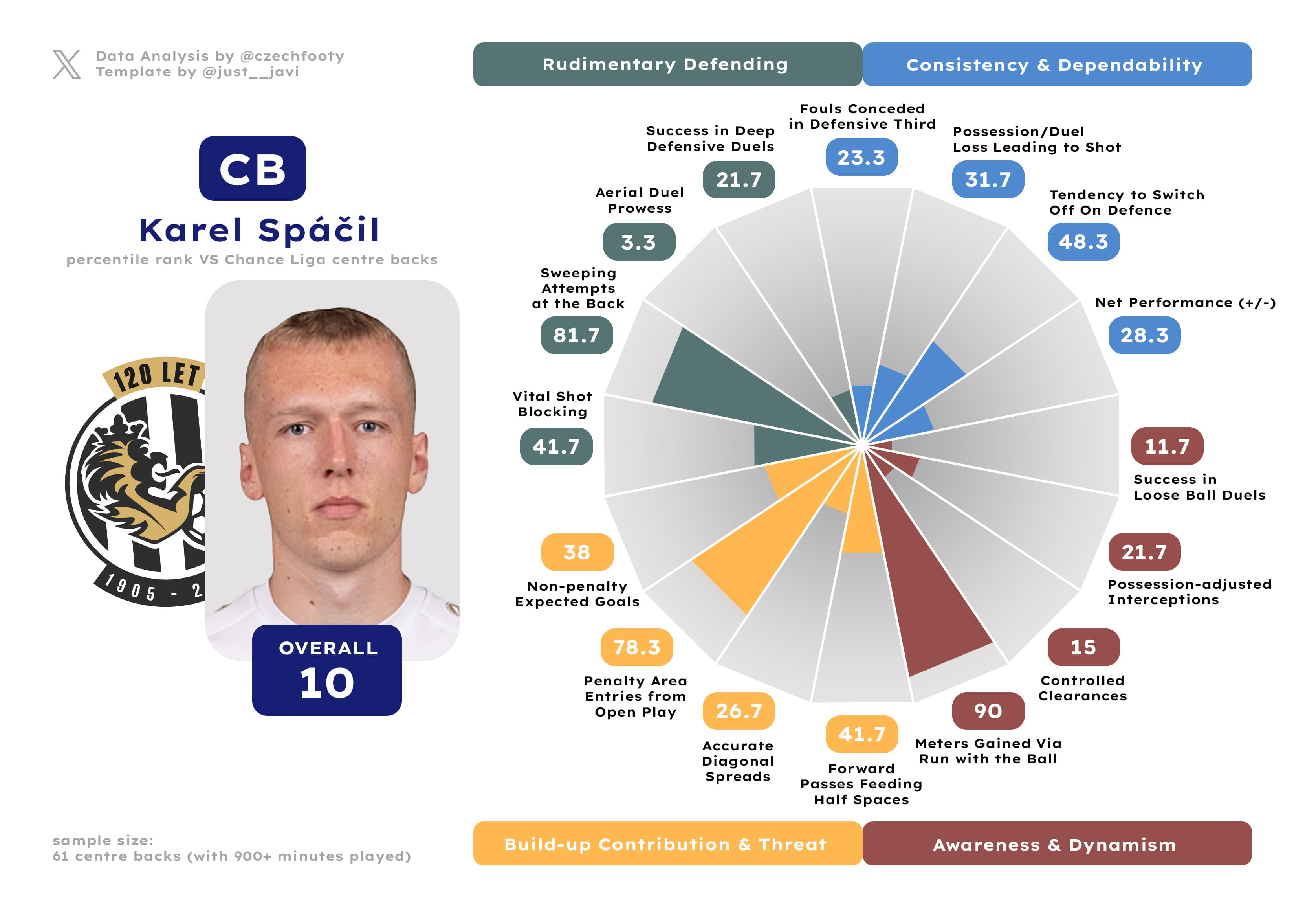
I was initially going to highlight a left-footed centre back as a need, but now I’m less sure. I had Jakub Uhrinčať down firmly as a RCB option, and potentially another alternative for a right wingback, but after earning plaudits for his Slavia performance on the left, the depth chart gets re-shuffled rather dramatically. At the same time, I am of the (seemingly controversial) belief that Karel Spáčil isn’t actually that big a stud, and definitely isn’t irreplaceable, so Uhrinčať may as well prove to be good enough in the long run, too.
Spáčil was an understated liability in the air (winning just 8 of 20 aerial duels inside his own box; and 3 of 18 aerials in the attacking box, for good measure), similarly understated chaos producer at the back, and surely an overstated passer from the back who had the flashy moments but didn’t bring it often enough. He wasn’t as bad as the pizza paints him, but he wasn’t great either, and Plzeň are killing two birds with one stone by not playing him at LCB.
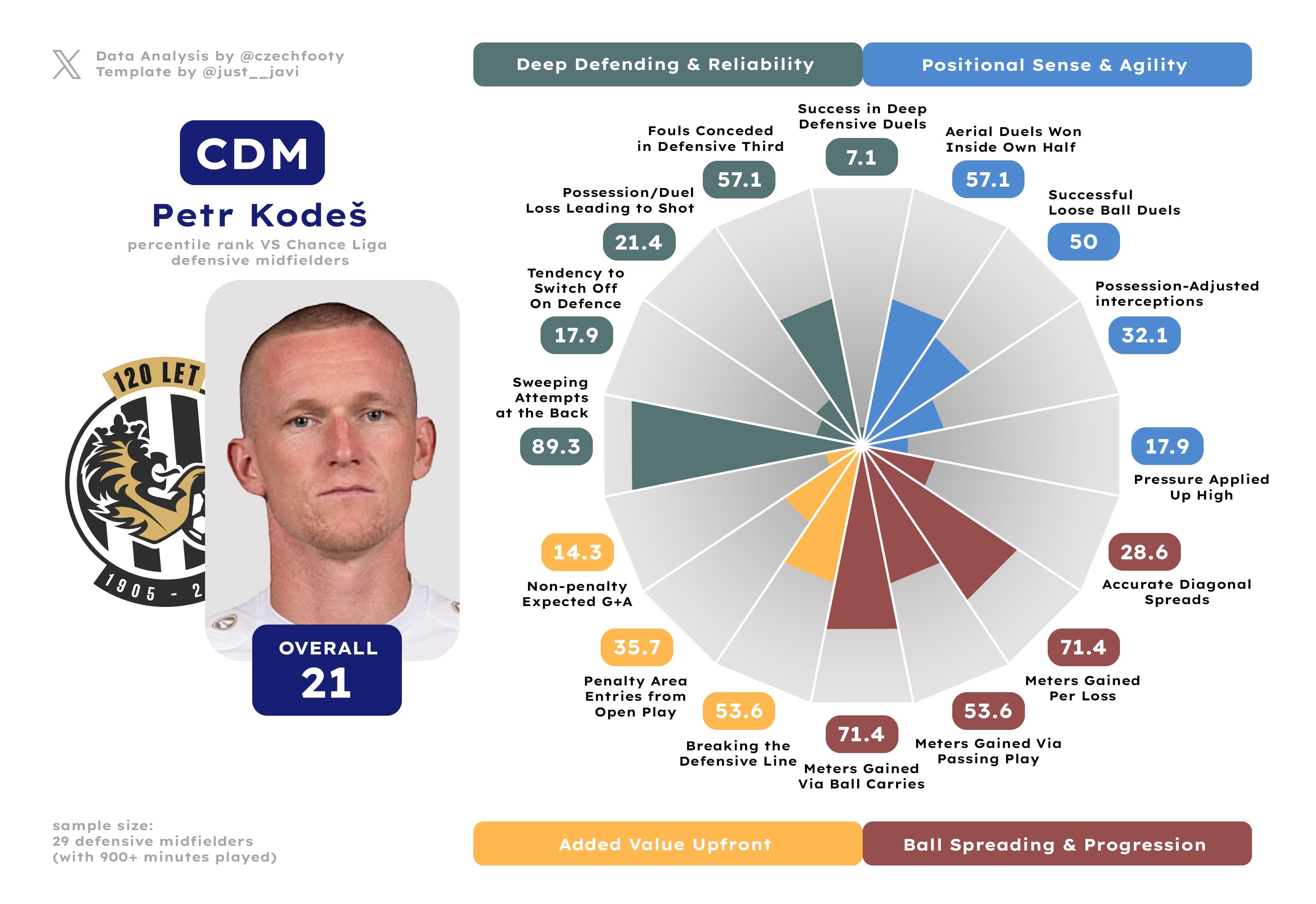
This also potentially solves my other dilemma: whether Petr Kodeš is a suitable LCB option. I have always liked him more in the middle of the back three, and that’s where he may end up deputizing once he recovers. I would still probably invest in a no. 6, though, to prevent him from pushing up to the midfield. He’s a very hasty passer and that becomes more of a problem when he receives a ton of balls in the pressure cooker that is the centre of the park. Play him closer to the goal where he can act as the old-fashioned sweeper he really is.
New kid on the block
It will take some time before we start seeing the footprints on the first team, but for Hradec’s U-19s and U-17s to return to the country’s top flight (and for U-18s along with U-16s to rise up a level to the second tier) is a massive deal for ‘Votroci’. As of now, from among the younger homegrown players, only Martin Hlaváč and Lukáš Hruška (b. 2004) are listed as members of the A-team. The former has done it repeatedly and is likely hitting his ceiling as the 5th/6th centre back option seeing that he hasn’t even taken in any loan experience since returning from Náchod in 2022; the latter is a relatively new face, but already 21, and also without any 2nd-tier loan stint under his belt. He was promoted on the back of a solid yet hardly spectacular campaign for the club’s 3rd-tier reserves (5+3) as a right wing-cum-centre forward, and going by Horejš’s reputation as someone not too willing to take a flyer on homegrown talent, he’ll soon be back there helping out the promising class of 2006, headlined by Adam Binár or Ebuka Okeke, to settle in. Lukáš Vaněk (b. 2008), a starting left back for the Czechs at this year’s U-17 Euro, is one to watch for the promoted U-19s.
Looking ahead to 2025/26
Below is the team’s current(ish) depth chart with a maximum of 4 alternatives for one position. The colourful ratings are a static snapshot of the league-wide situation on 5 July, and they are just a playful bit to add flavour to it; the names featured should be relevant to this day. To learn more about my approach to constructing depth charts, with all its limitations, head here.
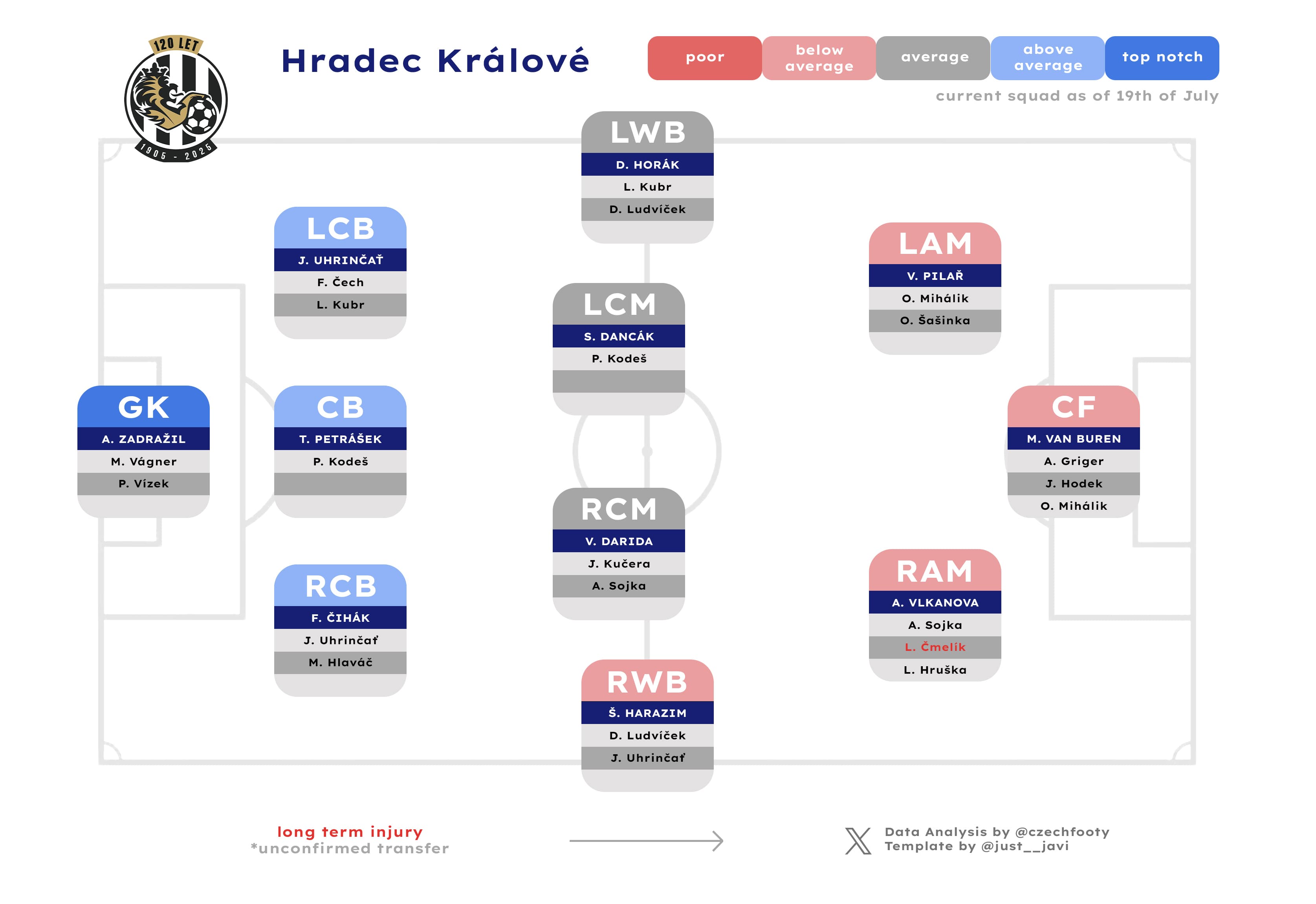
Primary formation
I don’t think this one is really up for a debate, unless it’s more of a 3-4-3 on some days, especially with two Lukáš’s — Hruška and Čmelík — used to play it wider than their colleagues who are poised to start, or perhaps 3-4-1-2 with Van Buren partnering Griger.
Notes on the depth chart
Right off the bat, it must be mentioned the coloured ratings were assigned before the MvB deal got even floated around. On this day, I would feel more inclined to push Hradec to the mediocre tier ahead of Liberec. The colouring was also done before Lucas Kubr came on board to bolster the LWB deck, but I’m not sure that would move Hradec all that much closer to Jablonec or Olomouc at the end of the day. Kubr’s Zbrojovka stint was — per @kone_brnensky — a bit of a mixed bag, with his stamina and acceleration coming through big time; almost as big as his poor handling of the ball, passing and decision-making.
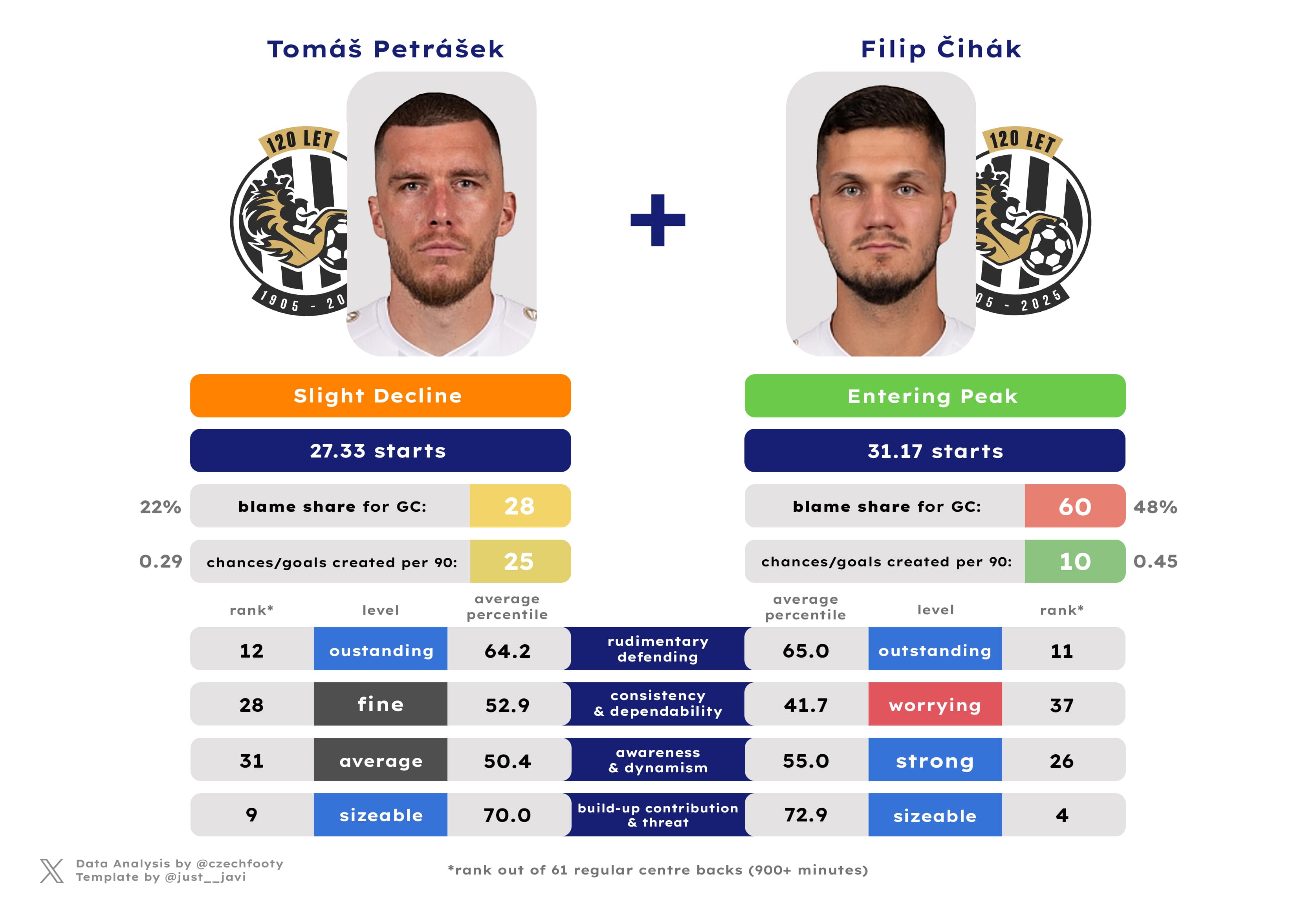
As things stand, then, Hradec Králové only register one above average department to go with the elite goalkeeping, and it is mostly down to two men. Something changed on Filip Čihák with the R11 injury, as he was an unusually frequent contributor to conceded goals afterwards (ultimately getting implicated in nearly half of them), but his underlying numbers still talk the talk and walk the walk to a decent extent. There is definitely a cause for major concern in terms of navigating ground duels (his success rate in key areas around and inside the box was more than 10 percentage points below Petrášek’s) as well as racing for loose balls (55.8% success rate turned 37.3%), but he was still a blocking machine that helps out with the build-up; a rare combination. I mean… rare outside of ‘Malšák’. Petrášek brought much on his own, complimenting Čihák’s ball-carrying and passing to the box with diagonal stretch passes.
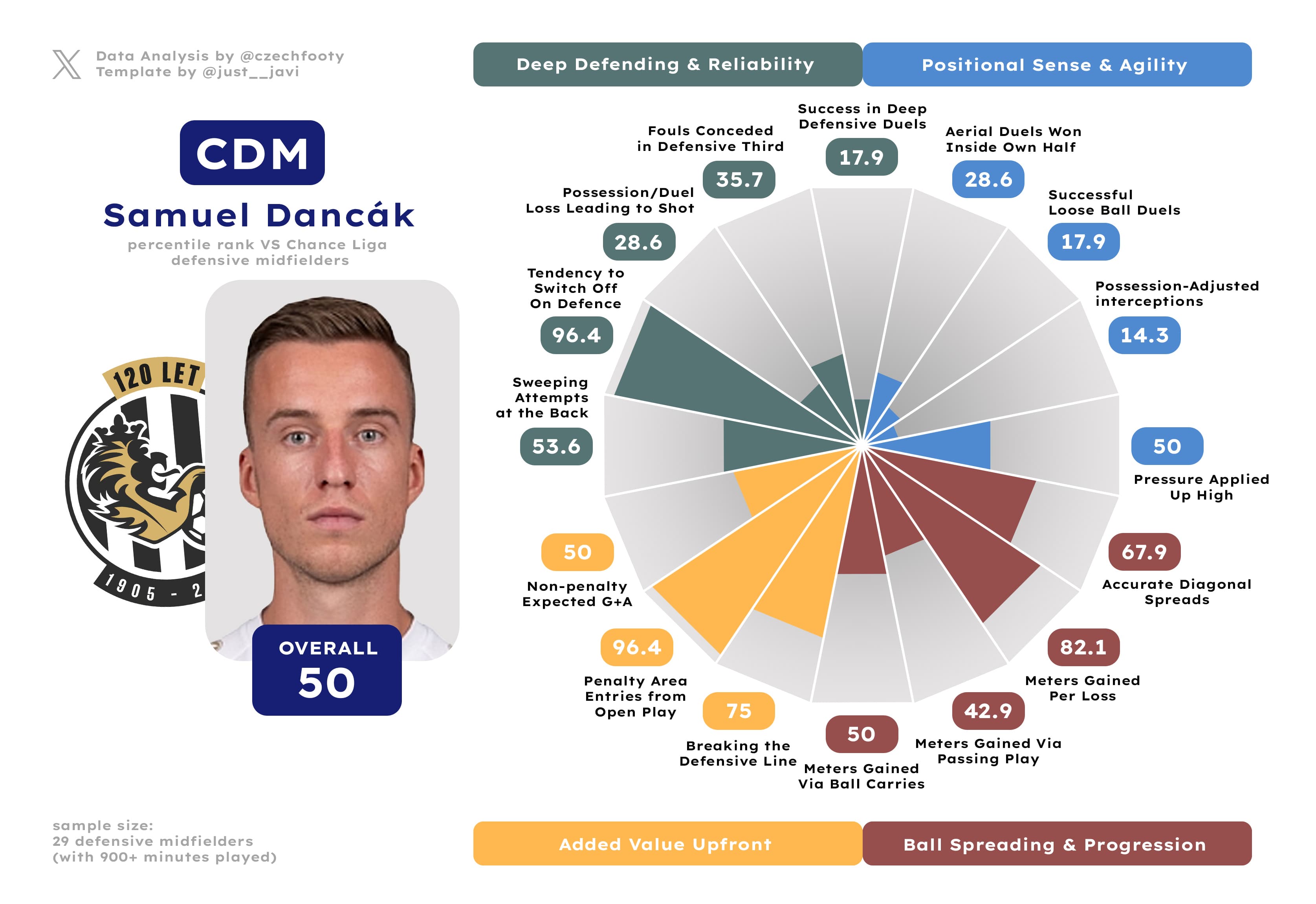
Anytime they mention Hradec not creating shit in possession, I think of him. Samuel Dancák deserves more respect of y’all, even as he exchanged “strong” positional sense & agility for “inadequate” courtesy of some wild drops in aerial and loose ball duel success rate (both down by roughly 15%) or possession-adjusted interceptions. I can’t explain this, but what remains — crucially — is a decent ball progressor and an absolute cheat code in gaining the attacking penalty area from open play. Only Kalvach was more prolific at this discipline.
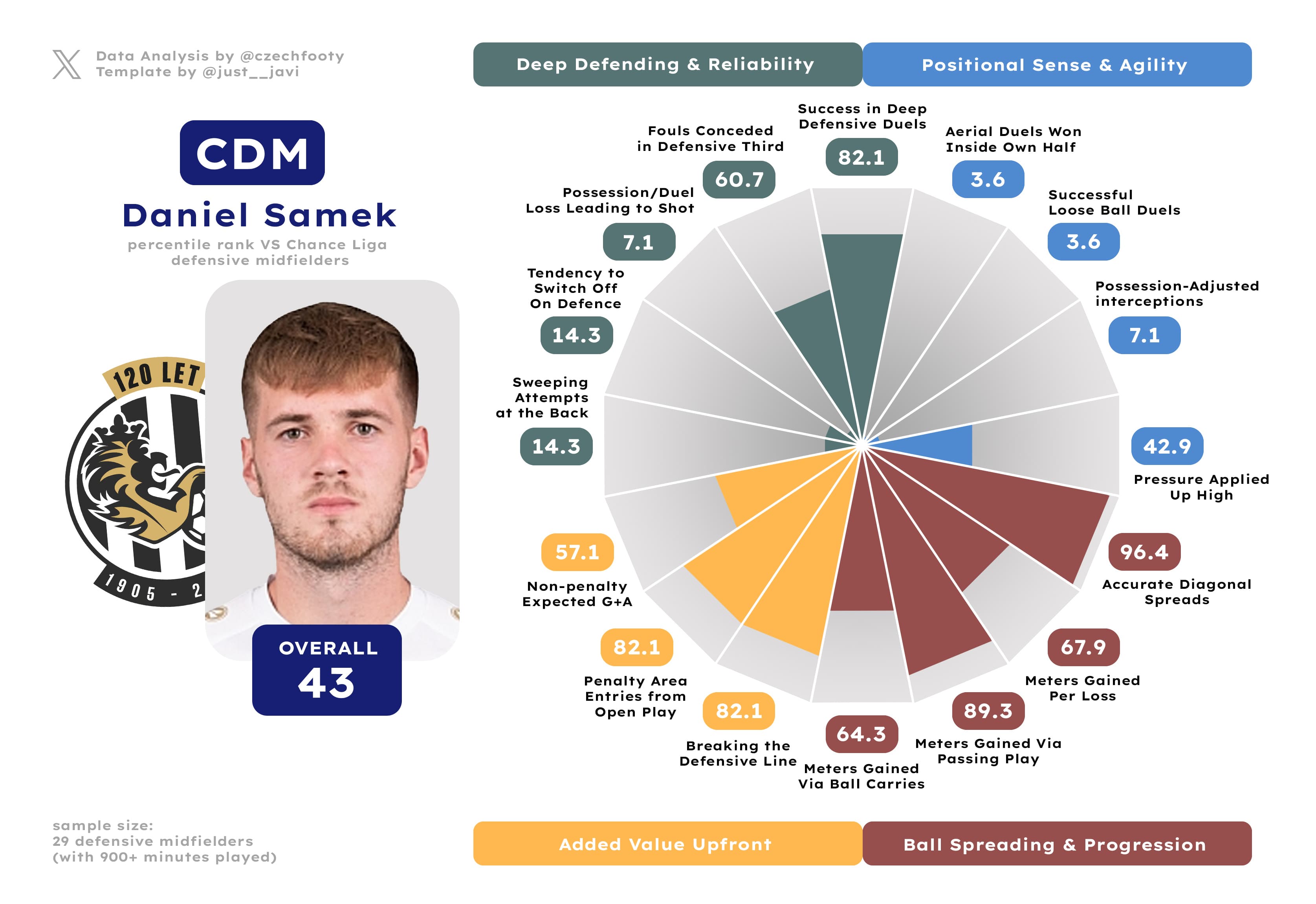
Finally, don’t show this — particularly the upper part — to Daniel Samek’s dad…
Roster battle to follow
In one of the pre-season podcasts last summer, I highlighted Štěpán Harazim as someone I’m really looking forward to see spread their wings. So, of course he was injured or benched more often than not, winding up with a measly 441 minutes (but, hey, two goals scored!). That’s still better than being wrong about him, though, so with a new season and old rivals gone, a new source of hope arrives. Facing Slavia on Day 1, Harazim is penciled for a starter’s role and should have what it takes to both run away with it and upgrade Jakub Klíma.
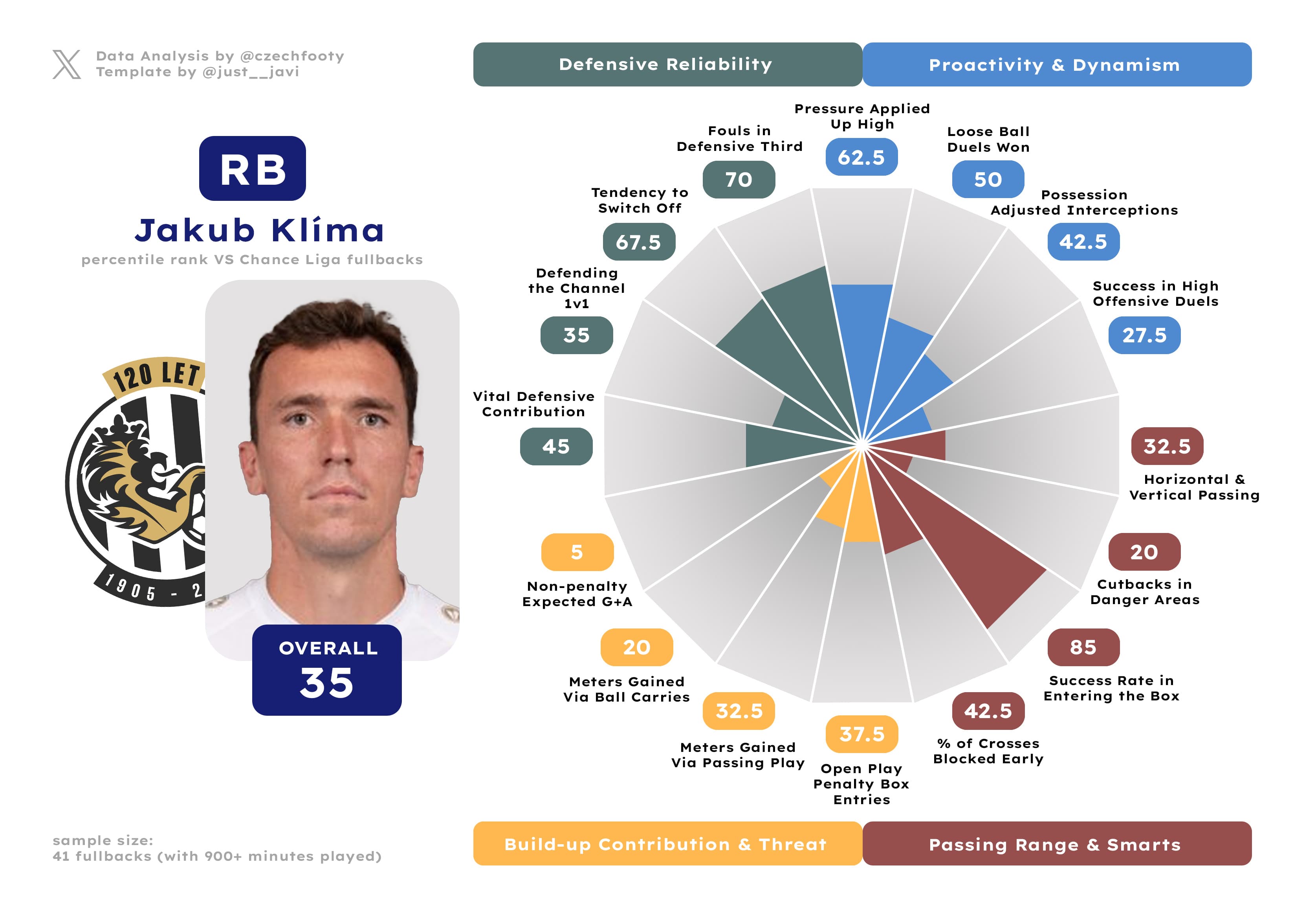
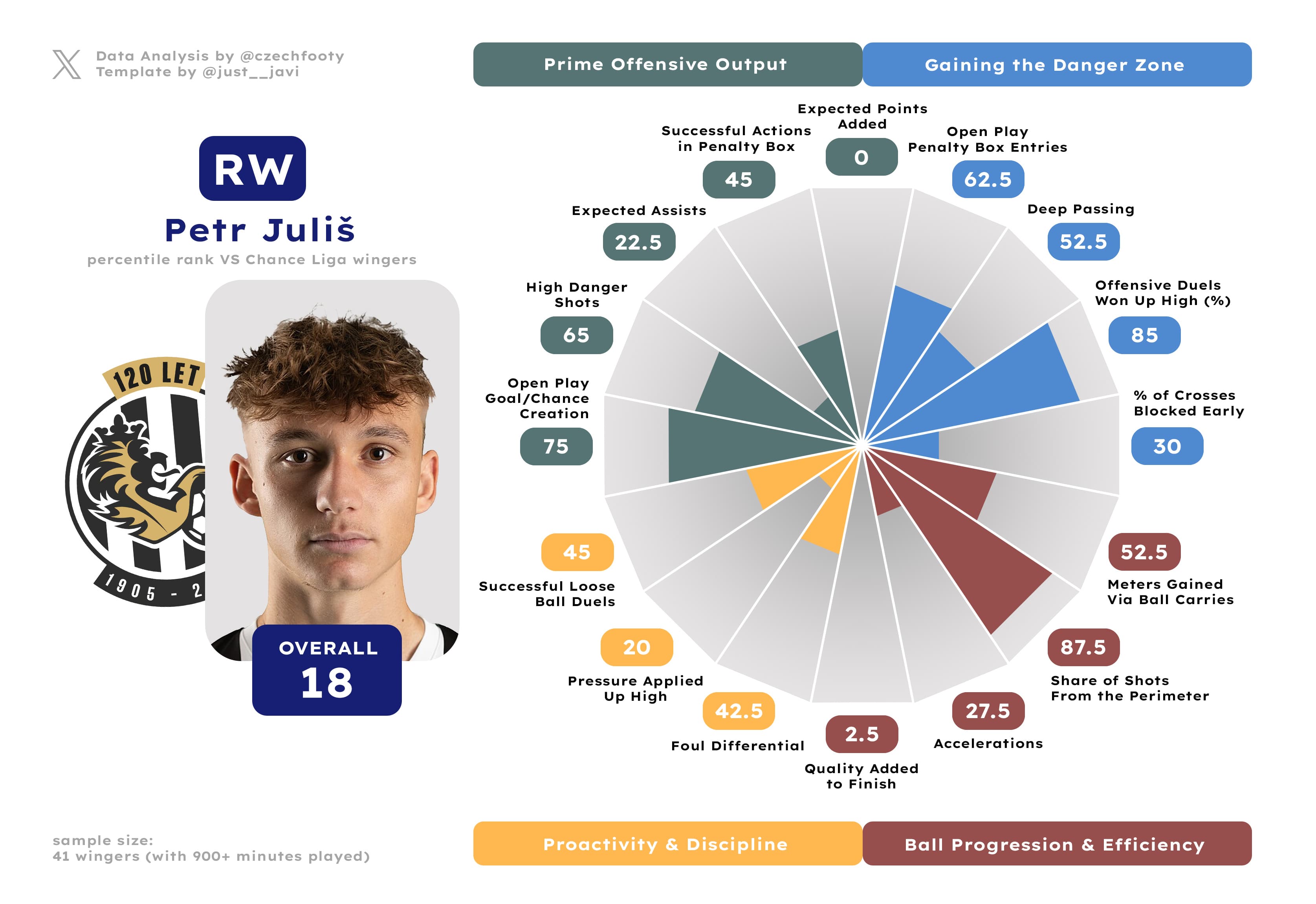
Still, you just can’t fight the feeling there will be some sort of a battle at right wingback, can you? It could take the form of an internal battle; Harazim against his health or consistency related demons. Or it may as well take the form of an external battle; Harazim vs Ludvíček (elevated by more conducive conditions) or Harazim vs Čmelík (since we know Horejš has a soft spot for a winger in that role). The Petr Juliš experiment didn’t last but I, for one, quite enjoyed it — and wouldn’t be stunned by some sort of a repeat. Harazim is hardly safe.
Season forecast
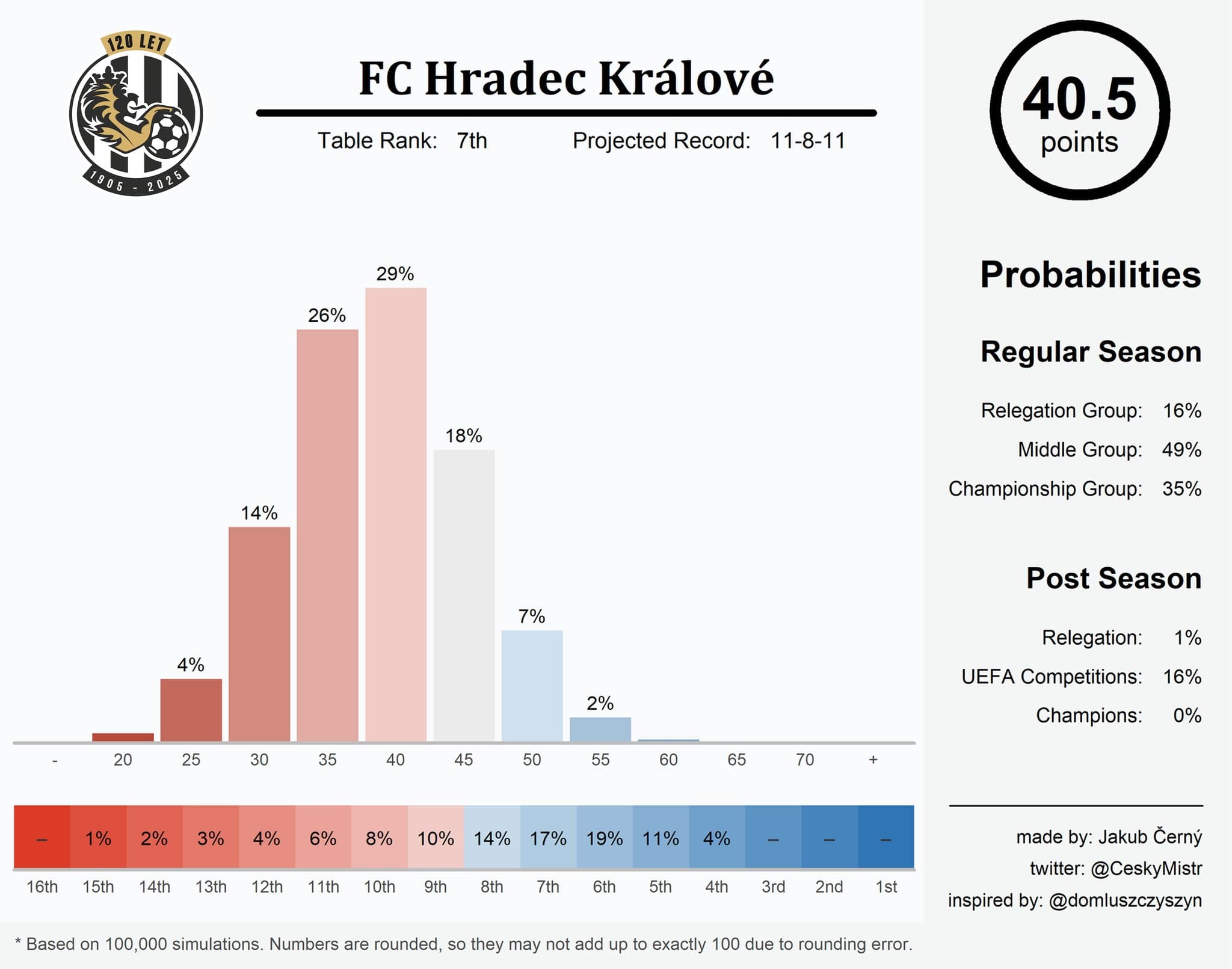
Returning to my earlier suggestion Hradec Králové are, in fact, not stagnating under David Horejš: they have improved in point-per-game gain on both counts, going from 1.32 points in 22/23 to 1.44 in 24/25. No major progress, I agree, but one wonders how much higher the club’s ceiling realistically lies. From the forecast point of view, Hradec did hit something of a roadblock, not reaching the regular season target for the first time, but it’s worth pointing out the said target (43.7) would also mean their highest modern-day total by a mile (41 from 10/11 leads the way). Currently, I think that’s got to be the goal: Hradec should aim to set the record as far as relatable seasons go (their title-winning campaign of 59/60 would’ve seen them net 54 points if there were 30 rounds instead of 26, and if the wins were already three-pointers then), which they manage to do in roughly every other simulation. Decent odds.
Bold prediction
The track record: 1/3. Petr Juliš didn’t score more goals than his brother Lukáš (also 0 lol)
The prediction: Horejš builds up momentum for new owners by becoming Coach of September
The rationale: While there’s always a possibility of delay, everything seems to be on track for approving the transaction by the end of September. It’s still Ondřej Tomek, co-founder of Centrum.cz, and Ivo Ulich, one of the more recognizable products of the famed Hradec Králové academy, leading the takeover bid; the appointment of Pavel Nedvěd as general manager of Czech national teams was but a minor complication, as it likely means Jiří Sabou and Richard Jukl simply keep their jobs, while Nedvěd stays on as one of five shareholders.
That’s a sign we can start preparing the ground for the kind people who are bringing more monies. Specifically, we’ll want to see David Horejš bag the Coach of the Month award for his September exploits, so that there is a nice sense of momentum at the time new owners take charge. The schedule works in our favour, I think: there are just 3 rounds due to the international break (which takes away some space for an extra fuck-up), with Hradec starting out at home vs Sparta (the obligatory upset), then heading out to Zlín (the obligatory easy win) and finally returning back home to face Liberec (the obligatory scalp of a fellow up-and-comer with similar ambitions). Even 7 points could suffice if everything else falls into place.
Have I already tried to pull this trick off twice, only to faceplant horribly? Sure, Hejdušek literally didn’t win a single August game in 2023 when he was supposed to be honoured, and neither did Jílek in September 2022. But hey… they say the third time’s the charm, no?

Enjoyed the text or the visuals, but don’t care for 🇨🇿 translations and dashboards? No worries, you can still support us by inviting us for a symbolic pint at the old BuyMeACoffeeBeer page.
