Also available in
 Čeština (Czech)
When FK Pardubice announced their RESTART last summer, this is most certainly not what they had in mind. Gone is the main sponsor after which the arena was named, head coach, sporting director, technical director/director of recruitment and chairman from that time; though in the case of the latter, Vít Zavřel — promoted in his place — insists Vladimír Pitter still “works the same way he used to”, whatever the hell that means. Granted, the initiative rather targeted a shift in visual identity or fan engagement, but even on that front, “maybe the font has changed” was one of my consultant’s sarcastic response. Most notably, the club has succeeded in uniting all the fans against itself.
I’ve always liked Pardubice, and Vít Zavřel specifically, for being open to share information with the public. To that end, not much has changed; at the curtain-raising press conference, the freshly minted chairman confirmed that some partners (other than the investment group CFIG who opted to not extend their 3-year contract) have slashed their contributions by 20-30%, while stating some of those reductions are ‘refundable’ by, for example, avoiding the relegation play-off. Here’s hoping then. At the same time, the search for a new investor continues, with Zavřel for once stopping short of sharing anything of note, citing an NDA.
Rumours around town are, meanwhile, split between those convinced Petr Dědek, the outspoken majority owner of FKP’s ice-hockey brother, is interested — the camp of wishful thinking — and those who believe Zavřel & Co. are demanding a truckload of money no one is willing to pay, having already turned down several offers deemed insufficient — the grumps.
The truth, as ever, could be found somewhere in the middle.
The bottom line is grim, though: here you have a club with an inflated squad short on high-end quality yet probably not too cheap, with partners potentially leaving en masse, and most people including some fans pegging it down as a clear-cut relegation favourite. That shows, among other things, on the seriously underwhelming season ticket sales, which — according to my latest information — are quite convincingly trailing even those of Jablonec.
Looking back on 2024/25
What went (particularly) right
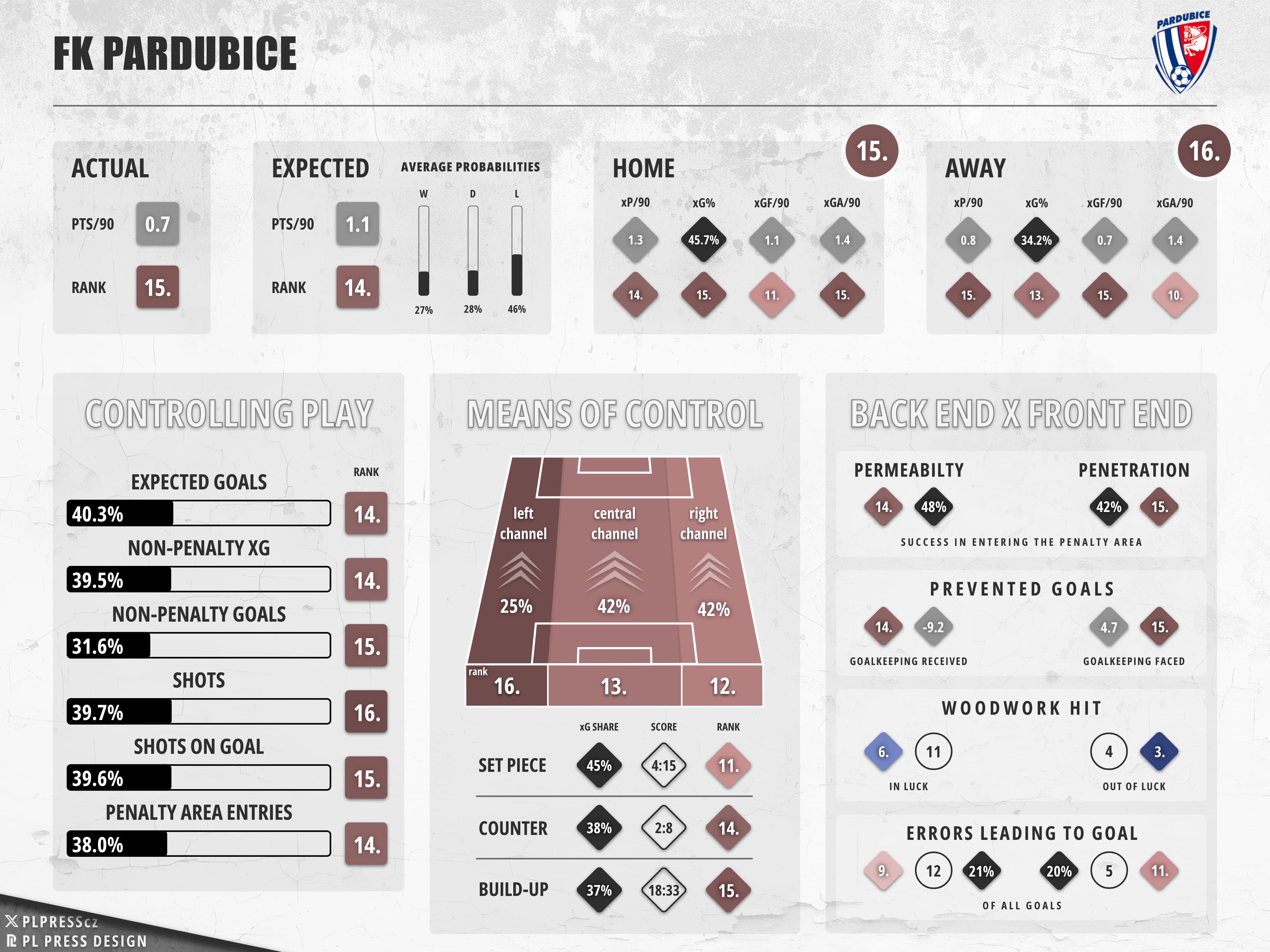
Towards the end of the autumn, it looked like David Střihavka was figuring it out in charge of Pardubice. And doing so relatively early, for that matter. In a week, Střihavka delivered the first clean sheet to end Pardubice’s longest ever run without it (12); within a month or so, he brought the team’s (at the time) season-worst five-game xGAExpected Goals Against (xGA) estimates how many goals a team should have conceded based on shot quality, location, and context. average of 1.74 down to 0.65 which (also at the time) signalled a Top 4 defence. Just as swiftly, Pardubice have gone from one of the most passive outfits in the league (on average allowing their opponents to exchange 11.22 passes before intercepting) to one of the more intense ones (7.86 PPDAPasses Per Defensive Action Allowed (PPDA) measure a team's intensity off the ball. The lower the value, the better — it indicates the team successfully pressures or disrupts the opponent’s passing sequences at an early stage.).
What’s funny is that even the marvelous value of 0.65 wasn’t the best five-game xGA average Pardubice managed across the whole season (it just marked by far their best run of a single loss in 7); despite facing Jablonec and Sparta early in that sequence, the team actually took it all the way to 0.59 following Round 33. That cannot be underestimated. For example, Hradec Králové — 7th best team not too far away from cracking the Top 6 — only reached 0.79 at the best of times. Sigma Olomouc — an actual Top 6 side — stopped at 0.88. And Baník Ostrava — ahead of Sparta — only went as low as 0.91. Even Slovan’s best mark (0.75), registered by Pardubice’s former mastermind, was beaten by two distinct 5-game sequences of Střihavka’s outfit. The defensive foundation was arguably always there, but as for everything else…
What went (especially) wrong
When it looked like Pardubice had finally put together some momentum, it was all gone in the blink of an eye. Coming out of the winter break, outshooting their opponents by a combined 16 attemtps in the five pre-Christmas rounds, Pardubice were annihilated in the next five, getting outshot by a combined 50 attempts and conceding 14 times. All along the way, and even further, they were goalless themselves. That streak eventually stretched to seven games, with the club’s previous low standing at a mere three. In all of 100-year history of the Czech(oslovak) top flight, in fact, only seven clubs have registered longer streaks, and just three of those have outlasted Pardubice’s most recent rut since the turn of the millenium. The only plus on such a depressing statistic is that one of those 3 clubs happens to be FC Hradec Králové; the very arch rival who kicked the 649-minute goalless streak off with their 3:0 demolition in Round 20 (Budějovice’s worst run, btw, clocks in at 568 mins).
Anything else we could pick on — like all non-penalty set pieces once again stinking, fetching 0.11 goals and 1.23 chances per game, both league-worst rates — really pales in comparison.
Most valuable player (still on board)
Per my MVP model (traditional stats): Louis Lurvink (ranked 55th league-wide)
Per my positional models (advanced stats): Jason Noslin (95th overall percentile at CB)
Per Statsbomb’s On-Ball Value (OBV) metric: Michal Surzyn
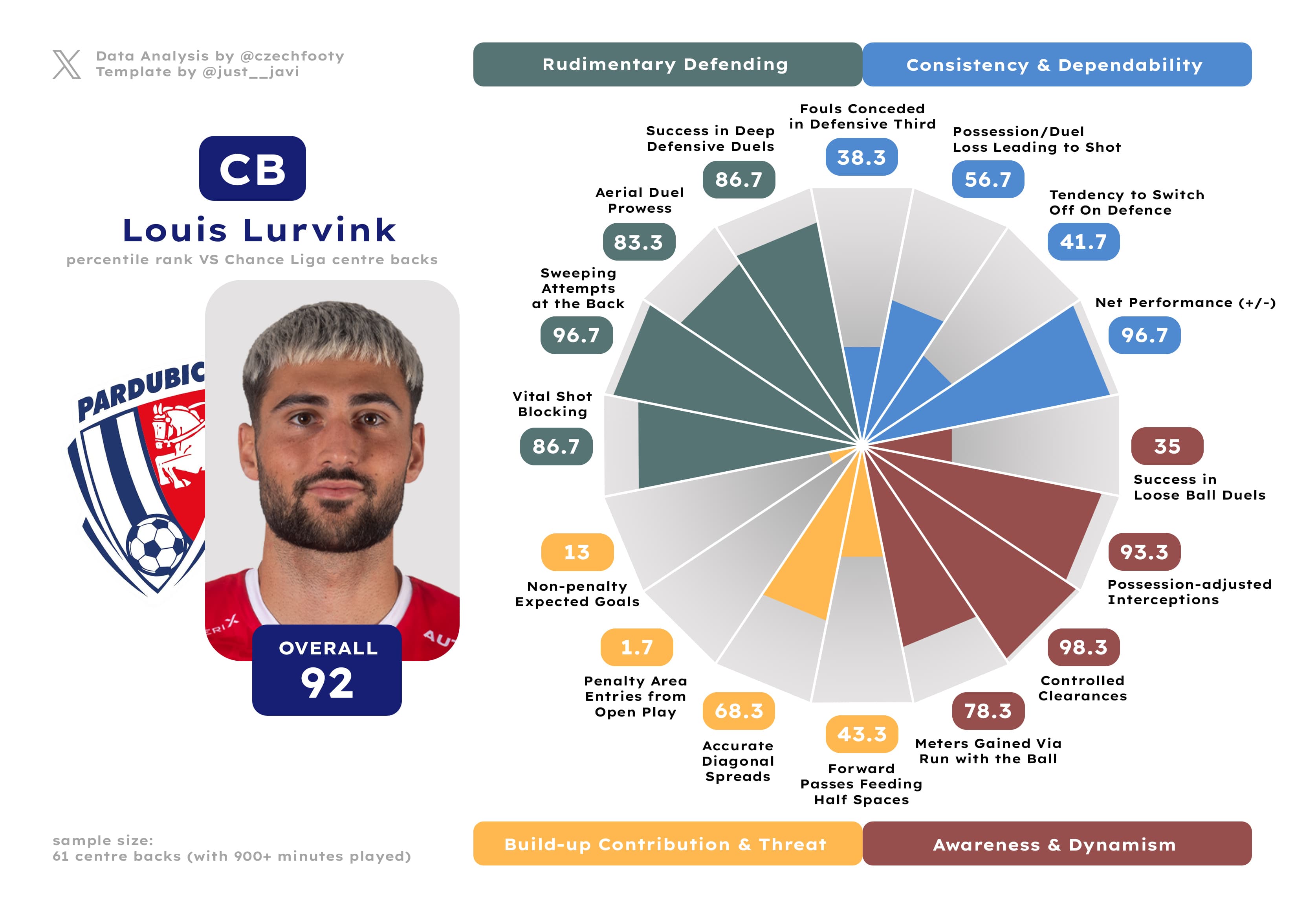
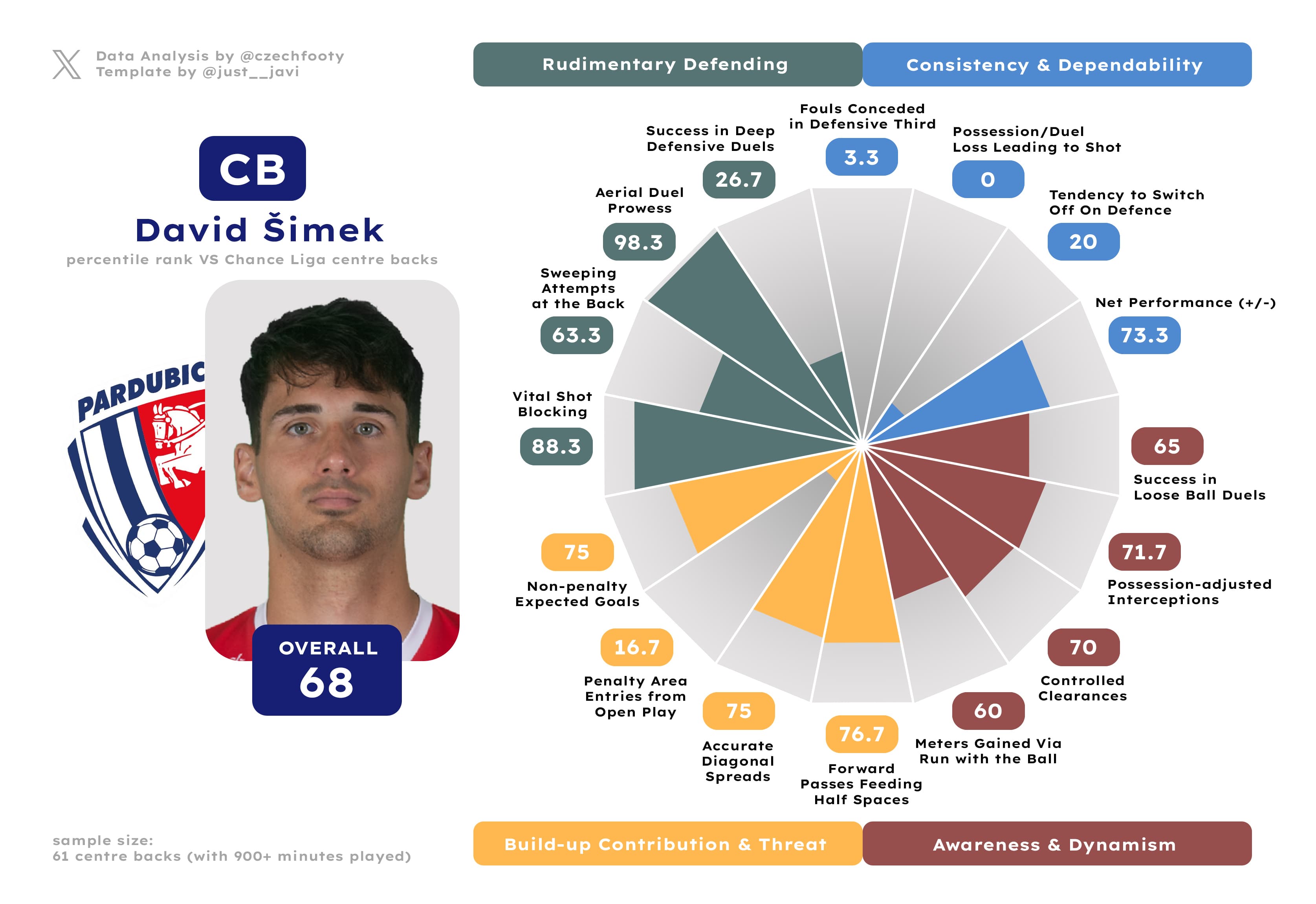
It now seems to be a widely accepted notion among fans that Jakub Dobiáš’s scouting network had brought little to no hits to Pardubice, and I would lean towards agreeing as far as attacking-minded players go (though we’d better wait for what André Leipold, poised to be a starter on Day 1, shows). When it comes to defenders, however, all of David Šimek, Jason Noslin and Louis Lurvink were almost certainly his recommended or approved buys, and all three now form something Pardubice can confidently build on. That starts with Lurvink who’s one of only three centre backs over the four years of me grouping metrics into four distinct sets who landed in the Top 4 for both “rudimentary defending” and “awareness & dynamism” (Lischka of 21/22 and Halinský of 23/24 — another Pardubice CB — are the other two). While the former can easily be a product of more opportunity, the latter less so.
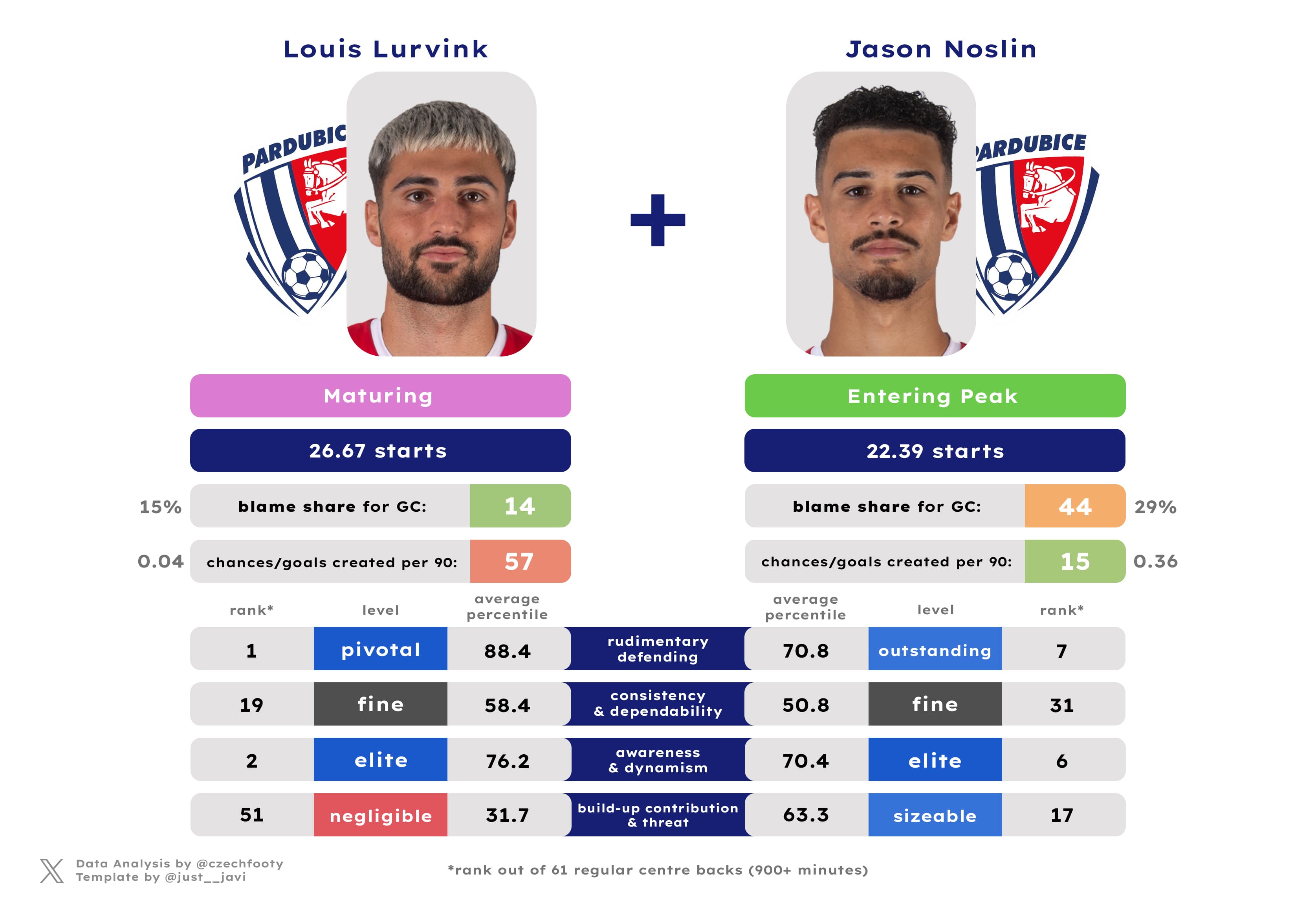
It gets even better when you pair Lurvink up with Noslin who actually grades out… even better. They complement each other well — Lurvink sends more diagonals, Noslin brings more verticality; one excels in ground duels, the other one takes the air — and they are both flattered by the WOWYWith Or Without You (WOWY) is an approach more commonly used in ice hockey, where attributing on-ice performance to a single player is easier (there are only 5 skaters instead of 10 outfield players). Still, it’s worth examining the extremes even in football. splits to a varying degree. In the case of Noslin, it’s properly extreme. There were 19 games that saw the Dutch centre half spend at least 3/4s of the playing time on the pitch. In those, Pardubice allowed an average of 0.9 xGA, whereas in the remaining 16 matches that number shot up to 2.02 xGA. Hardly a coincidence. With Noslin on the pitch overall, Pardubice conceded 1.16 goals per game; without him it was 2.23. The respective rates are only marginally less pronounced for Lurvink, who was — for a change — the more dependable one in terms of net performance (13 positive, 7 negative; Noslin was break even).
Chip on the shoulder
carried by the player who’s got something to prove — be it to himself, fans or the coach
It’s wild to think Štěpán Míšek — still a teenager for the next three days — will soon be two years and 50 top flight starts removed from debuting. On one team with Kamil Vacek, he’ll never be asked to step up to the plate as a leader, but he’s very much there as a player.
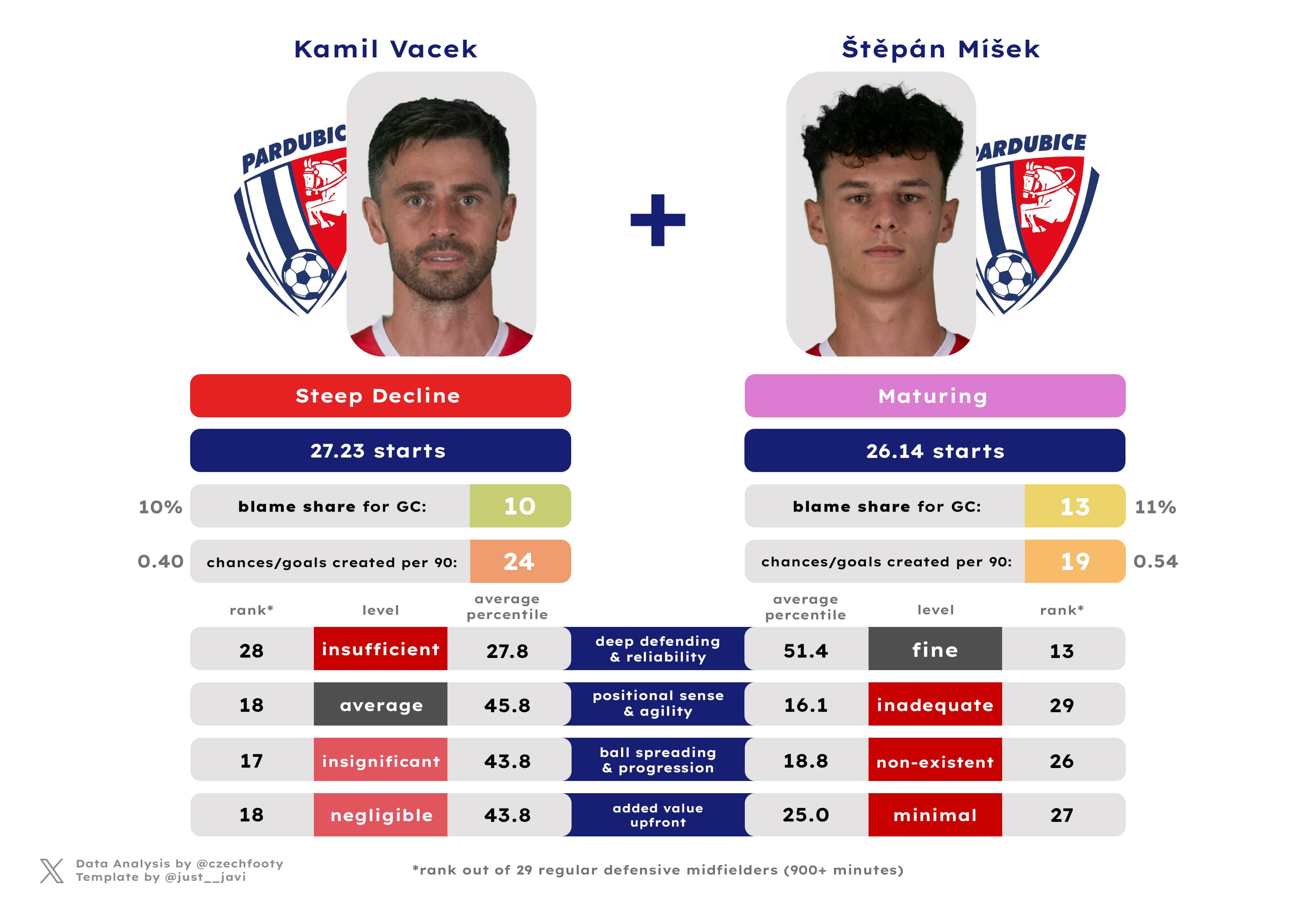
Or, well, ideally would be. The thing is, where Míšek as the 18-year-old sensation looked like a player who’ll once definitely arrive as this cerebral, technically sound midfielder, the 20-year-old version of himself inspires far less confidence. In summer 2023, I had “close control, ball spreading and game-reading ability, confidence and combativeness” cited by fans among his notable attributes; now I’m not sure I see any apart from maybe the close control. Even among defensive midfielders (as someone who’s appeared at right wing and in the hole), Míšek just doesn’t stand out whatsoever. His stretch passes went out of the bounds as often as they found a teammate, he progressed the play via passes more than just two CDMs, and entering the box in control, let alone winning a header, seemed an inconceivable task.
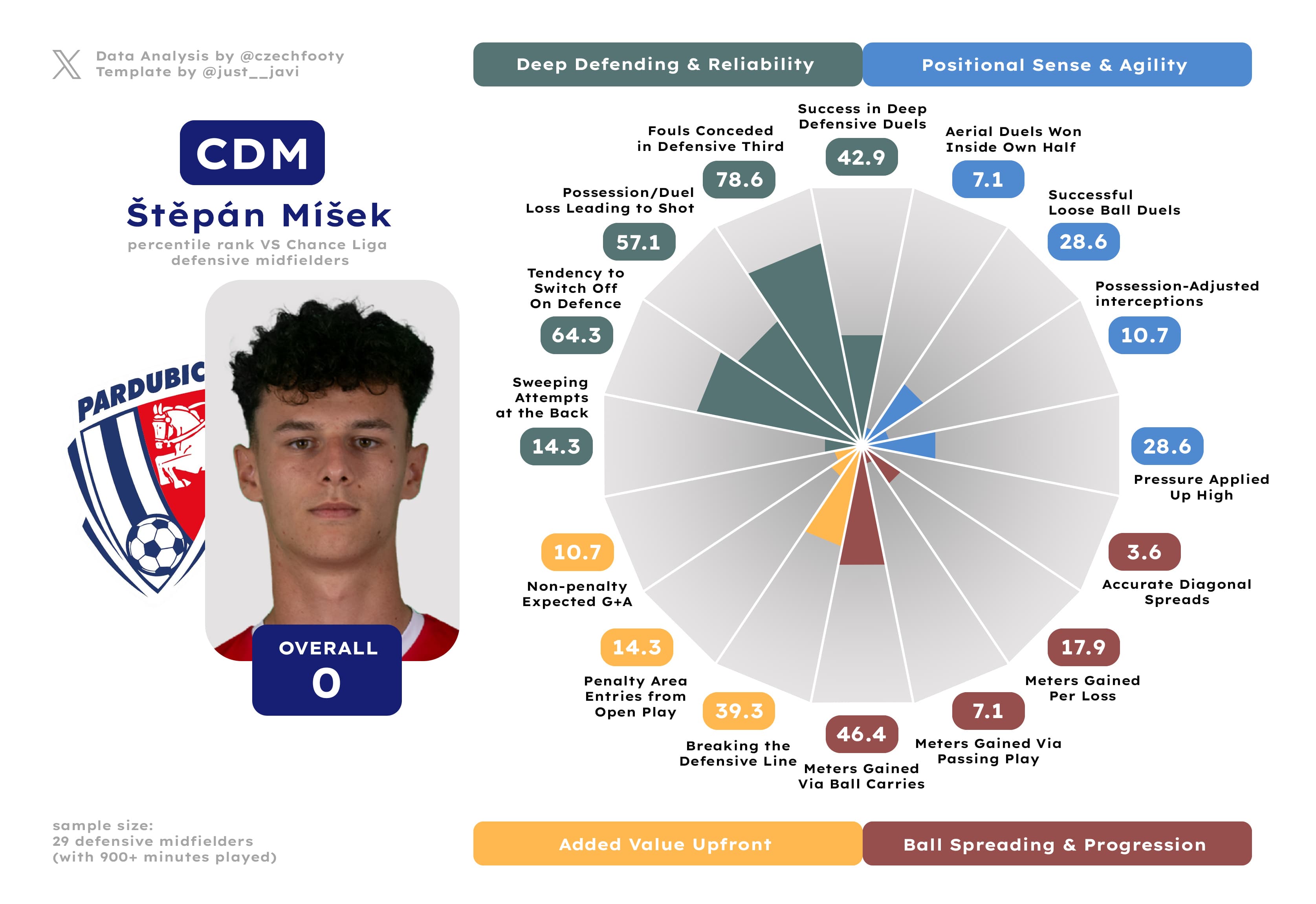
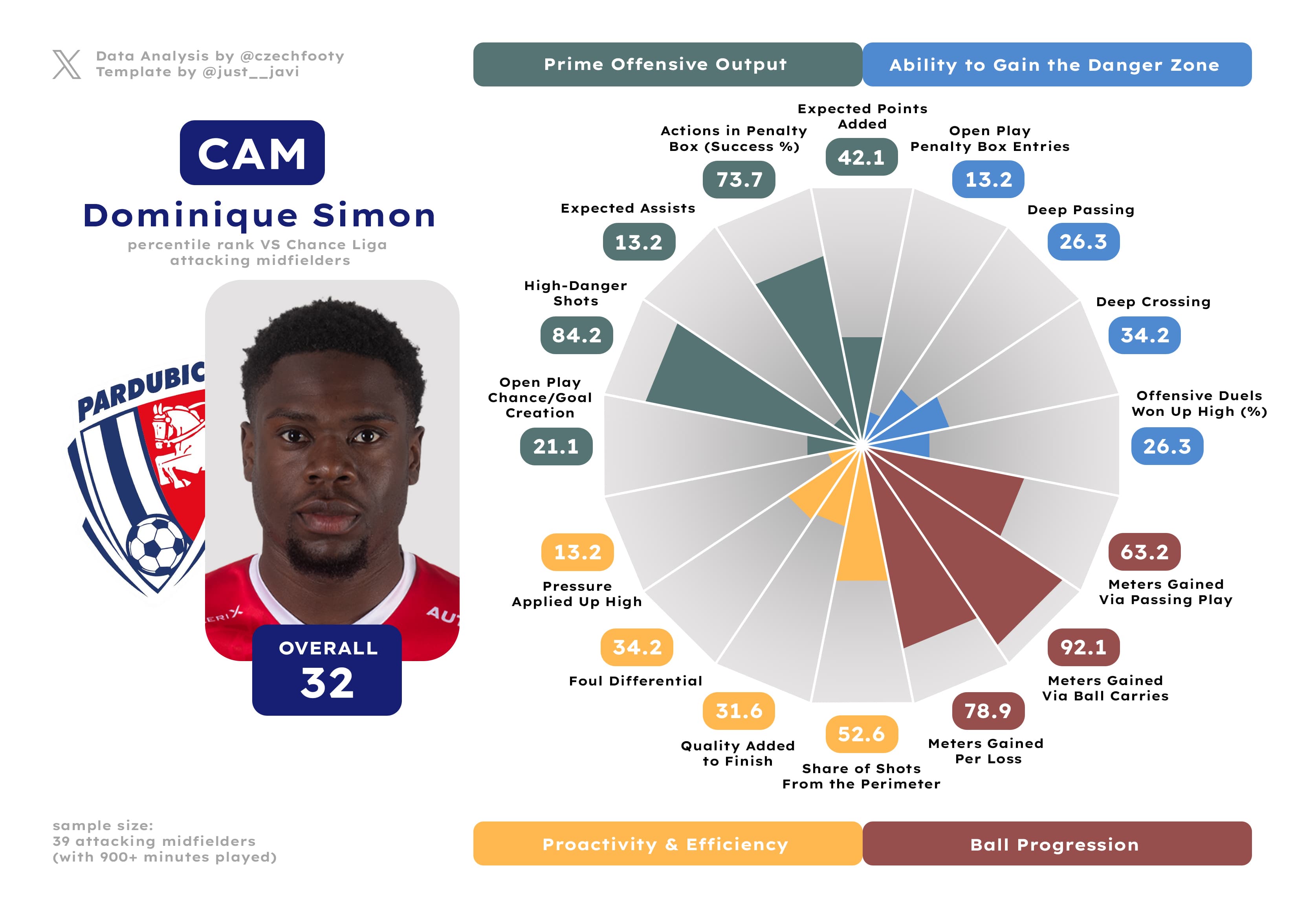
It shouldn’t have come to this, but Pardubice are basically in a position where they badly need the maturing midfielder to take strides forward and carry the midfield. You could potentially lean more into Dominique Simon for that, but he would need to A) stay healthy, B) add more than high-danger shots and drilling down the centre of the park with the ball at his feet to his arsenal. Those are nice features, but they don’t normally put your team in the driver’s seat. Still, if you filter out attacking midfielders who are above average in all three ball progression metrics, Simon’s company hails from Slavia, Ostrava, Sparta and Boleslav.
Not bad. Not bad at all.
Who you definitely cannot rely on some more is Kamil Vacek. He got a new contract, and judging by his appearance at the pre-season presser, he won’t be just a veteran helper to this team; he’ll form a spine. That was already the case throughout 24/25, when he was the most utilized Pardubice player (somehow 60th most utilized footballer in Chance Liga!), and it proved decidedly detrimental to everyone around him. As many as 28 of his ball/duel losses led to an opponent’s shot within 30 seconds (over one a game) per Wyscout, and as many as 9 of his fuck-ups in build-up led to danger (goal or big chance) per my notes. Out of depth.
Inside the off-season
special thanks for guiding me through the motions of FK Pardubice’s off-season go out to @matejsal & @Vocas46
Squad turnover
Last season, only České Budějovice (45) dished out top flight minutes to more players than Pardubice (42). That is normally not a great sign, but it’s an even worse sign when Dynamo are keeping less than 40% of those minutes on board — correctly recognizing the urgent need for a big-time trimming job — whereas FKP are retaining upwards of 75% of them. You could argue there’s a world of difference between readying to survive in the top flight and shedding baggage as you drop down a level, but I wouldn’t necessarily draw that thick a line between the two jobs. Dead weight is never needed and Pardubice are carrying over tons of it; losing just one member of the most used XI after having a hard time to navigate a relegation play-off (Eldar Šehić who barely took to the field in the spring anyway), and parting ways with attacking-minded players constituting only 11.5% of all playing time distributed in that department, after a historic period of impotence. Make it make sense.
Biggest upgrade
Slim pickings. Denis Darmovzal returning from a second-tier loan stint, where he regained some of his focus and signature swagger, might genuinely be the best bet — and that doesn’t sound right even to me, a noted fan. Jáchym Šerák, meanwhile, is another one making the short trip from Chrudim, but it’s tough to make a case for him upgrading Vojtěch Vorel after starting 3rd-tier games less than two years ago. Mikuláš Konečný as a more mature, better 19-year-old centre back slash temporary fullback than Václav Jindra? Yeah, whatever.
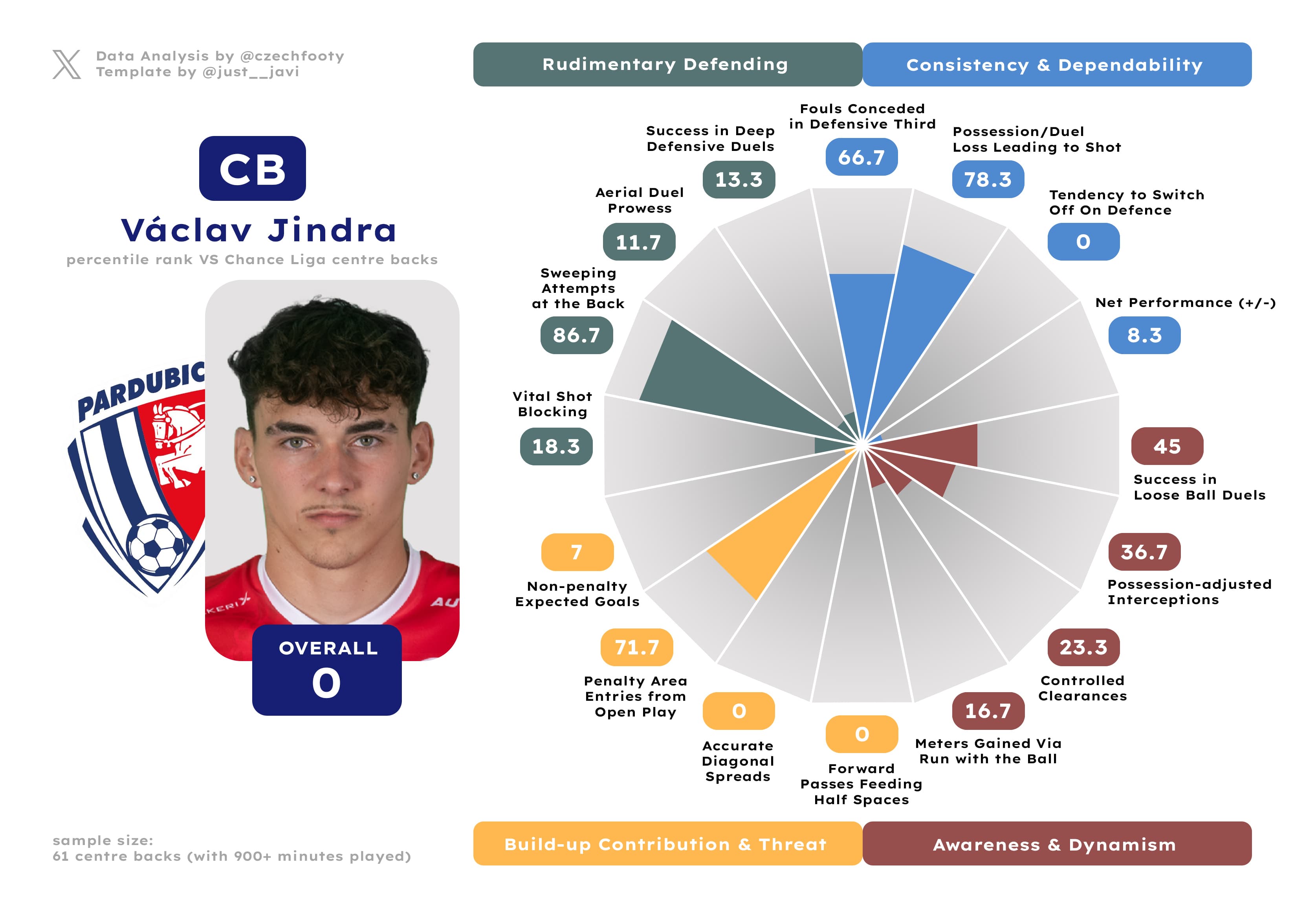
Freshly 19, Konečný is still feasibly one of the hottest CB prospects in the country, but it’s worth pointing out he’s making the leap into the top flight without taking a notable step forward at the level below in 24/25. That is the biggest concern here — not his age or talent — and his own coach and patron, who’s had Konečný under his watch since he was 13, actually recognizes that, specifically citing some degree of stagnation in his case. Konečný certainly looked distracted at various points of the last season, committing too many costly errors, and the sort of over-confident hugging of the ball was on display in pre-season, too. Until Konečný gets stronger and starts making smarter decisions at the back, he could bomb.
Biggest downgrade
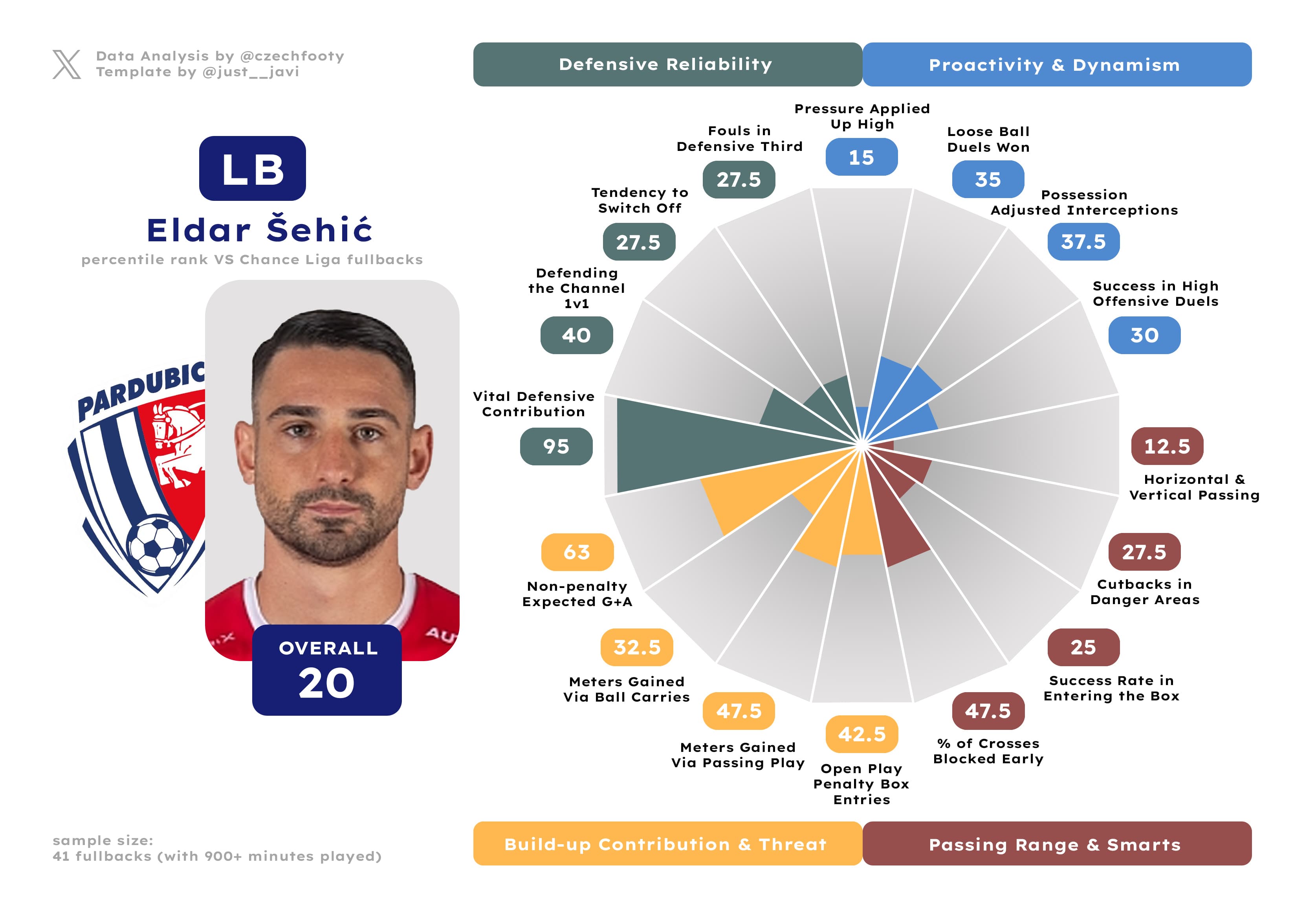
Slim pickings in this space, as well. While the experience and versatility of Jan Kalabiška may be missed the most, out of all summer departures, only Eldar Šehić has qualified for a pizza chart. And he’s actually a decent pick after effectively disappearing on the team for the last third of the campaign. Until then, Šehić managed to rack up 22 chance-creating and two goal-creating actions, quite a portion of them from set pieces. That somehow made him the second most threatening team member behind Vojtěch Sychra at the season’s end, as well, placing him 6th on FKP’s MVP leaderboard. I’m not sure it ends up mattering, since Dominik Mašek also possesses a long, powerful stride and started to take set pieces pretty much immediately after breaking through at Dynamo, but it’s clear who’s got the richer pedigree.
Need left to be addressed
The team is short on high-end quality and there’s hope two players, including “an international from the Baltic region”, pass the medicals before the season kicks-off, but it doesn’t sound like either one of them is a centre back — definitely an urgent need right now, with Noslin reportedly needing about two more months to recover from a delayed shoulder surgery that had already kept him out of the line-up in winter. David Šimek is more than an adequate stopgap, but he’s also one of two senior and healthy centre backs, with Konečný deputizing at fullback in the dress rehearsal. Pardubice generally register too many mystery injuries that are affecting the aggregate quality they can offer — missing Vojtěch Patrák or Ryan Mahuta throughout the entire pre-season, potentially solid options for the left side.
New kid on the block
There’s never a shortage of youngsters on the verge of a breakout at FK Pardubice, though there are questions about their pathways. Marek Halda (b. 2005) might be the closest maturity-wise, but he’s mostly stuck behind a stack central midfield deck. Two Diego’s of Mexican-American citizenship, Velasquez and Zarate (both born on the same day of August 2006 per Transfermarkt), have completed their first season at the club, split between the U-19 top flight and senior third-tier, and began the pre-season with the first-team. But apart from maybe Zarate getting the odd call as a versatile wide player, I see little chance.
Meanwhile, FK Pardubice have continued to supply bigger clubs with a high-end teen talent, seeing youth international Aleš Sukdolák sign a professional contract ahead of Sparta’s U-19 campaign at 16, and Matěj Kvaček (b. 2007) earn a month-long experience at a youth programme run by Bayern and overseen by the Munich club’s iconic striker Roy Makaay. The centre forward, who scored in our U-17 Euro 2024 opener, almost single-handedly beat Romania in his last start for the U-18s and has notched 11 points (10+1) for both the reserves and U-19s at the club level since mid-October only, should return from Germany on 27 July — just in time for a dance with Sparta (3 August), making fans joke about him potentially becoming another FKP youngster to debut vs the Prague giants (like Míšek, Jindra earlier).
Looking ahead to 2025/26
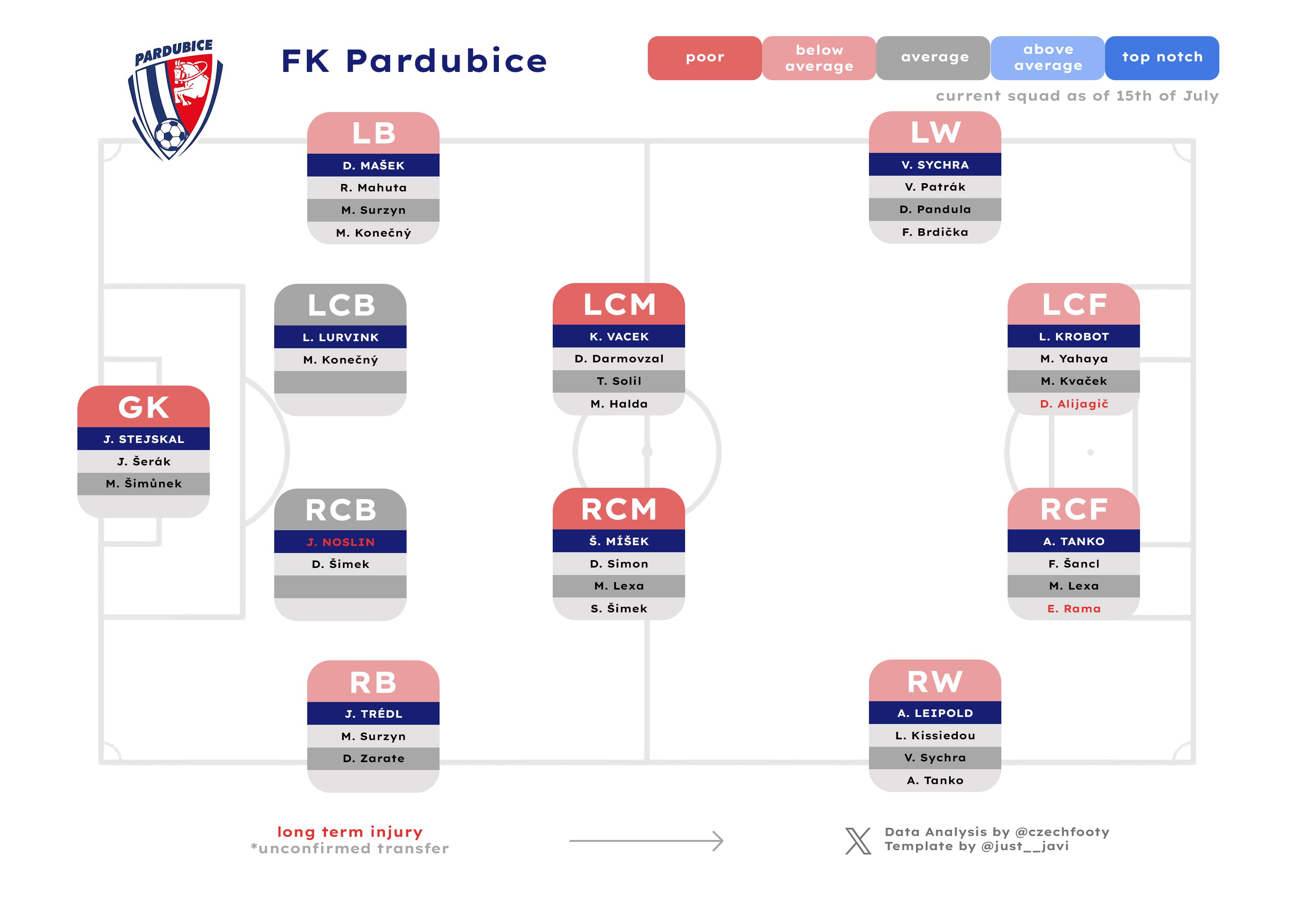
Below is the team’s current(ish) depth chart with a maximum of 4 alternatives for one position. The colourful ratings are a static snapshot of the league-wide situation on 5 July, and they are just a playful bit to add flavour to it; the names featured should be relevant to this day. To learn more about my approach to constructing depth charts, with all its limitations, head here.
Primary formation
It sounds like Pardubice are ready to go into the season in a 4-4-2; case of a suicide. It’s not like FKP don’t have enough CFs to deploy, which they’ll especially have once/if Elmedin Rama and Denis Alijagič recover from their longterm injuries, but there’s surely a shortage of central midfielders who can make it work. Plus, you’d ideally have Filip Šancl or Milan Lexa in the hole of a 4-2-3-1. It’s probably just a matter of time before the switch arrives.
Notes on the depth chart
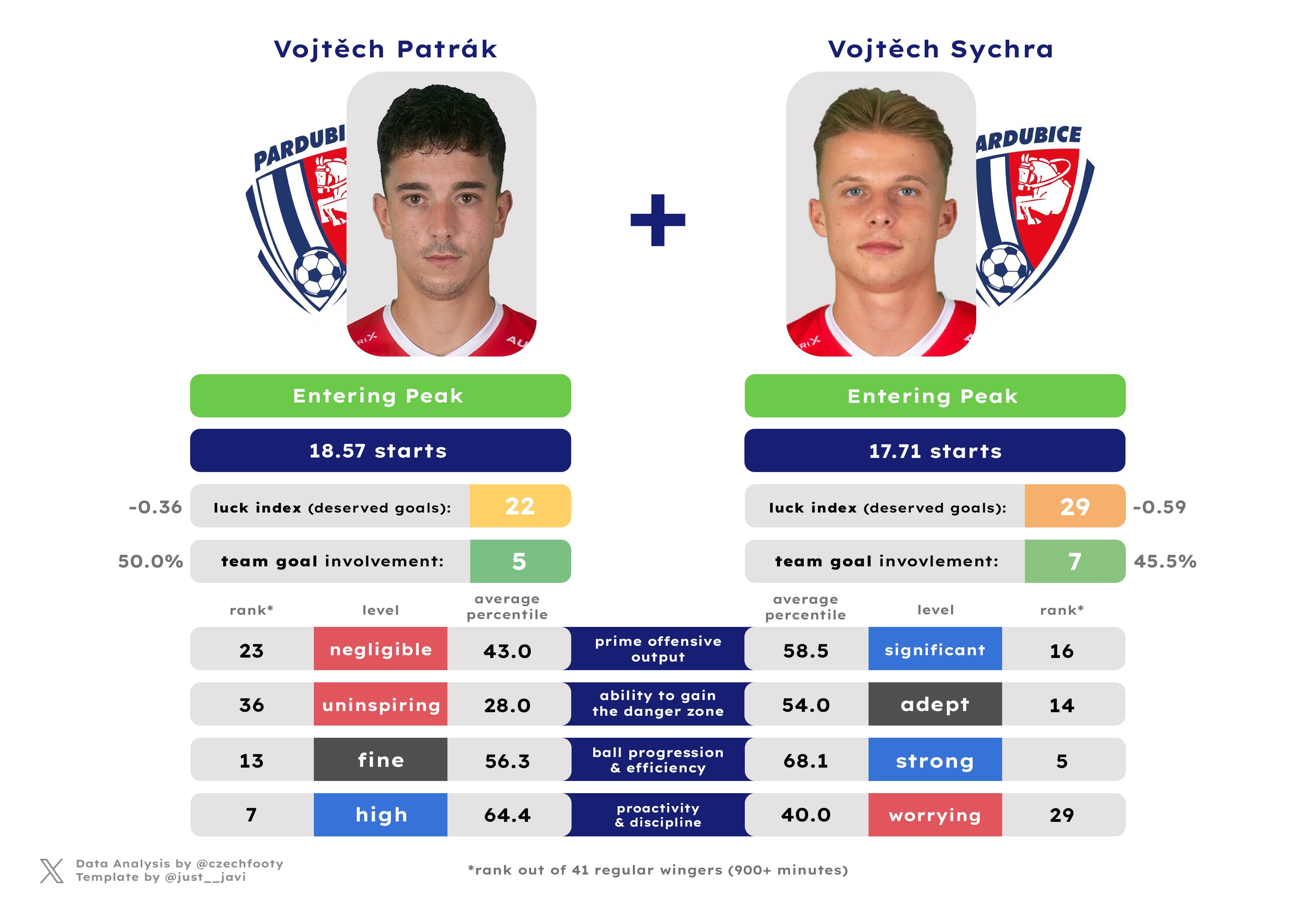
Last summer, I highlighted two namesakes as a key offensive duo taking Pardubice into the post-Hlavatý era. It’s time to check in on them. While there’s a good reason Sigma were all in on Vojtěch Sychra, there’s all the more reason for Pardubice hanging onto him as an integral part of its attacking corps. He still doesn’t have #numberz, but all his three points were vital, and his primary chance-creation rate being equal to that of 11-point Alexis Alégué (0.9 wasted chances set up per game) suggests some bad luck. Landing in the 77.5th percentile for expected assists per 90 without sourcing anything from on set pieces is legit great. As for Vojtěch Patrák, he actually participated on goals scored to a greater degree (precisely 50% involvement), but there’s much less value he brings to the table in terms of gaining the danger zone. Still, if Sychra does that and Patrák is there to finish, they work as a tandem on the opposing sides of the pitch; Patrák was in the 75th percentile for high-danger shots.
As for another key offensive duo, this time the one poised to join forces at the very top of the line-up, it’s also not doomed for automatic failure. Quite the opposite. Both Abdullahi Tanko and Ladislav Krobot possess qualities that stand out and make them useful, as long as one of them isn’t shoved to the side. Tanko enters the box and accelerates play at a fine rate, improving in staying onside and generally making for a more effective nuisance/presence off the ball; Krobot doesn’t press, rather focuses on providing his consistently high-end finish.
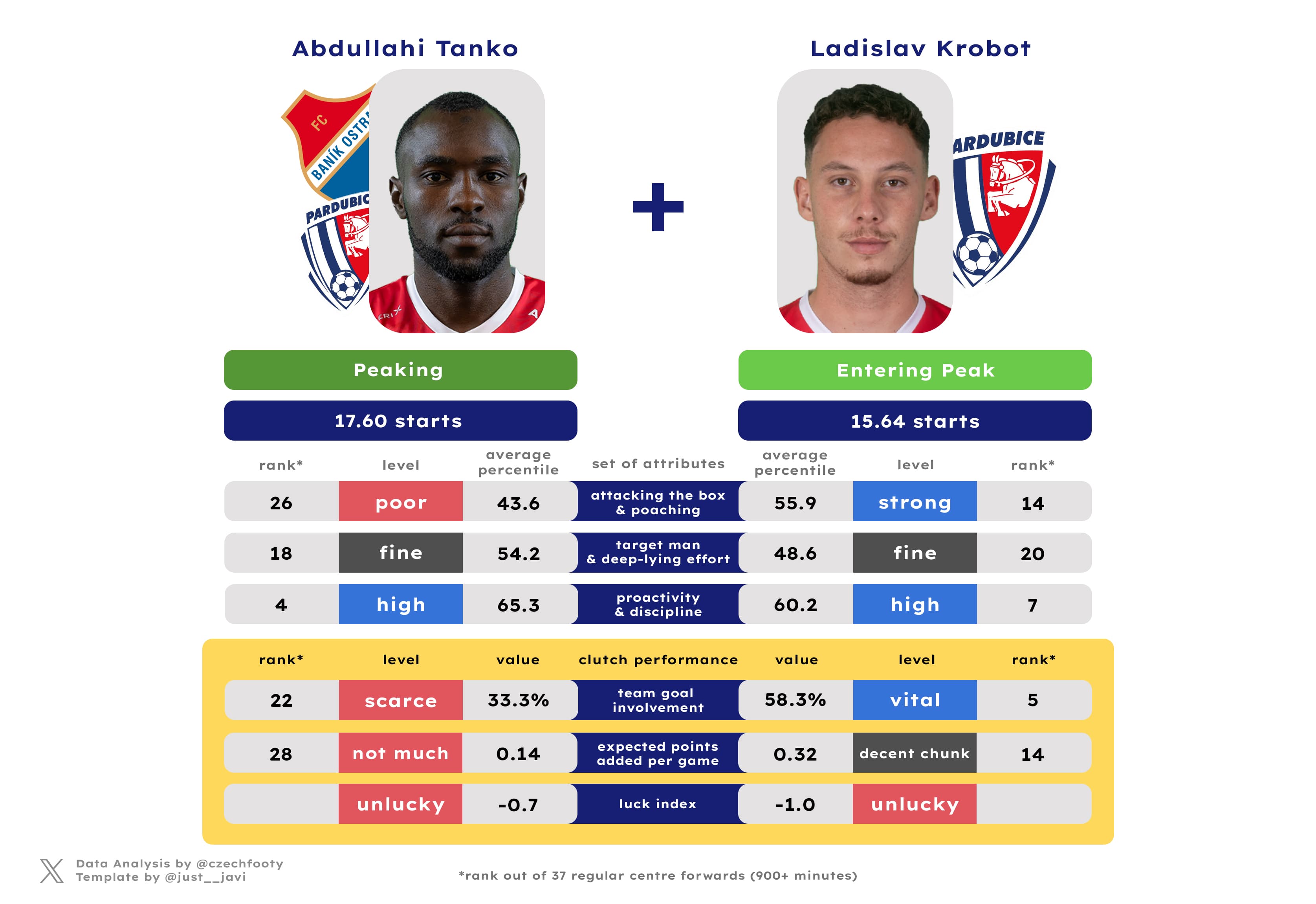
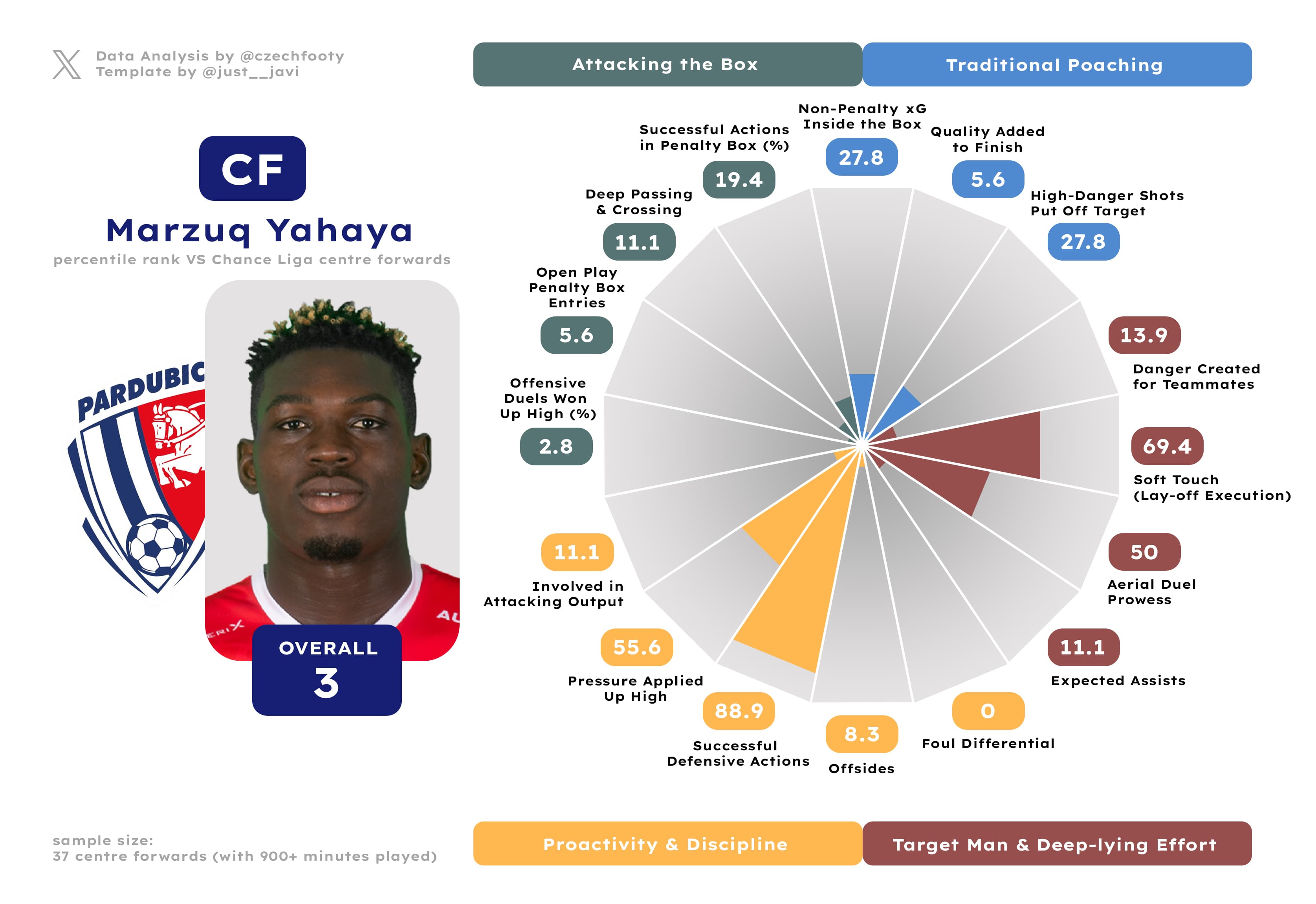
Their presumed rival who once looked like Střihavka’s favourite, Marzuq Yahaya has conversely got a lot of catching up to do. He’s reportedly on a rich contract after not exactly costing peanuts either, so not going anywhere for now, and that means the fans may have to endure some more of his clueless behaviour in the box (average percentile of 14.3 making him the worst of 37 regular centre forwards in “attacking the box & poaching”). His 4/10 aerial duels won inside own box also don’t look great for a man of his size (he does clear balls, though). That being said, with his offside or foul against rate, Yahaya is basically in the same boat Tanko was after 23/24 — and he managed to take a meaningful step forward now.
Finally, let us deal with the elephant in the room: The Undisputed Pardubice No. 1®.
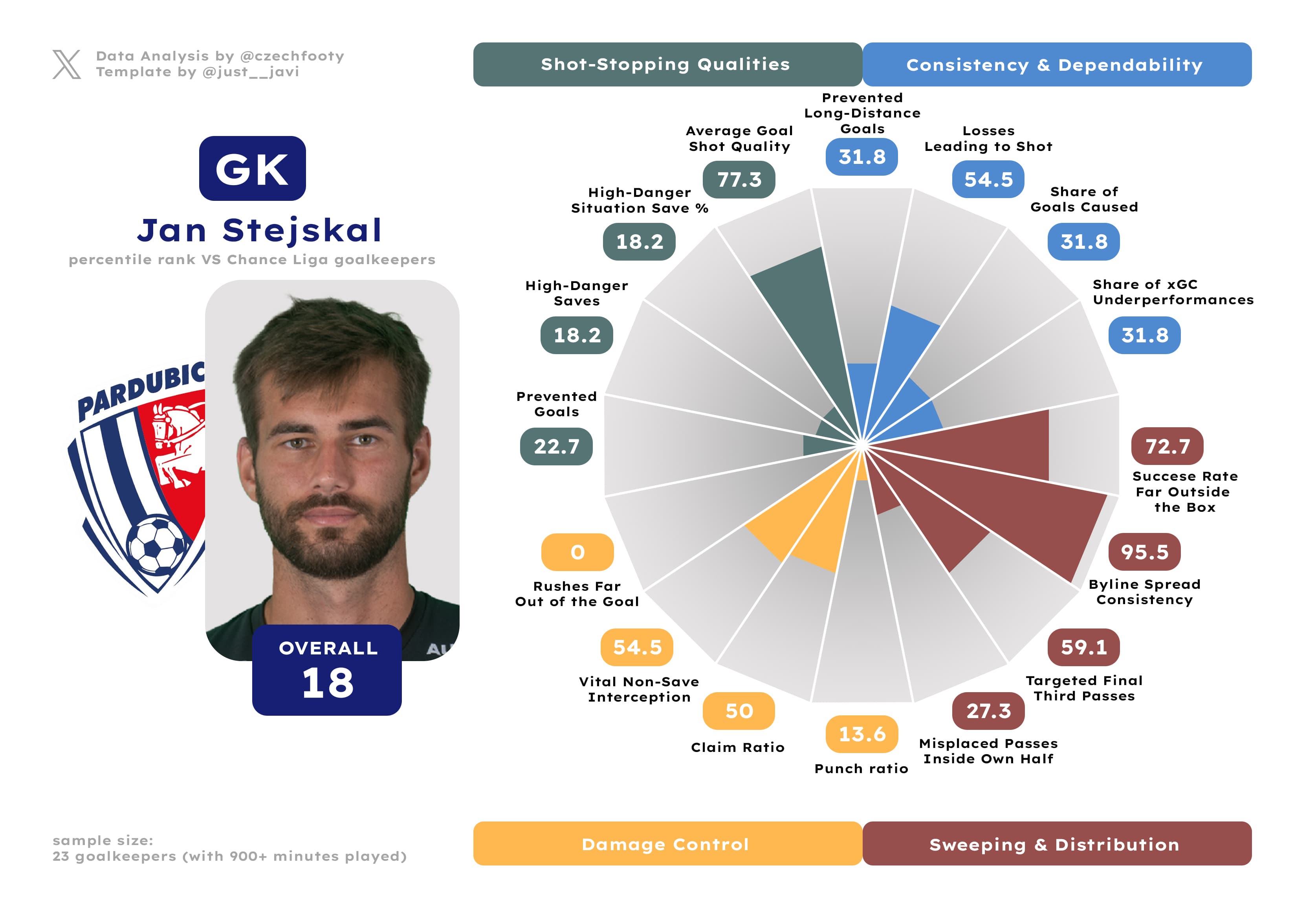
Jan Stejskal isn’t that, and arguably shouldn’t be, though I totally appreciate the sentiment of preferring a player you have under contract to a player you have no control over (certified by Vojtěch Vorel departing). Stejskal is unquestionably a goalkeeper who’s comfortable with his own feet and doesn’t stop anything extra. What makes the discussion fascinating is that Vorel basically constitutes the same package, minus the feet. He was marginally more dependable, a marginally better shot stopper (ranked 14th as opposed to 18th), offered marginally more efficient damage control, but there’s a gulf between him and Stejskal in distribution. If I am Střihavka, I’m leaning towards Stejskal. (But also frantically searching for an upgrade…)
Roster battle to follow
One aspect of football my model cannot accurately capture and Pardubice are banking on heavily going into 25/26 is the natural progression of a maturing player. That is the case of Míšek, as elaborated earlier, and it is also the case of Jan Trédl who was basically thrown to the deep end in early 2025 to swim. Now he’s got more time to get his feet wet, familiarize himself with the teammates etc., so he should be ready to take it up a notch or two.
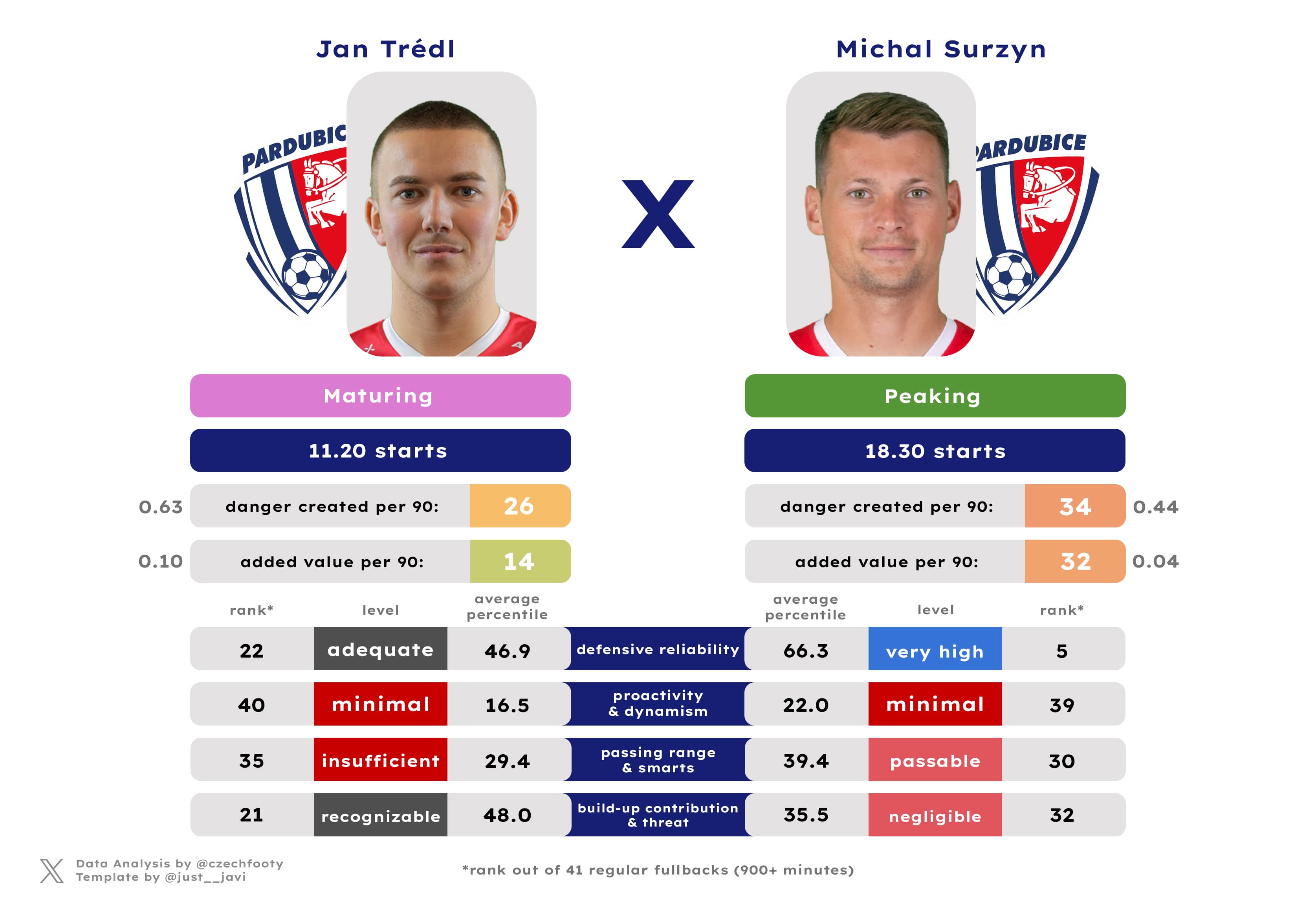
One area where Pardubice will expect more from Trédl, not least in comparison to the noted drag Michal Surzyn, is the build-up contribution & threat posed. As of now, Trédl is an extreme in both non-penalty xG (92nd percentile) and xA (5th percentile), the first rate likely unsustainable over a bigger sample. If Trédl can be a bit more balanced contributor in this sense, and add more than 9 open-play penalty area entries, he can change the game for FKP.
Season forecast
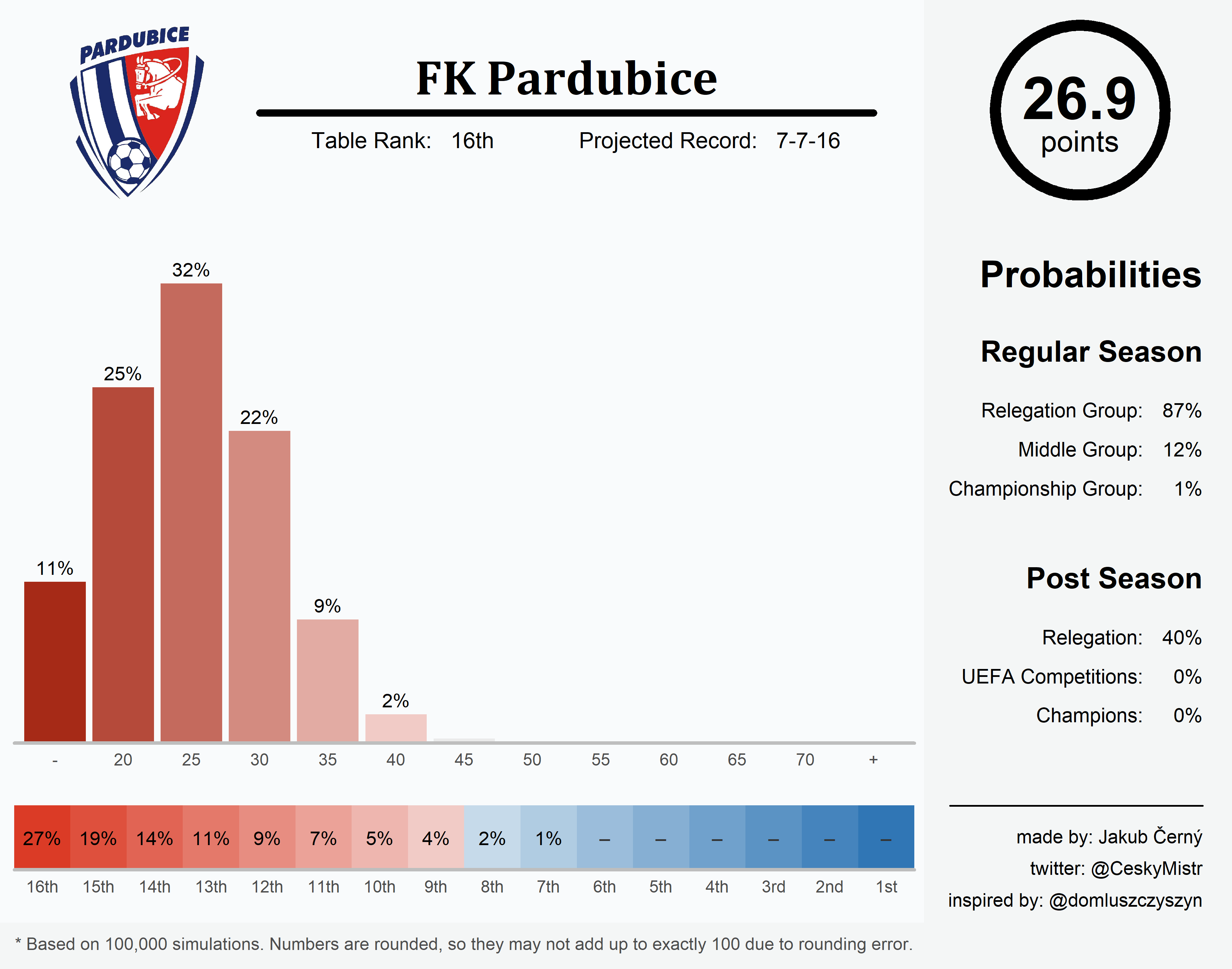
Sometimes, it so happens you only truly appreciate a head coach once he’s gone. Pardubice fans, for my money, should have arguably reached that point by now — with the forecast painting a sad picture. At the start of 22/23, soon before Jiří Krejčí and Jaroslav Novotný were relieved of their duties, FKP were projected to earn 28.2 points. In two incomplete seasons marked by insane squad turnover, Radoslav Kováč took that projection to 32.1 points in summer 2024. Having, give or take, cleared the bar set by the model for the regular season (falling short by 0.2 and 2.3 points, but compensating in the post-season), Kováč was followed by a pair of head coaches who came nowhere close to it — earning 13.1 fewer points.
And so here we are, after Kováč brought the likelihood of direct relegation down from the initial 22% to 14% (insignificant change, but still a positive one), Pardubice are now the main favourites at 40%. Including the chances of taking part in the relegation play-offs, the club was in some sort of a trouble in a whopping 74% of all simulations. It’s most certainly going to be one long season for the club whose chances of landing in the calm middle group waters have developed over the years like this: 15% — 18% — 28% — 12%. Brutal lack of progress.
Bold prediction
The track record: 1/4. Krobot didn’t score all his 24/25 goals before the break
The prediction: Pardubice will have to wait for their first point as long as 24/25 Dynamo
The rationale: It will come as no surprise whatsoever if Pardubice endure one heck of a rough start to the season. In case you’ve missed it, their early schedule reads as follows: Plzeň home, Liberec away, Sparta home, Hradec away, Baník home, Slavia away. That’s six Top 6 candidates filling up your first six rounds. Good luck. It also just happens that an infamously poor team started the most recent campaign with 6 straight losses. České Budějovice finally snapped the skid 7 rounds into the season, and Pardubice will follow the suit against Bohemians in this year’s R7. So, since we can all probably agree that is the first “softer” fixture on the calendar, what’s so bold about this prediction? First of all, even at their lowest point of 24/25, Pardubice waited for a point five matchdays in a row (they only went beyond that, for seven straight games, in those early days of 22/23). Second of all, it’s the specificity of it: if Pardubice skip Bohemians and take their first point even later than Dynamo, the following round, I fail. It must happen at the particular time and place.

Enjoyed the text or the visuals, but don’t care for 🇨🇿 translations and dashboards? No worries, you can still support us by inviting us for a symbolic pint at the old BuyMeACoffeeBeer page.
