Also available in
 Čeština (Czech)
For too long, Teplice fans had been left clinging to false hope of hearing from a new owner. When it finally happened this April, though, it was everything they’d hoped for — and then some. Billionaire Milan Kratina has not only brought smart presence and concrete vision for a refurbished Stínadla or a new training facilities; he’s also kept the previous main sponsor AGC on board, extending the deal for another 9 years with a focus on funding the club’s youth setup above all. If only the squad had matched the ambition off the pitch…
There is so much happening around FK Teplice right now, it’s frankly hard to keep up. The infrastructure, clearly, is of the highest priority — and Kratina’s Accolade has got a lot of expertise to share in this particular area, as a leading company (53rd most valuable Czech one per Česká elita’s 2024 list) in developing industrial infrastructure across Europe.
Next year already, works on a new training centre are supposed to begin; with some parts of the facilities to be made available for A-team’s use by 2027. What the ‘new Stínadla’ — hopefully finished by 2029 — are likely to lose in its capacity (not utilized fully since 1999 anyway), they will gain in presentability. The north stand shall make way for offices, administration space and player facilities; the main stand shall host a brand new VIP section.
Having already vastly improved matchday experience for home fans through the tireless work of Martin Kovařík and his team, discussed among other things in this great episode of Away Days podcast, the time has come for the travelling fans to also have more fun and maybe — just maybe — even enjoy a decent pint of beer somewhere down the line.
Closer to the pitch, coach Zdenko Frťala fully expects this was his team’s last engagement as part of the relegation group, though before this becomes the likeliest prospect, the club should arguably hire at least one scout; or a whole bunch. That is also the goal, as shared on the recent Kudy běží zajíc podcast; ideally closer to a short-term one than a long-term one.
Looking back on 2024/25
What went (particularly) right
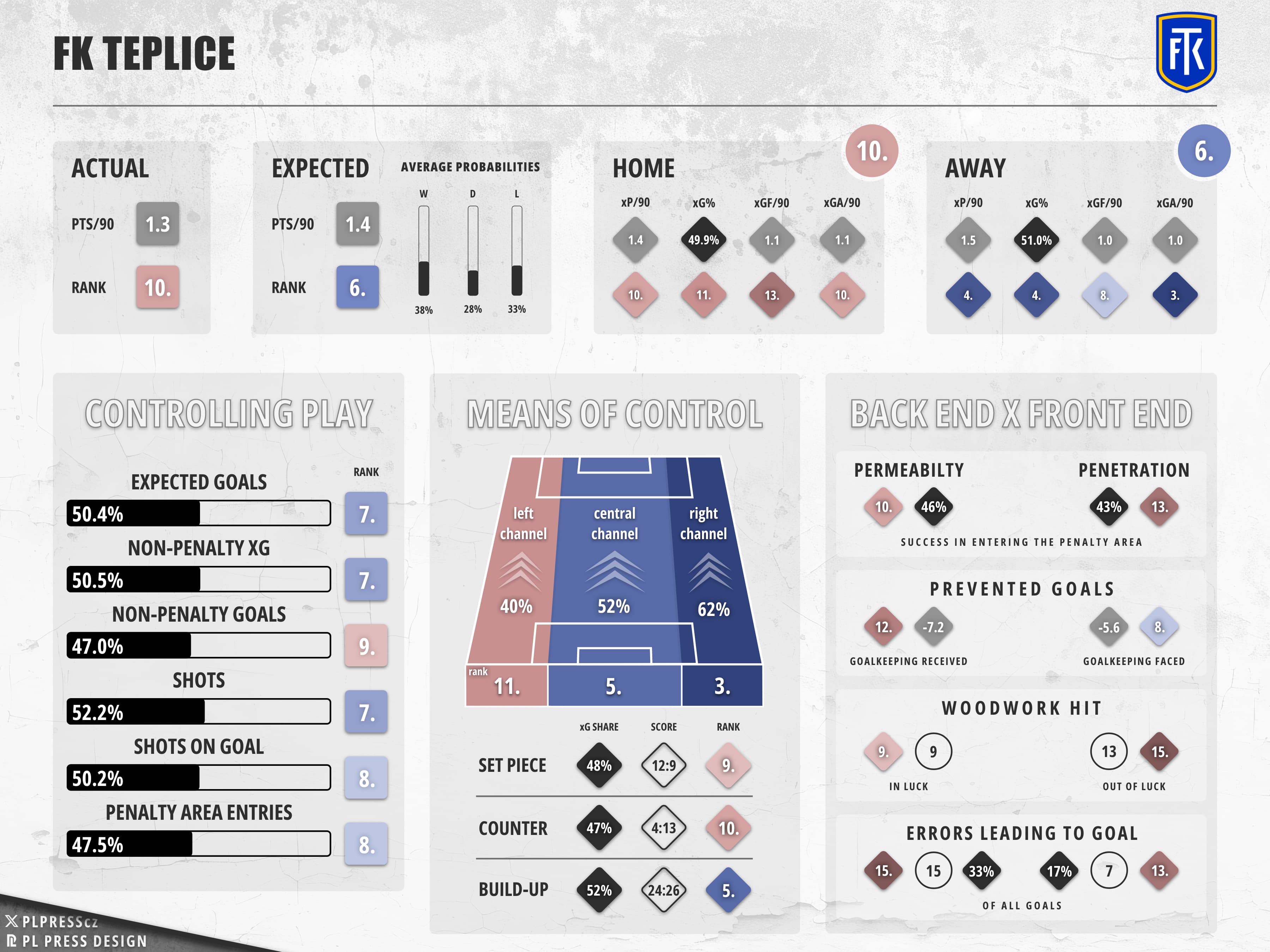
For a team stuck in the bottom six for much of the campaign, including the post-season itself, this is as sterling a team card as it gets. When it comes to controlling play, Teplice were basically Top 8-worthy. When it comes to away form and positional attack xG share, they could’ve even aimed higher. Their xPExpected Points (xP) measure a team's likely point gain from a particular game; not only based on sum xGF and xGA, but also based on distribution of shots (ie. five 0.01 xG shots won't give you the same chance for a win as one 0.05 xG shot). rate is influenced a bit by their dominant showing in the relegation group (average of 1.77 xP/game), but even upon the conclusion of the regular season, Teplice would’ve sat a comfortable 7th had everything played out the way the xG Gods intended. Instead of 41 points, though, they racked up 34; turning 22 positive xG performances out of 35 (the same portion like Baník, by the way) into just 12 wins on the season. Sigma, a championship group participant, found themselves in the green just 12 times, and still celebrated the exact same times. Bohemians were in a similar boat (14 to 10).
What this means, basically, is that Teplice’s season very much continued the way it started — via a 90th-minute disallowed goal due to Trubač’s faulty corner, hardly seen on this level, and the following Spáčil wonder winner at the end of a game where Hradec, prevailing over Teplice in all of the last 5 meetings without conceding, accumulated just 0.24 xGFExpected Goals For (xGF) estimates how many goals a team should have scored based on shot quality, location, and context..
At least this Hradec curse is now gone, through a narrow Round 30 win…
What went (especially) wrong
Well, that… but also this: since the marvelous xP rate away from home didn’t nearly keep up with their actual point gain (15 points from 17 away games instead of twenty-five), Teplice constantly needed to make up a whole lot of ground at Stínadla and decidedly kept failing to do so. Their point pace wasn’t too bad (8th), but the underlying numbers were; fourth least threatening offence per xGF, seventh worst defence per xGAExpected Goals Against (xGA) estimates how many goals a team should have conceded based on shot quality, location, and context.. Accounting for their own backyard, only two teams completed less passes and crosses in/around the attacking box.
What tripped up Teplice even more, arguably, was their careless behaviour at times. They conceded the second most goals from counter-attacks or forced turnovers (13), while their players racked up 15 individual grave errors leading to goals allowed. In terms of proportion of all goals conceded, only Plzeň did worse — and in the case of ‘Skláři’, it was still one third.
Most valuable player (still on board)
Per my MVP model (traditional stats): Michal Bílek (ranked 57th league-wide)
Per my positional models (advanced stats): Jaroslav Harušťák (85th overall percentile at FB)
Per Statsbomb’s On-Ball Value (OBV) metric: Ondřej Kričfaluši
There is no suitable candidate from the full-season servants. Michal Bílek fell off a cliff a little bit after Christmas and Jaroslav Harušťák was, for a considerable amount of time, losing the battle for the starting spot to Albert Labík. Luckily for the club, it had signed two guys in winter — not too valued (and for decent enough reasons) by their previous employers, yet game-changers later for Teplice, making their GAGoals allowed, including penalties average drop by a whopping 0.8 GA/90.
First up, it’s Matouš Trmal. He admittedly wasn’t great for Mladá Boleslav (leaking six soft goals), but he was mostly excellent for Teplice (leaking one such goal). After Richard Ludha and Luděk Němeček combined for 8.98 goals conceded above expectation, Trmal saved an extra 1.23 goals in their place — over a ten-goal swing. While Ludha also likes to come off the line and intercept plays in all sorts of ways, Trmal did so more effectively and reliably for both of his clubs in 24/25; only Zadražil was, on balance, more efficient in damage control.
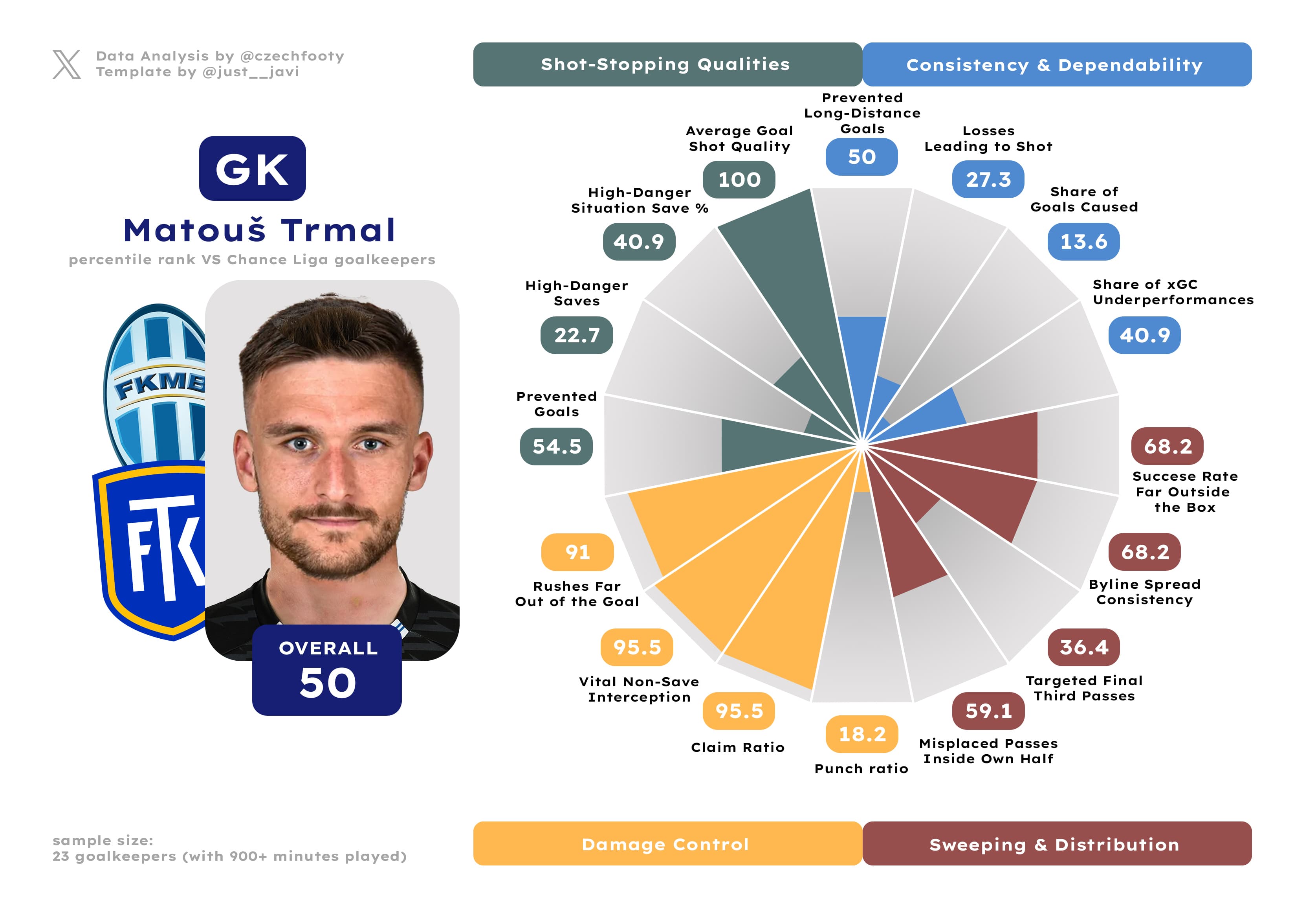
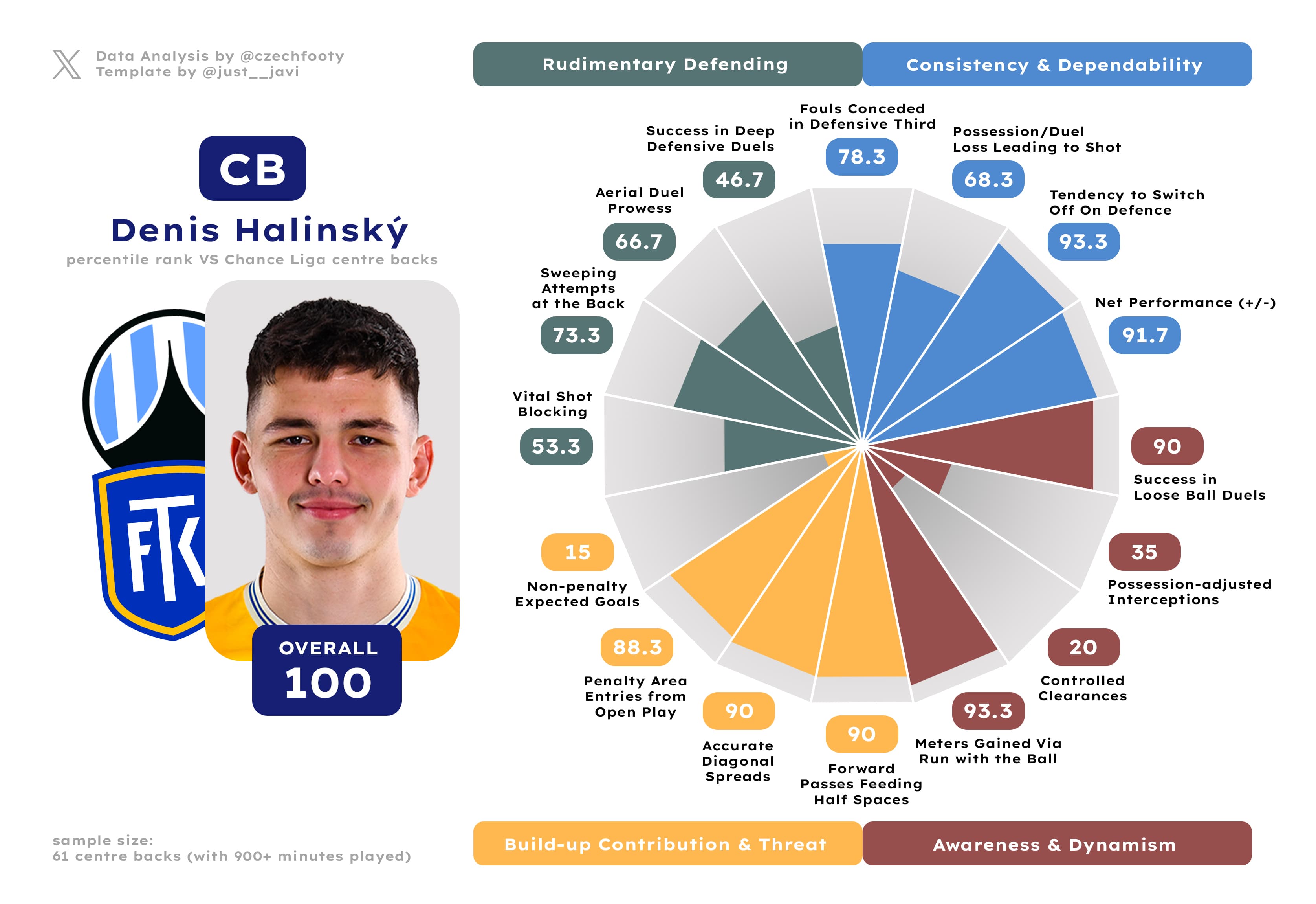
While Trmal’s frequent rushes far out of the goal also had something to do with it, Denis Halinský proved to be a stabilizing force for Teplice’s backline which contributed to the league’s very best xGA average over the last 10 rounds. The wildly differing strength of opposition in the post-season was inarguably a factor, but yes, that means also ahead of Slavia. With Halinský fully healthy for the last six rounds, Teplice’s average xGA read 0.56. Sparta’s best rolling five-game xGA (at any point of the campaign) was, just for reference, 0.63 (following R29). Across any six 24/25 games, Plzeň only barely outdid FKT in R2-7 (0.54).
It’s always tricky to attribute a whole team’s defensive performance to one player, but in this case, it’s hard to not track this improvement back to Halinský. His alertness was always great, and so was his positioning combined with dynamism. Besides, with the Slavia loanee, it’s never just about defence; in terms of build-up contribution and threat posed, only six centre backs grade out better (four of them play on Top 3 teams, the others are Čihák and Králik).
Chip on the shoulder
carried by the player who’s got something to prove — be it to himself, fans or the coach
Teplice are not necessarily used to bigger clubs showing interest in their players.
Now they’ve got two.
Ondřej Kričfaluši aims higher than even the cream of the Czech crop, and that’s neither secret nor surprise given that he’s started landing on various “best among U-21 players in…” lists from CIES Football Observatory. Kričfaluši was always going to be a high-profile draw for foreign clubs; combining height with mobility, game-reading ability and one of the best passing ranges we’ve seen in recent years. There’s interest in him coming out of Italy, and just like with Halinský (whose loan stint could be in imminent danger, actually, given that FKT backed a different Czech FA chairman candidate in the recent election than Slavia and the relationship is now cold as the Arctic), Teplice’s best-case scenario is probably “till winter”.
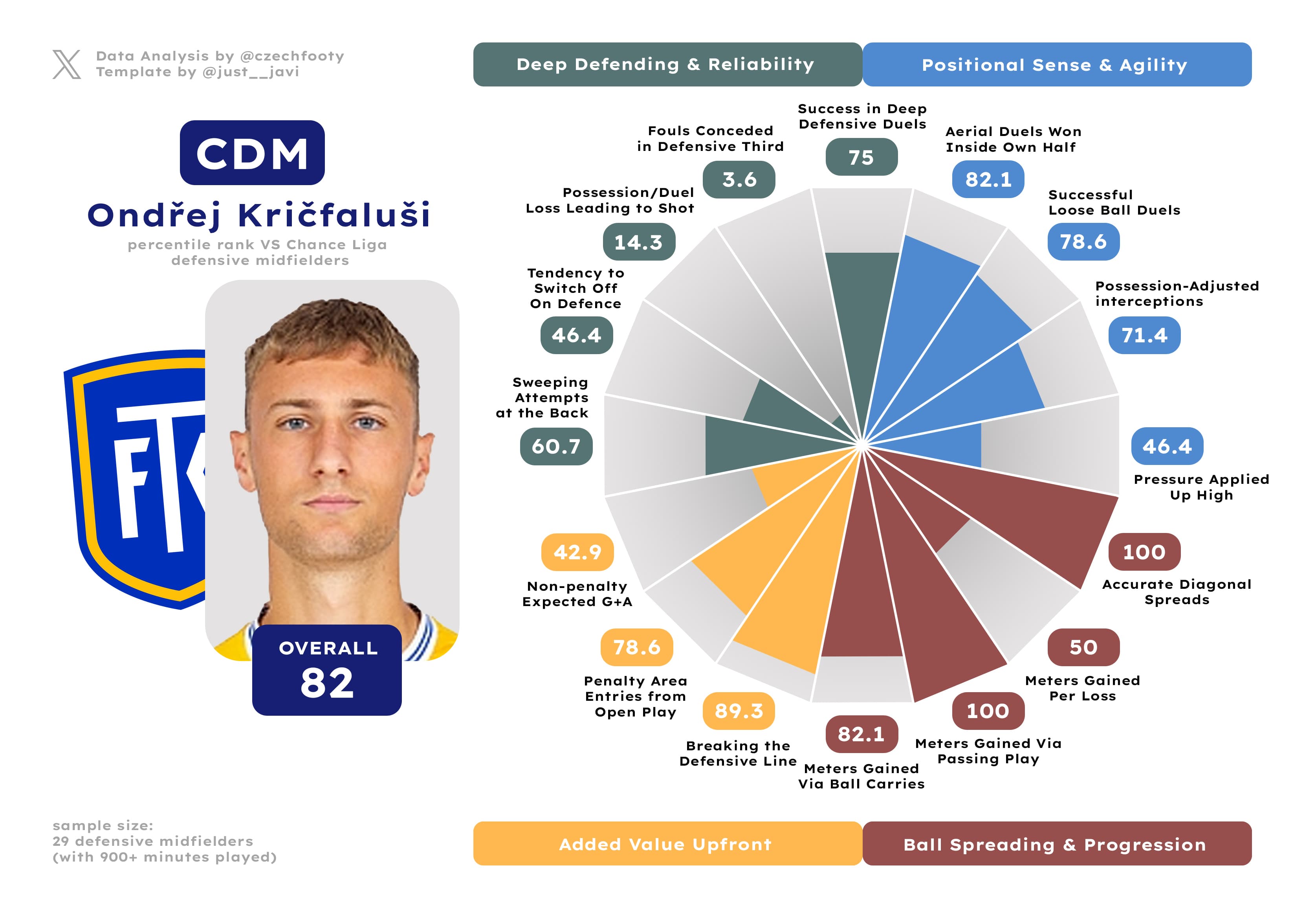
In the case of Daniel Trubač, conversely, Sigma’s interest was certainly real, intense and involved multiple improved bids, but they ultimately turned their attention elsewhere. In the case of Trubač, too, it’s less about earning that transfer after all, and more about rewarding his club for standing the ground. Trubač’s contract actually expires before Kričfaluši’s (next summer), and the fact he wasn’t part of the recent flurry of extensions together with Matěj Radosta and Robert Jukl could be interpreted as a source of some concern. Much like Trubač enduring rare injury struggles in 24/25 and not quite looking like himself in entering the penalty box successfully (down from 63.4 percentile-wise) or deep passing (previously 58.5).
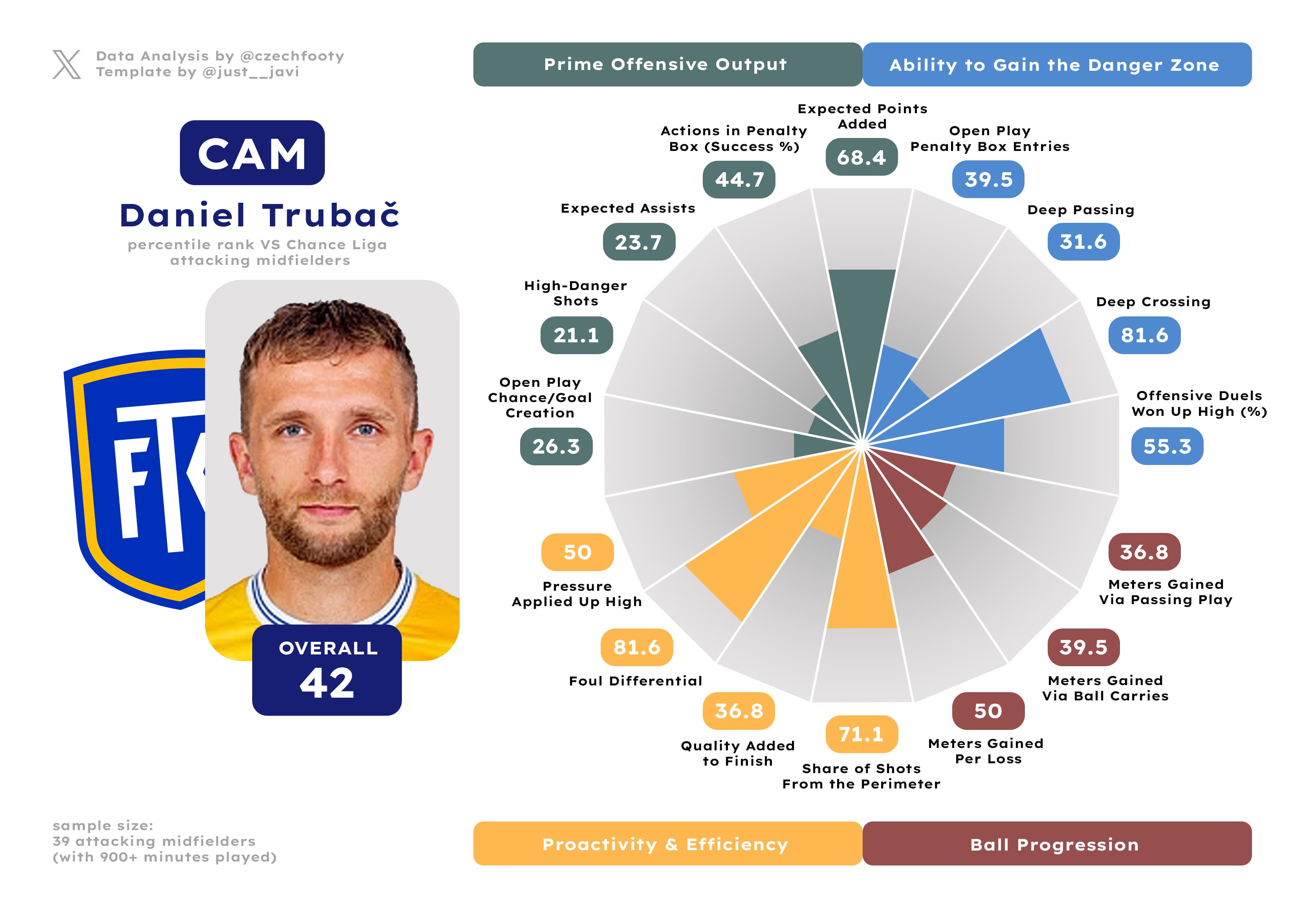
What’s funny is that despite arguably delivering less substance to Teplice now than in his previous campaign (61st overall percentile), the fact Trubač also delivered six goals (five of them vital) instead of four simply shines brighter for the outside world. If all goes well, the long-tenured midfielder should enter Teplice’s Top 10 in appearances midway through the season, and doing the same for goals isn’t out of the question either (needs 7 to separate himself from Jiří Pacenhauer). It would be a fitting farewell indeed, if it comes to it.
Inside the off-season
special thanks for guiding me through the motions of FK Teplice’s off-season go out to @SeveroCzech & @JohnHenry_1984
Squad turnover
Everyone talks about Boleslav, Dukla or Karviná, but Teplice are up there with them in terms of quality and playing time lost from season to season. In their case, it’s less about minutes — after all, Gning and especially Yasser were among the most economical attackers out there, with the latter chipping in to a goal scored every ~100 mins — and more about those sweet points and other valuable contributions. As things stand, Teplice are retaining just over half of their 24/25 goals (51.1%). There’s not much scope for this changing any more dramatically, but if you account for Harušťák not being at Frťala’s disposal for much of 25/26, and potentially also for Kričfaluši getting poached before the transfer window mercifully closes, you are suddenly left without your 1st, 3rd and 4th most prolific chance creators.
Biggest upgrade
This feels unnecessarily difficult. All their headline arrivals did is, at best, limit the bleeding caused by their headline exits. Matyáš Kozák and Matěj Pulkrab up top, Matej Riznič awkwardly doubling as both left back and central midfielder — none of them come close to being upgrades. They’re just flimsy patches slapped over some obvious downgrades. Perhaps if we isolate Filip Horský as a wide-leaning forward and compare him to the incoming Matěj Náprstek… could that somehow count? Náprstek was, of course, let go too easily by Jablonec, severely undervalued by Hradec, and then a big part of the reason why Chrudim pushed Pardubice all the way to the brink in recent relegation play-offs, scoring seven times in the second tier since late March only. Horský, meanwhile, was a much-maligned figure for fans.
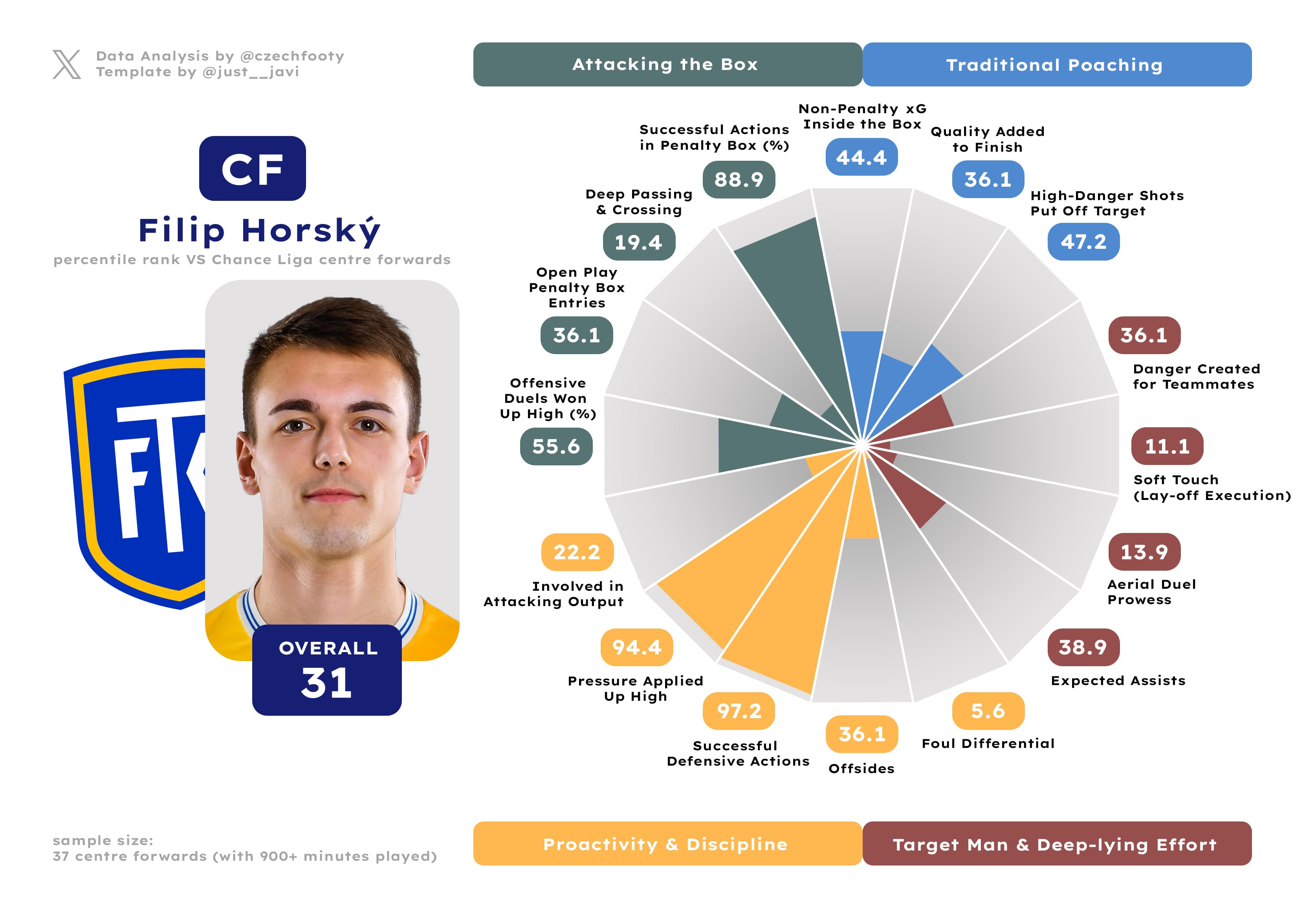
Look, the 22-year-old isn’t useless — he’s consistently popped up in the right spots in the box, and has been a disruptive presence off the ball, recovering 20 balls up high to set up danger 5 times via pressure — but he would’ve been on the sidelines for long anyway, there were stretches of lethargy between those bursts of speed, he’s never worked particularly great with or for teammates, and the minus-26 foul differential in 15.5 starts is scary as hell.
Biggest downgrade
Let’s stay on the matter of the propped up attacking department. We’ve already been over Gning’s near-singular qualities as part of the Karviná preview, but honestly, Mohamed Yasser could make for an even bigger blow. He was obviously massive for Teplice aerially, which none of the arrivals is compensating for, and generally made for a complex presence in/around the attacking box — winning the ground duels to enter or preserve possession, putting enough power behind his shots, not missing the target all that often. It’s hard to cry over this full a package leaving, when his lifestyle (something Frťala himself alluded to) and a vicious cycle of knocks suffered between the individual matchdays meant you could’ve started him in just 11 games; but it’s not hard to recognize Yasser was still immensely useful.
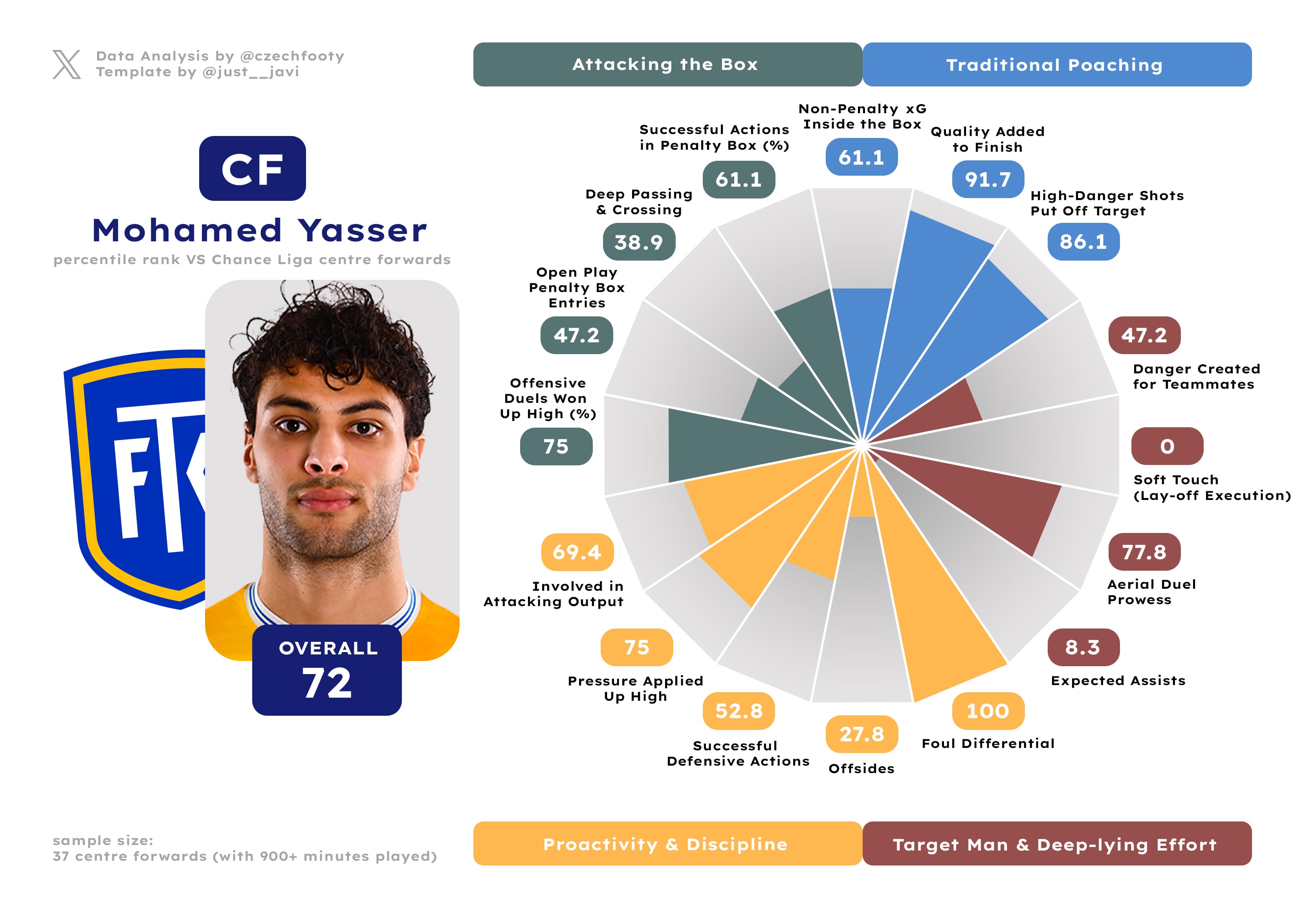
In theory, Pulkrab could at least replace the “fox in the box” set of skills Yasser offers. But going by his 24/25, even that would be a stretch. Pulkrab only produced 8 shots from inside the box in 10.5 starts (averaging the least inside-the-box xG per game) and exactly one penalty area entry. Kozák, for his part, produced 12 such shots in 11.3 starts (averaging the second least inside-the-box xG per game) and succeeded with 6 of his 29 attempted actions inside the box. It’d be hard to put together a more clueless duo of 24/25 box operators.
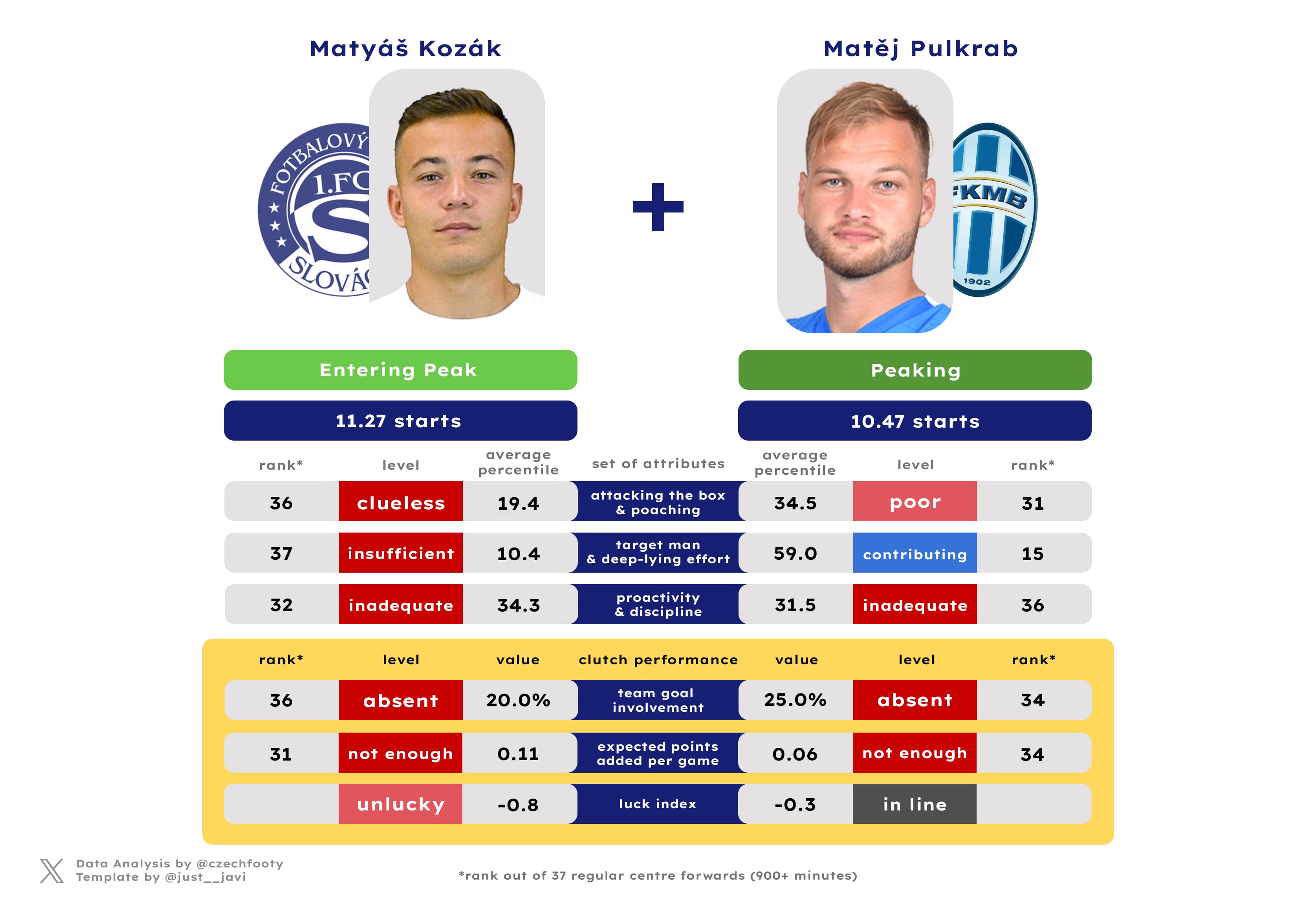
To be fair, Pulkrab does have a track record and a solid pre-season behind him, plus there were areas of his game where the small sample flattered him (e.g. expected assists, goal/chance-creating actions for teammates), but there’s no convenient spin for Kozák.
He’s firmly second-tier quality.
Need left to be addressed
I totally understand Teplice got blindsided by Slavia in losing Albert Labík, but he’s been preparing with Karviná for two and a half weeks already. When Jaroslav Harušťák sadly succumbed to a serious knee injury a week ago, it was becoming clear Teplice’s plan was to just ride with him into the dark. And so the sucker punch was twice as painful. Now there’s literally no one to lean on. Riznič was fine in pre-season, but the league is going to be a different animal for the Slovak second-tier’s left wing import. You don’t want to pull either Švanda or Bílek to their off side, much less the returning Hora, and Laco Krejčí doesn’t have the legs anymore. The situation got so desperate, even right wing Jakub Emmer got the call.
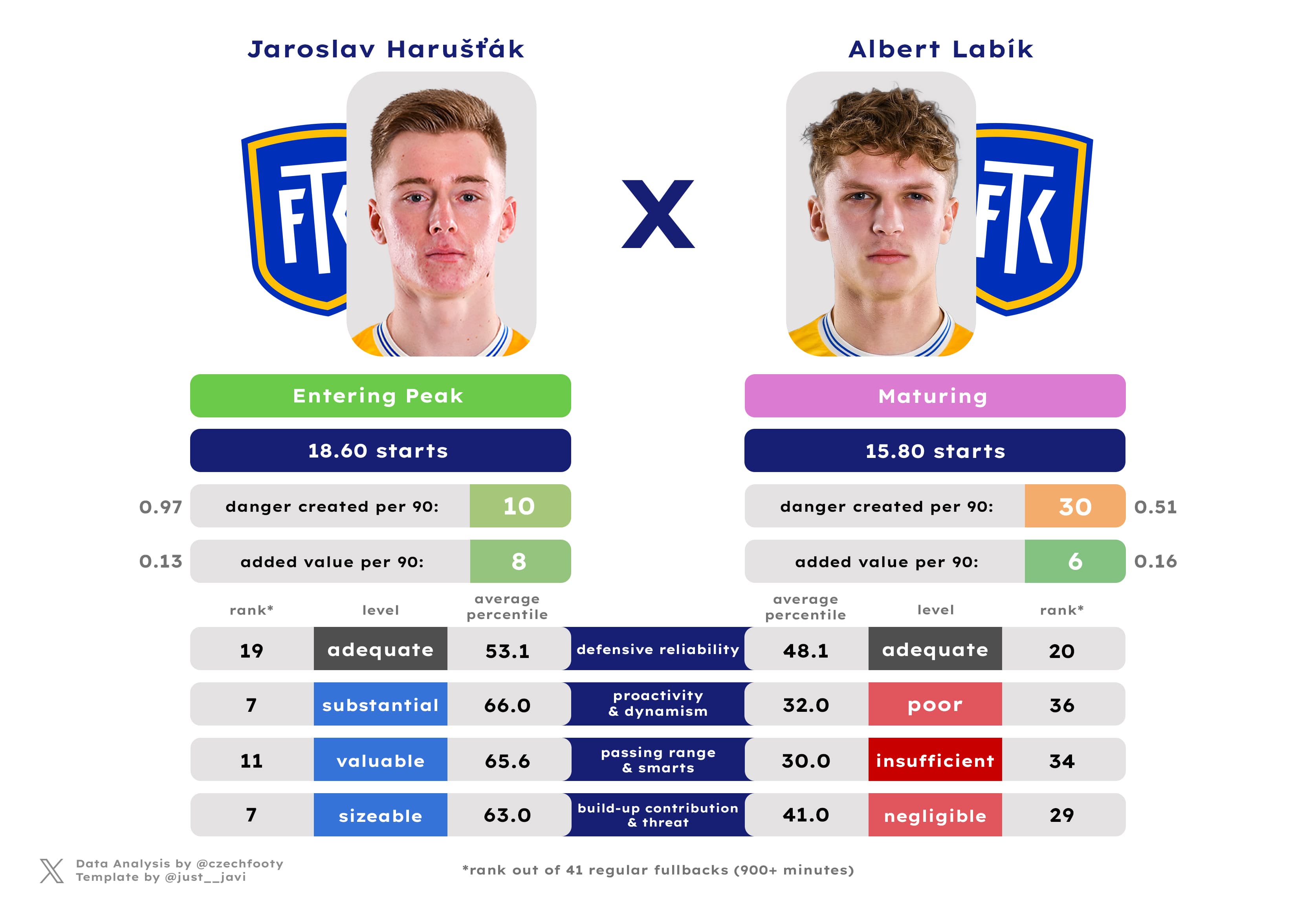
What’s worse: Harušťák wasn’t just missed dearly by Jan Suchopárek at the U-21 Euro or cautiously considered by Baník Ostrava for the activation of a buy-back clause; he was breaking out big time. For a first-year regular on a bottom-six outfit, ranking in the upper half of the fullbacks’ deck for all four sets of metrics is nothing short of amazing. Harušťák is in a company of two Slavia fullbacks, two Sparta ones, and Polidar. This now means more of Krejčí on left-footed set piece duty, and definitely less penalty area cracking done from open play. Harušťák ranked 7th league-wide in this particular metric, ahead of Sláma or Fleišman.
New kid on the block
Many Teplice fans are expecting big things from the wonderfully named Daniel Danihel (b. 2005), who could easily take advantage of Lukáš Mareček’s long term injury (skipped the whole pre-season), but he already sort of broke through last season. Another teen centre back, Nojus Audinis, could edge a bit closer to the first-team, as well, but probably not close enough to warrant his inclusion here. Does John Auta, with his 44-minute cameo in the post-season, still qualify? I’d say he should. He’s the youngest of the three after all (04/2006), and one half of football certainly isn’t enough to fully appreciate his fast, dynamic turns, enhanced by some seriously low centre of gravity. He got tested at left wing back, where he would likely get bullied on the top level, but if Teplice go 4-5-1/3-4-3, he could be a jackpot.
Looking ahead to 2025/26
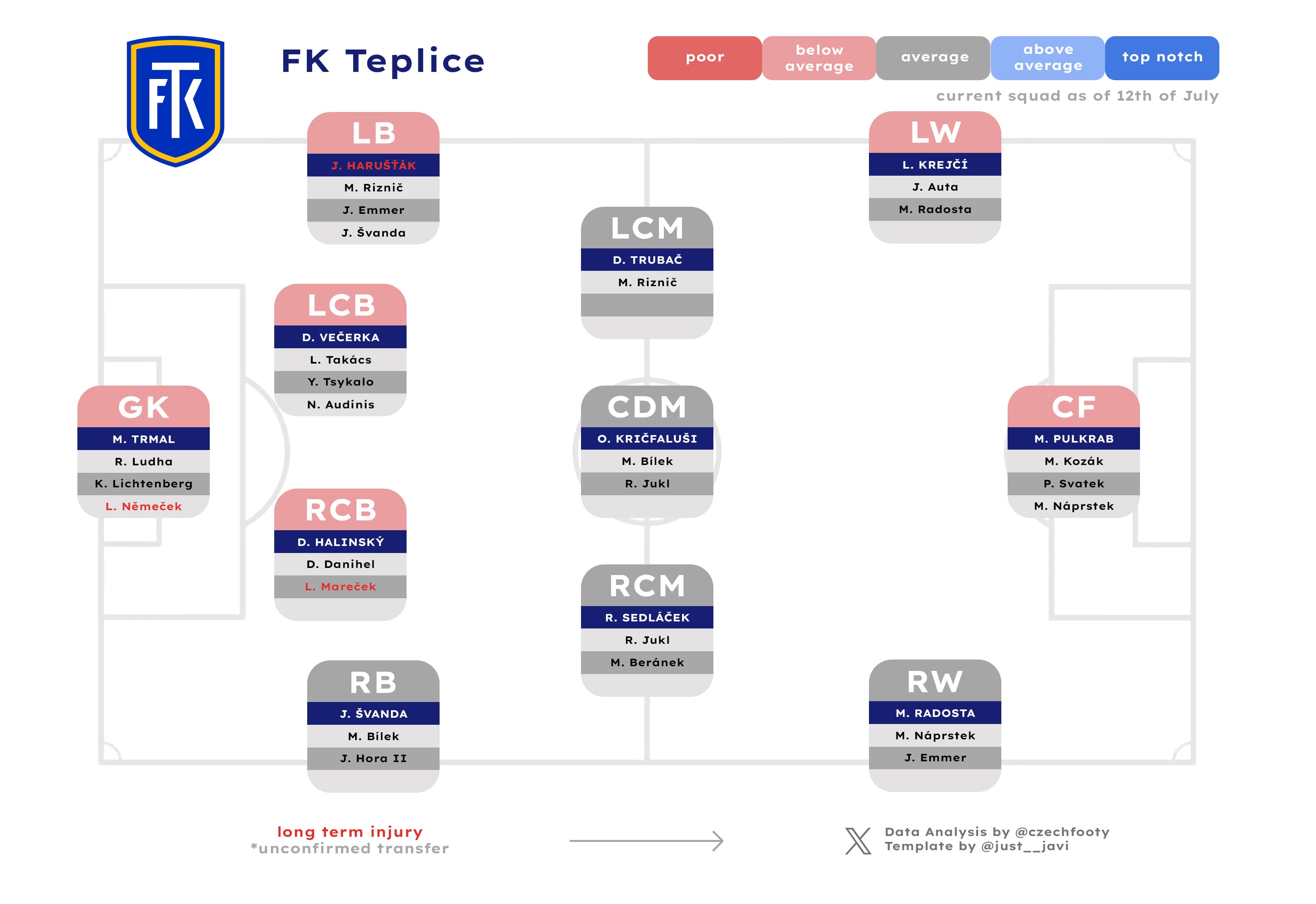
Below is the team’s current(ish) depth chart with a maximum of 4 alternatives for one position. The colourful ratings are a static snapshot of the league-wide situation on 5 July, and they are just a playful bit to add flavour to it; the names featured should be relevant to this day. To learn more about my approach to constructing depth charts, with all its limitations, head here.
Primary formation
It doesn’t exist, almost by design. Frťala likes to flip between various 3ATB3ATB means 3-at-the-back, ie. any formation with three centre backs and wingbacks, or alternatively, five defenders. formations as well as 4-4-2 or 4-5-1, and that shall continue given that the entire pre-season mirrored this kind of chaos. The absence of a traditional left back and the abundance of healthy centre forwards could well see Teplice start in a 3-5-2, with Krejčí benched, right-footed Matěj Radosta switching to the left and Kričfaluši beginning in defence; like in the dress rehearsal, basically.
Notes on the depth chart
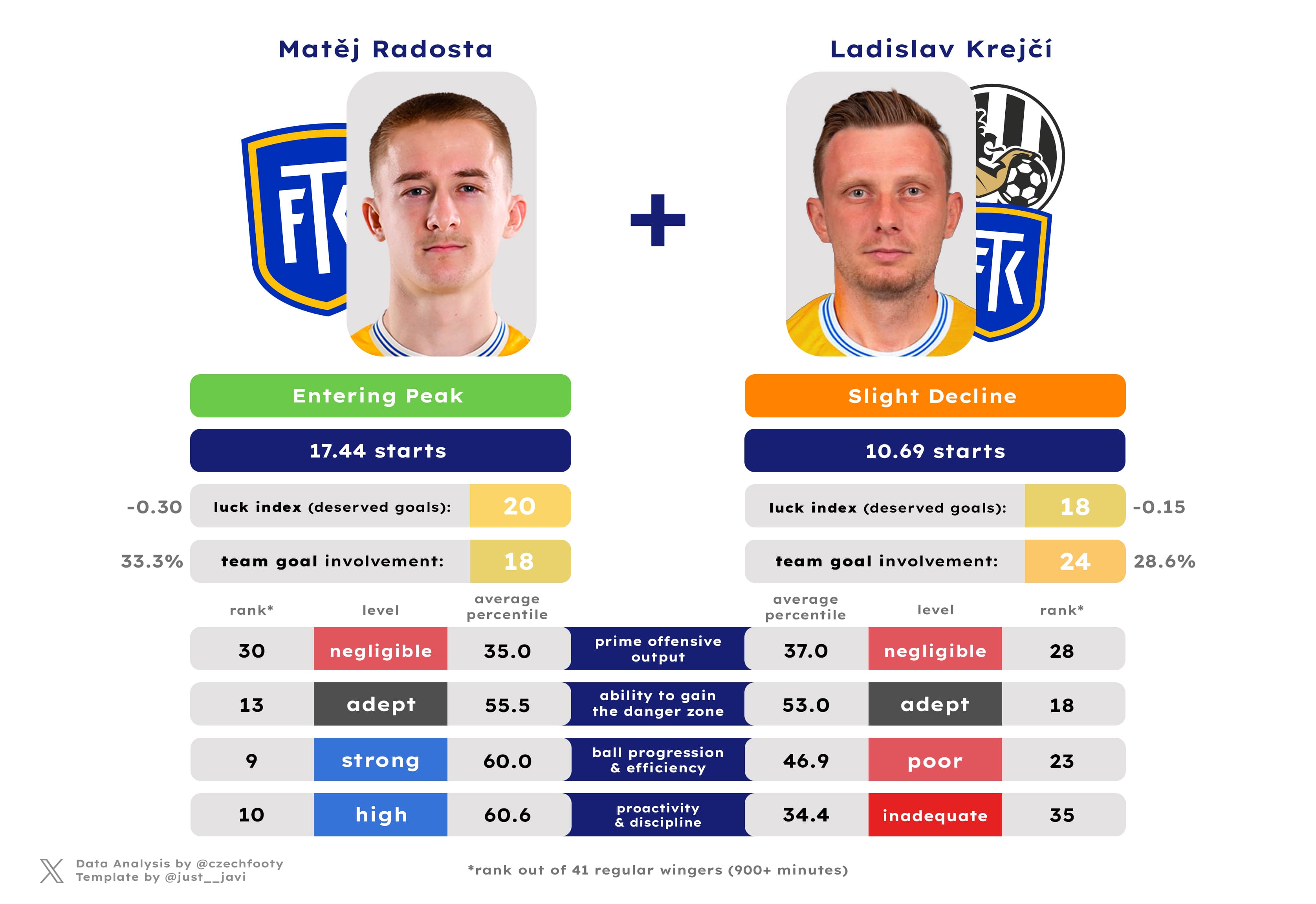
Speaking of Radosta, he took an encouraging step forward last term, effectively unnoticed, and could be the superior pick on that left side regardless of the (forced) situation. While Krejčí might just be postponing his demise, Radosta is still only just entering his peak and gaining on confidence in the final third as one of the better crossers of the ball around.
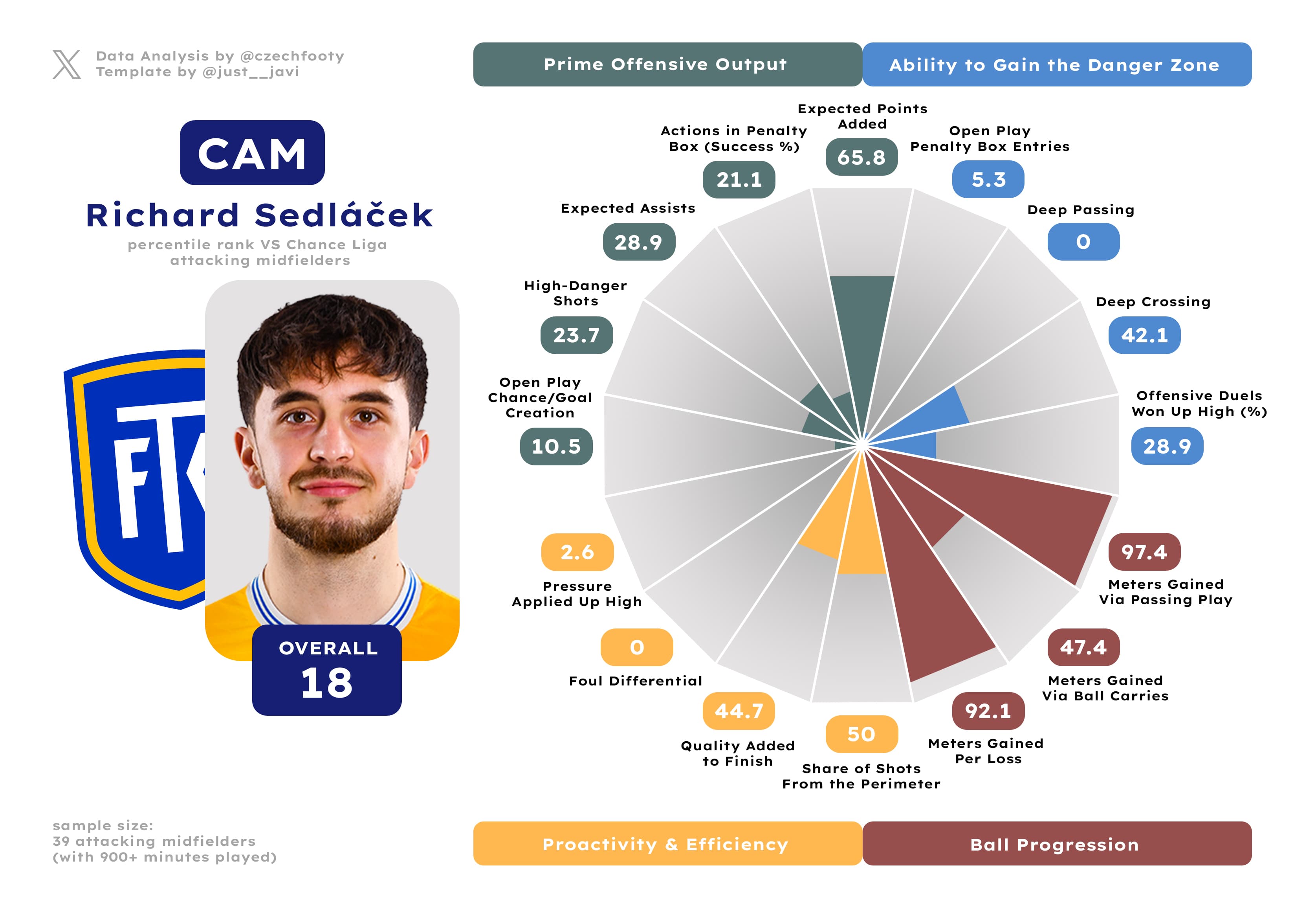
I had to resist showing you Michal Bílek’s pizza chart, because settling on where to place him in terms of the right positional dataset was a massive pain in the ass. Ultimately, I picked the CAM dataset, with Bílek often pushing up either as part of a three-man midfield or from the right wing, but I’m not happy about it. This summer, in a typically twisted fashion, he flicked between centre back and second striker. As you do. So instead, here’s my other 24/25 fav:
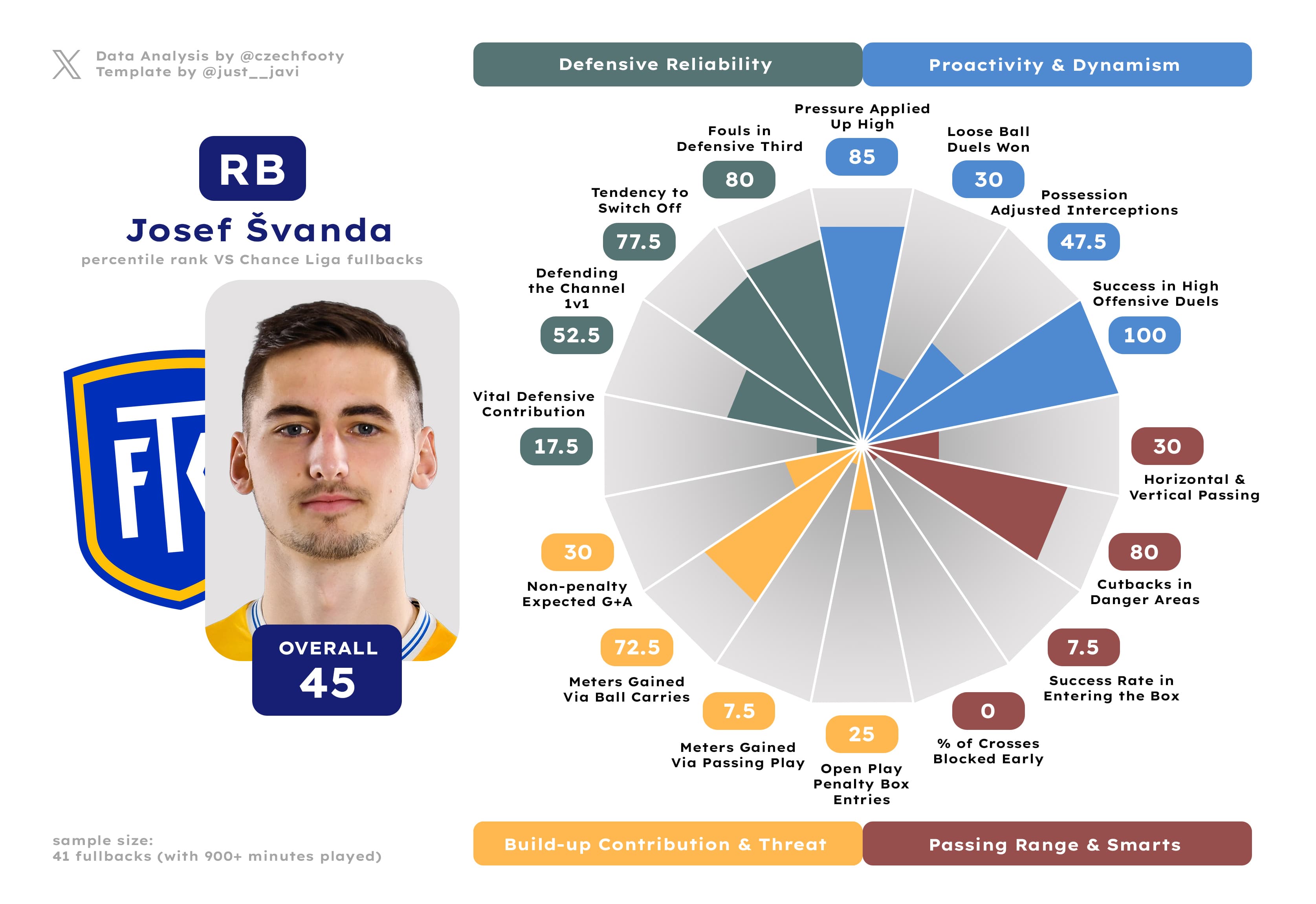
Finally, my favourite fullback to watch. Not the best one; but certainly one of the funnest. Josef Švanda would probably readily get called “non-Czech” these days, as he’s a very high-risk, high-reward type of a fullback we don’t tend to produce en masse. He does all the fancy stuff: beating his man 1-on-1 (possibly better than anyone outside of Diouf; he loves to poke the ball around you), pouncing on loose balls with some incredible flexibility, and operating in cutback areas. He’s one smart cookie, you see, as long as you don’t ask him to cross.
Roster battle to follow
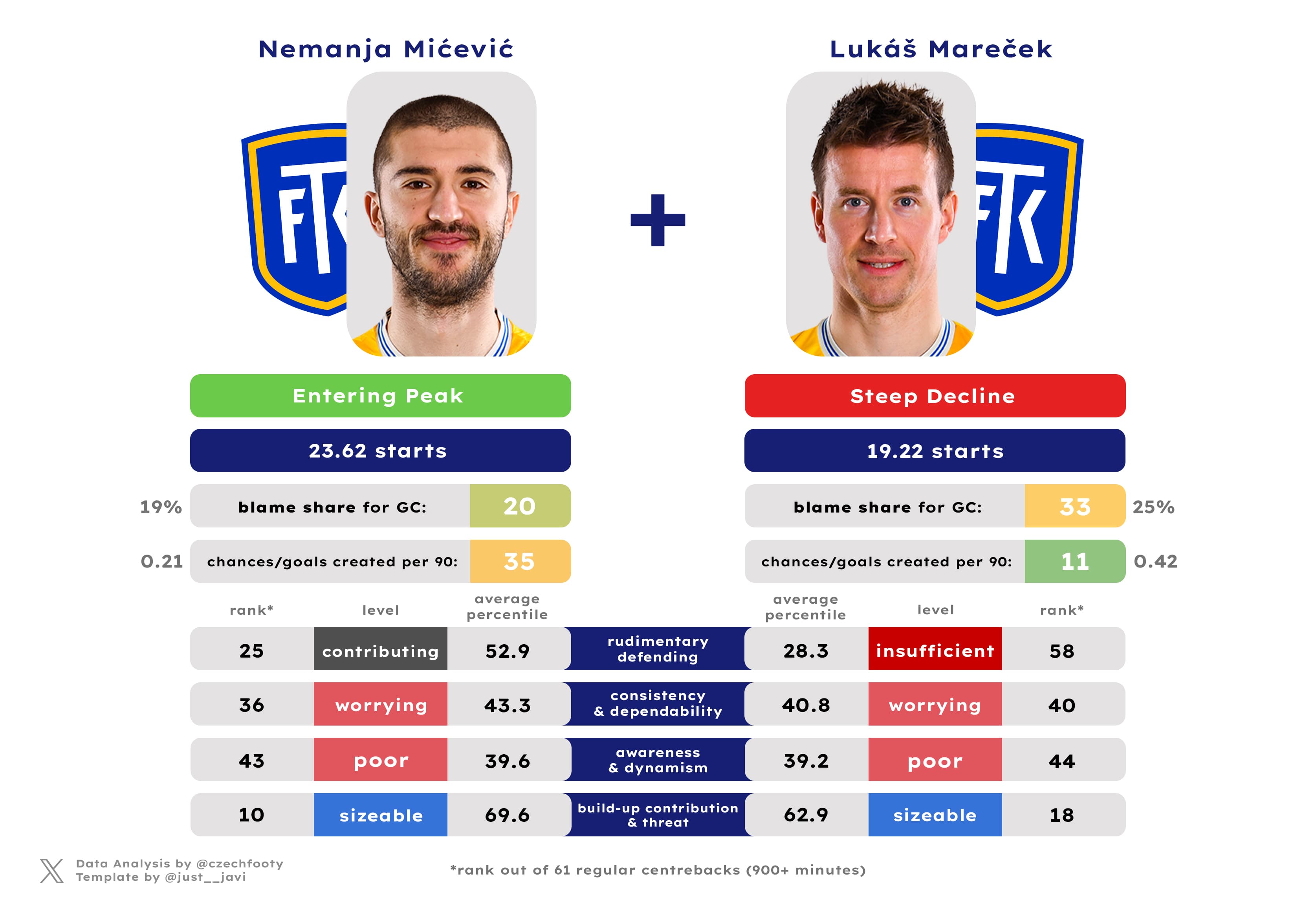
Losing Mićević to free agency and Mareček to constant health issues creates a certain headache, but even more so, opportunity. While the returning Yehor Tsykalo has failed to convince anyone this summer, Dalibor Večerka has probably tightened his grip on the starting XI ahead of Laco Takács. That, in and of itself, is a surprising turn of events. Watching Večerka in the spring I was mostly conflicted, seeing the bad stuff (poor decisions in the box; his active participation on 8 conceded goals, ie. 72.7% of all witnessed first hand) over the good stuff. But clearly, Večerka is a man of extremes. While he’s useless in some areas of the game (mostly having something to do with anticipation, positioning), he grades out as high-end in others (mostly having something to do with 1-on-1 battles).
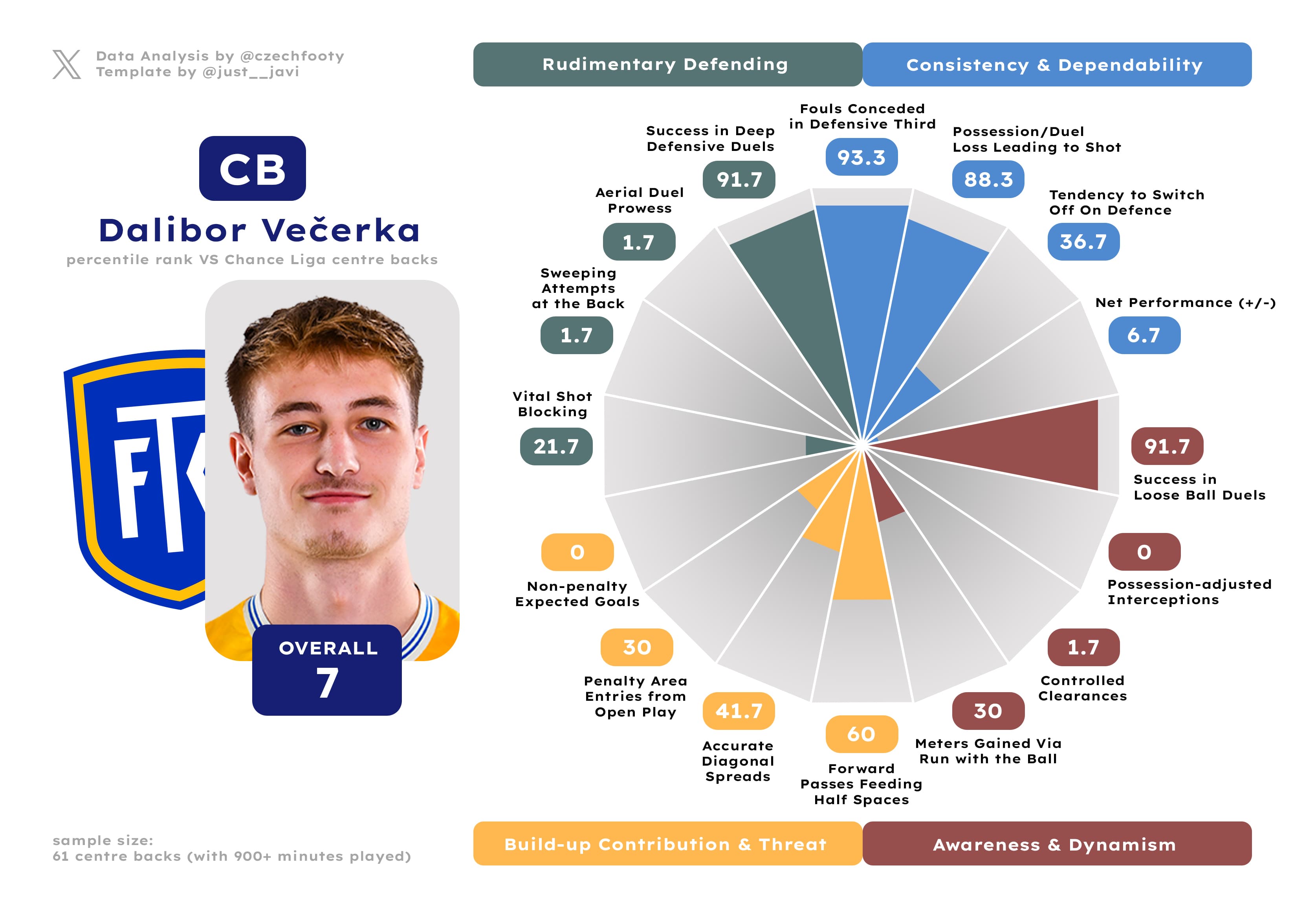
He’ll be a work in progress in 25/26, still, and that’s not what you hope to hear when you’re replacing two proven players and some of the top contributors upfront (which Večerka is not). Mićević was an all-round solid, improving passer, and Mareček is always ready to throw in the odd deep cross. Seeing this, keeping Halinský around becomes even more imperative.
Season forecast
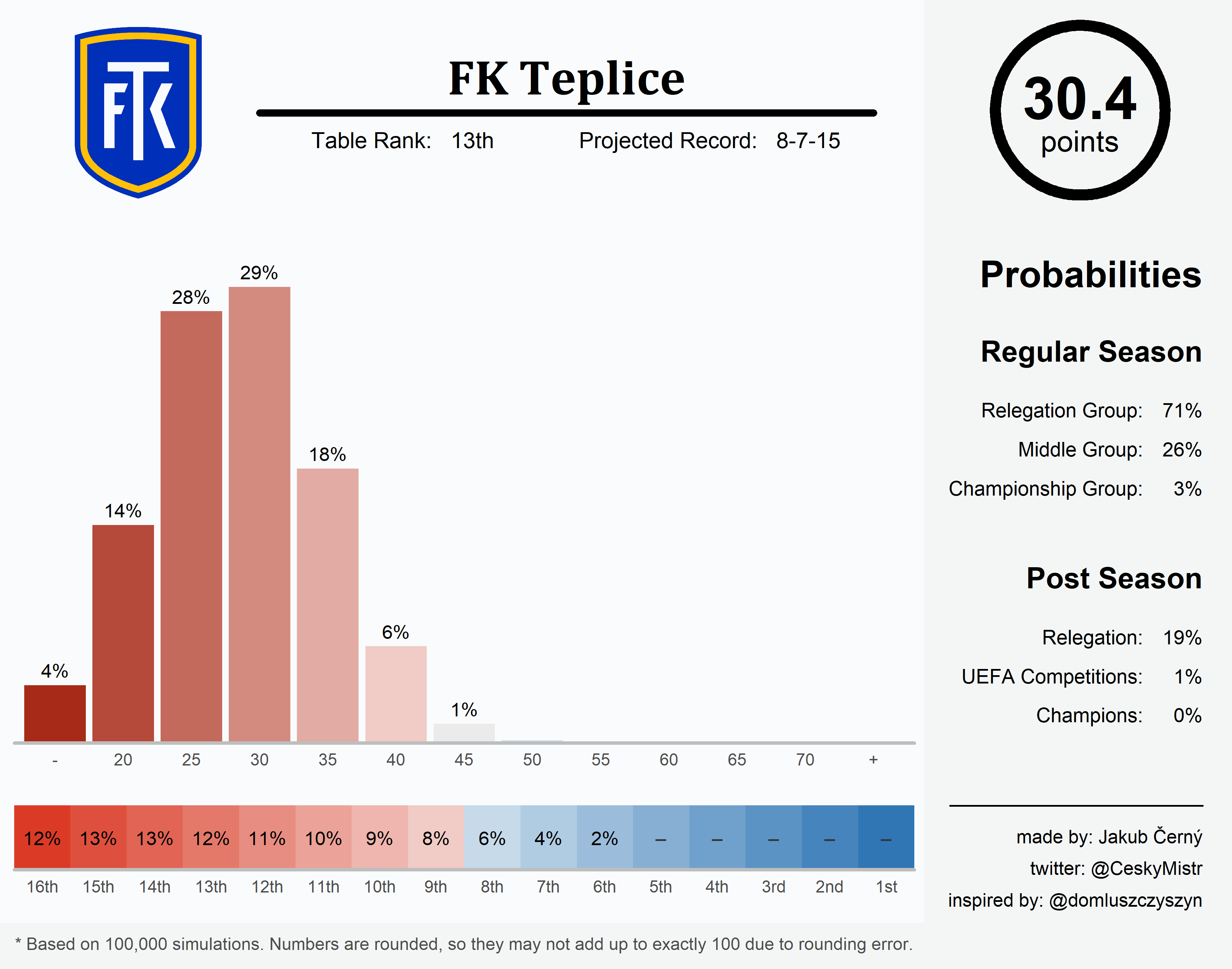
Despite outworking its original regular-season point projection for the third year on the trot (all put together, the model has already been wrong about Teplice by a staggering 19.6 points!), you can actually see a more pessimistic forecast above than a year ago. To be fair, the simulations were run at a time when it wasn’t clear what’s going to happen with Halinský, but even just losing Yasser, Gning, Mićević, Langhamer or Labík without replacing them solidly would’ve been enough to secure nothing more than stagnation. That said, it’s not all doom and gloom for Teplice; they were this model’s overwhelming favourites for direct relegation in 2022 (68%), whereas now there are three bigger suspects. They only have a 26% chance of landing where Frťala wants them to land (in the middle); with the exact same likelihood attached to not avoiding the relegation play-off. So, more of the same for ‘Skláři’?
Bold prediction
The track record: 1/4. Mićević did not earn another unlikely international cap
The prediction: Trmal will still own Teplice’s top ratio of clean sheets by the season’s end
The rationale: As of right now, Matouš Trmal has kept out all shots in a majority of his starts for FK Teplice (6/11), merely conceding five times. That’s obviously impossible to sustain with a further full season under his belt, but I believe there’s enough of a cushion to spend for him to stay atop the club’s leaderboard until summer 2026. What would this entail? Say Trmal features in 30 games for Teplice, allowing for some rotation/health issues/suspension; in that case he would need something like 13 clean sheets to stay aflot (above 46%). That’s OK.
Yet, it’s bold all the same. In the entire Teplice history, the legendary one-club man Jiří Sedláček is the only goalkeeper ever to have gone over 46% twice. Three most recognizable goalkeeping faces of FKT to me personally, Tomáš Grigar (2011/12), Tomáš Poštulka (2004/05) and Libor Macháček (1998/99) have only cleared the 13-shutout bar once each.
Now, is Trmal slated to stand behind the best defence Teplice have ever fielded? Certainly not. But could he be the most purely talented goalkeeper of the aforementioned trio? It’s not a definitive ‘no’, let’s put it that way. Trmal himself had come close to 13 clean sheets twice (10 in 2018/19 as a 20-year-old rookie; 12 the following season) before only just doing it stretched between two clubs last term (7+6 from 31 appearances). After crashing down to earth with a disappointing pair of shutouts in 25 starts for Mladá Boleslav in 2023/24, I wouldn’t bet against Trmal returning to the very pinnacle of his game next season.

Enjoyed the text or the visuals, but don’t care for 🇨🇿 translations and dashboards? No worries, you can still support us by inviting us for a symbolic pint at the old BuyMeACoffeeBeer page.
