
Also available in
 Čeština (Czech)
Amidst a complete top-down overhaul from the owner, sporting director and head coach all the way down to much of the dressing room, Dukla welcomed the year 2026 by losing one more longtime voice on the board (CEO Tomáš Mejzr), having that same new head coach called out publicly by the very same new sporting director (who’d wasted no time in signing a couple more random foreigners) for not introducing any tangible identity, all the while sharing the league’s basement and coming out as the favourite to wrap up the regular season dead last in our winter simulations. Yeah, safe to say, it’s not gone great...
The Outlook
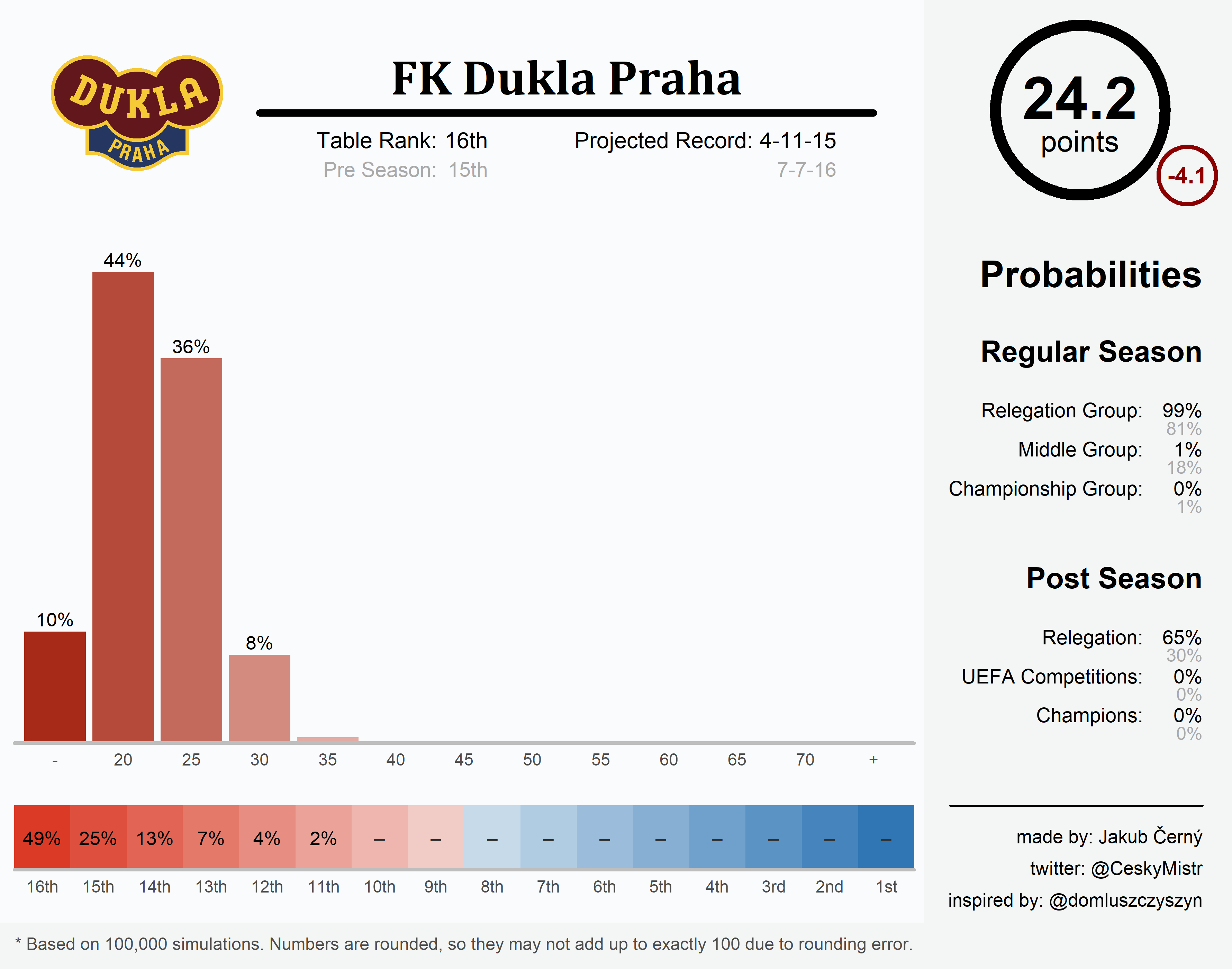
At the start of this very season, Dukla were earning 30+ regular-season points in 40% of all simulations. Now there’s not even a 10% chance of actually achieving it, with Dukla’s projected record dropping from 7-7-16 (in 2024 and 2025) to a staggering 4-11-15. God bless ties, of which Dukla already have 8, because winning is just so hard to come by for this club.
At this point, Dukla are a virtual guarantee to, at best, face another relegation play-off test, which — it bears remembering — they far from aced this past May. And if you are deciding between them and Slovácko who to peg down for direct relegation, looking at what lies ahead for both is a good way to start. Juliska is slated to host four of the current Top 5 teams, while another visiting side is the league’s 7th best road team per points gained (Zlín). That leaves the Pardubice matchup as possibly the only favourable home tie; grim outlook for a club that’s banked over 70% of all their 25/26 points (10 out of 14) in their own backyard. At the end of the day, something’s gotta give. And it might as well be Dukla’s top flight status.
Peak Gain: Plzeň 2:0 (home)
Peak Loss: Teplice 1:3 (home) / Bohemians 0:2 (home)
Toughest Assignments Left: Slavia (H), Sparta (H), Jablonec (H)
Softest Assignments Left: Zlín (H), Pardubice (H), Slovácko (A)
The Big Question
Can Dukla identify enough ways how to get into the box?
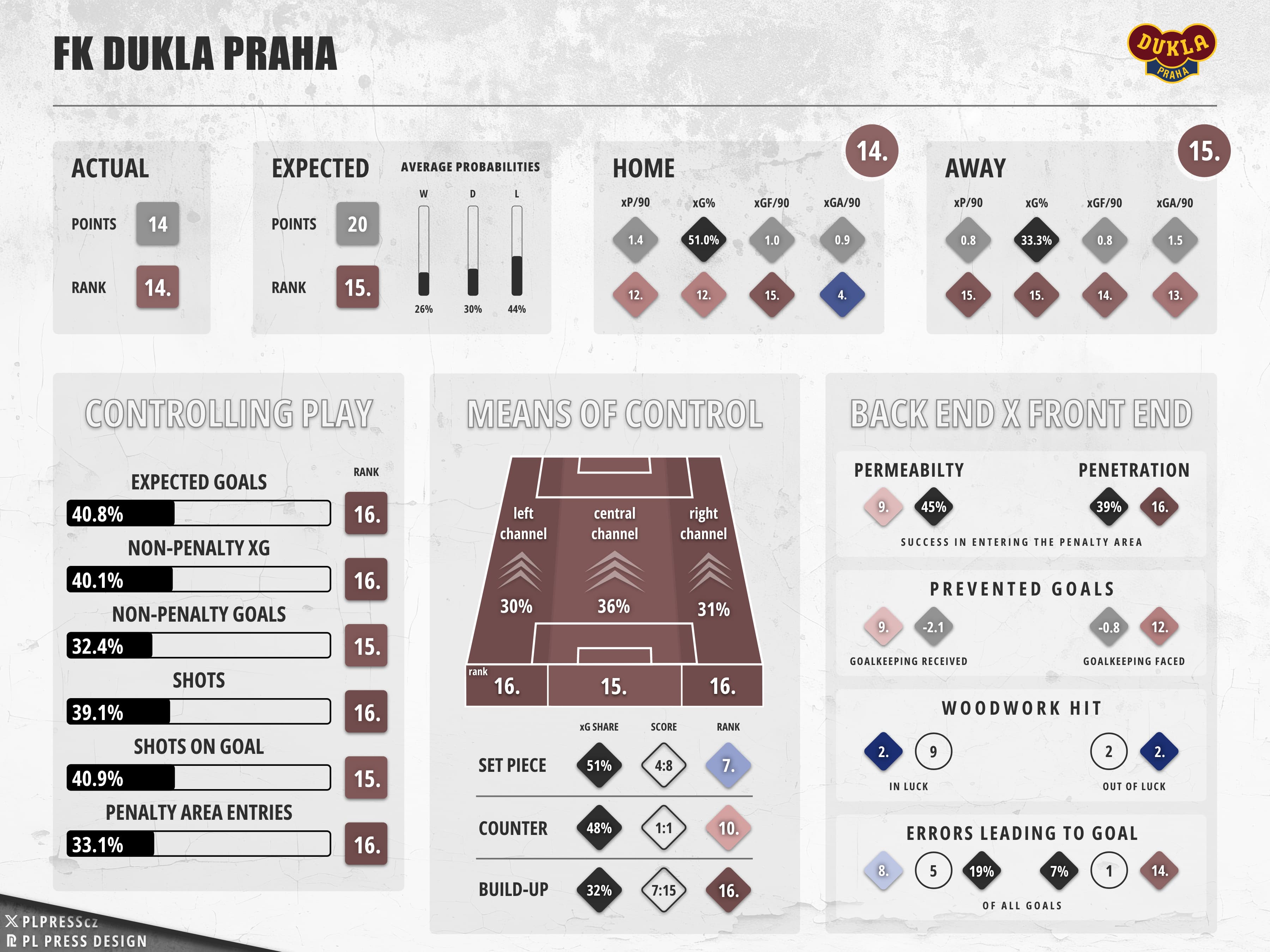
Dukla have underwhelmed on endless counts when it comes to scoring goals. They have delivered 4 second-half goals when good for 7.7 per xGFExpected Goals For (xGF) estimates how many goals a team should have scored based on shot quality, location, and context., their non-penalty set pieces have also fetched 4 goals all the while Dukla holds the 4th best set-piece xGF, and their post-shot xG (xGSExpected Goals Scored (xGS) only takes shots on target into account, including their power and placement on top of xGF.) lags behind their pre-shot one by exactly 3 goals (second-worst mark in the league). But it’s kinda hard to start lamenting any shortcomings in the finishing department before you address the real issue; indeed, it is kinda hard when Dukla’s prime trouble rather overwhelmingly lies in getting into decent shooting positions in the first place.
You see, Martin Hašek wasn’t entirely justified in saying there is “no signature style” and no “clear scheme” to talk about. There is, it’s just almost exclusively limited to the defensive third where Dukla defends well and their build-up looks carefully crafted. And that’s not the “(fun) action” Hašek seems to demand. Once Dukla pass an imaginary line some 30 meters away from their own goal, they look to only know a few open-play options to generate opportunities: the odd creative pass from Marcel Čemák (exactly 6 of them setting up danger), Samuel Isife pummelling through on his own (his dribbles leading to 7 dangerous opportunities, including goals, with the Nigerian serving himself up for a shot a total of 6 times), or Namory Cissé/other centre forward somehow battling for his own life and at least some danger. That was roughly it. Across the entire autumn, Dukla never reached the double digits of wasted goalscoring opportunities on a single matchday, and only once they did so when combined with goals (the famous Plzeň victory). And this is inclusive of set pieces, mind. Slovácko, a clueless outfit in its own right, did so 3 times (and 4 times respectively).
Slightly more advanced metrics back that up, too, and you can see them listed below:
Penalty area entries from open play per game: 6.26 (16th) — second worst value: 7.42
Success rate in entering the penalty box: 38.6% (16th) — second worst value: 40.6%
Touches in the penalty box per game: 11.47 (16th) — second worst value: 14.05
Deep completed passes and crosses per game: 6.53 (16th) — second worst value: 8.63
Proportion of positional attacks finished off: 21.6% (16th) — second worst value: 22.9%
xG generated from positional attacks per game: 0.36 (16th) — second worst value: 0.45
The X-Factor
An increasingly confident play of Tijani, Gaszczyk, Černák
Round 12 and the goalless draw with Jablonec marked a meaningful change in Dukla’s gameplan, and a change for the better at that — even though the 7 points from 8 games don’t necessarily suggest a seismic shift in the right direction after earning the identical amount of points in 11 games prior. But Round 12 was when Samson Tijani, now properly conditioned and ready to rock, re-entered the line-up and started playing 90 minutes week in, week out as the go-to no. 6, and it was also when Pavel Gaszczyk and Michal Černák started to impact Dukla’s campaign for the very first time. The former gradually through initial cameos, the latter through the first of his 6 consecutive appearances in the starting XI. They never really constituted a proper unit as a trio, but altogether they nonetheless symbolize a greater emphasis on smart positioning, fluid rotations and improved behaviour on the ball. Something the likes of Jan Peterka or Matěj Žitný, preferred earlier in 25/26, couldn’t offer.
As if by magic, Dukla’s success in entering the penalty area from open play rose by 5%, while their xGF generated from positional attacks swiftly went from league-worst 0.27 to 0.49 (14th) per game. Instead of seeing only 17.7% of their positional attacks result in a shot (16th), Dukla were suddenly finding a way to finish in 26.4% of cases (ranked 11th over the last 8).
This is by no means a victory lap; even after these incremental strides, Dukla remain deeply flawed offensively, with their attack-minded players still lagging behind much of the league in dynamic qualities on aggregate. But after a long opening period of disjointed performances, it finally felt like there was a foundation worth building on — and it’d be a great shame if another chaotic transfer window forced coach David Holoubek into re-shuffle.
The MVP Race Frontrunners
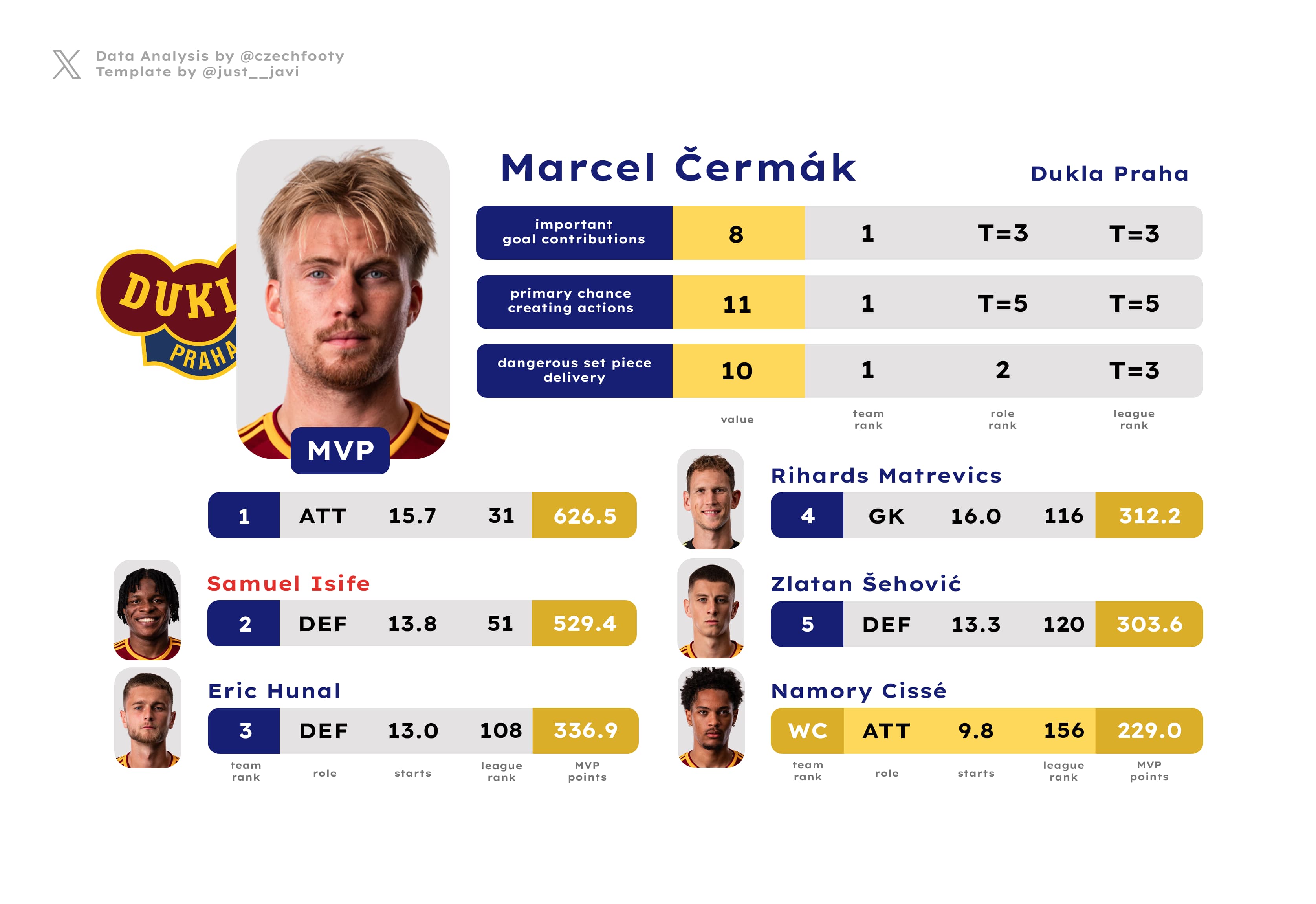
He might have a well-formulated set of weaknesses that ends up underlining Dukla’s shortcomings in the attacking department as a whole, but Marcel Čermák is still someone the club would be significantly worse off without. First victory of the season, the 2:0 Plzeň upset? A game-winning corner kick delivery followed by a clinching penalty. The crucial home scalp of Slovácko? The sole goal facilitated via his neat lay-off. Fetching 6 more important goal contributions and a total of 4.3 expected points through his goals and assists alone, Dukla would undoubtedly be left alone in the basement without the blonde midfielder.
That being said, there are still outside MVP candidates worth a shout. Rookie Eric Hunal has grown into the season and would have landed higher up the leaderboard had it not been for his U-21 injury. He single-handedly kept Dukla in back-to-back games against Sparta and Hradec, and is net positive when it comes to preventing and causing danger. At the opposite end of the pitch, Zlatan Šehović was also lowkey vital to Dukla’s slowly improving efforts, steadily discovering his attacking mojo and pushing Dukla’s awful left-sided xGF into a more acceptable territory in those last 8 rounds we discussed (from 0.05 to 0.16/90). Rihards Matrevics made 4 awful blunders for goals conceded, but his all-action style and 6 solid matchdays that brought him team of the week nominations make him a fellow frontrunner.
The Wild Card
We’ll see what the arrivals of two more attackers mean for his standing in the pecking order, but Namory Cissé ideally shouldn’t disappear from the fields (as opposed to Fokam, Diallo or Jedlička who bring next to nothing to the table). The production is evidently lacking (1+0+1 in almost 10 full starts), and that is of some concern, but the Austrian has been an important cog below the penalty area, registering the second most deep completions on team (12) and showing a good mix of self-sufficiency and teamwork in navigating a number of duels.
The Shake-Up
While the return of one lost son in Kevin-Prince Milla should be a good thing for Dukla, as he did very well in staying involved and facilitating plays for his teammates in his 24/25 mini-breakout, the fact Samuel Isife won’t be returning after all could be a slight blessing in disguise. That’s because for all the excitement his style brings on the ball, there’s the element of defensive unpredictability that wasn’t benefitting the team much. Dukla leaked league-worst 0.32 xGAExpected Goals Against (xGA) estimates how many goals a team should have conceded based on shot quality, location, and context. a game down the right side, and while the blame obviously doesn’t fall squarely on Isife’s shoulders, Bruno Unušić is not without a shot at improving the position.
The role of Tomáš Pekhart on the team is one to be closely monitored as well. If he’s coming to mostly just mentor the young side, I’d be at peace with the move. But if he’s coming to improve his standing in the Club of League Scorers, akin to Řezníček in 2024 (who wasn’t yet in), Dukla may be worse off. They desperately need proactive attackers who get them into the penalty area and ideally improve the team’s league-worst rate of balls recovered in the final third (9.4/90), not the static type Pekhart embodied even at his peak, some half a decade ago.
Enjoyed the text or the visuals, but don’t care for 🇨🇿 translations and dashboards? No worries, you can still support us by inviting us for a symbolic pint at the old BuyMeACoffeeBeer page.
