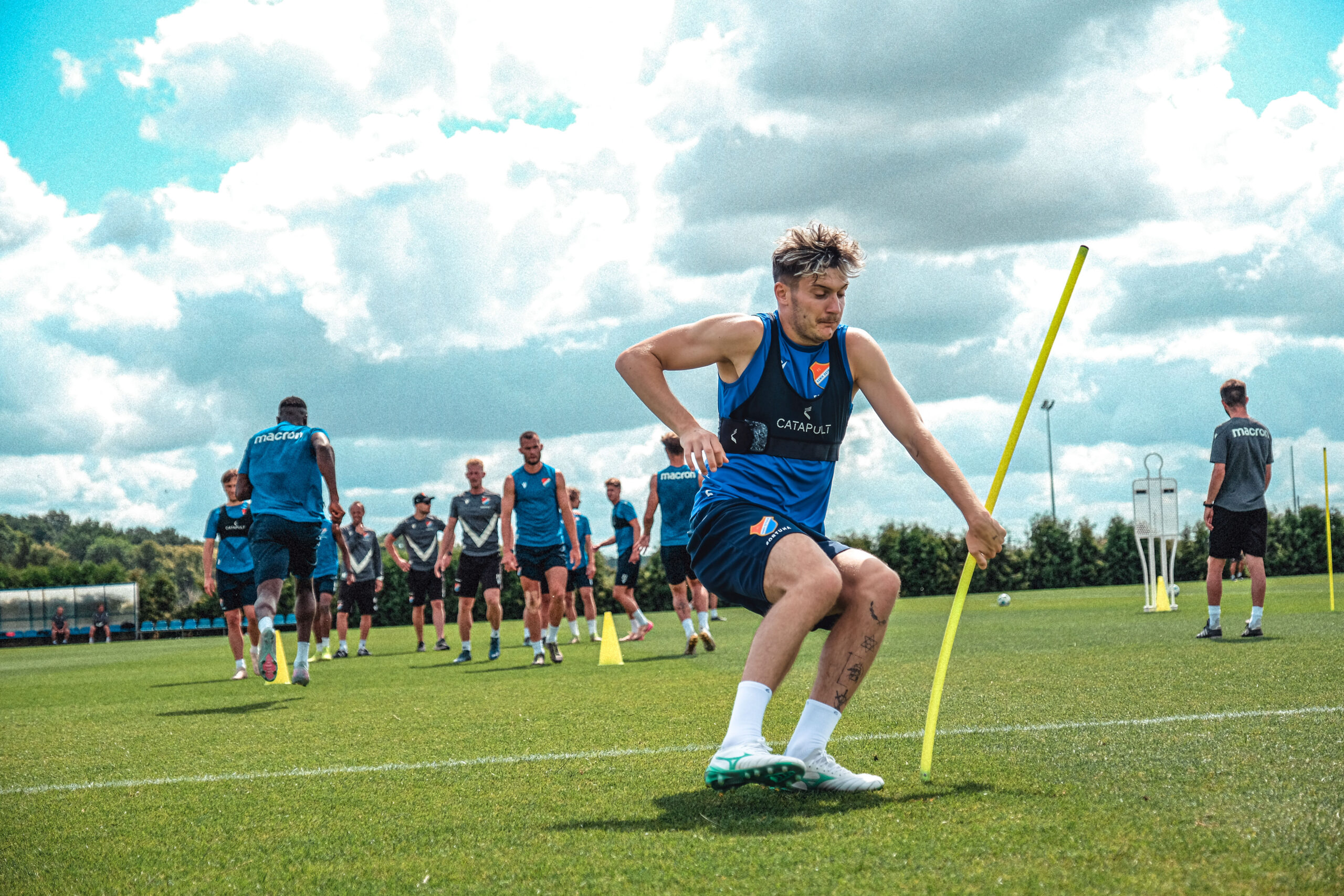
The word “vibes” is growing in popularity even among the Czech-speaking younger generation, and FC Baník Ostrava of 2023-25 could easily demonstrate what it means. On the face of it, the club just rattled off two Top 4 finishes, both remarkable in their own right — the first one marked a delayed return to UEFA competitions, breaking the glass ceiling of sorts, while the second one meant a suitable follow-up via a jump by one place and a whole lot of points. But the vibes… boy, the vibes were different. Where 2023/24 was an uneasy step in the right direction, 2024/25 was a confident statement of belonging.
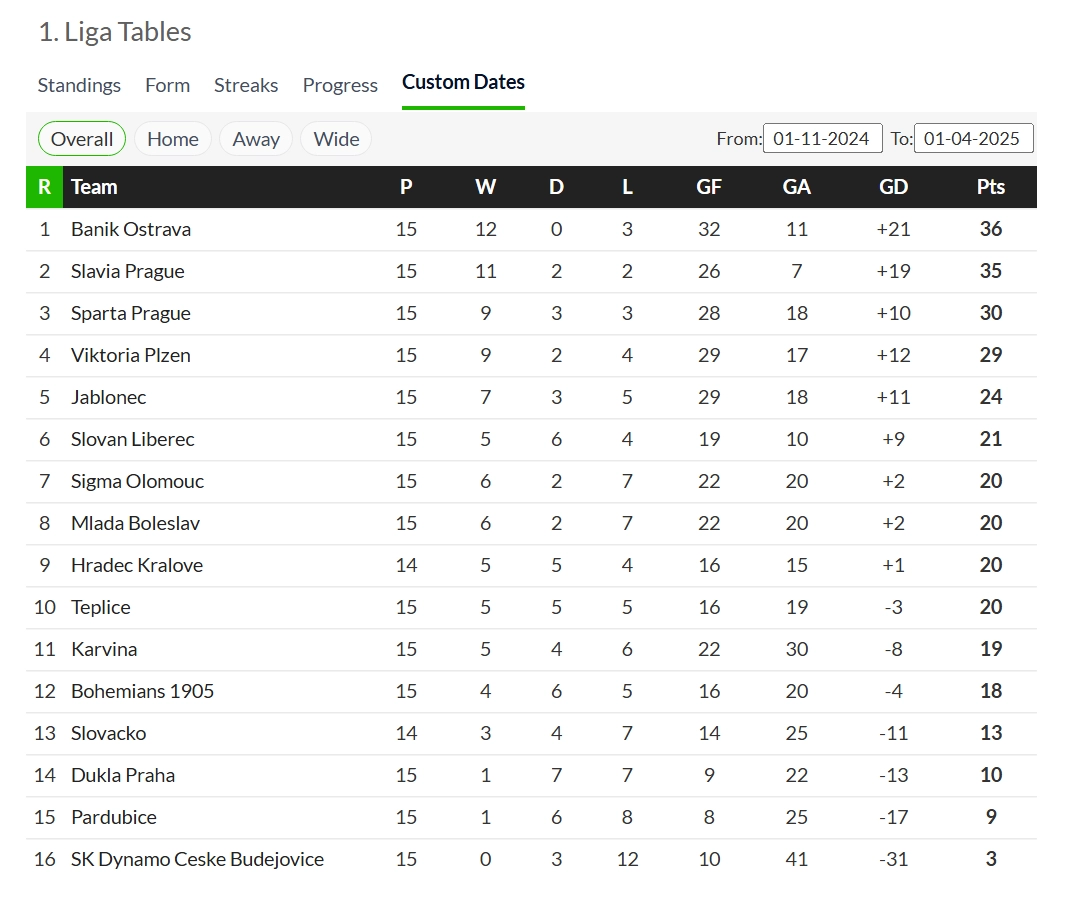
Indeed, Top 4 placements are not necessarily created equal. On the way to finally shake off the post-2004 title hangover via a 3rd-place finish in 2007/08, Baník started out strongly and didn’t surrender a spot in the Top 4 until Round 14. In 2009, the start wasn’t quite as rapid, but they would never watch a non-Top 4 outfit at Bazaly following Round 10. This and last season, Baník took their time in finally ascending to the Top 4 (around R14-15), but the difference was how long they stuck around. In 23/24, Ostrava finished 4th after wrapping up a mere 6 rounds of action as a Top 4 team; in 24/25, the number of rounds jumped up to 15.
Heck, as Danny reminds me, there was even a 15-game period between 1 November and 1 April when Baník stood tall as the most prolific point-getter in a league one other club had a tight grip on the whole time. That is no longer a flash in the pan; it’s the sort of consistency you’d expect from a Top 4 candidate. On the pitch, Baník are now more than just a candidate.
The onus is on the top hierarchy to move the club closer to the Top 3 off the pitch, as well, and they have certainly been proactive. The expansion of the executive branch through the addition of the coveted former Dukla sporting director Jan Staněk, as well as the expansion of the coaching staff through videoanalyst David Bernatík, are the foundational steps. The Chachar Pass initiative — with fair pricing, some additional content and a whole lot of confusion surrounding its roll out — was probably becoming a necessity, felt by plenty other clubs. New youth-level cooperation with Liverpool FC is a welcome complement to the already existing 10-day internship at ADO Den Haag that is mandatory for all those who are attending Ostrava’s Business Academy (high school level), much like some internationally acclaimed studios taking part in the ongoing architectural design competition of the ‘New Bazaly’ was a welcome reputation boost. Meanwhile, the full turf replacement — long overdue after an embarrassing decade of inaction — was more an exercise in reputation repair.
Closer to the playing field, a more stress-free season for the 2nd-tier Baník ‘B’ is among priorities, too. As can be seen on the signing of Dominik Simerský, still a Zlín regular in this promotion campaign, the squad-building is much more of a focus today than it was in 2024. There should now be the right pieces in place — a healthy mix of about 10 hungry youngsters realistically vying for future spots on the first team, and some steady hands on the steering wheel in the form of peaking or veteran players — to prevent much of the ad hoc and often useless help delegated from the top throughout 24/25. A repeat shouldn’t be a worry.
Looking back on 2024/25
What went (particularly) right
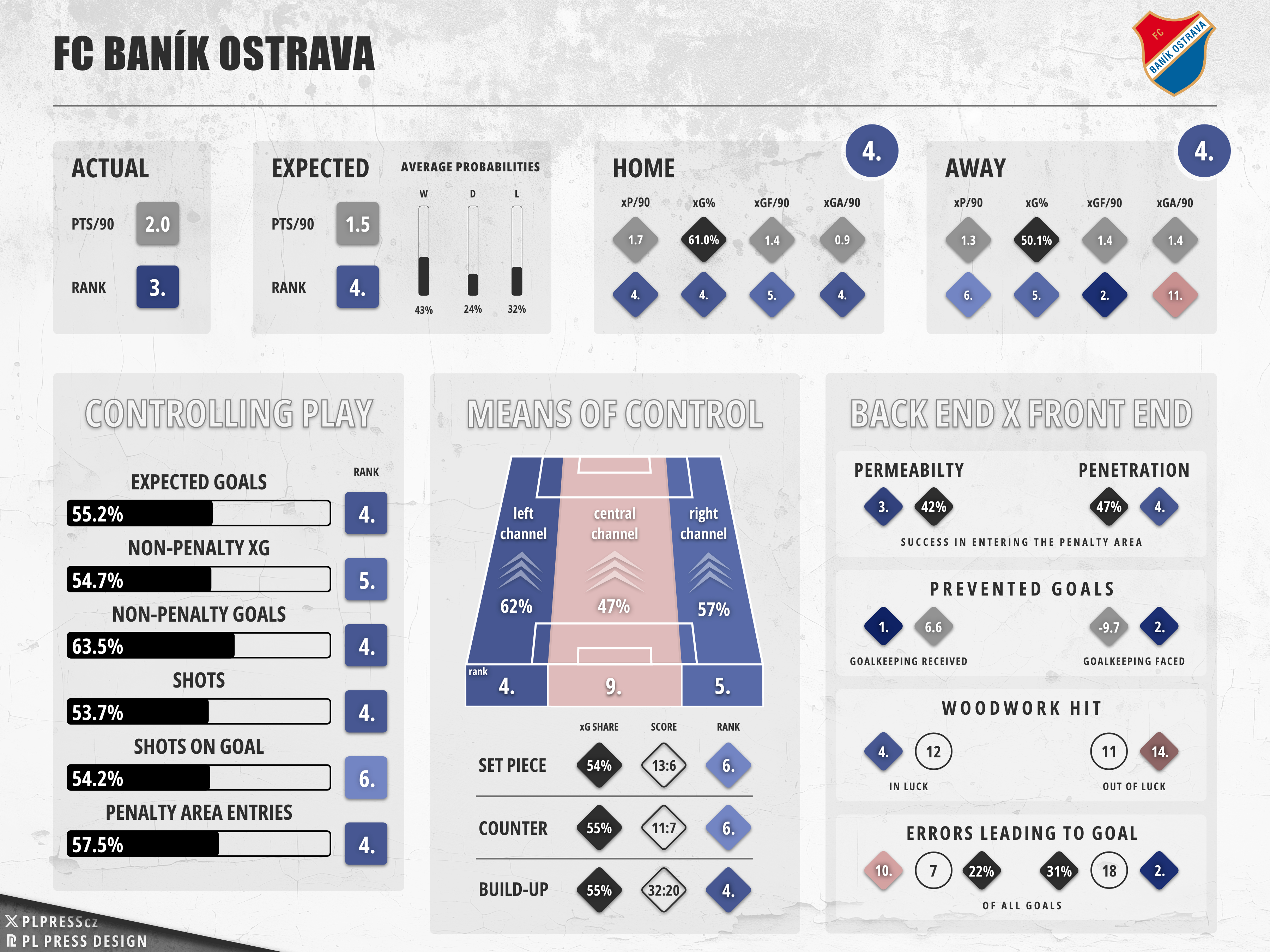
The key to taking a substantial step forward is normally fixing your biggest issue from the previous season(s), and Baník have done just that in appearing to be a Top 4 home outfit across the board. Last summer, we noted their second-worst home record since getting promoted, with the equal number of wins, draws and losses (5-5-5) representing only a minor step down from the already poor record in Hapal’s first year in Vítkovice (6-1-8). Enter Baník Ostrava of 2024/25; flipping the narrative on its head. This time around, Hapal’s boys were taking a stunning 12-1-2 home record into the post season where they went one up on each count. And it was A) well-deserved, since they formed a cluster of four teams in the 60-percent range in terms of xG share, far behind Slavia; B) done without taking anything away from the usually strong record on the road where they were still strong, tormenting the opposing defences to the tune of the second highest average xGFExpected Goals For (xGF) estimates how many goals a team should have scored based on shot quality, location, and context.. (The defence though!)
The key to such a splending home/away split is, of course, beating everyone — not just bullying the weakest. And boy, haven’t Baník just done that in a historic manner. Let’s see if I can get all of these right: after finally beating Jablonec in their backyard after 18 years in 23/24, they took it up a notch by crossing Juliska off their “Waiting for a Win” bingo dating back to 1994, pillaging Letná for the first time in a decade, and edging a high-stake post-season game at Štruncovy sady where they hadn’t succeeded in almost 17 years. Radim Řezník was still a teenage sensation then. The 3:2 home victory that let the fans dream of the runner-up finish for one more round and, perhaps even more remarkably, completed the first home & away double over Sparta since 1981/82 (to go with the first Plzeň double since 2007/08) was just a suitable cherry on top. In that game especially, Ostrava showed their greatest spring strength: holding onto first-half leads. Since R19, they were up on their opponent at half-time ten times (till then, it was two), totalling a goal differential of plus-9.
It’s nice to start well.
What went (especially) wrong
You may notice Slavia is suspiciously absent from the section above. Well… that is the emancipation bit Ostrava are (hopefully?) leaving for some time later, because the 2024/25 was as brutal as ever to them on that particular front. Baník didn’t score against the league leaders on either of the three tries, never going above 7 shot attempts (they managed 14 and 17 against Sparta and Plzeň respectively), with their combined score (0:5) actually matching up nicely with the xG differential (minus-4.99). There were 552 distinct xG performances across the whole season; two Baník efforts vs Slavia landed 519th (MD35) and 535th (MD22).
Ouch.
As a result, despite the podium and a higher finish than Sparta for the first time in 21 years, thus concluding on a high, the emotion-less xG Gods would actually disagree. The strength of the opposition was obviously through the roof for Baník, but considering they had 3 home stands instead of two, ranking 13th for offence (rolling 5-game xGF) and 14th for defence (rolling 5-game xGAExpected Goals Against (xGA) estimates how many goals a team should have conceded based on shot quality, location, and context.) isn’t what you’d like to see at the season’s most important stage.
Most valuable player (still on board)
Per my MVP model (traditional stats): Ewerton (ranked 6th league-wide)
Per my positional models (advanced stats): Filip Kubala (97 overall percentile at CF)
Per Statsbomb’s On-Ball Value (OBV) metric: Dominik Holec
Can one talk about a come-of-age campaign for an individual who already landed in the same, super-high (95th) overall percentile at the same position a year ago? You know what, I think you can — because this past season of Matěj Šín certainly did have that vibe. First of all, I was still a bit cautious with his placement on the depth chart ahead of 24/25, putting him behind Filip Kubala, and wondering whether Šín wouldn’t be forced to play deeper than he should. That didn’t prove to be the case, with Šín picking up 5 more starts on aggregate compared to 23/24, always starting as a no. 10 (spare for the twin Rigo-Boula absence).
Second of all, enjoying more of a platform and freedom has definitely unleashed Šín further. Where he averaged 72.7 percentile value in the “prime offensive output” set of metrics in 23/24 (6th league-wide), he now averaged 84.2 (3rd). Where his “ability and tools to gain the danger zone” were still considered borderline “unstoppable” on the strength of 71.5 average percentile (6th), they were now outright “unstoppable” to the tune of 86.2 average percentile (4th). Incremental steps forward for a fresh (!) 21-year-old? Sure, but I rather see Šín firmly establishing himself among the cream of the crop. The deputy captain has basically upped his game across the board — most notably in successful penalty area entries from open play where he rose from slightly above average to 5th best — to the point where it’s fair to wonder where his ceiling lies. The league’s MVP is probably the only reasonable ambition at this point. (Other than perhaps lasting for the entire 90 minutes more than twice per season.)
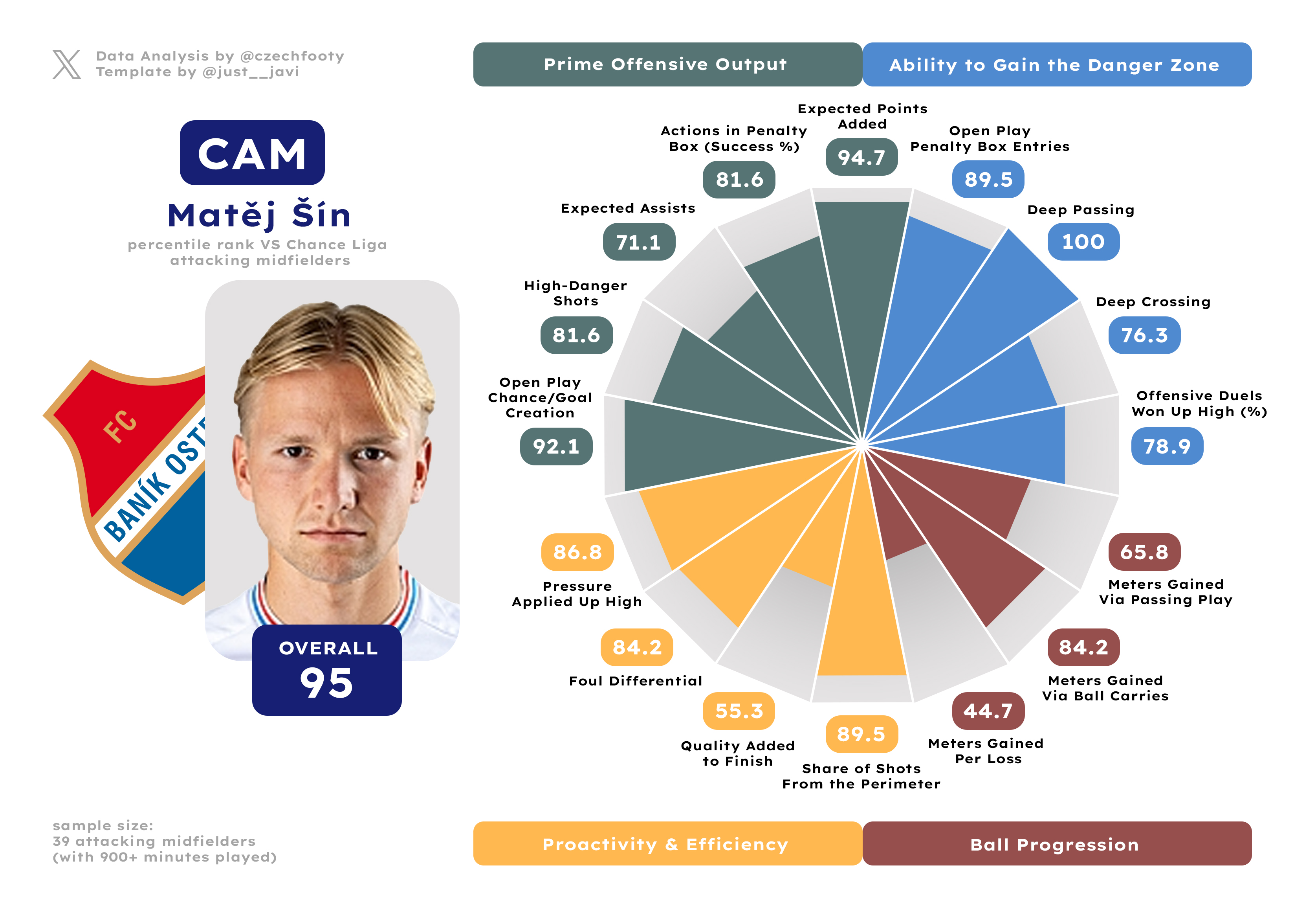
As for Šín’s current team MVP credentials, they are not unrivalled — I had considered all of Dominik Holec, Tomáš Rigo and Ewerton for this space — but they sure appear to be very strong. Only Šulc and Provod, two league MVP front-runners, delivered more EPAExpected Points Added (EPA) estimate the value of one's goals and assists based on game state (late game winners = top)./90 to their respective teams than Šín to Baník (total of 8.46). At the season’s end, he chipped in to the second most Baník goals (17), standing tall among Ostrava attacking-minded regulars with the majority of his points (11) delivered in close game states (7 IGImportant Goal (IG) was either a go-ahead goal, or an equalizer. The rest is a standard goal. + 2 IAImportant Assist (IA) was delivered either to a go-ahead goal, or an equalizer. And it must've mattered.).
Chip on the shoulder
carried by the player who’s got something to prove — be it to himself, fans or the coach
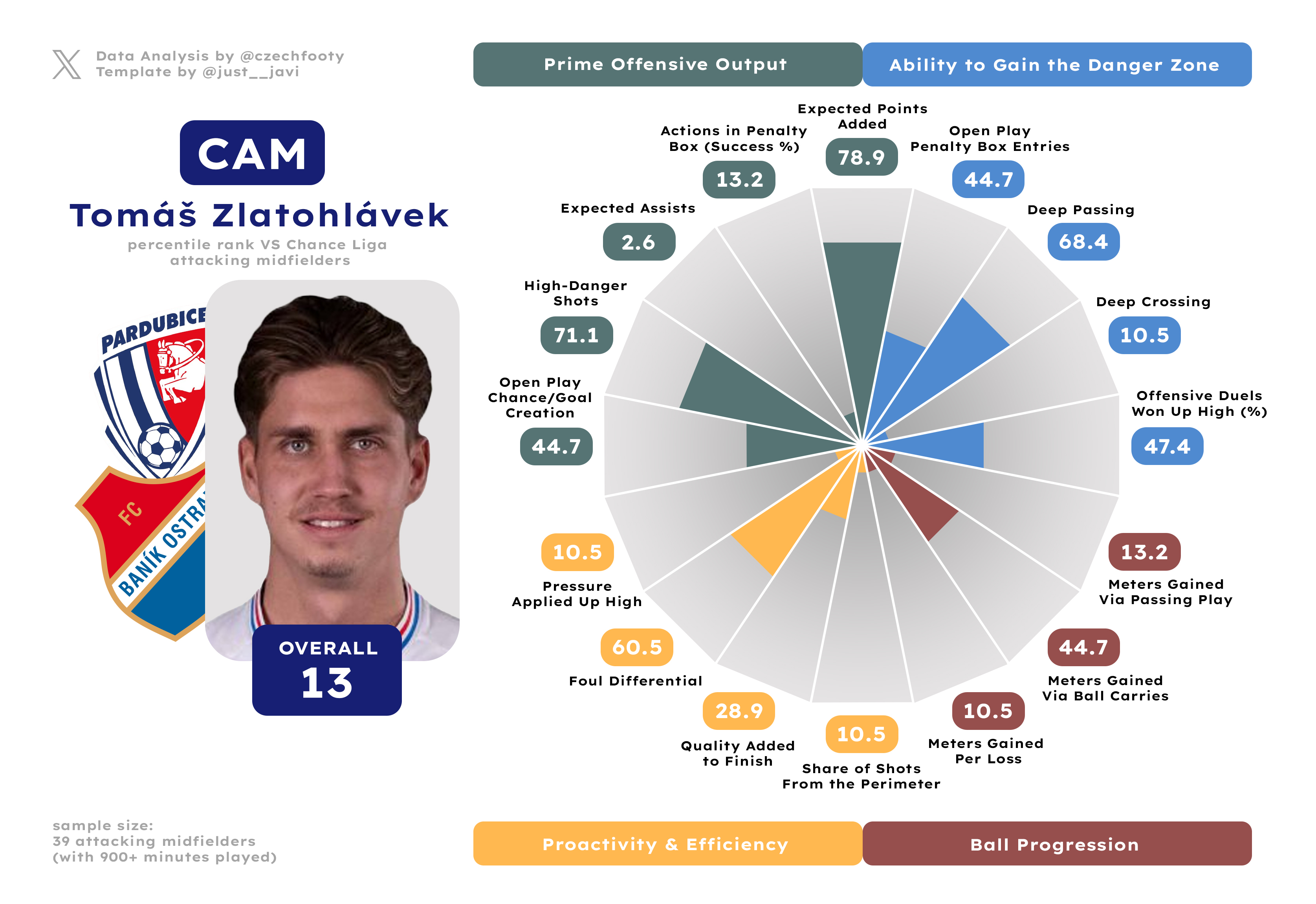
As he was leaving Pardubice, Tomáš Zlatohlávek was at the top of the world. In my mid-season review, I lauded him as this weirdly unsung hero of a broken team who still managed to be on pace for a career-high in points (9), producing most of them in situations that greatly mattered (4.03 EPA at Christmas), despite sometimes acting as a makeshift no. 8, if not even a no. 6, for coach Střihavka. He had improved his physical condition and defensive work rate to the point it indeed became a feasible, though suboptimal way of deployment.
These days, despite utterly botching his big audition in the role against Jablonec, Pardubice’s Plan C for Zlatohlávek appears to be Ostrava’s Plan A. And the poor guy had better come to terms with it, because the way the CF and LAM/RAM positions are populated, it’s his safest bet to get regular playing time (especially once Rigo inevitably crosses the borders).
To be fair to Zlatohlávek, he’s not a 100% miscast deeper down (just not as deep, please). He’s always ready to flash a surprising split pass to facilitate the build-up (his 9 completed smart passes per Wyscout definition only trail Šín on Baník), and it’s well worth noting that for the second consecutive year, he was involved in exactly three quarters of all the goals a team scored with him on the pitch (which, yes, includes going 2-for-2 at Baník so far), so he must be doing something right. But even after cutting him some slack for the difficult Pardubice context, Zlatohlávek’s pizza should never be this empty. In terms of overall percentile, he even trails Simon who never left the environment for greener pastures, like ‘Zlatan’ did.
Inside the off-season
special thanks for guiding me through the motions of Baník Ostrava’s off-season go out to Jaroslav Novotný, @KrenekHonza93, @Maassive1922, @homor1922, @Fildass, @IamTHEDannyP, @miroslavsilak & @smusil93
Squad turnover
You’re in a good place, it’s easy to argue, when your greatest summer subtraction in terms of MVP points is down to Jan Juroška. Baník had already shed a fair bit of value mid-season in the shape of Jakub Markovič and Uchenna (still ranked 13th and 15th respectively on the team’s MVP leaderboard at the season’s end), so after absorbing their losses surprisingly well internally through heroes of numerous glorious moments Holec and Michal Frydrych, it was imperative for Baník to avoid shedding a lot more. Now, hanging onto Tomáš Rigo would be a tall ask, potentially even counter-productive at the stage where there’s literally a new suitor reported with each dawn, but even with him gone, Ostrava would still be retaining upward of 80% of 2024/25 minutes, landing somewhere at the edge of Top 5 league-wide.
Biggest upgrade
For about a third straight summer Baník headed into the pre-season with too thin a central midfield deck, and only now they finally decided to fix it once and for all. By default, then, Christ Tiéhi is the biggest upgrade despite not being pencilled for a starter’s role as yet. No one can quite be sure about where his game is currently at, following stints in the relative English and Hungarian wilderness, but it won’t be hard to show (much) more than Samuel Grygar, Roan Nogha or Sacha Komljenovic who were considered for the depth chart last year.
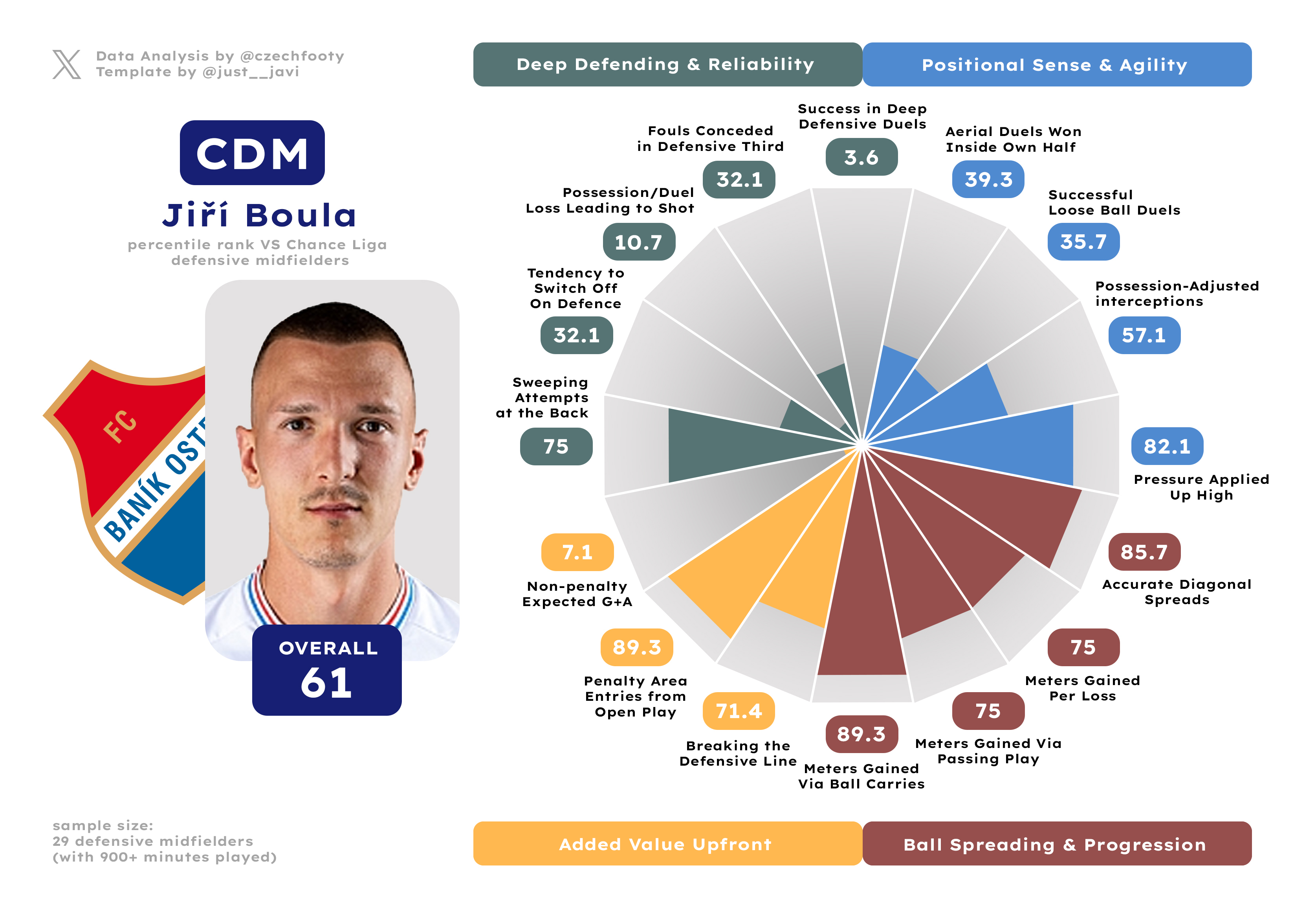
In fact, it might be fair to wonder whether Jiří Boula should still be viewed as an indispensable starter. After two years of delivering some quality, underrated football — having arguably served as more of a transcendent midfielder for 23/24 Baník than Rigo — the script has flipped to a rather dramatic effect in 24/25. Once Ostrava abandoned their chaotic brand of football, where Boula’s instinctive passing and smart positioning especially flourished, and once Rigo started to focus less on vertical and more on diagonal passing, taking away part of Boula’s prior uniqueness, there was a bit more “ordinary” on the national team hopeful’s campaign. This is not to say Boula suddenly isn’t a good player, far from it (his ball-spreading and progression was still elite), but he could now feel threatened by Tiéhi.
Biggest downgrade
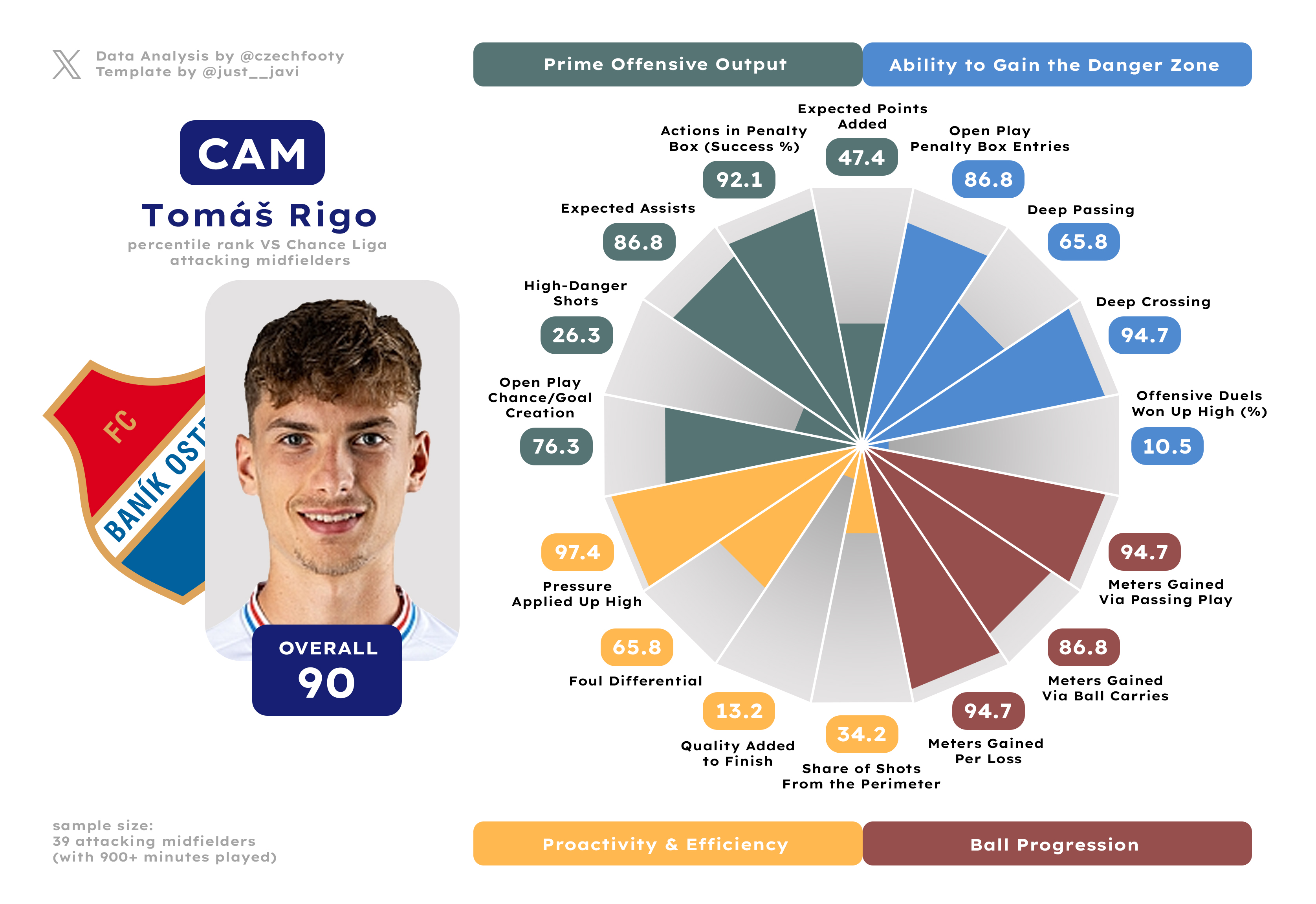
Let’s stay on the subject of the central midfield. With all due respect to Michal Fukala or Issa Fomba, it would be plain ridiculous to spend any time talking about them amidst the deafening noise around Tomáš Rigo. He openly spoke about wanting to capitalize on the individually fantastic U-21 Euro, and the scouting department has long had a task assigned to find a ‘new Rigo’, so yeah, let’s go out on a limb and consider him about as good as gone.
The pressing questions now are: can Baník find a suitable Rigo replacement, and do they even need to after acquiring Michal Kohút in winter? As for the second part, I wouldn’t call it an idea doomed to fail. Kohút currently profiles as a fairly similar player who’s just down a level (but not more) across all sets of metrics, and that’s — crucially — based on a full-season output compromised by the months spent on a bad Slovácko team. Where Kohút lags behind in opening up defences, especially through passing ability, he compensates for in superior strength in duels and finishing ability. It sure has got some potential and is worth exploring.
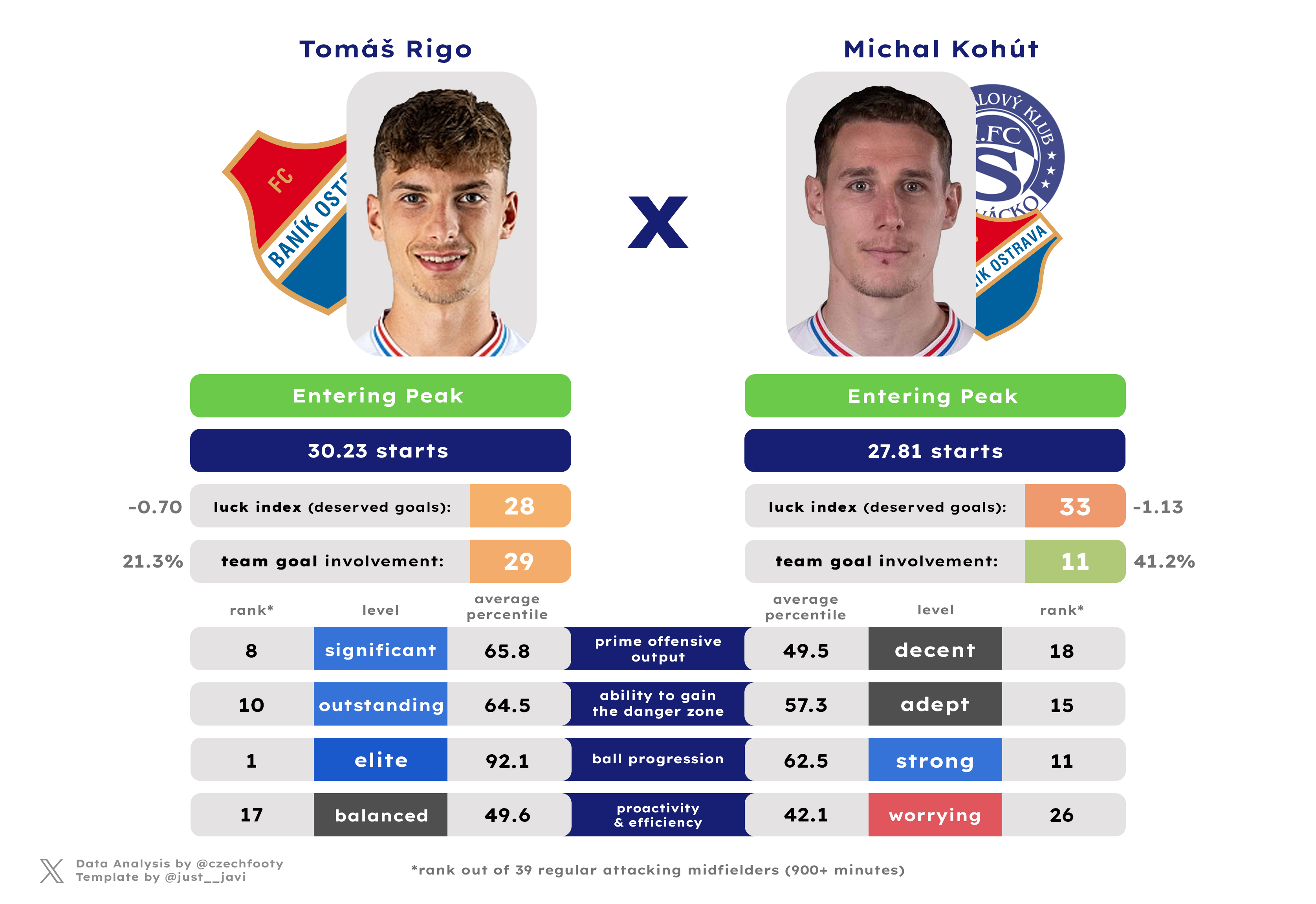
As for the first part — and you can probably already sense it — it most certainly doesn’t happen overnight. Unless Miroslav Pelta suffers some sort of a breakdown on the way to sell Michal Beran to Baník in particular, there simply isn’t a ready-made Chance Liga candidate. In terms of middle and final third output, there are only two truly comparable players to what Rigo has done… who both happen to play for Prague ‘S’ (Laçi, Zafeiris). And even then, these two are no matches for Rigo when it comes to (positive) foul differential or pressure applied high up. Rigo’s obsessive shooting from desperate positions (the maniac does that 1.16 times per game!) is pretty much the only thing he brings to the table that won’t be missed.
Need left to be addressed
In a recent FC podcast, I highlighted both wide areas as possible targets for improvement, which — it would be fair to add — didn’t go down too well with some of the fans. On a second thought, I can see it with the left-hand side where Daniel Holzer shows no signs of slowing down, Kohút demonstrated he can competently deputize there, too, and Patrick Kpozo offers a safer, 4-at-the-back oriented alternative that could come in handy for potential double weeks or international clashes (that is provided he stays, of course, which didn’t seem like the preferred option a year ago when he sent out that since-deleted tweet). Fine, I am happy to concede this is only a low priority area. As for the RWB starter’s role, I’ll be adamant.
Whoever has followed my work over time knows I’m very far from David Buchta’s hater, as I’ve always highly appreciated some of his skills, but the thing about those particular skills (like getting into the box, selling his high-end shot) is that they are harder to deploy the deeper you drop with your nominal role. It’s unacceptable that a player with his finish on a strong team is only slightly above average in earning high-danger shots per game, while his rate of entering the box (not to speak of any creative output like xA) is even more alarming.
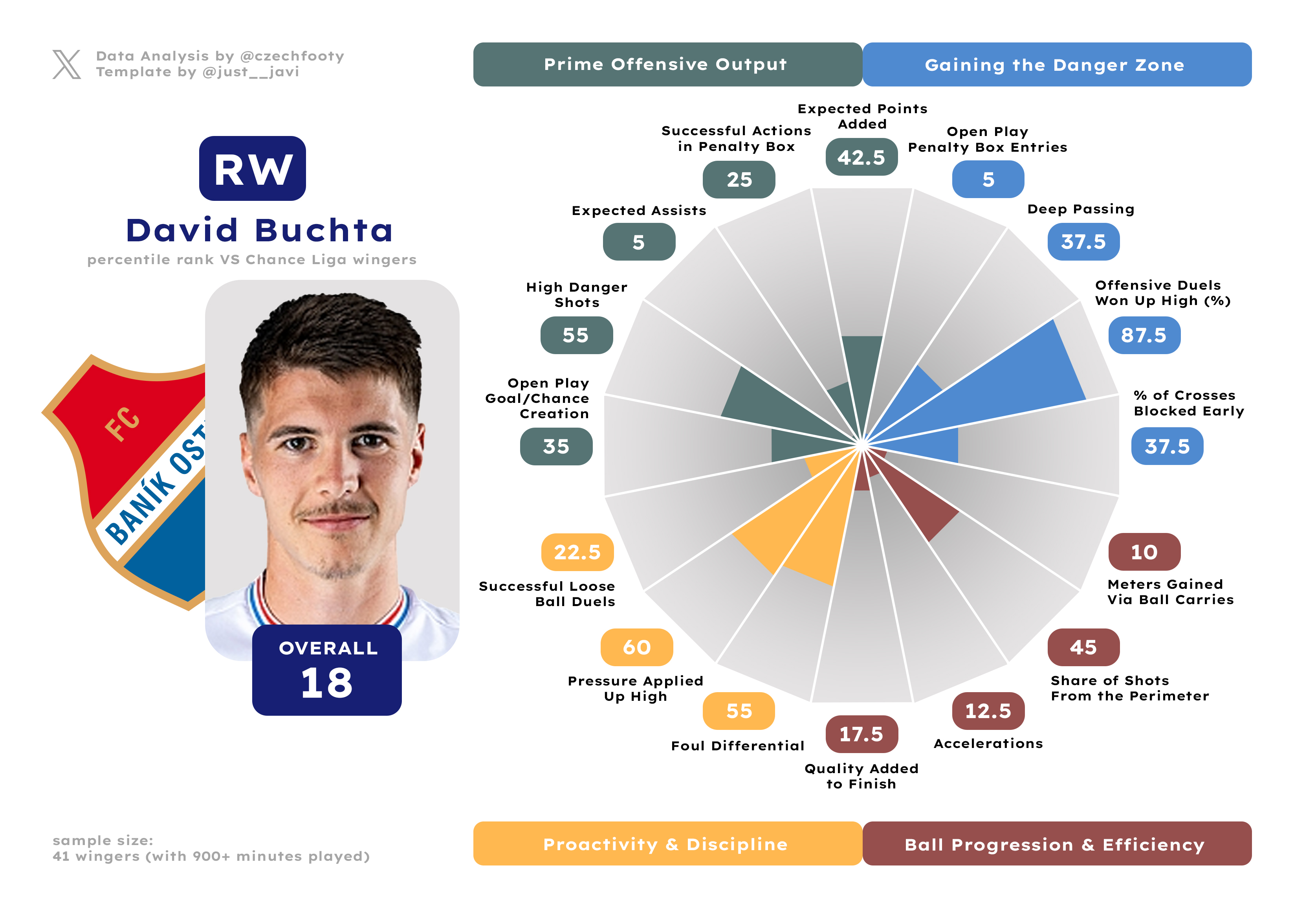
Maybe there’s an internal fix brewing in an up-and-comer (more on that later), but until I see him actually perform on the top tier level, I’m not buying it. And Matúš Rusnák or even Dennis Owusu strike me as players who’d produce a pretty similar pizza chart; maybe high on success rate with offensive duels (dribbles), but low on truly valuable substance.
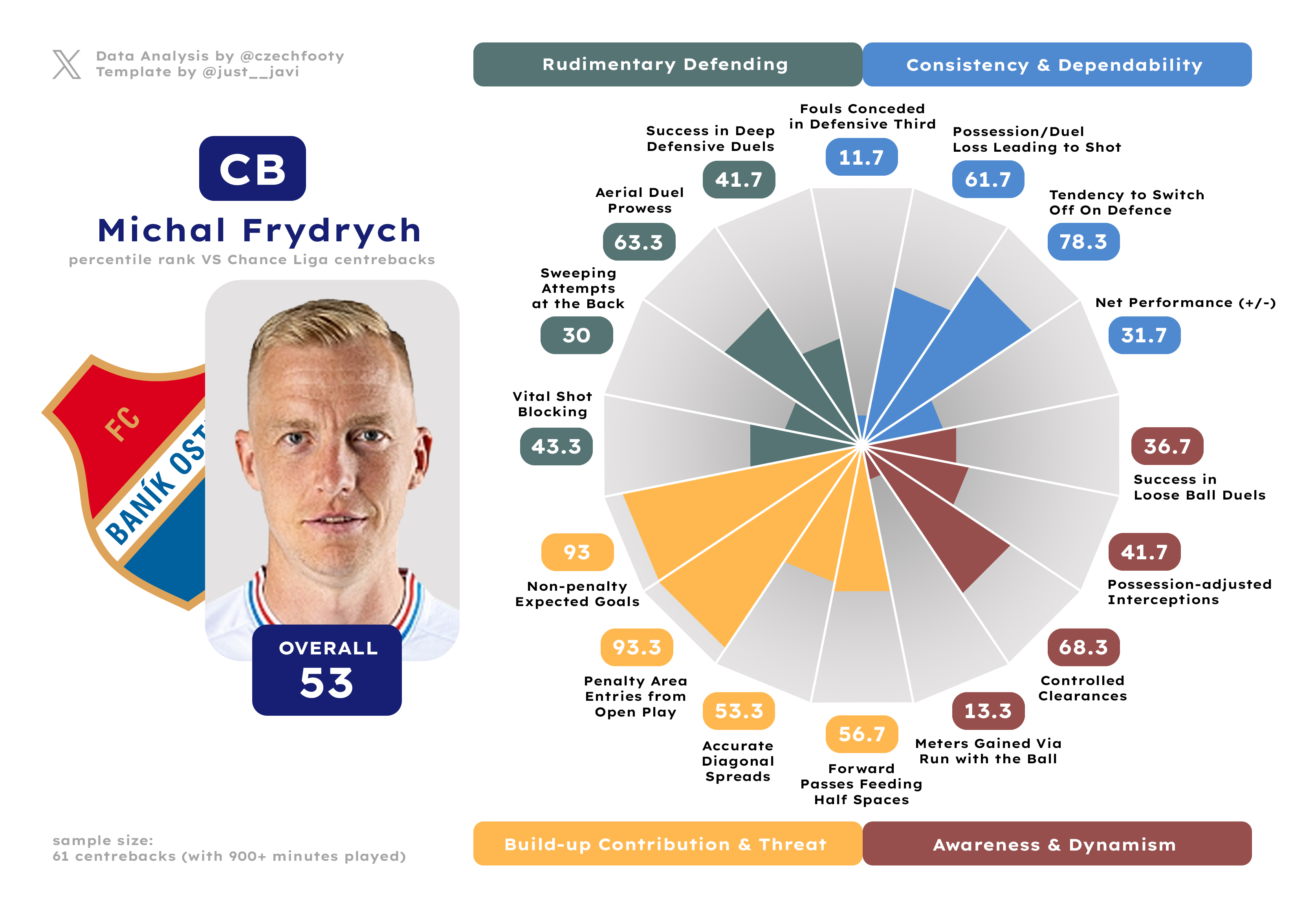
Perhaps a more immediately pressing need, not least due to Michal Frydrych’s long suspension, also concerns the right-hand side — specifically the lacking proven RCB rotation option. Alexander Munksgaard might be it (I mean he wasn’t brought on board to just help out the reserves every now and then), but his pre-season was disturbed by muscle troubles. Georgios Kornezos is probably best utilized as a Matěj Chaluš cover competing with David Lischka. And that is it; you’ve run out of senior options before even dealing with the obvious limitations of the presumed first-choice option himself. Frydrych is now firmly in the “steep decline” territory and any dynamism-related metrics do not flatter him. It would be smart to relegate him to the role of a veteran backup, in which he spent much of the 2024 autumn, but the only rumoured name capable of doing so (Jakub Pokorný) may be headed to India instead.
New kid on the block
Last summer, Uchenna was the easy pick in this space, and so it’s only fitting that this year’s pick carries a fair chunk of the Uchenna “vibe”. Fellow Nigerian Abdullahi Bewene (b. 2004) also started to gain traction in the spring only (after concluding a loan stint at 3rd-tier Kroměříž) and could make a smooth, accelerated transition to the first-team following a spirited pre-season, alternating with Buchta and Rusnák at RWB. Much like his rivals, he’s by nature a winger more than a fullback, but unlike them, he offers more of a dynamic and crossing presence. His nickname is — hilariously — Messi, while his best-case comparable might be Preciado. Or so Honza thinks. Not (yet) in terms of ceiling, but playing style.
Whether Bewene hits or not is a bit of a wild card, and it’s also far less important for a Baník fan than whether his younger colleagues from the reserves do. After a series of failed birth years headlined by the likes of Petr Jaroň (2001), Dominik Holaň or Zdeněk Říha (2002) Jakub Drozd (2003) and most recently the dramatically stagnating Patrik Měkota (2004; possibly saved by Šín alone if Radim Šudák doesn’t suddenly blossom), there are now three straight classes on the horizon that not only crushed their own age group — winning the U-19 national title after a long 22 years! — but already made substantial waves among adults.
Indeed, it was the bold bet on Marek Havran (b. 2006), Jiří Míček and Jakub Pira (b. 2007) that effectively saved B-team’s asses in the second tier; with Tadeáš Frýdl, Šimon Vlna, Lukáš Dvořáček (b. 2007) and Vít Škrkoň (b. 2008) poised to complement them, or outright hug the spotlight in their place, next season. Of those youngest up-and-comers, Škrkoň organically generates the most excitement as a natural goal machine who has already proven it up a category (10 goals in 10 spring starts for U-19s), but others are not without considerable intrigue, too. As a left-sided centre back capable of playing with both feet, Míček could be the closest to regularly make the bench in Chance Liga, while Vlna and Frýdl (in that order) appear to be accurate reflections of Rigo and Boula on the youth level. Let’s see how their game — much like Dvořáček’s 1-on-1 ability leading to 9G + 8A for U-19s — translates.
Looking ahead to 2025/26
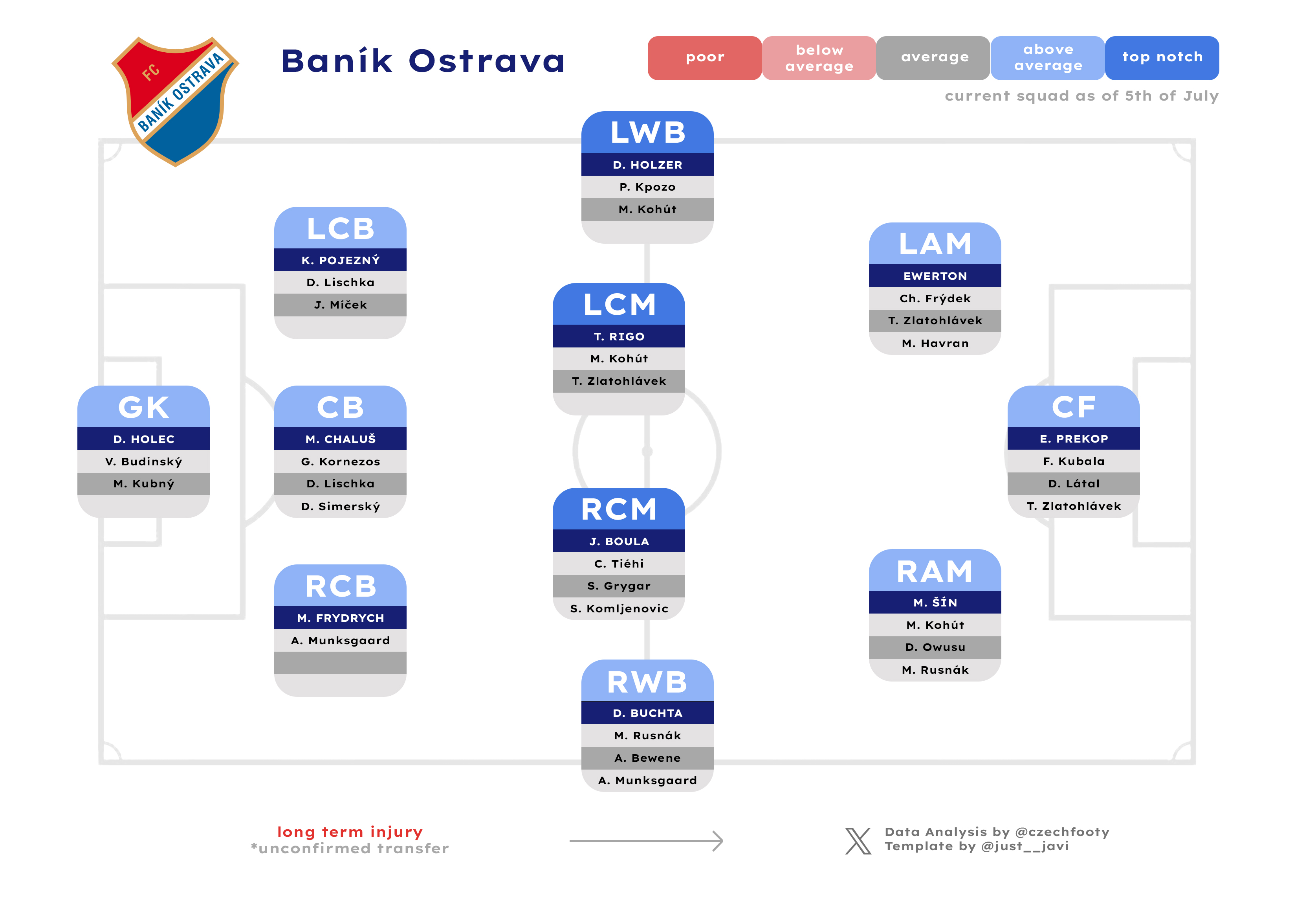
Below is the team’s current(ish) depth chart with a maximum of 4 alternatives for one position. The colourful ratings are a static snapshot of the league-wide situation on 5 July, and they are just a playful bit to add flavour to it; the names featured should be relevant to this day. To learn more about my approach to constructing depth charts, with all its limitations, head here.
Primary formation
Hapal has enjoyed great success with 3-4-2-1 so he’ll look to stick with it no matter what, unless he goes “safer” with Kpozo as pretty much the only natural fullback in the squad in a likely 4-2-3-1. My question is: who’s at the opposite side then? Probably Munksgaard? Risky.
Notes on the depth chart
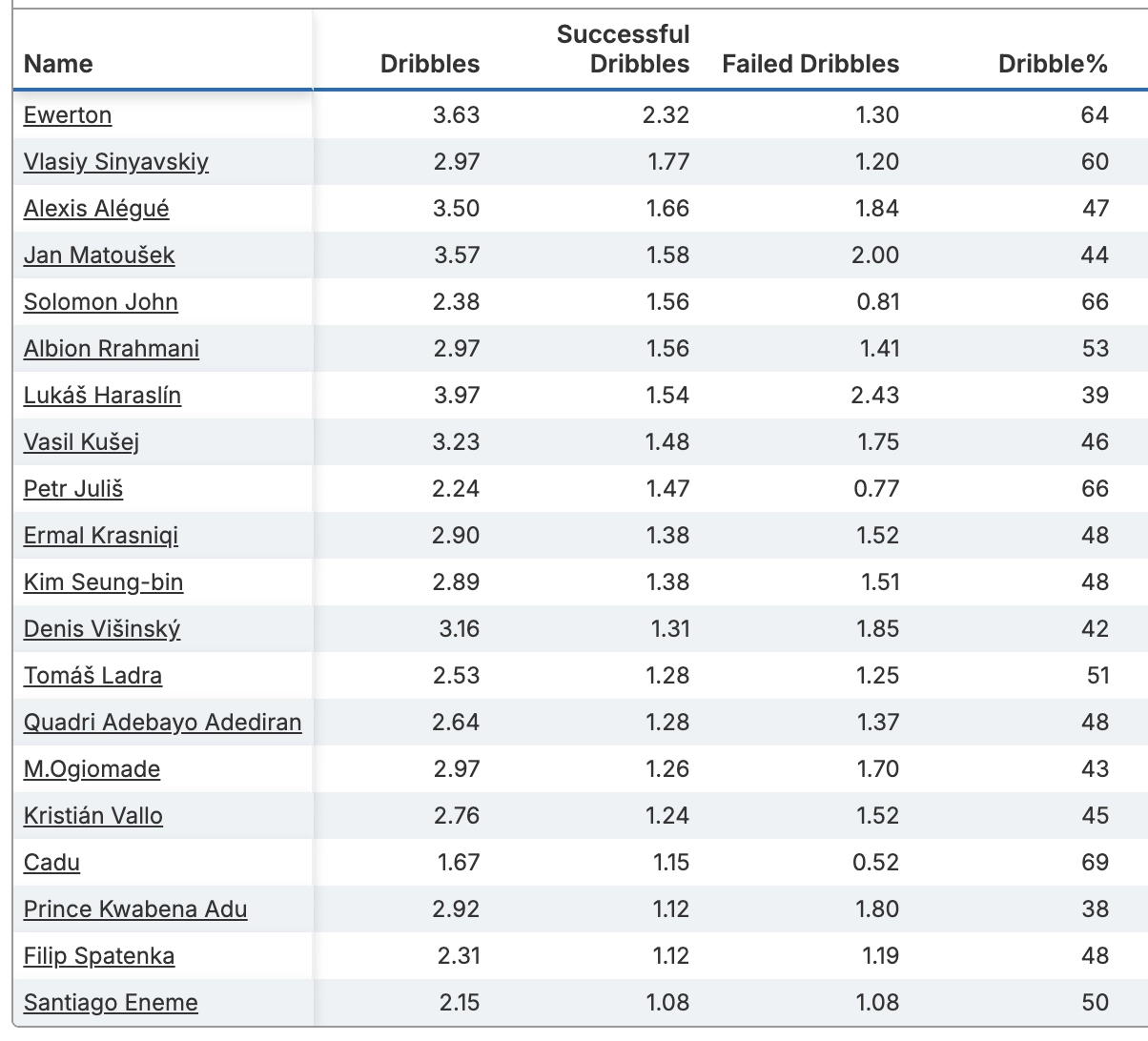
Courtesy of the latest Slavia double whammy (Diouf’s pending departure, Javorček’s serious injury), I was pretty much forced to bump Baník’s left-hand side up a level. They are obviously more or less even in quality, but remember I only have two “top notch” tags to dish out (and Haraslín-powered Sparta was set in stone), so something had to give. I feel pretty good about this, though, because while Ewerton factors solely into the LAM/RAM/CF rating, he does ultimately spend a lot of the time on the left to give Baník this powerful tandem:
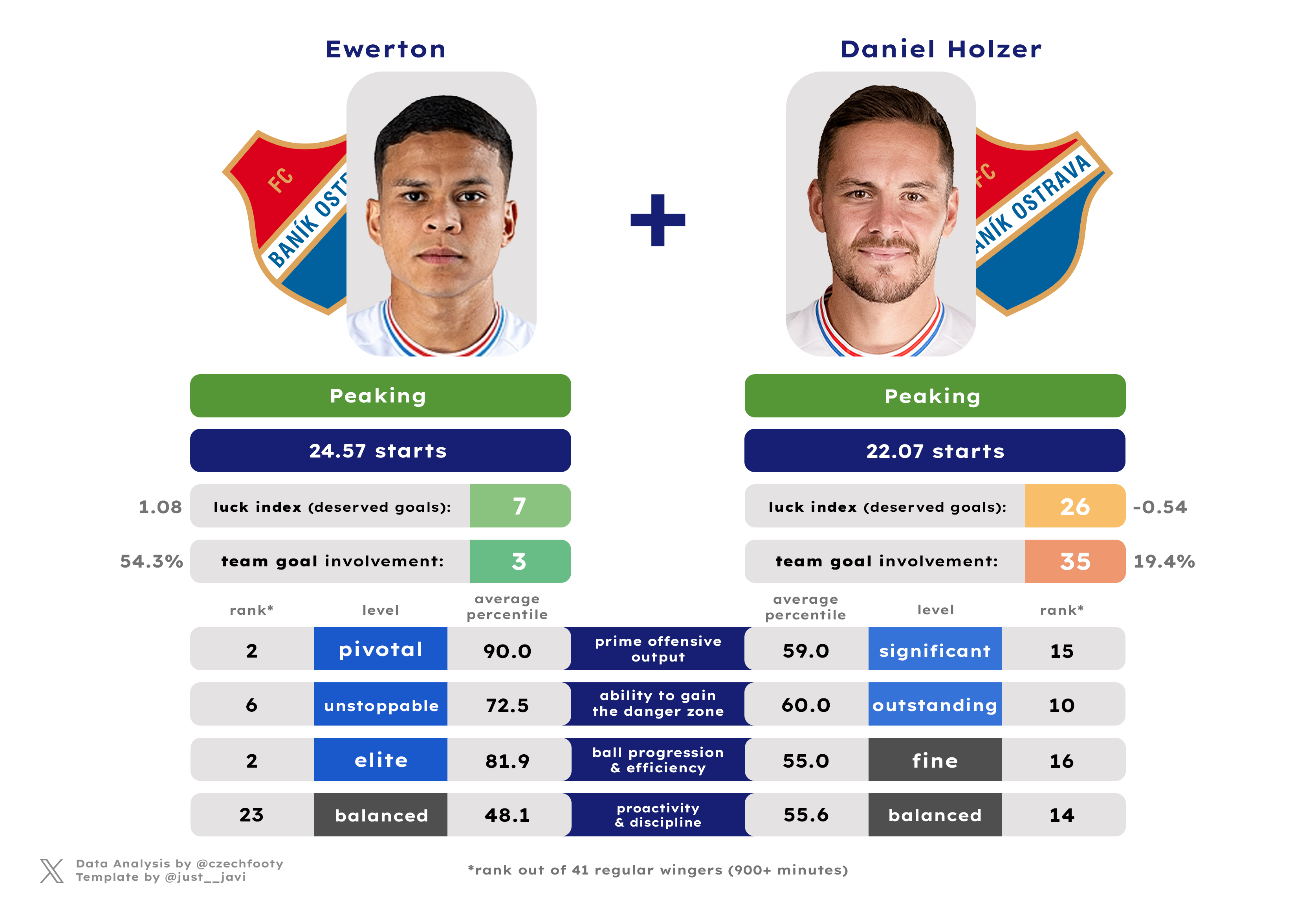
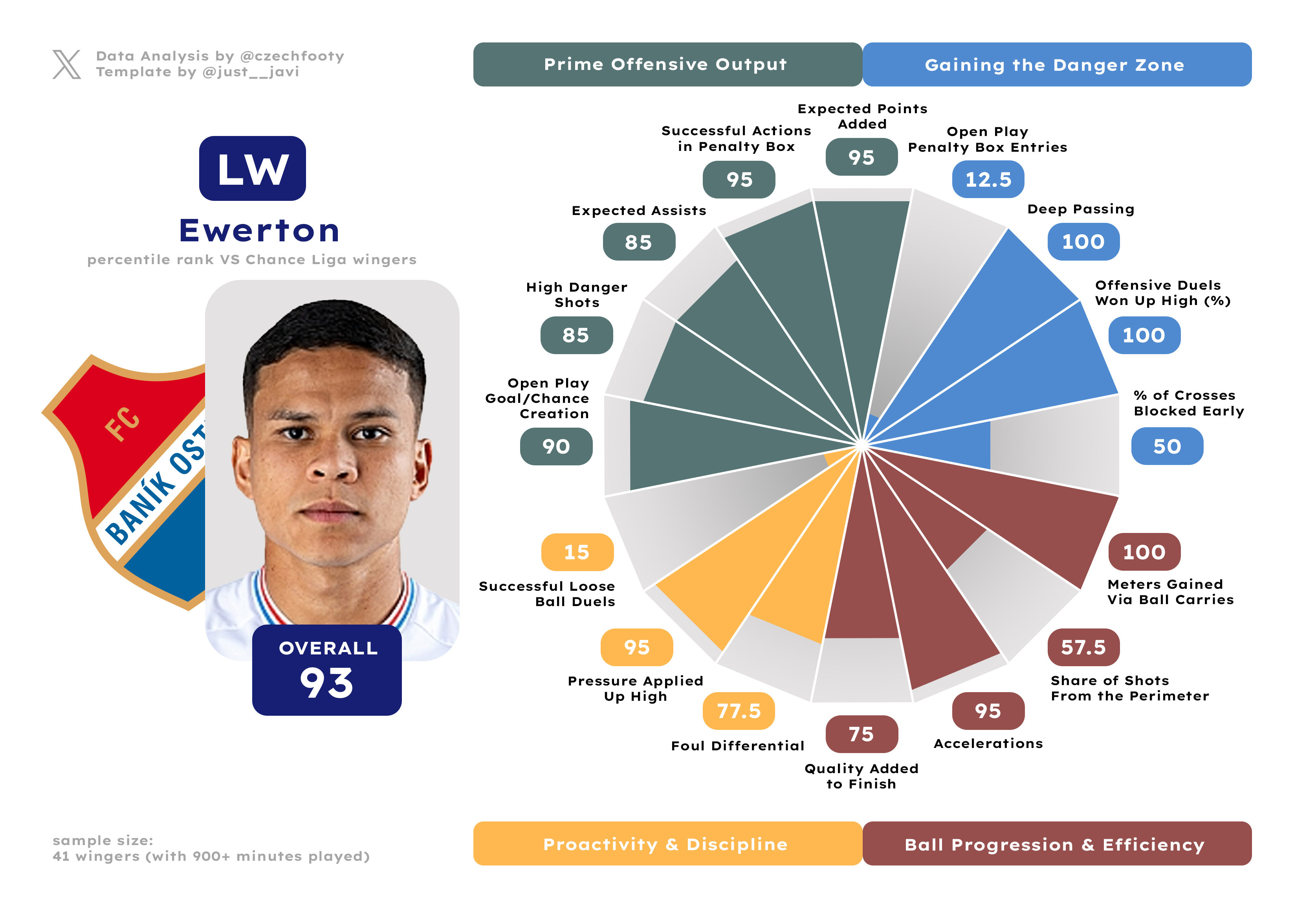
On the subject of Ewerton, Baník did extremely well in his absence for a change this season, rattling off two away victories against Plzeň, one against Hradec Králové, and the home win vs Sparta without the stud’s contribution. In other games against Slavia and Sparta, he was an early sub. As a result, he didn’t actually spend all that much time facing quality opposition this season… so, he actually showed some sweeping progress in the main winger categories. The very solid ranks of 5th, 9th and 4th have suddenly turned into 2nd, 6th and 2nd again, with average percentiles shooting up even further. To what extent this is down to Ewerton’s own progress, my substantial tweaks to individual metrics, or the relative strength of the opposition I have no idea — I just thought it’d be interesting to mention. (One thing is for certain: he’ll always be topping these sorts of tables, regardless of the context.)
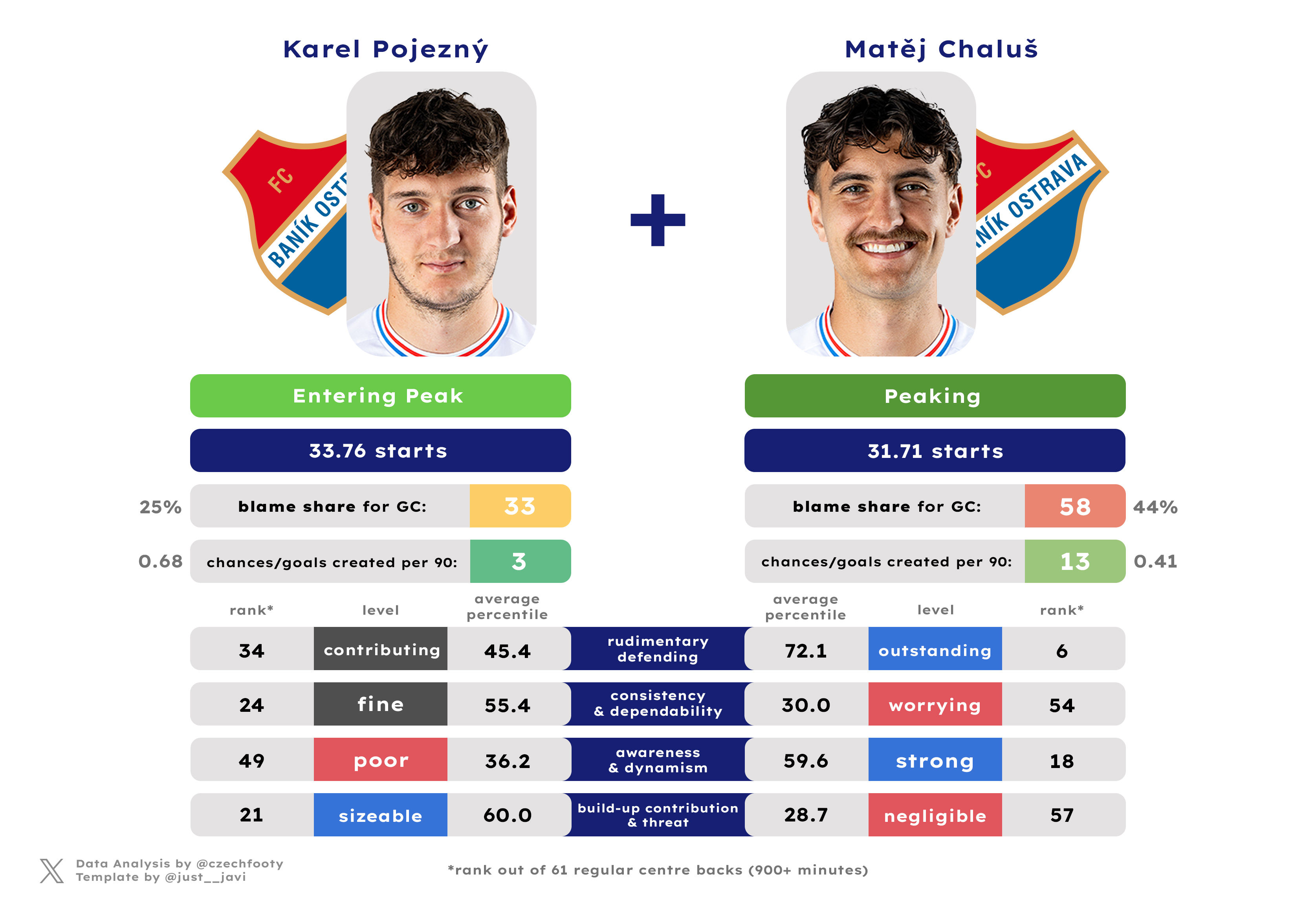
Staying slightly on the left side, I personally can’t decide whether Karel Pojezný’s fairly consistent qualities are nowadays flying under the radar, or if the lack of any sort of hype (with the exception of both regular-season Sparta games) is more a result of his underwhelming progress. Could it be both? Either way, in him and Chaluš, Ostrava seem to have found a working, complementary foundation. And that definitely means something.
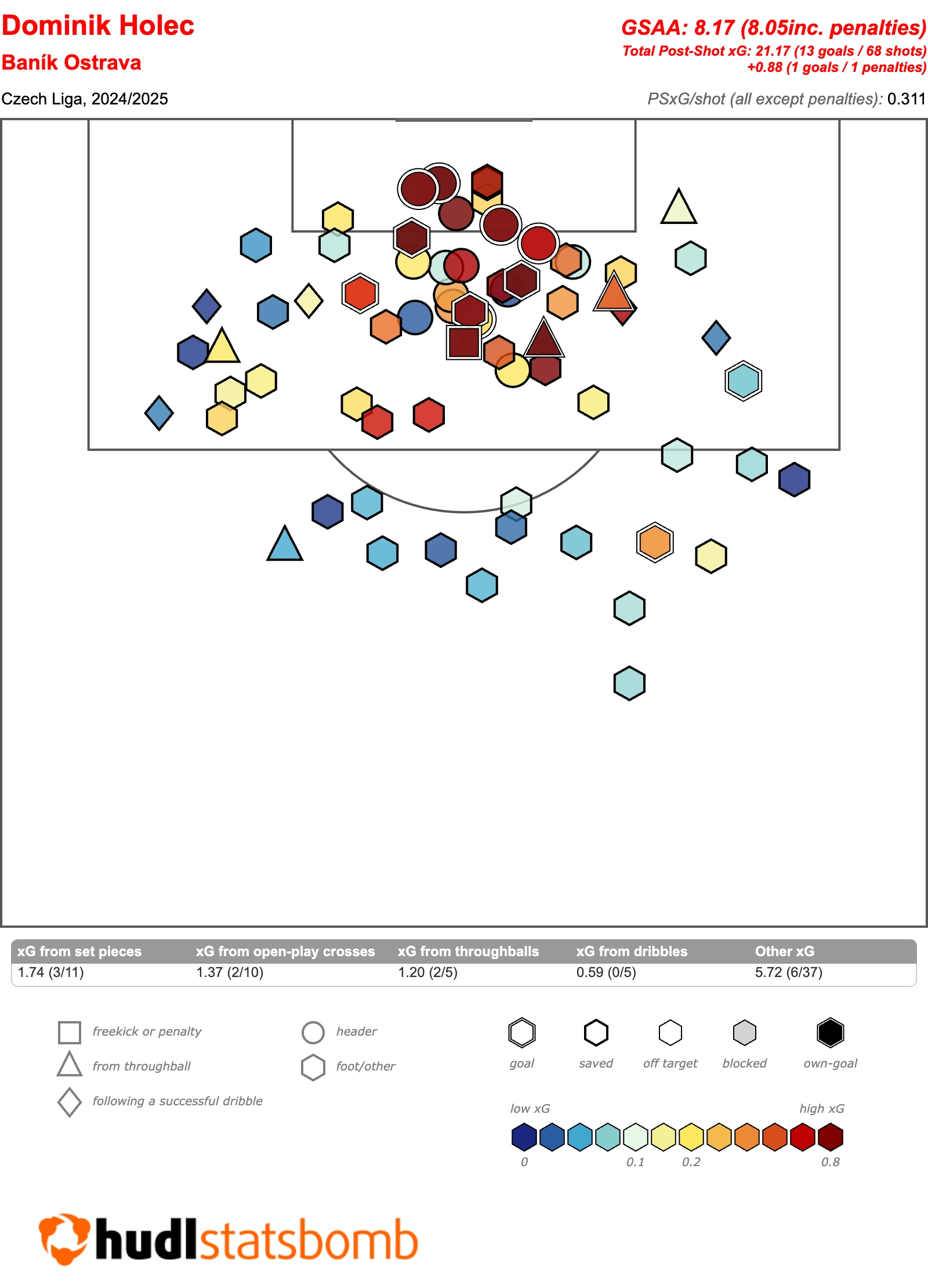
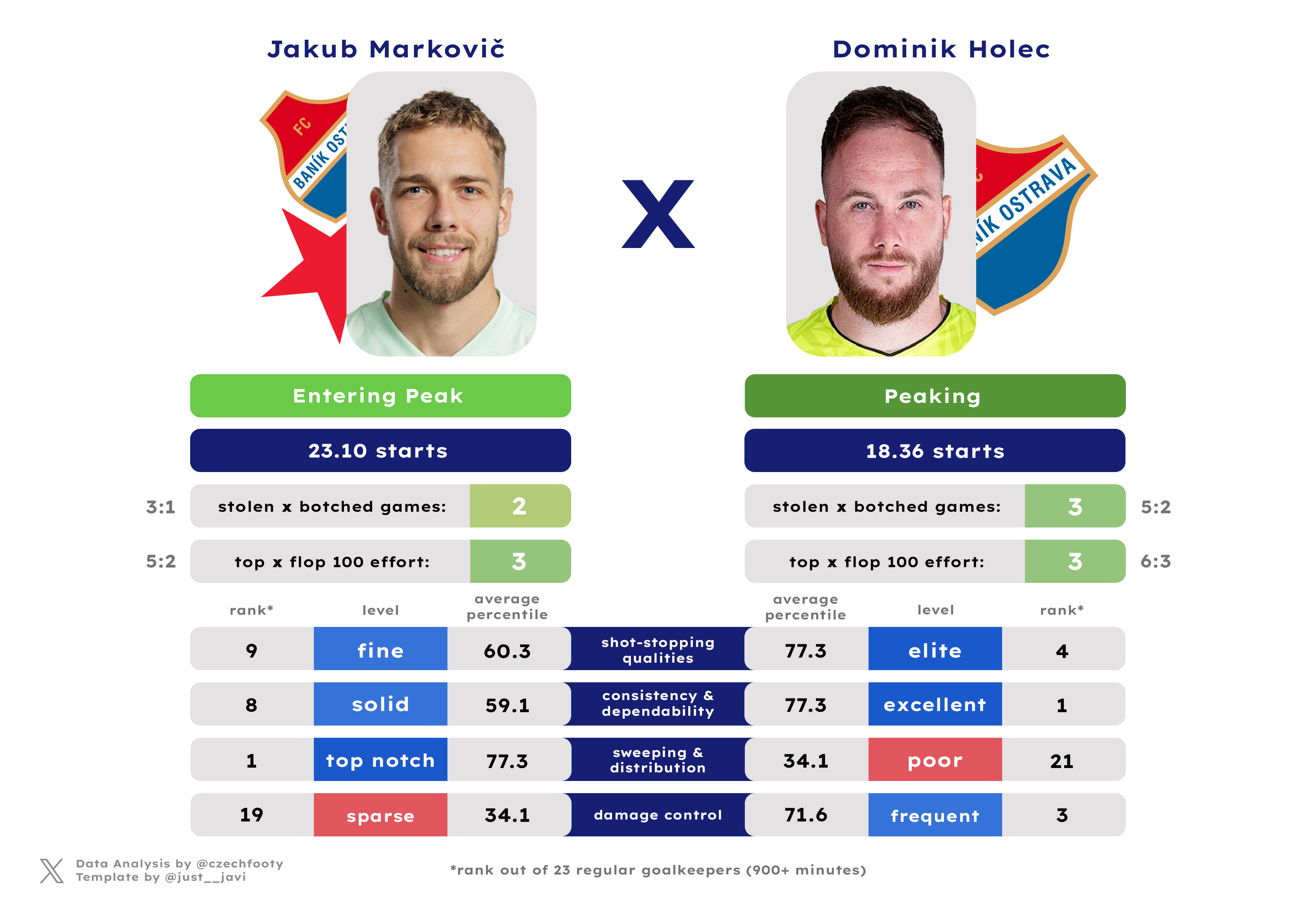
Finally regarding the depth chart, Baník are back at full strength in the goalkeeping department after getting significantly weaker for the spring. Viktor Budinský was deservedly dropped by Pardubice, but as an experienced backup, he will do. And as for Dominik Holec, he was a pretty clear upgrade on the already-great Markovič, establishing himself as a solidly Top 3 goalkeeper in the league. This is a view shared by not only my data powered by Wyscout tracking, but also by Statsbomb data (kindly provided by Marek Kabát) where the Slovak saved the most goals above average — 8.17. As for “my” prevented goals (a slightly different definition), he was at 5.96 — still leading the league both per game (0.33 vs Staněk’s 0.2) and in absolute terms when accounting for penalties (without them, Zadražil is at 6.56).
Roster battle to follow
This is where I lose some of you haters: Filip Kubala is the best. Well, not the best — 2nd best.
*patiently waits for the laughter to die down*
Maybe the narrative has caught up to the reality and I just didn’t notice, but if it’s still overwhelmed by the perception of Kubala being a wasteful finisher, I’d like to issue a wake-up call. It’s not that he suddenly stopped being wasteful — that’s still the one area holding him back. He put the fifth-largest share of high-danger shots off target and generally struggled to take resolute shots worth of much xGSExpected Goals Scored (xGS) only takes shots on target into account, including their power and placement on top of xGF.. But he’s been about so much more it should no longer stand as the defining aspect of his game. Kubala continues to be a very smart and effective withdrawn facilitator, with a soft touch and top notch feel for the game; that much is clear at first sight. What’s more interesting to find out, though, is him topping all centre forwards in pressure efficiently applied high up and successful defensive actions. Erik Prekop, meanwhile, finds himself rather close to bottoming out in both metrics.
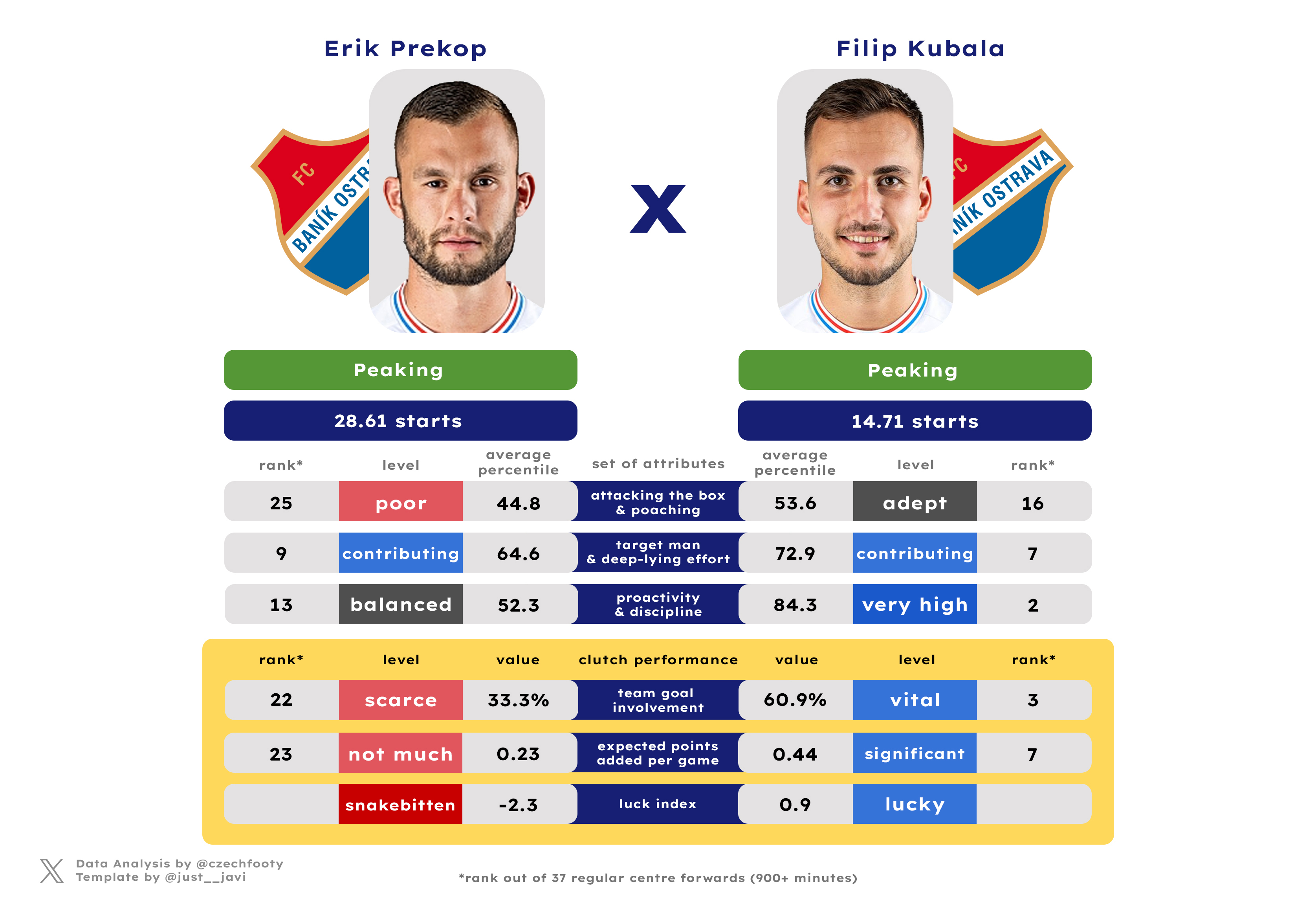
Look, Prekop obviously isn’t without his merit at the top of the depth chart. He’s still the annoying presence he came over to Vítkovice to be; drawing fouls, connecting with teammates in dirty areas, etc. But if it wasn’t obvious before, it should be now — when Kubala started scoring (6 goals vs Prekop’s 8 in half the time), picking up goal contributions (14 vs 15), and fetching EPA for Baník (6.51 vs 6.53) — that the higher upside lies with the region’s son.
Season forecast
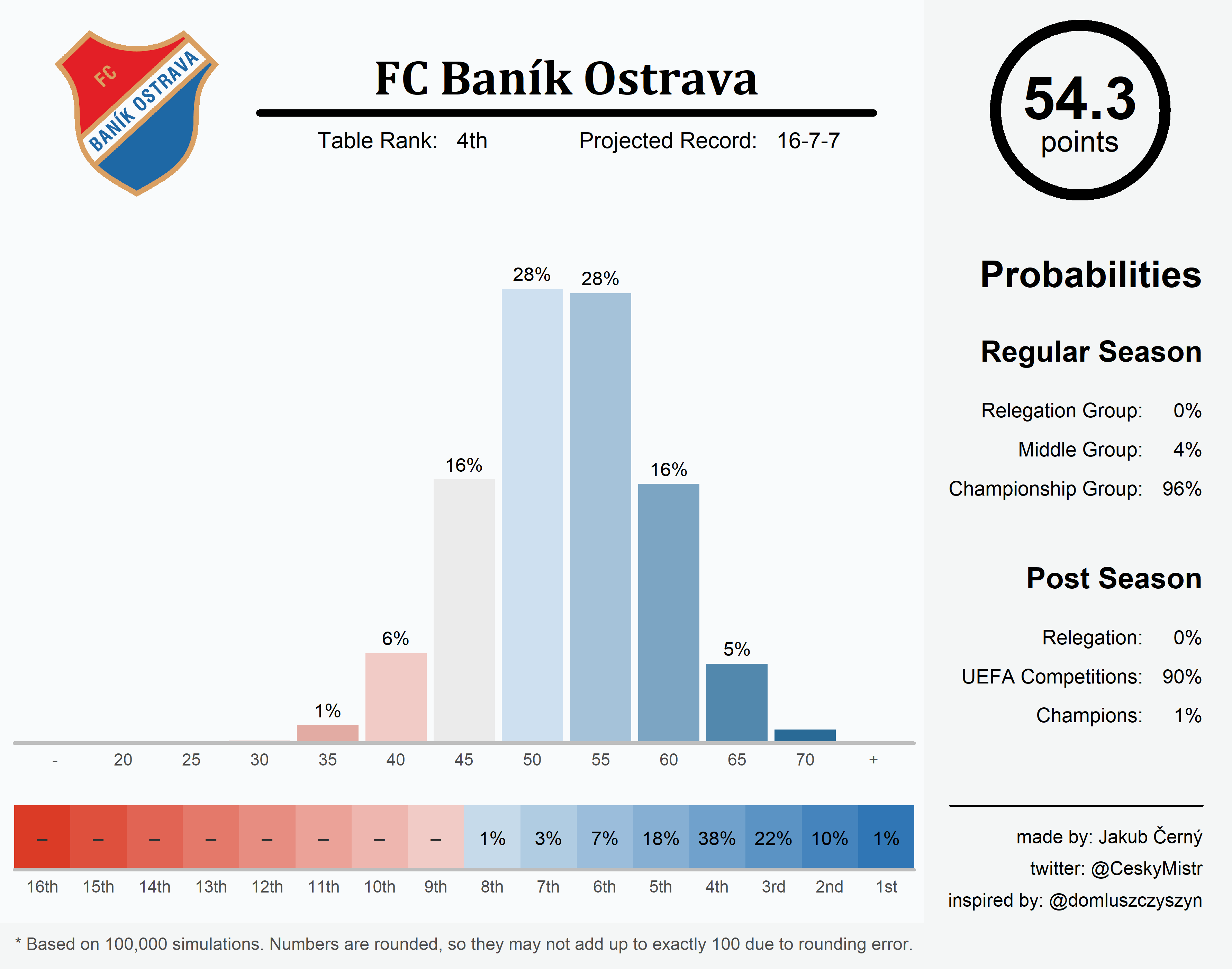
And so it is here, the Top 4 that’s about as set in stone as it gets. Ahead of 22/23, there was a clear Big 3 with a quartet of followers in the 20+ point distance clustered between 41.6 (Boleslav) and 44.9 (Ostrava) projected points. The following summer, the UEFA-tested Slovácko took a step forward, but the gap between them and 3rd Plzeň was still far more pronounced (9.6 points) than the gap between Slovácko and the next Top 4 candidate (4.2 points). Last summer, we were back to some semblance of parity in behind the Top 3; while Plzeň regressed and Ostrava progressed a bit more, they did so at a very slow pace. Baník were still more than 10 points back of Plzeň and only ca. three points up on 5th and 6th.
This year, there’s no lingering doubt. After finishing third for the first time since 2010, Baník are officially closer to land inside the Top 3 (6.1 points) than they are to falling out of the Top 4 (6.3 points). It’s close, but circle back to 2023, and you can appreciate how massive this is for Ostrava. In the two years, no team has propped up their forecast quite like Baník (plus-11.3 projected points). The next team in line (Jablonec) is at plus-9.3. The third (Slavia) at 6.3.
Guys, the boss may not fancy it, but there’s even a non-zero chance of becoming champions! So far, that privilege has only been reserved to the three usual suspects at the top, of course. Baník are not all the way there yet, but they are at least knocking on the Big Boys’ Club doors.
Bold prediction
The track record: 1/4. Hapal decidedly didn’t get fired within 13 rounds
The prediction: Baník will not win a single game in which they fall behind
The rationale: It has been well-documented over the season how frequently Baník managed to roar back after falling behind in a league game. Often not just about any game. In the fall, it was the overturned Karviná derby, partially salvaged Olomouc derby, and the famous three-goal Sparta turnaround. In the spring, Baník once again frustrated Pardubice to score a combined 8 goals in both games where they found themselves trailing inside the first 15 minutes. This was sandwiched by two instances in which Ostrava did the number on two fellow UEFA competition participants, Mladá Boleslav and Plzeň. The latest instance wouldn’t have even happened had Owusu, the second scorer, been allowed to come off seconds earlier as planned. Indeed, it was a marvelous ride — remarkable even in the European context.
Good. I’m sure they enjoyed it, so they can go back to being a little more miserable now.
In 2023/24, Ostrava turned a total of 15 deficits into a pair of victories. The year before, also led by Hapal, they were actually one of four teams to not win a single game after falling behind. All I’m saying: taking 22 points from 16 nervous games is not a normal to get used to.

Enjoyed the text or the visuals, but don’t care for 🇨🇿 translations and dashboards? No worries, you can still support us by inviting us for a symbolic pint at the old BuyMeACoffeeBeer page.