Metrics contained in the glossary of terms are based on my manually tracked data, or raw Wyscout data.
Metrics marked by ★ appear as part of the individual visuals, known as pizza charts.
Metrics marked by ☆ are considered as part of overall percentiles featured on pizza charts.
Both of these sets of metrics, weighted as per below, contribute to rankings featured on comparison visuals.
Some metrics, with no symbol, are only referred to as part of the various texts, without reflecting on charts.
This summer, I am also letting you in on the weight applied to the particular metric when it comes to producing an overall percentile for the position. With a much wider range of metrics now considered following the adoption of the vast Driblab database, it has become more important than ever to note that not all metrics are created equal; ie. considered equally vital when comparing the players. If there is a “Weight” missing, it means the metric has a purely informative value and was not used to “judge” the player.
(I) PRIME OFFENSIVE OUTPUT
HIGH-DANGER SHOTS
Source: Wyscout.hudl.com / manually tracked (for correction, and self-creation tracking)
Weight: 100%
After initially considering any shot worth at least 0.2 xG a "high-danger" one, I lowered the bar to 0.15 in 2024 and I think I am sticking to it. This is based on vast experience of reviewing every shot tag since 2022, and while an arbitrary cut-off will never be perfect (0.14-xG shots are still very dangerous), I'm also confident in calling every 0.15+ xG shot a genuine goalscoring opportunity. Any time one creates a chance for himself, he gets a bonus point for getting into dangerous positions.
EXPECTED ASSISTS
Source: Wyscout.hudl.com (heavily corrected through manual tracking)
Weight: 100%
Wyscout's measure of threat generated, inclusive of set pieces. Mind that xA value is only assigned to a pass/cross that directly precedes a shot; any sort of a partial touch from the opponent along the way, or even a longer dribble/run with the ball from the finisher, normally leads to no xA.
SUCCESSFUL ACTIONS IN PENALTY BOX
Source: Wyscout.hudl.com
Weight: 100%
This is basically any successful execution in the penalty area — be it a pass, a cross or a shot (only those directed on target count as successful); excluding ground duels, aerial duels or fouls. As opposed to attacking midfielders, I go for successful actions per 90 mins rather than success rate to get a feel on how often the winger influences the game in true danger areas effectively.
EXPECTED POINTS ADDED
Source: Manually tracked
Weight: 100%
Via all goals, only meaningful assists (ie. not just balls handed over to the lucky/sharp shooter at the edge of the box), and from 2025/26 onwards, also for any meaningful indirect goal contribution (at a lesser weight). Here's full explanation of the innovative model, initially introduced by CSfotbal.
For reference, here's the final leaderboard for 2025/26.
OPEN-PLAY CHANCE/GOAL CREATION
Source: Manually tracked
Weight: 100%
My own alternative to Wyscout's flawed xG/A, where I don't care for unfinished business. As long as the player delivers the ball to a dangerous position, onto his teammate's feet, he gets credited regardless of the outcome. Sometimes, if the teammate doesn't time his slide properly or wildly miscontrols the ball, the "on his teammate's feet" caveat doesn't apply, either. As opposed to xA, I also disregard set piece delivery to make sure the comparison is fair and indeed feasible.
GOAL INFLUENCE INDEX
Source: Manually tracked
Weight: 50%
A brother to the goal culpability index, this one is only relevant for attack-minded players. The index combines the player's involvement in goals scored with him around (ie. how often did he take up one of the 5 slots available per goal scored), and the goal scored rate per 90 mins with him on the pitch.
XG CHAIN FINAL THIRD
Source: Driblab
Weight: 50%
Driblab is much more playful with xG than Wyscout. Here I am leveraging on their metric that speaks to a sum of xG the player in question took part in, exclusively within the final third.
TEAM GOAL INVOLVEMENT
Source: Manually tracked
Weight: 25%
As previously noted, I assign up to 5 goal-creating slots to any goal scored; the scorer takes one, the helper takes another, and I can credit as many as three more people for delivering valuable contributions. But these really need to matter; it can be a penalty foul, a set piece delivery causing chaos, a pass splitting the defence followed by an exchange of the official goal contributors, anything. But it must be the kind of an action where if you take it away, everything falls apart.
LUCK INDEX
Source: Own construct, riding on data from Wyscout.hudl.com
Instead of looking at actual goals and expected goals discrepancy to find "(un)lucky" finishers, as many fans or journalists do, I have designed a simple concept doing — in my humble opinion — a far better job in capturing the actual luck factor. Instead of (pre-shot) expected goals, I am taking (post-shot) expected goals scored into account, deducting non-penalty goals scored, while any woodwork hit counts as a minus-0.7 goal against expectations. Previously I considered a bar/post to be worth 1 full goal, which wasn't quite right, but it's obvious that the finisher comes pretty close to actually scoring by hitting it, so I still go rather high with my valuation — in the vicinity of a penalty shot.
WOWY
Source: Manually tracked
In the case of an extreme, I might refer to the so-called "with or without you" index of sorts. There are a number of variations. I could look at goals scored or chances created with or without him around, separately, or lump goals together with chances and compare various averages.
(II) SMARTS & TOOLS TO GAIN THE ZONE
OPEN-PLAY PENALTY BOX ENTRIES
Source: Wyscout.hudl.com / manually tracked (for danger creation via first touch, feel for the game)
Weight: 100%
The number of times, normalized per 90 mins, a player enters the opposition’s penalty area in open play — via a carry, a cross, or a pass. It discounts set pieces for fair comparison. In addition, a co-efficient benefitting prolific chance/goal creators via superior touch and feel for the game is applied.
EXPECTED THREAT VIA PASSING
Source: Driblab
Weight: 100%
This is the Driblab staple metric, but only accounting for passing plays.
OFFENSIVE DUELS WON UP HIGH (%)
Source: Wyscout.hudl.com / manually tracked (for danger-creating actions via battles and dribbles)
Weight: 100%
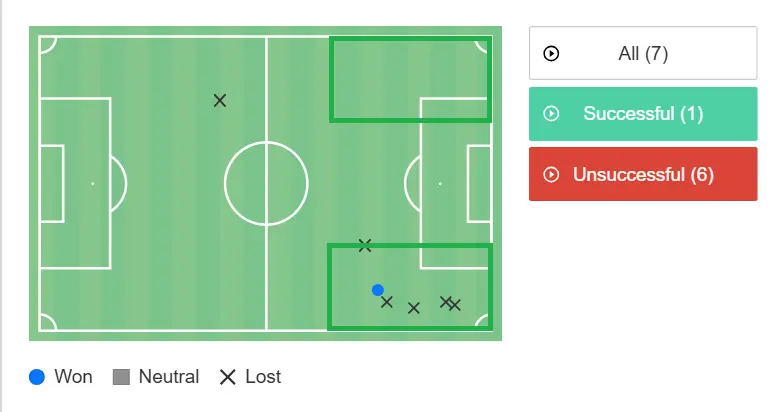
Here, I am severely limiting the space where an offensive duel needs to occur for it to count. It roughly corresponds to this area, and for two main reasons. Firstly, the relevant grouping of metrics is called "gaining the danger zone" and so this stat is supposed to capture the "entering" phase rather than what happens inside the box itself. Secondly, a great winger still needs to primarily dominate their own channel; so this is basically a mirror to fullback's 1v1 defending of his own channel.
CUTBACKS
Source: Driblab
Weight: 75%
Previously only considering this metric for FBs, now I am including it for Ws too, better capturing their full range of tools. Driblab defines this as "passing from baseline to back and inside the box".
OFF-BALL RUNS TO RECEIVE CROSS
Source: Driblab
Weight: 100%
A decent, proactive winger not only delivers the ball to the penalty box, he's also sometimes there to sweep it up. That's what this metric is designed to capture, looking at how often the player enters the box in a position to receive a teammate's cross. Whether he gets to finish or not is secondary.
LINE-BREAKING THROUGH BALLS
Source: Driblab
Weight: 100%
Switching from Wyscout to Driblab, I'm still interested in passes that penetrate the defensive line.
% OF CROSSES BLOCKED EARLY
Source: Wyscout.hudl.com
Weight: 100%
Even in the inverted winger era, crossing remains a big part of one winger’s game which is why most public models or databases include crossing accuracy. I myself had considered “accurate crosses to centre of the box” in 2021, but I quickly dropped it as a metric, and I’ll explain why: it’s too random. Is it necessarily the winger’s fault when he delivers the ball into the danger area only for no one else to take a hint and make the run? It quite often is not. Is it, however, the winger’s fault when his delivery gets blocked before it even enters the penalty area, potentially kick-starting a dangerous counter? It rather often is, yeah. So that’s what I’m looking at here. I don’t care if your cross doesn’t quite connect as long as it can feasibly lead to a lucky bounce or even an own goal in the end.
DEEP PASSING
Source: Wyscout.hudl.com
Weight: 75%
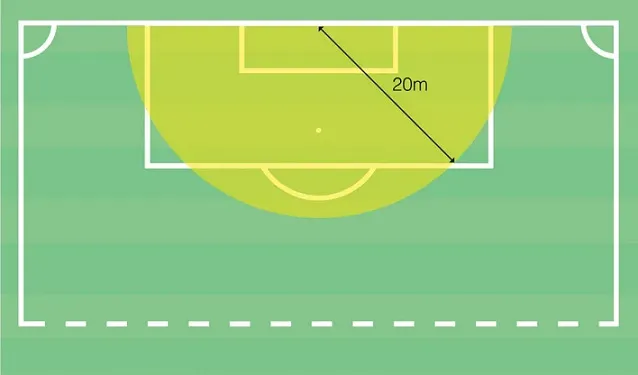
A deep pass is completed inside this area, and it can be both one that enters the area, or one that begins and concludes its journey within it. To add a bit more flavour on top, a co-efficient accounting for accurate smart passes ("a creative and penetrative pass that attempts to break the opposition's defensive lines to gain a significant advantage in attack" per Wyscout) is applied.
SUCCESS RATE IN ENTERING THE BOX
Source: Wyscout.hudl.com
Weight: 50%
When entering the box from open play, a winger in particular should think a little, since they normally have vast acres of space to utilize. While the metric speaking to the number of successful entries inherently favours players on big teams, enjoying loads of possession, this one does not.
(III) BALL PROGRESSION & EFFICIENCY
QUALITY ADDED TO FINISH
Source: Wyscout.hudl.com (heavily corrected through manual tracking)
Weight: 100%
Most data analysts would tell you finishing is too random to be worth spending much time — or any time — on dissecting it. It’s tempting to agree, since the very reason why Plzeň won the shocking 2022 title was all the same a big reason why Plzeň bombed the year earlier. It’s exactly for this unpredictability and virtual impossibility to detect any longterm trends that most data analysts readily give up on sizing up finishing ability altogether. I refuse. First of all, this particular metric still tells us a valuable thing or two even if we shouldn’t read too much into it. If the individual sum of xGS (expected goals scored; ie. post-shot xG) far exceeds the sum of xG (expected goals; ie. pre-shot xG), it can effectively mean two things: the player in question A) has a fine shooting technique so his shots tend to have a decent chance of beating the keeper, be it through sheer power applied or fantastic placement B) doesn’t miss the target all too often, because a shot off target doesn’t get assigned any xGS value. There are absolutely trends to be found along this line of thinking in particular, and you'd be surprised how consistently poor/great some appear to be per this metric.
METERS GAINED VIA BALL CARRIES
Source: Wyscout.hudl.com
Weight: 100%
This metric, normalized per 90 mins, measures how many meters a player advances the ball through successful carries, excluding passes. It calculates the difference in distance to the opponent's goal between the start and end point of a run or dribble, counting only forward movements.
EXPECTED THREAT VIA DRIBBLES
Source: Driblab
Weight: 50%
This is the Driblab staple metric, but only accounting for ball carries.
SHARE OF SHOTS FROM THE PERIMETER
Source: Wyscout.hudl.com (heavily corrected through manual tracking)
Weight: 50%
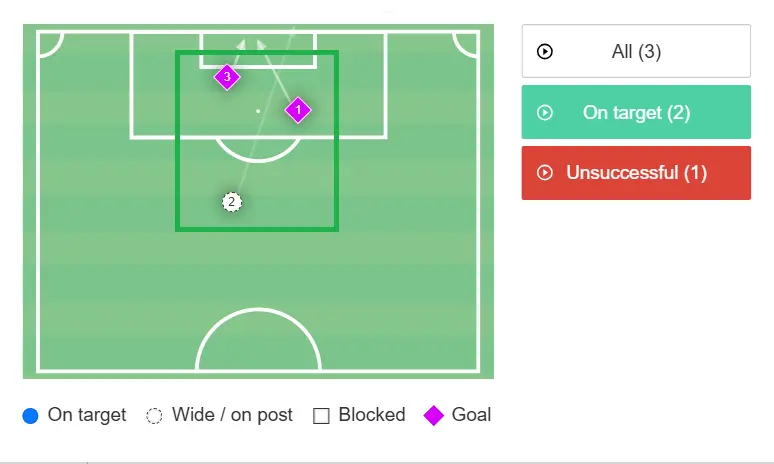
The central areas are, generally, where a vast majority of goals are scored from. You probably don't need scientific studies for that. This is why I designed a new metric in 2025 specifically for attacking midfielders and wingers, looking at how often they pull the trigger from the high-danger zone as opposed to trying their luck from the perimeter; ie. anything outside the green boundary here.
NET EXPECTED THREAT
Source: Driblab
Weight: 100%
Per Driblab's own glossary, "Expected Threat (xT) is a metric that measures the threat a player creates to the opponent by carrying or passing the ball to areas where the possession's probability of ending in a goal is higher". At the same time, Driblab also tracks how the player allows dangerous areas to be penetrated at the other end, which is exactly where the "net" aspect comes in play.
ACCELERATIONS
Source: Wyscout.hudl.com
This stat captures meaningful ball-carrying surges — defined as runs of at least 10 meters featuring a notable increase in speed. Only actions in possession count — pure off‑ball sprints do not.
BALL RETENTION INSIDE ATTACKING HALF
Source: Driblab
Weight: 25%
I am here to admit that "retain the ball" is not exactly the first instruction coaches tend to shout at their wingers, but hear me out. A winger's efficiency can indeed be easily measured by how well he picks the opportunity to do the risky thing. To that end, you'd be surprised how high even the most daring wingers like Haraslín or Slončík rank in 25/26. At a lesser weight, this is absolutely worth it.
(IV) PROACTIVITY & DISCIPLINE
FOUL DIFFERENTIAL
Source: Wyscout.hudl.com
Weight: Q00%
Not just a simple fouls won minus fouls conceded, but also normalized per 90 mins, because being a minus-12 in 10 starts obviously isn't the same as being minus-12 in 30. The former stinks more.
PRESSURE APPLIED UP HIGH
Source: Wyscout.hudl.com / manually tracked (forced high turnovers leading to tangible danger)
Weight: 100%
A standard feature: I take balls recovered in the final third (Wyscout) and add a weighted cherry on top in the form of forced turnovers leading to goals/chances. This adds a bit of a purposeful touch.
SUCCESSFUL LOOSE BALL DUELS
Source: Wyscout.hudl.com
Weight: 75%
As opposed to elsewhere, I am not too concerned with the success rate here; I simply want to see how many races — shoves and pulls — for a free ball in no one's possession the player in question successfully navigates per game. That, and only that, tells us something about his proactivity.
OFF-BALL RUNS IN BEHIND
Source: Driblab
Weight: 75%
Forward runs that break into the last defensive line, getting between defenders and goalkeeper.
DEFENSIVE ACTIONS
Source: Wyscout.hudl.com
Weight: 100%
"A defensive duel, interception or a sliding tackle made by the player", normalized per 90 mins.
SUCCESSFUL ON-BALL PRESSURES
Source: Driblab
Weight: 100%
Number of successful on-ball pressures (within 0-4 meters from the opponent) per 90 minutes.
DISTANCE TRAVELLED AT HIGH SPEED OR IN SPRINT
Source: Driblab
Weight: 50%
I don't think a player running fast for long is necessarily a good sign of anything, but it's trendy, so here you have it at a lesser weight. I specifically look at the percentage of time spent travelling at high speed or in sprint (above 19.8 km/h). The portions range from 7.2% to 13.3%, even more substantial for wingers than fullbacks, so I thought it'd be worth it. (And yes, Liberec sweeps it.)
OVERLAPS & UNDERLAPS
Source: Driblab
Weight: 25%
Movement where the player gets around a teammate in possession, from the inside or the outside.
INVOLVED IN ATTACKING OUTPUT
Source: Manually tracked
Weight: 100%
My full-season notes include any tangible danger created by a team — be it a goal scored (with 1 slot for the official assist, up to 3 slots for any other meaningful contribution in the build-up), or a goalscoring opportunity wasted (up to 2 chance-creating slots). As long as the player features as a creator or a finisher, he's considered involved. In the end, I take the % and see who was the most proactive ("out there") for his team. The range is very wide for Ws — from 13.8% to 48.1% in 25/26.
SUCCESS RATE WITH DRIBBLES INSIDE OWN HALF
Source: Driblab
Some didn't register a dribble, some registered too few to fuck up even once, so I couldn't possibly include this metric in the scoring. But I may refer to it in particularly relevant cases or extremes.