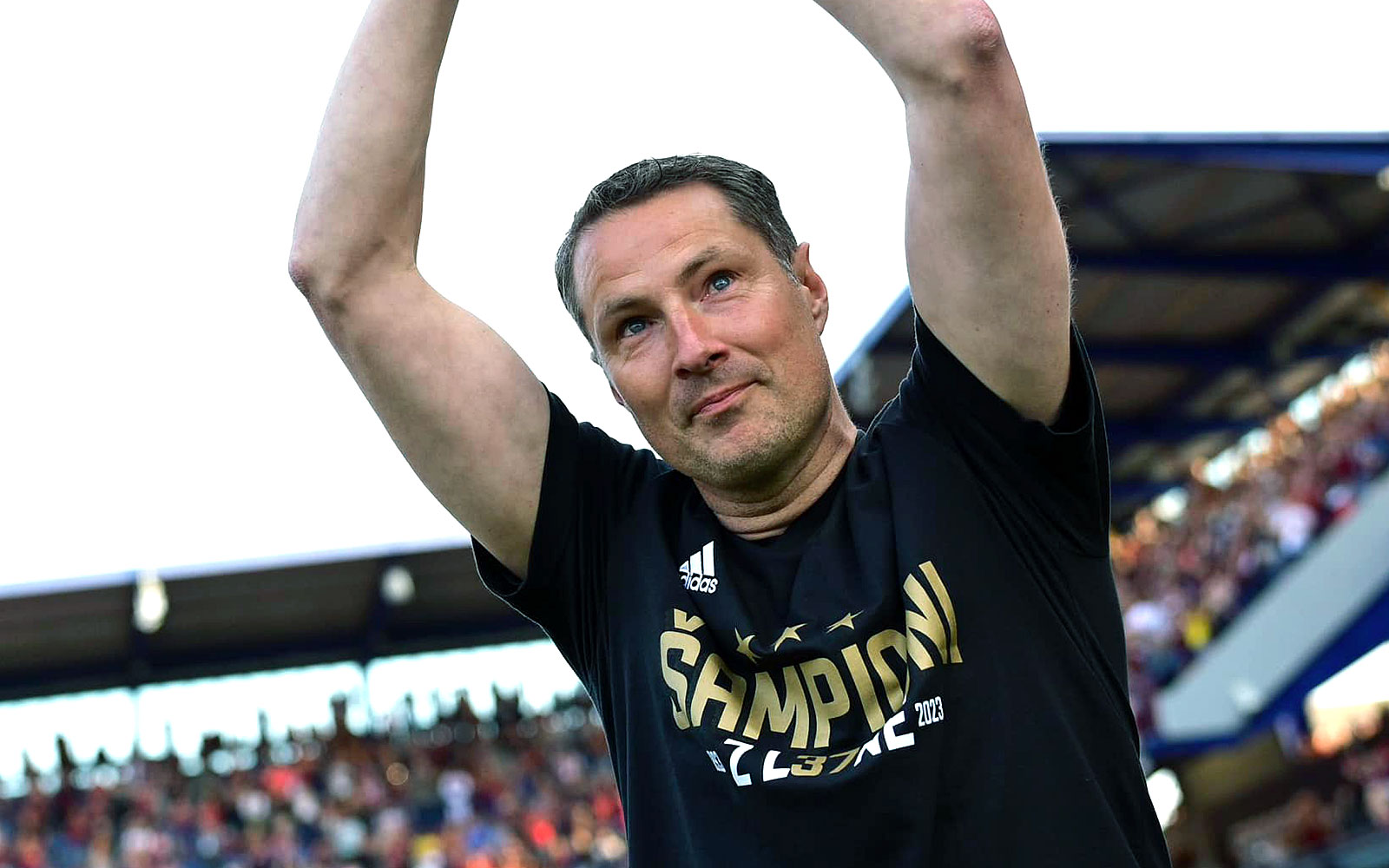
You’re not supposed to step into the same river twice — but Brian Priske isn’t much for proverbs, as evidenced by his less-than-blessed attempt to prove that the grass is greener in Rotterdam. Just a year after guiding Sparta to a long-awaited double, he’s back at Letná, undeterred by a short-lived and rather damp detour at Feyenoord. It wasn’t exactly a triumphant leap to a bigger pond, but Sparta fans won’t mind. To them, he’s still the man who had turned water into wine — and they’ll happily take a second vintage.
There’s not many past cases of successful coaches returning for a second run, much less after a break-up that wasn’t supposed to be a particularly amicable one. Yet, in the most straightforward sense, Sparta itself did enjoy some memorable second or even third runs under one leading voice. The legendary Václav Ježek, though tempting, is an unrelatable extreme, coaching Sparta in three different decades while skipping one (1970s). Vítězslav Lavička also offers up an imperfect parallel, since his stints preceding the one culminating in the remarkable 2013/14 title run were of temporary kind. Jozef Chovanec also enjoyed too long a break between the 1997 and 2010 titles, plus he left amidst an ongoing season.
For possibly the closest parallel, one’s got to reach all the way to the start of the sweet 90s. Jozef Jarabinský was leaving Letná a two-time champion in 1990, only to re-appear five years later to effectively save Sparta’s title challenge (five points back of Slavia with 11 rounds to spare), and then perform a marvelous half-a-season job the other way round, setting Jiří Kotrba up for a success with a dominant fall 2002 featuring 11 victories in 15 rounds.
There is a precedent of sorts, then, though what’s funny is that Priske himself is now living through a bit of a déjà vu: back in summer 2022, he was also following up on a derailed spring (actually delivering two more points, including the post-season, than this one) punctuated by a domestic cup final loss against a presumed underdog. Only this time, of course, he’s arriving to follow up on his own right-hand from the two title-winning seasons, with almost all of the old backroom staff gone. At least he’s bringing Lukas Balabola back with him.
There has been a rapid shift from Denmark to the British Isles in Sparta’s continuing internationalization. And an influx of new ideas. Christian Clarup, who had revolutionized conditioning at Sparta and deservedly left for Bundesliga, has made way for Ian Coll who’s said to prefer two-phase trainings and extended time in the gym to Clarup’s best practice of short, high-intensity sessions. There’s now a sport scientist, a whole trio of goalkeeping coaches, a dedicated set piece coach with Brentford, Man City or Wolverhampton featuring on his résumé, and a former head coach of Newcastle’s U-21 assuming the position of the first assistant formerly filled by Lars Friis (whose return also hasn’t been ruled out).
Of course, the two changes that made numerous headlines were the forced departure of chief doctor after he punched Jan Král in the cup final, and the (also forced?) departure of chief scout Jiří Rosický. Their most recent track records visible to public didn’t exactly flatter them, though there’s little clarity as to which arrivals Tomáš Rosický’s brother should get the credit for (apart from the open secret that is Jan Kuchta). Most importantly — and without indulging in conspiracy theories — parting ways with Jiří Rosický almost certainly opens the door for Sparta to professionalize and expand their scouting department. Something they are likely in the process of already, with Priske hinting at a long transfer window. They will for sure need it, as well as a couple of homeruns along the way, to catch up to Slavia…
Looking back on 2024/25
What went (particularly) right
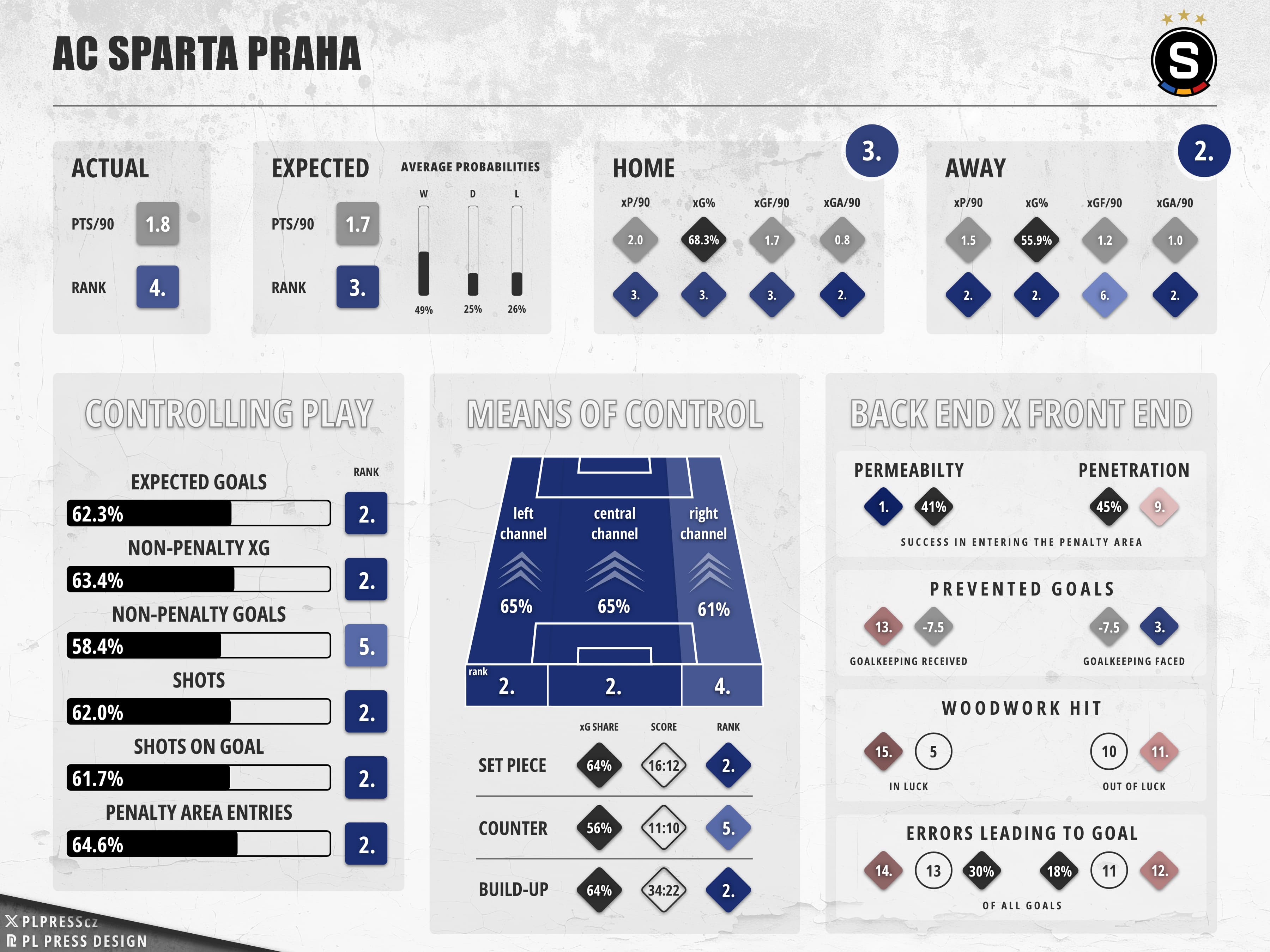
On 20 September, Deník Sport ran with a screaming headline “Friis is a jackpot” and a sub-title reading “The sensational start to the Champions League campaign is down to the coach, Sparta is no longer fragile“. I’d like to say it was the classic mainstream media jumping the gun, but you’ve got to remember one thing: at that point, we were already two months deep into the season, and Sparta were on par with Slavia (19 points from 7 rounds). It quickly became clear it was the league schedule propping Sparta up, but for those first 8 rounds before the Sigma debacle hit, Friis’ boys were at the top of the world by all metrics; creating danger to the tune of 2.17 xGFExpected Goals For (xGF) estimates how many goals a team should have scored based on shot quality, location, and context. per game, allowing opportunities totalling an average 0.72 xGAExpected Goals Against (xGA) estimates how many goals a team should have conceded based on shot quality, location, and context.. Martin Vitík was probably the best centre back in the league — so far back in the past it was.
Apart from that, Sparta also produced a nine-game winning streak split between the end of the fall and the beginning of the spring, but it hardly meant they were back; it was the exact same set of weak opponents (plus weakened Slavia) that made it possible in the first place. The two eight-game periods excluding the wild misrepresentation of Slavia’s strength (R1-8; R17-24) are, ultimately, what built the solid team card you see above. Across those 16 games of 15 wins and 1 draw, Sparta owned a 71.5% non-penalty xG share; in the other 18, it was 51.8%.
What went (especially) wrong
It’s naturally a long long list. There’s the historic Atlético beating, coupled with allowing all of Olomouc, Baník and Jablonec to break the Letná curse after a significant period of time (12, 10 and 18 years respectively) while somehow shipping three goals on each of those occasions. You could argue Sparta got stuck in an unfortunate Groundhog Day at some point in the spring (between R21-29, six opposing goalkeepers put in a shift against them that now rank among the 100 top performances of the season; preventing nearly five goals). But that’s little excuse for Sparta trailing at the break in six of their final ten matches — a trend that effectively set up the limp, one-point post-season showing. Sparta ultimately wrapped up 24/25 with the fourth lowest average xGF around over the last 10 matchdays.
What’s probably the most embarrassing bit on the entire embarrassing season: Sparta registered only the third case of conceding 20+ goals at home (22) since the early 1960s, spending a mere 38.7% of the time ahead of their opponent (lowest percentage since 18/19).
Most valuable player (still on board)
Per my MVP model (traditional stats): Lukáš Haraslín (ranked 7th league-wide)
Per my positional models (advanced stats): Lukáš Haraslín (100th overall percentile at W)
Per Statsbomb’s On-Ball Value (OBV) metric: Lukáš Sadílek
There is no doubt in my mind Sparta’s campaign would’ve turned out far better had Lukáš Haraslín managed to make himself available for more than just the 44.7% of the time. In such a limited space, totalling just over fifteen and a half appearances, Haraslín got shortlisted for the official Team of the Week twelve times, delivered as many IGImportant Goal (IG) was either a go-ahead goal, or an equalizer. The rest is a standard goal. as Pavel Šulc (8) in more than twice as many games, almost as many goal contributions as Matěj Vydra (16 to 17), fetching marginally less EPAExpected Points Added (EPA) estimate the value of one's goals and assists based on game state (late game winners = top). (11.5) than Ewerton or Chorý, and more than Zorvan or Provod.
There’s also only a short discussion to be had about who the best winger in the league was. I always laugh at people suggesting Haraslín is predictable in one-on-one’s. Unlike Ewerton or Jan Matoušek, for example, he actually prevailed in a majority of his offensive duels undertaken in the danger areas; a great rarity. With his unrivalled single-mindedness and guile, he created 15 chances for himself (almost one a game) compared to Ewerton’s 6. Haraslín wasn’t too shabby a creator, either, with his xA rate per 90 narrowly beating that of his (more traditionally creative) colleague Veljko Birmančević or Plzeň’s Cadu.
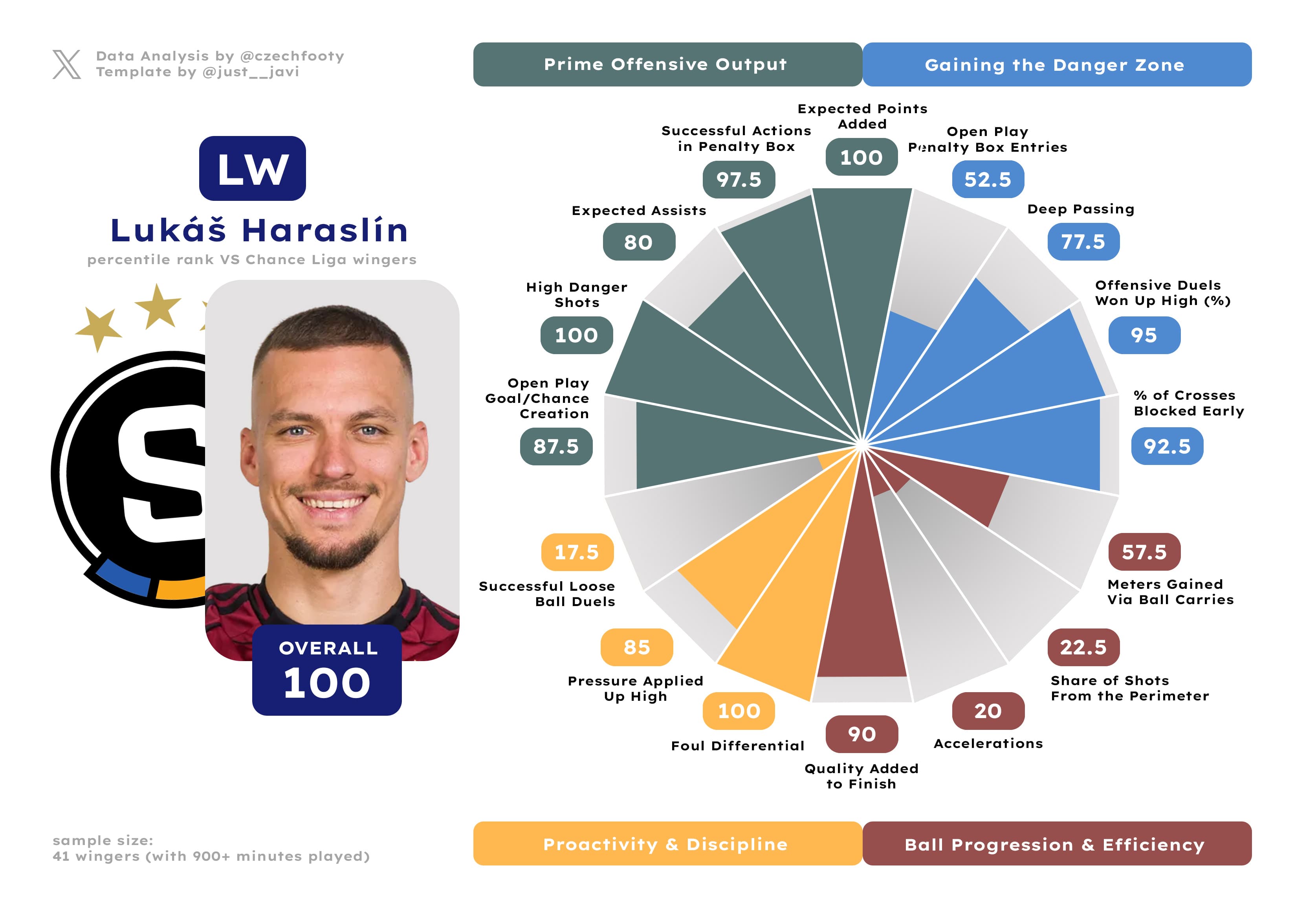
Still, there’s something inherently divisive about Haraslín. To hell with his 3.5 defensive actions per game, landing him towards the bottom of the W list. He’s earned every right to slack every now and that. But it’s interesting to note he was barely above average in cracking the penalty area from open play, despite only seeing 9 of his 55 crosses blocked early. What happened in those 46 cases, and how did he end up with just one assist from a cross?
Chip on the shoulder
carried by the player who’s got something to prove — be it to himself, fans or the coach
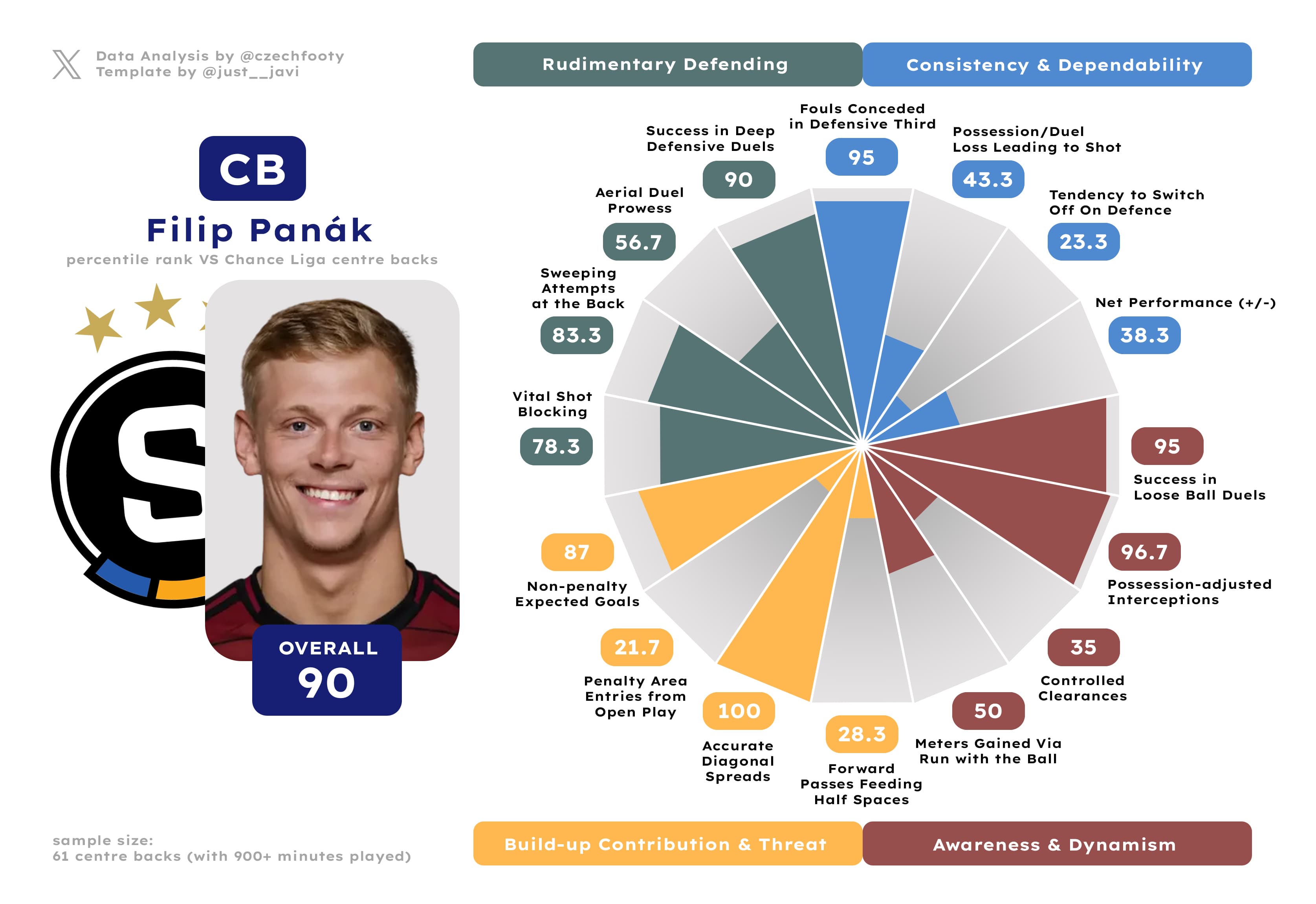
Sparta’s roster is full of players with a lot to prove, but two names stick out to me; for differing reasons. Filip Panák, with his captaincy now officially under review per Priske, was a much-maligned figure throughout 24/25, but it’s fair to wonder to how great an extent the narrative surrounding his humble, quiet persona “unsuited for the captain’s armband” has negatively influenced the perception of Panák the player; largely two separate things.
Without saying that one is more important than the other, the bottom line remains: as opposed to his partners who flanked him for most of the season, Panák was still one of the best centre backs in the league. On balance at least. He did enjoy some high-profile brainfarts, and overall participated on a larger share of goals conceded than Vitík or Sørensen (38.9%; which was true in 23/24, too, when it read 40%), but he was still a premier passer from the back and an interception machine who almost never fouls. What particularly stands out about Panák’s 24/25 is his lacking consistency: where he was net-positive in 14 games when it comes to preventing and causing danger (plus-5 in total) last term, he was now net-negative in 15 (minus-8 in total) — giving off some smelly vibes.
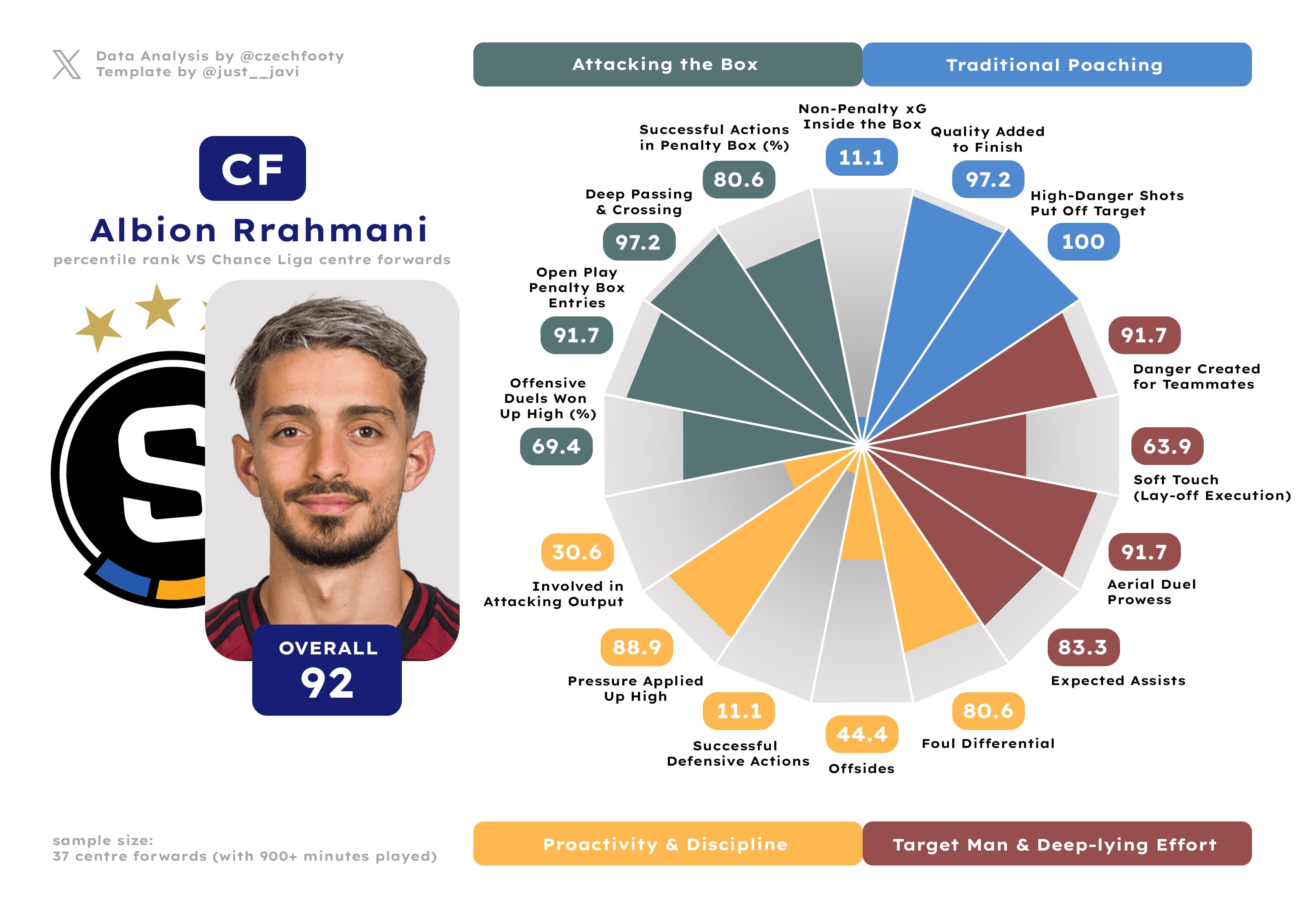
Second player, also recently name dropped by Priske just in a more positive context, is Albion Rrahmani. I, for one, concur he’s not a player Sparta should be giving up on just yet. Let’s do something of a fact-check of Priske’s quote: Finish from inside the box? Not much xG, but a heck of danger — as much as 4.06 xGSExpected Goals Scored (xGS) only takes shots on target into account, including their power and placement on top of xGF. (from 2.83 xG) due to sweet technique and not a single one of his high-danger shots (7) sent off target. Check ✔️. Doesn’t mind either foot? That shows on both his finishing skill, and a top notch success rate in duels undergone at the edge of the box. Can find his teammate? More than two deep completions per game (passes or crosses) tend to agree; Kuchta was on 0.7 per 90 mins. Intensity a bit off? Sure.
Check check check.
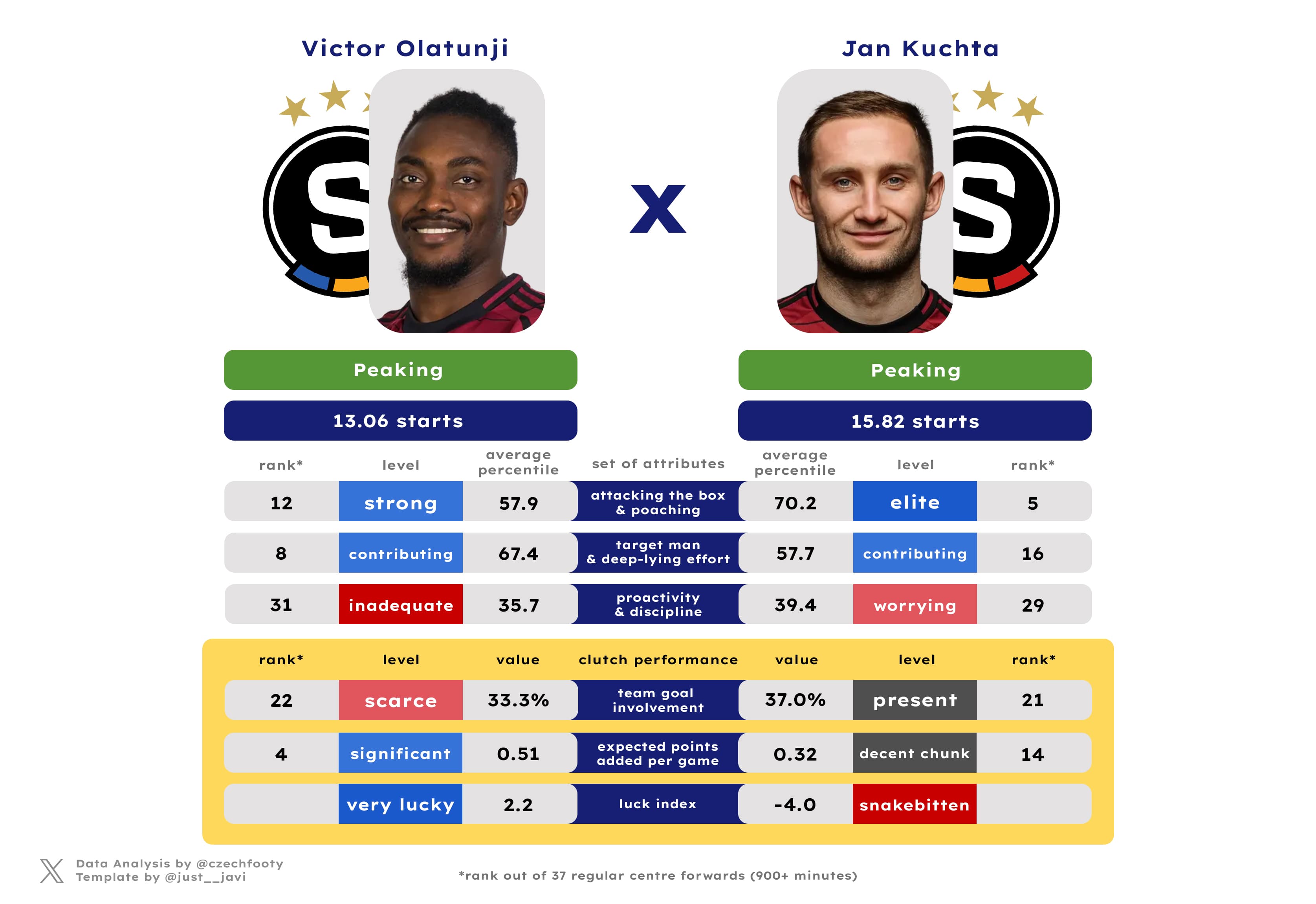
Speaking of Kuchta, I can’t wait to find out whether Priske can wake him up once again. He was a key cog of Priske’s high-pressing title-winning teams, especially the first one (above 94th percentile in pressure applied up high in both), but he looked far more ordinary as Friis’ took the foot off the gas. There wasn’t nearly enough creative output to speak of, either, with Kuchta missing the old Birmančević connection and only creating curious openings for his teammates at the 20th highest rate. Still less of a dead man (literally) walking than King Vic:
Inside the off-season
special thanks for guiding me through the motions of AC Sparta Praha’s off-season go out to @kridelnikv, @odbrzdeno, @martin2121h, @vitastudlar & @interhofer
Squad turnover
Sparta’s issue, contrary to many other Chance Liga participants, doesn’t quite lie in them retaining too few of 24/25 minutes — rather in retaining too much. Even when subtracting Martin Vitík, their 3rd most utilized player, Sparta are keeping north of 85% of all playing time distributed last term. After dropping out of the Top 3 for the first time in seven years and lagging thirty points behind the arch rivals at the season’s end. That doesn’t sound right; and indeed sits right with precisely *checks notes* zero Sparta supporters out there.
Indrit Tuci, Magnus Kofod Andersen, Markus Solbakken or Václav Sejk are not fixing the situation. If both Kaan Kairinen and Birmančević make the leap abroad long desired by themselves, and Victor Olatunji gets the push long desired by the tired fans… now that would be more like it (dropping Sparta to 69.8%). The depressing aspect of all this: there only appears to be concrete interest in Olatunji of all people (Turkey and the US, reportedly).
Biggest upgrade
The introductory video would have been lazy in case of just any new arrival, let alone a returning grandson of Václav Vrána — teammate of Václav Mašek, Tomáš Pospíchal or Andrej Kvašňák on the club’s first great post-war team in mid-60s — who initially arrived at the club of his heart in 1999, amidst Sparta’s joint-longest title-winning streak (5), but let’s focus on the more important, serious things: can he really replace Chance Liga’s best fullback?
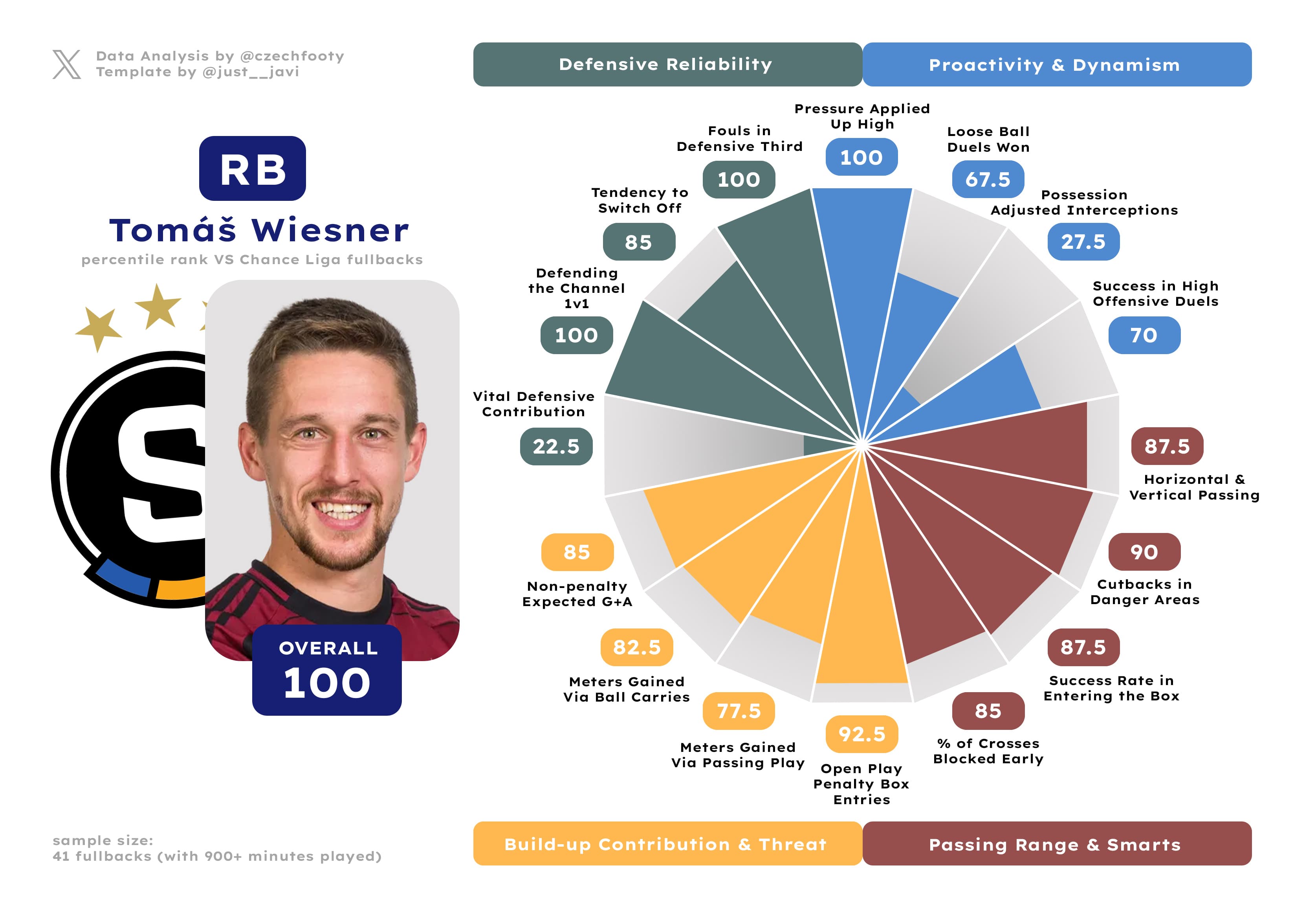
Fine, this is obviously tongue-in-cheek, but is it possible Tomáš Wiesner is leaving Sparta an underrated contributor? Is it possible Sparta will at least slightly miss his ground duel acumen and avid ball-winning up high? Is it possible that Sparta’s xGF plummeting to an average of 0.86 in the last 7 rounds (from the previous 1.62) had something to do with the disappearance of one of the most frequent box infiltrators? I’d say there’s some true to it.
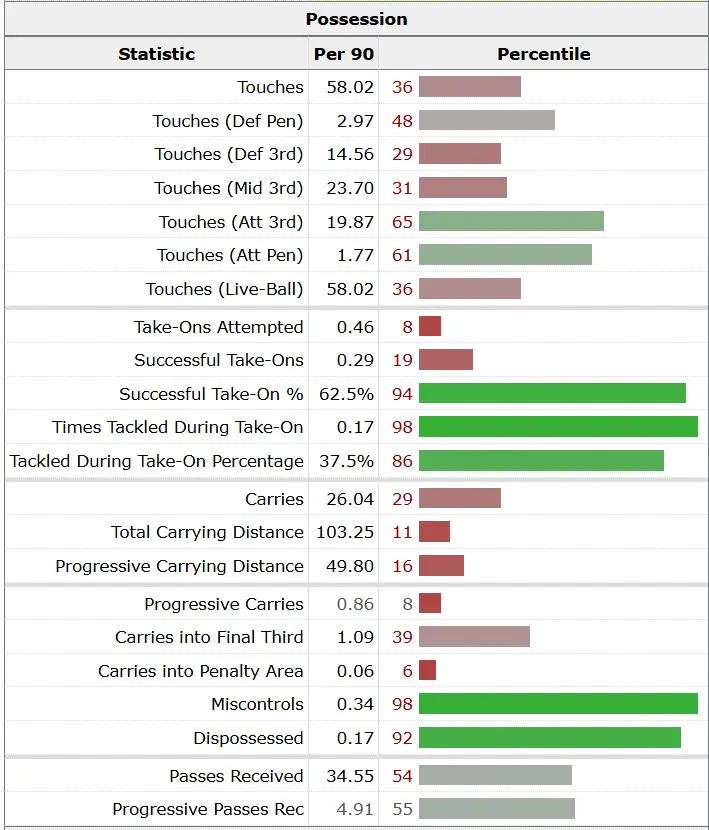
That being said, Pavel Kadeřábek possesses all the pedigree of an eventual upgrade. He mostly wasn’t anything special in 2024/25 Bundesliga, but his aerial strength is an asset, much like his slicing yet economical behaviour in possession per these FBref percentiles comparing him with other BL fullbacks. If the Gebre Selassie comeback is anything to go by, Sparta are in for a ride. But there’s a worry that a 33-year-old who’s always thrived on physicality may not be what many expect — an unquestionable upgrade for months to come.
Biggest downgrade
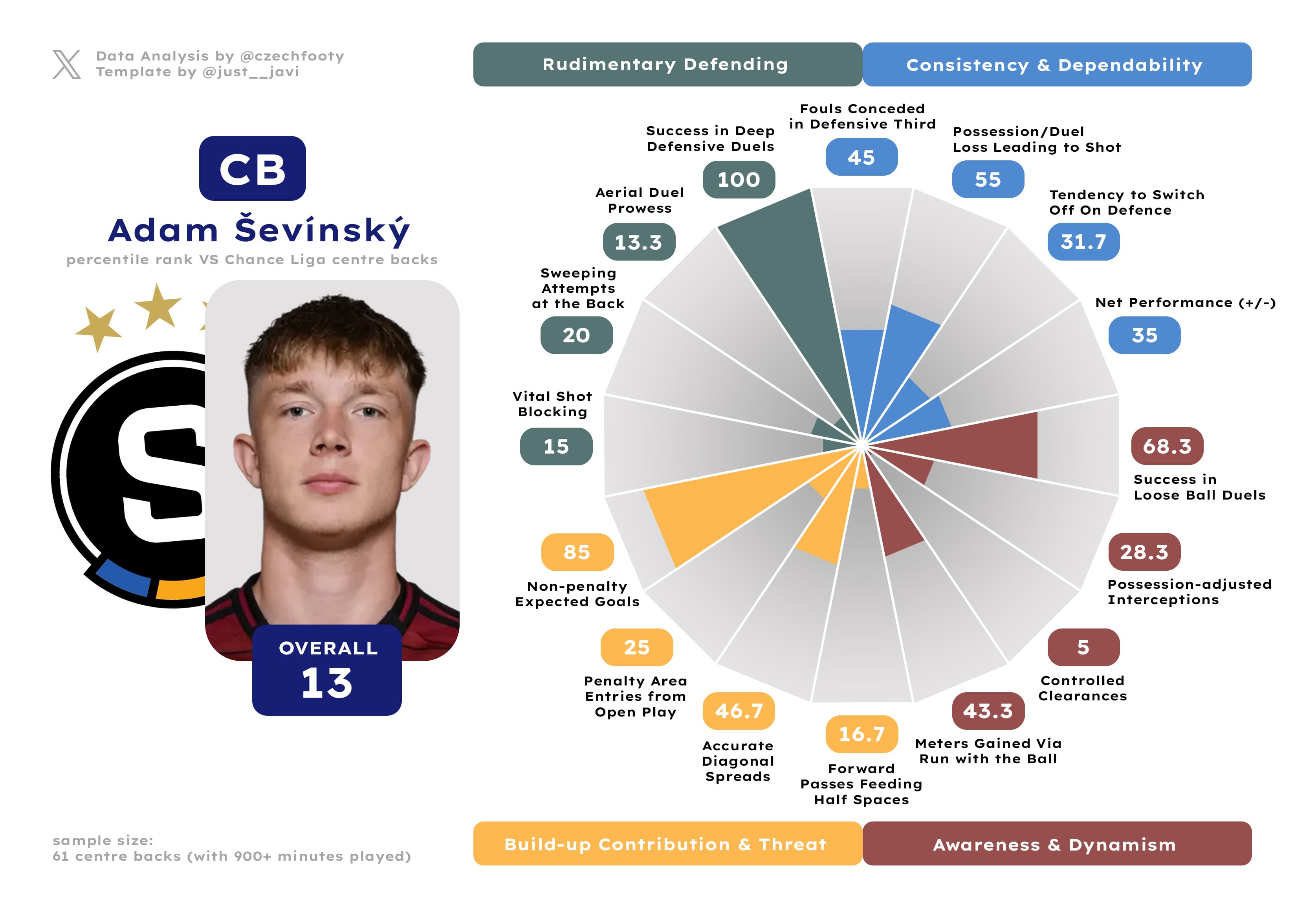
Many were surprised Martin Vitík’s value held firm when Bologna came back for him. I was, meanwhile, highly appreciative of the Serie A side seeing the forest for the trees rather than betting too heavily on half a season’s form. This is still one talented centre back who landed in the top 10% in his age-20/21 campaign. And while 2/3s of this past season didn’t see him hitting the high notes, Vitík at least continued to be an aerial force at both ends of the pitch, posing the most threat (0.14 xG/90) of all CBs, and an above-average ball carrier. Seriously, what would Adam Ševínský, now 21 himself, give for a career arc resembling that of Vitík…
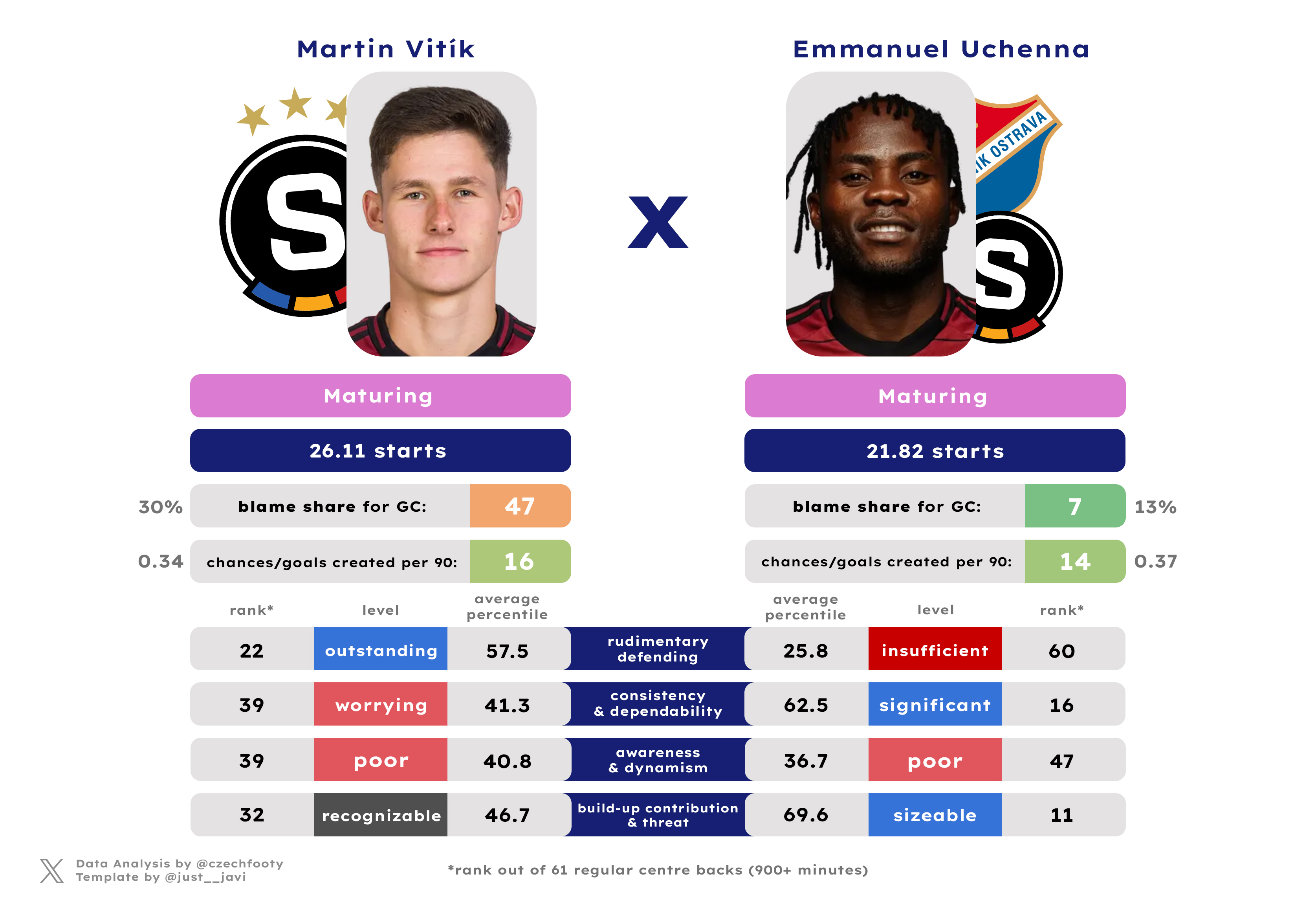
Even as I believe that Uchenna has a decent chance to come through for Sparta, there’s also a serious chance he doesn’t quite reach the heights of Vitík in terms of consistent presence at the back end. For all the hype and a much better pass, Uchenna can appear a lot sluggish.
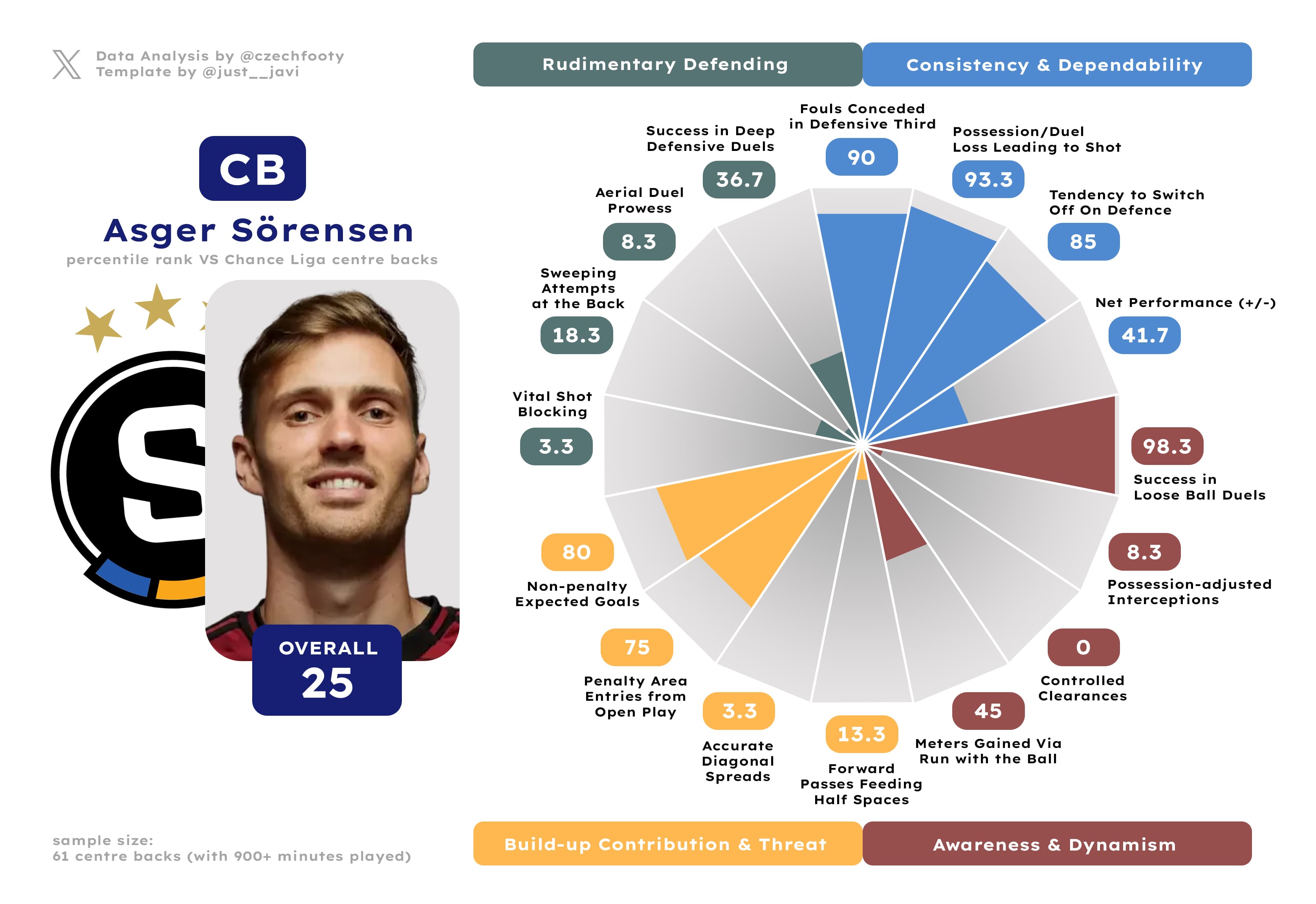
Ultimately, the CB-related downgrade isn’t just about Vitík and his replacement; it’s also about Asger Sørensen effectively making for a sub-par alternative, bafflingly being run ragged by Friis down the stretch, through all the sleepless nights attending to a newborn baby. While partially forced by Elias Cobbaut’s numerous health issues, Sørensen had no business playing as much as he did in the second half of the season, eventually succumbing to an injury of his own after getting exploited by both Plzeň and Ostrava. His pizza is grim.
Need left to be addressed
Even in the title-winning season, Peter Vindahl had a fair share of his critics. A mediocre shot stopper whose main value came in feeding attackers purposefully on a swift counter or otherwise, his only elite quality in 24/25 remained to be… that. Vindahl was once again a remarkable kicker or a thrower, setting up danger a record seven times (1 goal), but other than that, he was a serious liability this time around. If you felt like his concentration levels dipped, your instincts were right: he went from preventing 1.62 goals (roughly 80th percentile) from outside the box to allowing 2.04 goals in those exact same situations (league worst). If you felt like he said “fuck it” in too many situations, not bothering to at least try to pull off a wonder save, you were most likely correct, too: his high-danger save % went down by 7 percentage points. He was no more comfortable on the ball, misplacing 32 low passes.
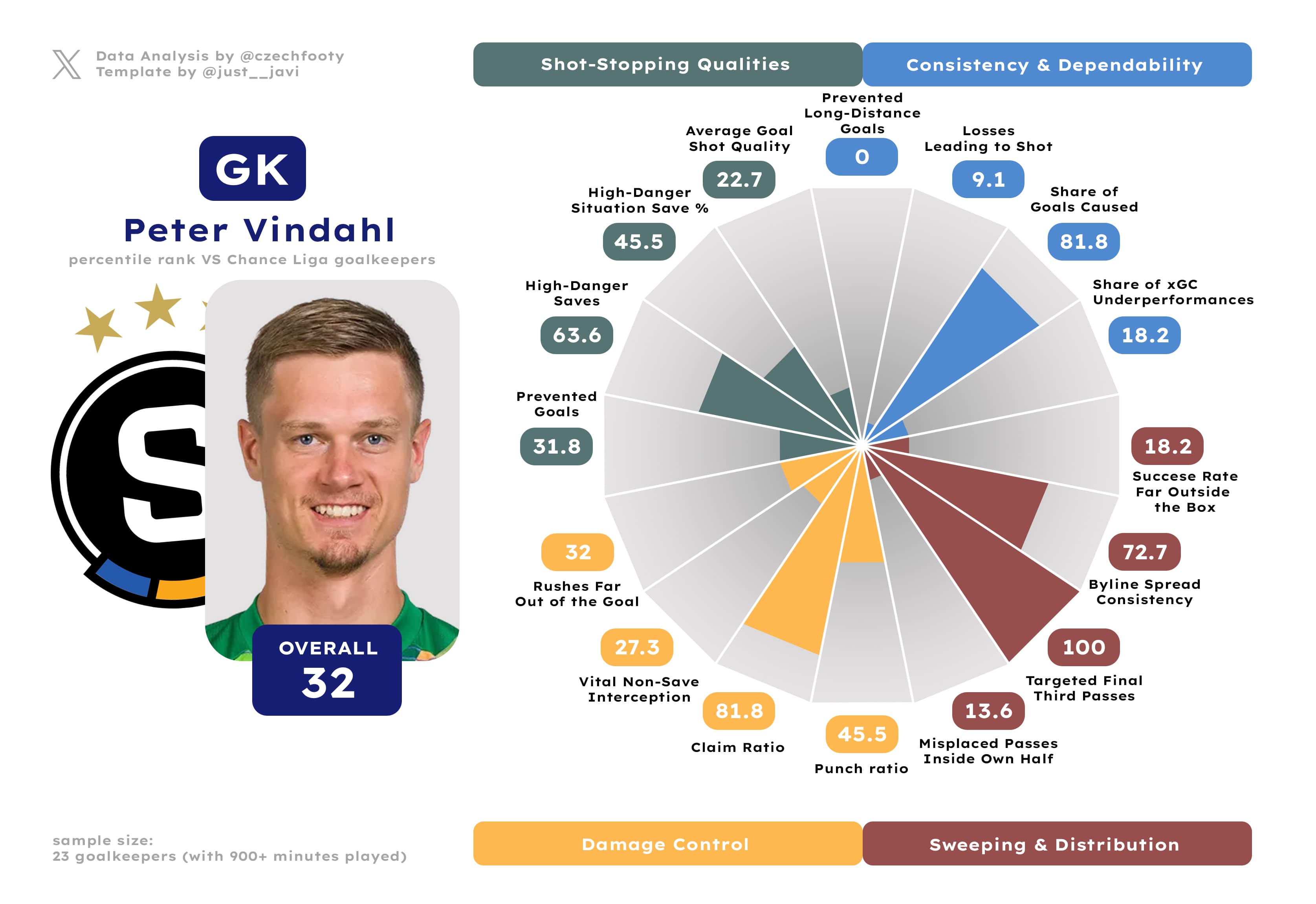
It’s honestly inexcusable Sparta have failed to sign a goalkeeper who would at least competently rival Vindhal, if not outright replace him. Sure, they may be desperately holding onto Joeri Heerkens as we speak, but there’s no avoiding the sense they only just started caring for him when he shone at the U-19 Euro. And as per the most recent reports coming out of Amsterdam, the ship may have already sailed on Heerkens anyway. He’s just a kid, too.
New kid on the block
That being said, there are indeed kids who could end up masking some other needs left to address. If Jaroslav Zelený doesn’t age well and Matěj Ryneš sorts through a couple more injury troubles, Enes Osmani (b. 2004) has flashed some potential at left wingback in the pre-season. If Sparta fail to add a high-end right winger/no. 10 after all, maybe Roman Mokrovics (b. 2006) can finally turn a positive off-season into something of note after an unfortunate injury robbed him of a legitimate chance last year. And if Sparta don’t feel like shopping for a fresh Vitík replacement, Ivan Mensah (b. 2004) seems ready to factor into the first-team after initially getting signed from Banská Bystrica for the reserves only. For a newbie, he strikes Martin as a keen student of the game, an active communicator, and his physical parameters are impressive at a glance. The first impression was as strong as it gets.
Looking ahead to 2025/26
Below is the team’s current(ish) depth chart with a maximum of 4 alternatives for one position. The colourful ratings are a static snapshot of the league-wide situation on 5 July, and they are just a playful bit to add flavour to it; the names featured should be relevant to this day. To learn more about my approach to constructing depth charts, with all its limitations, head here.
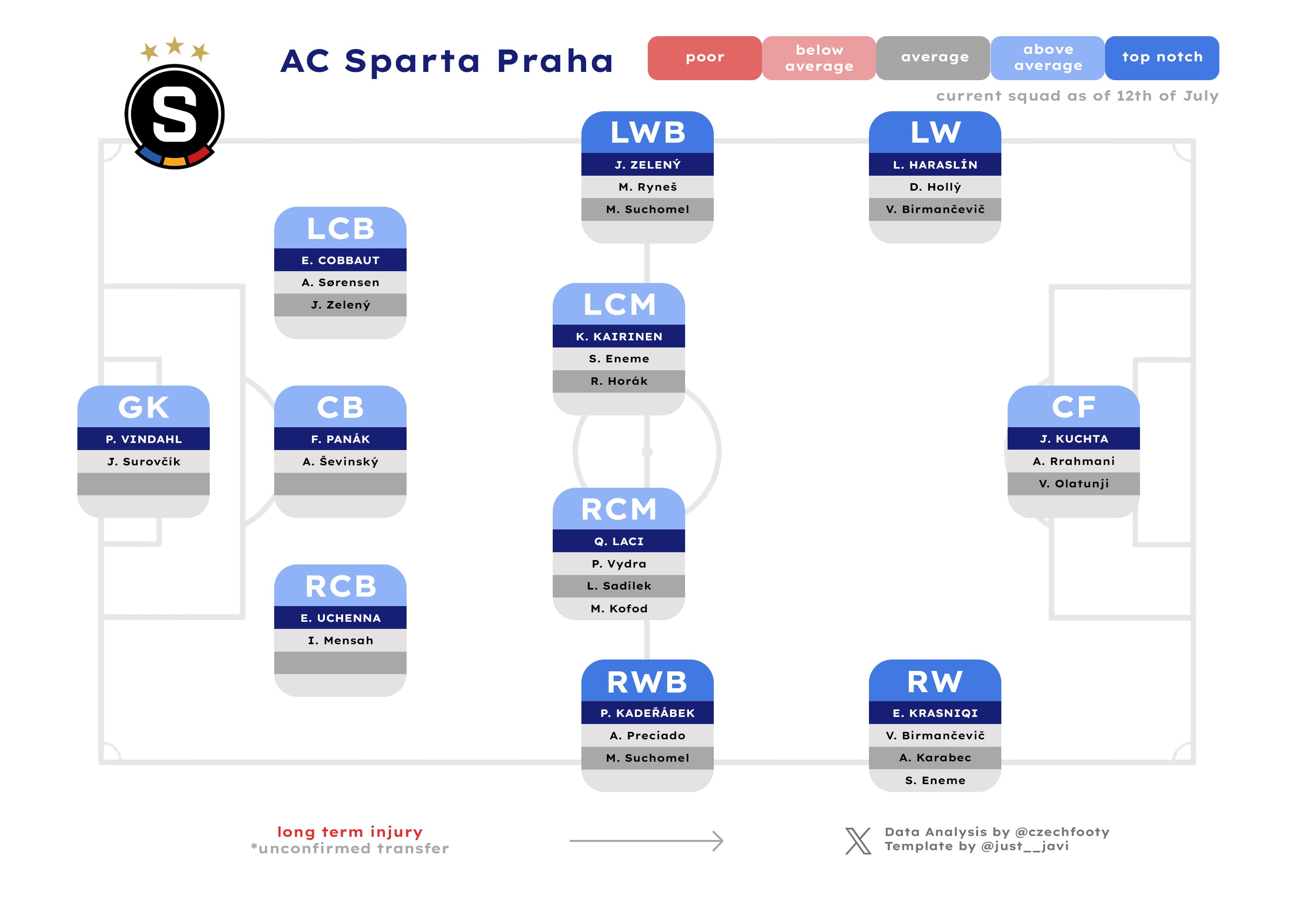
Primary formation
It’s going to be more of the same from Priske: likely no return to 3-5-2, and primarily a 3-4-3 that often looks and behaves more like a 3-4-2-1, with the wingers/no. 10s dropping deeper and wingbacks pushing up. There will be more pressing and more verticality while playing out from the back, which should be (more) fun with Uchenna and Cobbaut potentially stepping in for Vitík and Sørensen full-time. Adam Karabec is a late addition to the chart.
Notes on the depth chart
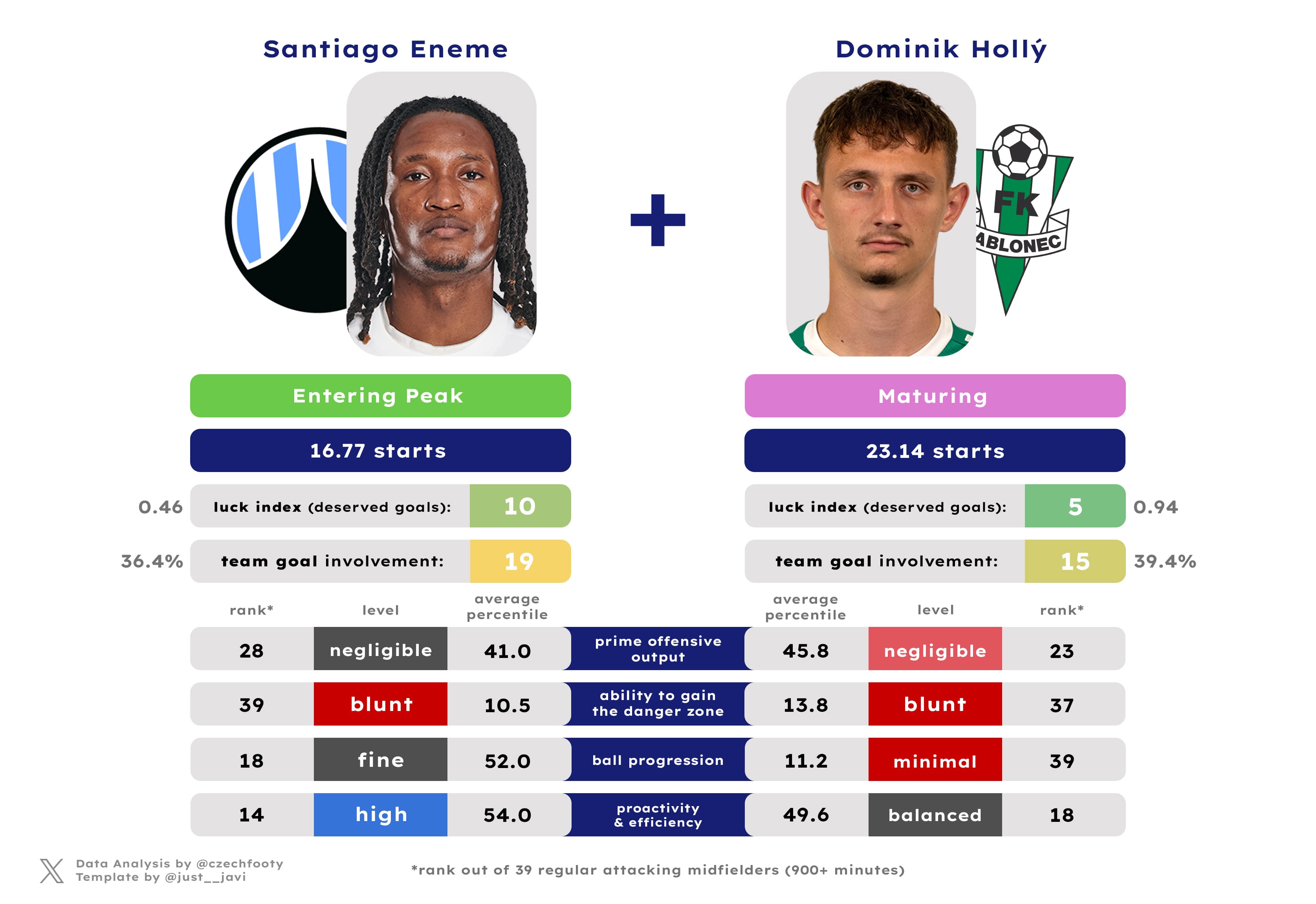
First off, let’s check-in with the two most high-profile signings — and quite expensive ones. While I wouldn’t worry too much for Santiago Eneme who brings poise and strength on the ball and could really discover himself as a cross between a no. 6 and a no. 8, potentially replacing a worn out Kaan Kairinen, I rather wouldn’t hold my breath for Dominik Hollý who’s likely bound to be out of his depth wherever fielded. I had previously highlighted him as a fine domestic target if you’re looking for a late game breaker, since his instincts in the box are great, but you normally don’t pay €1.5 million for those. This has “flop” written all over it.
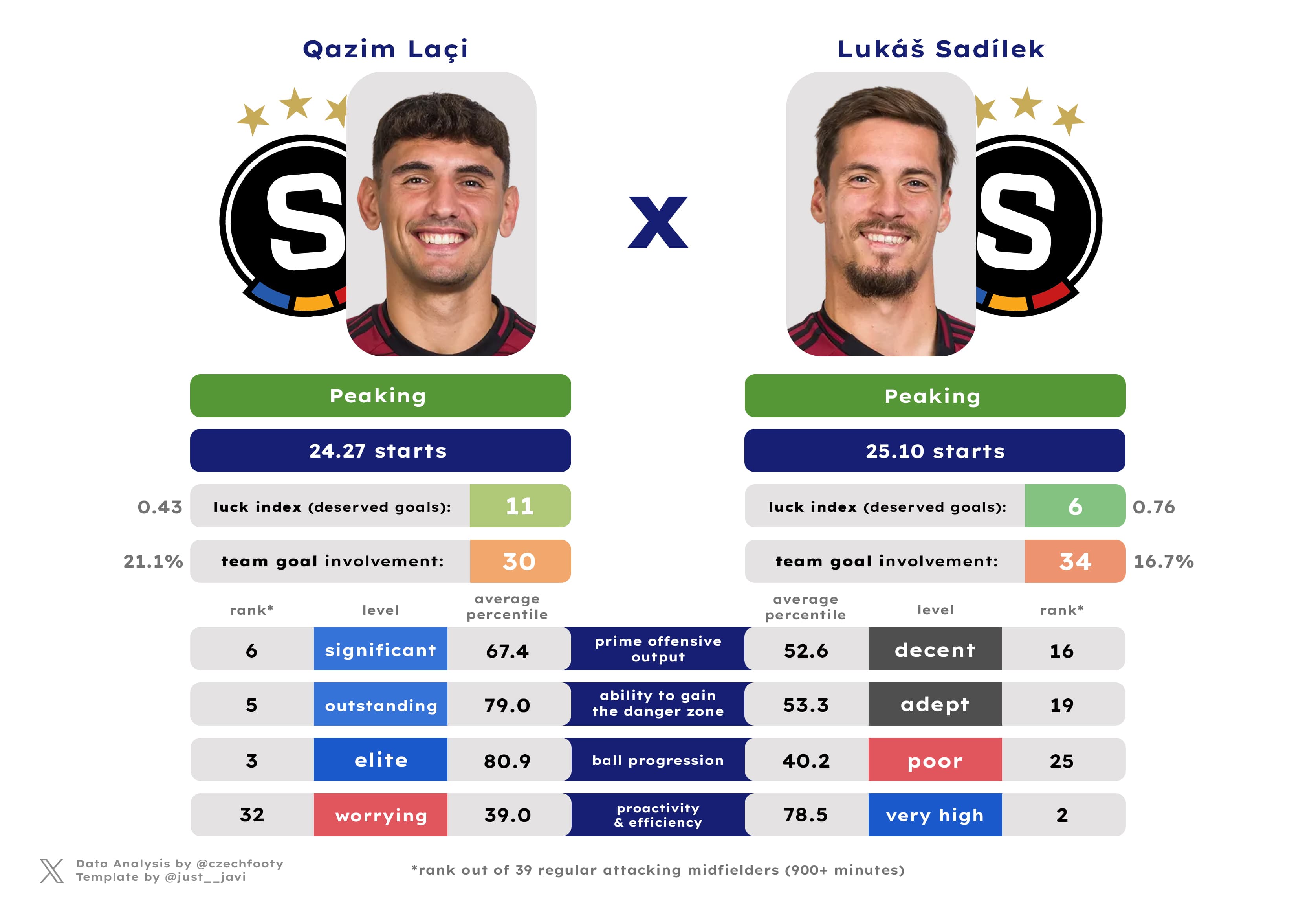
Here’s something I didn’t realize until I crunched the data: Lukáš Sadílek played more than Qazim Laçi? Not necessarily in his stead, in the same role, but… that can’t be healthy, can it?
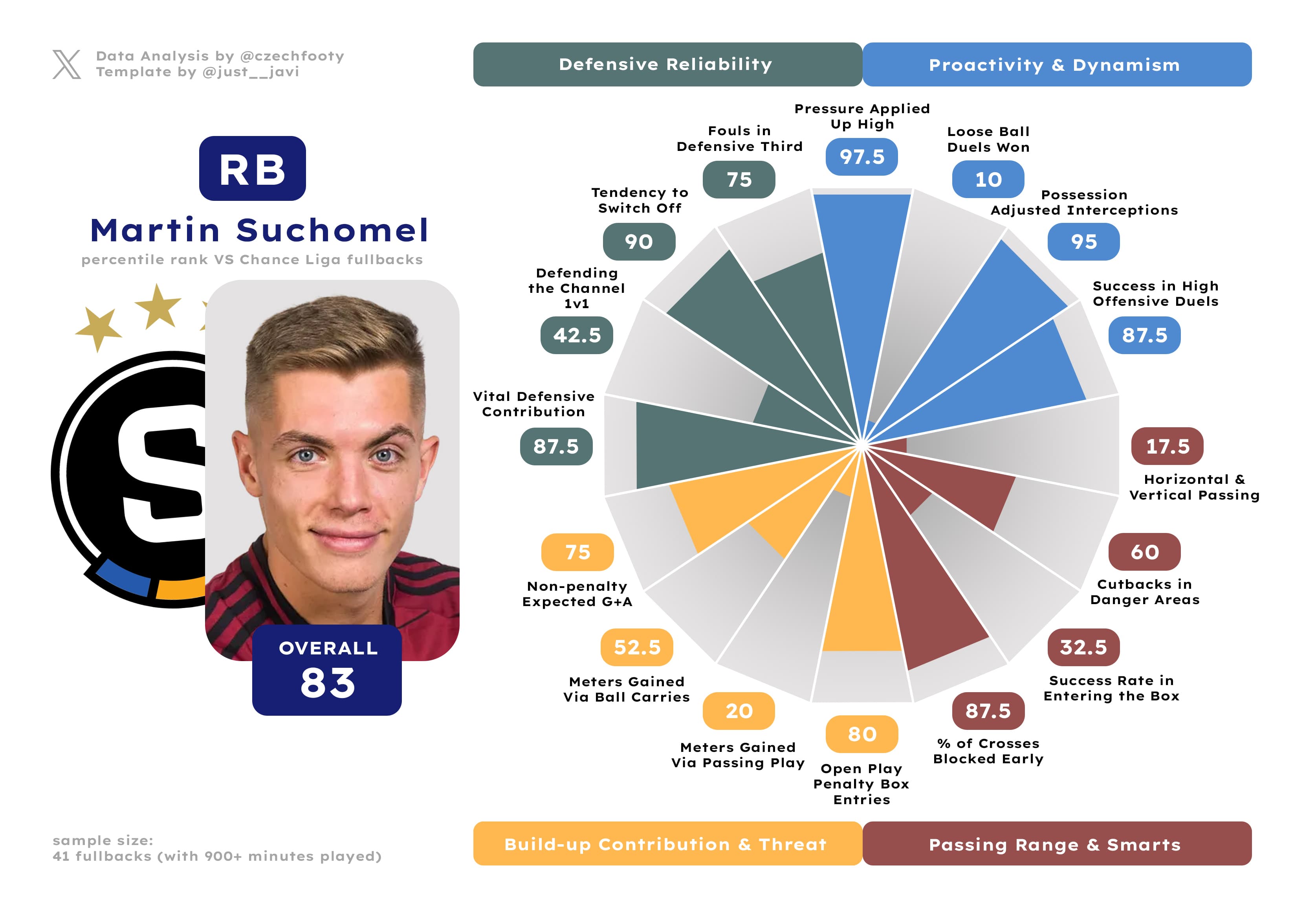
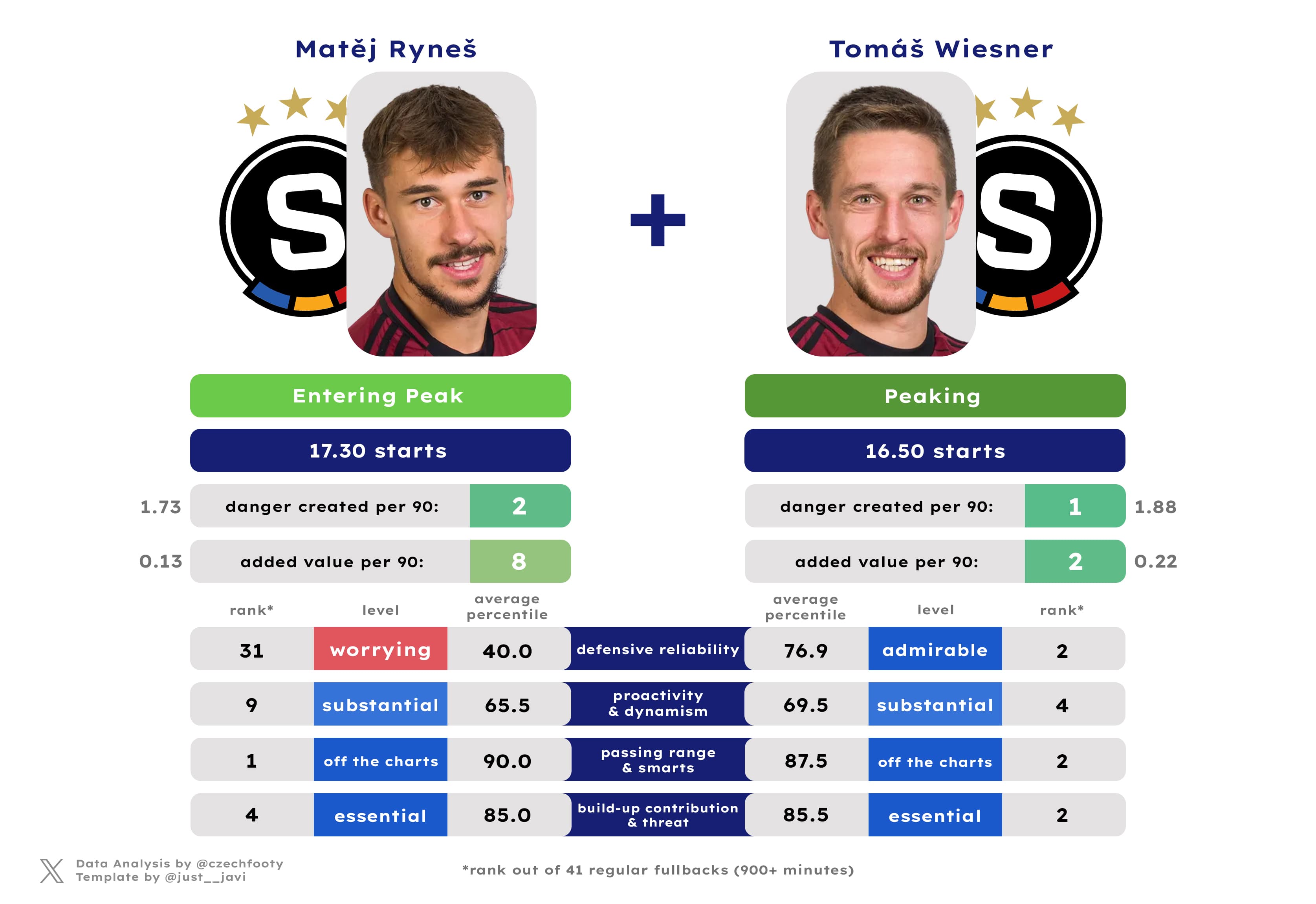
Taking the mantle from Wiesner, Martin Suchomel is now officially The Homegrown Player Who Should Not Come Close to Starting. And once again, you are all dead wrong! (No, seriously, with his proactive, muscular profile, he’s always going to grade out well in a model that values complexity; in reality, all the passing values represent a meaningful drag.)
Finishing on another fan scapegoat who’s, for a change, severely underappreciated: Matěj Ryneš deserves better. He’s the polar opposite to Suchomel in that he’s a tremendous passer who frequently stretches defences, while there are steps he still needs to take defensively, getting bypassed and fouling a lot. Still, on balance, you should be able to live with this:
Roster battle to follow
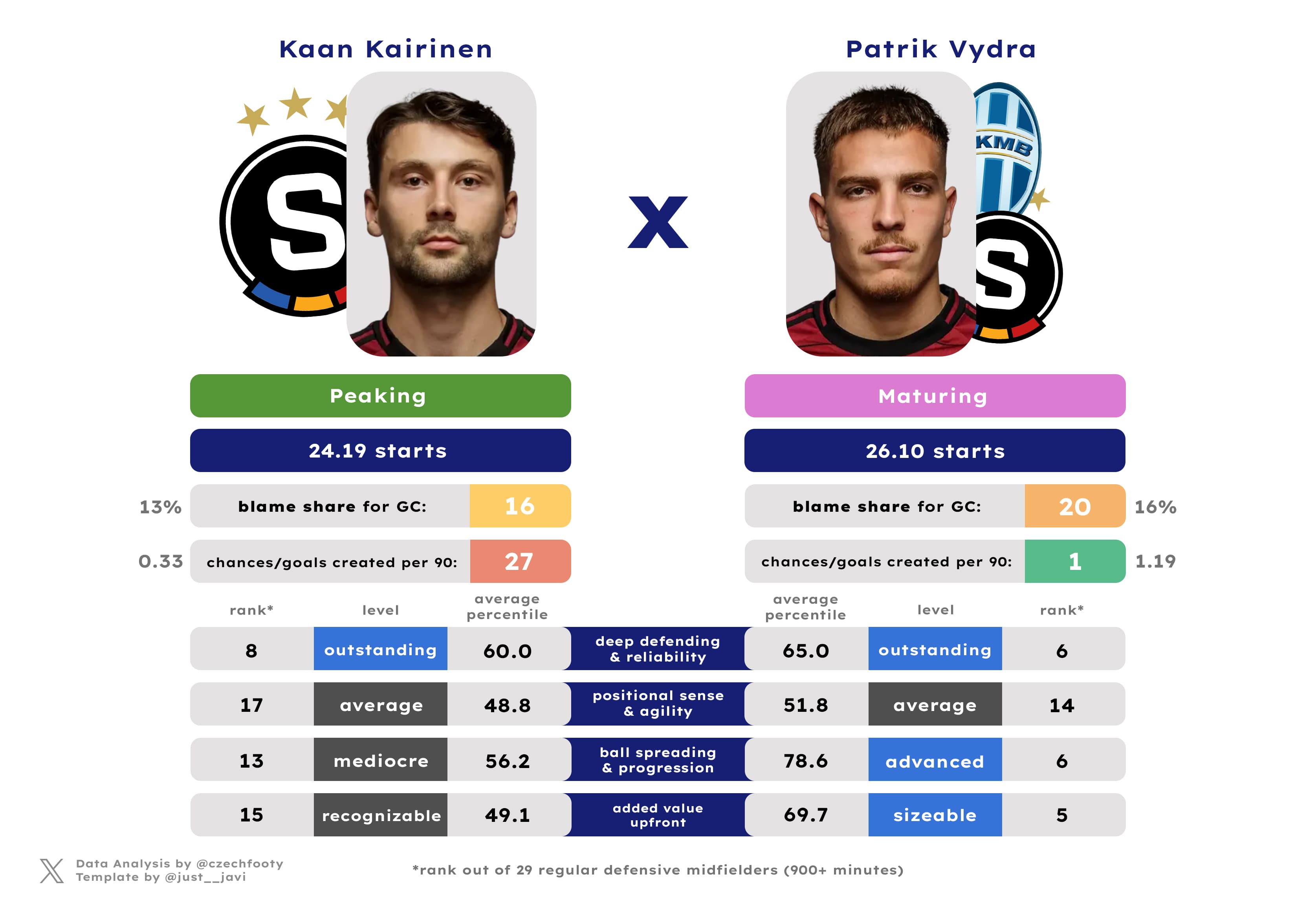
As long as the two mainstays of the second title-winning campaign haven’t left, I am looking forward to watch their respective battles unfold. First up, there’s Kaan Kairinen shouldering pressure from Patrik Vydra. I’d much rather see the latter function as a no. 8 closer to the opponent’s goal, but it’s safe to assume they won’t ever line-up side-by-side (given the dynamism-related concerns), so it’s also safe to brand this a battle. And after taking a wild step back in all sorts of creative metrics, Kairinen probably doesn’t hold a particularly sharp edge. There was too much mediocrity on the Finn’s 24/25 game, whereas only two defensive midfielders not named Vydra landed in the 80th+ percentile for ball progression via both runs and passes. Being in a company of Beran and Kričfaluši is hardly ever a bad sign.
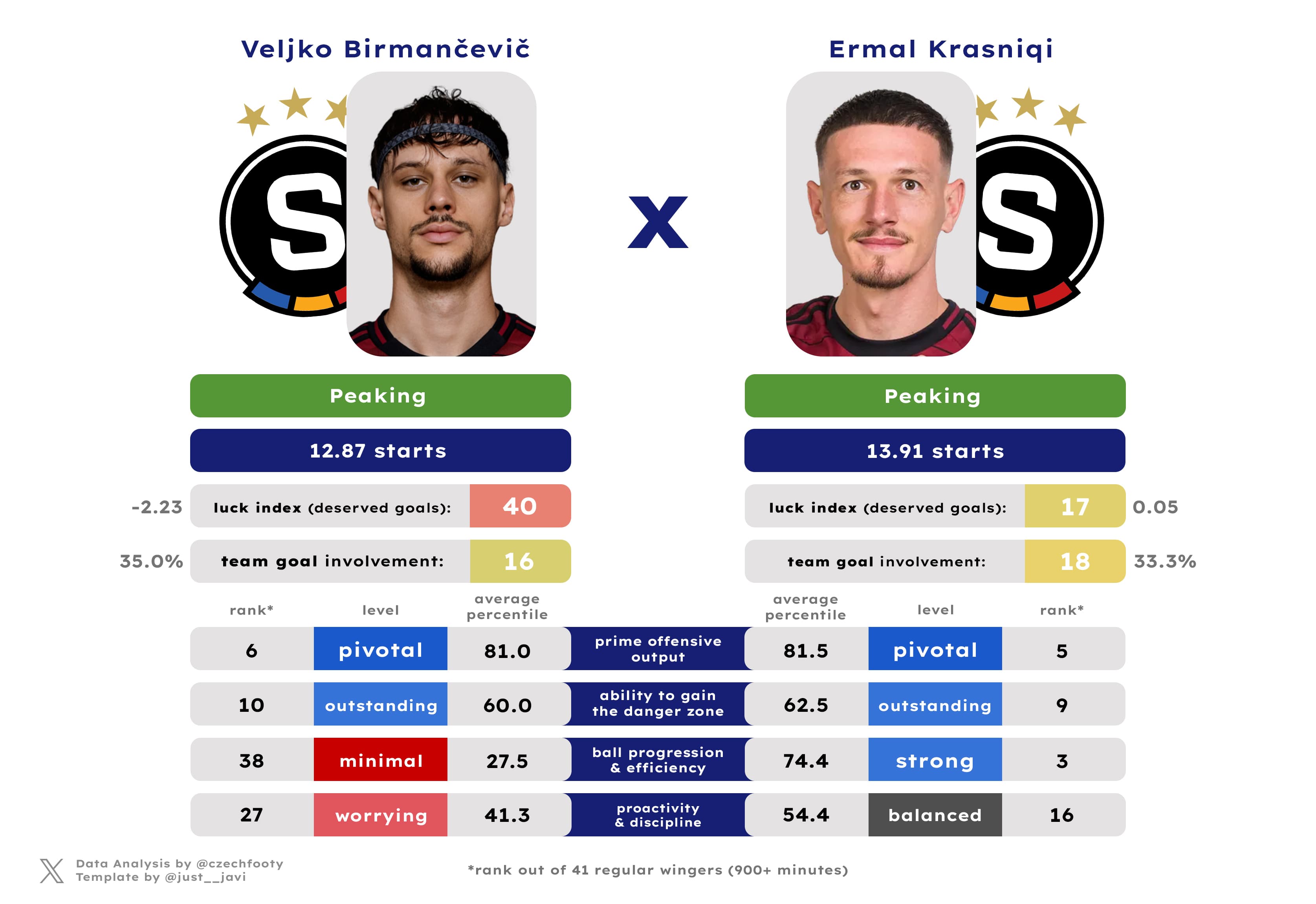
Similarly to Rrahmani, Ermal Krasniqi is another candidate for a breakout if he convinces Priske he deserves more looks. I wouldn’t say Krasniqi grew into 24/25, but he was Sparta’s bright light on more matchdays than Birmančević, esp. early against Jablonec or much later against Mladá Boleslav. It gets forgotten how much he delivered across a small sample as a surprisingly frequent shot-pass double threat. ‘Birma’ was, meanwhile, super unlucky.
Season forecast
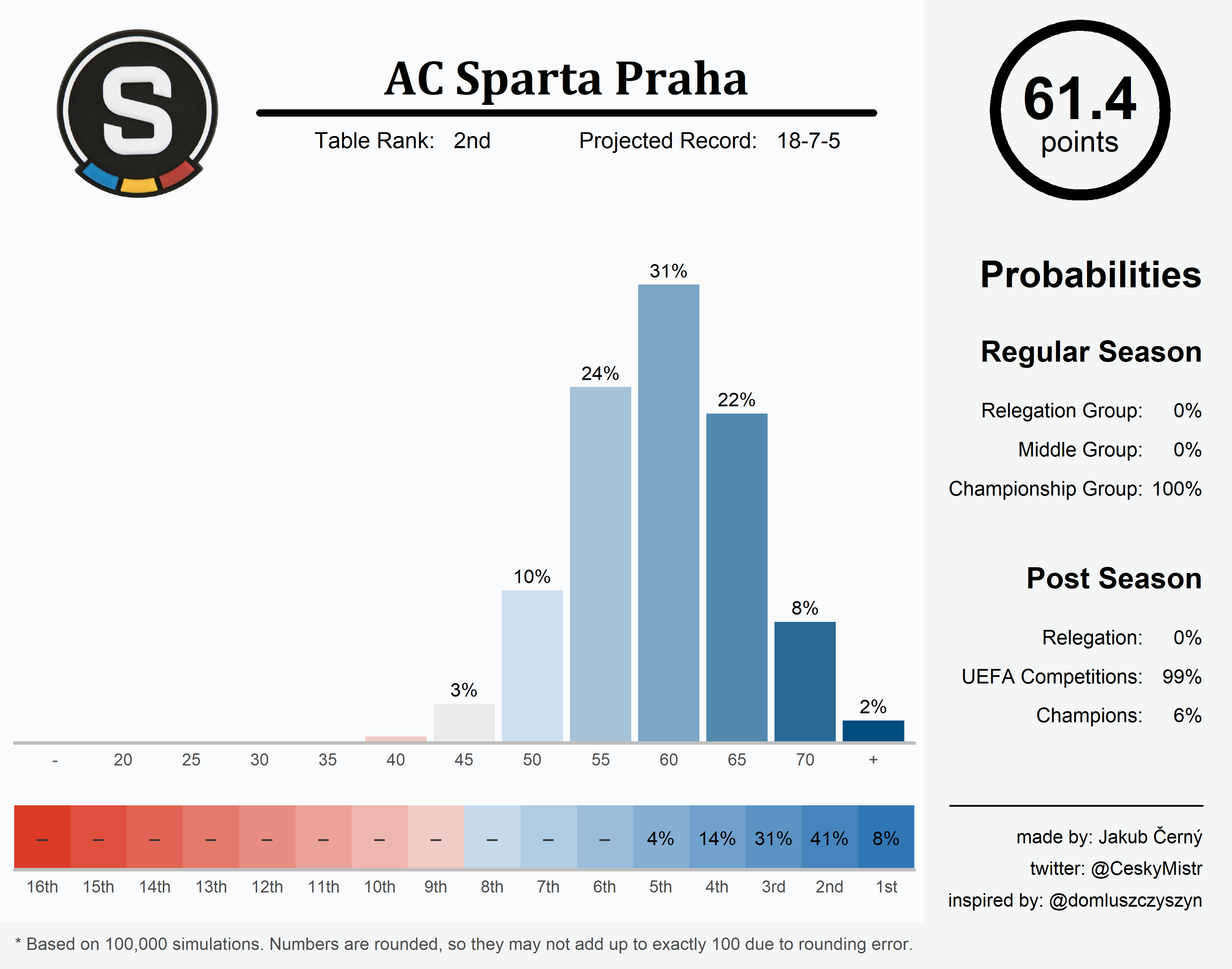
The twin titles took Sparta all the way to 66.2 projected points; now they are suddenly at the lowest point of their four-year life with our forecast. That is harsh; and without yet factoring in Vitík’s loss. Right now for Sparta, it’s more about looking over the shoulder than trying to chase Slavia. After separating itself from Plzeň by a significant 8.3 points in summer 2024, the two clubs are now within one point of each other. Is it really an equivalent of a coin toss between Sparta and Plzeň for the runner-up finish? The former was ahead of Plzeň by 17 points in 23/24; the latter was ahead of Sparta by 11 points now. You tell me what’s more real.
Bold prediction
The track record: 1/4. They didn’t score 3 goals in Round 1, and Round 1 only
The prediction: Kadeřábek scores his first goal since the return in May
The rationale: We’ll keep it nice and simple in this space. Just before leaving to become a Hoffenheim icon, Pavel Kadeřábek bagged a remarkable three goals in his last five starts for Sparta in May 2015. This time I say he’ll wait till May to re-open his scoring account at Letná.

Enjoyed the text or the visuals, but don’t care for 🇨🇿 translations and dashboards? No worries, you can still support us by inviting us for a symbolic pint at the old BuyMeACoffeeBeer page.