Whenever Viktoria Plzeň have climbed the table in recent past, it meant one thing and one thing only: a title. In 2011, they went from 5th straight to 1st — just like three years ago. In between, they had turned three more podium finishes (2012–13, 2014–15, 2017–18) into the ultimate glory. Now, for a change, we are talking incremental progress — from 3rd to 2nd, from 70 points to 74, from a UEFA Conference League quarter-final to a UEFA Europa League Round of 16 — but meaningful progress nonetheless, not least because of Koubek’s Sophomore Year Curse ©. And if Plzeň navigate three tricky UCL play-off rounds (a tall task), or manage to hold off Priske’s Sparta and close the gap on Slavia at least a little bit (potentially an even taller one), the oldest coach in the league will have done it again.
We have reached the point where the narrative surrounding Miroslav Koubek gets a bit too patronizing, and I honestly wouldn’t mind the Maestro soon lashing out at one of us “smart asses” for getting too busy with putting an age-related asterisk to each performance, the way 69-year-old Jana Paulová did during the latest season of Stardance. Sure, Koubek is already more than two years clear of the second-oldest top flight coach and needs an in-season break every now and then, but he wouldn’t have recently cleared the 300-game bar had he been out of his depth. Koubek is about to equal Karel Jarolím as the second most seasoned veteran since the turn of the millenium (15th year), and as opposed to the most seasoned one — who keeps referring to his age in every other interview while seven years his junior — Koubek is still capable of innovation, opting to go with a rarely deployed formation just now.
As a result, pretty much all of my consultants-supporters are fine with Koubek staying on.
They all the same recognize the coach thrives on the role of a relative outsider — dropping easy points domestically, banking unlikely wins continentally — and make note of his peculiar habit of tripping up just short of truly memorable achievements like overcoming Lazio in UEL’s R16 or Sparta in either of the two domestic cup encounters (final in 23/24, semifinal last term), especially after going 3-0-0 against them in 2024/25 Chance Liga. But it’s still plausible Koubek remains to be the best-case scenario for Viktoria right on this day.
Looking ahead, the inevitable coaching change may be one of the many occurring at the club these days. Only this summer, Viktoria laid down a new hybrid (and fully retractable) turf, swapped Betano for Tipsport in the role of a titular sponsor, and finally completed the renovation of the complex on Luční street, where the youth teams play and the first team trains. It should now be ready to potentially host second-tier games, Viktoria’s short-term ambition with the improving reserves, or help the women’s team reach the next level and slowly catch up to Prague ‘S’ following the appointment of a longtime national team coach.
Looking back on 2024/25
What went (particularly) right
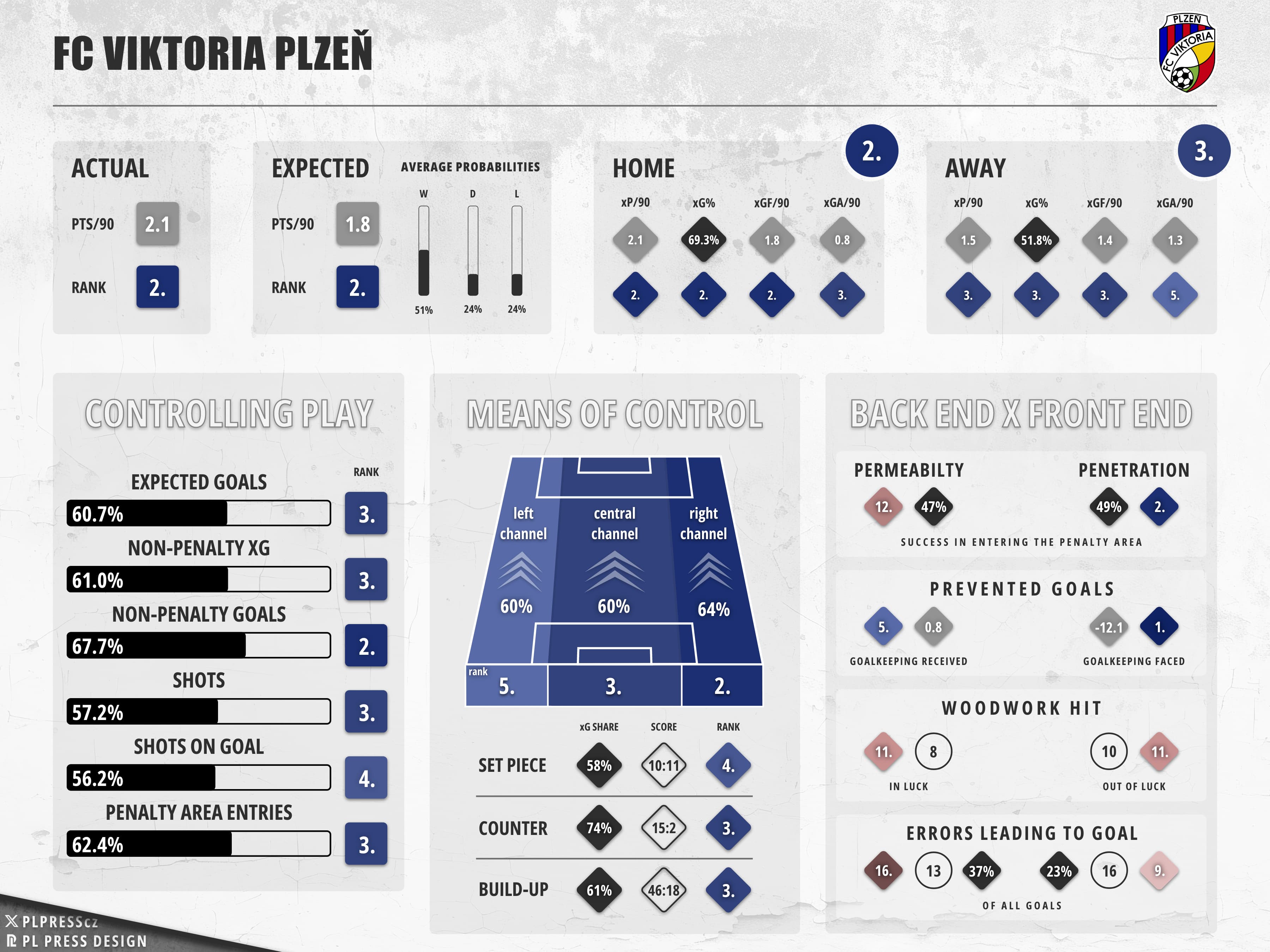
There’s an argument to be made about Plzeň being at its most ruthless throughout 24/25. They led the least attacks for one performed touch in the box (1.35), registering the shortest average shot distance from the goal (16.54 meters) and the highest xGSExpected Goals Scored (xGS) only takes shots on target into account, including their power and placement on top of xGF. value per shot on goal (0.37 to Slavia’s 0.32). Viktoria also set its own record in post-season strikes with a full dozen despite holding a lead for just 31.8 mins per game; notching 5 of the goals against Prague ‘S’.
There’s also an argument to be made about Plzeň taking advantage of the weakest goalkeeping ever. After already topping the league with an extra 9.92 goals to their name, Viktoria took it a step further now, hugely benefitting from opposing custodians collectively allowing over 12 goals above expectations. Over the entire course of the season, as many as 6 different goalkeepers (Dukla’s Hruška twice) outright bombed (ie. allowed over one goal above expectations), with 10 more weak performances (over 0.3 goals) contributing to the eventual top-flop balance sheet of plus-9. As a direct result of this, no Viktoria team has ever produced as many victories by 2+ goals (10), with the next in line registering a “mere” seven. Only Slovan (71/72) and Sparta (04/05) outdo 24/25 Plzeň across the 100-year league history.
What went (especially) wrong
There’s compensating at the back, and then there’s whatever the hell Plzeň were doing this season. Viktoria conceded 35 goals, and a staggering 13 of them were preceded by a full-blown error. Not just any mistake; an obvious fuck-up. Goalkeepers contributed an embarrassing quartet, Sampson Dweh a worrying trio. Their rest defence on attacking set pieces was a mess, leading many to complain about them even as they kept producing chances, and the defending of set pieces was every bit as messy. Only six teams conceded more often, and together with Bohemians and Karviná, Plzeň wrapped up the campaign as one of three Top 10 outfits with a negative goal difference on set pieces (10:11) per my notes.
Oh, and how about the peculiar relationship between the champions and the runners-up? Since 1951, Plzeň fans across generations have been scarred by a total of 10 relegation campaigns. Yet, this past season may stand the test of the time as the only one in which Viktoria allows over 3 goals per game against Slavia. If we expand it to Prague ‘S’, only two full-season experiences with Sparta were more miserable in the exact same period (average of four in both 94/95 and 00/01). Across three games, it’s frankly all the more stunning.
Most valuable player (still on board)
Per my MVP model (traditional stats): Pavel Šulc (ranked 1st league-wide)
Per my positional models (advanced stats): Pavel Šulc (97th overall percentile at CAM)
Per Statsbomb’s On-Ball Value (OBV) metric: Pavel Šulc
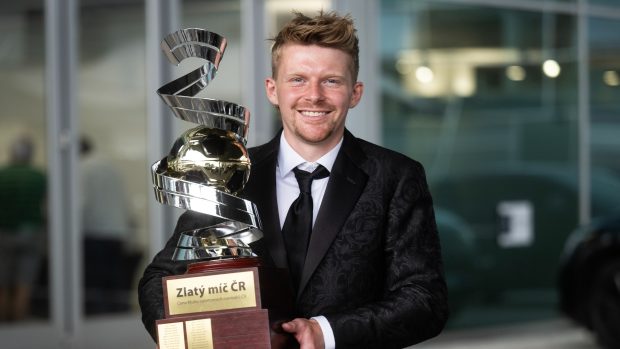
Welcome to the first triumvirate of MVP honours, with Pavel Šulc coming out on top in all three models to the surprise of absolutely no one. With 32 direct or indirect goal contributions, he led the whole league by 8. His 14 important points means he directly lent a hand to 35% of all equalizers or go-ahead goals of his team (account for indirect goal contributions, and you are at 42.5%). His 8 Man of the Match honours from Deník Sport led the league by three. After Round 31 where he knocked out Sparta — appearing in a 59th competitive game in 12 months — he collected his third MoTM award in a row. His EPAExpected Points Added (EPA) estimate the value of one's goals and assists based on game state (late game winners = top). from goals alone (9.41) would’ve been enough to beat all but 7 EPA league values including assists.
I could go on.
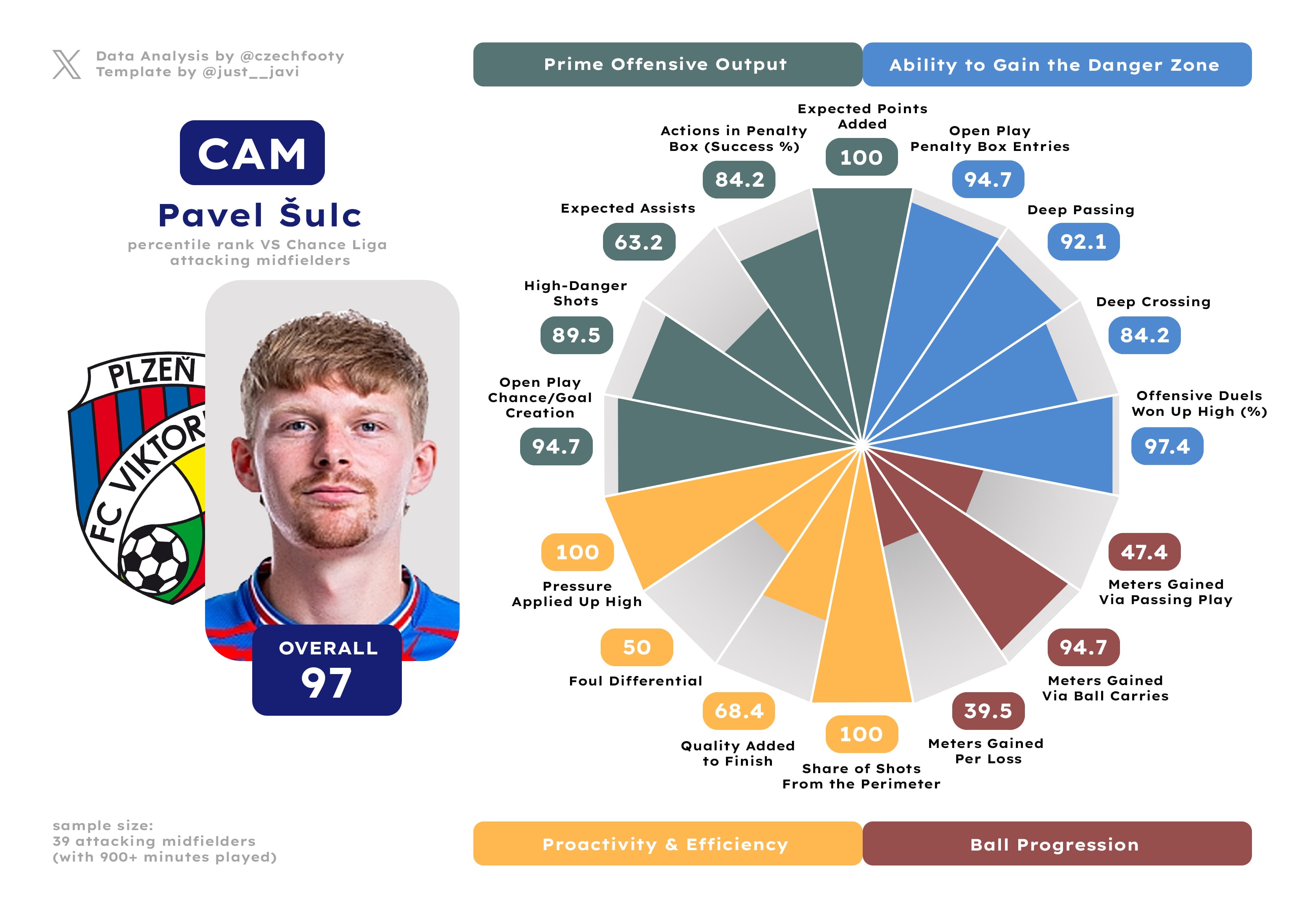
Is Šulc helped by the fact he didn’t skip a single Chance Liga game? In the aforementioned stats, sure. But when we take that away, he’s still tops in EPA/90 and near the very top in metrics like high-danger shots, meters gained via ball carries or passes completed in/to the box; three very different skills for that matter. For such a high-volume shooter (nearly two attempts per game), it’s insane a league-leading 84.7% of his shots were taken from central positions. For an 11-goal sniper, it’s no less insane to think he was arguably still more unlucky than anything else (racking up 10.54 xGS while getting denied by the woodwork once).
If you wanted to poke holes in his play, you’d need to start arguing against him fouling as much as getting fouled (still good for average) or complaining about his ball progression via passes which can hardly be better for someone who often acted as a second striker.
Šulc is a complete package. As good as it gets. And a well-deserved Golden Ball winner.
Chip on the shoulder
carried by the player who’s got something to prove — be it to himself, fans or the coach
Ever since he broke into the league as the second worst centre forward per my positional model (21/22), Rafiu Durosinmi has yet to qualify for a pizza chart, once again falling short by an agonizing margin (this time roughly one start). That made me angry… and run his number regardless on the side. They sit well with my eye test, highlighting some singular qualities of the Nigerian (like doing the right stuff inside the box; racking up high xG, posting a third-best success rate with all actions in the box, and completing a lot of passes there, too) along with some surprising shortcomings (like below average success rates in ground/aerial duels). Durosinmi didn’t look as strong as he used to, and as sharp with his lay-offs as he should. While his season features some notable highs like the trio of points against Sparta, especially his contributions below the edge of the box constitute an ever-present low.
That, leading to his phase out in the latter stages of the campaign and coupled with a weak (partially injured?) pre-season, has made Durosinmi a mere back-up to start the season Viktoria may even want to actively shop but basically can’t; a vastly disappointing outcome.
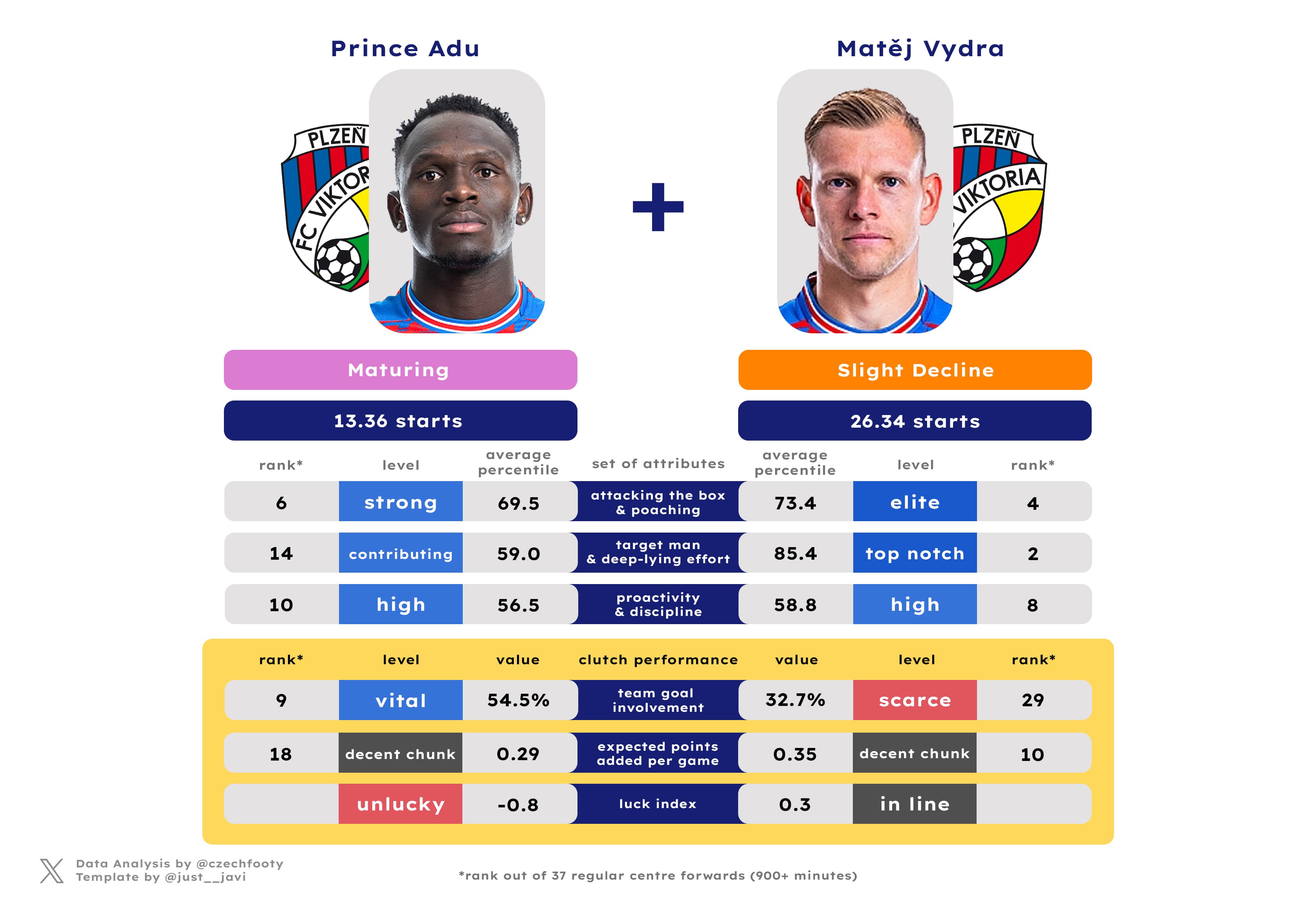
For Durosinmi personally, this is especially dark considering who’s ahead of him. Both Prince Adu and Matěj Vydra have been excellent this summer, with Adu regaining some of his earlier swagger. He’s far more effective in getting into the box, either via duels or by rounding opponents and playing off his teammates, something Durosinmi just couldn’t consistently deliver in 24/25. The finish — Rafiu’s fine attribute — is basically the only major drag on his game now. As for Vydra, he’s in a league of their own with Kušej as the other CF landing in Top 8 for all three sets of metrics / areas of play. Like a fine wine something something.
Inside the off-season
special thanks for guiding me through the motions of FC Viktoria Plzeň’s off-season go out to @belly11mb, @lisak_v, @HonzaKocab, @MartinNov5, @poskal77 & Michal
Squad turnover
Viktoria are one of only 5 teams losing a stud fitting inside the league’s Top 50 of the most utilized players. That would be Lukáš Kalvach, of course, ranking as high as 12th. Curiously, though, he was one of seven Plzeň players vaguely making up the league’s Top 60, with Cadu (59th) and Vydra (61st) falling right at the very edge. That is a pretty remarkable number, and a testament to Koubek’s unnerving faith in a relative few amidst a demanding season including a short spring run in the Europa League. That there were only 8 footballers busier than Šulc in the entire Chance Liga, who’s still going strong today, is beyond me. Ultimately, Viktoria are in a good shape; only losing 20% of goals and 30% of all goal contributions.
Biggest upgrade
I am not sure who exactly he’s upgrading, and taken literally he might actually be upgrading my own biggest downgrade (lol), but Tomáš Ladra is ultimately a notable upgrade in that he arrives as both an insurance policy for Šulc — still a feasible Top 5 league target — and his great complement should he stay. Chance Liga knew precisely three absolute cheat codes in gaining the danger zone (ie. landing an average percentile of 90+ in that category), and here you have Plzeň holding two of those aces. The other one is Provod; funnily enough a homegrown Viktoria talent just like Šulc. Guys, they seem to know what they are doing.
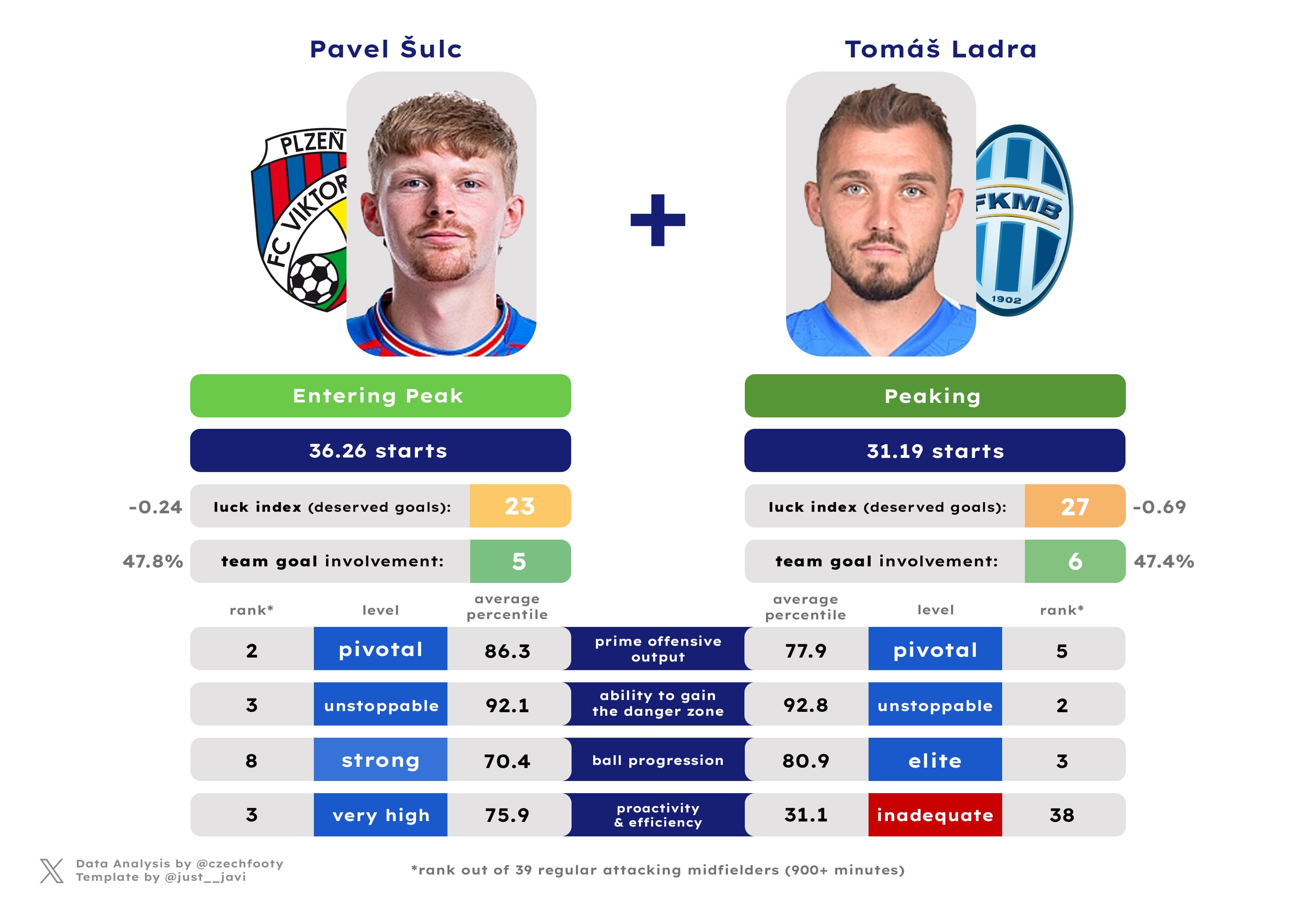
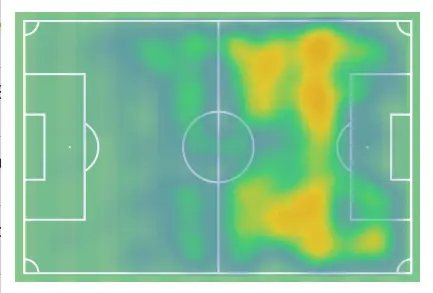
Ladra may not post as sterling numbers as he did at Mladá Boleslav, figuring to start a bit deeper as more of a no. 8/10 and an advanced playmaker, but that should still sit well with him. For someone who was often the second closest player to the opposing goalkeeper on his team, his ball progression numbers are pretty baffling. Bafflingly awesome. Reaching the 80th-percentile bar in ball progression via both passes and runs should honestly be impossible with a heat map looking like. It’s much harder to rack up meters gained when nominally stationed this high, more so with over 30 starts under your belt. Thus, it’s scary to think what Ladra could do deeper down; unless some old dynamism concerns shine through.
Biggest downgrade
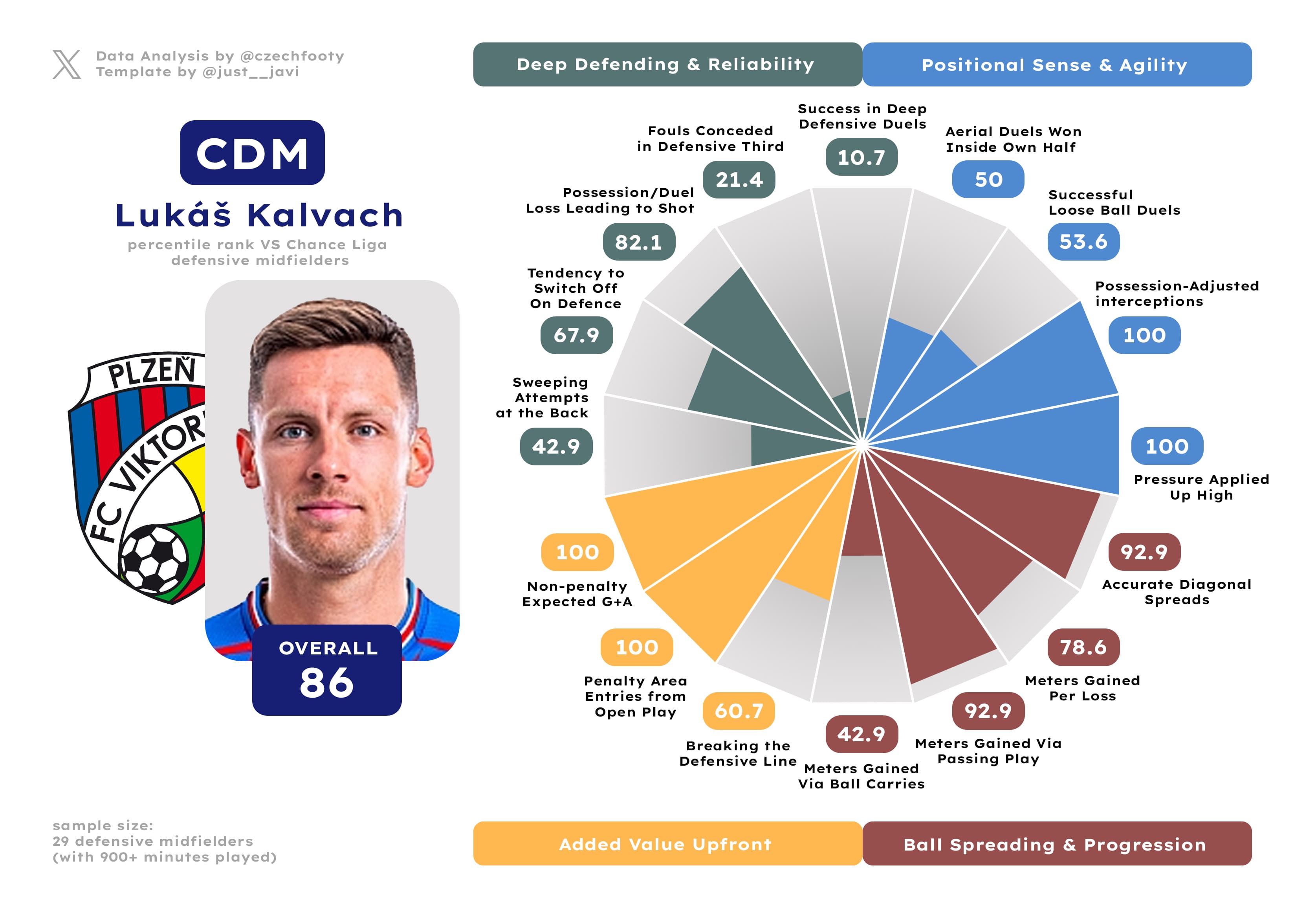
While Cadu also had a solid case, it would feel wrong not to highlight Lukáš Kalvach in this space. He’s something of a modern-day icon, even though when I suggested this to my consultants, about half of them were hesitant to call him that, with one even going as far as suggesting that out of the six seasons, he only felt truly key in the last two (ie. following the departure of Pavel Bucha, when he had to adjust and carry the midfield, or later Tomáš Chorý and Jindřich Staněk as two foremost difference-makers). At the same time, it’s admirable Kalvach had never dropped out of the ideal starting line-up as Plzeň sorted through (very different) coaches and went through a period with less money than used to be normal. As a result of commonly fighting two strong Prague clubs instead of just one, Kalvach stands out among the Top 10 busiest Plzeň players since the turn of the century with a single championship to his name (the rest has 3-5). At the same time, though, the success he oversaw across all three UEFA competitions — including the very first European quarter-final in the club’s history in 23/24 — is very much unparalleled. It’s difficult to compare.
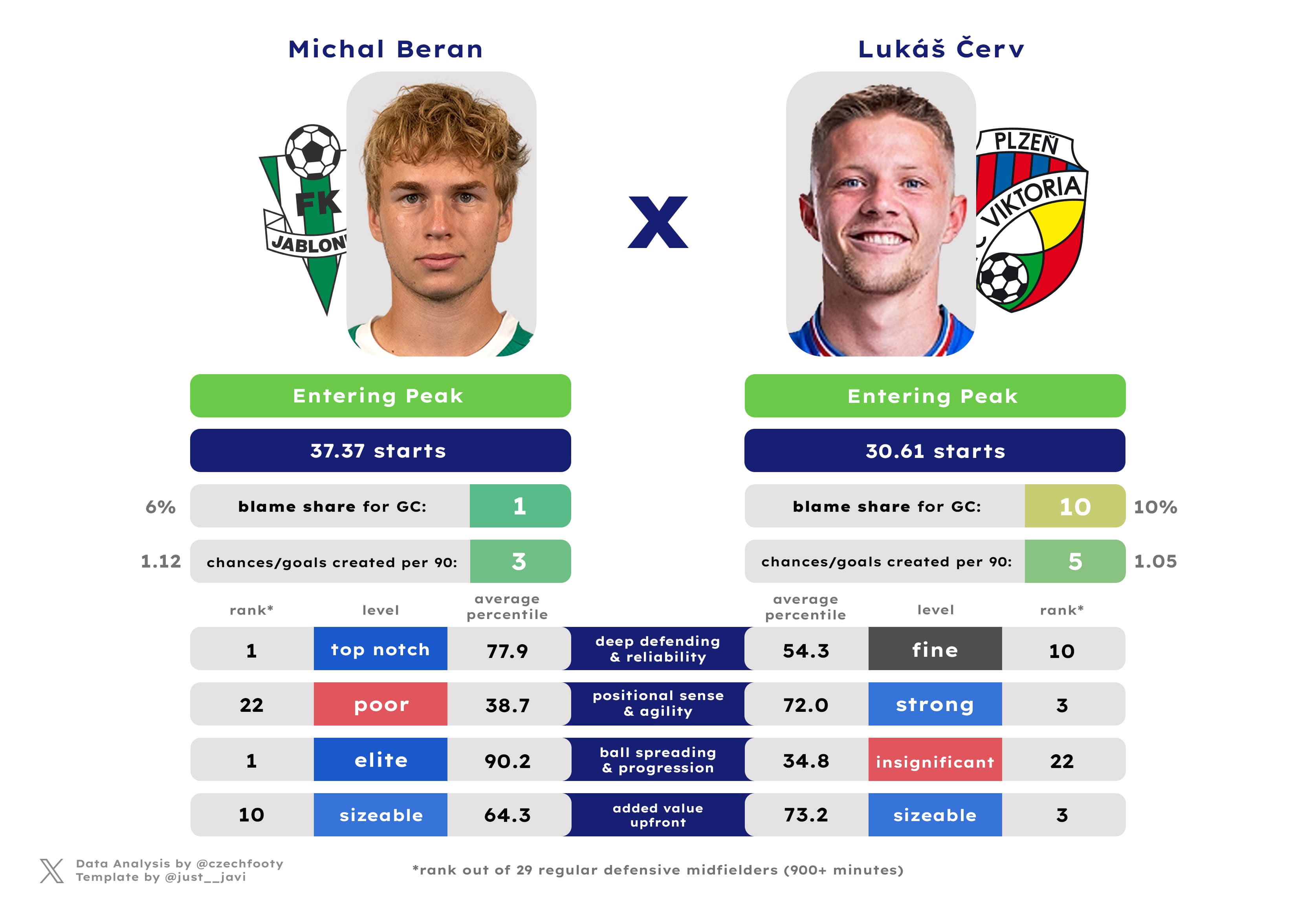
What will also be difficult to compare is Plzeň with Kalvach, and Plzeň without him. The former relied heavily on a double pivot, whereas the latter seems to fancy itself in a single pivot formation. That makes the downgrade aspect of it all both less likely to develop (see Ladra), and more likely to come through given the load dropped on one set of shoulders. If it’s Lukáš Červ handling that, I’d know about one better alternative of shorter build:
If it’s Adrian Zeljković — on the contrary 8 cm short of two meters — I wouldn’t be surprised in the slightest if the returns are more positive. He’s a concerning foul machine, and I know for a fact Plzeň fans haven’t been swept off their feet yet, but give him time. Not everyone is a Pavel Šulc and it’s important to note Zeljković has got as good a case to feel utterly knackered as the team’s MVP. As @slovak_football points out, he played basically nonstop the last two seasons, stretched between the Slovak top flight (always north of 2000 minutes), one Conference League proper, and two national teams — significantly extended through this year’s U-21 Euro where he featured for all but 8 minutes as recently as in June. It’s been a lot.
A rested Zeljković, meanwhile, has got potential to soon grow into a beloved warrior. He was described to me as a fine passer, an even better decision-maker, and someone who’s willing to let one fly from mid-range. As a smart reader of the game with limited mobility, the Slovenian honestly sounds a fair bit like Kalvach (plus the edge, minus the passing range), who once again combined sterling rates in possession-adjusted interceptions and pressures; always timely in returning to the desired position after keenly pushing up.
Need left to be addressed
Whereas many are actually satisfied with how Plzeň approached and managed the Kalvach situation, factoring in a healthy Matěj Valenta, too, the wingback positions were a frequent mention in terms of needs left to be addressed. I’ll leave the left-hand side for later, instead focusing on the right in this section. That one actually has a set-in-stone starter, but one who may get exposed in certain kind of games. As a former winger only briefly tried out at wingback (thank Juraj Jarábek for the original experiment, everyone!), Memić is handling the new role extremely well, channeling his dynamism through pressures, loose ball duels won and accelerations. As for defensive awareness, naturally, there are question marks.
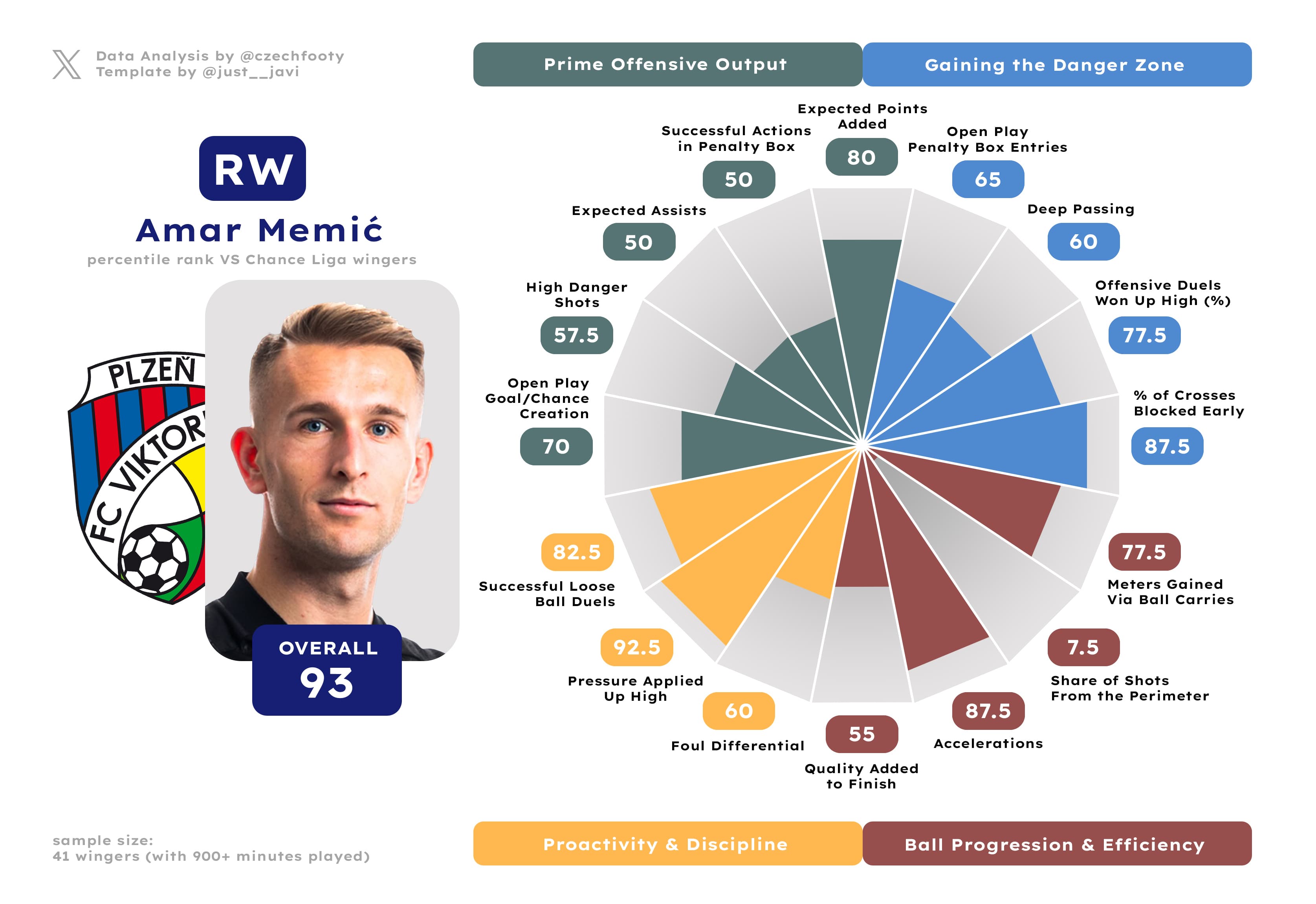
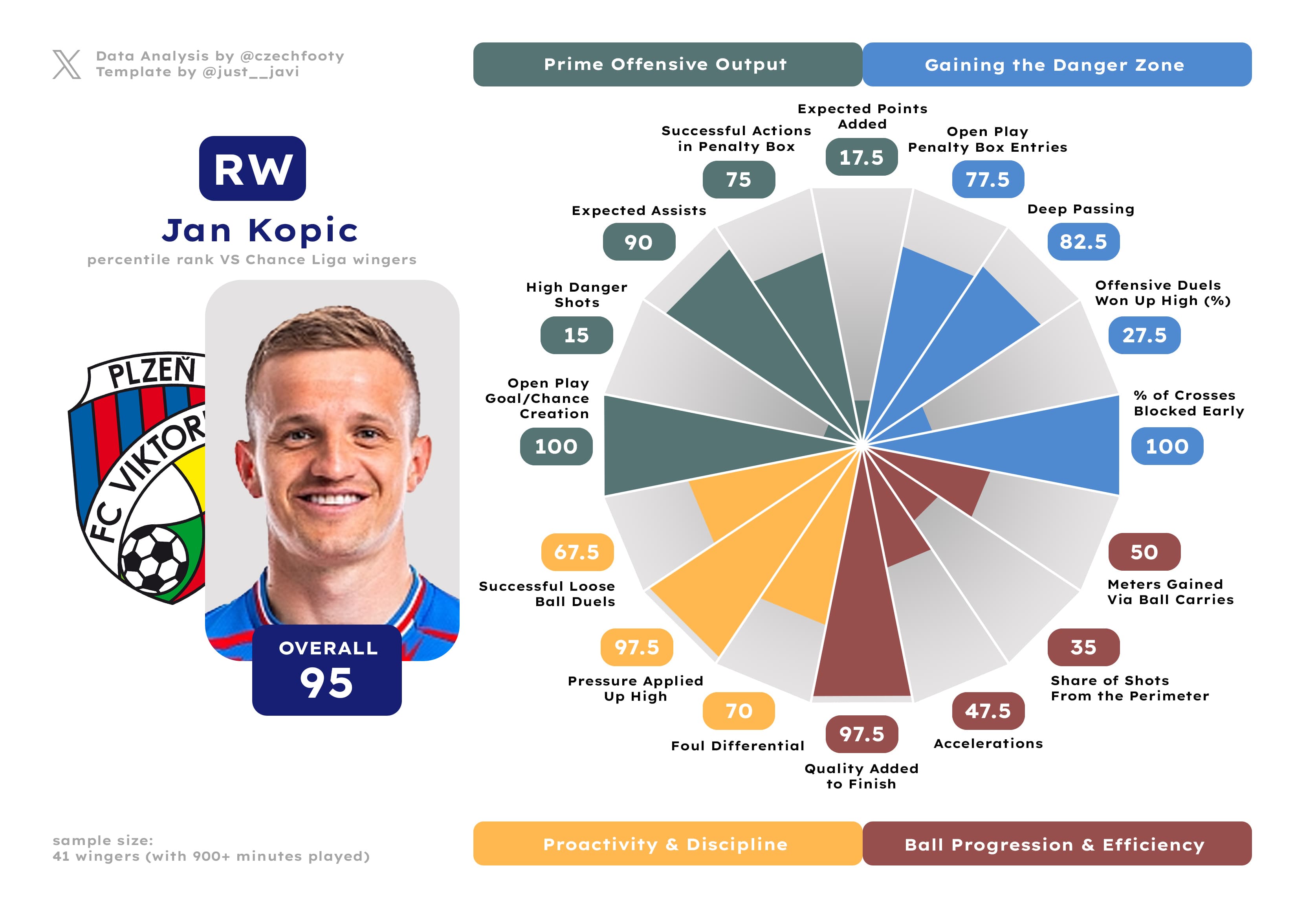
This would all be less pressing if Plzeň had someone more fullback-y, more solid lined up as his backup. But that’s decidedly not the case. Defence was never Milan Havel’s strong suit, either, and he’s probably more of a wide centre back at this point. And Jan Kopic, while looking impressive per overall percentile, is obviously a luxury player at this stage of his career. A small sample largely built against weaker opposition (139 mins vs Top 4) can do wonders, and if you take a closer look at the pizza chart, you can mostly appreciate his offence alone. It’s a bit easier to “add value to finish” when you only take 11 shots all told.
New kid on the block
Staying on the matter of RWB, there might be a wild card on the way. It’s always dangerous to put too many eggs in pre-season’s basket, but James Bello (b. 2005) has impressed to a point it’s hard not to. He’s not quite new, but considering he was still more of a striker/right winger last summer, soon getting loaned out to Pardubice for no playing time whatsoever, I don’t have a problem featuring him here. He flashed 1-on-1 skill, decent cross, pace and acceleration, but his defensive deficiencies may as well make him a good loan candidate.
On the opposite side, some could already imagine Martin Doubek (b. 2004) picking up minutes here and there as an offensively inclined wingback alternative to Merchas Doski, but there’s been some confusion as to whether he isn’t off to garner experience in the second tier after his ommission for the second phase of the summer preparation. Jakub Chalupa (b. 2006) — a smart, technically adept, defensively sound ‘mini Kalvach’ who was one of the 3rd-tier’s B-team top performers at 18/19 years per Honza — is in the same boat. And his peer Petr Kubín, opening the summer with the first-team, would be skipping a whole level with no appearance for the reserves, which is a particularly tall task for a (tall) centre back.
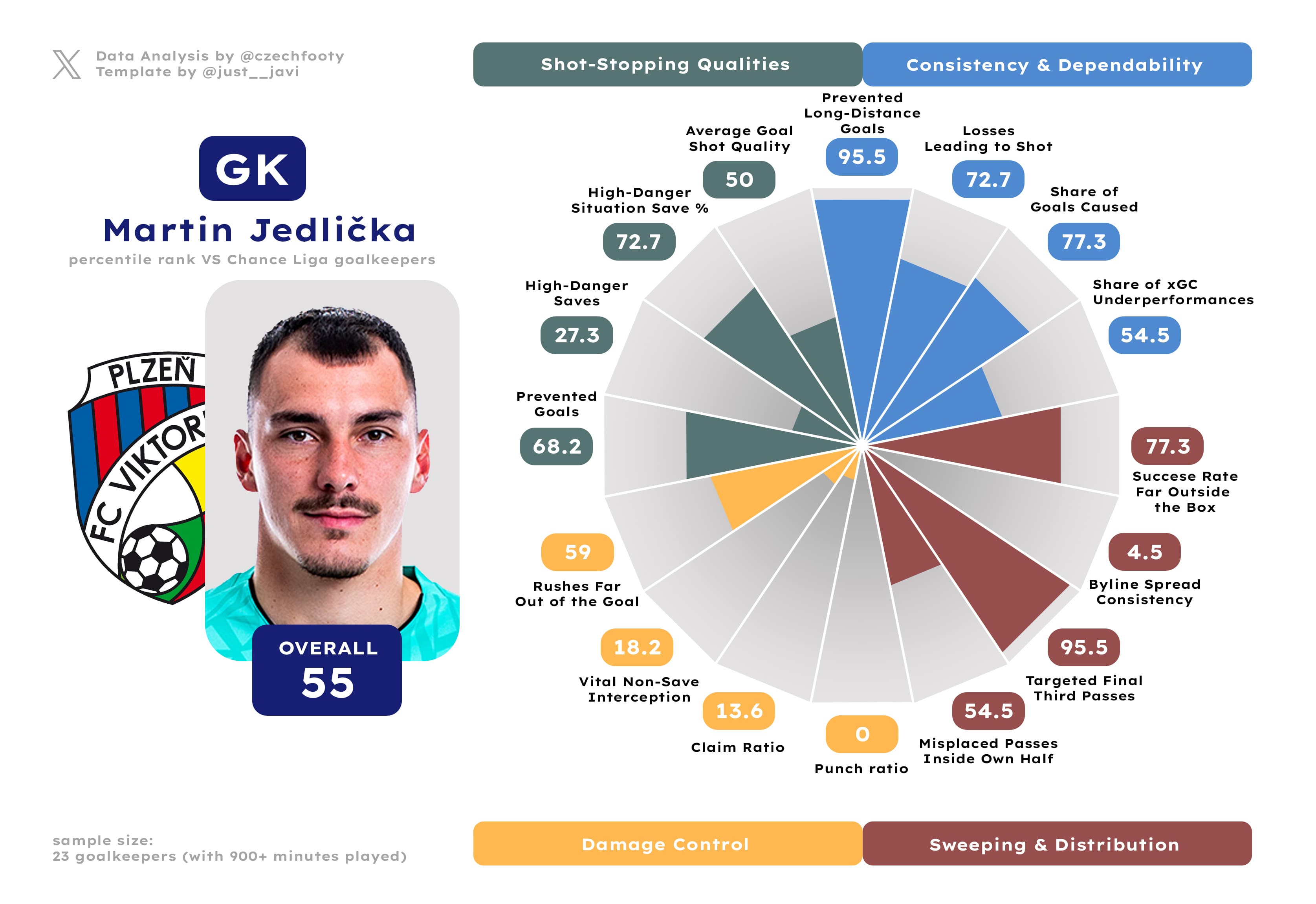
Finally, I must mention Florian Wiegele. He’s no longer a kid at 24, but he’s still on the younger side as a goalkeeper, and there are those who see him seriously grasping at Martin Jedlička’s playing time. It was effectively a 50-50 time share this summer between the two (Marián Tvrdoň is a firm no. 3 these days), and it was clear the Austrian had enjoyed a good loan spell in his home country, putting in a series of assured performances and some reflex saves. Jedlička may be Plzeň’s continental hero, but he looked vulnerable domestically:
Looking ahead to 2025/26
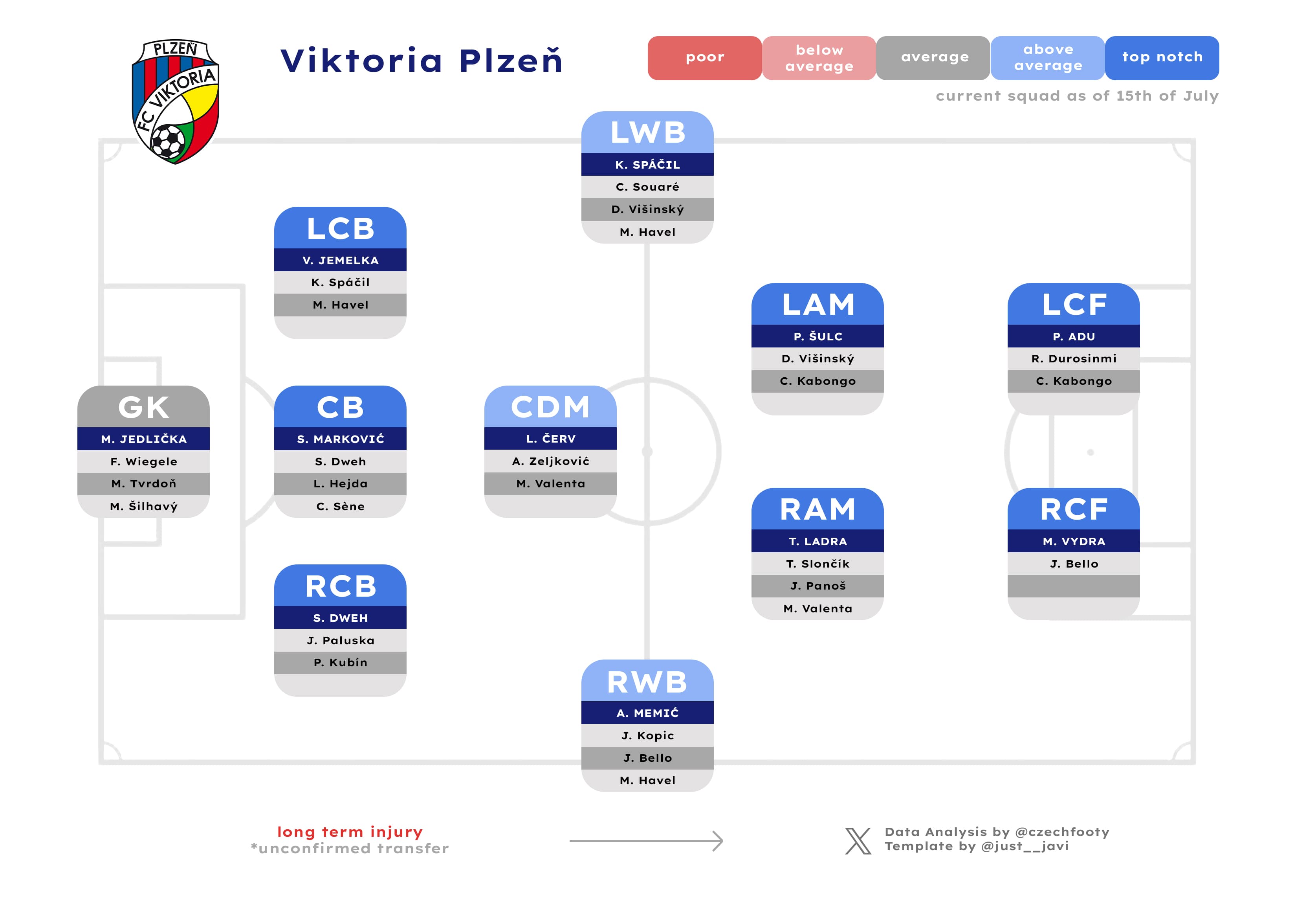
Below is the team’s current(ish) depth chart with a maximum of 4 alternatives for one position. The colourful ratings are a static snapshot of the league-wide situation on 5 July, and they are just a playful bit to add flavour to it; the names featured should be relevant to this day. To learn more about my approach to constructing depth charts, with all its limitations, head here.
Primary formation
For now, Koubek seems to be dead set on giving the unusual 3-1-4-2 a proper look. That is potentially good news for Christophe Kabongo as there appear to be more slots he could feasibly fill, but it’s important to note he hasn’t hit his stride after the serious knee injury suffered early on in 24/25. A breath of fresh air last year was closer to the worst player now.
Notes on the depth chart
Sampson Dweh started off very well, pushing up aggressively and curiously being more dependable while stationed higher in the pitch than later on when he sometimes took on the role of a middle CB. In his first 21 starts, Dweh was implicated in just three conceded goals per my notes; since then, he contributed to 8 of them. There’s generally too much random stuff in his game still, and if Plzeň ever receive a high enough bid, I wouldn’t pause for even a split second. It’s possible, if not certain, you can never build a high-end defence around him.
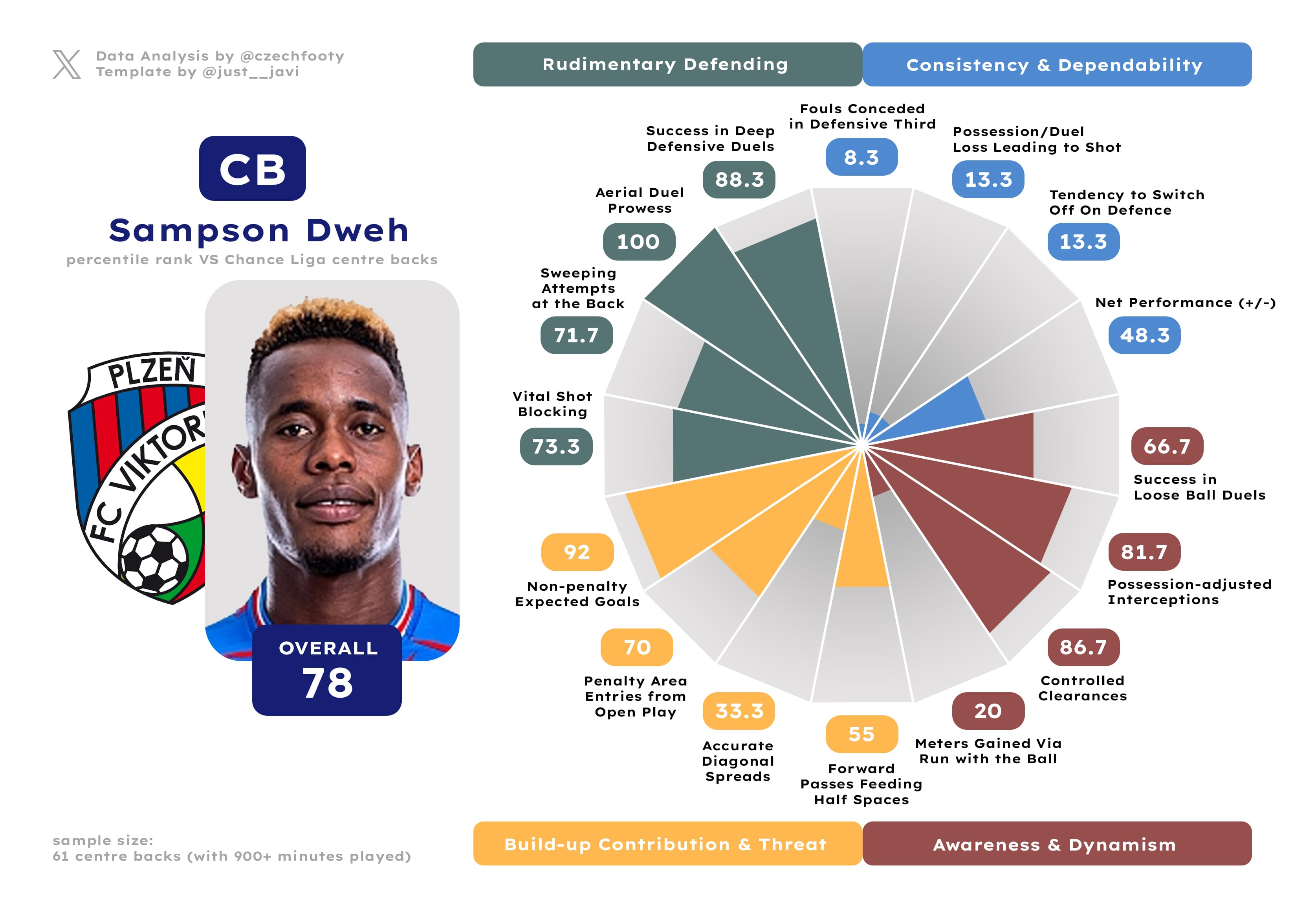
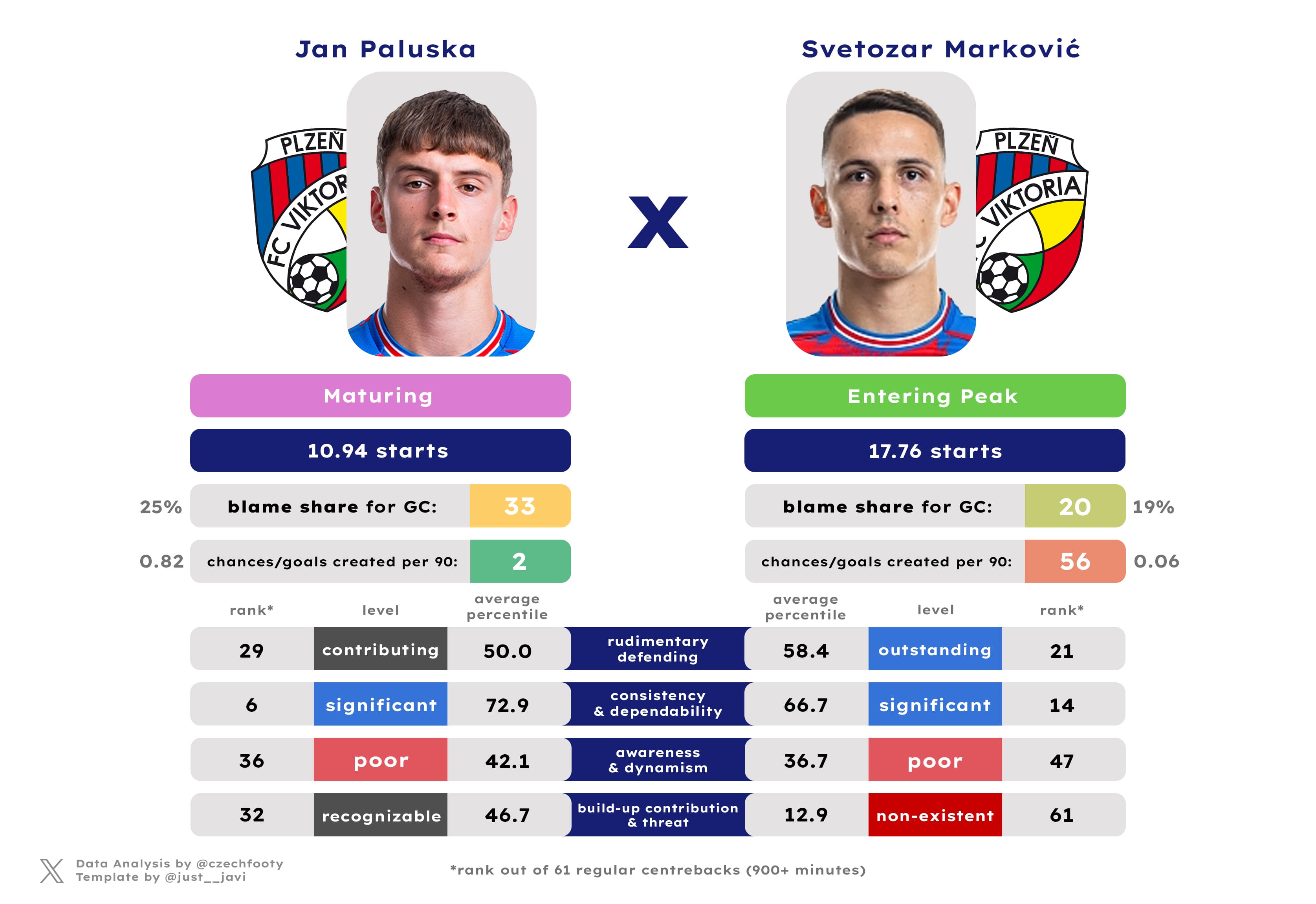
As for those who can pose as his rivals and colleagues simultaneously, Jan Paluska and Svetozar Marković have shown some promising qualities. For one, they are both much more consistent than Dweh. In terms of % share, Marković was only in on 19% of all goals conceded and 12% of all chances allowed. For Dweh, those respective shares read 33% and 24%. Marković is a particular black hole on the ball and in front of the opponent’s goal, but he carries tremendous value as a steadying presence at the back. Only six of his possession/duel losses led to an opponent’s shot, he won a spectacular 14 of 17 aerial duels inside his own box, and didn’t fare much worse on the ground, either. His duel behaviour generally seems top notch, but the raw strength lets him down, as demonstrated by the (overly physical) Hradec encounter. As for Paluska, he’s clearly a confident kid on the ball, but the 0.82 chance/goal-creating actions per 90 are most certainly a by-product of a very small sample. On the other hand, his ball-carrying will for sure be an asset anytime he plays.
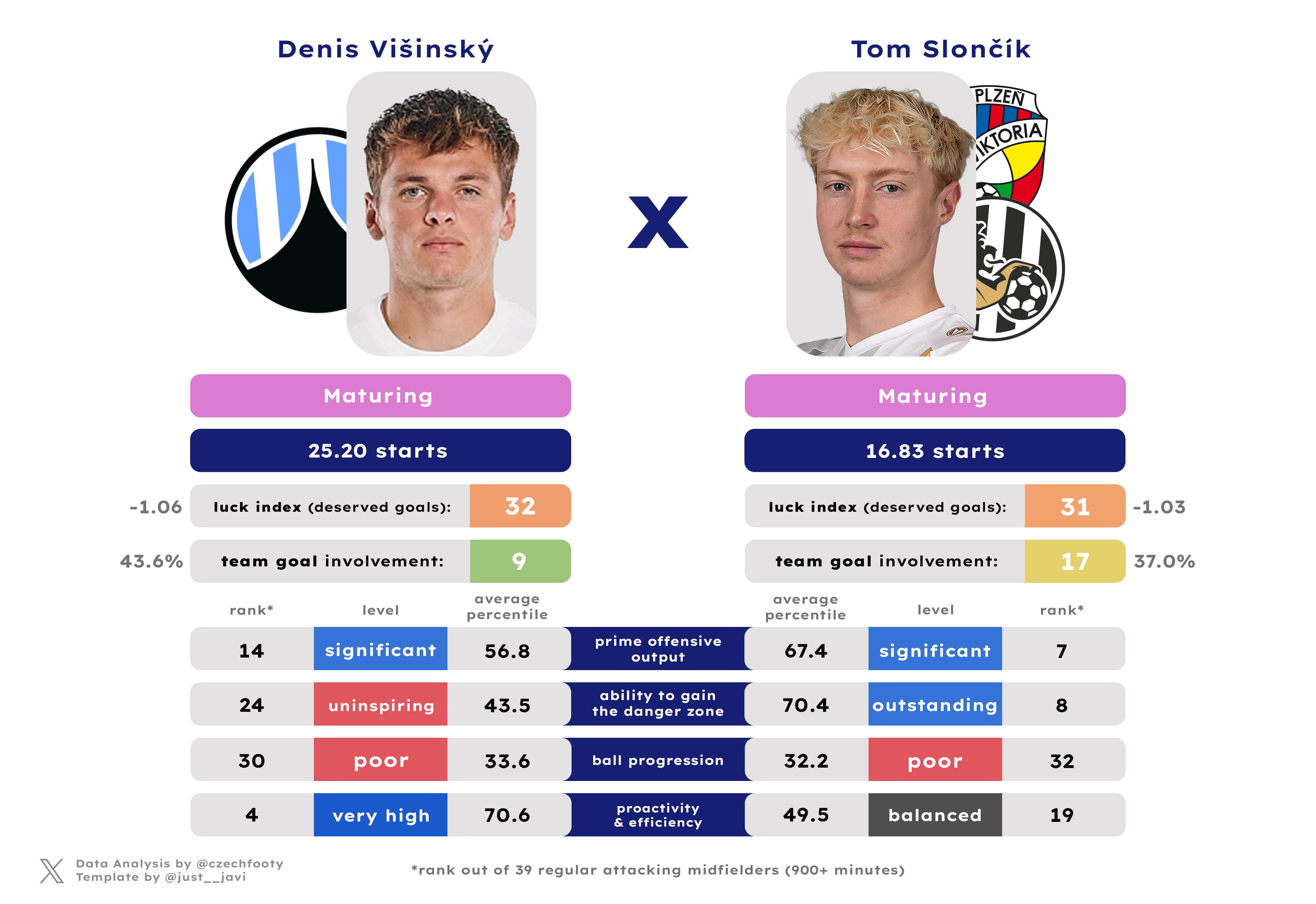
Finally, there is one secondary roster battle we need to touch upon before diving into the main one. Tom Slončík is known to rub Miroslav Koubek the wrong way, but he’s gotten his opportunities in pre-season and more or less taken them — to a greater extent, arguably, than the incoming Denis Višinský. Will that matter? With Jiří Sabou not sounding overly confident of bringing him back despite interest (it’s not an active discussion as of now, he admitted), it’s possible Slončík stays until the very end of the summer at least, with Šulc officially marked as the only player potentially allowed to leave. Both Višinský and Slončík, meanwhile, excel in the final third — with Slončík more of a selfless player in the box.
Roster battle to follow
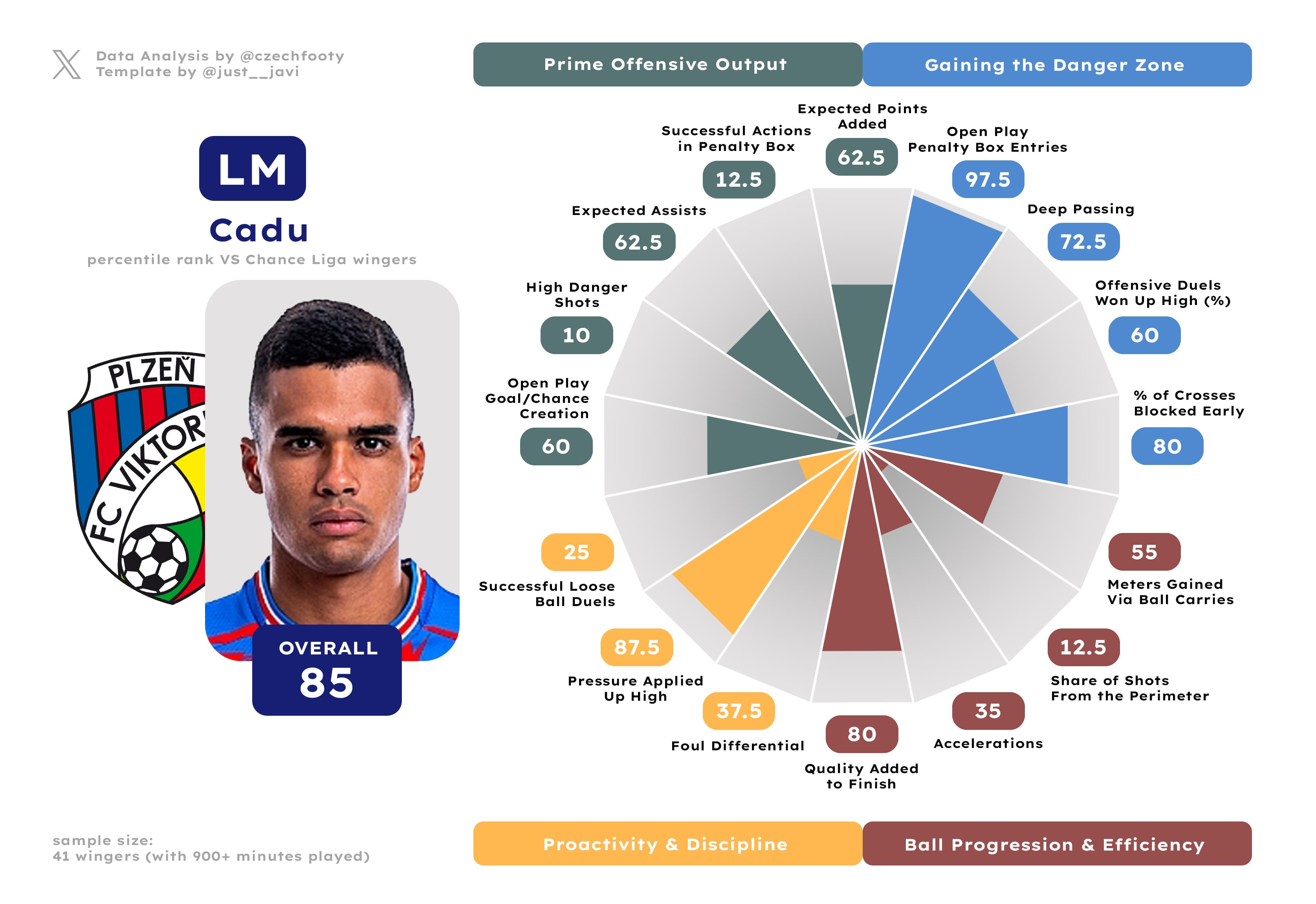
There is no doubt Cadu will be missed at Doosan Arena, not least because he didn’t really care whether he’s deployed on the right or on the left. Curiously enough, his pizza chart is actually a lot similar to Kopic’s in make-up, as they both score high on penalty area entries, pressures, finish or blocked crosses, but are often pushed to the perimeter with their shots (in Cadu’s case even more so!) and their dynamic qualities leave a fair bit to be desired. Cadu was too much of a middle third contributor as opposed to a final third one, opening up an interesting avenue for what could be an unlikely upgrade provided by two men.
Merchas Doski didn’t earn himself a good rap with Plzeň fans this spring, but any damning conclusions would be both rash and harsh at the same time. As you can see below, Doski grades out as the cream of the crop in two useful sets of metrics, and it’s not all down to his Slovácko stint. He definitely needs to showcase more of his passing range at Štruncovy sady, but there are consistent dynamic qualities (he ranked 7th in the same category last summer).
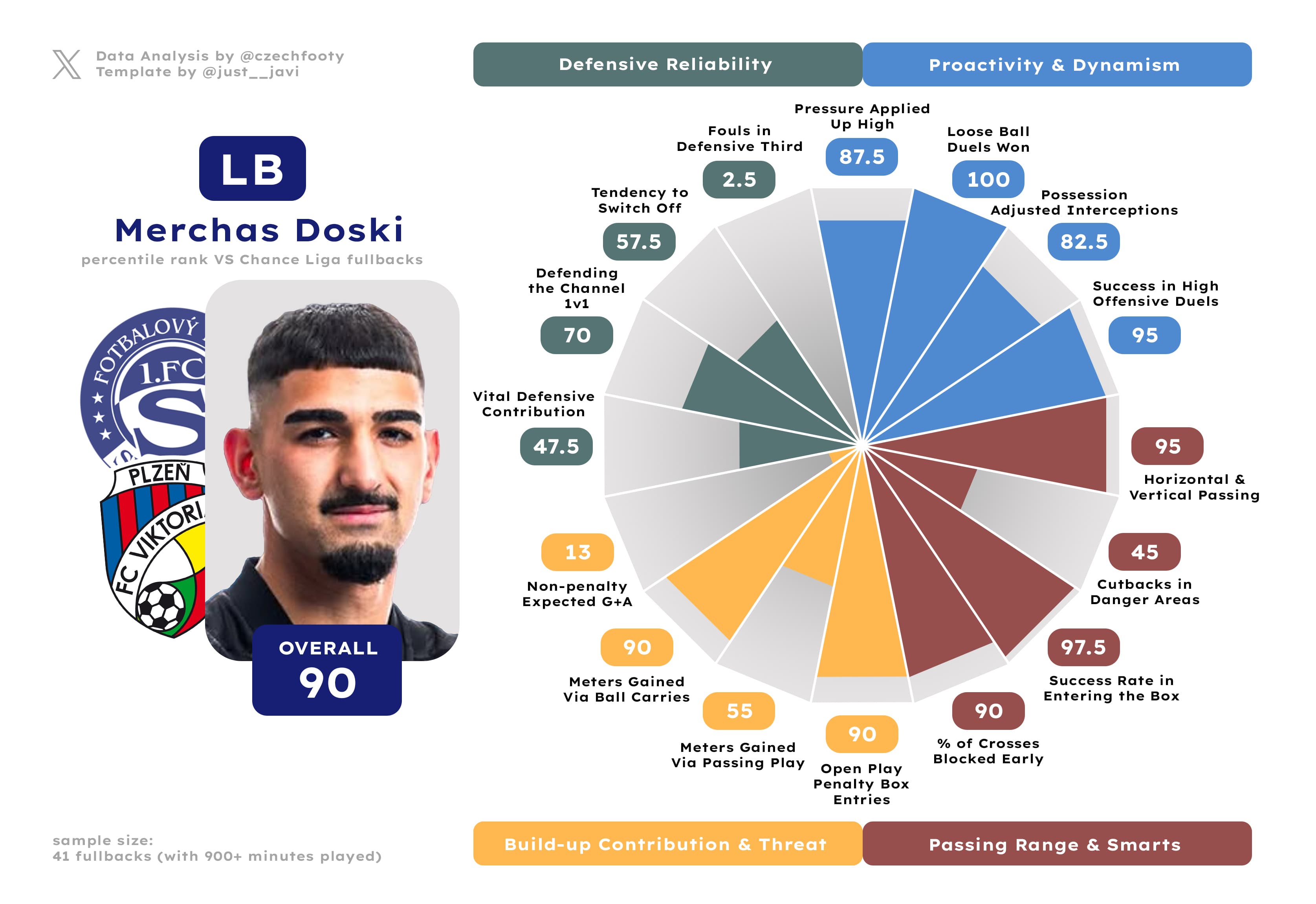
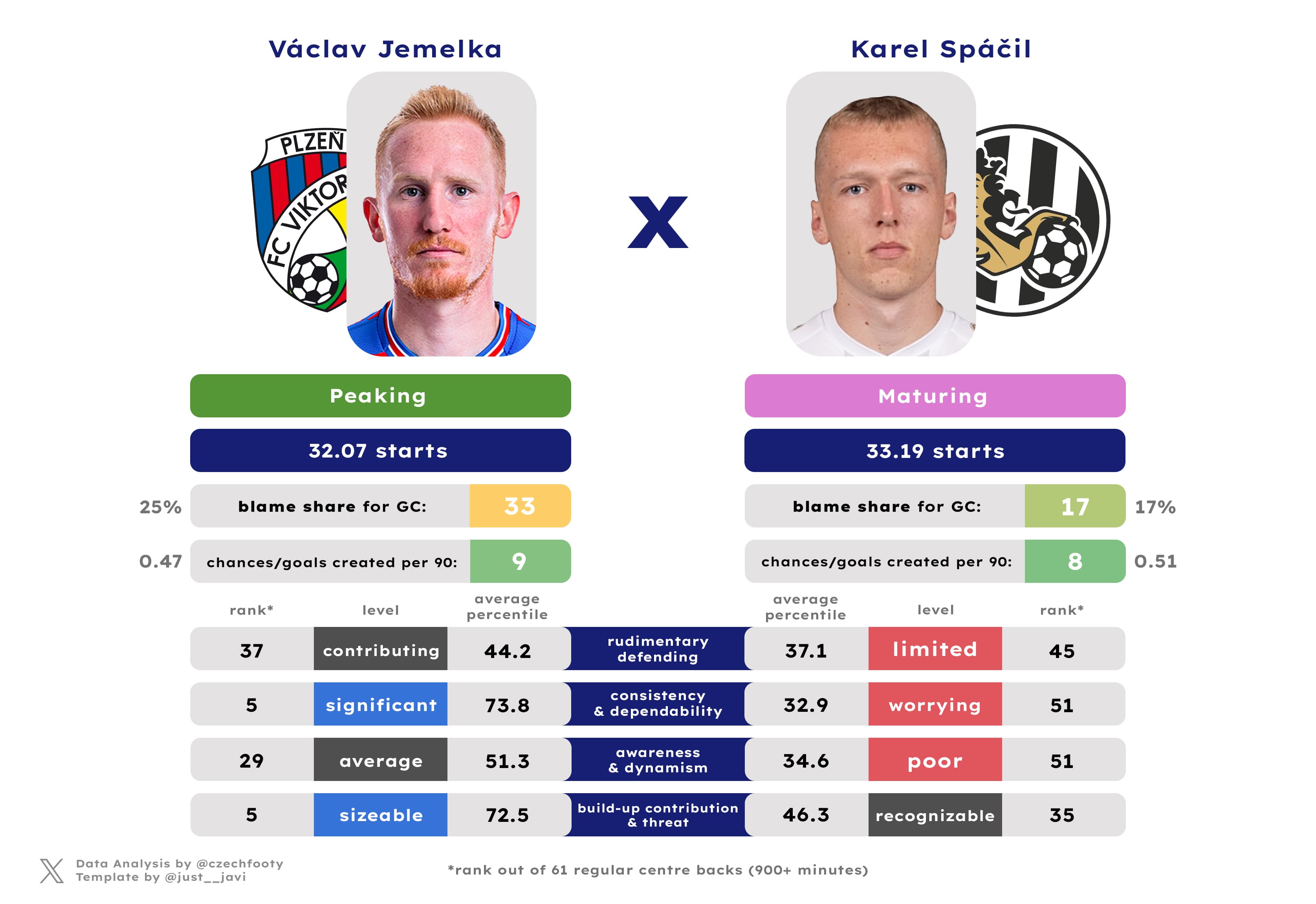
With Doski skipping the dress rehearsal, it’s near certain Karel Spáčil gets the audition at LWB in R1. There’s not much my model likes about him — and I mostly concur, seeing him as more of a project than an immediate solution of anything — but those that it does, like ball progression via ball carries (90th percentile) or cracking the penalty area from open play (78th percentile), can be easily translated higher up. I wouldn’t be surprised if he ends up spending 3/4 of the time at LWB as opposed to rivalling the peaking Václav Jemelka.
Season forecast
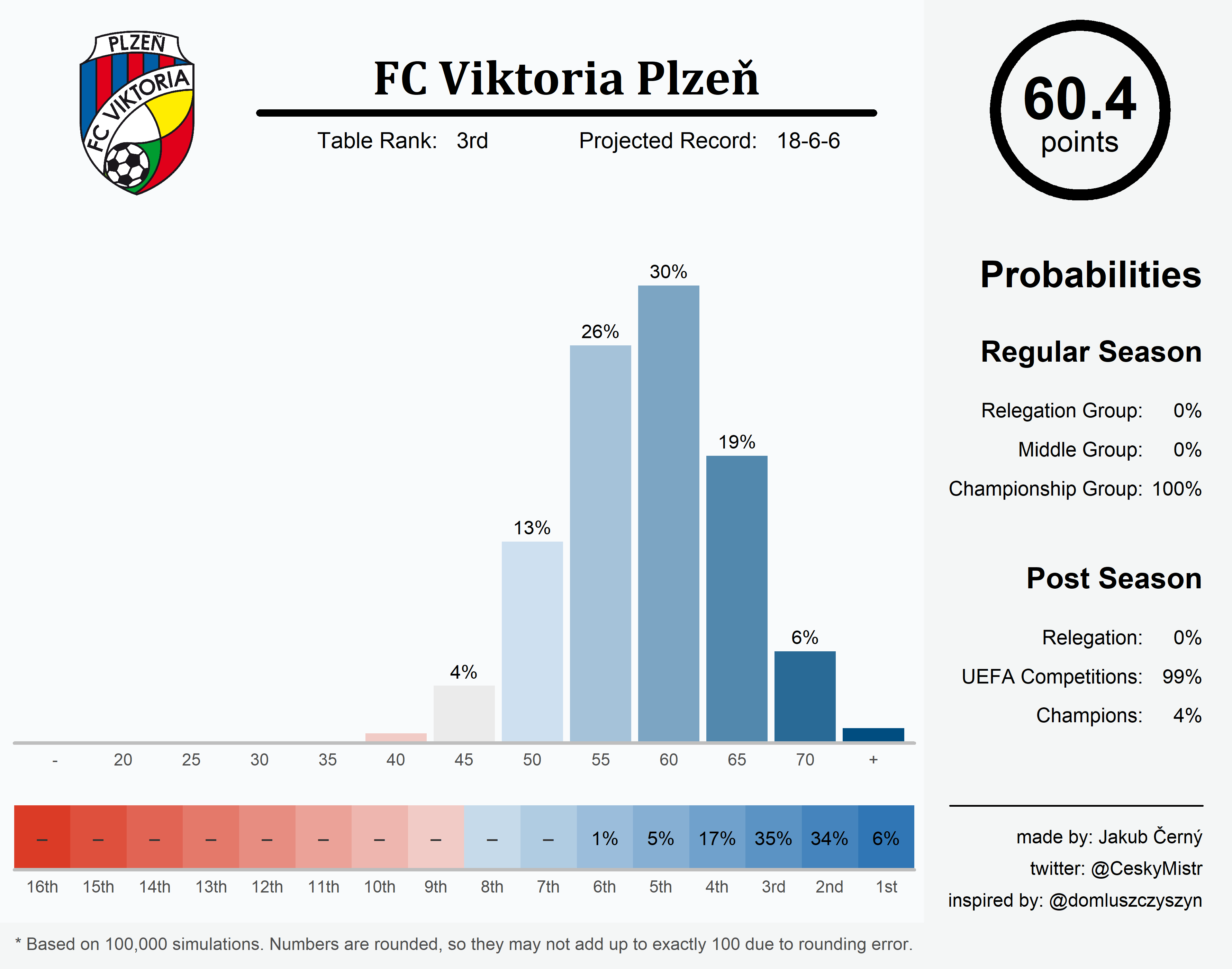
When the model was asked to reward Plzeň for its unexpected title in 21/22, the regular-season point projection read 66.5; something the model actually doubled down on at Christmas, rising the projected total to 68.9. At that point, Viktoria were the title favourites, but we all know how it turned out — 57 points it was. This is the first time since that Plzeň finally climb over the 60-point bar, hoping to not let the model down again. It’s quite funny to note that last year’s runner-up finish only made for Viktoria’s joint-10th best regular season per points. Koubek’s boys hitting 60 is just barely the more likely outcome (ca. 55%).
Bold prediction
The track record: 0/4. Červ was sent off against his former team, but not Slavia
The prediction: Plzeň will honour Kalvach by leading the pack in set piece goals
The rationale: At the peak of his powers, Lukáš Kalvach was a marvelous set piece taker. He was a big reason why Plzeň elevated their relatively lousy set piece goal total from years past to fifteen in 22/23 and then twenty-two in 23/24; set pieces were, in exchange, a big reason why he led the league in expected assists over the last three seasons, racking up nearly 23 of those per Wyscout tagging. Assists, though… a different thing altogether. I started tracking match events in 21/22, when Kalvach had to wait for his first set-piece assist till Round 33. A year later, at least, he notched 5/6s of his assists that way, keeping the standard in the following season (5 out of 7) only to crash down to earth last term with a poor 4 assists, leaving three (plus one indirect) for the last three rounds. All that in the face of so many wasted chances; in both most recent campaigns his set pieces chipped in to 30-plus.
Lukáš Kalvach had deserved better. And so Ladra & Co. are coming to avenge him.
While the prediction may not feel bold enough on the basis of the average set-piece xGFExpected Goals For (xGF) estimates how many goals a team should have scored based on shot quality, location, and context. (0.43), ranked second in the league, it certainly is on the basis of the average set-piece GF (0.29), ranked 9th in the league. In fact, over the entire Kalvach era, Plzeň had never led the pack in set piece scoring. Now, in what may be Dweh’s last box-dominating season (a total of 3.39 xG last season, after racking up 3.92 the year before), I say it’s bound to change.

Enjoyed the text or the visuals, but don’t care for 🇨🇿 translations and dashboards? No worries, you can still support us by inviting us for a symbolic pint at the old BuyMeACoffeeBeer page.