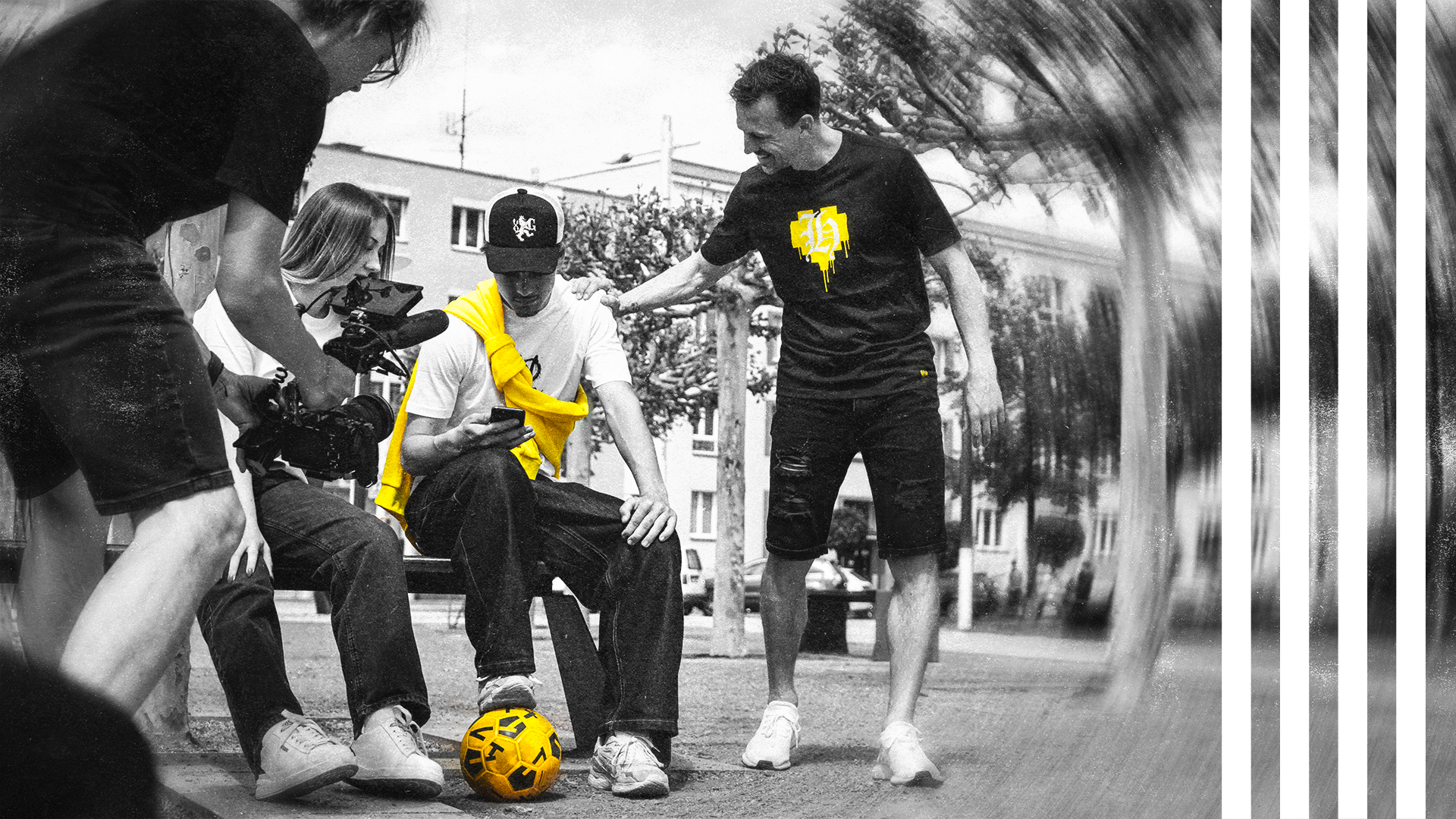
Each year, the football team of FC Hradec Králové seem to raise the bar even higher. In 2023, they returned to their hometown with a brand-new stadium, filled it to the rafters on a regular basis and even welcomed the Czech national team, coming within a whisker of an unlikely European adventure. In 2024/25, they lifted their point-per-game average to 1.44, setting up the scene for only their second Top 4 placement since the shock title win in 1960. All along the way, FCHK’s marketing team has been opening new chapters as effortlessly as opening a pack of Bon Pari, effortlessly swapping the club’s 2025 First Republic-themed appeal to older generations for a fresher look in 2026, continuously adding more exciting layers to the brand. It’s as if the club simply cannot put a foot wrong.
Yet, among all the footballing and PR success, by far the most important step the club needed to take — and couldn’t possibly mess up — was the ownership takeover. And that’s where the word “effortless” left the equation. In a fresh Liga Naruby interview, Ondřej Tomek — the face of the takeover and billionaire local whose brother Petr runs a remarkable charity tournament — described a tedious struggle that only the mayor herself could bring to an end. Sure enough, it took roughly four extra months beyond the initial estimate. Then, when it finally happened, the quartet of musketeers (plus Pavel Nedvěd, the busy bee) went suspiciously quiet for another four months or so, mulling together over every small thing, finally deciding to drop chairman Radek Šenk, slash the share of the city’s footballing icon Ivo Ulich to a mere 10%, and concentrate more power in the experienced investor’s hands.
While Tomek insists he never entered the club to run it, mostly planning to focus on resurrecting the academy, the club arguably couldn’t wish for an architect more suited for these times. He is humble enough to genuinely enjoy talking to youth team coaches because, in his own view, their perception of ambition and troubles is ultimately the most accurate thermometer for the entire organization. He is an honest realist who describes his own club’s current scouting setup as “amateur”, putting it at a ghastly no. 1 on a scale from 0 to 10 in terms of potential. He is a grounded visionary who refuses to pump his own trumpet for building a gym or a roof over the artificial pitch for the academy, because his ultimate goal is having all the teams clustered around ‘Malšák’, the big arena, and they are nowhere near that. Even a new hybrid turf, supposed to be of Top 4 quality, seems to be an afterthought for the driven owner at a time when he’s yet to conclude the search for a new chairman and continues his quest for a major sponsor in the absence of a big company based in Hradec.
When SK Hradec Králové came one penalty shoot-out away from the Cup Winners’ Cup quarter-final, it was OEZ — one of the country’s leading electrical engineering companies from nearby Letohrad, freshly privatized at the time — adorning the club’s simple yellow kits. Those same shirts now, roughly 30 years later, serve as an admitted inspiration for the new visual direction, contributing to yet another record sale of season tickets (4 200 as of today).
Apart from the Václav Pilař PR disaster, which he attributes solely to the coach, the club is firing at all cylinders. The U-19 runaway champions reminded the veteran fans of the only title-winning senior team that also did it as a promoted side all those 66 years ago. The World Cup invitation for Vladimír Darida, meanwhile, reminded the same group of fans of Hradec’s only other WC candidate, Jiří Hledík, who didn’t miss a single minute on the way to the 1960 title and would’ve certainly gone to Chile ’62 had it not been for… a random red card in Indonesia? Man. When you consider the poor fella also missed Sweden ’58 because of a complicated move away from Sparta Prague, prompted by his wife’s health issues, you’d almost think the communist regime was out to get him. Like it was evil or something.
Anyway, where was I? Oh yeah, the coolest club in the league doing cool shit. May it last…
Looking back on 2025/26
What went right
When ‘Votroci’ line up for the derby in the opener, they’ll be aiming to set a new record in consecutive regular-season wins. The kind of a finish David Horejš’s team put together, punctuated by the first of two obligatory wins against Slavia, had only been achieved by two iconic coaches of the early 1960s golden era (Jiří Zástěra in 1960, Oldřich Šubrt in 1963). Later beating Liberec at home for the first time in 15 years to move ever so close to UEFA qualification was only a suitable follow-up, with a majestic 3:1 Slavia clincher as the mic drop.
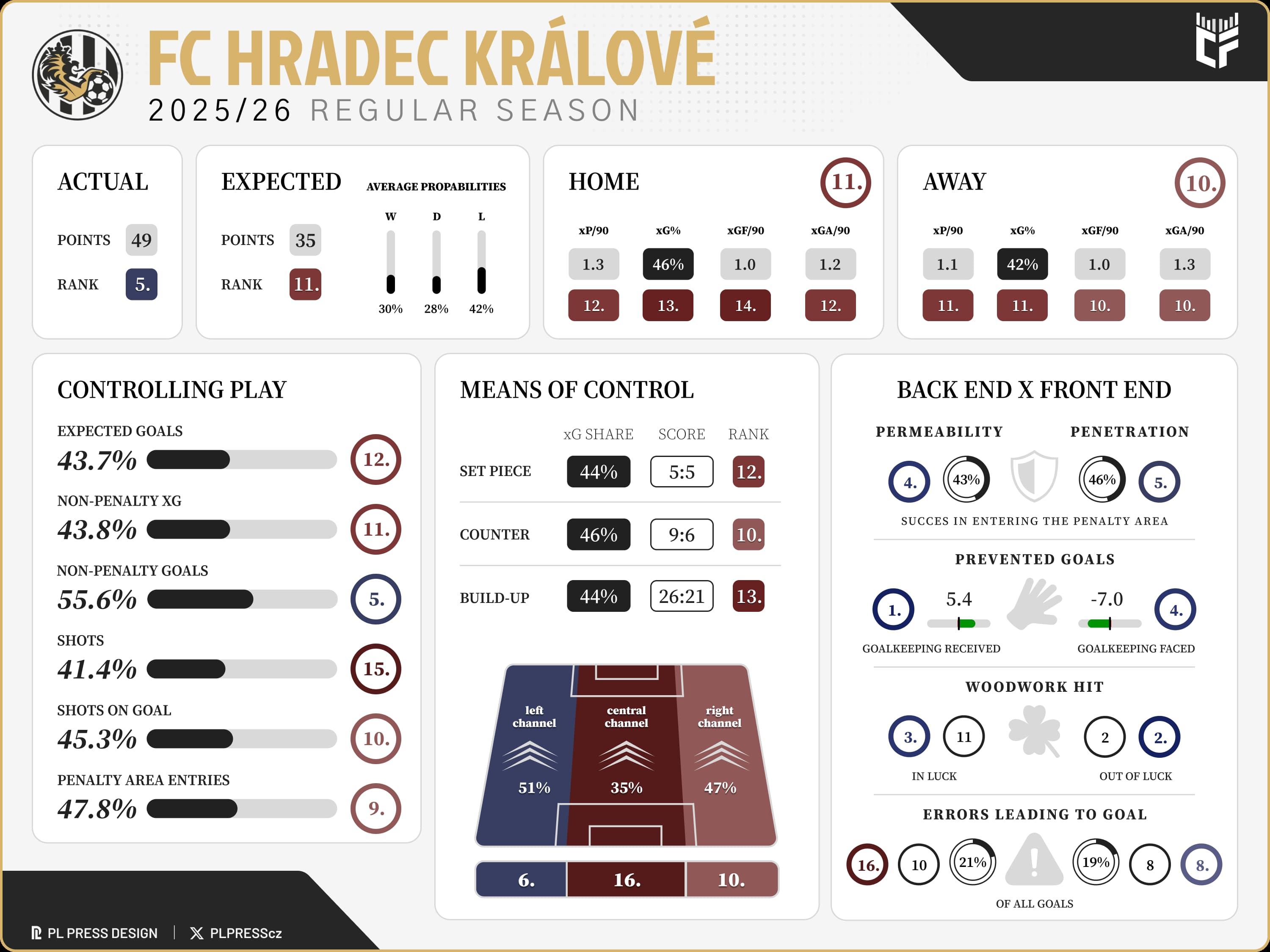
Looking at the table above, it would be too easy yet somewhat accurate to call ‘Votroci’ the PDOPDO is the combined shooting and save percentage of a team, with unusually high or low values often signalling unsustainable mis/fortune. kings. The old metric — standing for combined shooting and save percentage, commonly used as a proxy for fortune and/or efficiency — normally features a cluster of teams at the top. This time around, there was Hradec Králové followed by no one. Adam Zadražil, Ondřej Mihálik et co. put together a remarkable 87.9 PDO value, with second Teplice checking in at 83.5. Of the two, however, it is indeed more a story of efficiency than luck. While Zadražil led all goalkeepers in prevented goals (5.18 including penalties), Mihálik spearheaded the most ruthless bunch of shooters posting xGSExpected Goals Scored (xGS) only takes shots on target into account, including their power and placement on top of xGF. over 8 goals higher than xGFExpected Goals For (xGF) estimates how many goals a team should have scored based on shot quality, location, and context..
Whereas the pre-shot xG saw 11th-best danger creators good for 35 strikes, pretty much on par with 12th Zlín, the post-shot xG looking at tangible danger brought to opposing goalkeepers had Hradec good for a much more solid 43 goals over 35 rounds, 6th-best mark.
What went wrong
Hradec continued to struggle in familiar areas — failing to control the game’s flow, appearing bottom two in shot share, and once again seeing too many of their goals conceded being preceded by a grave error — but there was one peculiar unfamiliar area: attacking set pieces. It was still true at the end of February 2025 that ‘Votroci’ sourced exactly half of all their goals scored from set pieces, while their end-of-season total of 12 goals following corner kicks led the league and represented an amazing 30% of the season total. Now they started off reasonably hot, but between Rounds 10-33 they failed to score from a single set piece.
Most valuable player
Per my MVP model (traditional stats): Vladimír Darida (ranked 2nd league-wide)
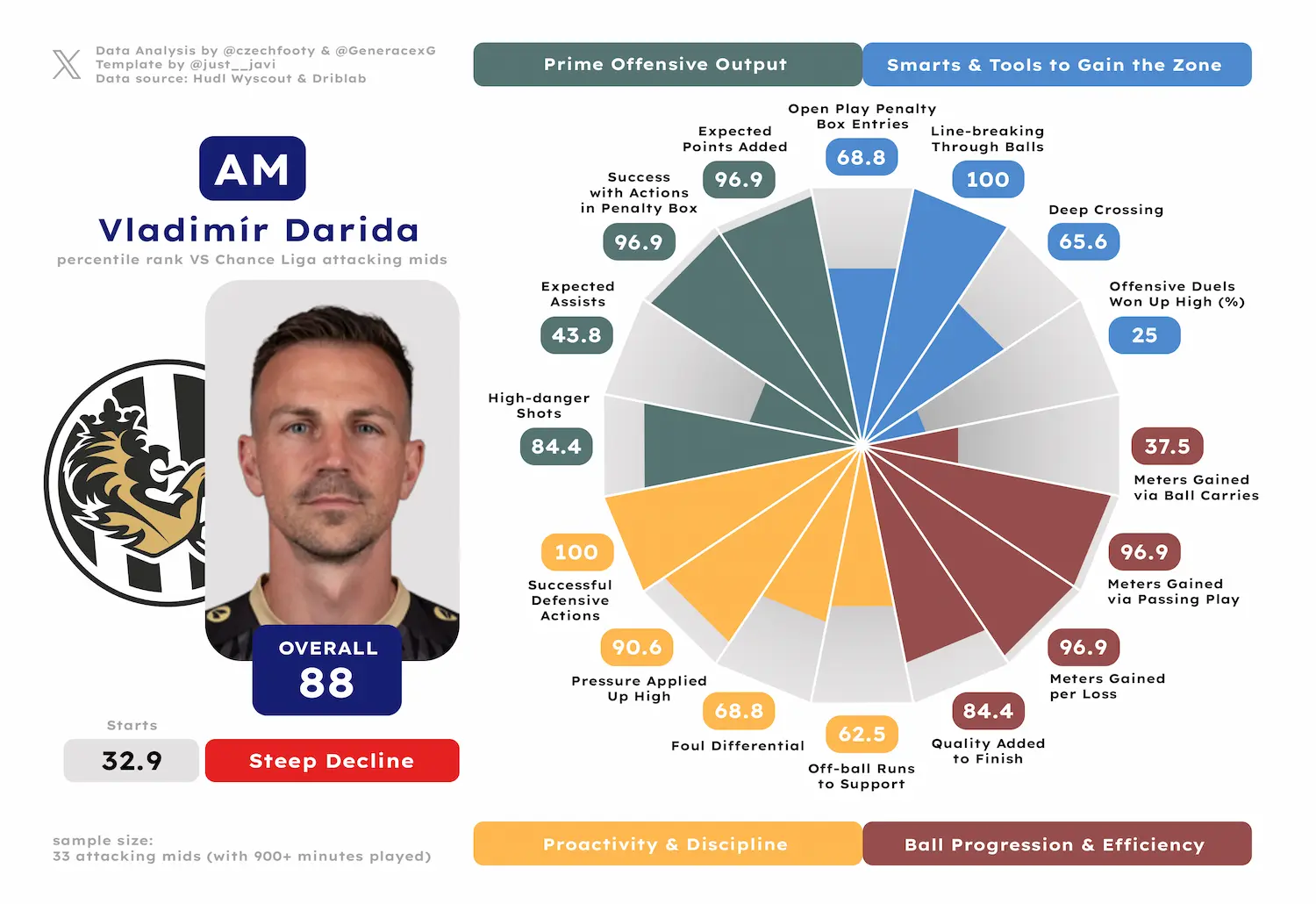
Per my positional models (advanced stats): Vladimír Darida (88th overall percentile at AM)
I’ve got to admit, I wasn’t quite ready to believe the hype for much of the season. I saw Vladimír Darida popping up in all the right places at the right times, but what about all the inbetween? Wasn’t he as much a hero of many heroic team performances, most memorably those against Sparta and Plzeň only two games apart, as he was a reason for the very worst xG share from central positional attacks, with Hradec responsible for a measly 35% of xG generated down that strategic channel Darida patrolled in every regular-season game bar one? After all, at Christmas, he chipped in with a miserable 3 primary chance-creating actions from open play to go with his 14 goal contributions. That was clearly unsustainable.
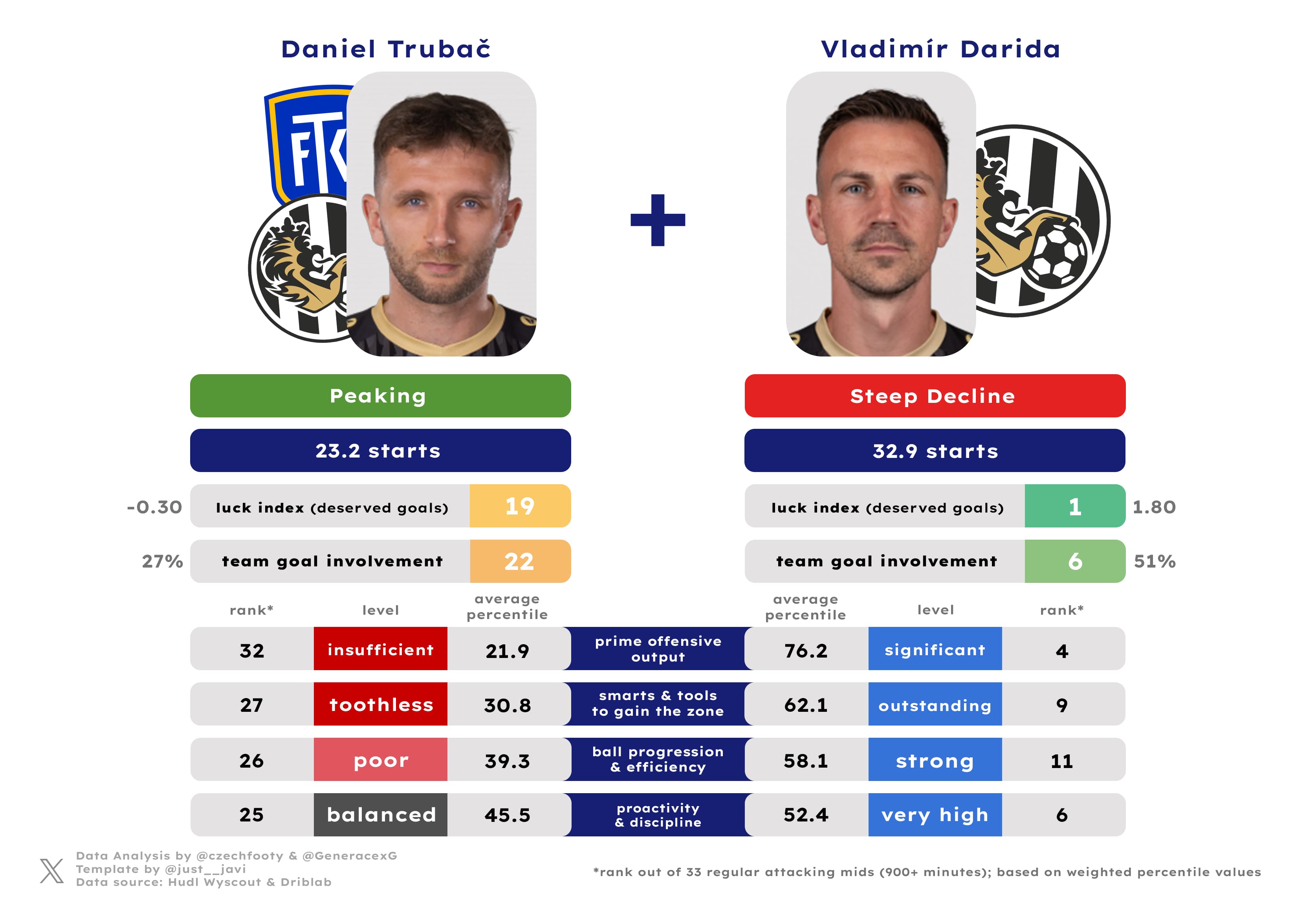
I still kind of stand by these points. But at the end of the day, with my pizza charts famously looking below the surface where these traditional stats are merely scratching it, you are looking at a 5th best attacking midfielder in the field of 33 per overall percentile, doing it in the twilight years of his career as the sole regular who’s supposed to be in “steep decline”. Even more impressively, Darida was one of only four attacking midfielders whose output in all four areas of game fits inside the league’s Top 12. He progressed play superbly without losing the ball much, he was breaking the lines with through balls at the highest rate of all, and once in the box, he also successfully connected on 29 of his 53 ball touches in the zone, showing up for a decent amount of high-xG shots. It was only natural, then, to make him a diligent no. 6 who never gets the ball when he kindly agreed to return to the national team.
Chip on the shoulder
Last summer, Adam Zadražil was a unanimous MVP choice who had a dream move to Italy blocked by the board. This summer, Zadražil was still a front-runner who would’ve been an MVP on all teams outside of Slavia and Sparta per my model and once again appears to have a big move blocked, though this time it would be a domestic kind and it might be the destination “blocking” it rather than Hradec. Same same… but also quite different.
This description perfectly fits Zadražil’s campaign as a whole, too. He was still a stud in terms of shot-stopping. He pulled off 13 high-danger saves while denying a shooter on a breakaway 10 times. His high-danger save percentage was down from 40.3% to 29.3%, but still only trailed two regular goalkeepers. There still weren’t many goalkeepers you’d rather send out to a sea of outfield players to safely claim a high cross for you. Yet, at the same time, Zadražil cost his team an expected 6.5 points through his glaring mistakes, appearing far more distracted when rushing out of goal line, going for a punch or building from the back.
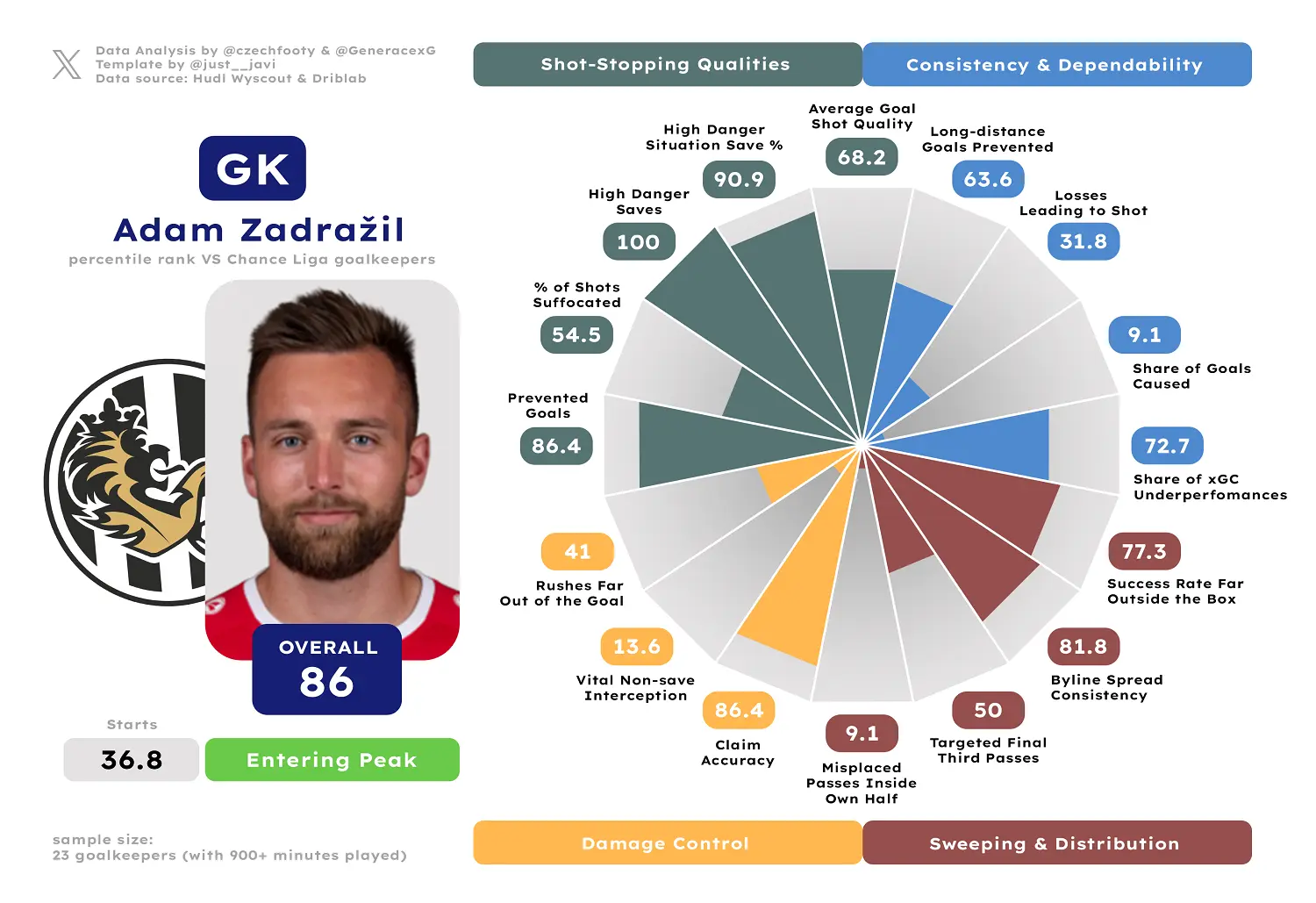
Maybe the change of scenery really was something he needed. Maybe the change of scenery is still very much on his mind. But with the UEFA competitions on the horizon and the depth behind him appearing less convincing than ever due to Matyáš Vágner failing to convince for the reserve team as well as in his odd starts for the first team, it could take a lot — and too much for any buyer — to acquire Zadražil at this point, so he’d better put it all back together.
Inside the off-season
special thanks for guiding me through the motions of FC Hradec Králové’s off-season go out to @OndejSouek2 & @vitsvoboda16
Squad turnover
Nothing to see here. As of now, only two other teams (Zlín and Plzeň) are holding onto all their 11 busiest players of 2025/26, while only Zlín is retaining more minutes (91.8% to 86.7%). For a team that’s so stubbornly set on their core, identifying as many as 8 players who were worthy of 20+ starts (ie. 1800 minutes or more), this is a massive deal. Equally as massive, then, is the lingering issue currently bothering Tomáš Petrášek who’s one of their five defence-minded players sitting inside the league’s Top 100 of busiest bees. Then again, Jakub Uhrinčať was very nearly their fourth centre back cracking the 20-start club (1752 mins).
The outlook is no less rosy upfront. Hradec are altogether losing 15 goal contributions as of today, a clear majority of them courtesy of one Pilař. This is kinda offset by the return of Tom Slončík, as these two were twice each other’s sub and only got to share the pitch together for 456 mins to fairly limited effect. Would you take Pilař’s or Slončík’s 9 goal contributions?
Biggest upgrade
Can you even call it an upgrade when the player in question spent the entirety of year 2025 with you? When you’re nonetheless the club’s statement signing, coming back on permanent transfer for a change, I would argue you can. They say “better the devil you know than the devil you don’t“, and I guess this goes twice as much for whatever the opposite of devil is.
Last summer, I featured Tom Slončík in the Biggest downgrade section. He was leaving a Swiss knife of an attacking midfielder, posing various threat from predominantly central positions and warranting the 71st percentile. Now we are talking about an inside forward/inverted winger instead, reaching even higher in terms of overall percentile (87th), but all the same posting a significantly smaller sample (13.1 vs 16.8 starts). Is Slončík ready to sustain a considerable impact over a 35-game season where he’s leaned on heavily? With the subtraction of one capable backup in Pilař and without bringing anyone in, we are bound to find out. It’s one of (his) game’s few remaining big mysteries, and I couldn’t be more intrigued.
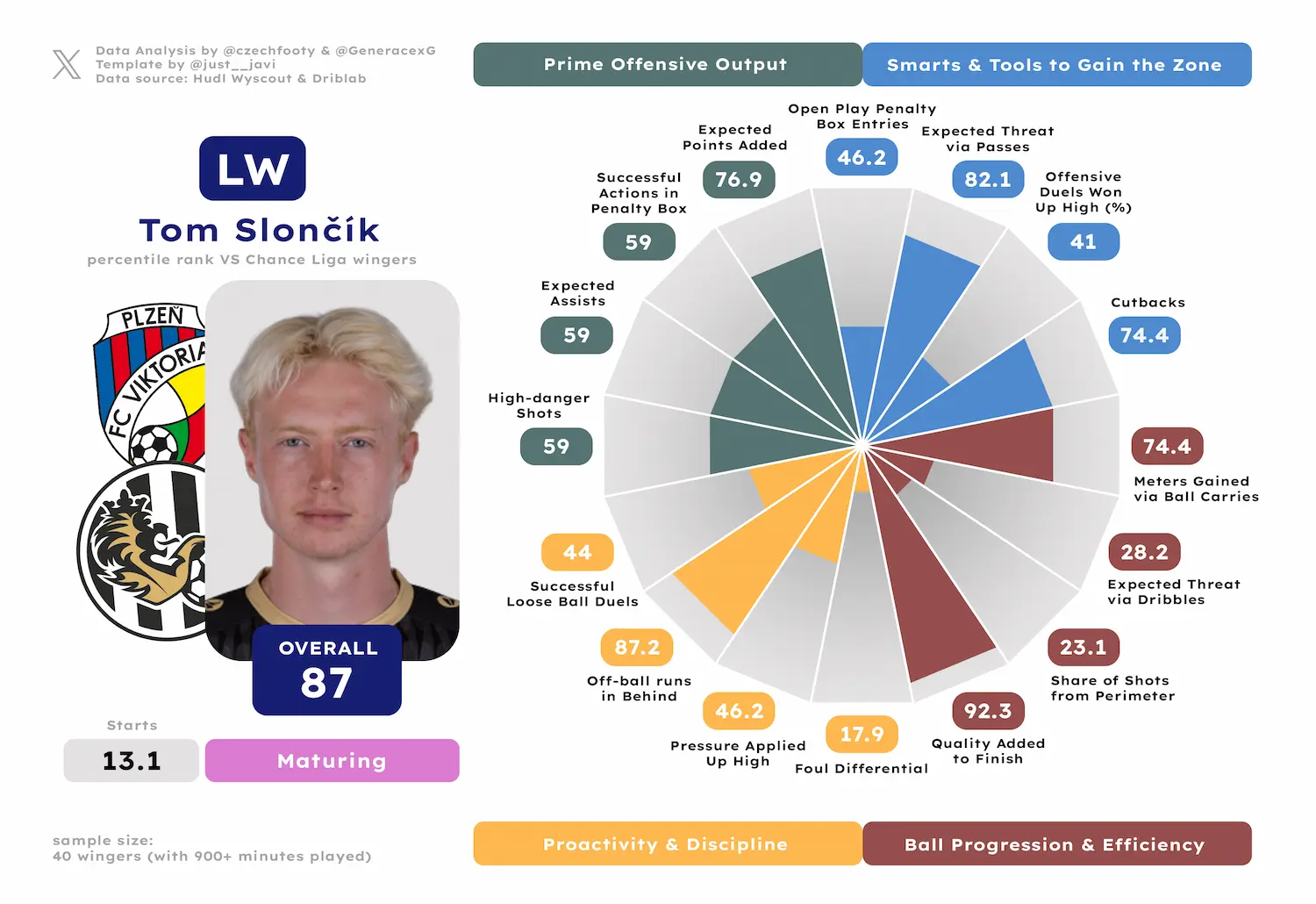
What we do know at this point: Slončík boasts a heck of a shot. Half of his goals were born out of a low-xG situation he alone made deadly. Despite generating 1.89 pre-shot xG, he posted 3.22 post-shot xG, adding the most value to his finish out of all regularly shooting wingers. What we can also be confident of: Slončík will constantly be a thorn in a team’s side, scoring high on both off-ball runs in behind and off-ball runs to receive cross in the box. Finally, he’s damn strong on the ball, consistently getting you closer to the opponent’s goal and playing through balls without losing possession in the attacking half all too often.
Biggest downgrade
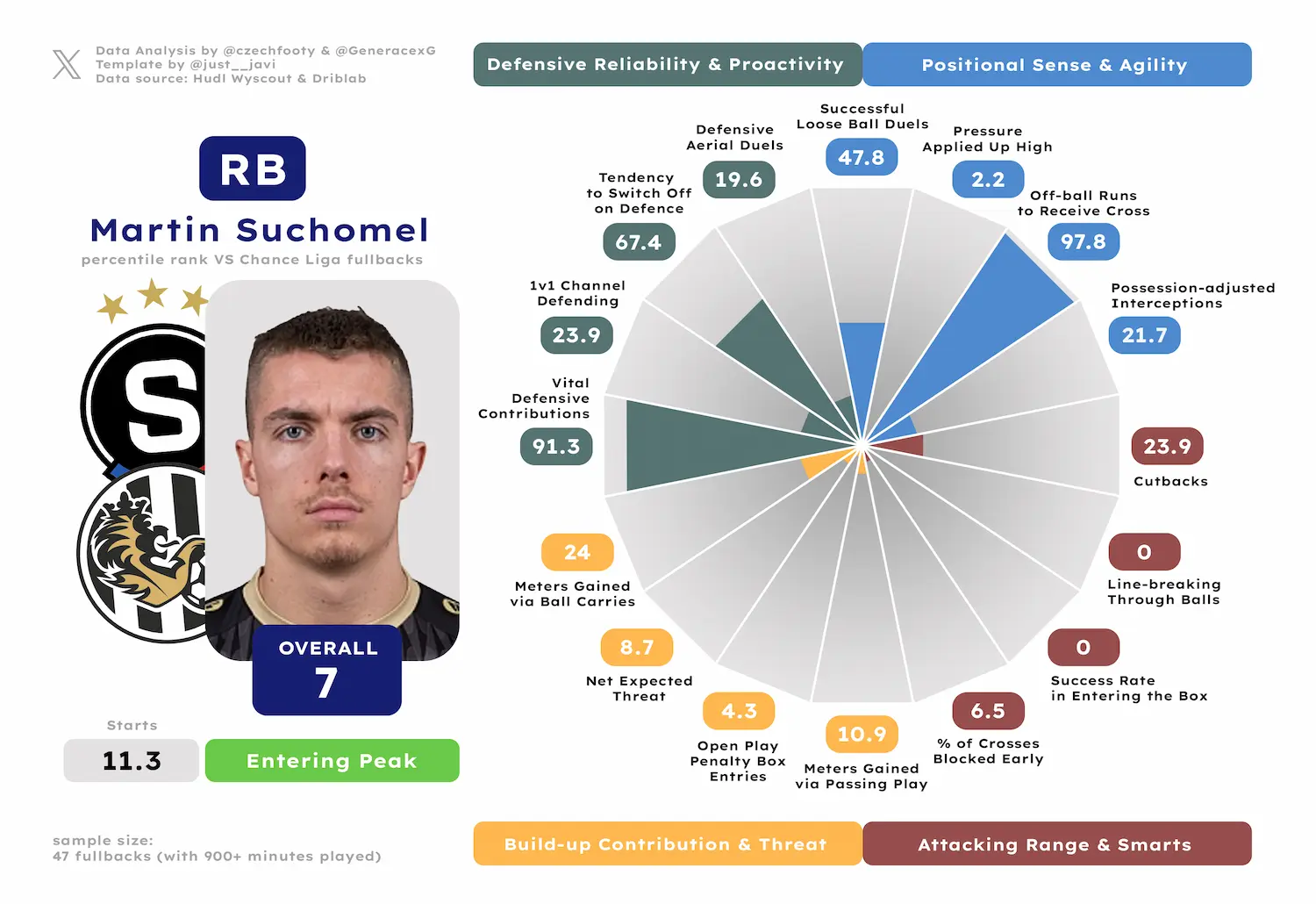
Juraj Chvátal is returning from a serious injury. Tomáš Wiesner is returning from the US having been good/healthy enough to play two games for Houston Dynamo reserve team, apparently scoring once while acting as a central midfielder which was also his position for a chunk of this pre-season (no. 8, when Darida was still away), and I don’t want Tomáš Rosický to be too angry at me once my Sparta preview is out so what the heck: it’s Martin Suchomel.
Martin Suchomel is great at exactly one valuable thing. A clear starter out, two unknowns in.
Need left to be addressed
In reality, it’s likely Pilař who’ll be missed the most. Not because he would be pushing these two below for playing time, but because he would be an obvious third choice where there’s now none. Adam Binar didn’t travel to Austria due to health reasons, Štěpán Ponikelský is very talented but also freshly 19, Lukáš Čmelík was cut loose and Jakub Kučera is a different kind of a player altogether. If your two stars that absolutely can be moody struggle, who exactly are you banking on to create openings? Jakub Hodek cutting inside from the right?
C’mon.
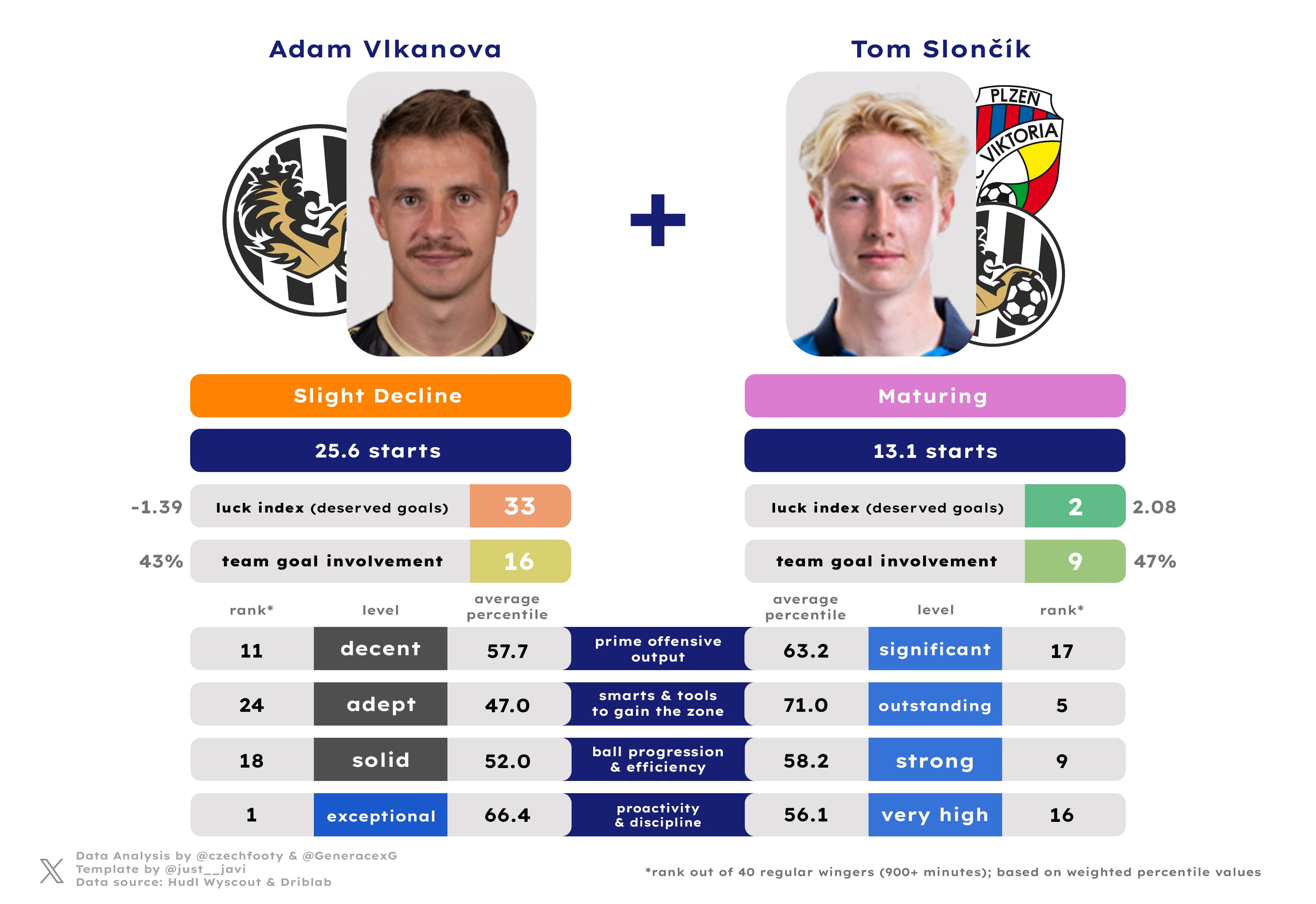
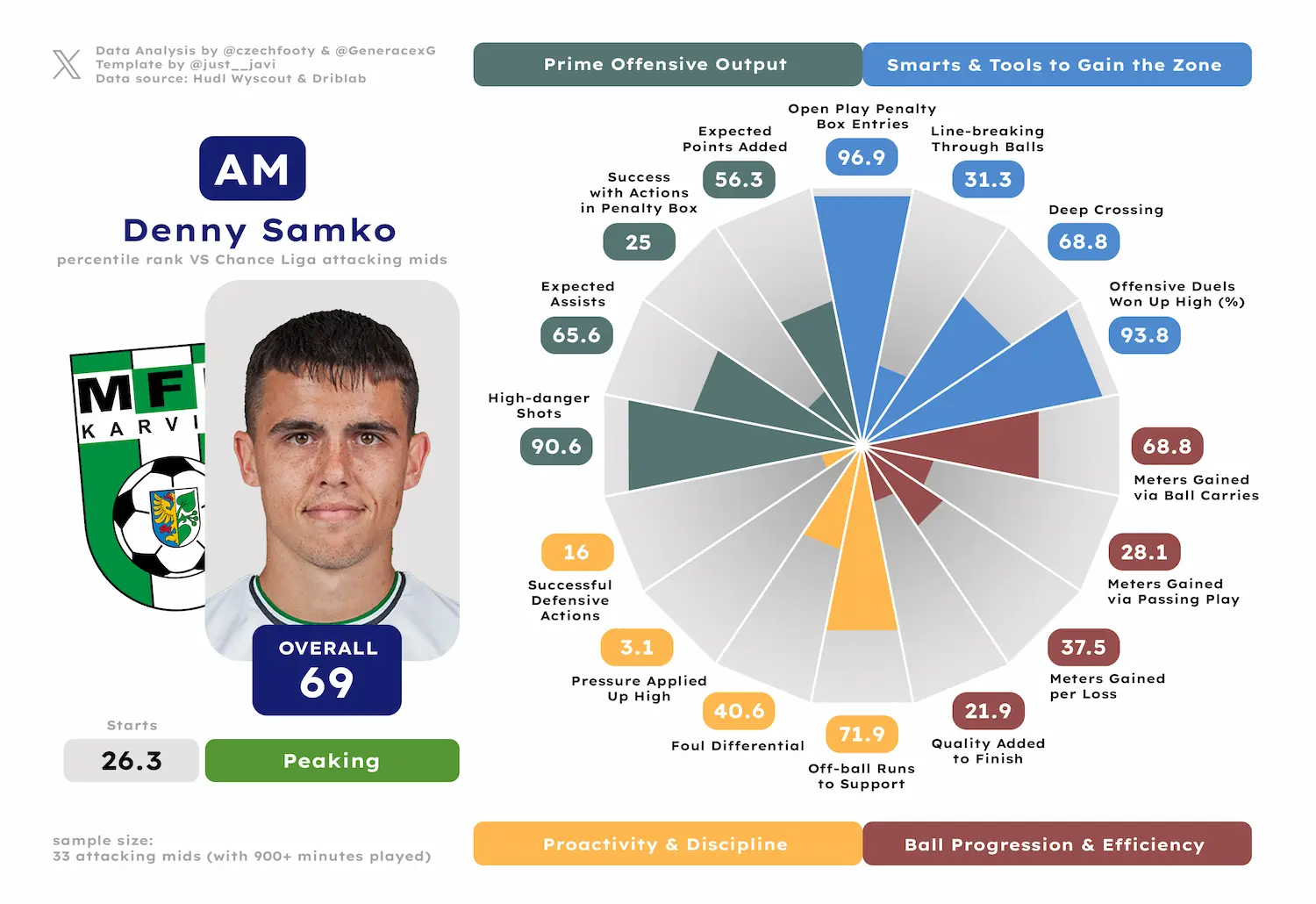
This question above has one painfully obvious answer: Denny Samko. Painfully because it’s only been two years since a stubborn someone who’s now (luckily?) in Brno shouted at Samko, one of the few recent Hradec academy graduates, from a curtain-rising press conference for choosing “regularly playing for Karviná” over “getting a look at Hradec“. How dared he! Water under the bridge in Hradec Králové, it seems, but now it’s Karviná who’s stuck. ‘Votroci’ can probably afford to play the long game here, and if they do stick it out, they would be rewarded with a player who doesn’t mind playing centrally or on either side and loves getting into the box. Ever so improving at the edge of the box, Samko’s soft touch and knack for a neat lay-off are a particular asset that both Adam Vlkanova and Slončík lack.
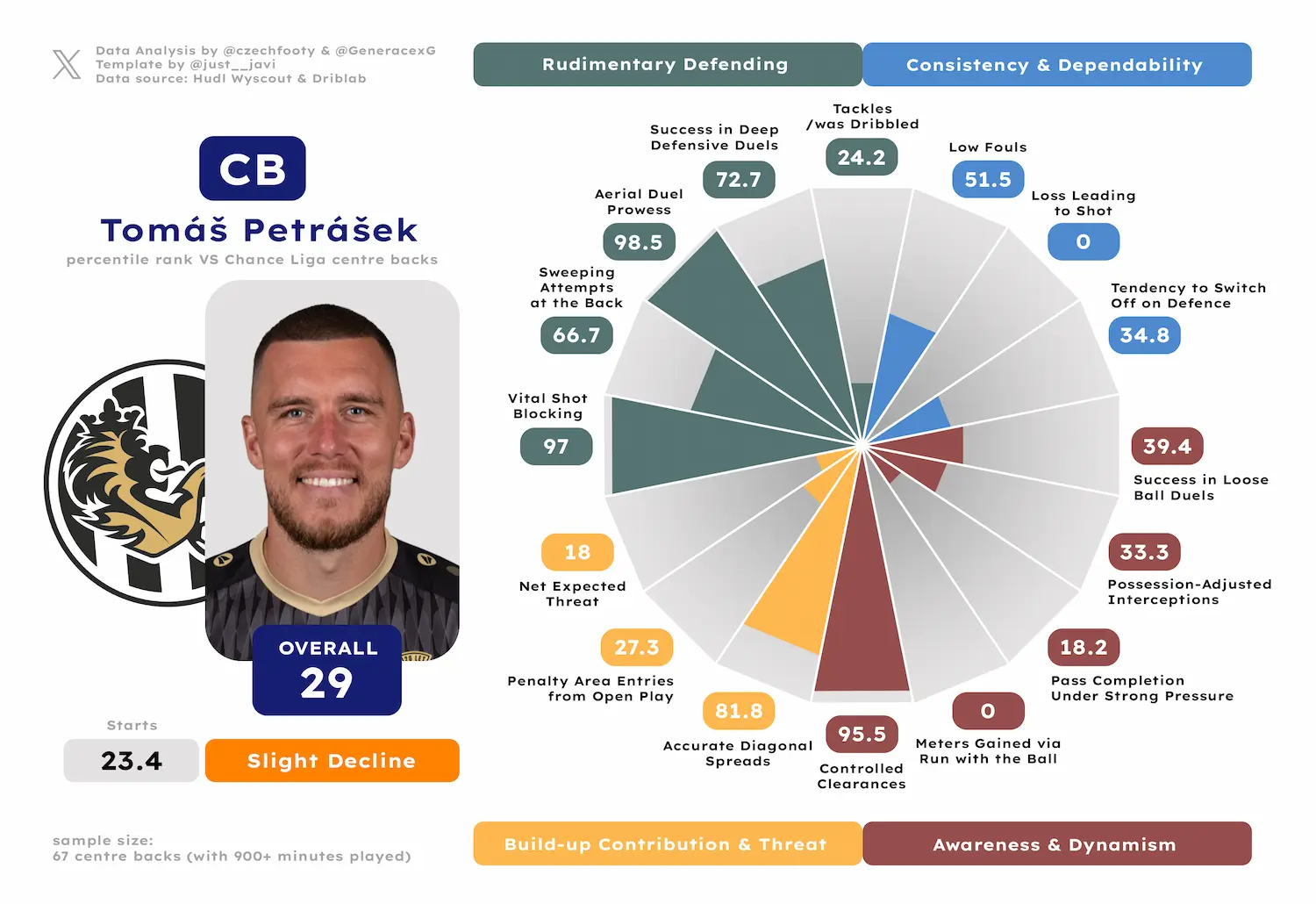
Finally, with the fresh news that Tomáš Petrášek is struggling with a lingering Achilles heel issue that may rule him out for the next month or so, it becomes mandatory that Hradec signs an additional centre back; preferably a no-nonsense type for the middle CB slot. Petrášek is a Top 4 centre half in exactly the sort of disciplines you can imagine. His aerial duel win rate inside his own box (25/31) is right up there with the strongest I’ve ever seen.
New kid on the block
For years we’d been miserable in this space. Between 2022 and 2025, my New kids on the block combined for 6 bench appearances and zero top flight minutes. Once (2023) I didn’t even bother, with all this now convincingly overshadowed by Lukáš Hruška’s one minute in 2025/26. Still, there were promising signs already a year ago. I mentioned Adam Binar (b. 2006), soon promoted to the first team; Ebuka Okeke (b. 2006), soon prolific for the 3rd-tier reserves despite an injury and off to Prostějov for a first big loan; as well as Lukáš Vaněk (b. 2008), soon a star of the triumphant U-19s. They were all hits in some ways, and boy were there more to come. Antonín Thiele (b. 2008) was the midfield general for the U-19s, and Alexandr Hronek (b. 2007) was the team’s Petrášek per @OndejSouek2 — vocal leader and a set piece threat. Eduard Wenke was picking up minutes in bunches at a tender age of 16 (August birthday of 2009). And all of these paled in comparison to Abdullahi Umar (b. 2007).
A safe bet given that he was already promoted to the A-team and played there towards the end of 2025/26, Umar was an adult among the kids in the U-19 top flight. He bagged 25 tallies across the entire campaign, 8 of them against Ostrava, Plzeň, Slavia and Sparta. Of his 29 appearances, only a dozen didn’t receive his goal celebration. He was too fast, too clever, too strong for his peers. He impressed in pre-season through his duel behaviour, too.
Luděk Zajíc, by the way the man in charge of Hradec’s European adventure in 1995, deserves a lot of credit for his ruthless accountability and high demands in charge of the academy. Luděk Klusáček, the title-winning manager now moving into a newly created role of chief coach overseeing the development from U-17s to U-19s (including the young B-team), was a big factor, too. As was, frankly, the establishment of Slavia’s C-team and a younger Sparta U-19s. But it’s ultimately all about the players who will now be writing their own stories in UEFA Youth League and beyond, like Petrášek, Tomáš Holeš or Milan Knobloch did back in 2011, following up on recent graduations of the likes of Jaroslav Zelený or Tomáš Koubek.
Finally a new batch; not just the odd individuals!
Looking ahead to 2026/27
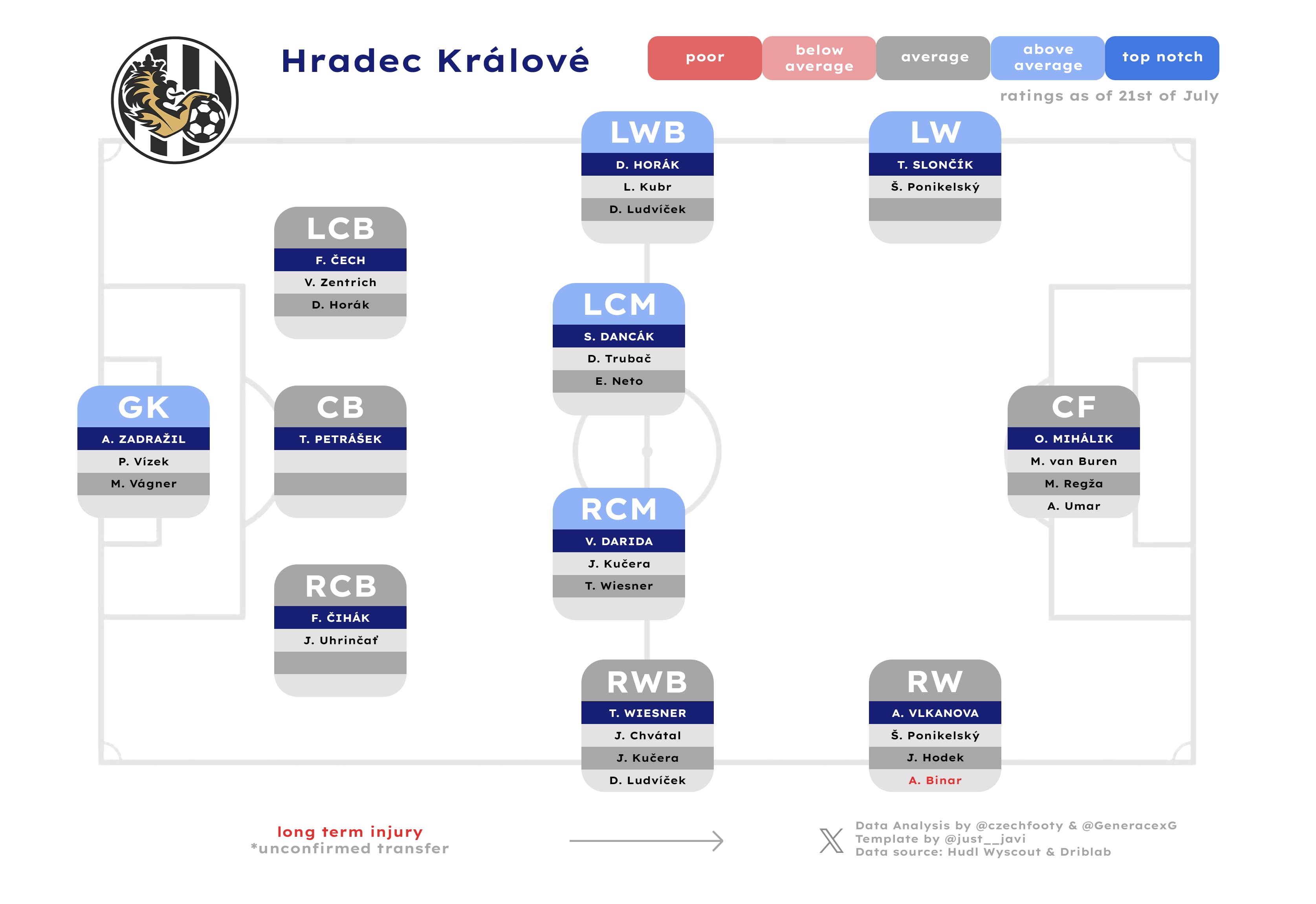
Below is the team’s current depth chart with a maximum of 4 alternatives for one position. The colourful ratings are a static snapshot of the league-wide situation on 21 July, and they are just a playful bit to add flavour to it; the names featured should be relevant to this day. To learn more about my approach to constructing depth charts, with all its limitations, head here.
Primary formation
As the last season progressed, David Horejš very much settled on the wider 3-4-3 formation, which can however look more like a 3-4-2-1. A two-striker formation is also not ruled out.
Colours I grappled with
Both the keeper and the left side could aspire for the top notch tag, but the depth is… oof.
Notes on the depth chart
There were times when Daniel Trubač was the league’s underrated ball-playing/carrying midfielder. Even though he’s theoretically peaking, those times could be gone for good, but don’t be surprised if he suddenly blossoms as a newfound constructive number 6.
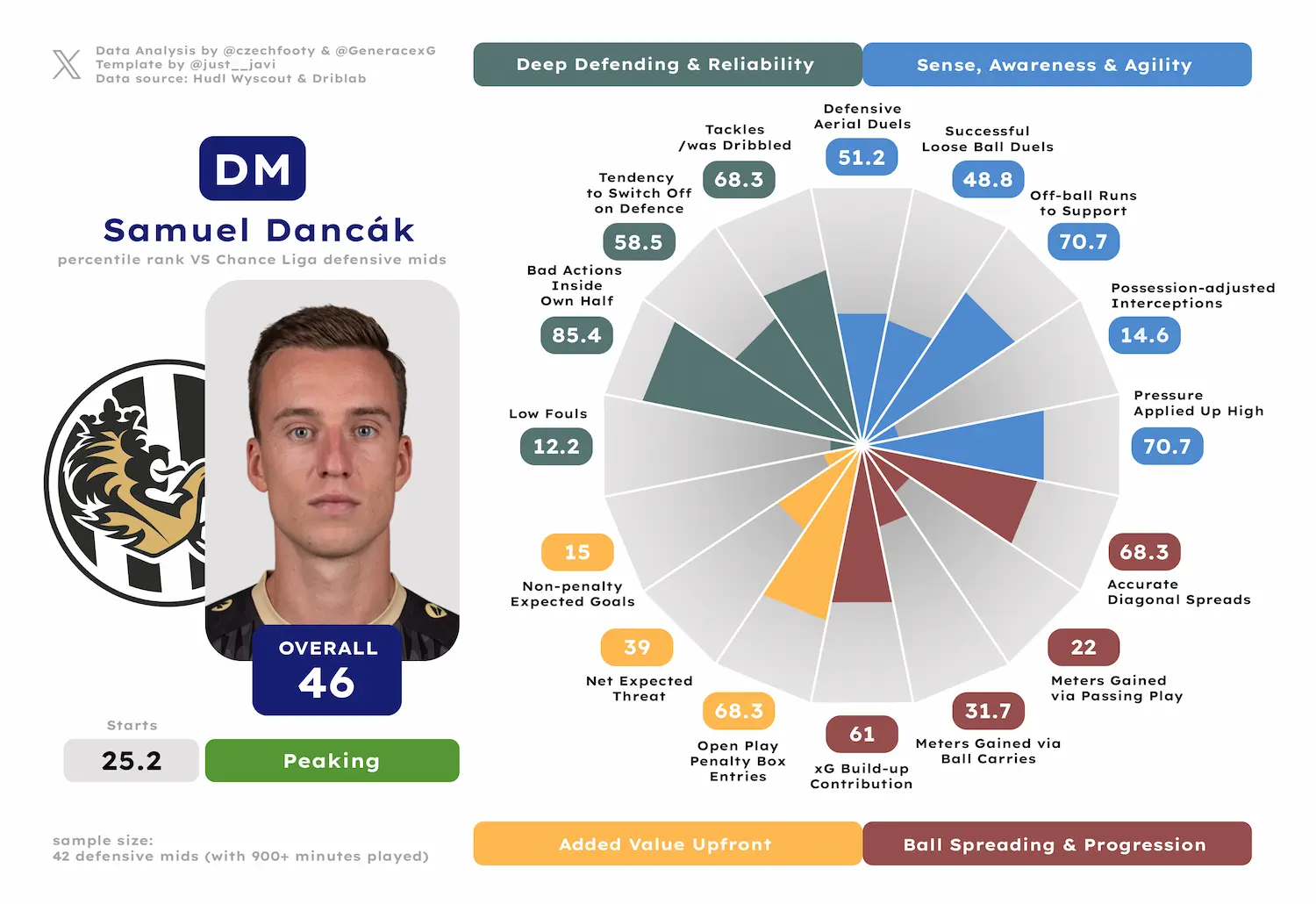
A better candidate to predominantly feature next to Darida still, Samuel Dancák endured a bit of a rough year, uncharacteristically failing to get the ball into the danger areas. He’s always been exploited defensively, but his on-ball performance used to be markedly stronger.
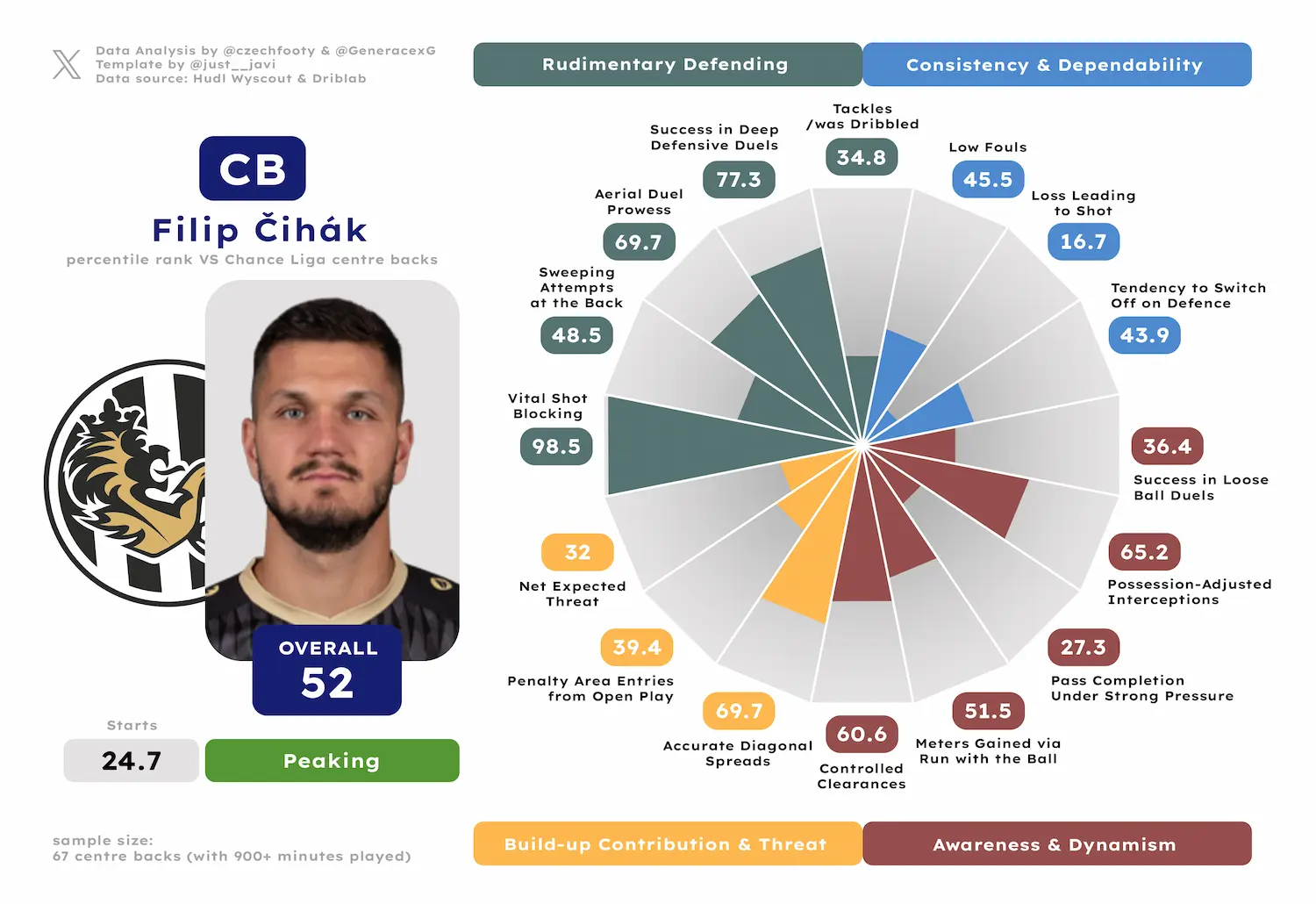
Speaking of lowkey underwhelming seasons: Filip Čihák got rather seriously injured somewhere in the middle of the campaign, and it showed on his vaning confidence on the ball. After he was the 4th most pronounced build-up contributor/threat, he’s now mediocre.
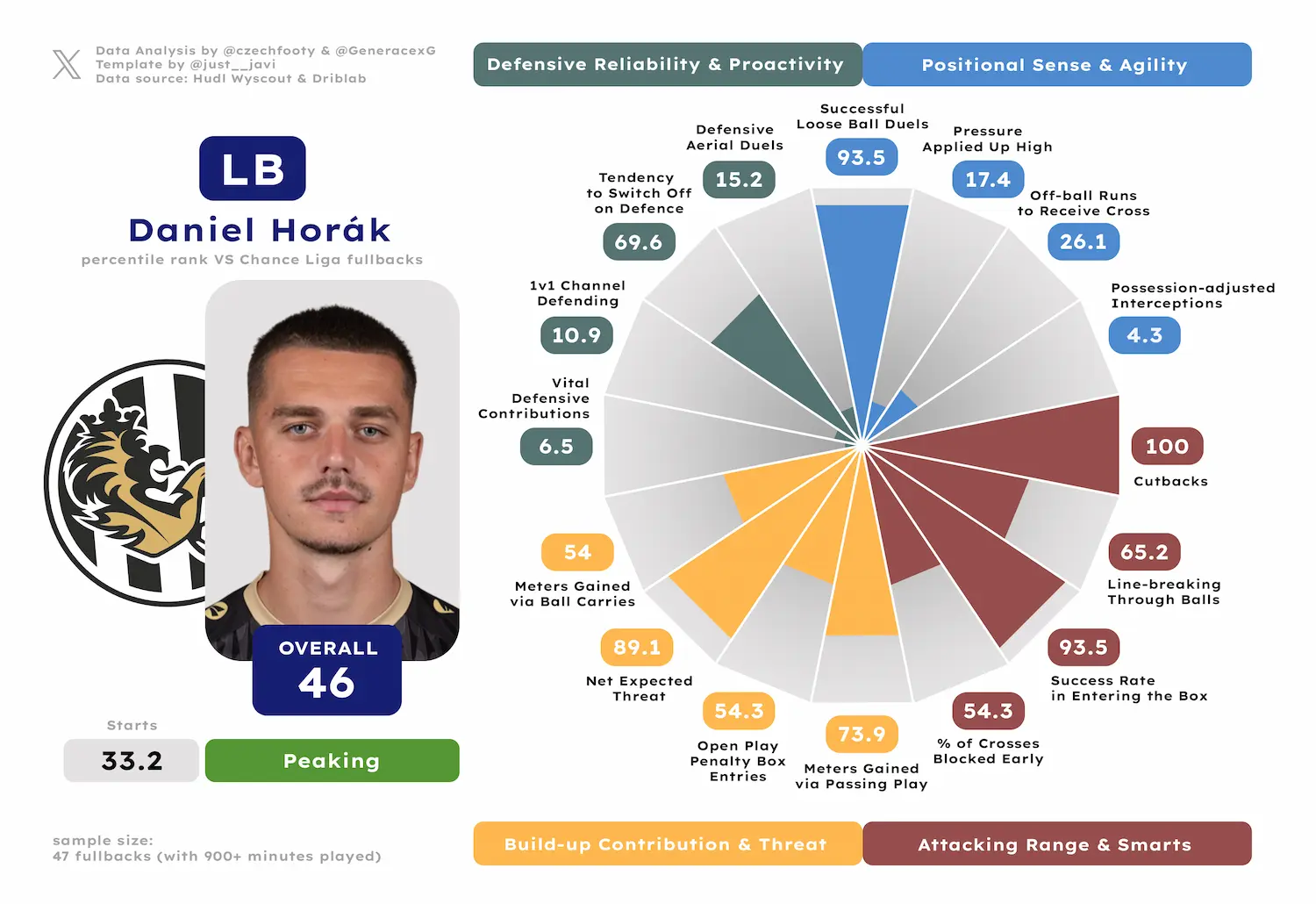
Whether Daniel Horák should play the left centre back or stay at left wingback seems to be the question on many fans’ lips these days, and I honestly don’t know why it would even be a dilemma to begin with. Here’s a fullback who ranks 40th and 41st (out of 47) in both defence-oriented areas of play, while shooting up to 5th and 11th in both offence-oriented areas of play. Where do you think he’ll feel most natural? Do not overthink the pre-season.
Roster battle to follow
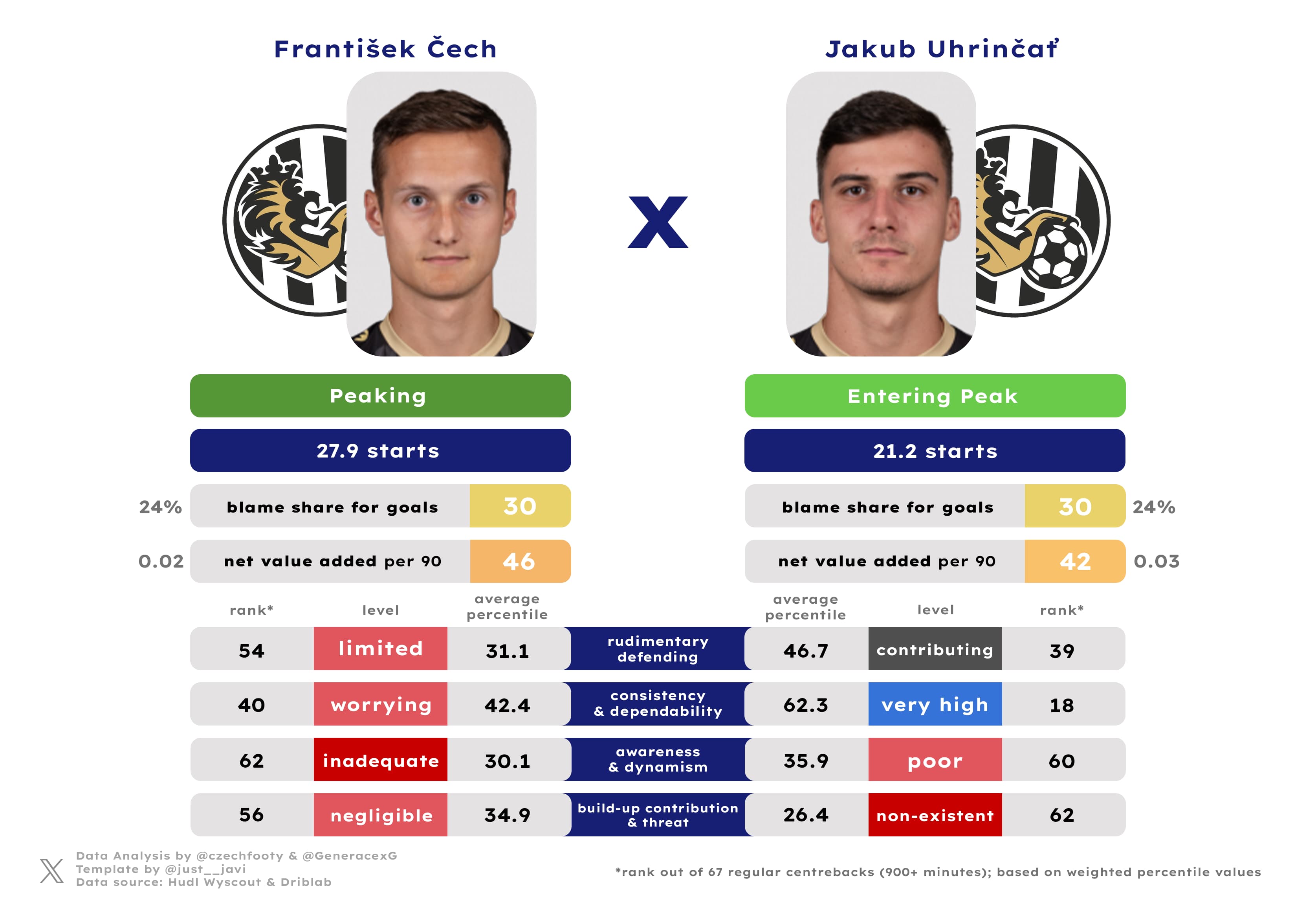
Once Petrášek gets healthy, it will be fascinating to watch whether Jakub Uhrinčať edges out František Čech for the third centre back spot. While the beloved local boy is incredibly weak in the air (6 duels won inside his own box out of 18), Uhrinčať isn’t and generally doesn’t switch off. He wins 81.1% of ground duels around/inside the box, whereas Čech is down by twelve percentage points. It’s obvious who’s the heir apparent to the Petrášek-Čihák tandem, while neither of the two is a particularly good complement to them. Hradec need variety.
Finally, do you trust the Pišta hype? There was a stretch of 7 games between March and May across which Ondřej Mihálik produced 12 shots, all but one directed on target. It was when he notched an impressive eight goals. Mick van Buren, for what it’s worth, also wasn’t a misfiring shooter — he just didn’t deliver the goods and failed to compensate elsewhere.
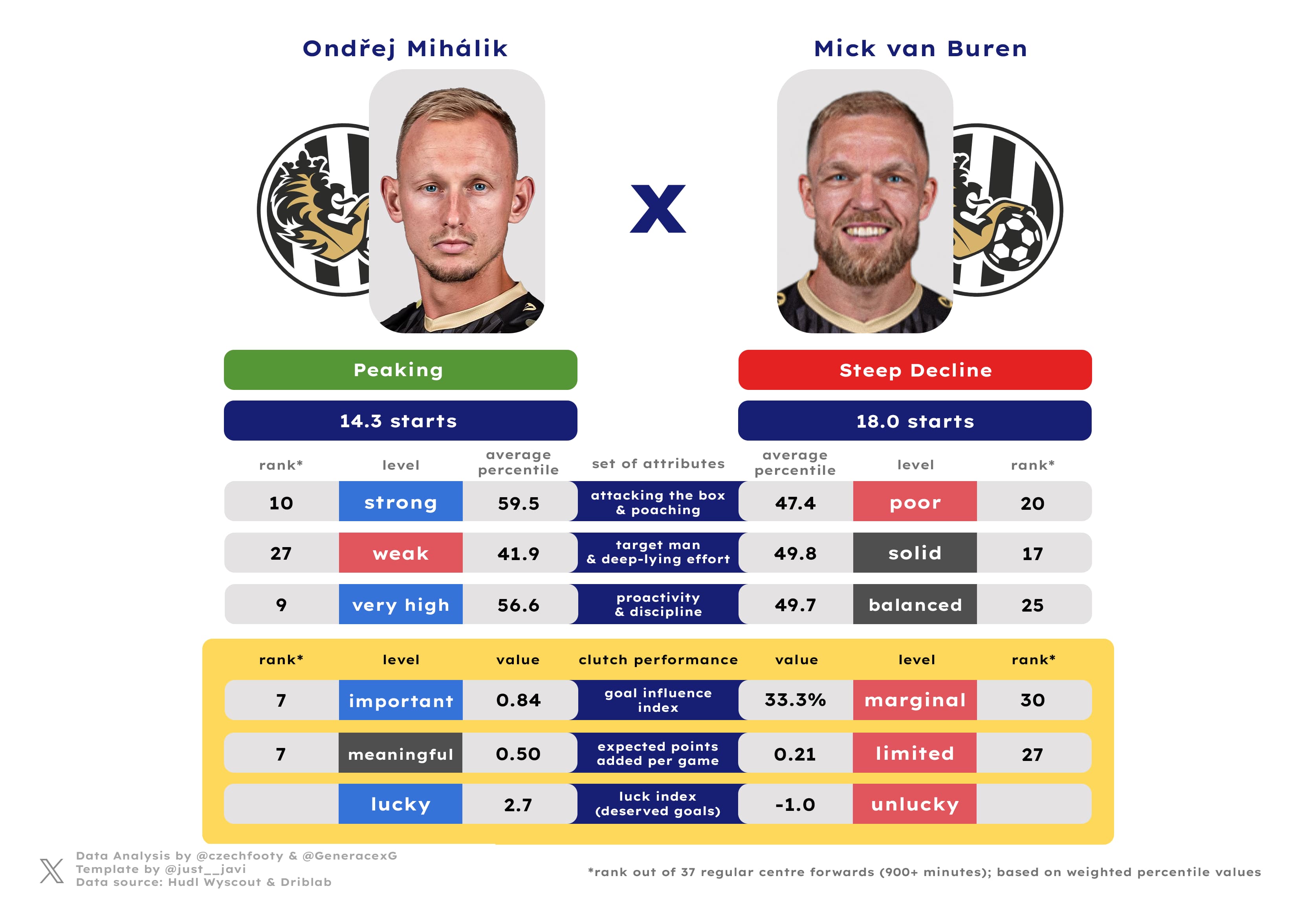
Visibly off the pace most of the time, the Dutchman was easily denied far too many penalty area entries and surprisingly bombed as a final third creator, his noted strength back in the days. Mihálik doesn’t break lines for you either, but at least he’s dependable with his back to the goal, excelling at metrics like pass completion under strong pressure and ball retention.
Season forecast
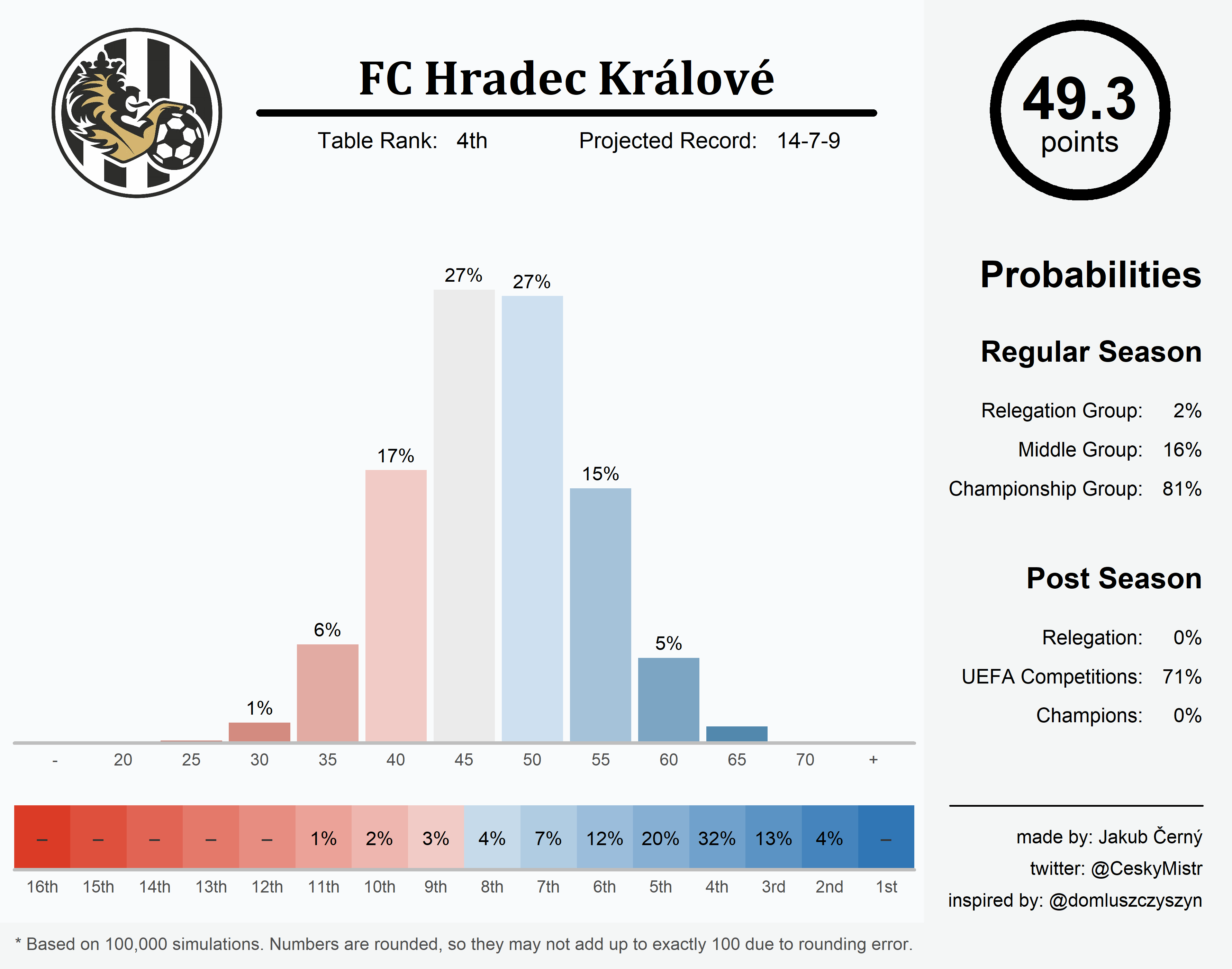
After taking a rare step back on our projection last summer, dropping ever so slightly to 40.5 regular-season points, Hradec Králové are roaring back — to no one’s surprise. In fact, this is a crystal clear recency bias since ‘Votroci’ set their club record by earning 49 regular-season points in 25/26, now being pegged down for the exact same total by Jakub‘s model.
Coincidence? I think not.
The more fascinating thing for me, even rather than jumping from 16% chance to qualify for UEFA competitions to 71%, is that the 2025 threshold for Top 4 was exactly 5 points higher courtesy of a high-powered, all-conquering Baník Ostrava. Now the bar is lower; fall softer?
Bold prediction
The track record: 1/4. Horejš didn’t become the Coach of September
The prediction: Horejš is let go before he manages to oust Škorpil as the record holder
The rationale: Roughly a year after turning 80 and soon before he watched Hradec beat Slavia to ensure continental qualification, Ladislav Škorpil — famously born and bred in the ‘Salon of the Republic’ where he was also a city councillor — showed up belatedly to receive two major honours. He was inducted into the city’s sport Hall of Fame as only the third football-connected person and received Jan Modřický Award for lifetime achievements in supporting football in the region. There was no doubt Škorpil deserved this, and then some.
What he also deserves, in my view, is to hold onto his all-time club record in regular-season games overseen (84) for much longer, which may not end up being the case. As things stand, David Horejš is 11 games away from equalling the legend. Funnily enough, the 11th game happens to be a trip to Eden, so he’s obviously winning that one. The key to my success here, therefore, lies in a slow start of a thin squad that results in Horejš’s firing inside the first 8 rounds that will see Hradec deal with one of the toughest home schedules (Pardubice, Ostrava, Plzeň, Sparta). It’s easy to forget Horejš was this close to getting the hook as recently as late February. Another poor run, and those conversations will resurface in an instant.

Enjoyed it and just want to casually support us with an amount of your choosing? No worries, you can still do that by inviting us for a symbolic pint at the old BuyMeACoffeeBeer page.