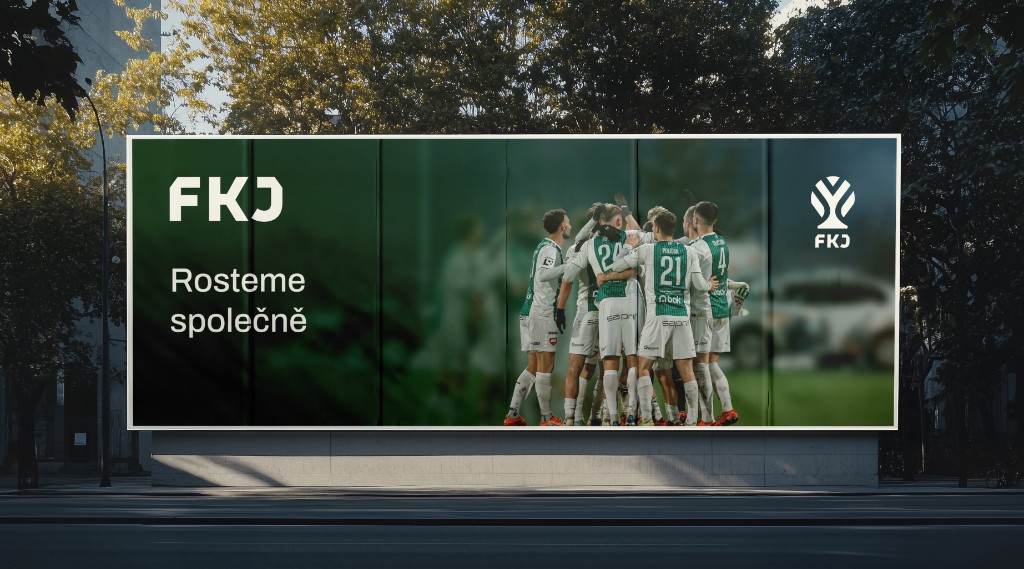
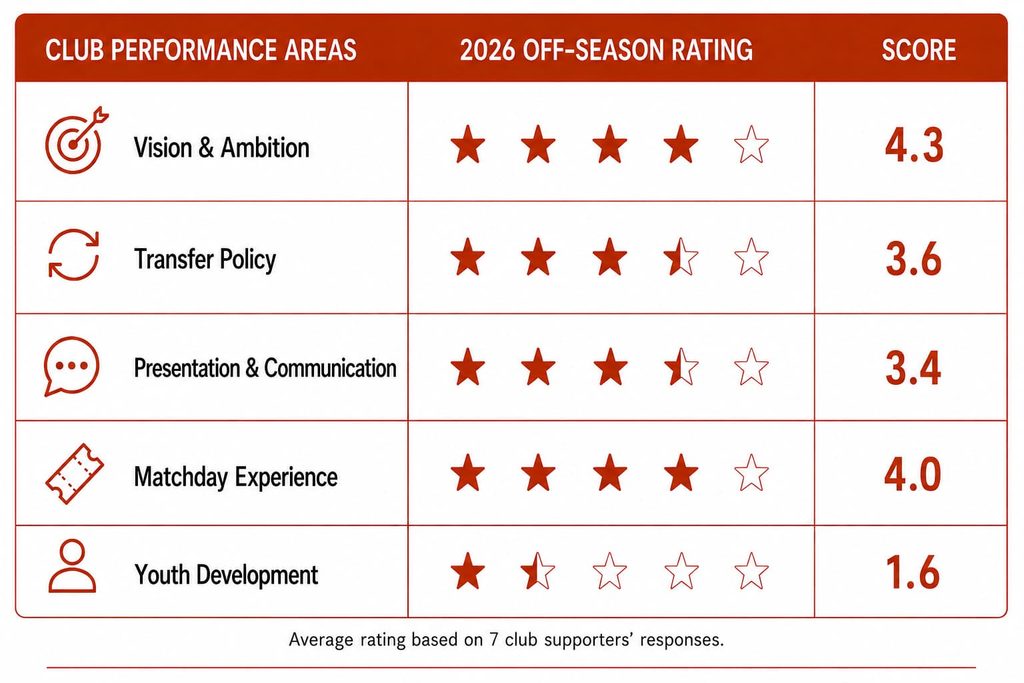
For the longest time, FK Jablonec had been living on borrowed time — in terms of financial sustainability (ie. over-reliance on Miroslav Pelta and friends), the age profile of the squad, and the club’s overall presentation widely perceived by fans as neglected. While the team was still broadly in its prime where it mattered most, the logo had long since passed its expiry date. This summer, then, brought a welcome step forward on all those fronts (yes, you read that right)… perhaps with one lingering caveat regarding the financial side.
Indeed, the fact that the club has thus far failed to distance itself from its major sponsor, as Dynamo Kyiv already have, remains arguably the only black mark on the summer. Otherwise, after some initial sticker shock, the logo has been received rather well (with most criticism directed at the chosen shade of green), particularly once everyone saw it paired with the beautiful custom-made Macron kits and the much-improved merch all together. All five major permanent signings are aged 27 or under, with Dušan Pavlović threatening to eclipse the pricetag of Dāvis Ikaunieks, still somehow the club’s record signing. Even the academy, normally a forgotten subject, has entered the conversation. And so while the lack of supporters in the stands was still worth writing about in November, that may soon change.
What was once Pelta’s ego-driven one-man show is now, above all, the work of a capable tandem. Owner Jakub Střeštík swiftly took care of the long-standing debt and has managed to connect well with both the fans — frequently visiting the most active stand (‘kotel’) — and the town, regularly meeting with the mayor. CEO Tomáš Mejzr, only appointed in January after previously holding the same role at Dukla, is meanwhile saying all the right things about the data analysis and likely spearheaded the identity change that makes a whole lot more sense once you read up on it. The club is also understood to have hired two videoanalysts.
After the late-spring free fall left a sour taste in everyone’s mouth, FKJ could hardly have hoped for a more positive summer. And if their exploits on the continental stage keep adding to it, as the Varaždin turnaround just did, we might have a genuine big fish on our hands.
Looking back on 2025/26
What went right
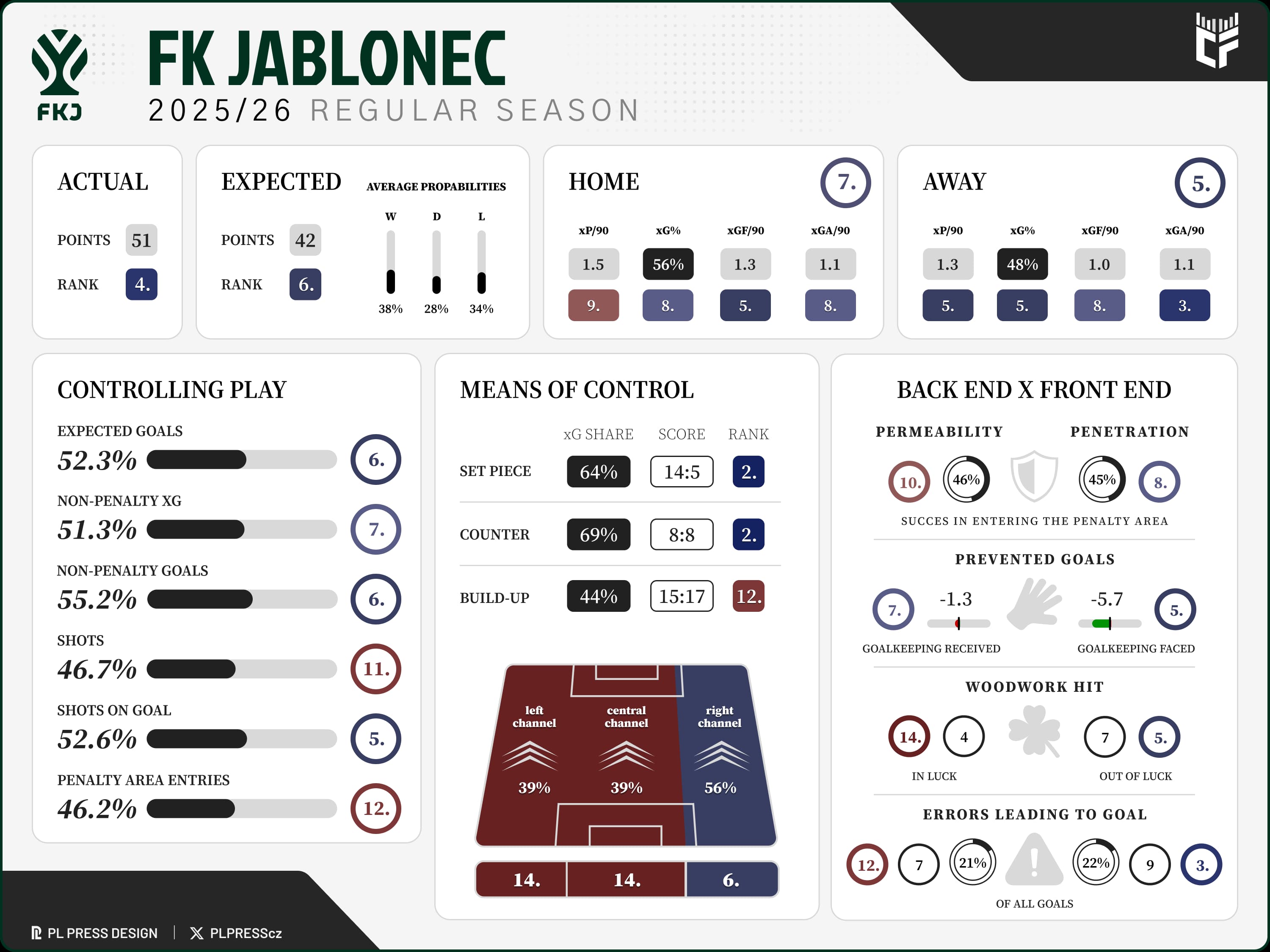
After posing as the league’s poster boys of overperformance for much of 24/25, Jablonec were back at what they do best under Luboš Kozel. Through MDMatchday — different to Round (R) in that matchdays are in order, rounds get postponed, shuffled. 23, by which point they had established themselves as a Top 3 staple, the team got significantly lucky on 11 occasions, with two of their four losses serving as the sole cases of misfortune. At that juncture, Jablonec were a 45-point side when they were more deserving of 31 points instead.
But as ever with these things, why would you even care? After all, Jablonec were fresh off the club’s first-ever 10-game unbeaten start to a league season (their previous best was eight matches in 2002), which earned the players some ad hoc bonuses, and they reached the halfway mark seven points better off than in 2024 — already a sign of significant progress.
What went wrong
As ever with these things, regression to the mean is always possible, if not probable. And so Jablonec spent the final few weeks in a complete tailspin, winning just three of the remaining 12 league games. The cup provided a bright spot throughout, only for the favourites to lose the final decisively, leaving their UEFA future at the mercy of a favourable Karviná verdict.
Generally, Jablonec’s balance sheet was spotty to say the least. Their positional defending looked worse than ever, with none of the three channels ranking higher than 12th in terms of xGAExpected Goals Against (xGA) estimates how many goals a team should have conceded based on shot quality, location, and context. allowed per game, and there was only one leakier team over the final 10 rounds overall.
Most valuable player
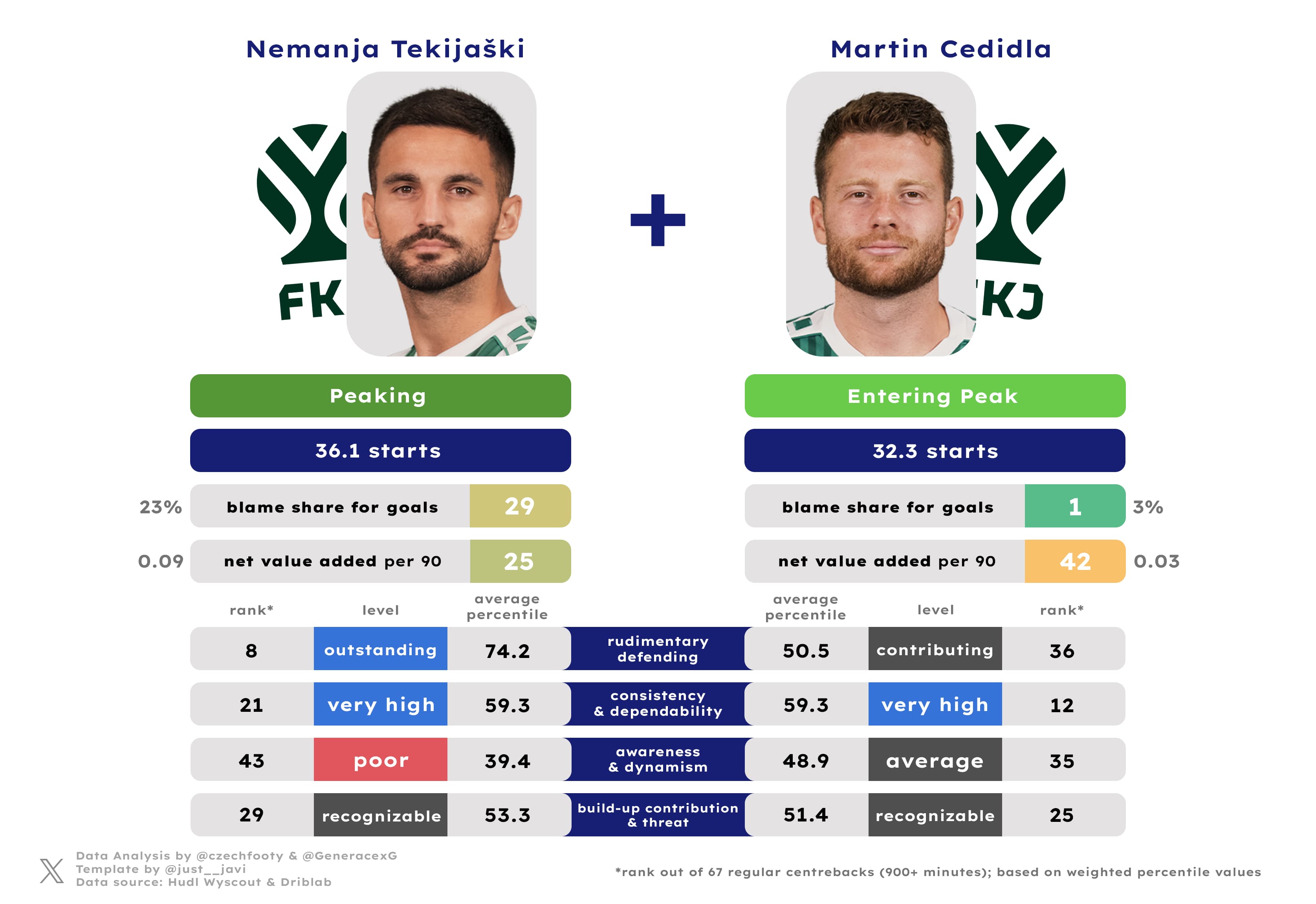
Per my MVP model (traditional stats): Nemanja Tekijaški (ranked 12th league-wide)
Per my positional models (advanced stats): Nemanja Tekijaški (76th overall percentile at CB)
For a team that formed the Top 4 for a majority of the season, this is unnecessarily hard.
As ever, Nemanja Tekijaški wouldn’t have made for a bad choice, as he continued to pose a significant threat up front (six goal contributions topped Holeš, Čihák or Dweh) and was by far the most appreciated Jablonec player with 12 team of the week shortlist appearances (the runner-up had nine), but his finish to 2025 marked by two horrific errors left a sour taste in my mouth, with Tekijaški taking a worrying step back in possession-adjusted interceptions — somehow going from 8.50 to 5.47 per game. I could still easily point at him, but… meh.
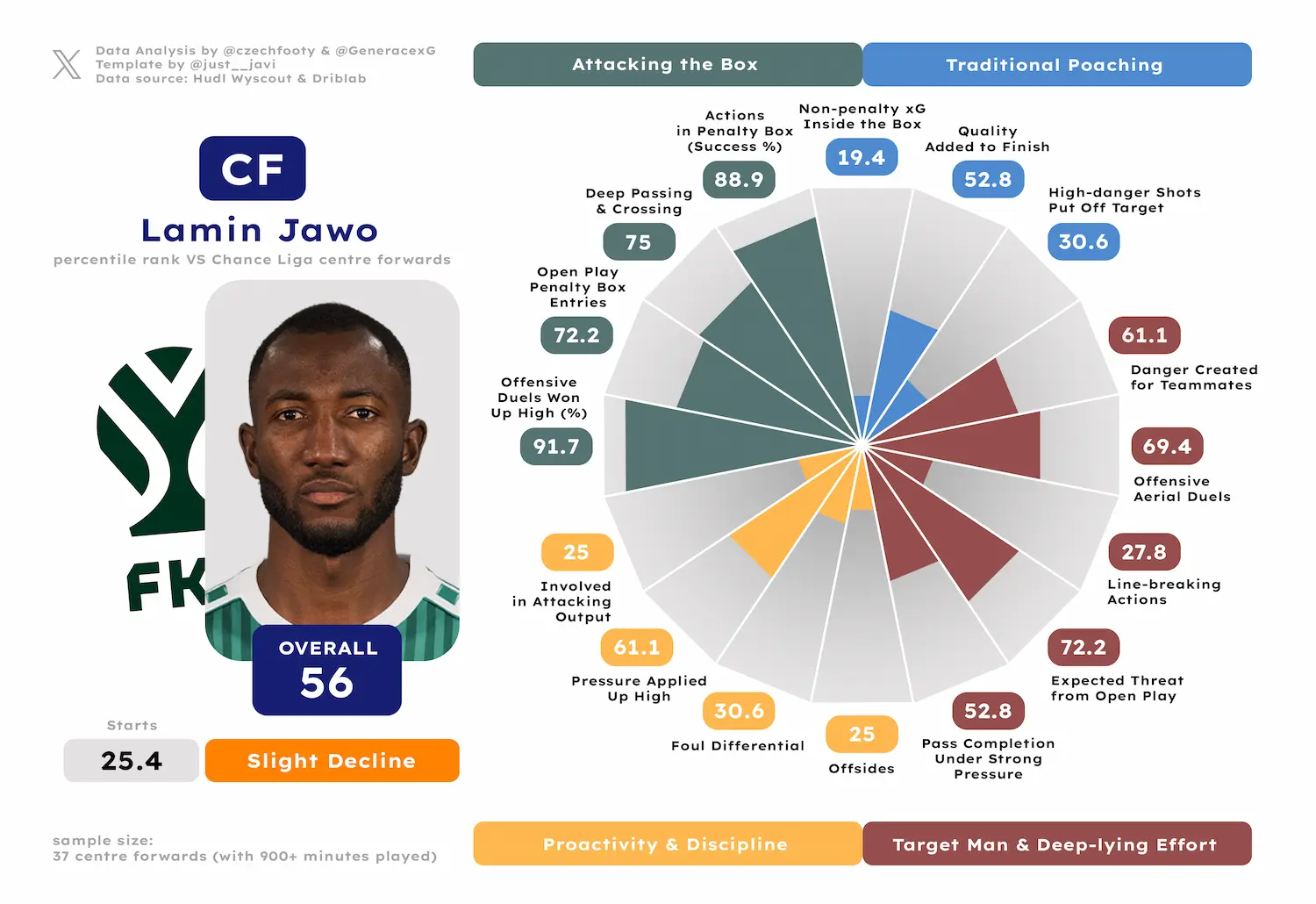
The thing is, once you make this controversial choice, you’re left with an uninspiring field of candidates who’d hardly get picked by Spartacus for his own rebellion. Alexis Alégué would’ve turned heads, but he’s gone. Jan Chramosta would’ve done the same if the season had ended in December, when he notched his last tally, only hitting the target three times afterwards. Filip Novák or Martin Cedidla, two Tekijaški’s accomplices who still occupy my MVP leaderboard’s Top 70, would feel too hipster. And so I land on Lamin Jawo, ranked 46th.
My issue with the Jawo pick is that I expected him to grade out far better in the CF model. Normally I wouldn’t mind the overall percentile too much, but I had never realized he was — on balance, and in comparison — so disengaged (involved in over half of all goals, but only 27.6% of all danger where Chramosta settled on 46.6%) and so absent from the box (even David Puškáč produced more high-danger shots, and they share the same concerning territory as far as inside-the-box xG goes). In a way, Jawo is a perfect symbol of this Jablonec side: his 17 goal contributions look amazing (only five players in the league managed more), but his 19 chance-creating actions to go with them make it all look amazingly unsustainable.
Chip on the shoulder
As far as I can tell, Jablonec are the only team in recent memory entering this campaign on a conscious rotation in the goal. Jan Hanuš took care of Varaždin and will almost certainly face Riga, too, while Klemen Mihelak expertly navigated both league games (two Ws, one goal conceded) and outright excelled against Pardubice in the “rebranding derby” this week-end. That’s all well and good, but once Jablonec’s European adventure inevitably ends, who starts?
I had called for Jablonec to challenge Hanuš in some sort of a meaningful way for as long as I can remember, and finally it’s here — suitably after the first campaign since covid (20/21) in which Hanuš failed to crack the 30-start bar, and the first campaign which truly felt like a sign of steep decline. There was already something to criticize in 24/25, but Hanuš still managed to land in the 41st overall percentile then. Now there’s no meaningful metric which would make him look at least average, and that’s a massive cause for concern. Mihelak sadly didn’t qualify for a pizza chart of his own, but I would expect him to fare considerably better.
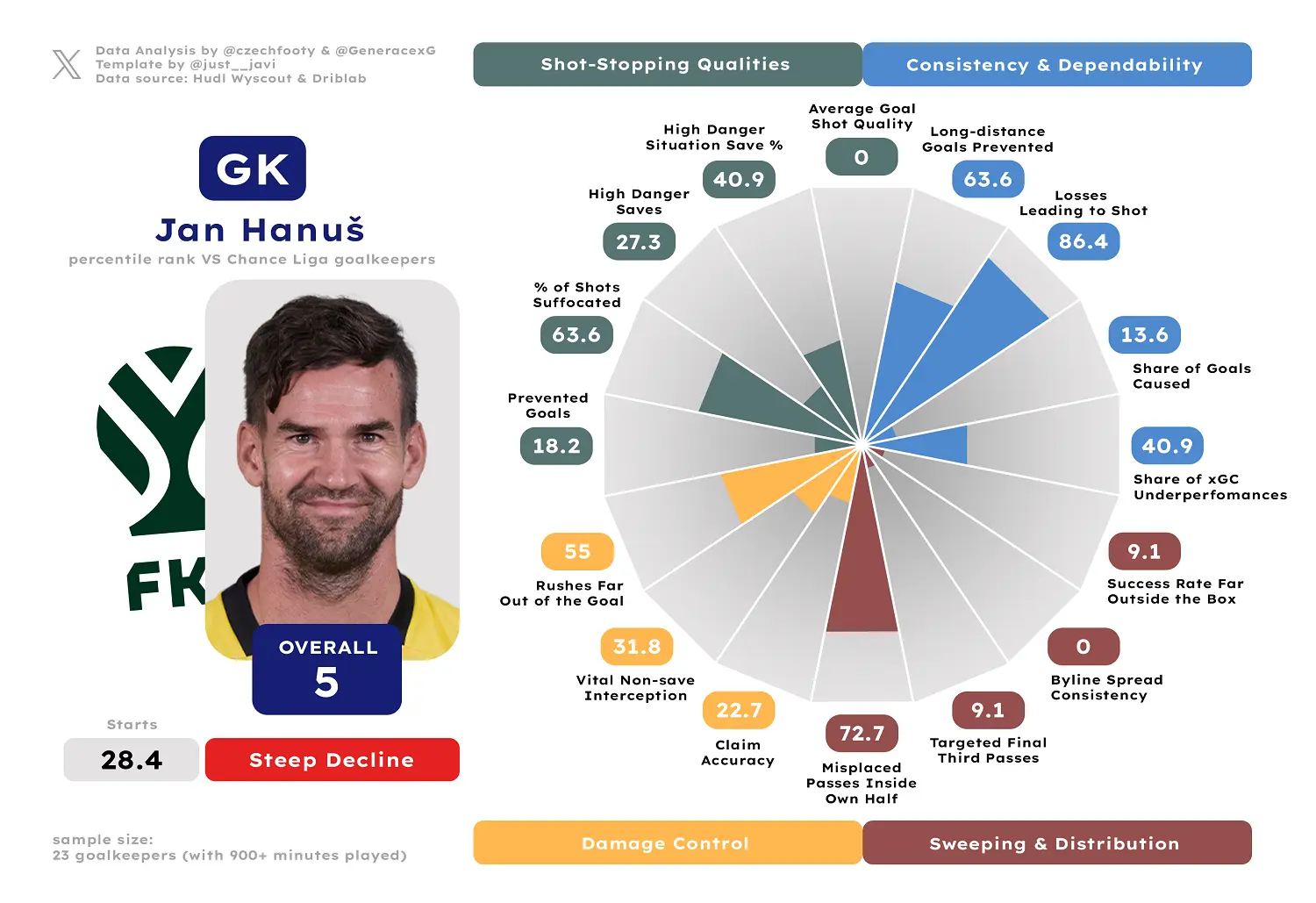
Now, why placing a chip on the shoulders of a 38-year-old veteran who might just be happy to pick up some more minutes in UEFA competitions for the fun of it? Well, because there some milestones to chase domestically. If Hanuš starts only 18 more league games, he’ll equal Jan Stejskal Sr. on 320 (just not in terms of titles with, erm, 0 going up against 8) soon after surpassing legendary Ivo Viktor (318). To get into Jablonec’s Top 5 of most appearances regardless of position, Hanuš would basically need another season as a bona fide starter (22).
Inside the off-season
special thanks for guiding me through the motions of FK Jablonec’s off-season go out to Šaman, @Gablonzer, Ondřej Svačina, @KocourMichal & @Jbc_mistrligy
Squad turnover
For much of summer, it looked like Jablonec’s greatest losses will still be dated to September 2025, when Jakub Martinec decided to test himself at Sparta soon after Michal Beran couldn’t say no to Olomouc’s money and ambition. The former was leaving the club having accumulated 492 MVP points in just 553 minutes of action; the latter didn’t garner quite as much value, but his 628-minute workload still placed him an incredible 18th on the team’s leaderboard at the campaign’s conclusion. They were massive parts of FKJ’s 24/25 success.
Then the Alexis Alégué bombshell dropped.
Seemingly out of nowhere, after a rumoured altercation with the coach, Jablonec went from retaining 87% of goal contributions to 73.1%. The Northern Bohemian outfit had the most attack-minded players fit inside its most-utilized XI, and the remaining six are staying put, but the odds are that Alégué’s seven vital points will be extremely hard to replace.
Biggest upgrade
We’ve already mentioned Jablonec got significantly younger this summer, and in no place it was arguably as needed as at left centre back. Dušan Pavlović might be right-footed, but Luboš Kozel is no stranger to playing a rightie at LCB (he did so with Cedidla when needed) and the 22-year-old looked right at home there as Jablonec dominated both Olomouc and Varaždin (in the return game) to the tune of a combined 0.77 xGA. Promising early returns.
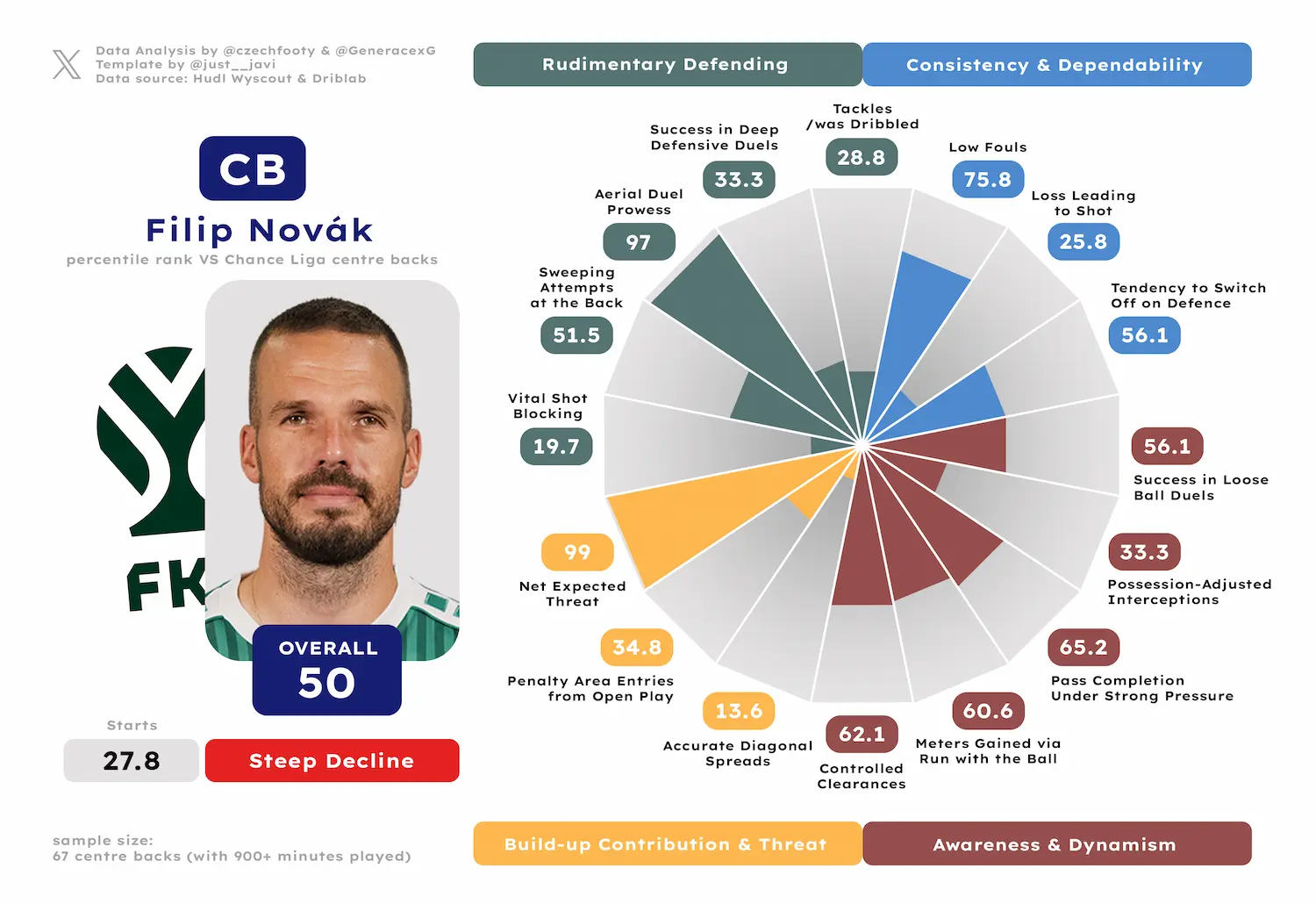
Pavlović was described as a ball-playing centre back upon arrival, and that’s where he’ll have the largest shoes to fill as Novák was still a game-changer in consistently moving the ball into danger areas. In terms of aerial dominance, Pavlović should have no trouble after winning 68.4% of aerial duels inside his own box in 25/26 for a better success rate than Tekijaški or Cedidla put together. Novák’s rate of 77.4% was insane, but he wasn’t as efficient elsewhere on the pitch, so Pavlović shouldn’t be afraid of underwhelming in that particular department.
Biggest downgrade
I get it, Alexis Alégué and Ebrima Singhateh were both moody and likely clashed with the coach and teammates on various occasions. It’s obviously advisable to preserve the dressing room as a happy place, and the club probably knows best what is needed to keep it that way. Then again, coupled with Górnik winger Taofeek Ajibade Ismaheel’s reported million-euro move falling through despite advanced talks, this complete abandonment of the concept of wing play (with neither Matěj Polidar nor Vakho representing it in the traditional sense of 1v1 ability, pace etc.) seems too radical a departure from what… simply worked in 25/26.
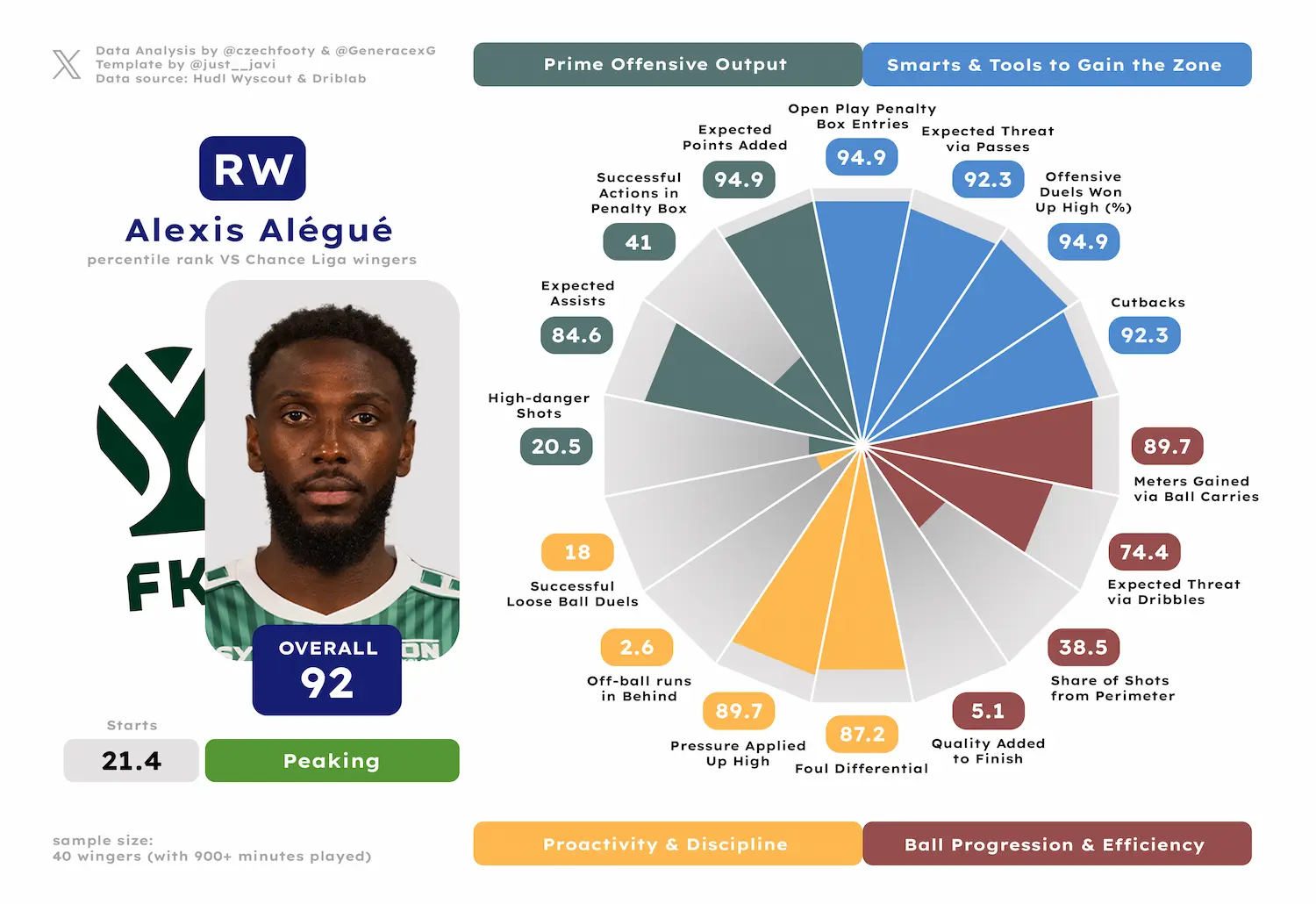
Besides, for all his maddening inconsistencies, Alégué still grades out as a beast. He was so good it’s actually Lukáš Haraslín who’s the best reference point for him, with Alégué putting the most unstoppable package of smarts & other tools to gain the zone with an average percentile value of 76.9 across the nine metrics considered. Haraslín was good for 70.1.
With regards to Singhateh, it’s probably Chramosta who would’ve been his primary rival if the 3-4-3 scheme was to continue, and the contrast in skillsets there could not be any starker.
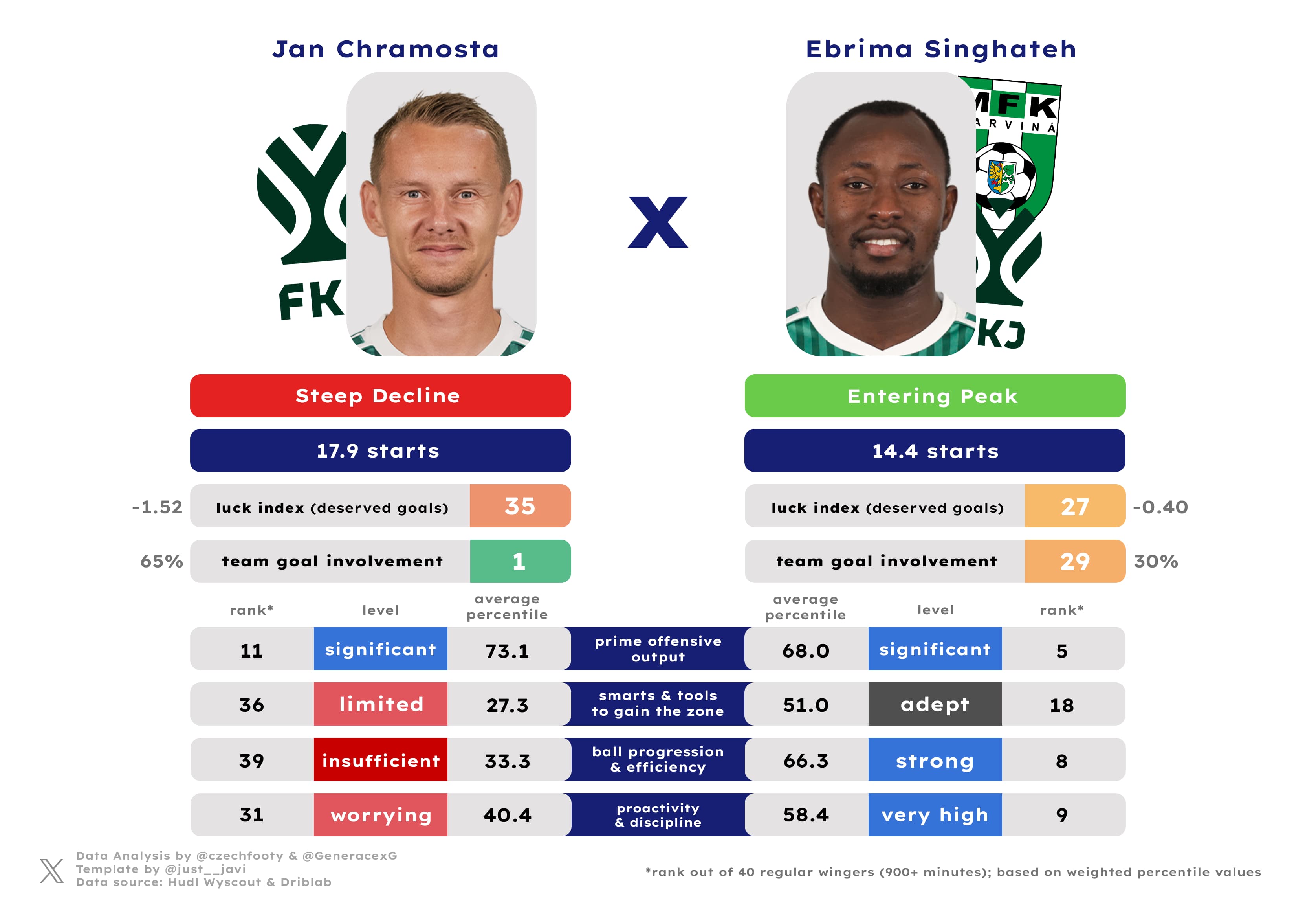
To Jablonec’s credit, the club is still trying to bring in a winger per Kozel’s latest remarks, fully realizing Hugo Ahl — while an interesting profile of a tall shooter — is not enough.
Need left to be addressed
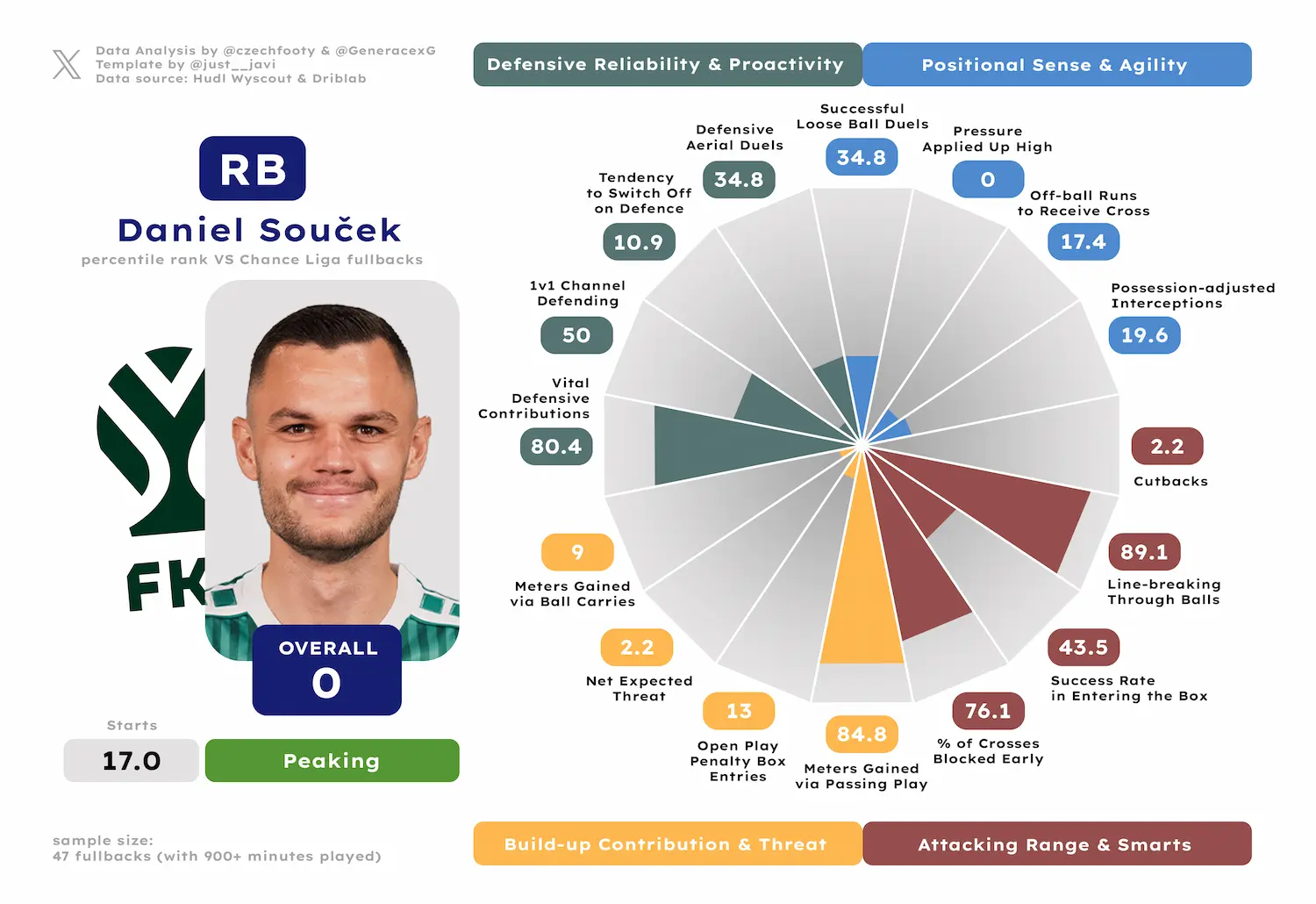
Considering how stacked Jablonec look at LWB whenever they opt for 3ATB3ATB means 3-at-the-back, ie. any formation with three centre backs and wingbacks, or alternatively, five defenders., it’s fascinating to note how thin they are at the opposite end of the pitch, basically ready to ride Vakho into the ground. That’s risky for two reasons: the less of Daniel Souček we see, the better it is for FKJ, and Vakho himself also showed signs of a slight (likely age-related) decline in 25/26.
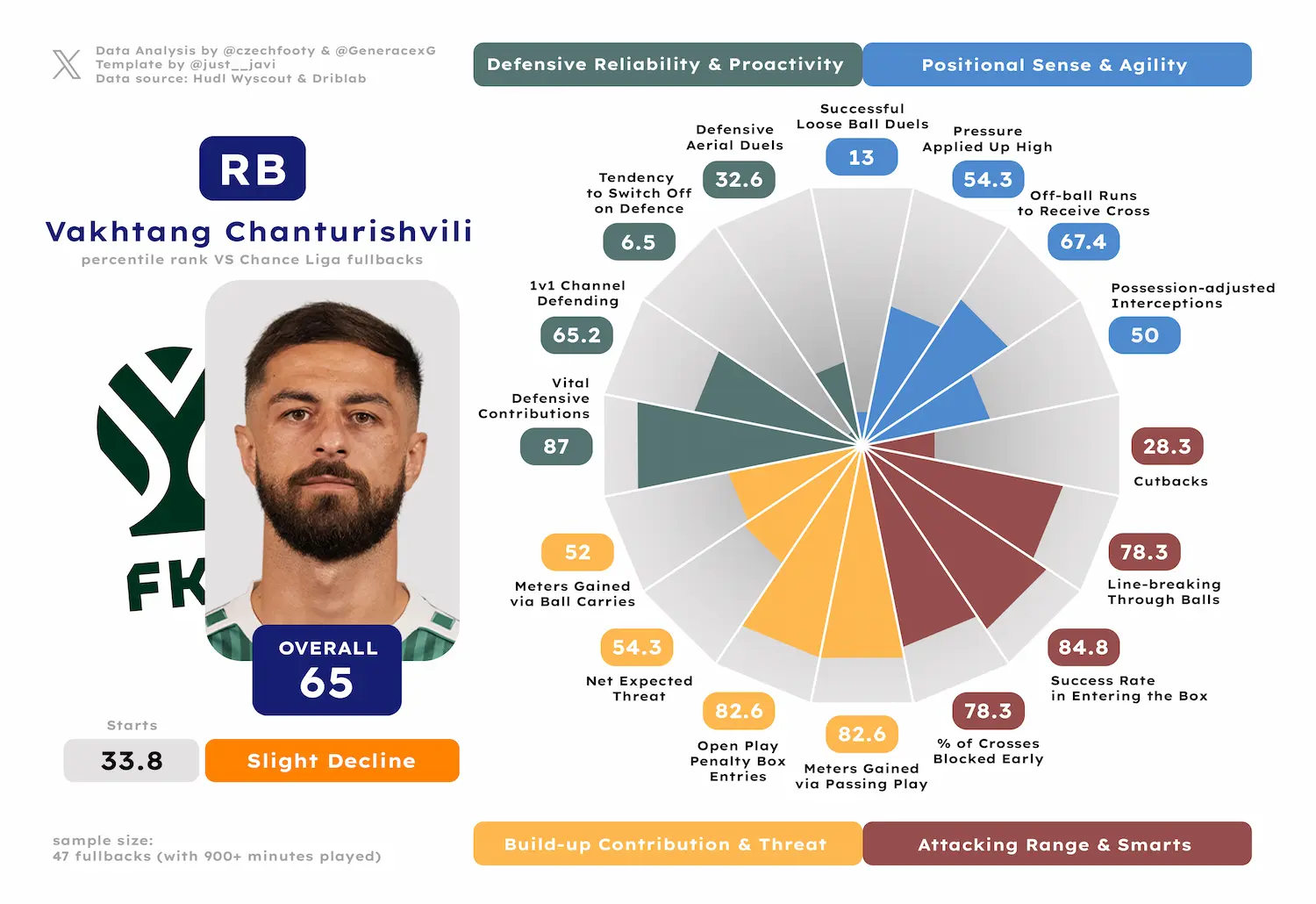
Vakho was still a workhorse who never gets injured (going from 37.4 starts to 33.8), but he was notably not only less of a threat up front (going from 0.99 dangerous looks created per game to 0.74), but also less of a presence there altogether (registering a mere 0.68 touches in the box compared to 1.18, and barely threatening with cutbacks which constituted his major weapon in 24/25). This might have something to do with his ageing legs, since Vakho also performed a below-average number of over/underlaps to support his teammates.
He’s too smart and skilled to become a non-factor on the ball, but the fact his immediate backup very much is that non-factor already (though, to be fair, weighted down by his frequent deployment as wide centre back) should be of some concern to Kozel and company.
New kid on the block
The long-neglected academy is getting a face lift, that much is clear from the point Adam Pelta, son of the club’s long-time boss, became its director in February this year. Among the numerous re-shuffles, two moves stick out: the recruitment of Vilém Fendrich, who pairs up with another former top-flight pro Oldřich Pařízek to improve the goalkeeping school, but especially the appointment of Michal Kolčava to the role of a sporting director. He’s a Jablonec man through and through, hired upon lifting local club SK Zásada all the way up to the 5th tier. Along with gradually improving infrastructure, the future could be bright.
Jablonec now also seem to be willing to flesh their financial muscle to pull some premium youth talent, as seen in the case of Filip Végh (b. 2008), but it will take some time before he’s given the opportunity to show what’s got (even a jump to ČFL shall be a notable one at this point), and even longer before more high-end peers start joining him. Now it’s still true that both U-19s and U-17s were threatened by relegation at some point in their second-tier campaigns, while some tremendous work with the youngest only serves the biggest Prague clubs a mere hour down the road. Just like that, Michal Špidlen (b. 2011), Jablonec’s sole U-15 international, vanished to Sparta. A region that houses one of the best ice hockey academies (Bílí Tygři Liberec) simply remains unable to hold onto the footballing cream of the crop.
Looking ahead to 2026/27
Below is the team’s current depth chart with a maximum of 4 alternatives for one position. The colourful ratings are a static snapshot of the league-wide situation on 21 July, and they are just a playful bit to add flavour to it; the names featured should be relevant to this day. To learn more about my approach to constructing depth charts, with all its limitations, head here.
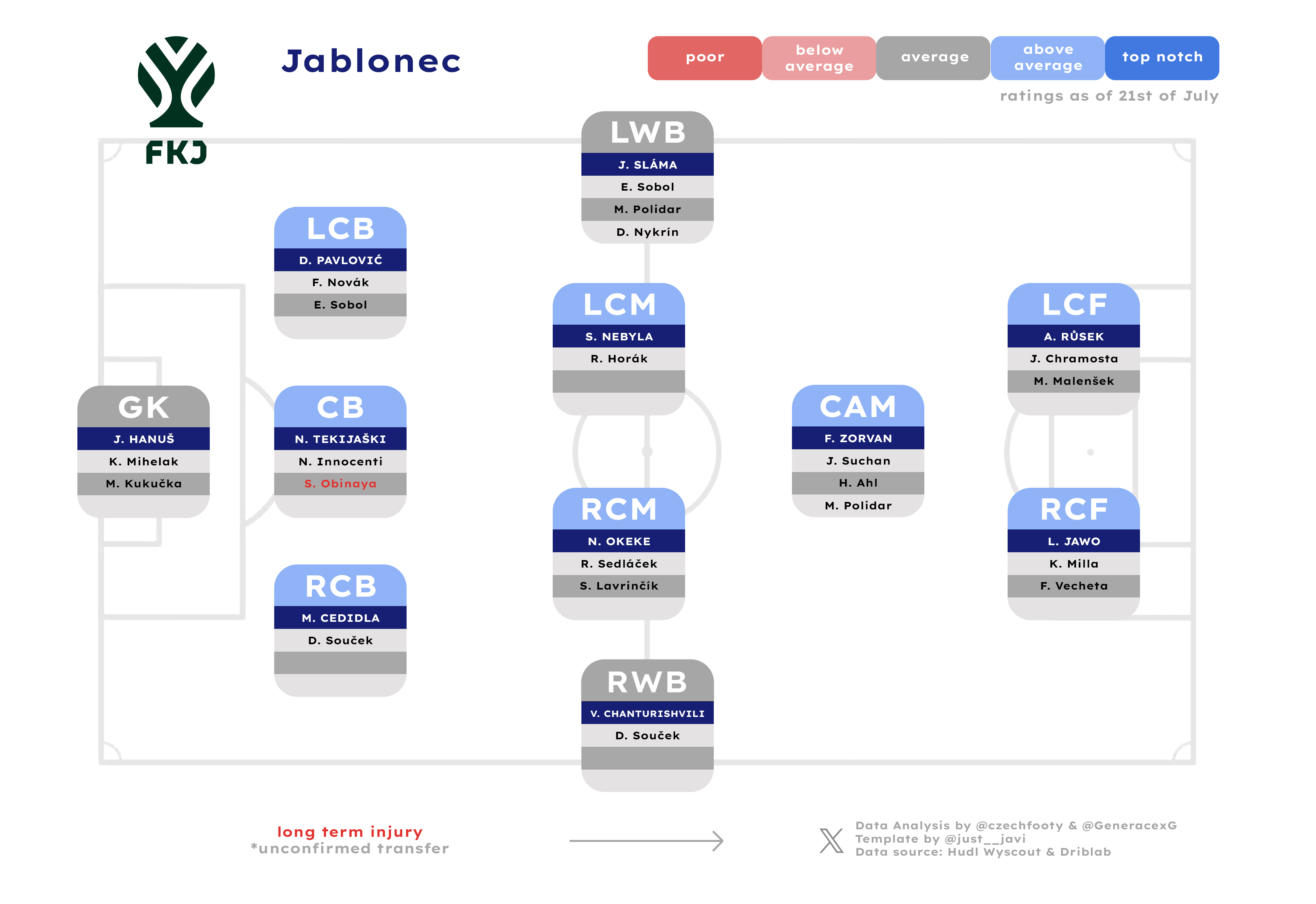
Primary formation
There are many, in fact. Jablonec initially continued in 3-4-3 despite losing Singhteh and Alégué, before switching to a more sensible 4-2-3-1 with former wingbacks (Matěj Polidar, Vakho) deployed as wingers. In such a case, Matej Malenšek and Jan Chramosta also become W options, but I would see little reason in bringing all of Antonín Růsek, Kevin-Prince Milla and especially Filip Vecheta (on loan) if this is your Plan A for the season. There’s likely multiple. (Sure enough, it was more of a 3-5-2 against Pardubice this past Sunday.)
Colours I grappled with
None really, which is quite an exception. I think Jablonec would be satisfied, too. I don’t think Nelson Okeke is good enough for the prominent role he’s clearly slated to play, and neither does my model, but he could grow into it and there’s always plenty to choose from.
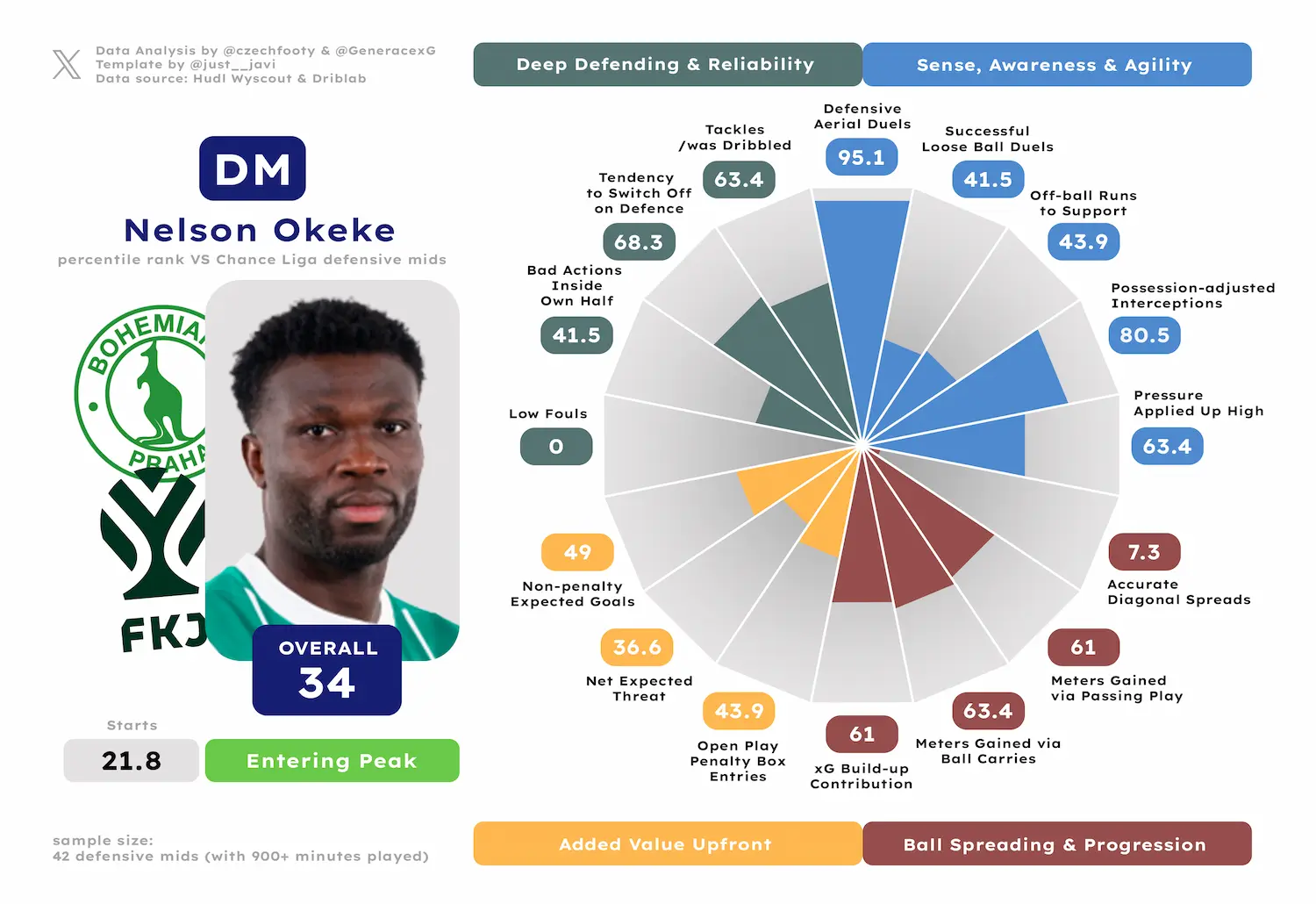
Notes on the depth chart
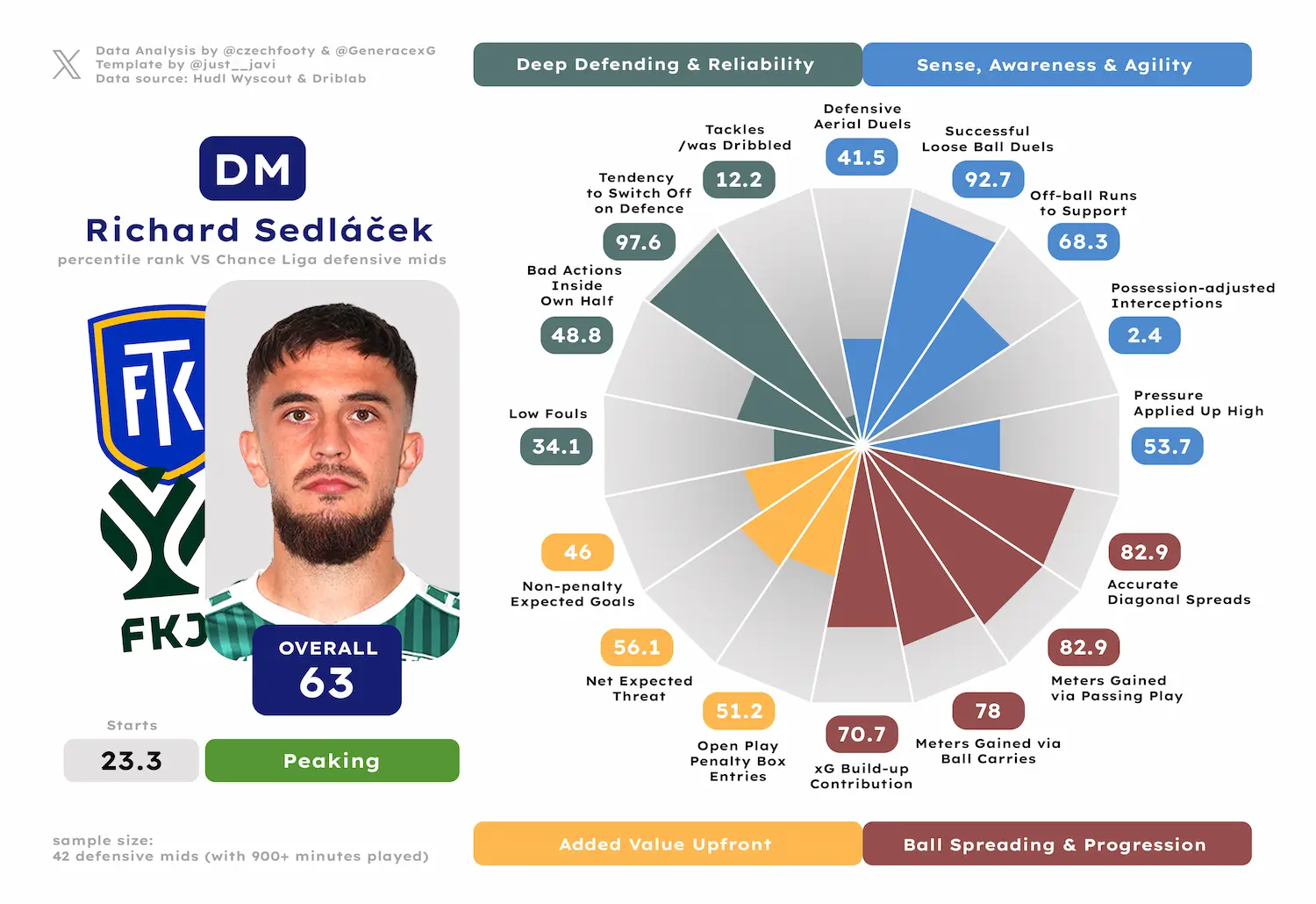
One limiting aspect of Okeke’s game is his passing range, conversely a major calling card of Richard Sedláček — either his primary rival or partner, depending on the type of match.
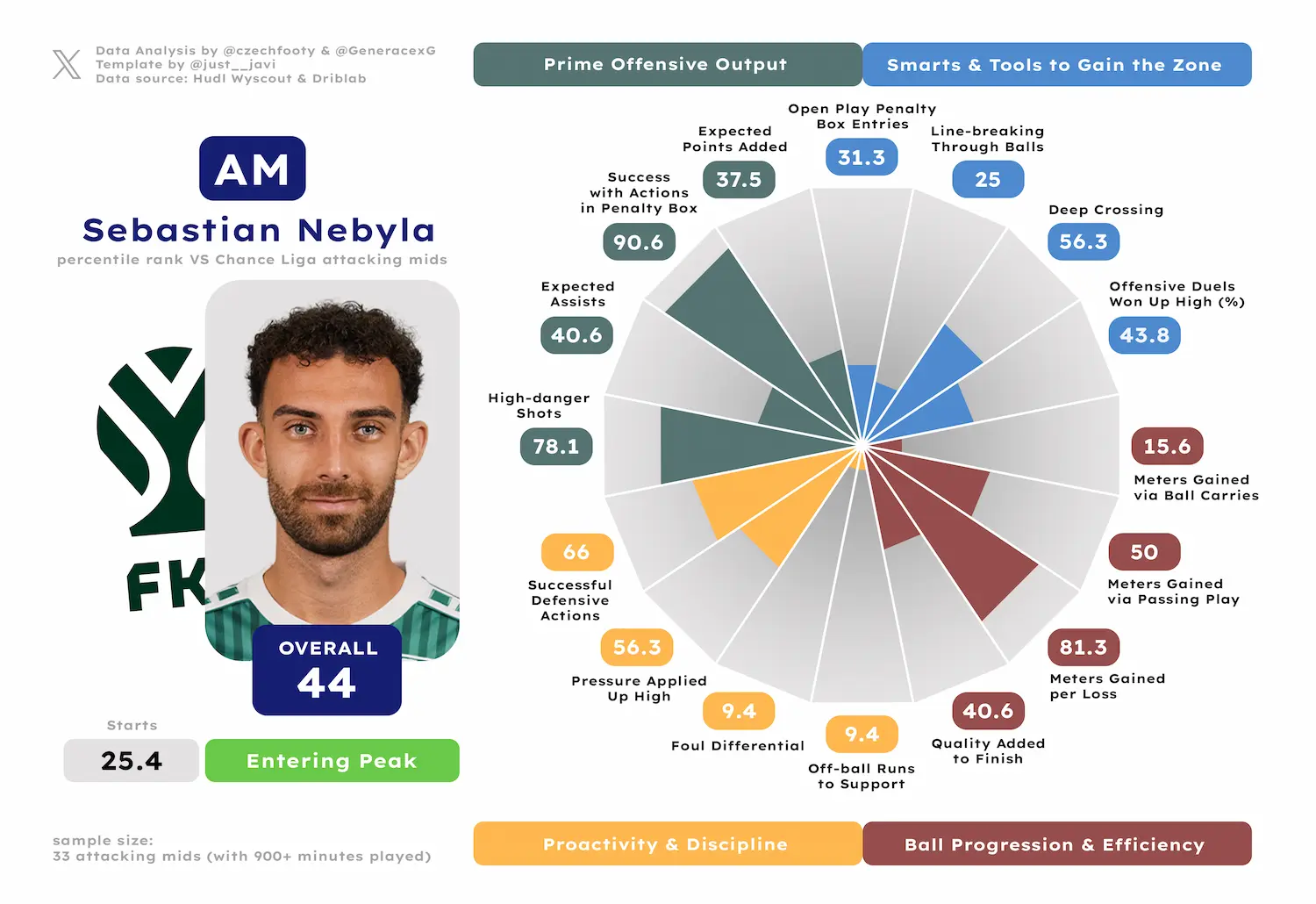
I have always found Sebastian Nebyla a tad overrated and his gradual disappearance from the “one of the first names on the team sheet” territory is a testament to that. He wasn’t a starter against Slavia (R33), in the cup final or in either of the Varaždin matchups, and it’s surprisingly easy to see why. For a presumed attack-minded midfielder, he continues to do shocking little to gain you the danger areas, and he’s officially not dynamic enough both on and off the ball. You can rely on Nebyla to not lose the ball too often and close down the box every now and then as a shooter, but that may have flown when it was basically just him and Beran as viable double pivot options. Now that there are five of them, he needs to step up.
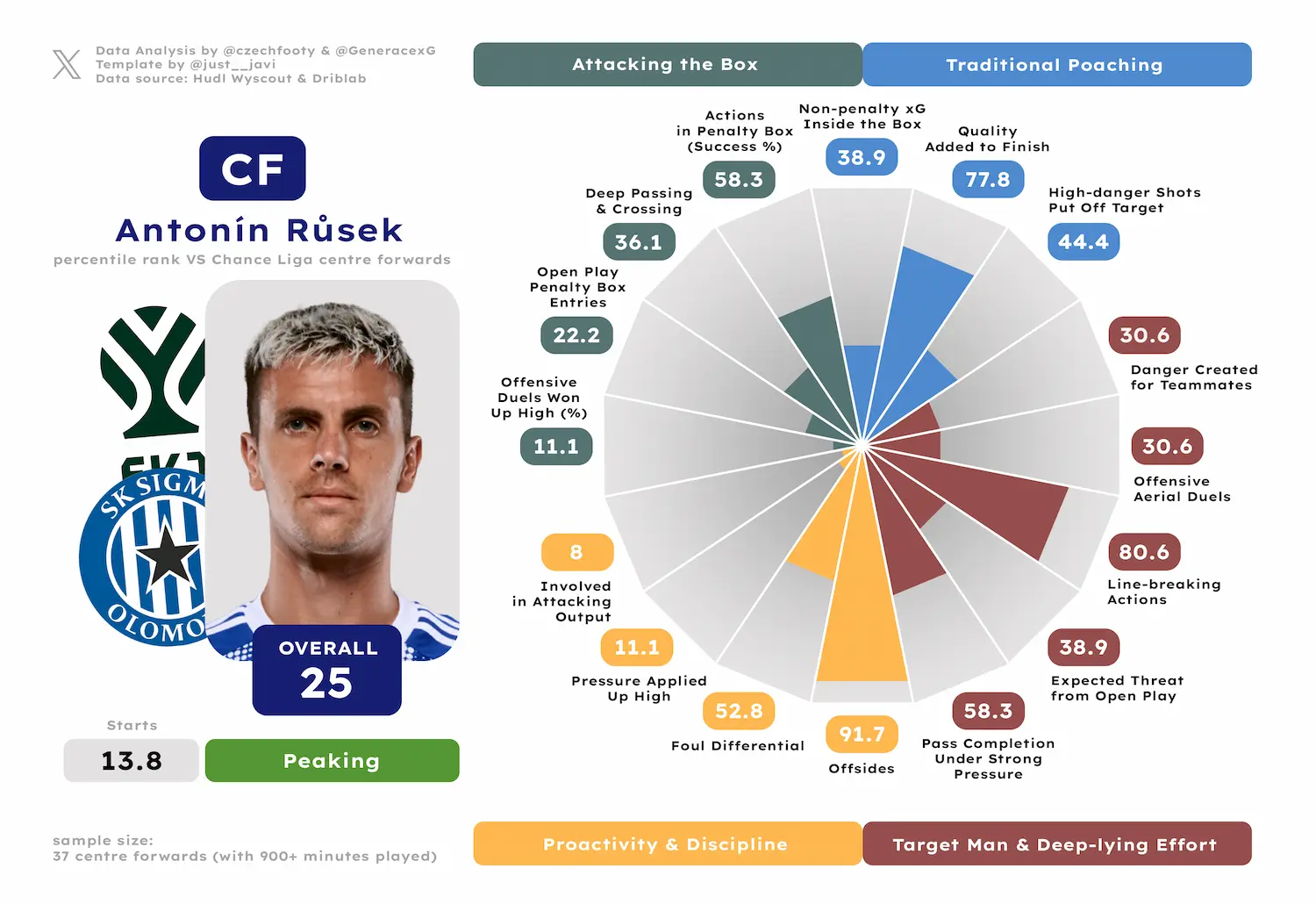
Now a word or two on the two high-profile returnees. Let’s start with Antonín Růsek, who’s arguably closer to being a starter when he perhaps shouldn’t be. The highest he ranks among the three areas of centre forward’s game I highlight is 19th for “target man & deep-lying effort”. Historically prone to being unlucky, that’s also not his excuse anymore (scored 1.1 extra goals compared to what he deserved), and so there’s not much to support his case.
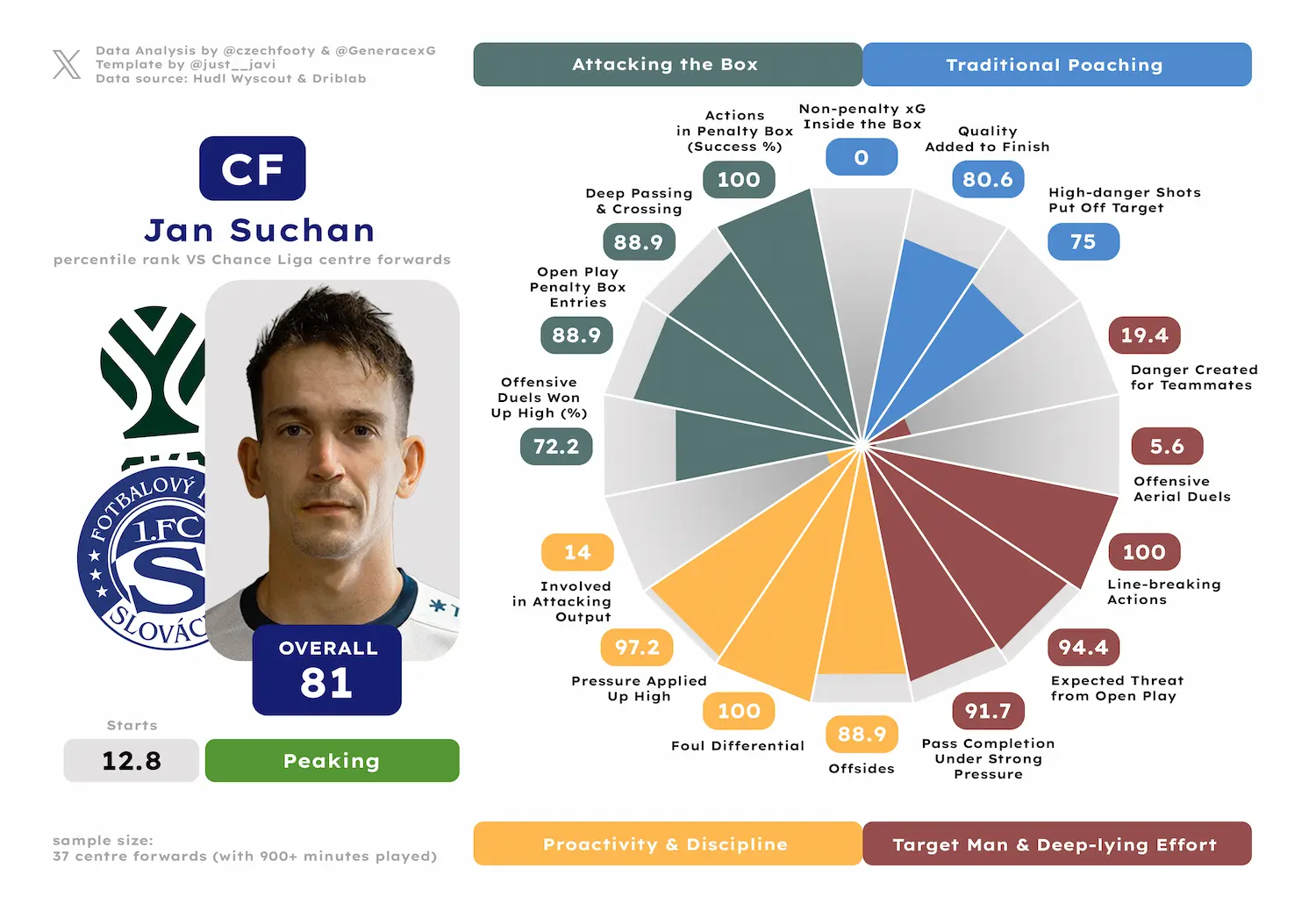
Jan Suchan is the opposite of Růsek: legitimately elite in a number of ways (though certainly helped by the small sample size), yet a prime candidate to eventually get loaned out. I wouldn’t do it, as he frankly constituted a bit of a unicorn among CFs and could be an upgrade on Filip Zorvan if Jablonec employ a system that knows the no. 10 role. Suchan historically does a lot of things very well below the penalty box, helping to enter it…
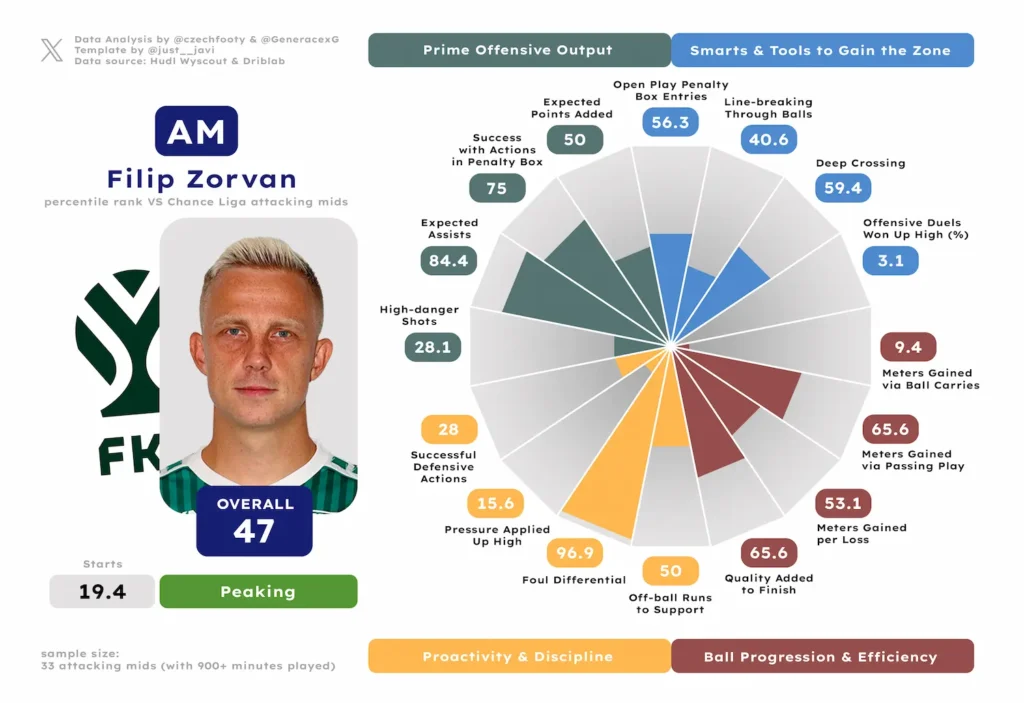
… which Zorvan himself decidedly failed to do on a sufficiently regular basis in 25/26. @KocourMichal is of the opinion signing Zorvan was a mistake, and I’m inclined to agree. It’s also not like I’m shocked: last summer I wondered whether Sigma aren’t, in fact, upgrading him despite the glossy G+A numbers; this year I could easily be doing the same for Jablonec.
Roster battle to follow
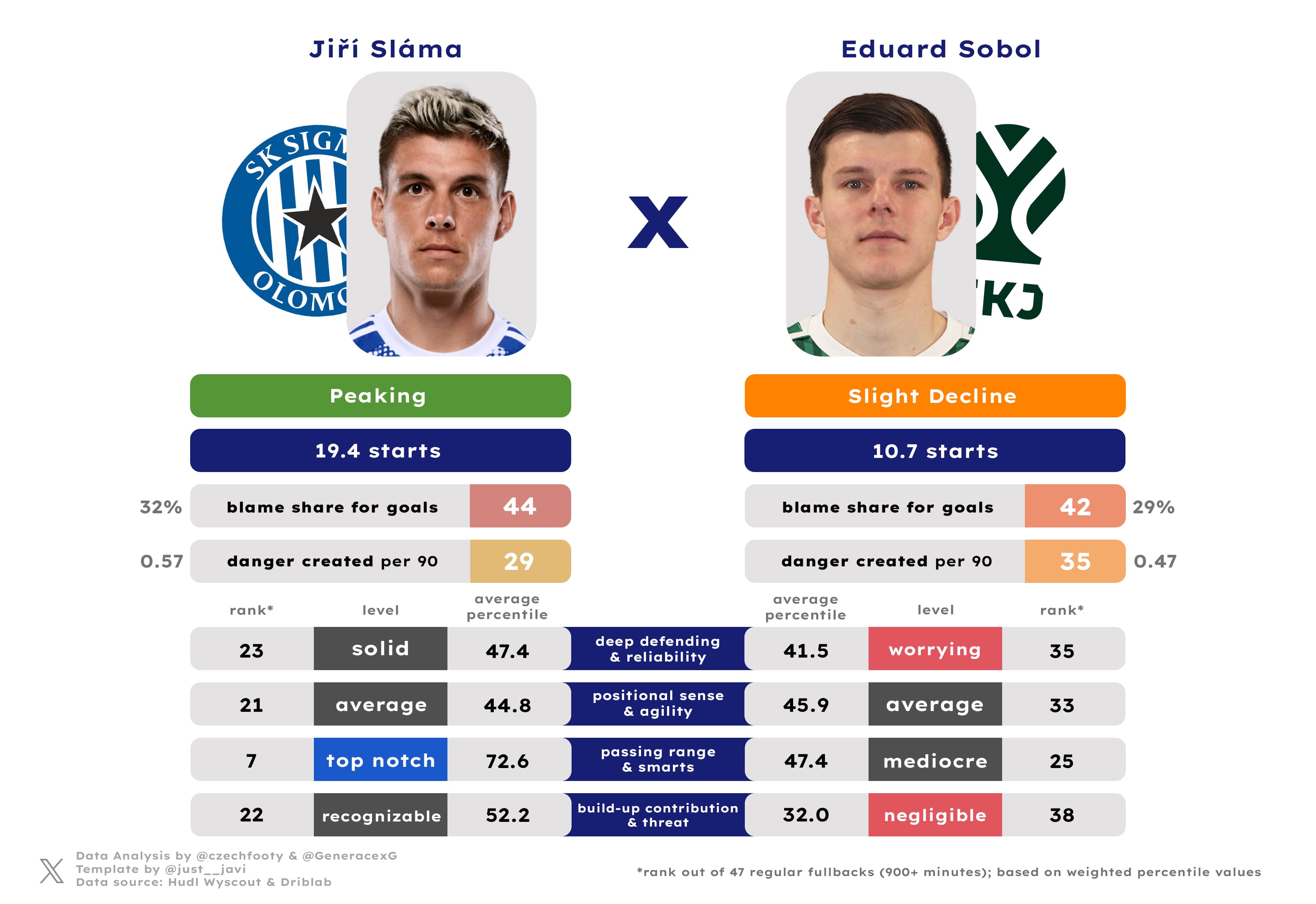
There are two very different ones that particularly intrigue me. Firstly, I’m fascinated to see how Eduardo Sobol holds up vis-à-vis the much-increased competition at his position following the addition of Jiří Sláma. Could it be that Sláma’s unique profile pushes Sobol more towards the CB crop he seemed to be primarily a part of throughout the summer? It’s hard to tell, as Sobol is yet to play a single minute since the first Varaždin game (spent at LWB).
More intriguingly, how will the great battle of centre forwards shake out? Filip Vecheta arrives as the biggest reclamation project of them all, having gone from an up-and-coming prodigy straight into the “vastly overrated” box before spending all of 25/26 trying to figure out what exactly his one selling point is. He still pops up in all the right places in the box.
That’s about it.
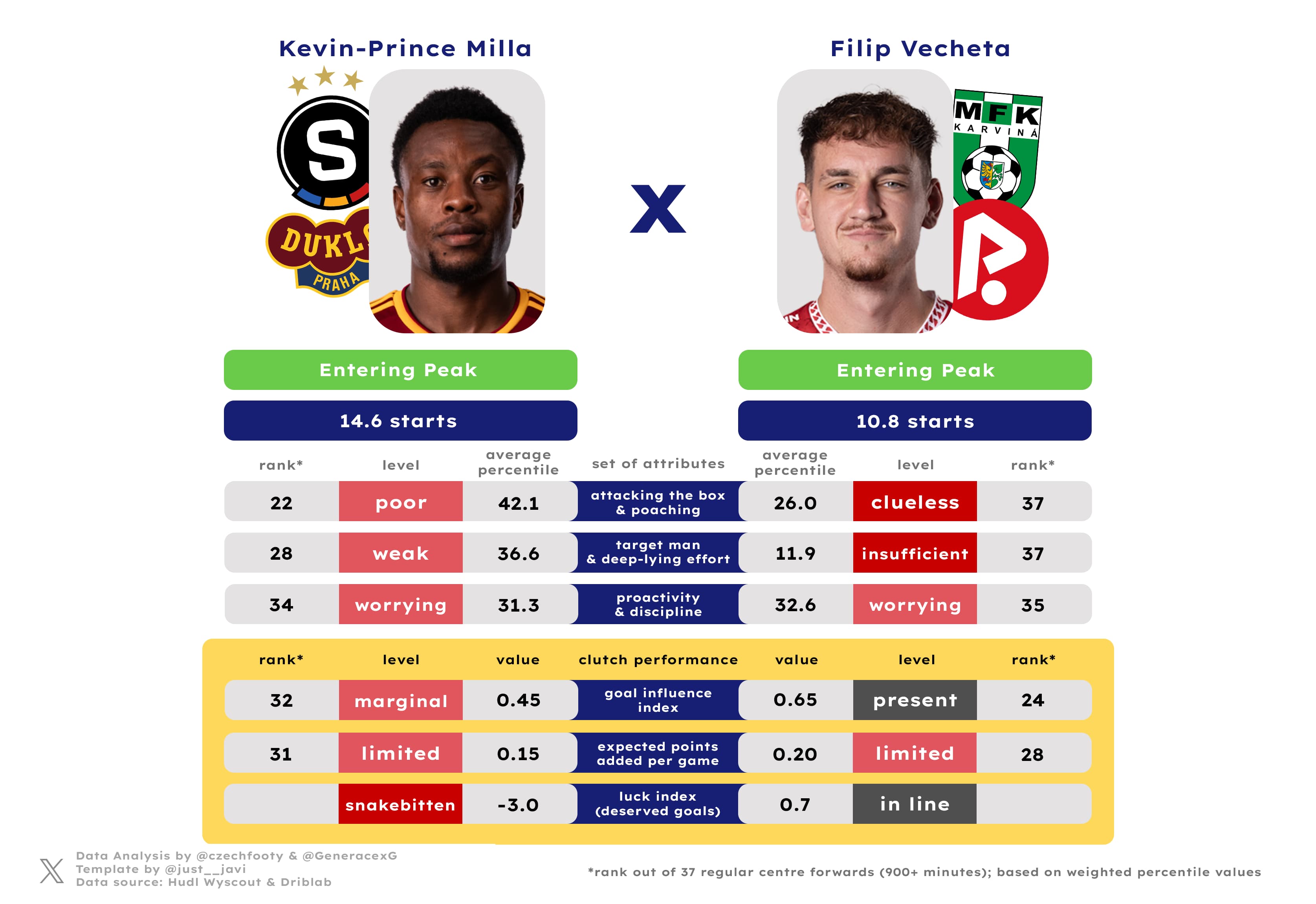
Kevin-Prince Milla is in a similar boat, with the added bonus of sometimes producing a surprise key pass (or generally a line-breaking action), but at least he’s got the terrible luck to point to as a finisher. He hit the woodwork three times, otherwise mostly being in line. If those three shots went in, he most certainly wouldn’t be the third-worst finisher per xGSExpected Goals Scored (xGS) only takes shots on target into account, including their power and placement on top of xGF..
Season forecast
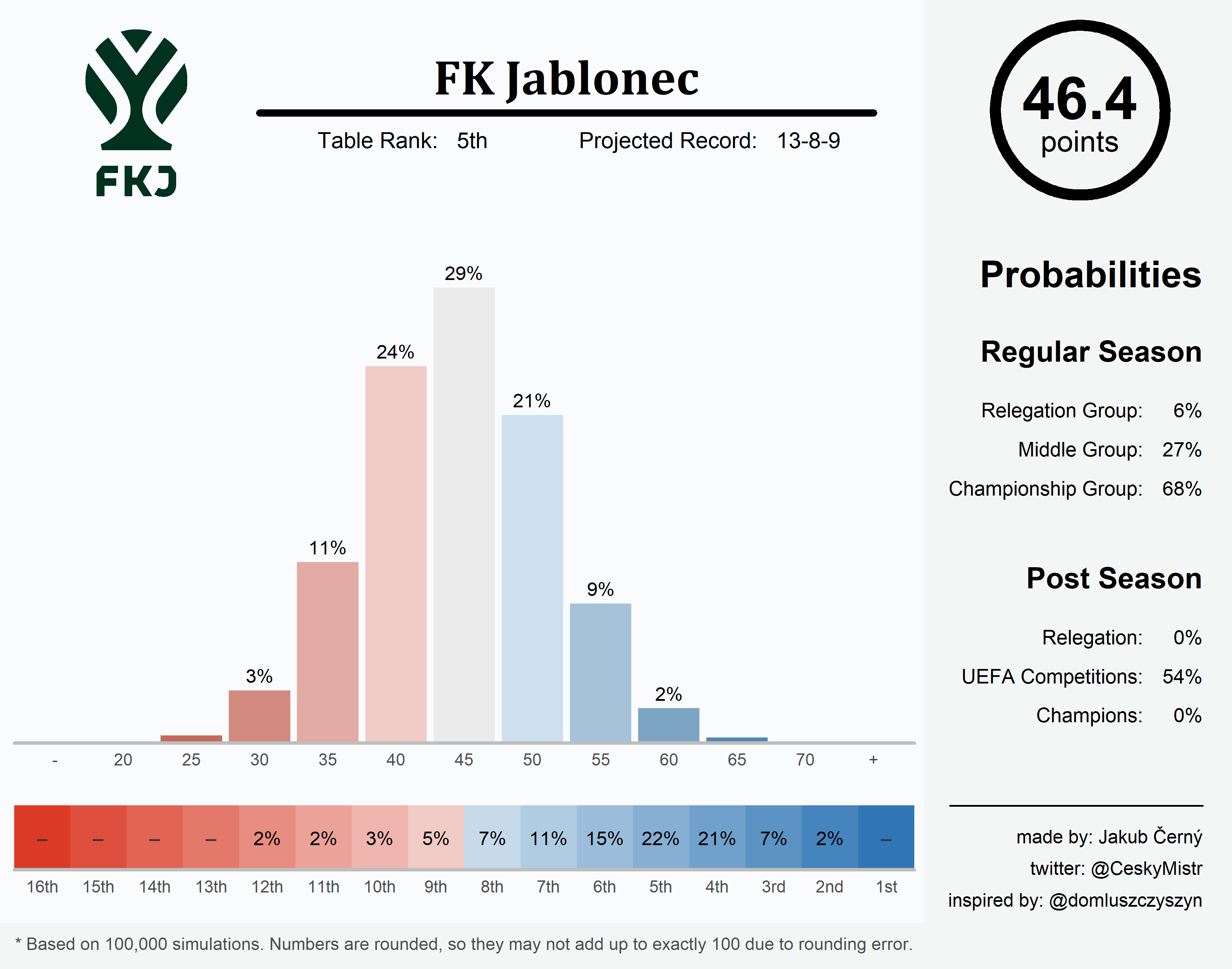
Last year, the model got decidedly carried away. It went from projecting 35 regular-season points to 48, or from 9 regular-season wins to 14. Sure enough, Jablonec used the forecast as fuel, eventually landing on 51 points and one extra win. The 61% chance of UEFA football technically didn’t come to fruition, but hey, they are there regardless! All-round success.
Now that Jablonec are still aiming to spend the entire autumn spread across two major competitions, repeating the feat could be a tough nut to crack. While I rated FKJ as slightly improved over the summer at the time, Plzeň or Hradec weren’t doing any worse. In the end, Jablonec are favoured to finish 5th, like they did after 35 rounds in both Kozel-led seasons.
Bold prediction
The track record: 1/5. Jablonec didn’t even get to 56 points inside 35 rounds
The prediction: Jablonec will have at least as many shots on goal as new apple trees
The rationale: Seriously, guys, you have no idea about the town’s relationship with apple trees. Let me educate you. While there is a theory that the name “Jablonec” actually borrowed from the local river’s branching or even taxes rather than “jabloně”, the iconic tree has been part of the town’s coat of arms for at least the past 120 years, eradicating most doubts about its shared roots with the frontier town. It’s been even longer (160 years) since Jablonec nad Nisou was officially granted town status, hence the symbolic celebration earlier this year, when the town hall offered residents one of 160 heritage Czech apple tree varieties for CZK 160, aiming to return the cherished age-old symbol to Jablonec’s gardens.
That is one beautiful number.
As soon as I saw it, I thought, “Now that’s some vintage bold prediction material for you.” Professional deformation, they call it. Specifically, digging into the numbers, I found that 160 falls within a bold yet realistic ballpark for Jablonec’s next tally of shots on target. They finished the 25/26 campaign on just 130 — actually well short of the threshold — but aiming somewhere between Baník’s 140 and Sparta’s 180 from last season doesn’t sound overly ambitious. On a second thought: Kozel’s Jablonec have already managed 177 shots on target once before, and got off to an inspired start against Olomouc last week with seven.

Enjoyed it and just want to casually support us with an amount of your choosing? No worries, you can still do that by inviting us for a symbolic pint at the old BuyMeACoffeeBeer page.