One for the ages. A phrase normally reserved for historic feel-good stories like the one Hradec Králové just wrote, or the one Ostrava’s little sister Karviná would’ve authored had it not been for that tiny little match-fixing incident. Baník, however, proved to be the exception: its story for the ages was one of spectacular self-destruction, an epic collapse brought about entirely by footballing means — with the club still likely to end the sorry campaign comfortably in the black. Baník may have gone from a Top 3 finish straight to a Bottom 6 finish for a shocking third time in my lifetime, but this one still hits different.
As Baník went from eight straight Top 6 placements to an 11th spot in 1994/95, it was in times of severe economic crisis gripping Silesia, with Ostrava stands regularly drawing less than 2000 fans and soon-to-be-departing iconic coach Verner Lička regularly fielding a line-up with an average age of around 23 years. When Baník swapped the near-title for the 14th place in 2011, it was once again in times of financial uncertainty, amid a search for a buyer. Back then, the season started unraveling through a disappointing European exit (like now, against Legia) in a summer symbolized by quick-fire sale of key players such as Mario Lička, Tomáš Mičola and Matěj Vydra (like now, with Tomáš Rigo, Matěj Šín or Erik Prekop either belatedly or insufficiently replaced or both). Their very recently successful coach was gone within 13 rounds (almost like now, when Pavel Hapal actually lasted two games less).
This is where similarities must end. Baník of 2010s got stuck, saved only by Václav Brabec who’s now calling the shots at the other end of the curve. To his credit, this summer was no autopilot like the last one. The re-shuffle at the top aimed to clearly separate the club’s economic and sporting leadership. Michal Bělák, previously wearing both hats as a CEO, will now focus on the financial side alongside the new boss Matěj Šturala, formerly the director of the marketing and PR department. Footballing direction, meanwhile, will be provided by Luděk Mikloško and his heir apparent Michal Kordula, whose worldview I personally rate.
On the face of it, Šturala is a solid choice; a relatively young man who breathes Baník and managed to navigate the intricate events such as the anniversary match against Celtic or the launch of ChacharPass. But lest we forget that he also headed the department which gave us the Josef Dvorník PR fiasco (who went from a “long-term” committed relationship to a “temporary” play-off situationship) while failing to turn the same ChacharPass into anything more than an early promise that quickly plateaued, stuck well short of fulfilling its potential.
At the same time, after a trying season, fans don’t seem to expect fireworks. A stabilizing season inside the middle group would probably suffice, since the club is nowhere near ready to enter a new era. That may begin somewhere around the year 2028, when the spectacular New Bazaly could open well ahead of the 110th club anniversary (2032), with the particularly hungry sharks like HC Oceláři Třinec boss Ján Moder already circling around Václav Brabec.
Looking back on 2025/26
What went right
The hired guns of the last few rounds, for sure.
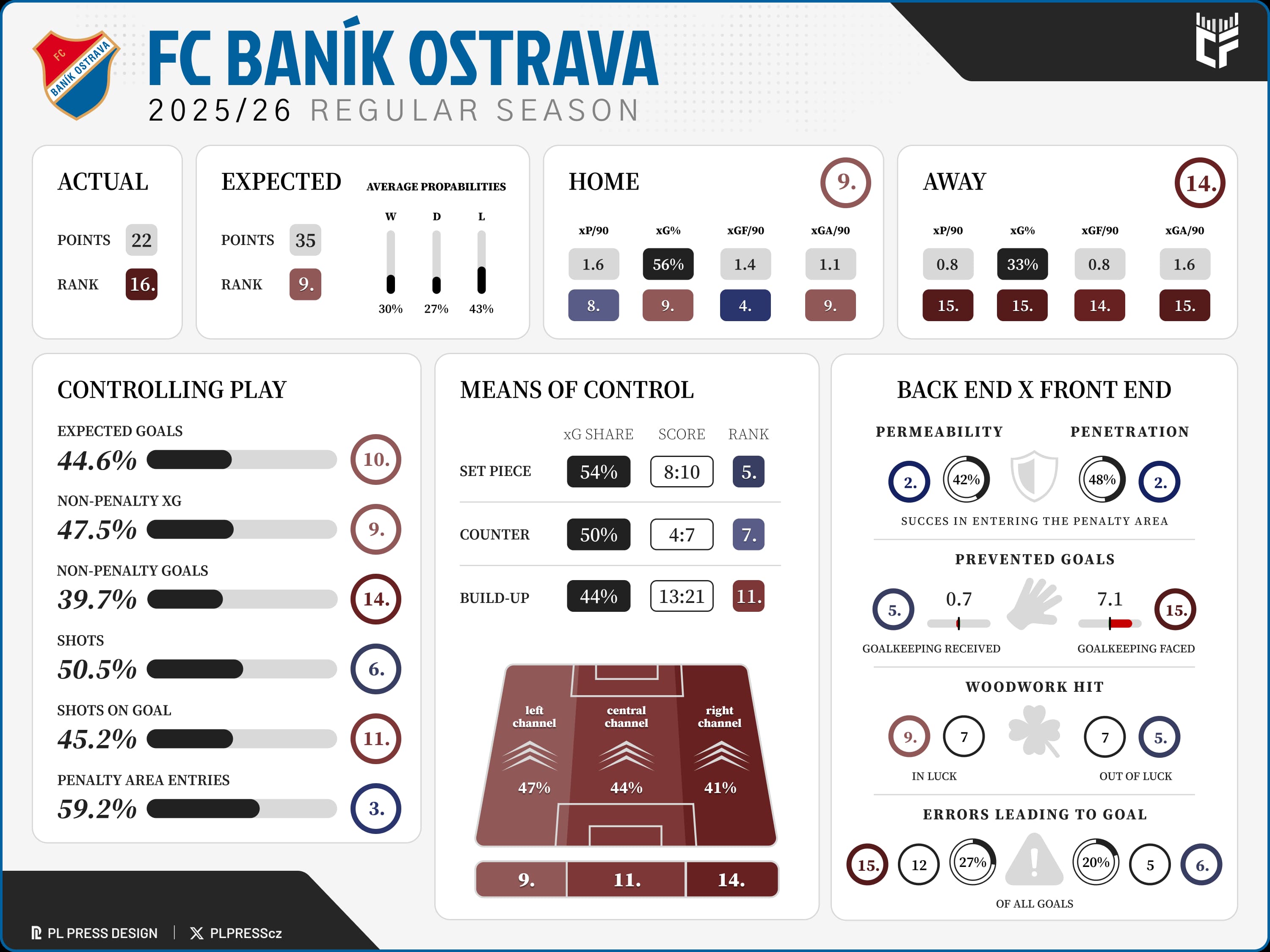
Somewhat more seriously, Josef Dvorník was about as big a success as he could’ve been at the time. Brought in to stop the bleeding after Ondřej Smetana, he expertly closed the shop for the post-season, overseeing a league-leading 0.5 xGAExpected Goals Against (xGA) estimates how many goals a team should have conceded based on shot quality, location, and context. over the last five rounds of 25/26.
What went wrong
The owner calling fans “defeatist doomers” in September, just before the notorious October rolled in, was a good start. But there were still too many months to sort through. And so here came November, with its travesty of a goalscoring drought. December was short but managed to provide Tomáš Galásek’s tactical masterclass in fielding an innovative 3-3-3-1 formation on the way to a 1:4 home defeat to Pardubice. A round and a few weeks later, it was the very different 4-4-2 formation served up by the same coach that took Baník’s sixth (!) lead on the season vs Slovácko and pissed it away. March was the month that was supposed to uncork Smetana’s era through the 6:2 victory against Zlín, gracefully making way for a one-goal April that culminated in the famed Abdullahi Bewene at false left wing experiment.
It was like a twisted chocolate Advent calendar.
Most valuable player
Per my MVP model (traditional stats): David Planka (ranked 80th league-wide)
Per my positional models (advanced stats): Michal Kohút (72nd overall percentile at AM)
If you asked 20 Baník fans for their 3 most valuable players of 25/26, how many different combinations would you get? The mere fact it’s so difficult to settle on an MVP — heck, even an inner circle of candidates — speaks volumes about the volatile nature of the campaign FCB just endured. Ondřej Kričfaluši ultimately topped their MVP leaderboard with 760 points, which wouldn’t be enough to unseat any other leader; including both Dukla and Slovácko.
In the end, I mercifully settle on two hopefuls.
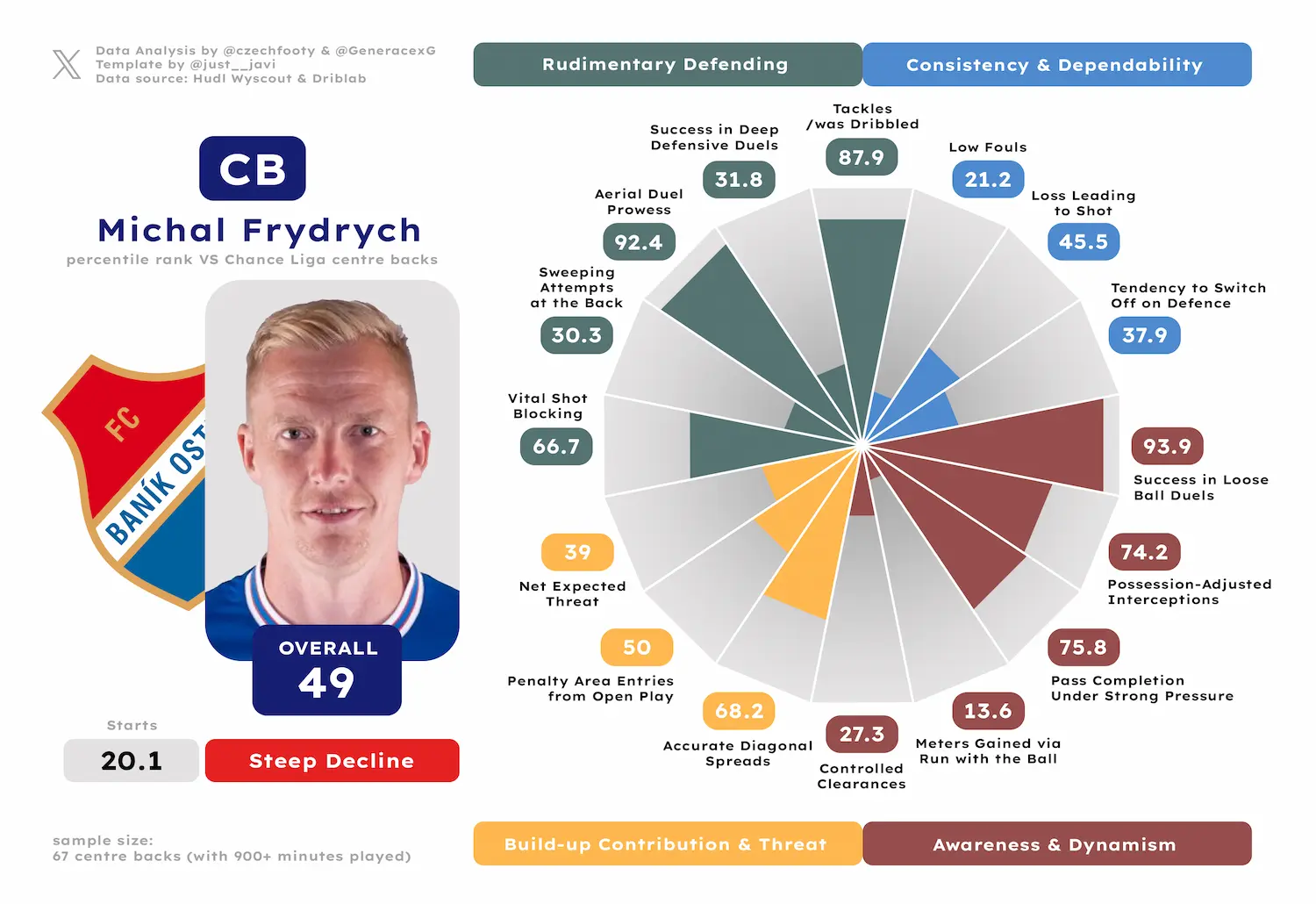
Michal Frydrych was far from flawless, but he picked up the glove when it mattered. Both his goals scored came inside the post season, and he was a particularly confident defensive force in the safety-clincher against Dukla. Especially remarkably at his age, Frydrych was the only one of 67 regular CBs who landed in the top 15% in three different yet similar metrics — aerial duel prowess, loose ball duel success and tackles/was dribbled. In 18 games Frydrych oversaw in full, Baník averaged a solid 1.01 xGA. Without him, it was roughly half a goal extra.
Probably the more conventional choice for an MVP would be the newly minted captain Martin Jedlička. His start to life in Ostrava was nothing short of phenomenal: the first four spring rounds saw him prevent a combined 5.12 goals while dealing with an astonishing seven balls in behind the line, many of them resulting in a face-to-face battle with the shooter. The thing is, by the end of the regular season, Jedlička was break-even; allowing exactly the same amount of goals above expectation in the following seven rounds. Then again, without him, Baník most likely don’t have those 5 early points — AKA 22.7% of their regular-season total.
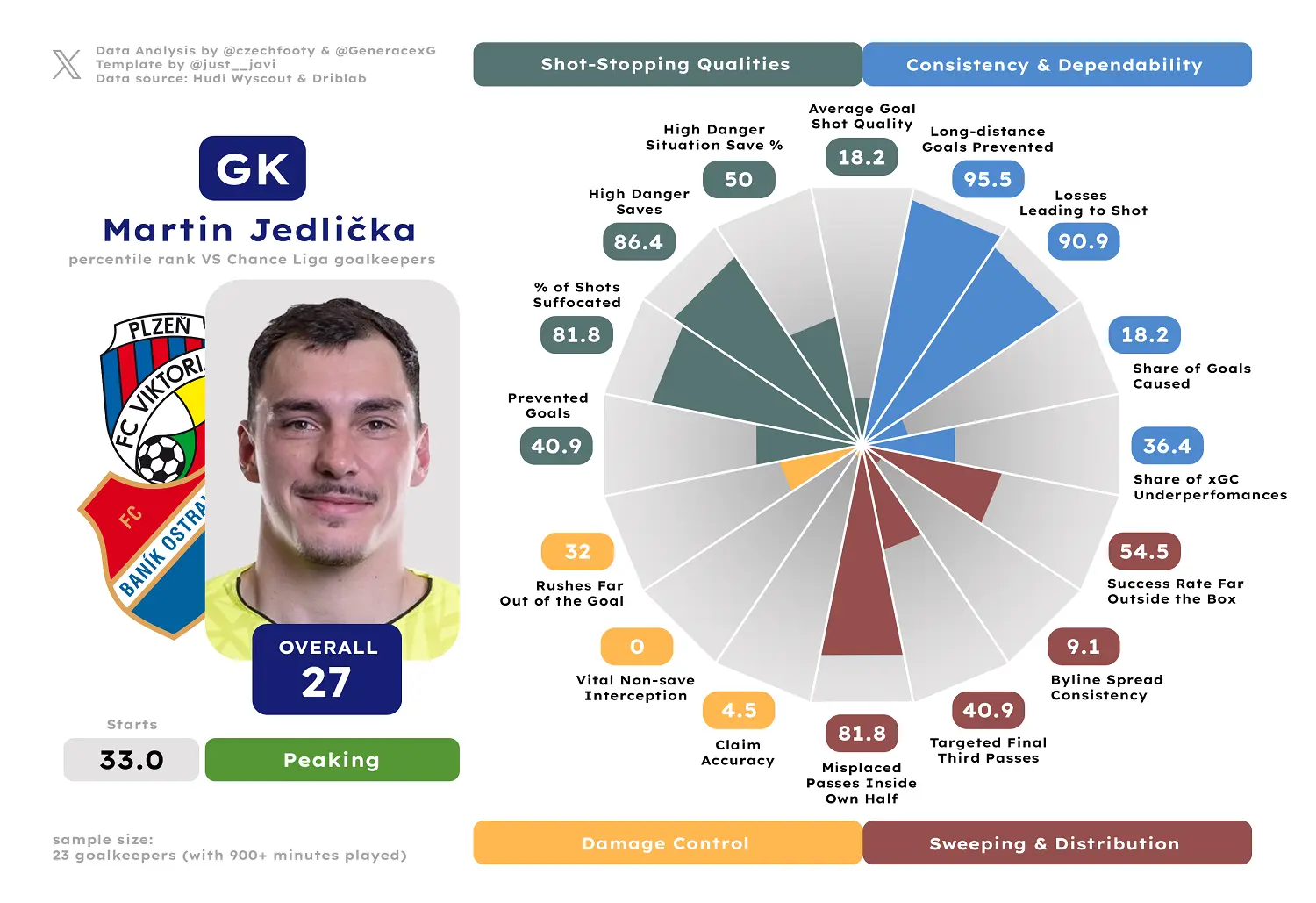
At the end of the day, Jedlička is the man of the moment. He always has been, which is why most casual fans perceive him as a good-to-great goalkeeper because of those saves in Europe. Jedlička pulled those off for Baník, too, but his full-season picture is rather grim.
Chip on the shoulder
It would be a stretch to call David Buchta a Baník Ostrava star at any point. Even when he would be considered a regular, you’d assume he was always close to the last name on the team sheet, and one of the easier upgrades to potentially make. Nevertheless, to see him suit up for the reserves more often than for the first team since late February was extremely odd. Following his last-minute penalty miss against Legia, Buchta’s head was irreversibly messed up, which inevitably resulted in the weakest half a year of his career. Sure enough, the chart below is a direct consequence of his lost confidence, as Buchta — famously a solid finisher — suddenly found himself hitting the target with a mere 4 of his 20 shots, not scoring once.
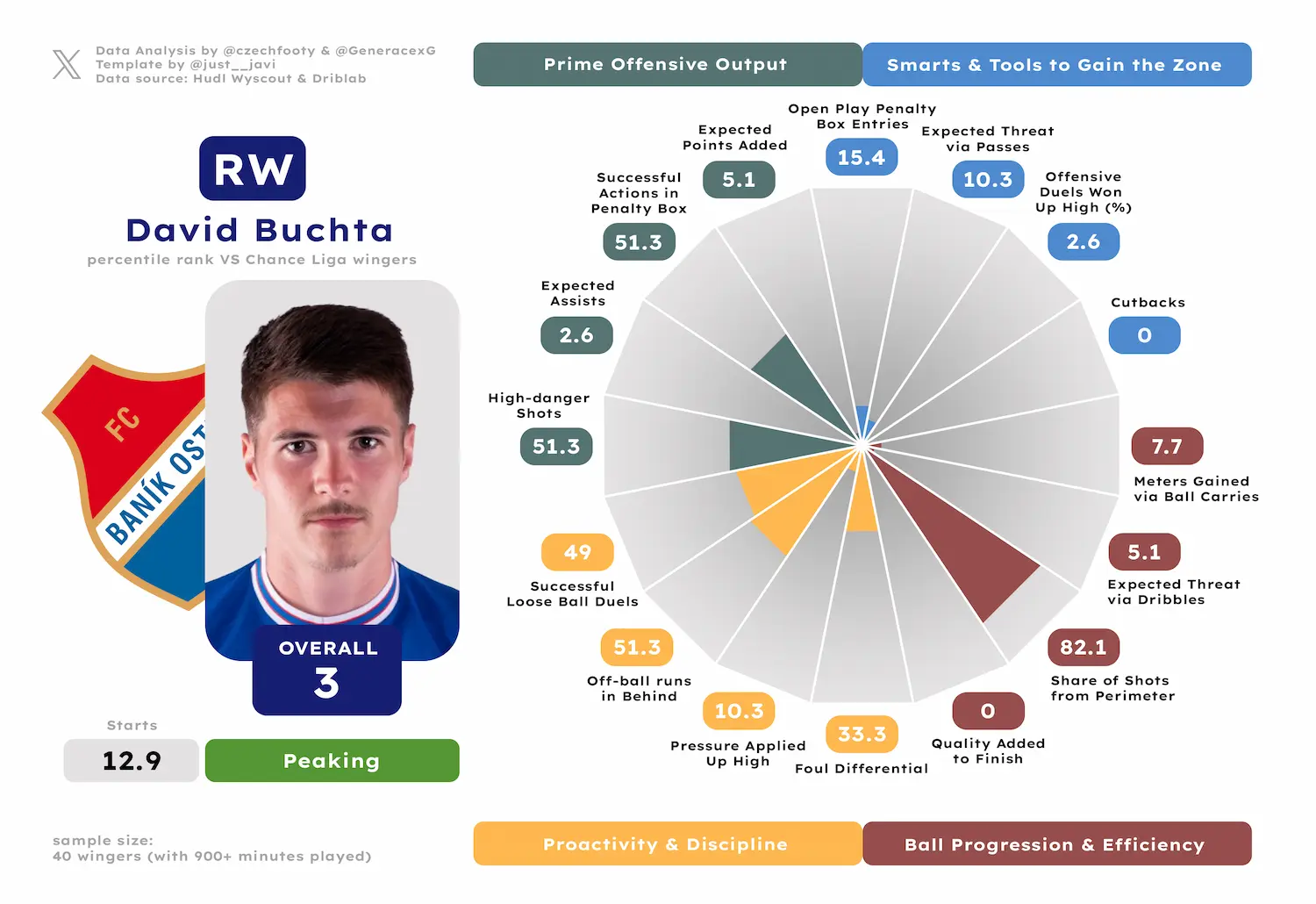
We’ve been through this: if Buchta is not getting into the box often enough, what does he do for you? When you look above, all the half-decent performance is in metrics like off-ball runs in behind, high-danger shots, share of perimeter shots or successful actions in penalty box which speak to exactly that narrow skillset. No wonder his career year (2023/24) came when he was getting by far the most touches in the box. Could his pre-season promise turn into a serious bounce back? Now ripe at 27 and on an expiring contract, he needs it more than ever.
Inside the off-season
special thanks for guiding me through the motions of Baník Ostrava’s off-season go out to Jaroslav Novotný, Matěj Prauzek, Martin Král, Kamil Novák, Vrchov, Fanda K, @JiDuek15, @KrenekHonza93, @Maassive1922, @homor1922, @Fildass, @IamTHEDannyP, @miroslavsilak, @hrubes_radim, @1grdecoca, @prgowski & @smusil93
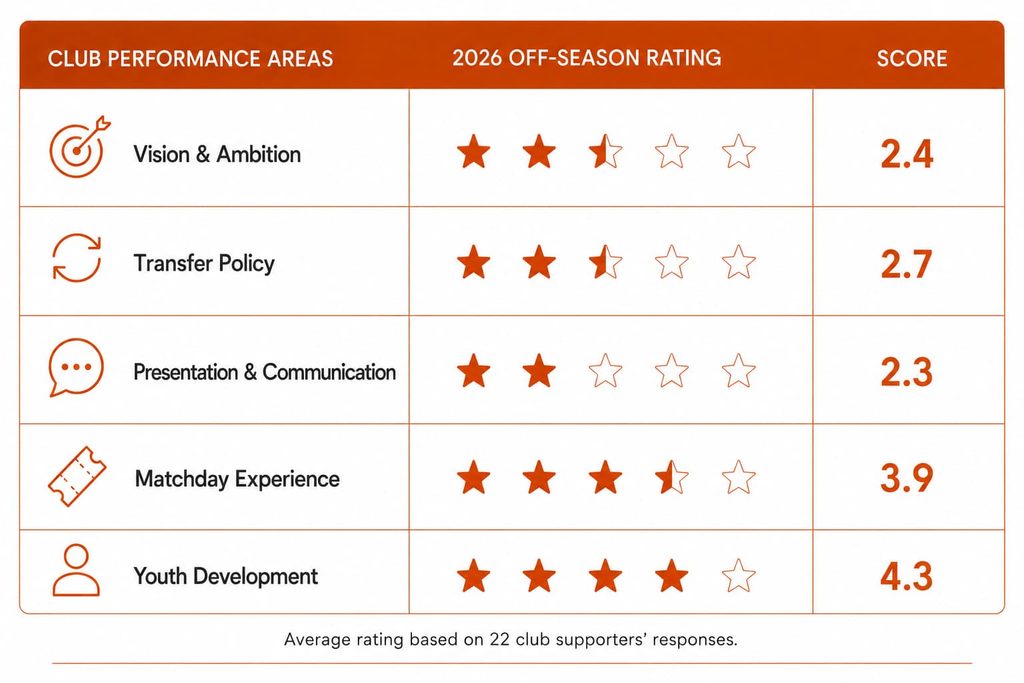
Squad turnover
There’s a concerning trend contained in my “squad churn” spreadsheet over the years that Baník Ostrava certainly do not want to follow. In summer 2024, at the time of the preview production, Dynamo České Budějovice were losing by far the most utilized players (17). In about 12 months, they were gone from the top flight. Last year, it was Dukla (20) — headed towards the same fate. Now, if the pattern was to be repeated, Baník (20) are next up. For reference, they are losing as many players as Karviná, and they are in a kind of special position. The good thing, in a way, is that while Karviná are shedding 20 players out of a total of 32 used, Ostrava are waving goodbye to the same number but out of a total of 43. Why it is a good thing: many of those 20 players have been long gone. In fact, of the 10 outfield starters on the opening day, an incredible half (5) didn’t suit up for Baník beyond Round 15, and none of them even topped 400 minutes in Ostrava’s jersey. Sure, the losses of Rigo, Šín, Ewerton or Prekop were huge for 25/26, but they arguably shouldn’t be factors for 26/27.
Indeed, Baník effectively had a team in mind for the opener, and then that team turned into Atlantis — vanished overnight. As a result, four members of the most utilized eleven (Planka, Bewene, Jedlička, Jurečka) weren’t even part of the club or matchday squad in August (R7). This has a knock-on effect in that Baník are not suffering too much for their 20 departures; they are retaining give or take 65% of minutes, goal contributions and other indicators. That’s not too bad for a team in flux — barely half of Dynamo and Dukla squads survived.
Biggest upgrade
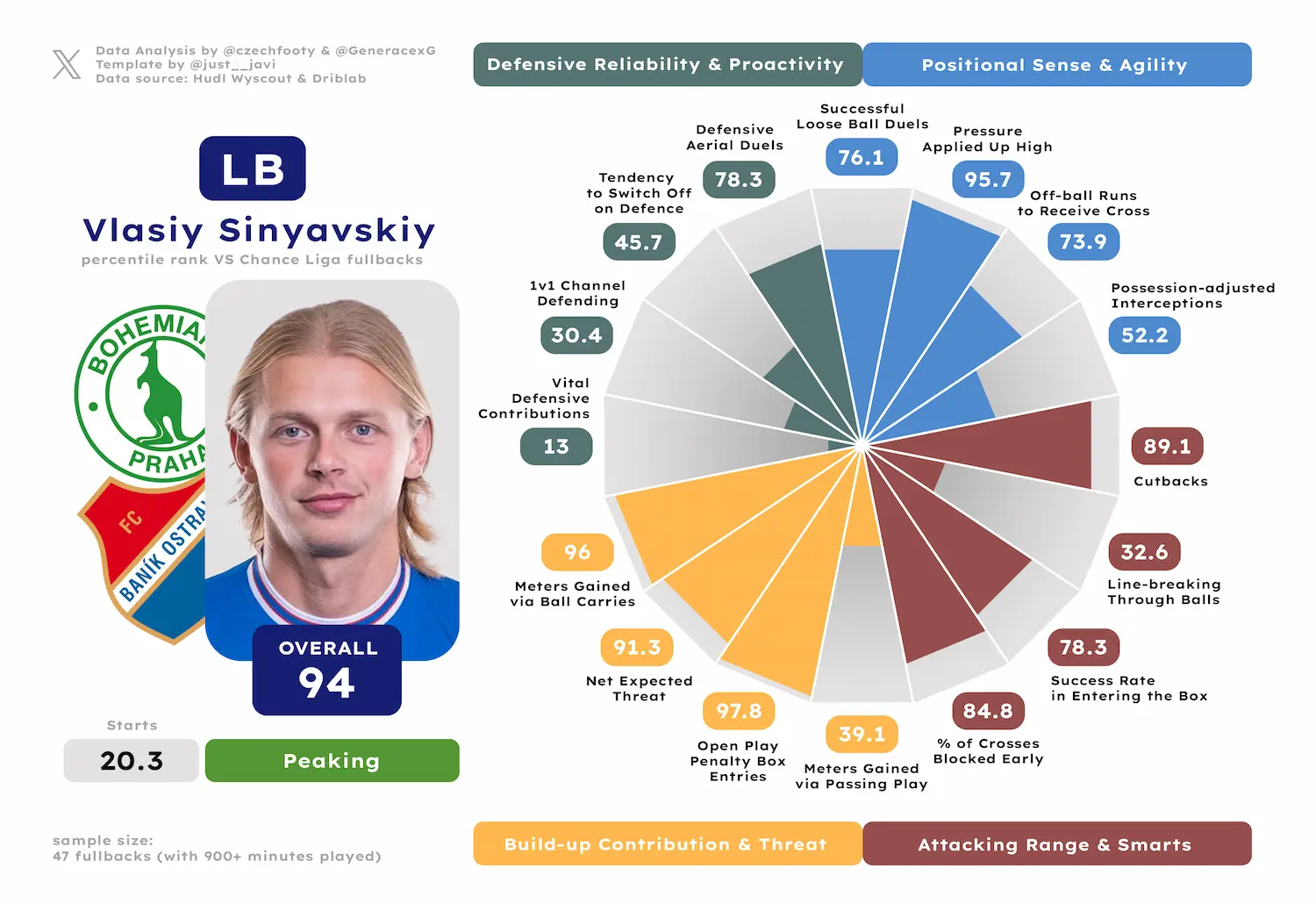
They often say the sweetest upgrade is the one you find from within. They don’t? Ah well, Baník fans might as well, since there is a decent chance one is coming their way in the form of Vlasiy Sinyavskiy. Missing the entire winter prep and much of spring league action, one of the league’s stars of the autumn never found his groove in Ostrava’s shirt; posting his first primary chance-creating action in his penultimate start, his first goal contribution in his last. Regardless, he still finished the campaign with 50 deep completed crosses — second to only Provod — and as an outright cheat code in entering the penalty area with the ball at his feet. Sinyavskiy has formidable poise in his cross delivery, timing it correctly, after the right amount of twists and turns. When in the box, he always looks for a cutback, often coming up with a surprise solution only a step away from the goal line. Baník fans saw too little of that.
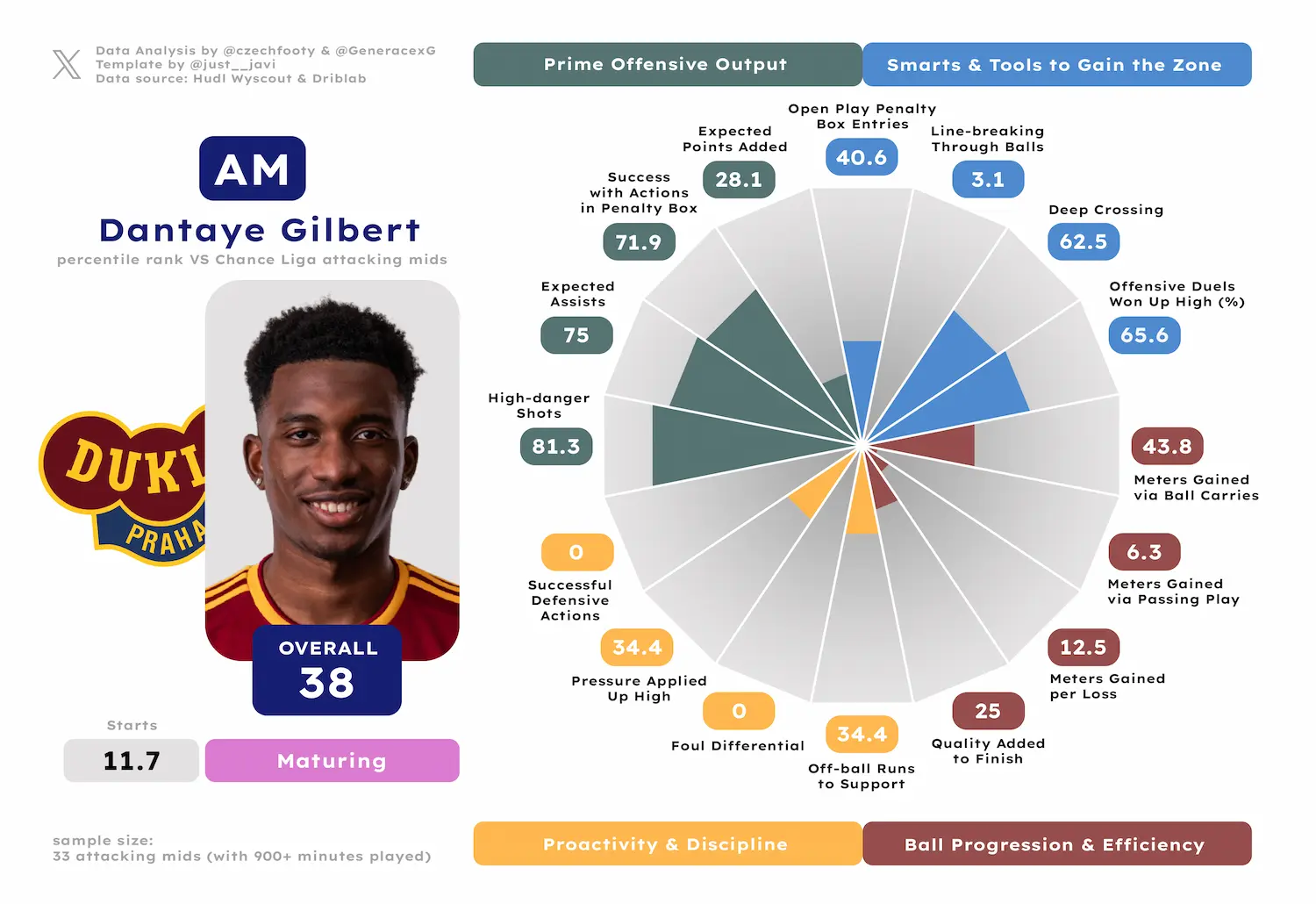
As for a real upgrade brought from the outside, it’s not straightforward. Baník mostly focused on boosting the depth and such lateral moves are usually difficult to nail down as clear upgrades. I mean, what do you see in Matúš Kmeť: someone who pushes Buchta into a more suitable role but doesn’t stand for anything special himself, or a baby TAA? It’s a real dilemma. On a serious note, Dantaye Gilbert is about as good a low-key breakout candidate as it gets. When there’s the underwhelming production (2+0) on the one hand, and the prime offensive output that ranks him 7th ahead of the likes of Zorvan or Samko on the other, you should be well aware you potentially have a ticking bomb on your hands. Gilbert’s toolsy.
Biggest downgrade
It’s funny because Baník’s biggest downgrade simultaneously constitutes the biggest need left to be addressed (we’ll deal with that later), while the somewhat desperate pick for the biggest upgrade probably won’t do much to offset what I’m just about to talk about. You see, Srdjan Plavšić is far from a perfect player. He gets pushed to the perimeter far too often and his decision-making leaves a frustrating lot to be desired. But he was also the only regular winger who was able to keep up with Alexis Alégué in terms of gaining the danger zone. Some of the values are a product of a small (volatile) sample, but especially his insane success rate in entering the penalty area (60.3%) hardly is. Sample size doesn’t affect this much.
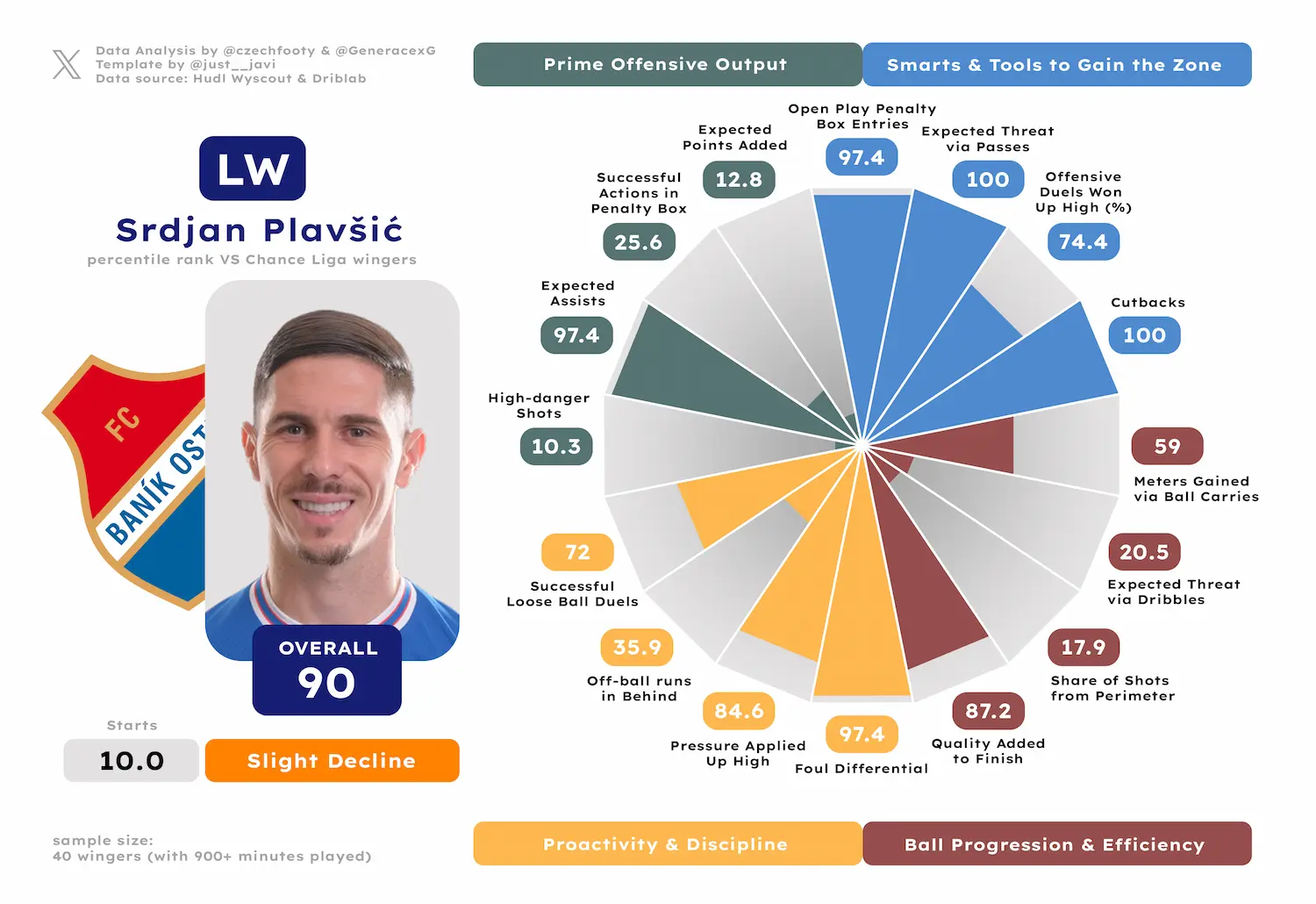
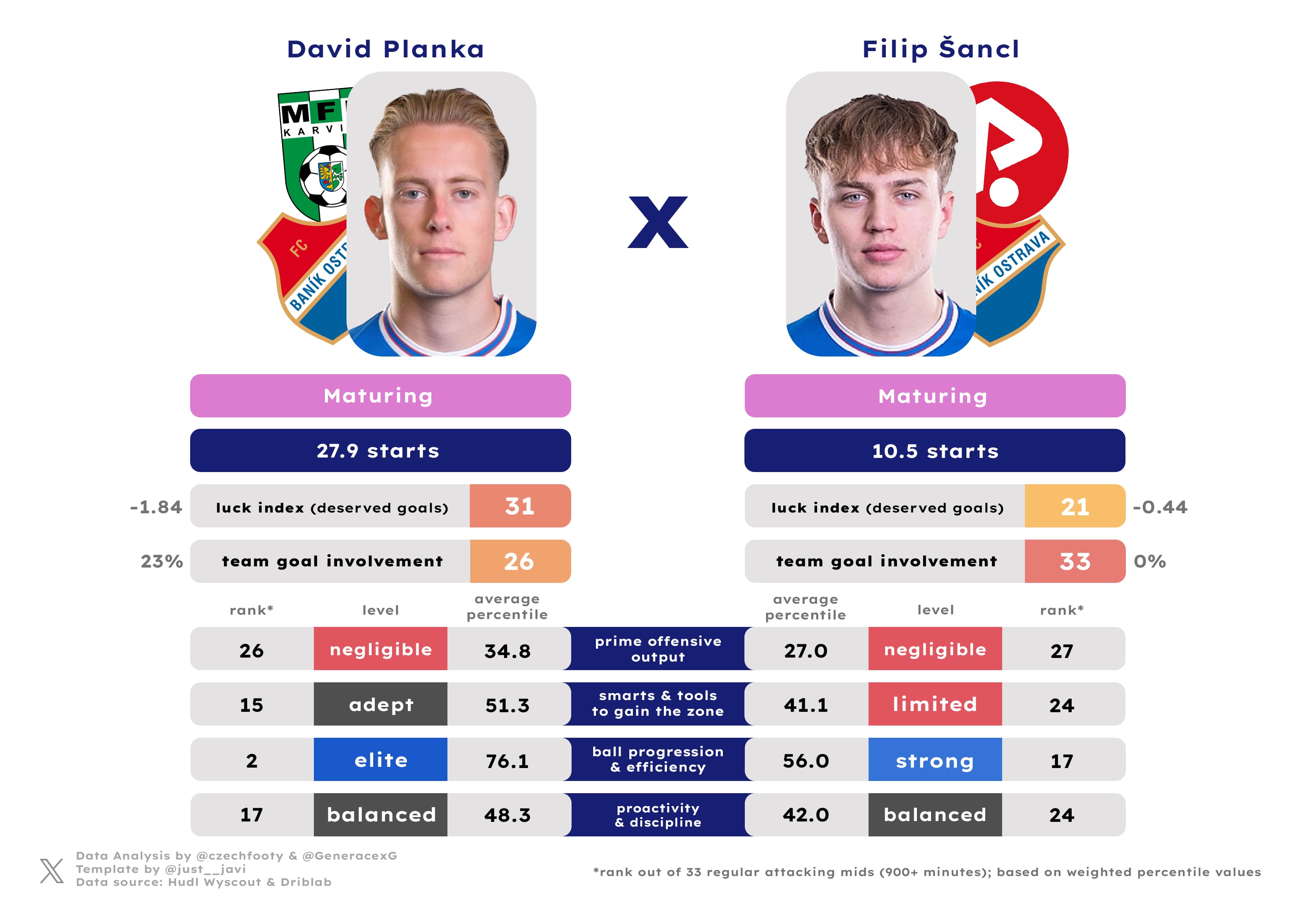
The thing is, while Baník may not deploy wingers in most games and they certainly boast an array of options for the second striker/no. 10 slot, there’s no obvious candidate to fill specifically Plavšić’s shoes. Gilbert’s got the tools, but they are still too raw — averaging the 46th percentile in this particular set of metrics. Meanwhile, David Planka or Filip Šancl are at home in other areas; they both are capable of incisive dribbles and sudden accelerations, but cracking the box is not their forte (Šancl was even the second worst AM in xG chain in the final third). This is very much where Baník needs the true Sinyavskiy to step up to the plate.
Need left to be addressed
Pretty much immediately when he signed on the dotted line, we all thought it: Ondřej Kričfaluši would leave a crater behind him at the first opportunity. Since he was himself belatedly replacing Tomáš Rigo who was in a similar boat with one leg out of the door for about two years straight, it was also a perfect opportunity to expect one thing from Baník: surely this time, they will be ready for the inevitable. Nope. It’s always better to be surprised.
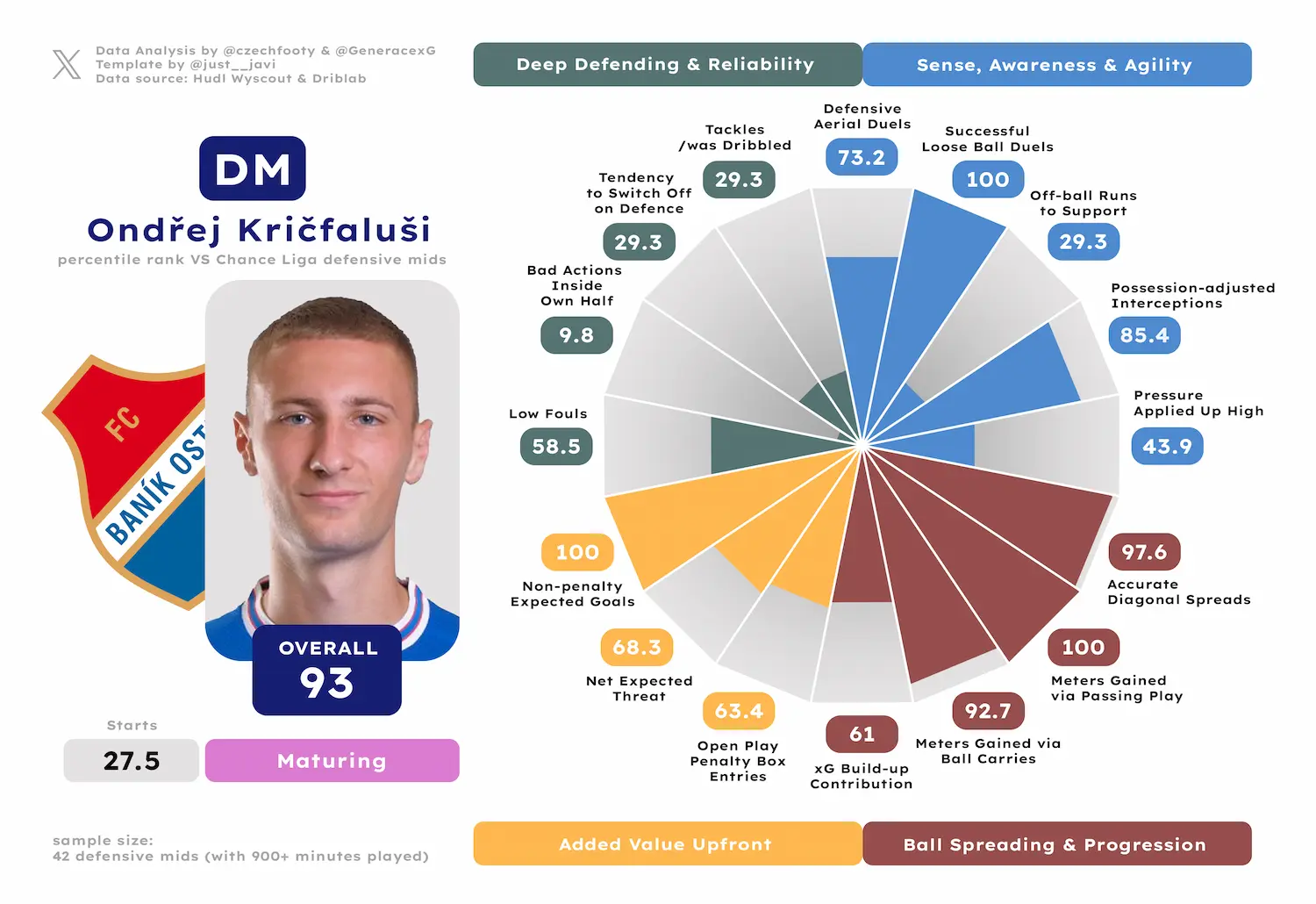
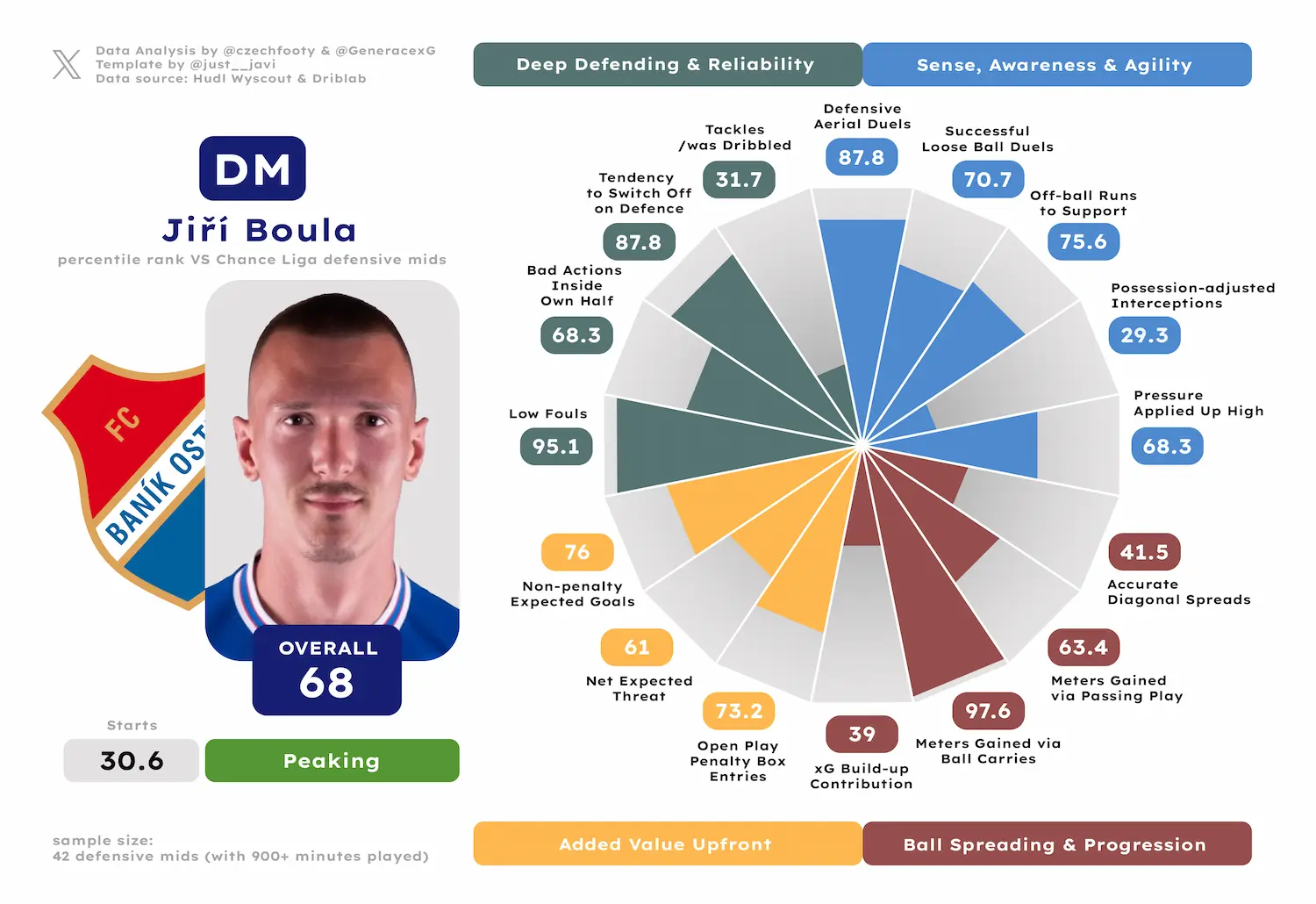
Maybe they thought Samuel Grygar was suddenly a finished product. Naive, but possible. Now that he’s injured for some time, even this questionable backup plan is out of the window. And so Ostrava are left scrambling once again, this time replacing a proper unicorn whose ball progression is widely recognized, and his other outstanding ability (to anticipate and sweep up loose balls with tremendous efficiency despite his limiting height) forever underrated. The task alone is daunting, but it’s made harder and more critical by the season Jiří Boula just endured. Formerly a game-shifting passer on long distance, Boula took a few steps back to the more run-of-the-mill territory, particularly scaling down his signature diagonals and focusing more on pure defence. If that continues to be the case, and Planka doesn’t quickly rediscover his mojo after playing his way onto the bench, Baník are in trouble.
New kid on the block
After fast-tracking Marek Havran and Jakub Pira to A-team roles they were frankly never ready for (the latter landed in the 3rd percentile among regular centre forwards, with his only stand-out quality being not getting caught offside much), Baník may be back to a more patient blueprint. While a number of members of the 24/25 title-winning U-19 began the summer “A” preparation, perhaps only striker Vít Škrkoň (b. 2008) — no longer a new face — should stick around in place of Pira, with talented centre back Jiří Míček (b. 2007) most likely blocked by the flurry of new signings for the position. Tadeáš Frýdl (b. 2007) is almost certainly headed back to the second-tier reserve team to play for his favourite U-19 coach Robert Pištěk, who immediately switched to 4-3-3 and introduced a more attacking brand of football to follow up on Josef Dvorník. (Pištěk, an ambitious coach lured by Sigma, is now on a fresh contract; to everyone’s relief.) Lukáš Dvořáček (b. 2007) could suffer for a potential wing-less formation, but otherwise may be a solid bet for a similar amount of mins Havran received last term. He loves a 1v1 and already feels the game on a better level than Havran, who often pushed himself aside with his dribbles, but he’ll get bullied until he bulks up.
After spending much of the 25/26 season near the top of the table, Baník “B” will once again make for a fascinating testing ground of young talents. Šimon Drozd (b. 2007), formerly of a higher ceiling than Škrkoň, should finally be ready for senior football after overcoming a pair of knee injuries and topping the U-19 scoring leaderboard in the role of an elder statesman (13 starts were enough for that). Dominik Zajac (b. 2008) wasn’t far behind with 10 tallies and opened B-team’s summer camp along with an even younger Jakub Cahlík (b. 2009). We also cannot leave this space without mentioning a familiar surname: Baroš. But don’t worry, we are not old enough to watch Milan’s son; rather excited for his half-bro Simon (b. 2009).
Looking ahead to 2026/27
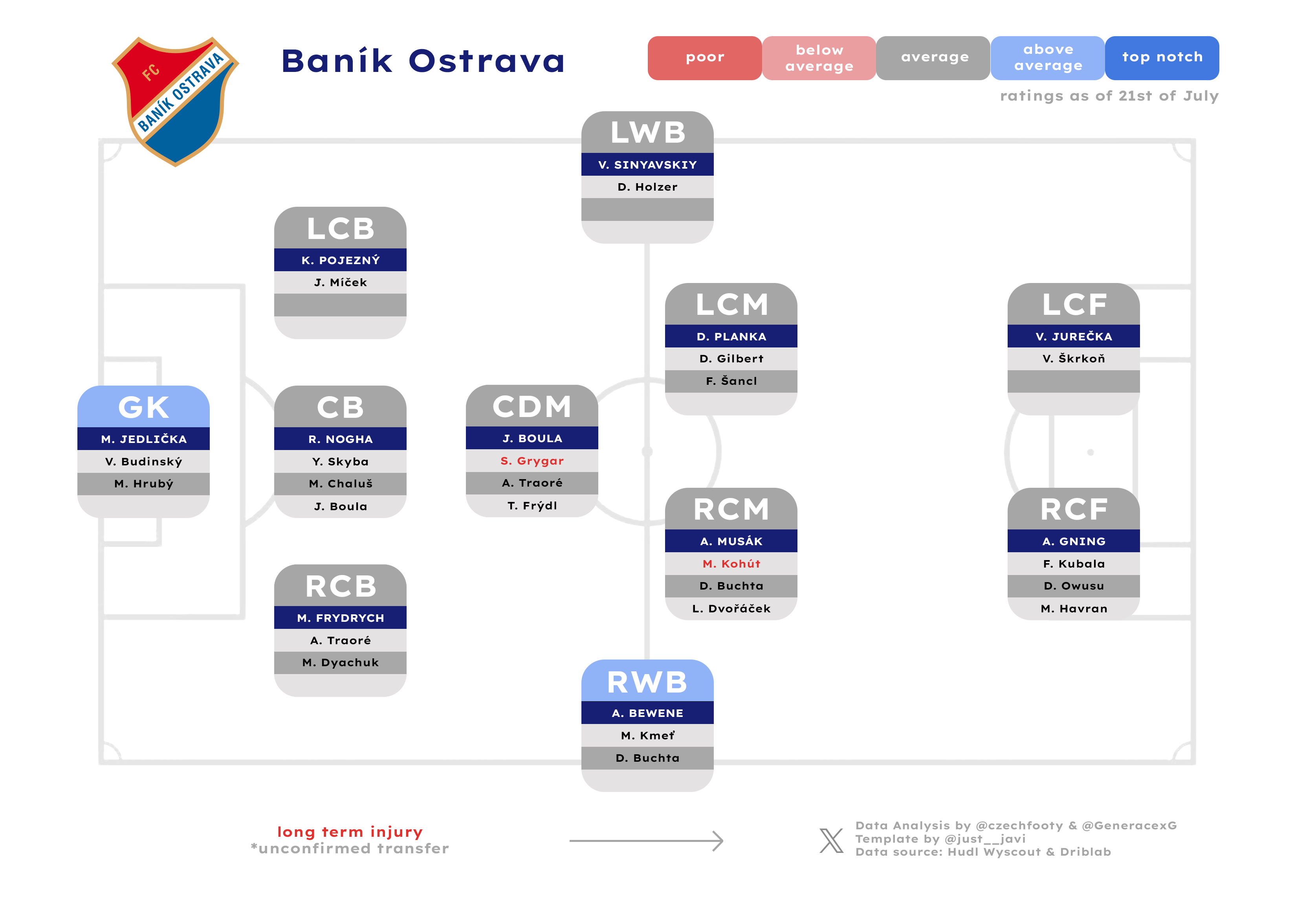
Below is the team’s current depth chart with a maximum of 4 alternatives for one position. The colourful ratings are a static snapshot of the league-wide situation on 21 July, and they are just a playful bit to add flavour to it; the names featured should be relevant to this day. To learn more about my approach to constructing depth charts, with all its limitations, head here.
Primary formation
Roman Skuhravý seems dead set on a formation with three centre backs, though 3-5-2 is certainly not a guaranteed scheme. With Dantaye Gilbert in, the formation morphs into a 3-4-1-2. There was also a test involving Buchta and Filip Šancl as inverted wingers in 3-4-3.
One interesting tactical pattern my consultants observed throughout the pre-season was Roan Nogha playing the middle CB out of possession, and pushing up to the midfield when in possession (often swapping with Boula). This must feel natural to an former DM like Nogha.
Colours I grappled with
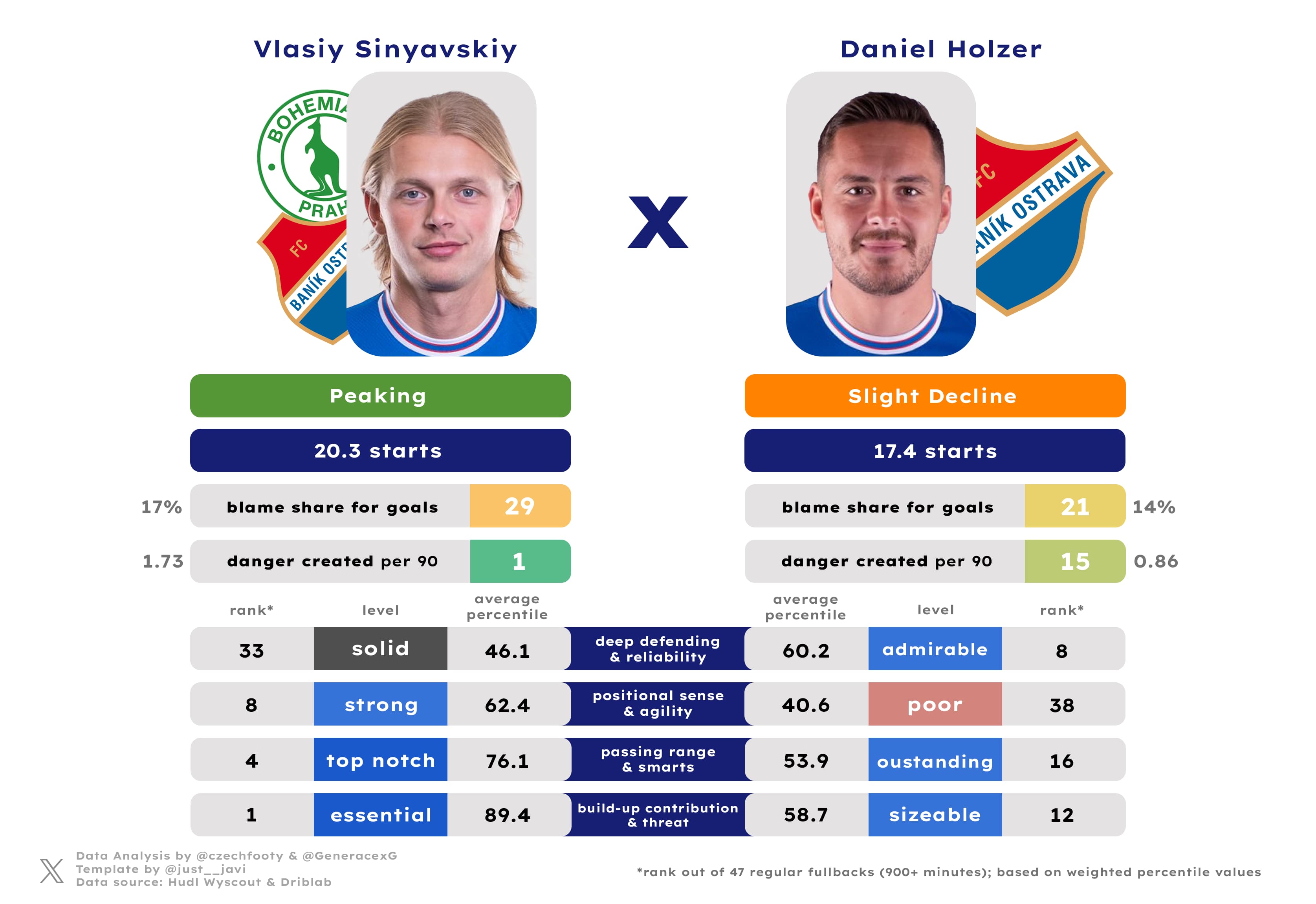
If I were to take the 25/26 high points of both Sinyavskiy and Daniel Holzer, there’s no doubt the left-sided clique would be at least above average, maybe pushing top notch. But given how their spring went, it’s best to exercise caution. Goalkeeping, meanwhile, feels fragile.
Notes on the depth chart
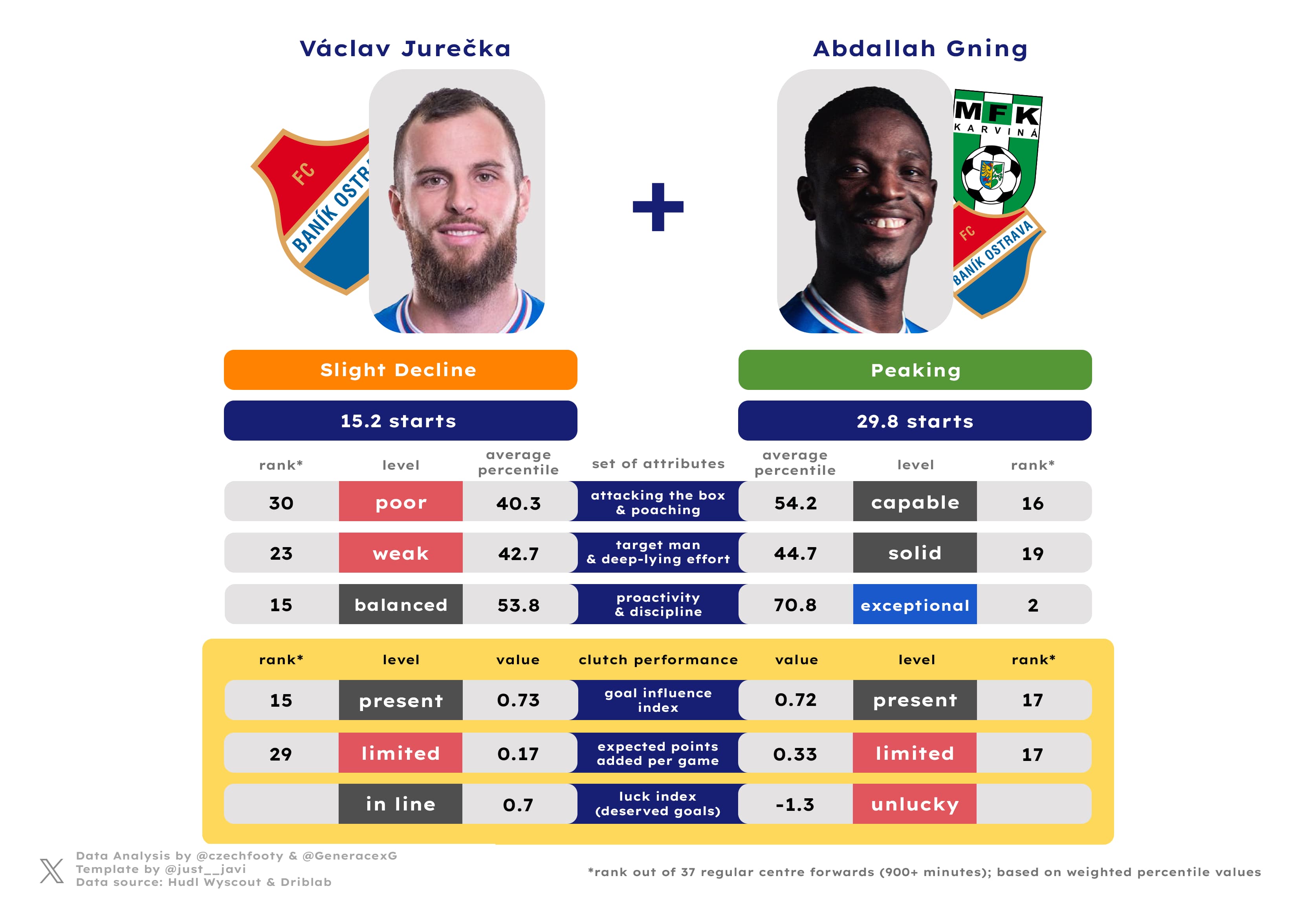
Václav Jurečka may be an automatic starter for now, but the clock should already be ticking on such a status. While Abdallah Gning at least scored in pre-season after a wasteful spring, the veteran only prolonged his agony. Jurečka was rapidly becoming a meme with his missed sitters towards the end of 25/26, somehow getting gradually worse at it, which is why he ended up with such a red-coloured balance sheet below despite the 9 goal contributions that actually topped Baník’s leaderboard. The thing is, my model doesn’t reward just any points, they must be vital to matter, and Jurečka did a lot of empty-calorie scoring (two of his seven goals and assists came in tight game states), while actively harming the team with his lethargic off-ball play and too many offsides to count. If Skuhravý truly holds a blank cheque to write players off regardless of their reputation, Jurečka may well be his first casualty.
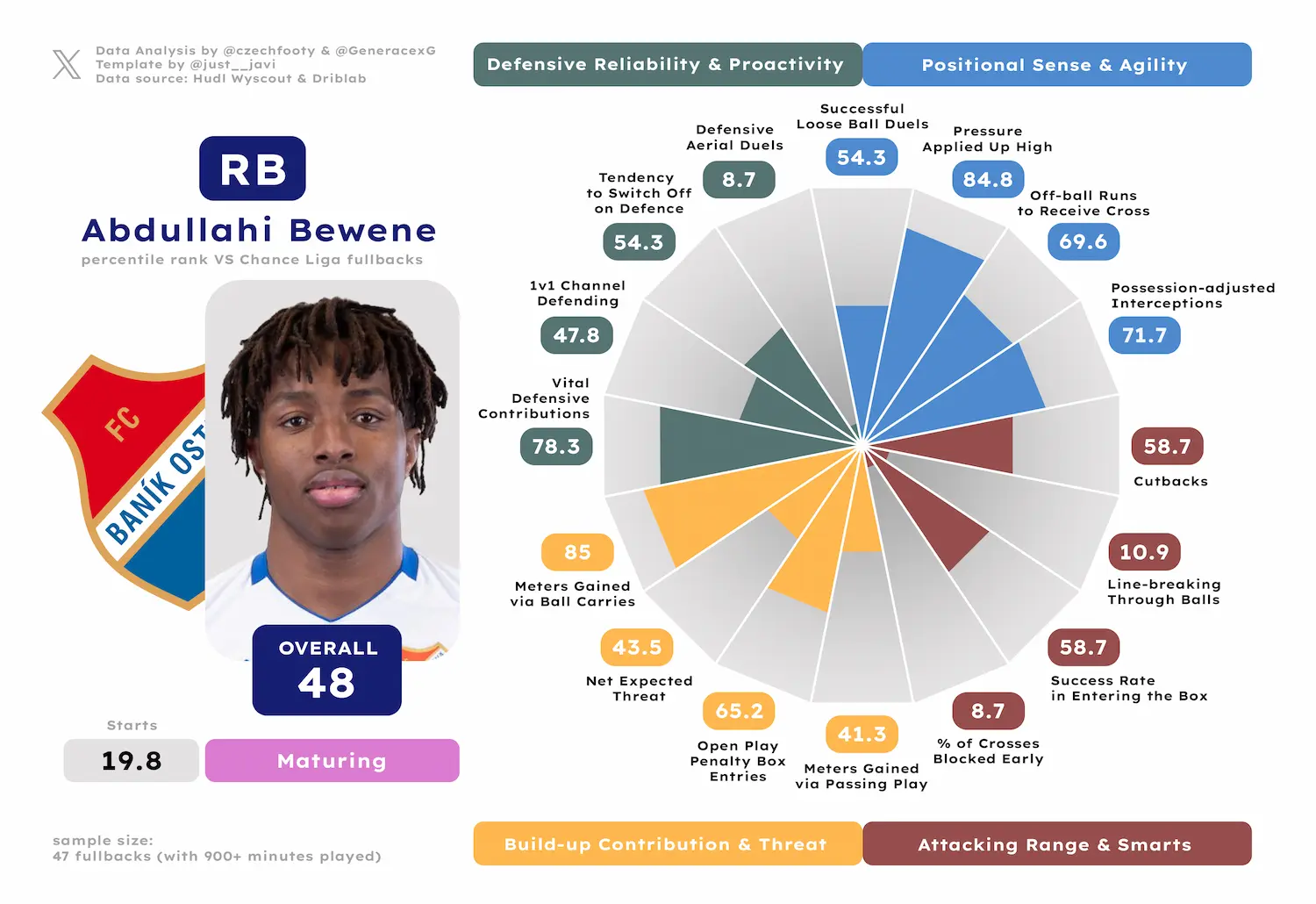
It’s never easy for a maturing youngster to get his big break amid a historically turbulent campaign, and so the fact that Abdullahi Bewene didn’t fall from the sky and enters the sophomore season as a clear-cut starter can’t be taken for granted. He’s a workhorse, a tireless backtracker whose agility always catches the eye. But to flourish under Skuhravý, Bewene will have to add some flair to his game — and do it quickly. At this point, the Nigerian is basically a copy of Aziz Kayondo (honestly, he’s scoring almost identically in all four areas), which means a solid start for a 21-year-old, along with a vastly limited attacking range.
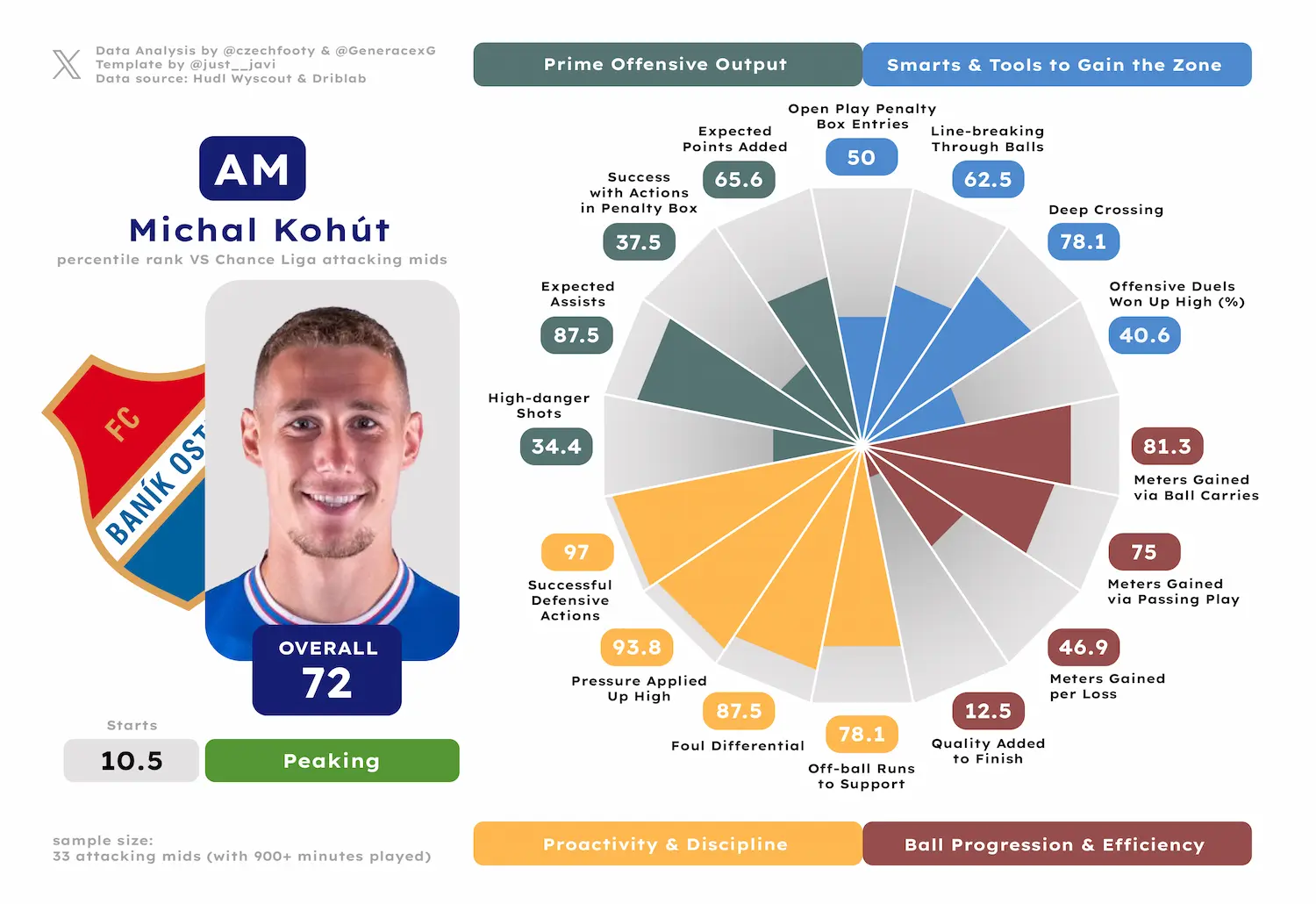
“Where would Baník be with a healthy Michal Kohút?” used to be the question on everyone’s lips before giving way to a much simpler “Where is Michal Kohút?”. As long as he was on the pitch, the former Slovácko midfielder was everywhere: involved in 54% of all goals scored (5th highest rate among AMs), a foul magnet, a defensive stud, and both a progressive passer and ball carrier. But when the minutes barely add up to 10 starts, the perceived value diminishes. Especially as we once again talk about a missed opener and more. Damn shame.
Roster battle to follow
If you’re left wondering why Baník’s summer shopping list included a whole trio of centre backs (though jury is out on Aboubacar Traoré both in terms of where he primarily slots in and, erm, literally), despite the club already employing three of the most recognizable faces at the position in the league, it’s quite likely that the reasons why you recognize them are… all bad. Because it just so happens that of the 10 least consistent and dependable centre backs per my model (out of 67 regulars, remember), three are cashing in cheques from Baník.
Yes, kids, that’s bad. And yes, they are the same three you were thinking of.
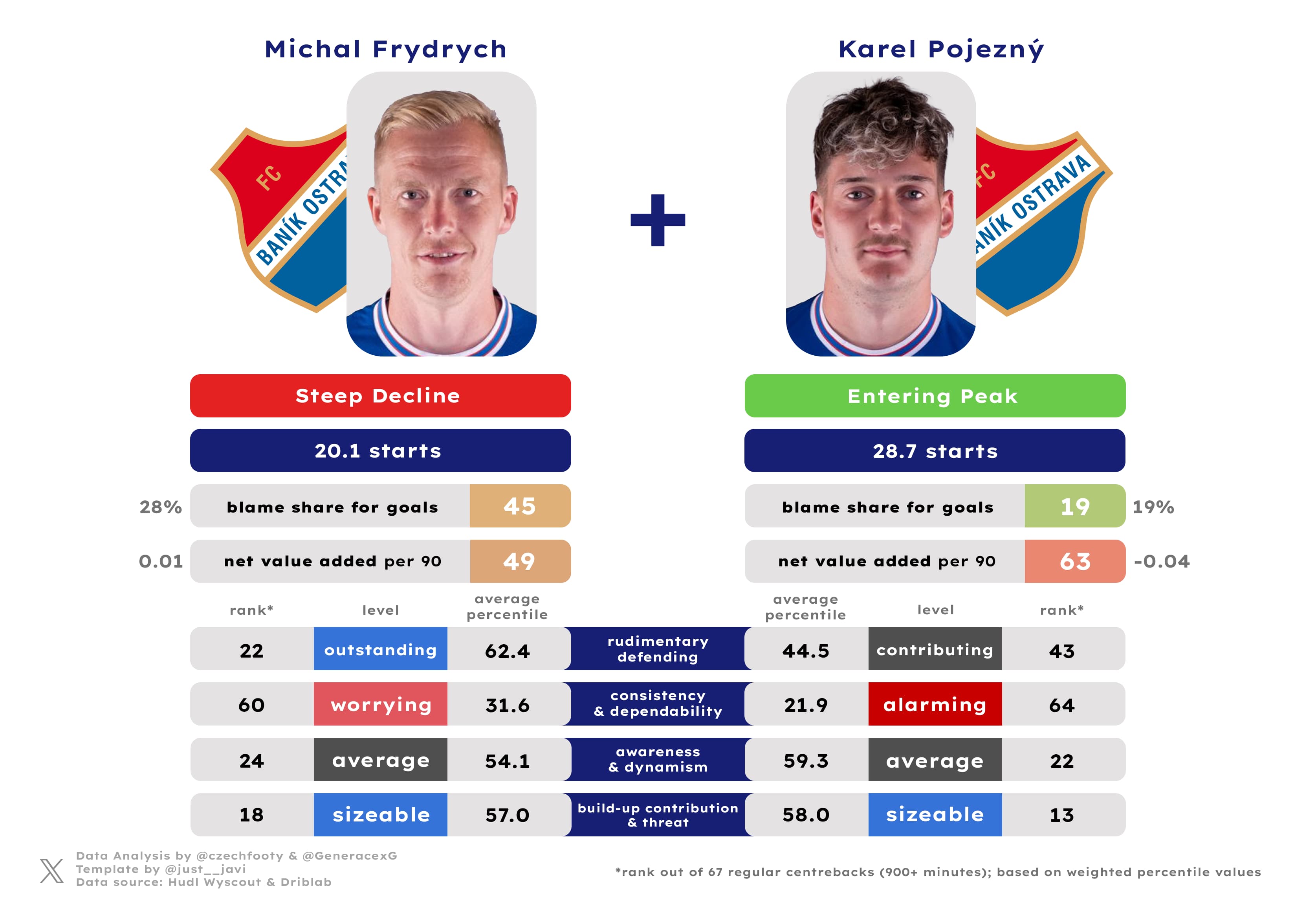
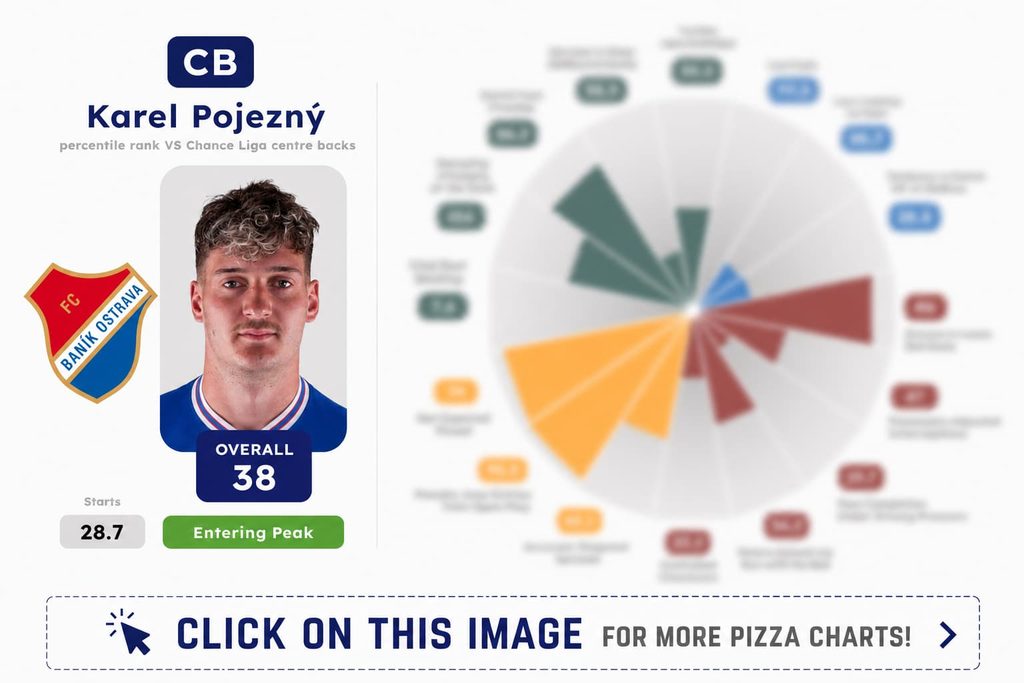
Michal Frydrych, my MVP front-runner all the same, is below average all across the board but at least nothing sticks out above all else and he richly compensates with last-ditch heroics. Karel Pojezný and Matěj Chaluš, on the other hand, cannot be bought out easily. The former fouls a lot and generally performs too many bad actions inside his own half, while the latter is particularly prone to falling asleep on a number of occasions. As a result, Chaluš is the biggest faller of all, going from a no. 1 centre back and a presumed fix in 2024 to a no. 3 at one centre back slot behind a promoted B-team player and a late arrival from Karviná.
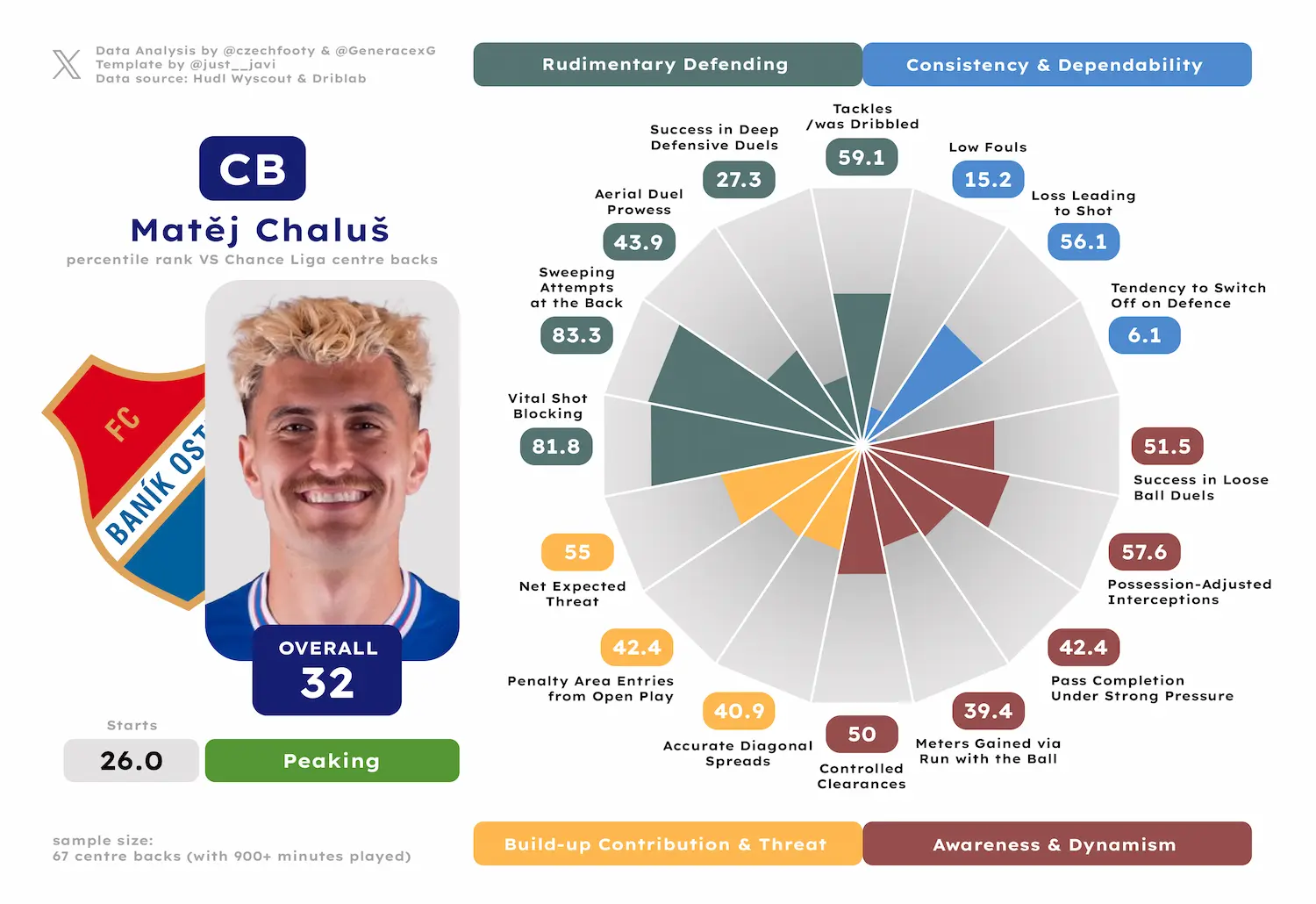
Could it be that Nezmar knew exactly what he was doing when he moved on from Chaluš almost as soon as he stepped back in his Slovan office? (Of course he did, I’m not surprised.)
Season forecast
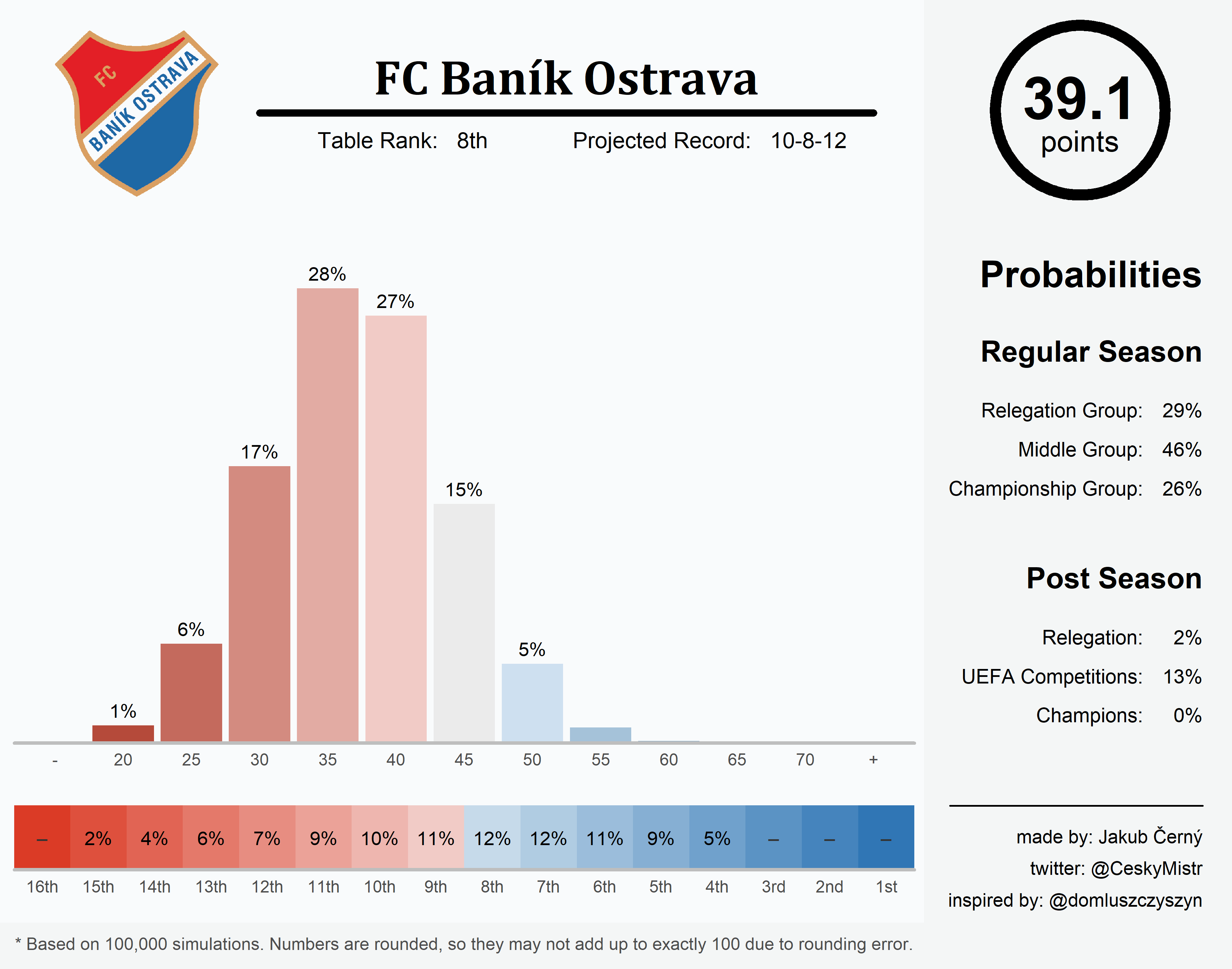
To its credit, the model had long been cautious and non-committal re. Baník’s Top 4 ambition, almost to a fault. Between summers 2022-2024, Ostrava were projected for something between 43-46.7 regular-season points, always tip-toeing around the edges of the Top 4. Then, last summer, the model effectively said “fuck it” and finally went all in: 54.3 points, 90% chances of some more UEFA football. We don’t need to beat the dead horse by reminding you what followed, but let’s just say there was a 26.7-point correction in January.
To be fair to the model, the 2025 forecast wouldn’t have been nearly as kind had we known about everyone who was soon headed out of the door. Still, to go from a 71% likelihood of holding down a Top 4 position at the start of the post season to a mere 5% is just… brutal.
Either way, a return to Top 4 isn’t on anyone’s list of priorities in Ostrava. Above all, those who hold Baník dear in their hearts will be glad to hear that a repeat of the relegation play-off experience is only given a 5.8% chance, while relegation only occurred in 1.6% of cases.
Bold prediction
The track record: 2/5. Baník indeed didn’t turn one of 20 deficits into a single win
The prediction: A left-footed strike will open Baník’s scoring account
The rationale: In 2024/25, Baník sat neck-and-neck with Slavia at the top of the league’s leaderboard when it comes to left-footed hits. Courtesy of Prekop, Šín and company, they racked up 26 such goals — one fewer than the champions, and ten more than the next in line. Last season, Baník had to wait till late November for Kohút’s wonderful solo, with only Planka adding to the total with his deflected strike much later, deep inside 2026. How awkward is that? David Lischka alone, while at Bohemians, managed to score twice with his left foot.
We’ve got to change that.
Even with Kohút injured, there is someone — anyone — sweeping the ball in with their left foot to open Baník’s 26/27 goalscoring account. Who knows, maybe it’s been Jurečka’s or Gning’s lucky foot all along, and one of them realizes it just in time to snap out of his funk.

Enjoyed it and just want to casually support us with an amount of your choosing? No worries, you can still do that by inviting us for a symbolic pint at the old BuyMeACoffeeBeer page.