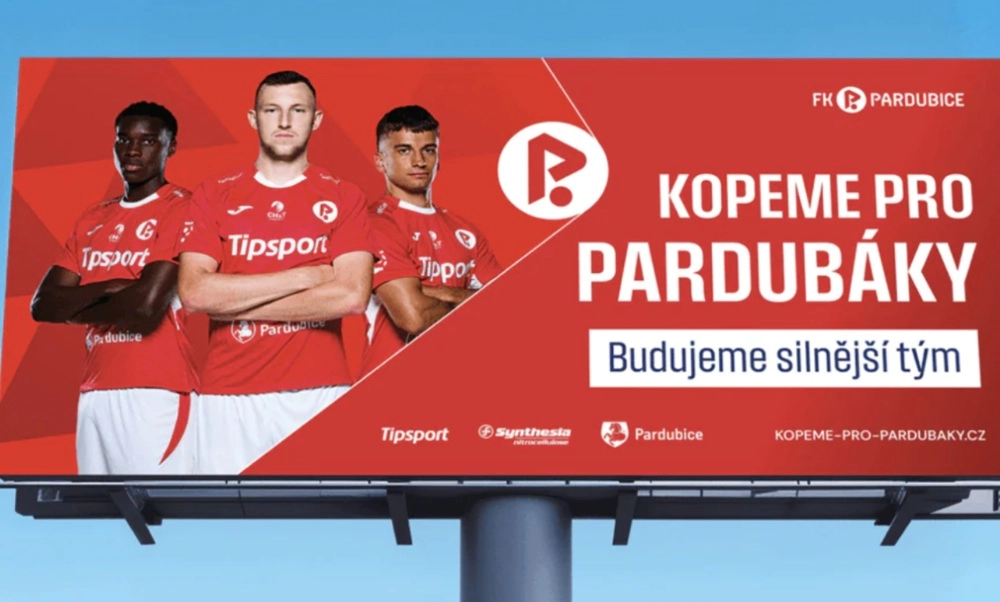
A new logo always comes with sticker shock. I’m old enough to remember when Slovan’s new logo was but the latest confirmation of football becoming “too corporate, too soulless”, or when Sparta’s new logo marked too stark a departure from tradition; now both commonly feature near the top of many neutrals’ rankings. A new logo also tends to invite comparisons. FK Jablonec, changing their identity just before FK Pardubice, learnt that the hard way — though at least you can see why some drew parallels with Lesy ČR, the state-owned forestry company, seeing as both are built around fucking trees. What does it say about the new FK Pardubice logo, then, that most see Pinterest or the country’s largest health insurer (VZP), while the nerds swear it’s lifted straight from an Albanian tabloid?
It’s all the more unfortunate that Pardubice, unlike other cities, actually has a widely recognizable symbol that’s both iconic and visually rewarding — the horse. FWIW, the club does a decent job in communicating the unique connection between football and the world-renowned horse races, but most people won’t research a logo before or after seeing it. That goes against the very purpose of a logo: to make something click in your brain without you even noticing, by creating an immediate, familiar association. In that regard, this is a fail.
It’s also a shame that the failure didn’t stop with the logo. The unveiling of a new kit set, two thirds of which would have suited the arch rivals far better, followed by an opening defeat to those same rivals, who literally burst out laughing when the designs got revealed? It was the proverbial kick in the guts, with a horse’s kick to match. Now, all of a sudden, the subpar fanshop suddenly doesn’t seem like much of an issue — traffic won’t be high anyway.
Finally, it’s a shame that all of this came just as some unprecedented momentum had been building behind the coaching tandem of Jan Trousil and Tomáš Polách, rewarded with new long-term contracts well ahead of schedule. Within days, much of that feel-good factor had already evaporated, replaced by a palpable sense that worse is still to come. Even the slogan (“Kopeme pro Pardubáky”), which at least tries to evoke the city’s equestrian heritage, is grammatically awkward; as if the fans ordered this bloody change. As @Vocas46 quipped: only “Pardubičáky” — the loathed outsider’s term for the people of Pardubice, one that would perfectly suit the Prague-based agency behind the logo — could have made it any worse.
The only way is up. Preferably somewhere else entirely.
Looking back on 2025/26
What went right
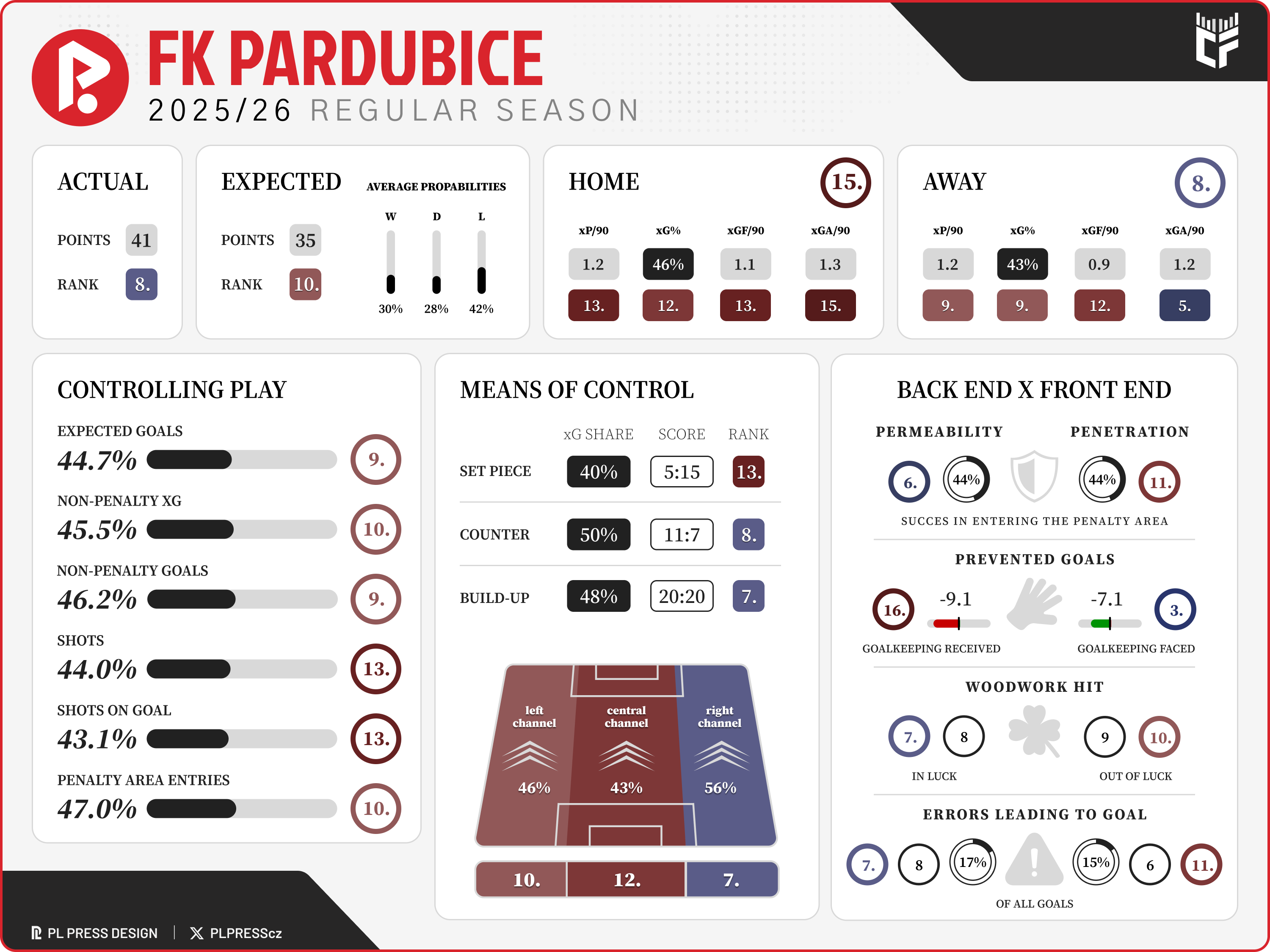
Over the last 25 rounds, Pardubice earned more points than Kováč’s Liberec and were the 3rd strongest side of 2026. Not a single outfit enjoyed the road trips more, with Pardubice taking home an average of 2.1 points, posting an impressive record 5-0-2. Their opponents weren’t the strongest, but facing Plzeň and going all the way to Karviná twice isn’t a ‘selanka’.
Indeed, while their full-season picture doesn’t look awesome, their spring performance is definitely something worth building on. While not having to face Sparta or Hradec certainly helped, Pardubice nevertheless produced the second-best average xGAExpected Goals Against (xGA) estimates how many goals a team should have conceded based on shot quality, location, and context. of all teams in 2026 (0.52), with their right-hand side allowing a grand total of 0.92 xGA from positional attacks. They got lucky on seven occasions, as their offence was nothing special, but the defence was.
What went wrong
You may have forgotten, but Jan Stejskal still opened 25/26 as the designated starter. A current number 4 or whatever then became just the first of three goalkeepers who got their hands on the steering wheel only to land in the red. Stejskal allowed 3.48 goals above expected across two games, Jáchym Šerák chipped in with a further 5.86, and Aleš Mandous delivered two horrendous errors on top of a modest minus-0.71 prevented goals. No wonder the club is reportedly after one more warm body to pair up with Luka Kharatishvili, the only option that didn’t bomb but also didn’t lift the team from the goalkeeping bottom all told.
To balance out the formidable away form to close out the season, Pardubice remained absolutely terrible in their own backyard throughout. Their stadium, still a relatively new sight, was the second-least visited of all (average of 2,575 people in the stands) and certainly the unhappiest place to be at, with Pardubice banking only 40% of all goals scored there. They routinely got outplayed at home, claiming responsibility for just 45% of xG generated.
Most valuable player
Per my MVP model (traditional stats): Vojtěch Patrák (ranked 31st league-wide)
Per my positional models (advanced stats): Vojtěch Patrák (94th overall percentile at CF)
I’ve got to admit, when I saw him named to the preliminary World Cup squad, I thought it was a wild stretch. When Jan Podroužek of Kudy běží zajíc mentioned him among the front-runners for the league MVP honours, I thought he was mad. But that’s the beauty of the data: when you don’t pay attention, it does. Vojtěch Patrák was a legitimate star of the campaign.
This is true through multiple lens. First of all, his 10 IGImportant Goal (IG) was either a go-ahead goal, or an equalizer. The rest is a standard goal. walk him right behind Tomáš Chorý as the league leader with 11 vital strikes. Second of all, there is just one centre forward who ranked inside the Top 8 for all three areas of centre forward’s game (Albion Rrahmani). Thirdly, some of the individual values making up those group rankings are nothing short of amazing. On a mid-table side no less, Patrák was in the top 15% for line-breaking actions, high pressures and quick recoveries, quality added to finish (missing the target with just eight of his 37 shots), foul differential (plus-27, while his teammates were minus-13 and minus-15 respectively) or offensive ground duels around the edges of the penalty box.
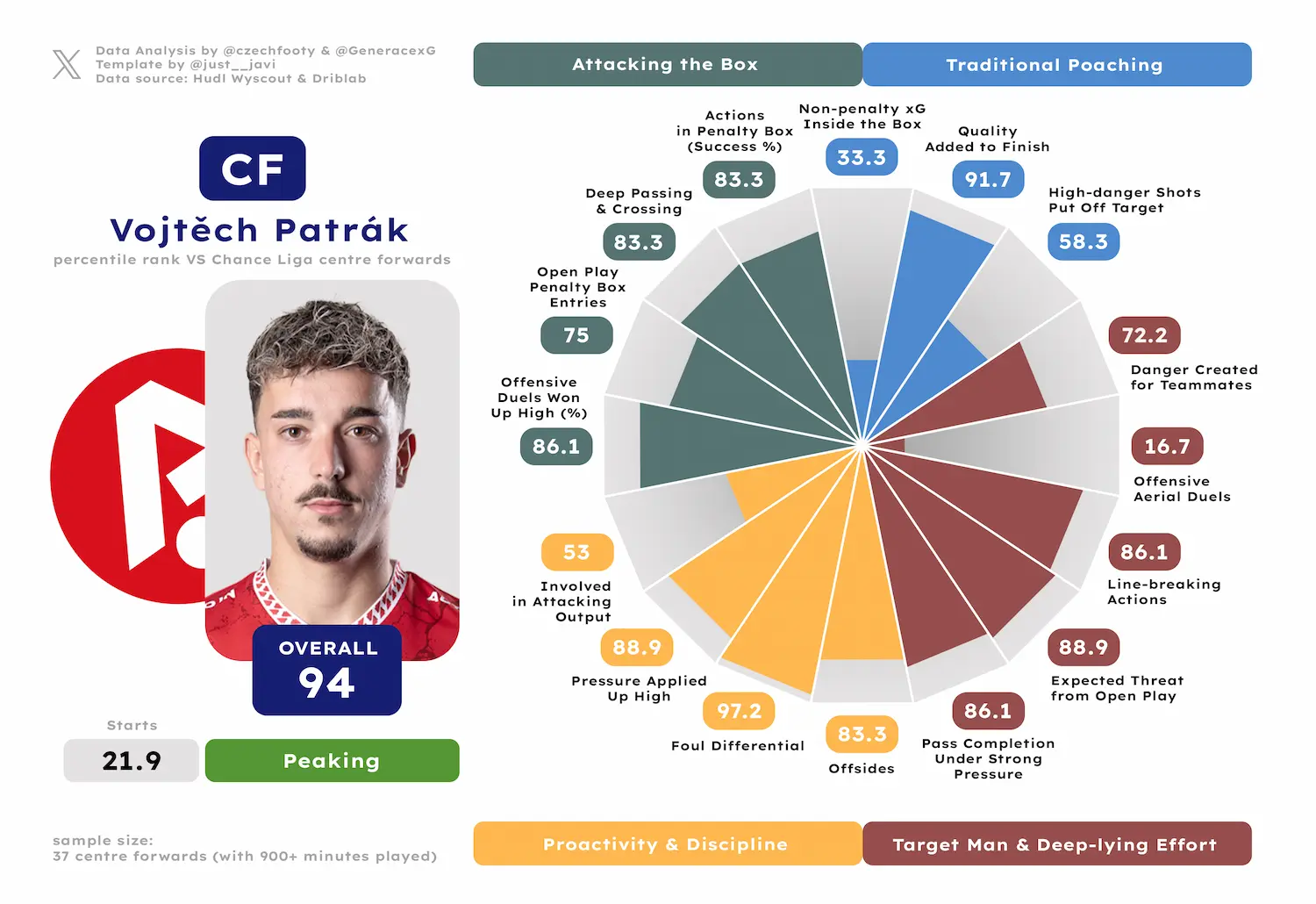
I wasn’t fully on board with Patrák belonging to a wider national team bubble. Now I’m not sure how he could not. You can play him virtually anywhere across the front three without losing any of his efficiency, and he’s ripe at the age of 26, still in his peak for some time.
Chip on the shoulder
It could be Marek Icha returning for his second run with the club, while not many fans see the need, but I simply must highlight Giannis-Fivos Botos in this space. He was the flavour of the week not too long ago at Karviná, and he certainly can’t complain about a lack of opportunities at Pardubice. But what can you do when his first run of four consecutive full starts resulted in an early injury and a mere two created chances, while his second run of five consecutive full starts to open the spring saw him create three. He notched just a single, largely meaningless assist without further contributing to a goal scored (even indirectly).
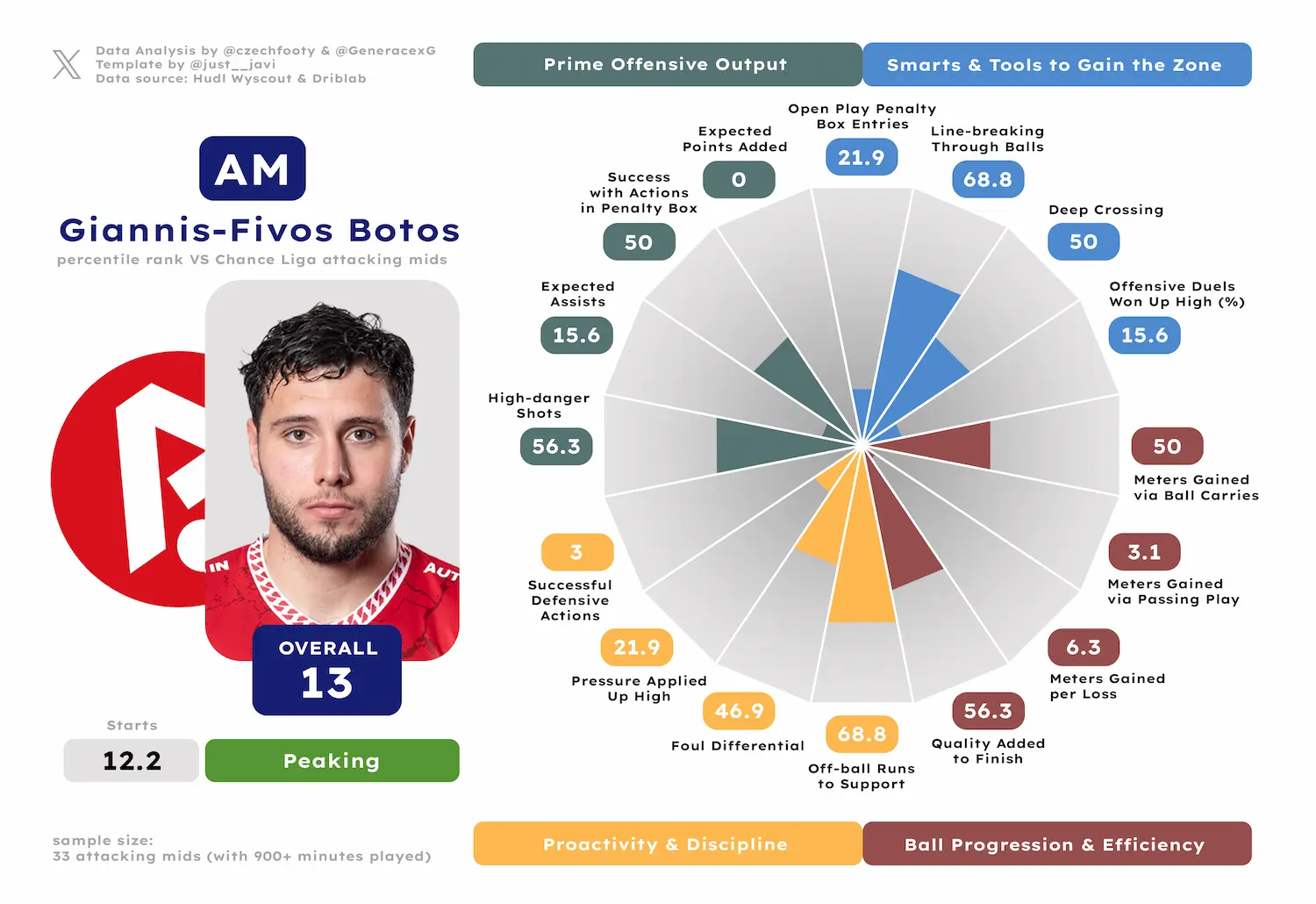
Goal production is often random, but in the case of Botos, there’s nothing to cling to. His play offers so little net substance he’s sitting below the likes of Ulbrich or Ristovski in terms of overall percentile, and his xA rate is sandwiched by that of Cupák and Mikulenka. His success rate in gaining the penalty area languishes in the bottom three as well. Just ineffective.
Inside the off-season
special thanks for guiding me through the motions of FK Pardubice’s off-season go out to @matejsal, Sajfy, Vojtěch L. & @Vocas46
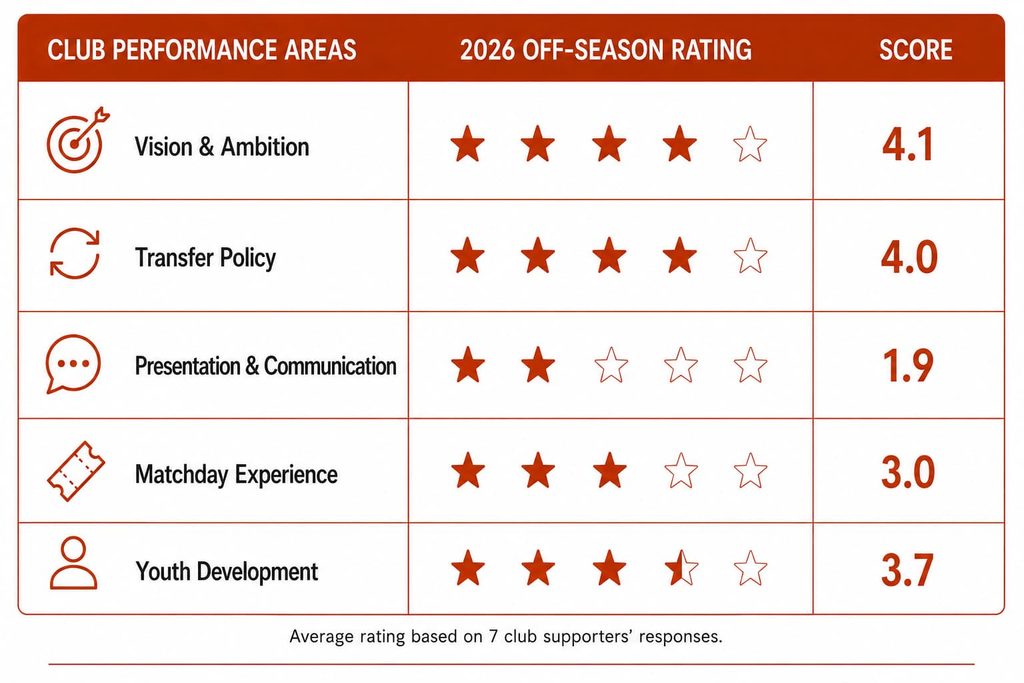
Squad turnover
Pardubice have actually managed to shed some negative contributors in terms of MVP points, like David Šimek, Laurent Kissiedou or Dominik Mašek, and so when it comes to value retained, they are doing extremely well — better than anyone other than Teplice and Zlín. They have only lost two members of their most utilized XI, and one of them was a loanee who might have a non-zero chance of coming back, while the other centre back already departed over the winter. In terms of points, only a dozen of them got wiped out, so little harm there.
One major takeaway from Pardubice’s squad sheet is getting all too familiar: they once again didn’t have a clearly identified core (only five players accumulated 20+ starts), meaning they were the only team in the league not to have a single player among the Top 50 used. Simon Bammens, who we now know is a chemical engineer (cool!), was the closest at 52nd.
Biggest upgrade
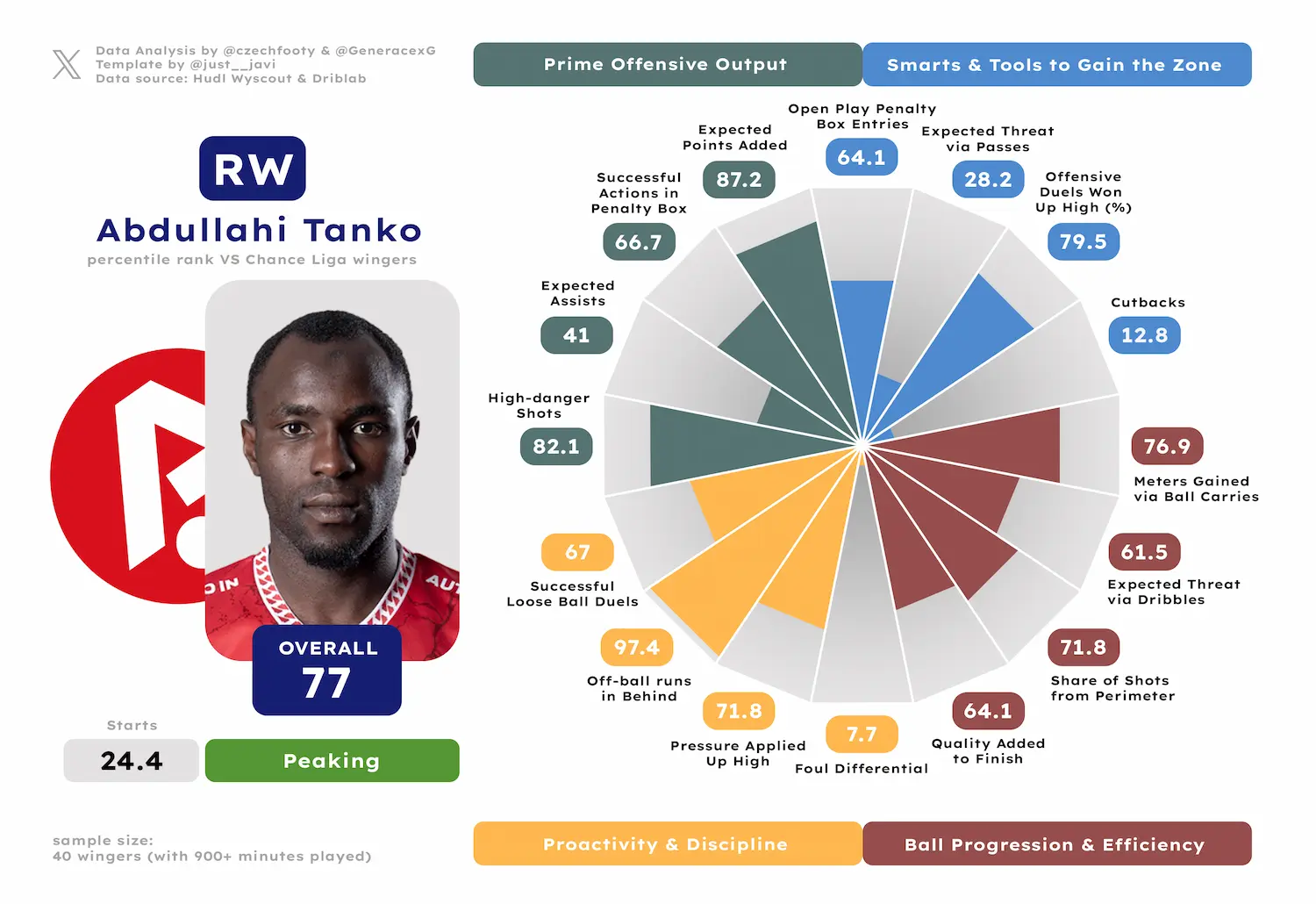
It’s a matter of how you frame it. I’m not sure Václav Drchal is much of an upgrade if he’s here to strictly eat into Daniel Smékal’s playing time, as appears to be the case. But if you choose to primarily view him as someone who effectively doubles up at both right wing and centre forward alongside Abdullahi Tanko, thus serving as kind of a 1-for-2 in replacing both Vojtěch Sychra and Ladislav Krobot simultaneously, I might be ready to come on board.
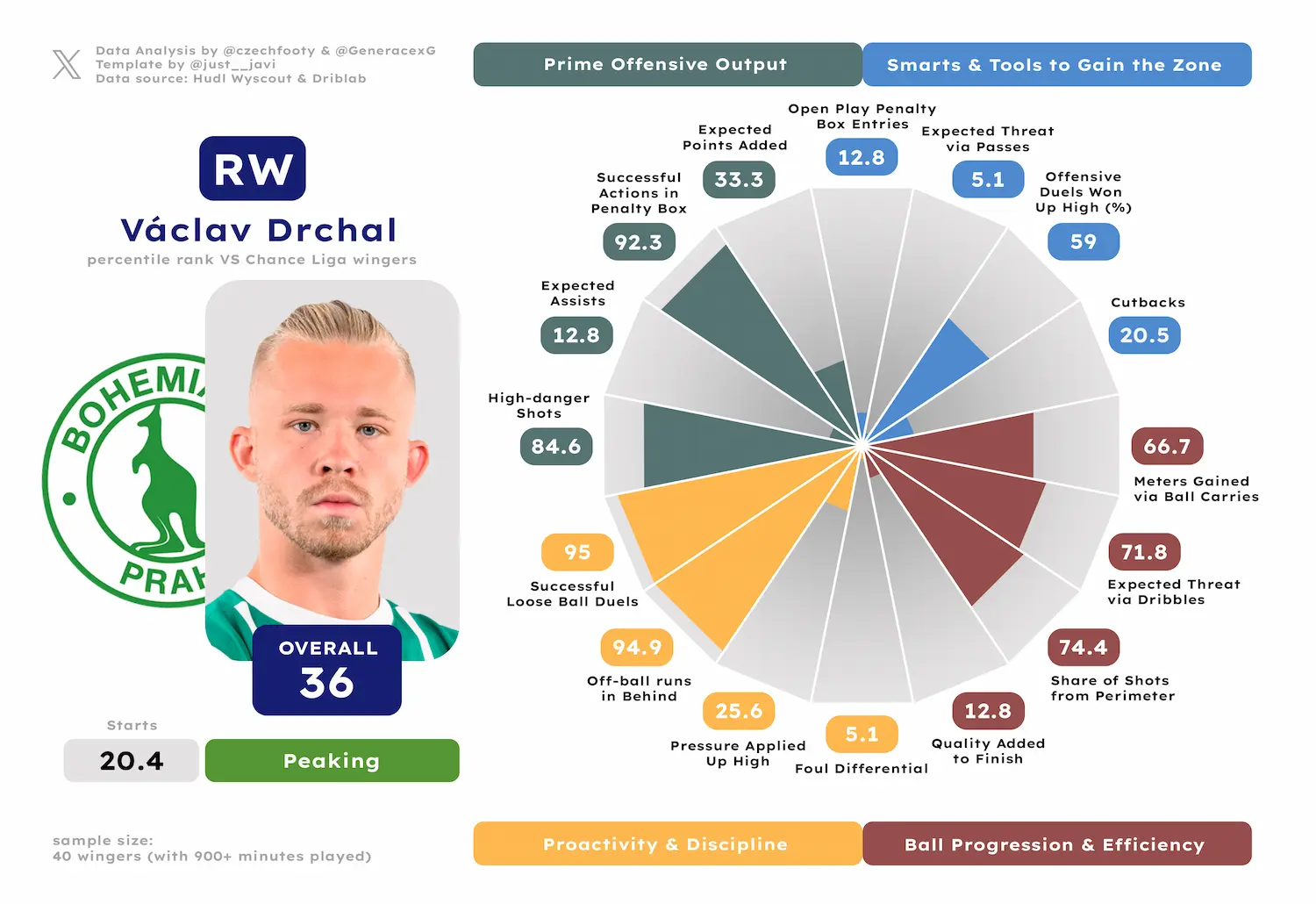
Drchal was part of a straight-up swap with Krobot, and what he definitely brings as opposed to him is frequent runs in behind as well as some above-average ball-carrying ability. Anyone could tell you he didn’t do well with his many high-danger shots (converting on a measly two out of 13), but fair’s fair: he deserved more, almost four extra goals in fact, with his 17 shots on target and two more attempts that landed on the woodwork (including that one, yeah).
If Drchal and Tanko can both receive the support they need in getting fed behind the back line to capitalize on their pace and 1v1 acumen while in the danger zone, Pardubice can have a deadly duo. If they apply pressure on defenders like they did in 25/26, it’s a lovely bonus.
Biggest downgrade
No wonder Pardubice would love to bring Mikuláš Konečný back, and equally no wonder Slavia are so far hesitant to allow that to happen. For a teenage centre back, it’s rare enough to pick up 20+ starts (and it would’ve been more had he not injured himself at two points of the campaign); it’s even rarer to look the part for most of the substantial playing time. In fact, it often seemed as though the bigger the occasion, the better Konečný was. He was the best Pardubice defender in the poor Plzeň opener, he was easily net positive when allowed to face his parent club in R5, and for a period of 537 mins between MDMatchday — different to Round (R) in that matchdays are in order, rounds get postponed, shuffled. 18-25 Konečný literally didn’t put a foot wrong per my notes. He had some blips, but the consistency was mostly there.
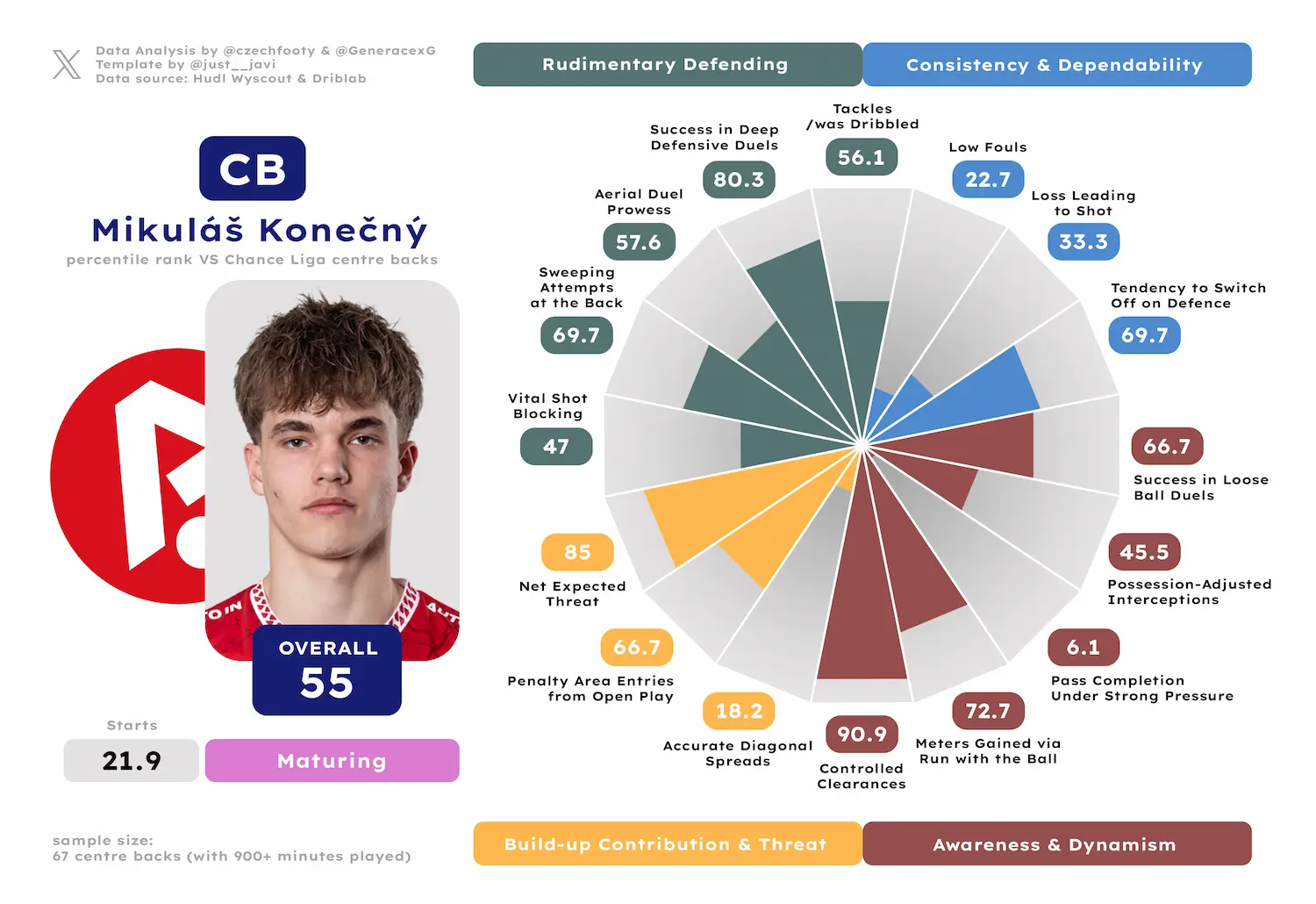
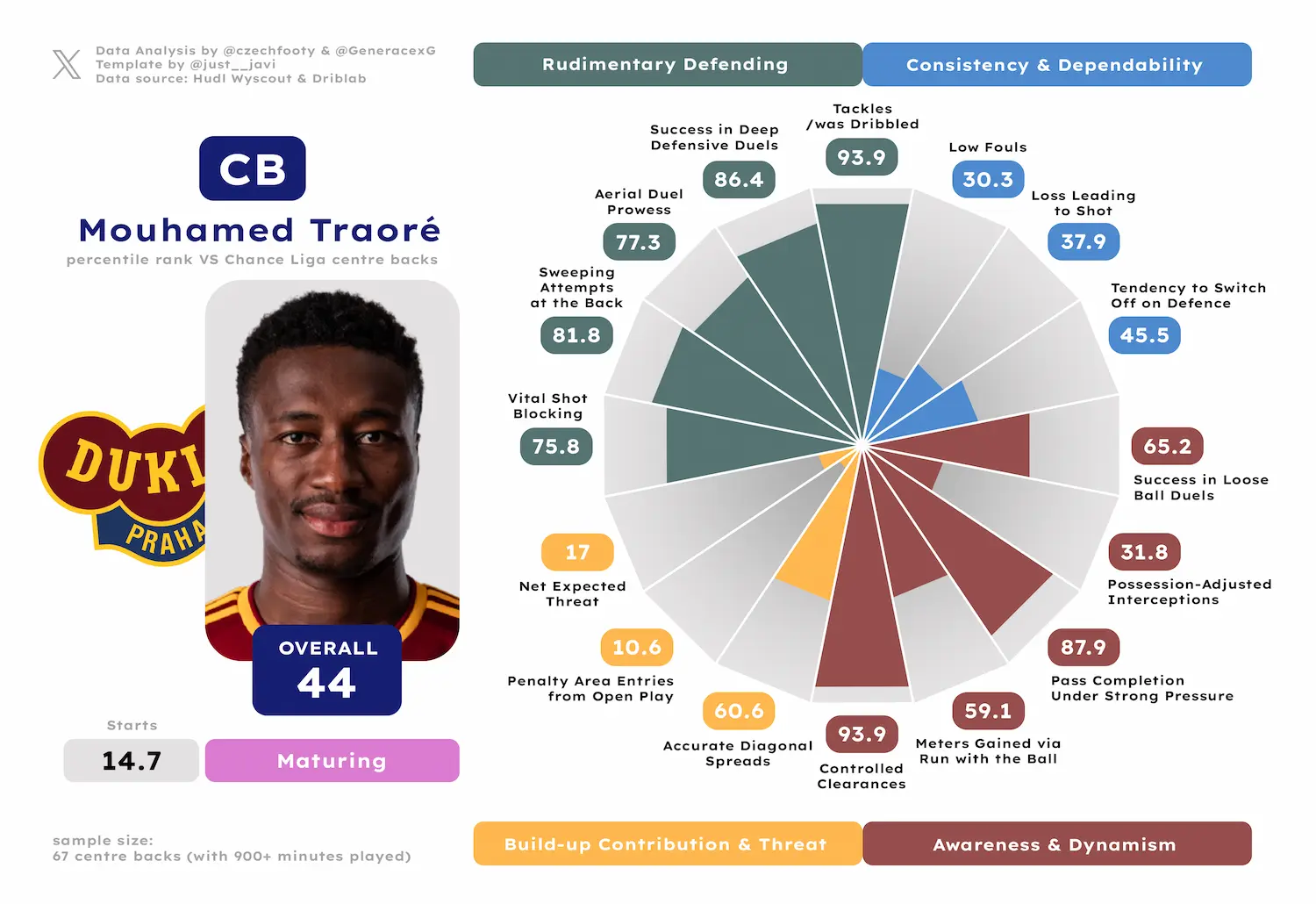
To Pardubice’s credit, they have brought in one of the better replacements on the market. As far as physicality and duel behaviour goes, Mouhamed Traoré is even further up the ladder, with an average percentile value of 81.3 across all the “rudimentary defending” metrics (ranked 2nd). But when it comes to behaviour on the ball, Pardubice are in for a different experience. Konečný often stepped up from the back line, pushing the ball into the danger zones frequently, and sometimes took risks with his passes. Traoré rather plays it safe and is more keen on charting a diagonal, without playing any line-breaking through balls ever.
Need left to be addressed
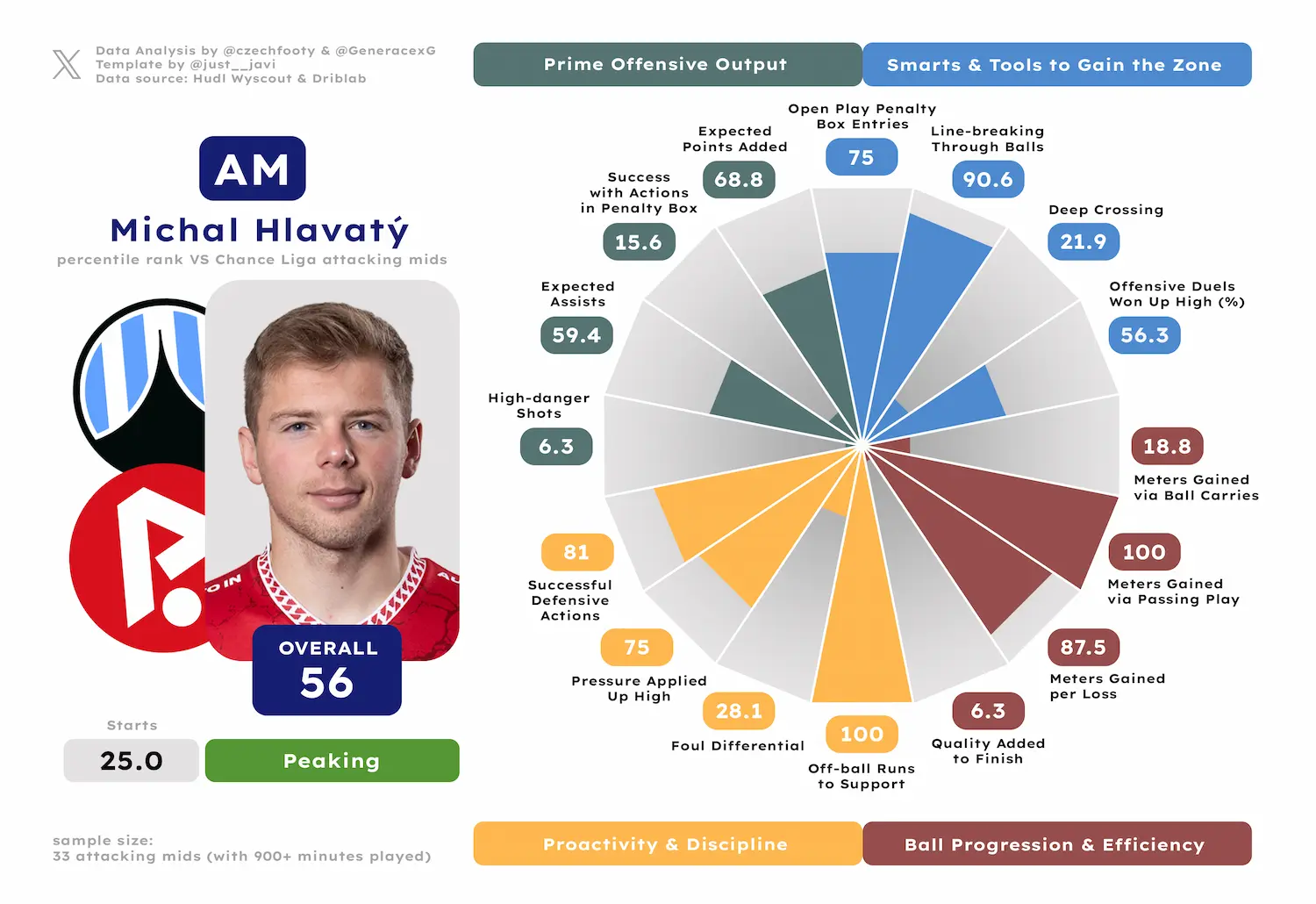
If I was Trousil and Jiří Bílek, I wouldn’t be happy with my central midfield options. That starts with the marquee name, Michal Hlavatý, who was supposed to rediscover the mojo at his old club, but instead offered more of the same uninspiring stuff after taking a step back at Liberec. He’s still an excellent passer, gaining meters without playing it overly safe, but he’s becoming more of a non-factor in the final third with every added year. Across the entire 25-start campaign of his, Hlavatý produced five assists and just six primary chance-creating actions. He’s pulling the strings without being impactful, more prone than ever to getting erased by opponents. He looked overrun and frankly out of his depth on too many occasions.
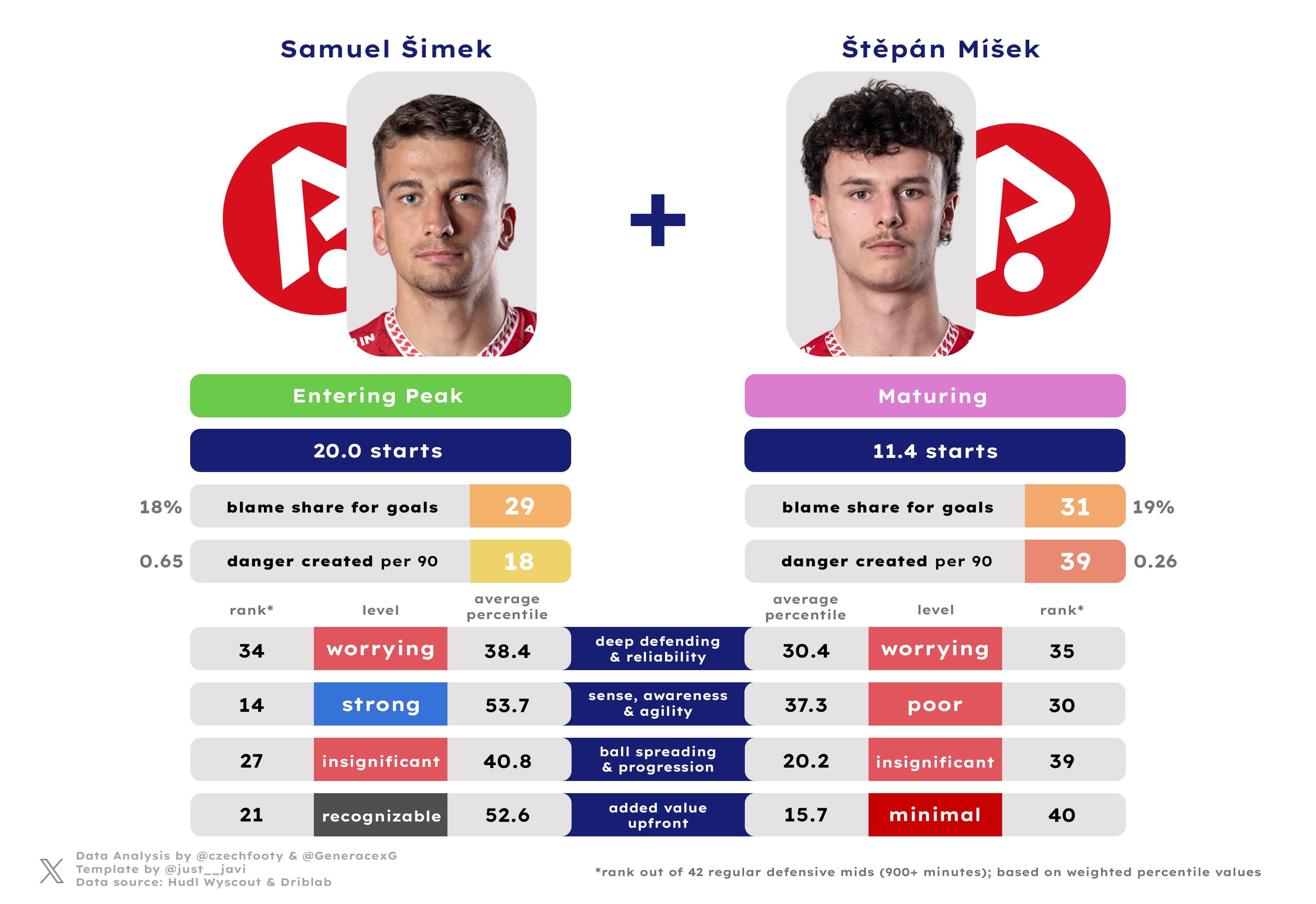
Perhaps even a bigger question mark is the position of his partner in crime. Samuel Šimek is a nice story of a late bloomer, and he was a fantastic find as a set piece taker, but spare for some top-notch fight, you can’t yet rely on him to move the needle for you. Unless Tomáš Jelínek — another dynamic midfielder with questionable passing range — breaks out big time, Pardubice could have trouble controlling games; especially whenever Hlavatý is out.
New kid on the block
The covid era of Pardubice’s U-19s attacking the Top 4 seems to be gone, and it’s interesting to note this is less of a reflection of weaker generations, and more of a result of Luděk Zajíc swapping the chief youth coach role at Pardubice for the one at neighbouring Hradec Králové. He left in 2023 as a very result-oriented youth coach, which is not necessarily a good thing (!), but I hear their arch-rivals are not complaining. Meanwhile, Pardubice’s U-19s were below average for a third straight year, though to be fair, their third-tier reserves shot up to the top half of the table upon receiving a boost from some U19-eligible youngsters. Ondřej Vencl (b. 2007) is now trying to make it at second-tier Česká Lípa after captaining the B-team towards the end of last term, and right back Martin Reil (b. 2006) was also a nailed-on starter. Trying to take the leap to the first team and stick there, unlike his teammates Filip Brdička and Daniel Pandula, is Jiří Zima (b. 2007) — “Panoš from Wish”, per @Vocas46.
Looking ahead to 2026/27
Below is the team’s current depth chart with a maximum of 4 alternatives for one position. The colourful ratings are a static snapshot of the league-wide situation on 21 July, and they are just a playful bit to add flavour to it; the names featured should be relevant to this day. To learn more about my approach to constructing depth charts, with all its limitations, head here.
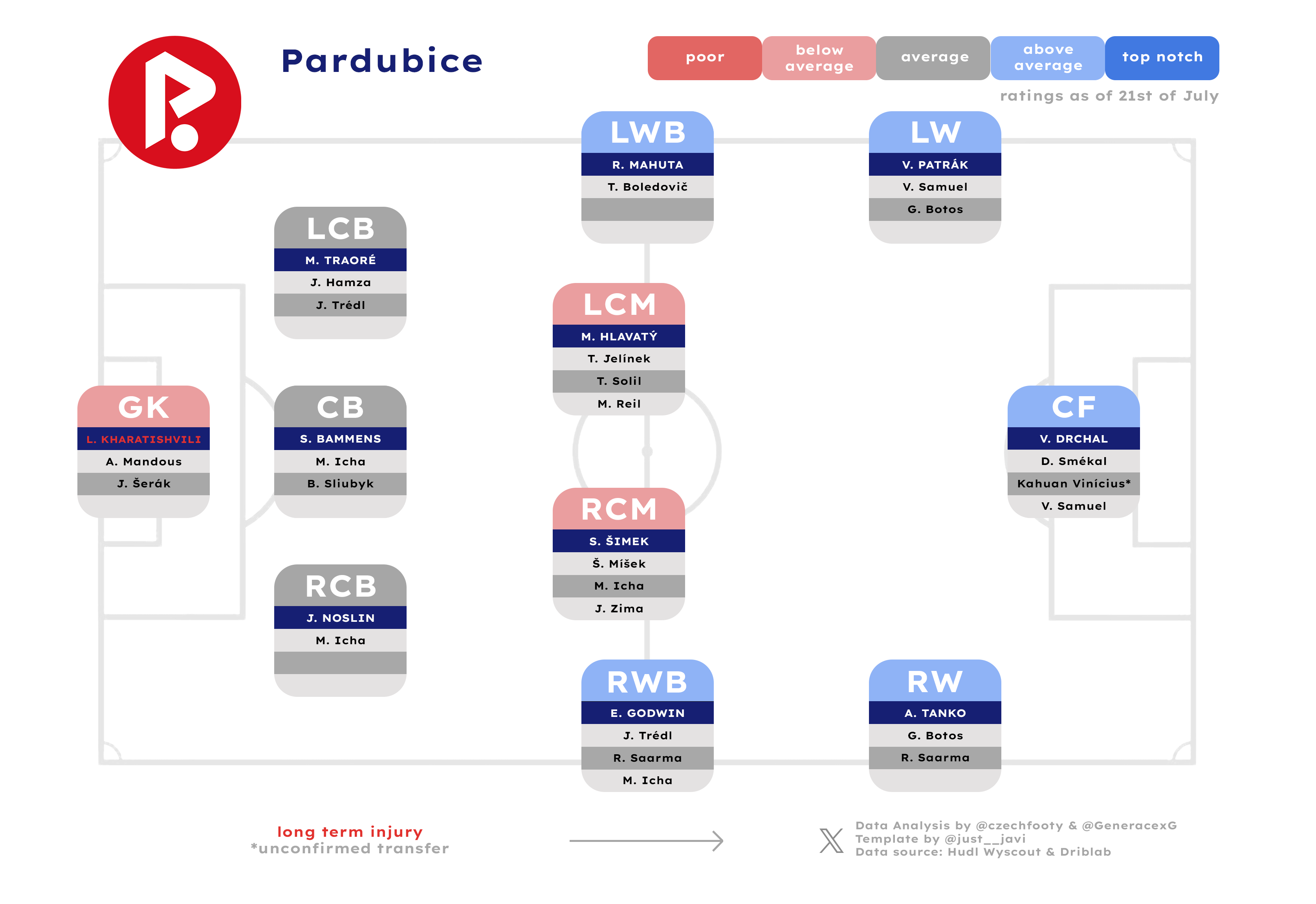
Primary formation
In their opener, Pardubice opted for a more narrow 3-4-2-1, with the two other starters supporting Patrák up high. I would consider those changes cosmetic, as the personnel stays.
Colours I grappled with
Václav Drchal or Daniel Smékal may need to start banging in goals in bunches to fully warrant the “above average” tag, but their no. 3 and especially no. 4 (in reality higher up the pecking order because of his ability to start on the wing, as well) are among, if not the strongest in mid-table waters. The depth is, meanwhile, what’s dragging the GK crop down.
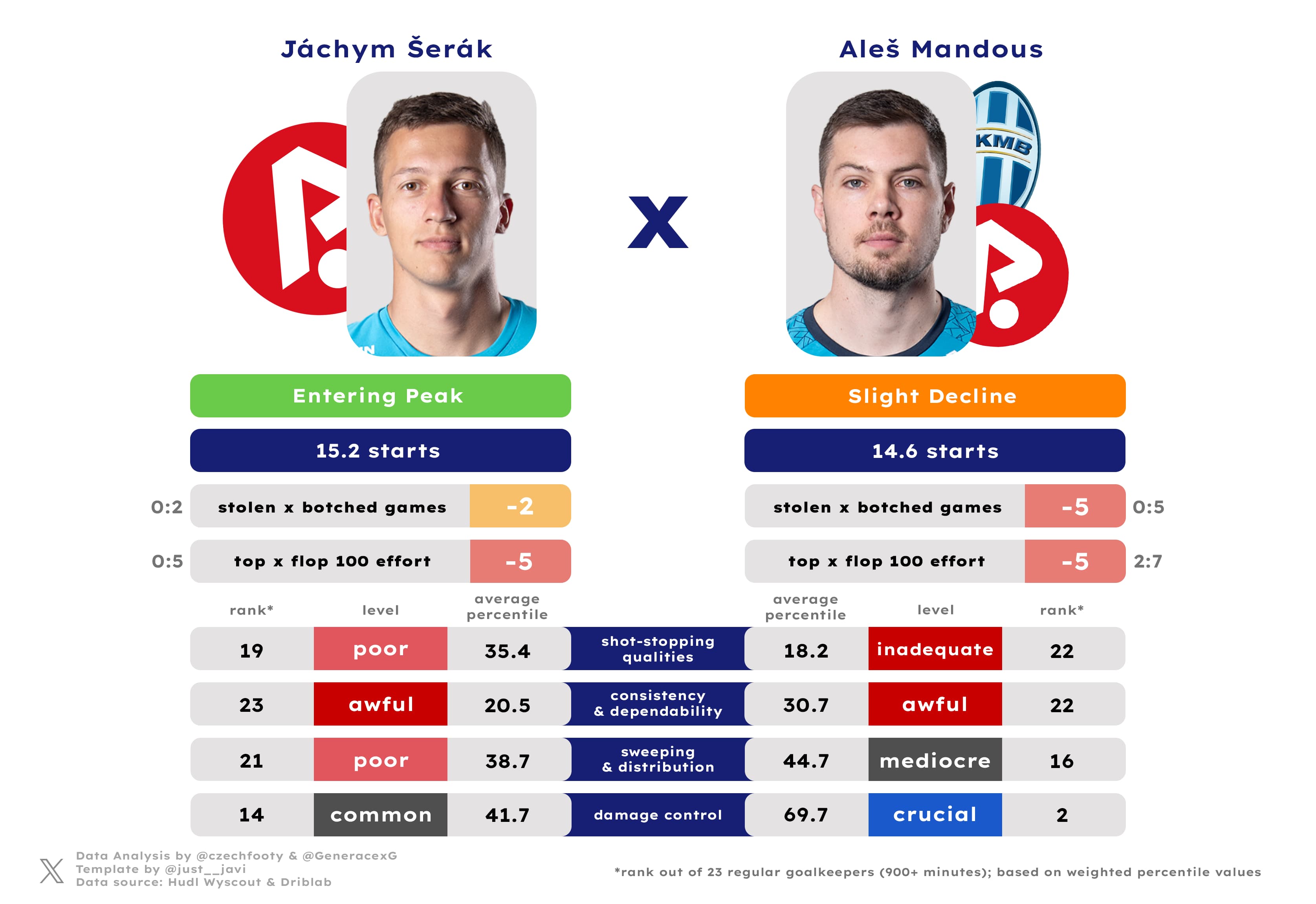
Notes on the depth chart
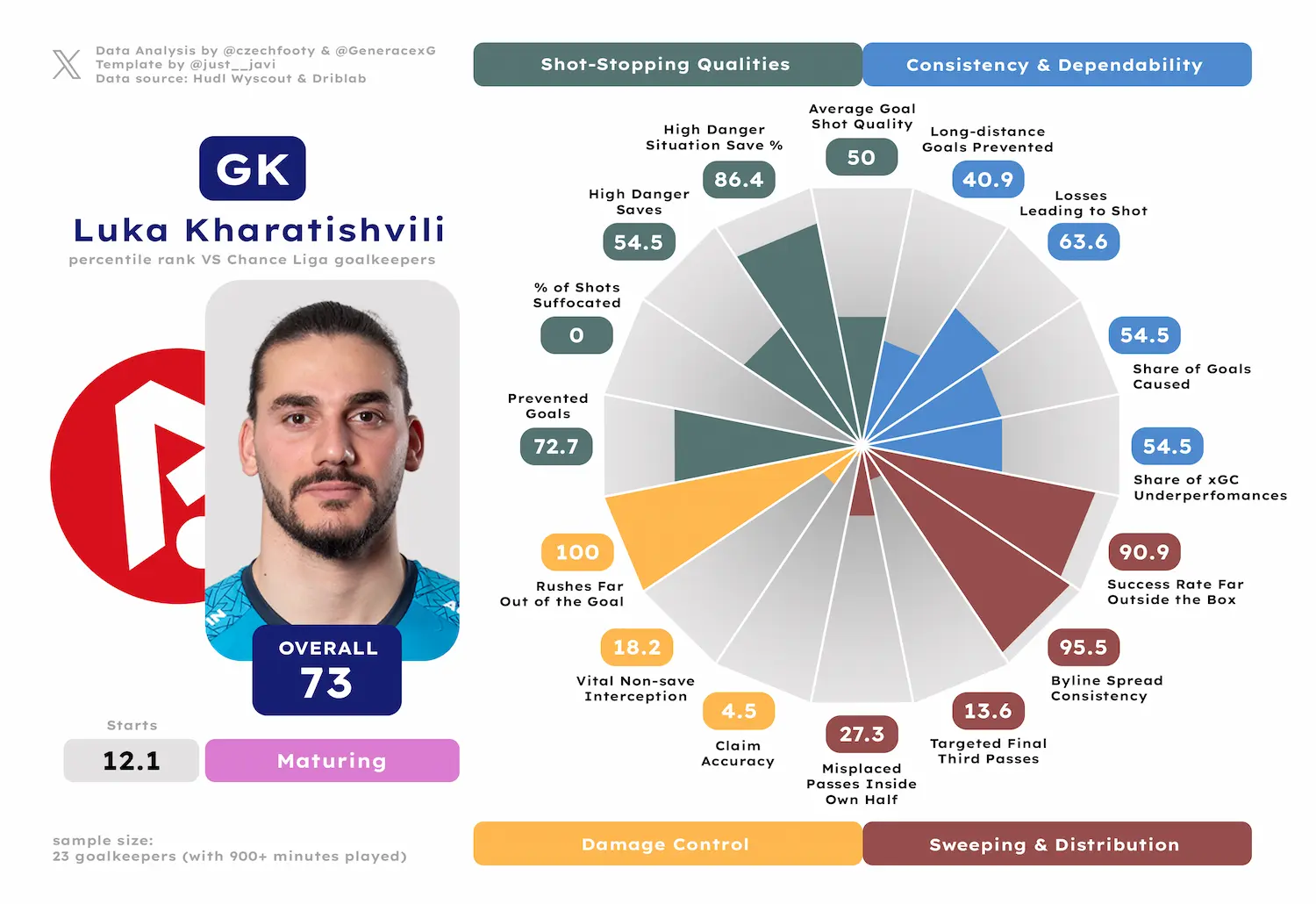
Staying on the subject of goalkeepers, Luka Kharatishvili was a true revelation, and so his ongoing shoulder issues hurt immensely. He was very assured in stepping far out of his goal, succeeding with a high portion of his actions and often preventing outright danger that way. He’s a big fella and only five regular goalkeepers produced more vital punches or claims.
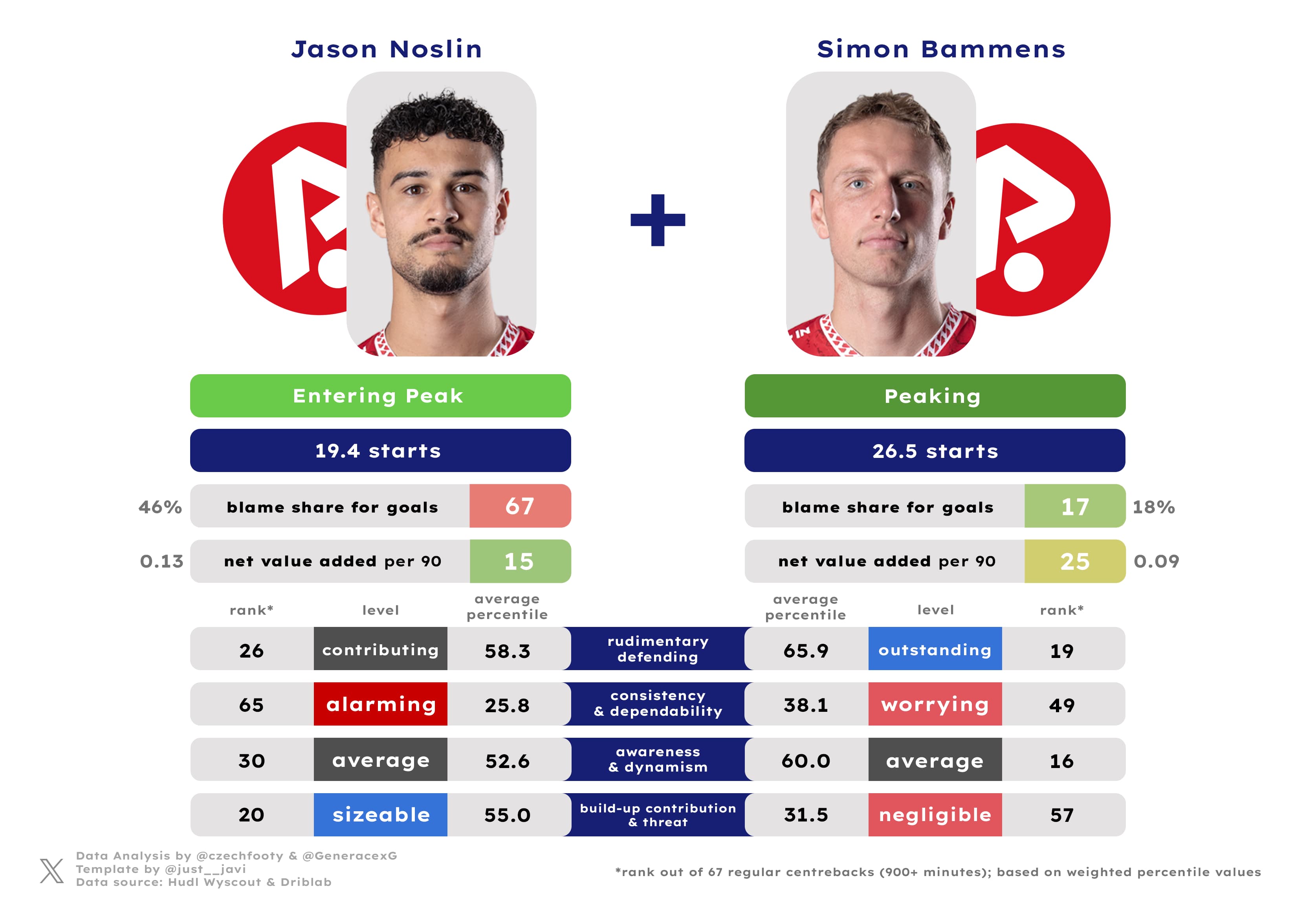
Providing a balanced backbone in front of Kharatishvili are Jason Noslin and Simon Bammens. The former is reasonably solid on the ball (in the top 15% for both diagonal spreads and net xTExpected Threat (xT) measures how the player increases the probability of scoring a goal by carrying or passing the ball.), while getting tagged for an alarming 11 goals conceded out of 24 he oversaw; whereas the latter is more focused on the basics — like producing vital blocks, barely getting outsmarted in a ground duel, and almost never getting outjumped in an aerial.
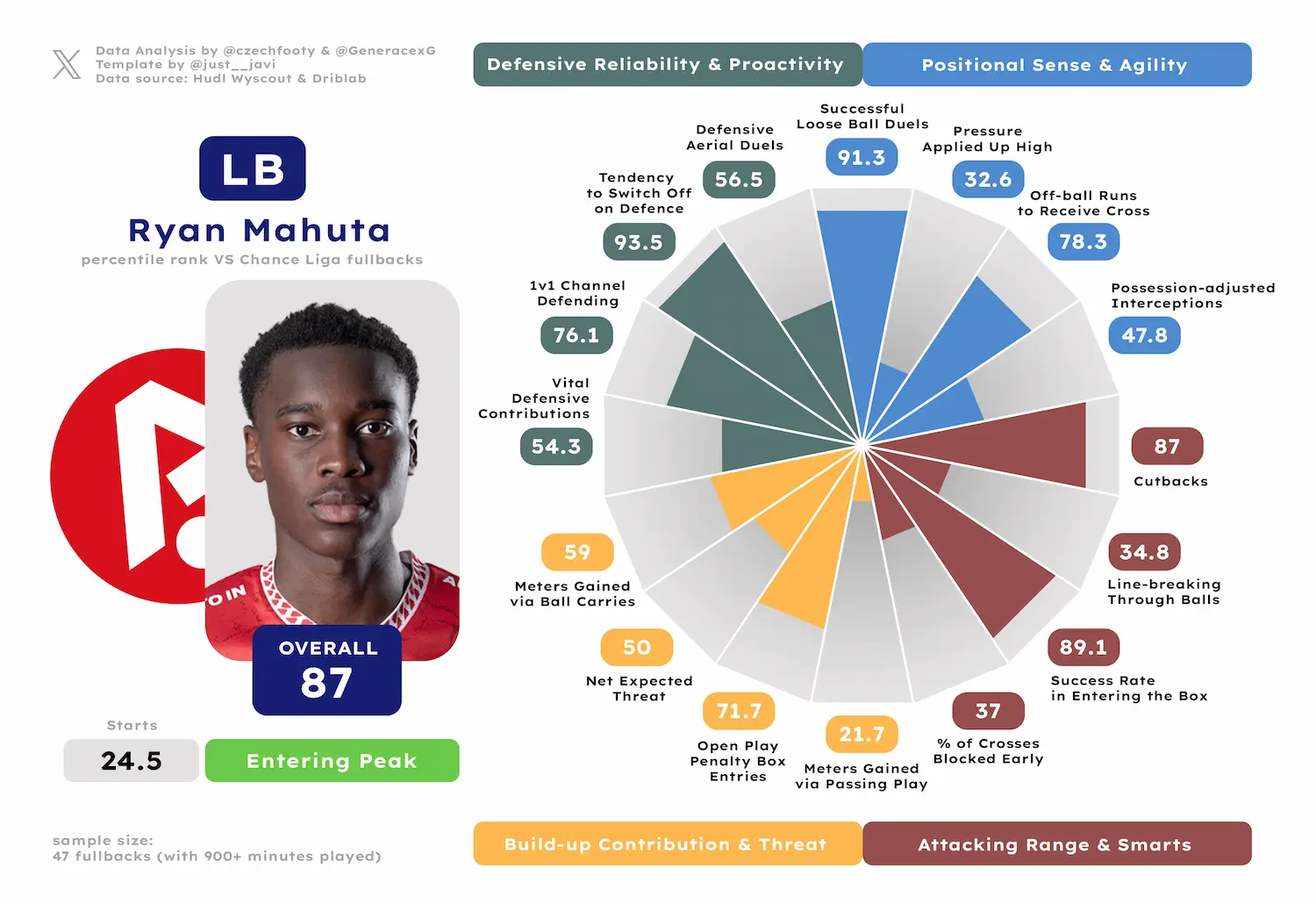
Another player Pardubice are sorely missing to open the campaign: Ryan Mahuta. He’s only just getting started at a fresh 24, but he already looks like a beast in gaining the penalty area (succeeding with 41 of his 72 attempts) and causing damage while there, be it through cutbacks or otherwise. I don’t track this stat for fullbacks, but Mahuta connected with 16 of 32 actions in the box for a better success rate than Tanko or Patrák (both around 43%). Having debuted for Finland national team in November, Mahuta could soon be lured from abroad and so it was refreshing to see Pardubice extending him through 2029 before it’s late.
Roster battle to follow
Starting the first two 26/27 games on the bench, Daniel Smékal is in a peculiar position. He was an underrated force behind Pardubice’s spring run after not finding the target with his first 10 shot attempts, eventually delivering six points and one secondary assist to the tune of some generally sky high involvement in attacking output (he was there as either a finisher or a creator for 40% of goals or chances). He’s also pretty much the reason why Filip Vecheta dashed to Jablonec. Yet now, Smékal finds himself on the outside looking in, with Pardubice clearly looking for more pace, dynamism and greater strength in ground duels.
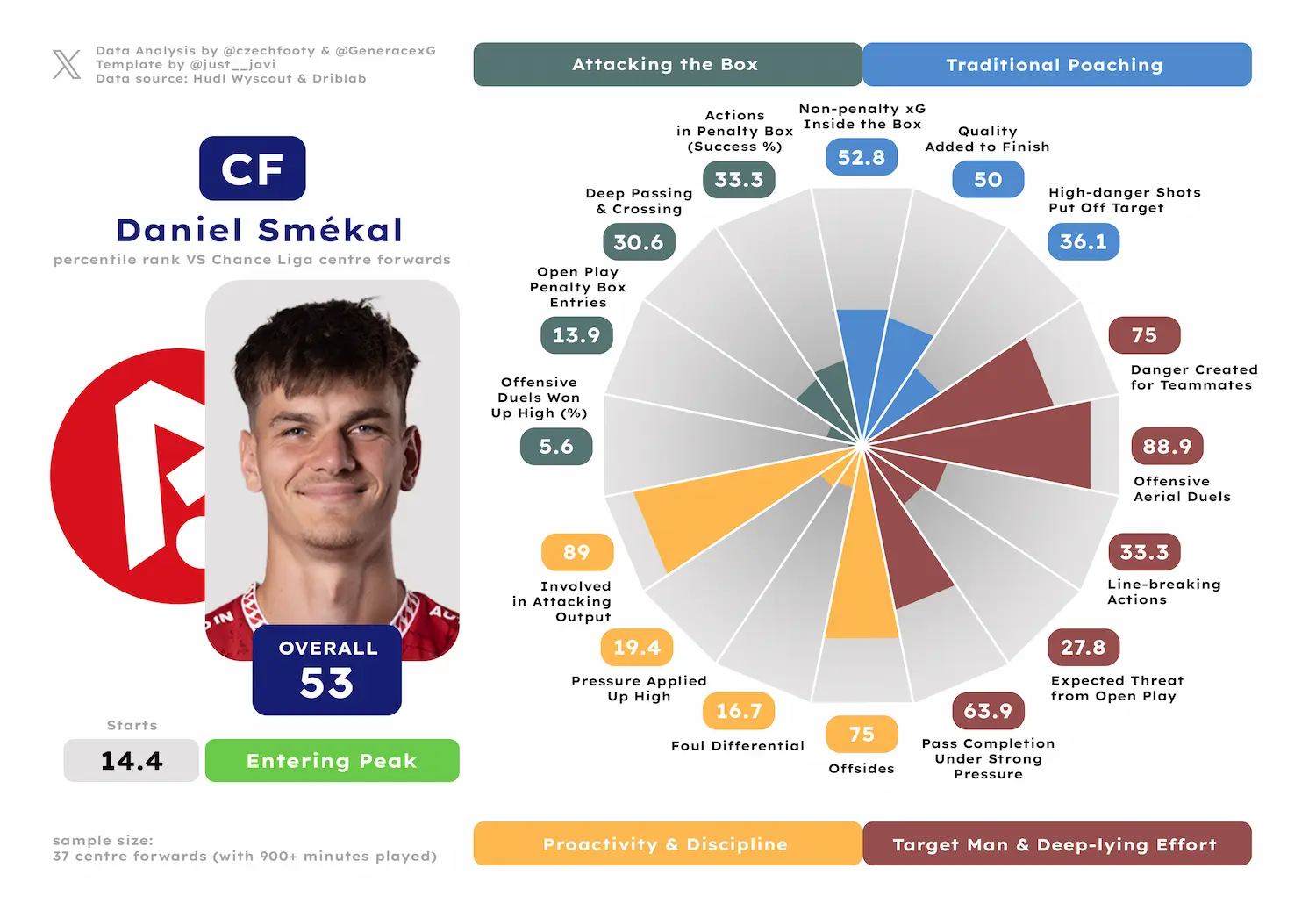
Still, there is likely a big role to play for Smékal off the bench, as he combines one stunning attacking header (44% success rate in that kind of aerial duels) with selfless invention.
Season forecast
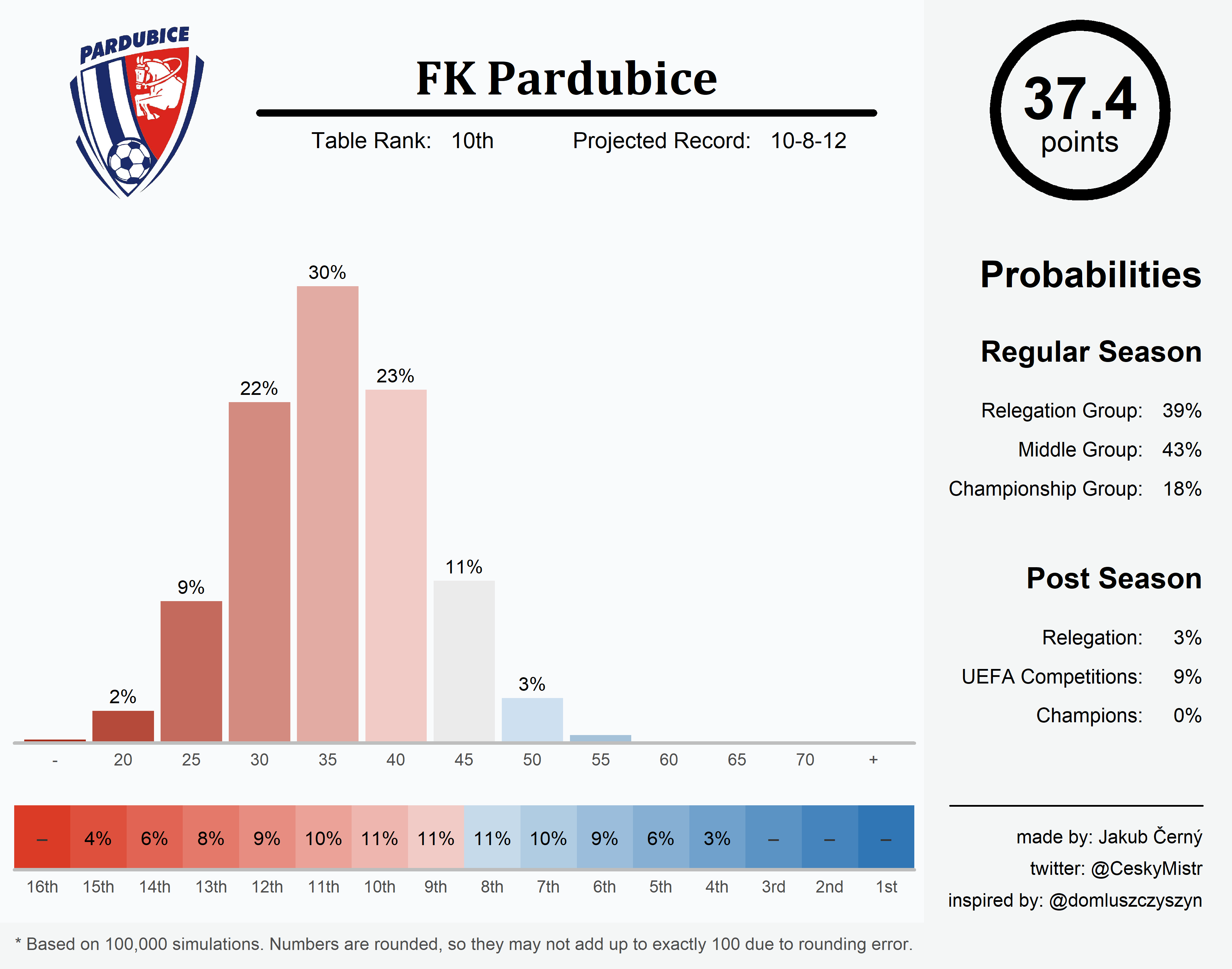
The juxtaposition is damning: despite rising back to the top flight a year after Pardubice, this was Hradec Králové’s second Top 6 finish to go with two near misses. Pardubice have, meanwhile, never formed the Championship Group, only coming close once at the first try. That season is no longer on the model’s radar, as it only works with a 5-year window, which results in another projection the fans would rather unsee. Then again, it’s best to remember they were many people’s (and the model’s) favourites to go down directly in summer 2025.
On the one hand, Pardubice earning 10 extra points on their regular-season projection is a massive vote of confidence. On the other, an 18% chance of making the Top 6 compared to a 39% chance of the relegation group placement doesn’t quite align with the club’s ambitions.
Bold prediction
The track record: 1/5. Their first point came 3 rounds earlier than I predicted
The prediction: Pardubice will pick up the most points after losing at half-time
The rationale: Since the horse, or lack thereof in the logo, was such a hotly-debated topic throughout the summer, it wouldn’t make sense to source inspiration for the bold prediction from anywhere else. At this point, I’d like to say the options are endless, but given the late publication date I had lost access to Pardubice falling at the first fence, which would feel like flogging a dead horse anyway, while branding them 26/27’s dark horses is hardly daring.
I don’t want a pun, I want a number. And sadly, reaching for something like the year there was no winner in Velká Pardubická to set up a punchline with the longest winless streak ever or whatnot doesn’t quite work, because who would even care about the 106th anniversary?
Then I stumbled upon something: in 1927, Lata Brandis controversially became the first woman to compete in the Great Pardubice Steeplechase (seriously, petitions were filed to keep her off the start list), not minding multiple falls from her horse to finish fifth. In 1937, she defied the odds to become the only woman to win the famous steeplechase, symbolically ending a string of German victories in what proved to be the final edition before the WWII.
So here goes the horse-themed bold prediction: a whole century after Lata Brandis’ fall-riddled debut, FK Pardubice will now overcome their own share of adversity. Specifically, no other team in the league will recover more points from losing half-time positions.

Enjoyed it and just want to casually support us with an amount of your choosing? No worries, you can still do that by inviting us for a symbolic pint at the old BuyMeACoffeeBeer page.