Metrics contained in the glossary of terms are based on my manually tracked data, or raw Wyscout data.
Metrics marked by ★ are contained in both individual and comparison visuals, ☆ signals only the latter.
Some metrics, with no symbol, are only referred to as part of the various texts, without appearing on charts.
(I) ATTACKING THE BOX
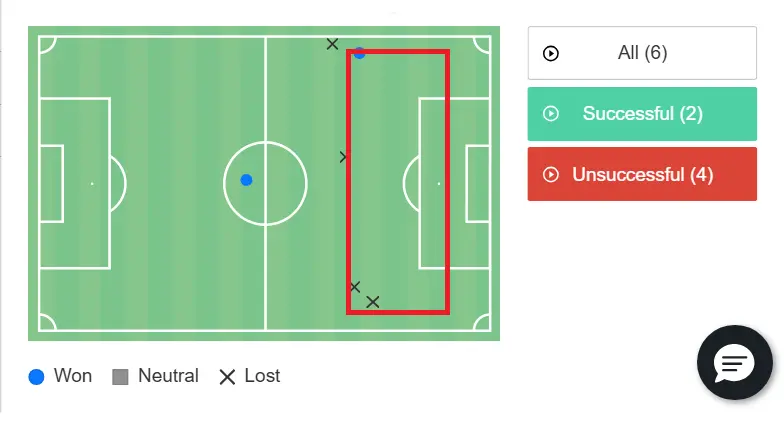
OFFENSIVE DUELS WON UP HIGH (%)
Source: Wyscout.hudl.com / manually tracked (for danger-creating actions via battles and dribbles)
Here, I am severely limiting the space where an offensive duel needs to occur for it to count. It roughly corresponds to this area, and for two main reasons. Firstly, the relevant grouping of metrics is called "attacking the box" and as opposed to others, this stat is supposed to capture the "entering" phase rather than what happens in the box. Secondly, this area is both crowded enough and close enough to goal to allow for meaningful, skill-based impact. In contrast, duels deep inside the box often hinge on split-second reactions or blind adjustments, which I find less indicative of actual quality. That’s a sweeping generalization, of course — so to balance it out, I award bonus points for duels or dribbles that directly lead to a goal or big chance, regardless of where they happen.
OPEN-PLAY PENALTY BOX ENTRIES
Source: Wyscout.hudl.com
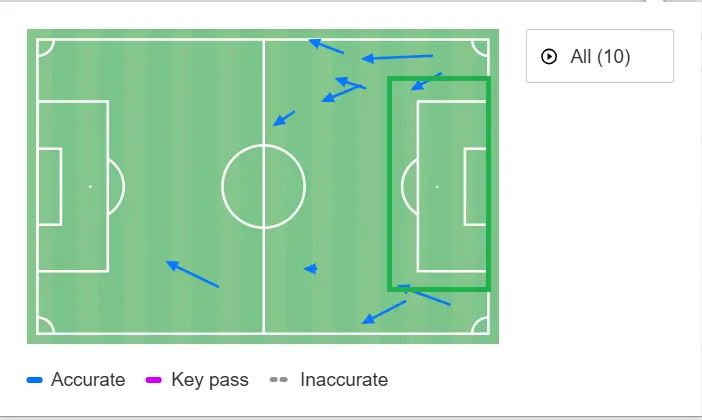
The number of times, normalized per 90 mins, a player enters the opposition’s penalty area during open play — via a carry, a cross, or a pass. It discounts set pieces to allow for fair comparison.
DEEP PASSING AND CROSSING
Source: Wyscout.hudl.com
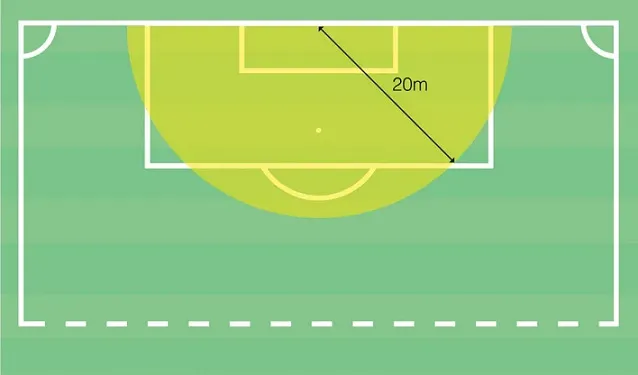
This is actually a combination of three Wyscout metrics, ha! The database tracks passes and crosses separately, whereas for centre forwards specifically, I don't care whether they connect inside this area one way or another; that they do connect at all is most important. It's also notable that a deep pass/cross can be one that enters the area, and one that begins and concludes its journey within it. That's quite neat because the stat doesn't discriminate against either a traditional target man (who mostly knocks balls down for teammates inside the box, Jan Koller style) or a lower-sitting operator who's more helpful in entering the box instead. To add a bit more flavour on top, a co-efficient accounting for accurate smart passes ("a creative and penetrative pass that attempts to break the opposition's defensive lines to gain a significant advantage in attack" per Wyscout) is applied.
SUCCESSFUL ACTIONS IN PENALTY BOX (%)
Source: Wyscout.hudl.com
This is basically any successful execution — be it a pass, a cross or a shot (only those directed on target count as successful); excluding ground duels, aerial duels or fouls. I’ve opted for success rate to not disadvantage those who — not just through their own doing, or lack there of — don’t get to influence the game from inside the box too often. This is my way of utilizing the "touch in the box" stat, btw, often referred to just like that — even if touching the ball in the box alone barely matters.
FEEL FOR THE GAME
Source: Manually tracked
On a rare occasion, I might refer to someone standing out for their rate of danger creation via superior feel for the game. I track this type of danger creation manually, specifically as give-and-gos (where you exchange a pass with a teammate by moving into an advantageous position quickly), dummies (like letting the ball fly past for the benefit of a better positioned teammate), poise shown in rounding an opponent or delaying the finish, and set piece signals. It is a real mixed bag, but all these actions have one thing in common: the player shows a great understanding of the game's flow.
(II) TRADITIONAL POACHING
NON-PENALTY EXPECTED GOALS INSIDE THE BOX
Source: Wyscout.hudl.com (heavily corrected through manual tracking)
Previously, I had a metric specifically tracking "hopeful", long-range shots taken from outside the box. Now I'm just happy with this one accounting for shots taken from inside the box only. It's little else than cosmetics, since most outside-the-box attempts fall within the 0.01-0.05 xG range and also most CFs still source upwards of 90% of their individual xG from inside the box (only two, Kozák and Rrahmani, went below 80% in 24/25), but I find it a key interpretive lens anyway. Whatever your style, the 18-yard box is ultimately where you want your striker to try his luck above all.
QUALITY ADDED TO FINISH
Source: Wyscout.hudl.com (heavily corrected through manual tracking)
Most data analysts would tell you finishing is too random to be worth spending much time — or any time — on dissecting it. It’s tempting to agree, since the very reason why Plzeň won the shocking 2022 title was all the same a big reason why Plzeň bombed the year earlier. Per this metric, Jean-David Beauguel made for the 8th best finisher in the title-winning 2022/23, a wild swing from being the 11th worst the year before when he missed the second most high-danger chances. It’s exactly for this unpredictability and virtual impossibility to detect any longterm trends that most data analysts readily give up on sizing up finishing ability altogether. I refuse. First of all, this particular metric still tells us a valuable thing or two even if we shouldn’t read too much into it. If your individual sum of xGS (expected goals scored; ie. post-shot xG) far exceeds the sum of xG (expected goals; ie. pre-shot xG) it can effectively mean two things: the striker in question A) has a fine shooting technique so his shots tend to have a decent chance of beating the keeper, be it through sheer power applied or fantastic placement B) doesn’t miss the target all too often, because a shot off target doesn’t get assigned any xGS value. There are absolutely trends to be found along this line of thinking in particular, and you'd be surprised how consistently poor/great some appear to be per this metric.
HIGH-DANGER SHOTS PUT OFF TARGET
Source: Wyscout.hudl.com (heavily corrected through manual tracking)
After initially considering any shot worth at least 0.2 xG a "high-danger" one, I lowered the bar to 0.15 in 2024 and I think I am sticking to it. This is based on vast experience of reviewing every shot tag since 2022, and while an arbitrary cut-off will never be perfect (0.14-xG shots are still very dangerous), I'm also confident in calling every 0.15+ xG shot a genuine goalscoring opportunity, and so anytime you don't threaten the goalkeeper from such a position (ie. blocked goalbound shot is fine here), you fail your team. Again, while a small sample can easily trick you (some regulars only get to finish off 5-7 high-danger shots, so even one miss trips them up greatly), eye test mostly concurs.
SHOT STREAK
Source: Wyscout.hudl.com
On a rare occasion, and only in the extreme, I might refer to a player putting together a particularly long/short uninterrupted series of non-penalty shots placed off target. This is really a "just in case" stat, since the 24/25 extreme is 5 in the case of Abdulla Yusuf Helal (while the average is around 3), but it's also worth noting that someone like Vasil Kušej never went back-to-back with his attempts.
(III) TARGET MAN & DEEP-LYING EFFORT
DANGER CREATED PER 90
Source: Manually tracked
My own alternative to Wyscout's flawed xG/A, where I don't care for unfinished business. As long as the player delivers the ball to a dangerous position, onto his teammate's feet, he gets credited regardless of the outcome. Sometimes, if the teammate doesn't time his slide properly or wildly miscontrols the ball, the "on his teammate's feet" caveat doesn't apply, either. You still created a situation which made the opposition sweat. As opposed to xA, I also disregard set piece delivery.
SOFT TOUCH (LAY-OFF EXECUTION)
Source: Wyscout.hudl.com / manually tracked (for goal or chance created via lay-offs, first touch)
The basis of this metric is formed by back pass accuracy, specifically in areas where the centre forward in question is under some sort of a pressure — either directly from an opponent, or indirectly from teammates who expect him to deliver 100% of the time in this space. On top of that, I assign bonus points for danger created via a neat lay-off or a beautifully coralled difficult ball.
AERIAL DUEL PROWESS
Source: Wyscout.hudl.com
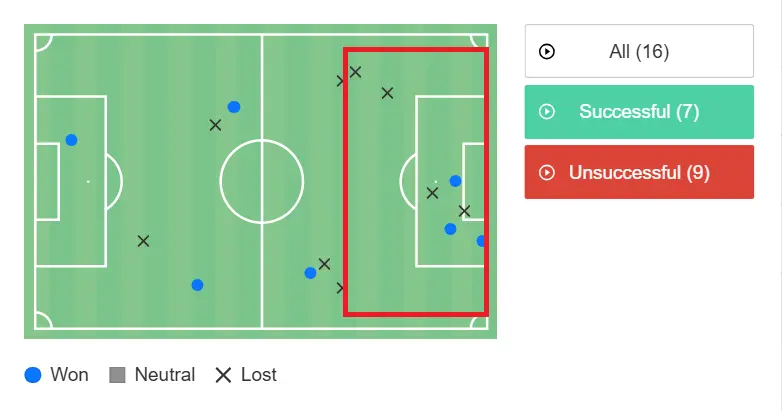
Previously, I was only tracking a player's success rate in aerial duels up top, in roughly this vast an area of influence. Now I'm also concerned about one's success rate inside his own penalty box; something that is a big part of the appeal of, say, Tomáš Chorý (winning 11 of 16 duels at the back).
EXPECTED ASSISTS
Source: Wyscout.hudl.com (heavily corrected through manual tracking)
Wyscout's measure of threat generated, inclusive of set pieces. Mind that xA value is only assigned to a pass/cross that directly precedes a shot; any sort of a partial touch from the opponent along the way, or even a longer dribble/run with the ball from the finisher, normally leads to no xA.
(V) CLUTCH PERFORMANCE
TEAM GOAL INVOLVEMENT
Source: Manually tracked
As previously noted, I assign up to 5 goal-creating slots to any goal scored across the season; the scorer takes one, the helper takes another, and I can credit as many as three more people for delivering valuable contributions. But these really need to matter; it can be a penalty foul, a set piece delivery causing chaos, a pass splitting the defence followed by an exchange of the official goal contributors, anything. But it must be the kind of an action where if you take it away, everything falls apart. (Disclaimer: the % only ties to goals scored with the player on the pitch, but if there is a huge drop/increase in danger generated with or without him around, I will make sure to note it down.)
EXPECTED POINTS ADDED PER GAME
Source: Manually tracked
Via all goals and only meaningful assists (ie. not just balls handed over to the lucky/sharp shooter at the edge of the box). Here's full explanation of the innovative model, initially introduced by CSfotbal.
LUCK INDEX
Source: Own construct, riding on data from Wyscout.hudl.com
Instead of looking at actual goals and expected goals discrepancy to find "(un)lucky" finishers, as many fans or journalists do, I have designed a simple concept doing — in my humble opinion — a far better job in capturing the actual luck factor. Instead of (pre-shot) expected goals, I am taking (post-shot) expected goals scored into account, deducting non-penalty goals scored, while any woodwork hit counts as a minus-0.7 goal against expectations. Previously I considered a bar/post to be worth one full goal, which wasn't quite right, but it's obvious that the finisher comes pretty close to actually scoring by hitting it, so I still go rather high with my valuation — in the vicinity of a penalty shot.