Metrics contained in the glossary of terms are based on my manually tracked data, or raw Wyscout data.
Metrics marked by ★ are contained in both individual and comparison visuals, ☆ signals only the latter.
Some metrics, with no symbol, are only referred to as part of the various texts, without appearing on charts.
(I) DEEP DEFENDING & RELIABILITY
SWEEPING ATTEMPTS AT THE BACK
Source: Manually tracked
Instead of relying on Wyscout's clearances (sometimes bizarrely tagged deep into the attacking half) or vague "successful defensive actions", I rely on my own set of eyes and track truly vital defensive actions by myself. For this metric, I combine one's balance in damage control (vital clearances or cases of backtracking versus those missed ones) with the number of vital blocks produced.
TENDENCY TO SWITCH OFF ON DEFENCE
Source: Manually tracked
This is where I bash the player for any time he was caught sleeping; specifically whenever he caused a goal or a major chance via poor positioning, loose marking or lacking gap control (not applying pressure on a shooter/passer soon or urgently enough); a special co-efficient is applied on top of this to account for goal-causing errors. To be clear, I am no seasoned coach or even a tactics experts, so I might be off on a lot of these situation, but across the full season, I'd argue it evens out.
POSSESSION/DUEL LOSS LEADING TO SHOT
Source: Wyscout.hudl.com / manually tracked (for broken build-up leading to danger)
This is an interesting metric in that it accounts for both misplaced passes and lost aerial or ground duels. The follow-up shot needs to occur inside the next 20 seconds per Wyscout rules, otherwise it’s rendered a “harmless” loss. To extra punish those who lose possession more often (when the ball is under their actual control), I apply an additional co-efficient accounting for any major chance/goal caused via a squandered pass or getting dispossessed while building from the back.
FOULS CONCEDED IN DEFENSIVE THIRD
Source: Wyscout.hudl.com
Pretty straightforward; with an added co-efficient applied to bring out penalty fouls.
SUCCESS IN DEEP DEFENSIVE DUELS
Source: Wyscout.hudl.com
To filter out noise that doesn't matter, I'm concerned purely with ground duel success rate in here.
BLAME SHARE FOR GOALS CONCEDED
Source: Manually tracked
As noted, I assign up to 4 goal-allowing slots to any goal conceded across the season. There is one slot reserved for a grave fuck-up and three extra ones for more run-of-the-mill mistakes like losing a key aerial/ground duel, getting peeled off by a ball carrier, etc. This metric, contained in the comparison tables only, then speaks to how big a percentage of goals the defensive midfielder "caused" — only accounting for goals against he is, in fact, on the pitch for to be entirely fair.
IMPLICATED IN DANGER ALLOWED
Source: Manually tracked
See "Blame share for goals conceded" and extend it to missed opportunities, too. I may refer to it only at one of the extremes, which were not too far off each other in 24/25, btw (6.4% vs 17.2%).
NET PERFORMANCE (+/-)
Source: Manually tracked
I have notes on all tangible danger occurring in each game, detailing culprits of all goals and chances allowed. For goals, these can be up to 4; for chances a maximum of 2. Similarly, any prevented threat gets assigned the "saviour". Once you put all starts together, how often does a defensive midfielder appear on the right side of the history? Given that there are more slots to go around for culprits rather than saviours, while a defensive midfielder also sees less opportunity to act as a saviour than a centre back, there wasn't any net-positive DM in 24/25, but there is — of course — a garden variety of net-negative and I could refer to it at the extreme without including it in percentile calculation.
(II) POSITIONAL SENSE & AGILITY
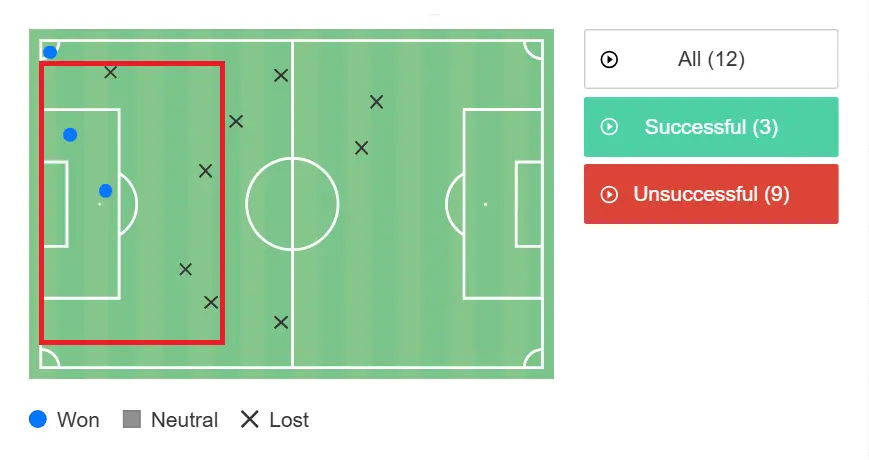
AERIAL DUELS WON INSIDE OWN HALF
Source: Wyscout.hudl.com
For centre backs and centre forwards, I look at how they fare in both penalty boxes to some degree. For defensive midfielders, my focus is squarely on the entire defensive half, and success rate there.
SUCCESSFUL LOOSE BALL DUELS
Source: Wyscout.hudl.com
As opposed to elsewhere, I am not too concerned with the success rate here; I simply want to see how many races — shoves and pulls — for a free ball in no one's possession the player in question successfully navigates per game. That, and only that, tells us something about his proactivity.
POSSESSION-ADJUSTED INTERCEPTIONS
Source: Wyscout.hudl.com
Interceptions alone don’t tell the full story — if your team dominates possession, you barely get the chance to make any. Wyscout fixes that by normalizing for context: they assume every team spends an equal 30 minutes per game out of possession (based on a 60-minute average of actual ball-in-play time). That way, players from possession-heavy teams aren’t punished for simply doing their job — which is how guys like Zelený or Diouf still manage to land in the 80th–100th percentile.
PRESSURE APPLIED UP HIGH
Source: Wyscout.hudl.com / manually tracked (forced high turnovers leading to tangible danger)
A standard feature: I take balls recovered in the final third (Wyscout) and add a weighted cherry on top in the form of forced turnovers leading to goals/chances. This add a bit of a purposeful touch.
GAME-READING ABILITY
Source: Manually tracked
While for the deep defending section, I pull out "damage control" related back-stopping actions from my notes, here I focus on one's balance in reading and anticipating dangerous plays. That means any crucial interception counts as a plus, while any botched interception attempt along with a mistimed jump or a case of wild miscommunication counts as a minus. The result is, again, normalized per 90 mins, because being a minus-3 obviously doesn't mean the same across 10 and 30 starts.
PROGRESSIVE PASSES ALLOWED TO GO PAST
Source: Wyscout.hudl.com
This one is a bit vague because it simply tells you how many progressive passes were completed in the said player’s zone (ie. central areas here). Thus, it’s always a collective effort, but you’d expect your holding midfielder to be responsible for cohesion and organization of your team down the middle, which is why this metric shows up on this board in particular (and doesn't re-appear).
(III) BALL SPREADING & PROGRESSION
METERS GAINED VIA BALL CARRIES
Source: Wyscout.hudl.com
This metric, normalized per 90 mins, measures how many meters a player advances the ball through successful carries, excluding passes. It calculates the difference in distance to the opponent's goal between the start and end point of a run or dribble, counting only forward movements.
METERS GAINED VIA PASSING PLAY
Source: Wyscout.hudl.com
This metric quantifies how much ground a player advances the ball through their passing, measuring the forward distance (toward the opponent’s goal) between the start and end points of each completed pass. It doesn't account for any lateral/backward movement, as per common sense.
METERS GAINED PER LOSS
Source: Wyscout.hudl.com
This metric, normalized per 90 mins, measures how many meters a player advances the ball through both carries and passes, divided by the number of times he registers a duel or possession loss.
ACCURATE DIAGONAL SPREADS
Source: Wyscout.hudl.com
Sorting through tags, I filter out accurate long passes that stretch play more or less diagonally, hitting the channels, and take away any out-of-the-bounds stretch passes from the total. This metric is also normalized per 90 mins since being plus-4 means something else across 10 and 30 starts.
(IV) ADDED VALUE UPFRONT
NON-PENALTY EXPECTED G+A
Source: Wyscout.hudl.com (heavily corrected via manual tracking)
Wyscout's approach to measuring threat generated. Mind that xA value is only assigned to a pass/cross that directly precedes a shot; any sort of a partial touch from the opponent along the way, or even a longer dribble/run with the ball from the finisher, normally leads to no xA. (Disclaimer: For the sake of pizza chart's compactness, xG+A are bulked together; for the sake of comparison tables and calculating the respective average percentiles, they are separate.)
PENALTY AREA ENTRIES FROM OPEN PLAY
Source: Wyscout.hudl.com / manually tracked (for danger created via touch/feel for the game)
The number of times, normalized per 90 mins, a player enters the opposition’s penalty area in open play — via a carry, a cross, or a pass. It discounts set pieces for fair comparison. In addition, a co-efficient benefitting prolific chance/goal creators via superior touch and feel for the game is applied.
BREAKING THE DEFENSIVE LINE
Source: Wyscout.hudl.com / Manually tracked (for danger-creating actions via a creative pass)
As I dish out chance/goal-creating actions, I always assign tags to it — with "pass" standing tall, quite understandably, as the most frequent means of generating threat. This is naturally not just any pass, but a creative pass that showcases at least some vision; be it peripheral or finding a hole in defence vertically. The number of these danger-creating actions, normalized per 90 mins, is then enhanced by the number of accurate smart passes ("a creative and penetrative pass that attempts to break the opposition's defensive lines to gain a significant advantage in attack" per Wyscout definition).
CHANCES/GOALS CREATED PER 90
Source: Manually tracked
My own alternative to Wyscout's flawed xG/A, where I don't care for unfinished business. As long as the player delivers the ball to a dangerous position, onto his teammate's feet, he gets credited regardless of the outcome. Sometimes, if the teammate doesn't time his slide properly or wildly miscontrols the ball, the "on his teammate's feet" caveat doesn't apply, either. And with the exception of goals, the player can also be credited for creating danger for himself. As opposed to xA, I also disregard set piece delivery to make sure the comparison is fair and indeed feasible.
ADDED VALUE PER 90
Source: Manually tracked
Via all goals and only meaningful assists (ie. not just balls handed over to the lucky/sharp shooter at the edge of the box). Here's full explanation of the innovative model, initially introduced by CSfotbal.