Also available in
 Čeština (Czech)
There’s symmetry in how both Northern Bohemian clubs have handled their respective ownership takeovers — they both (more or less) started in 2024 following a period of vanishing success. But there’s a far greater asymmetry to it all. Where Slovan Liberec were getting a clean break from their late 1990s saviour, including full-blown re-brand, FK Jablonec are likely headed for yet another period of remote club control by Miroslav Pelta, who’s had some sort of a say at the club since 1991 — practically uninterrupted.
In theory, of course, the situation wasn’t always straightforward. Between 1999 and 2005, Pelta held the title of Sparta’s CEO. Then he briefly headed the marketing section of the Czech Football Association (STES), most likely laying down the building blocks for an upcoming Czech FA boss election race he first won in 2011 and then again in 2013 (though the latter was hardly a race; more a walk in the park). This career phase ended in 2017 upon the initial investigation into a grant fraud, which ultimately resulted in the (hopeful) events of last summer, celebrated by a rapid firing of coach Látal, and the (damning) verdict this summer.
Through much of this (1994-2018), Pelta was also a regional politician under the umbrella of the centre-right Civic Democratic Party. Through it all, football in Jablonec nad Nisou has stayed unapologetically intertwined with Miroslav Pelta. And despite remaining convinced of his eventual acquittal till the very end, there’s no way Pelta wasn’t busy making sure he wouldn’t completely disappear from the scene. Meanwhile, there is certainly no shortage of suggestions as to who bankrolls the club in Pelta’s absence — they range from the already binned ones (Vojtěch Kačena), through the “where there’s smoke, there’s fire” ones (Daniel Křetínský as an unadmitted sponsor made some sense even before the €1.5-million Dominik Hollý pricetag leaked), all the way to the plausible wild cards (Josef Dufek, formerly of Mladá Boleslav, who’s known for his friendly relationship with Pelta; or perhaps Dalibor Dědek of Jablotron, who fits the rumoured “one of the richest in Czechia” bill, and was already interested in the club’s shares before). But as to who’ll actually run FKJ, you know the answer.
It would frankly be silly to expect new sporting director Zdeněk Koukal to assume a great deal of Pelta’s powers, having earned the reputation of a quiet, hardly involved manager at the neighbouring Slovan even at times when he had a quiet, already somewhat hands-off owner above himself in the ageing Ludvík Karl. For better (player signing instincts) and worse (marketing, merchandising, social media — all this fan experience stuff of the 21st century), every major decision at FK Jablonec went through Pelta for about three decades straight.
That is likely not changing with the court’s verdict; at least not immediately.
Still, with the neighbours causing waves at every step of the way these days, it’s only natural that some FK Jablonec fans are craving a significant change ever so strongly, seeing this development as something of an opportunity. A new logo is coming soon, that is for certain (though frustratingly delayed, to be unveiled only after the club’s 80th anniversary & Hübschman farewell have passed), but one of my consultants would have more ideas. You say Liberec and Teplice have got actors Ladislav Hampl and Marek Taclík as their recognizable faces? Jablonec can do them one better by anointing an actual famous sportsperson — a bloody record holder at that — as their unofficial ambassador. Still angry at Slovan for erecting a provocative new era billboard at the dam? Re-claim it fully; turn it into a popular pre-game spot by partnering with a popular bistro like Základna run by a former footballer.
Options are endless.
Looking back on 2024/25
What went (particularly) right
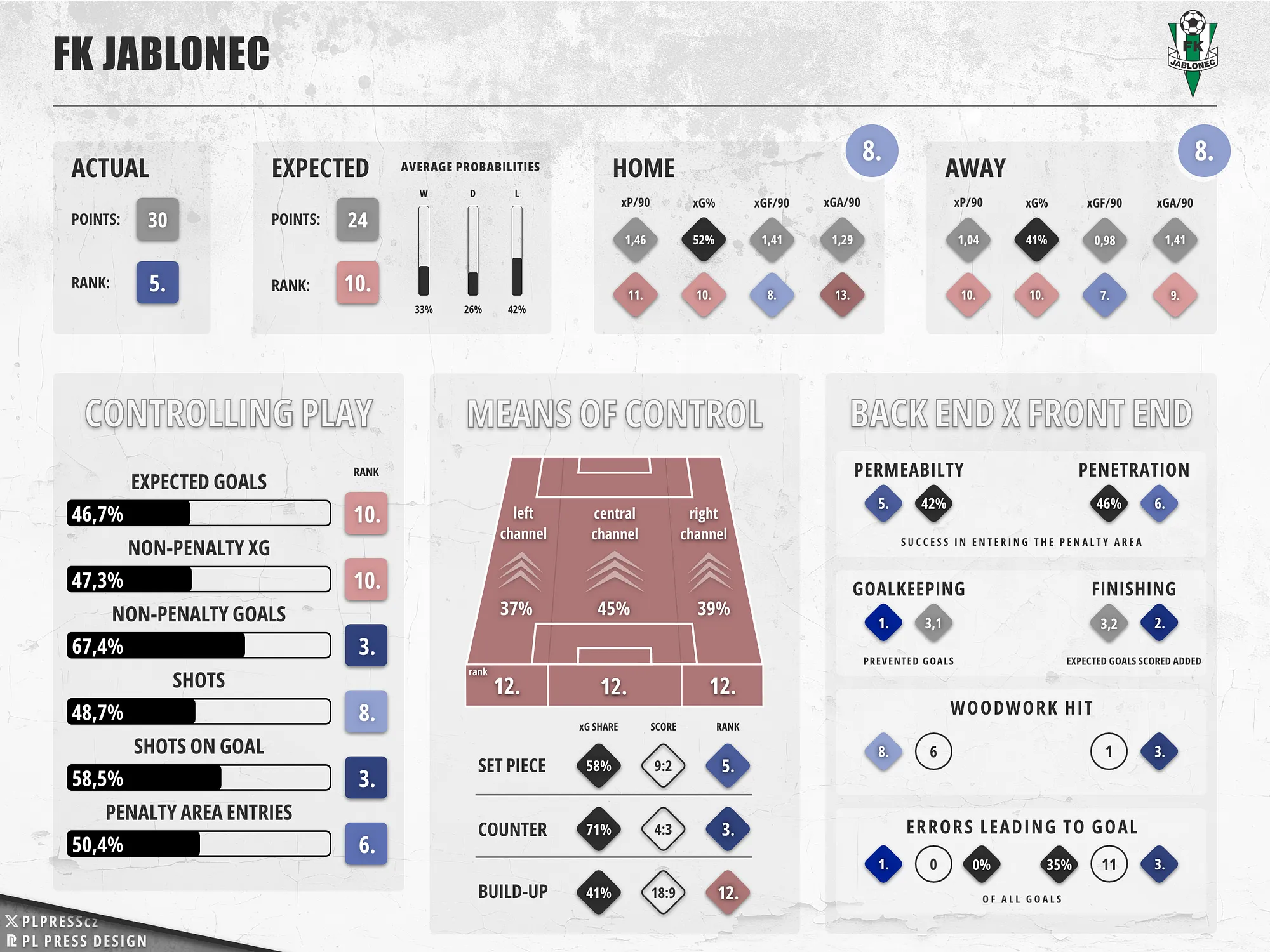
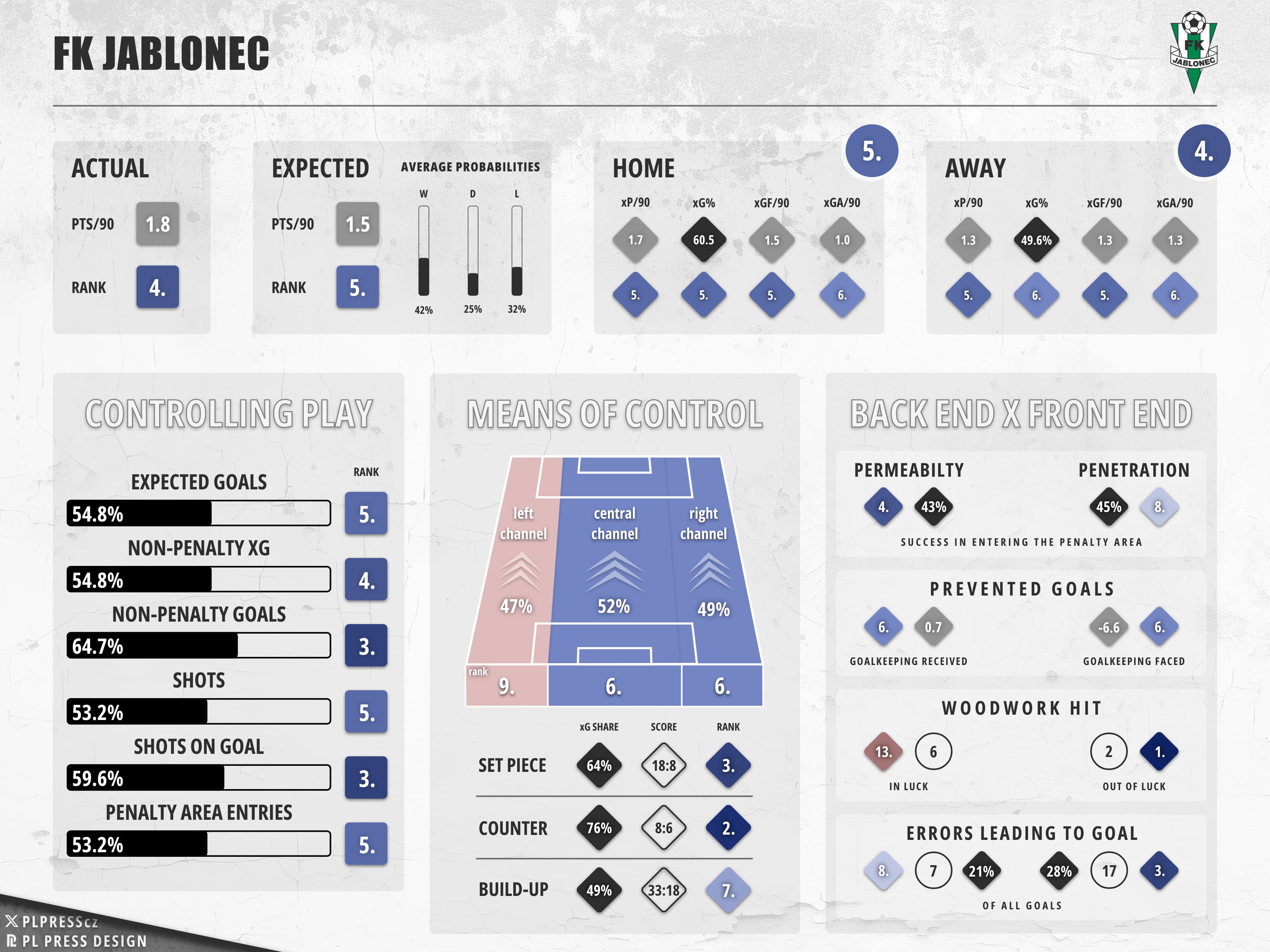
In January, I warned against the xG Gods coming for a pay-back. At that point in time, with 2/3s of the regular season almost behind them, Jablonec were 12th in xG flow share down each of the three channels. They were barely Top 10 in terms of non-penalty xG share (47.3%), yet maintaining a Top 3 non-penalty goal share (67.3%!) all the same, courtesy of 11 grave errors leading to goals, just one instance of ringing the crossbar, and some shoddy goalkeeping facing them (allowing 3.2 goals above expectation). So how come Jablonec actually improved their point pace in the spring, earning one extra win (10) compared to their autumn total? Believe it or not, “Tomas was being dumb again” explains only a small part of it; the bigger part was simply about… levelling up. Where their autumn average win probability read 33%, it was suddenly 53% in 2025 — with Jablonec earning an extra 0.6 expected point per game. Their NPxG share didn’t catch up to the G share all the way, but it did rise by ca. 10 percentage points. As a result, pushing Sparta to the brink was far more deserved than weird.
While Jablonec’s positional attack xG share got a boost, as well, their sustained excellence on set pieces was a much more notable factor across the board. I’m quite critical of Martinec or Cedidla below, but there’s no denying they are essential parts of a two-headed beast. “Two-headed” because Jablonec are a relative rarity in that they dominate upfront — crushing Olomouc, Budějovice and Slovácko through 2+ set-piece-goal efforts — without compensating for it at the back like Sparta, Plzeň or Sigma frequently did. Jablonec keep Slavia company on an island, only conceding in two games vs teams outside the Top 4.
What went (especially) wrong
The “outside the Top 4” caveat is quite important, because Jablonec shipped 5 more set piece goals otherwise, and got utterly hammered by those who finished around them in the standings. Exactly half of FKJ’s non-victories (8/16) came against the Top 4. Extend it to the Top 6, and you are suddenly at 10/16. Getting outshot by 48 attempts and outplayed by nearly 8 expected goals of difference wouldn’t have mattered that much — since Jablonec still beat all of Sparta, Slavia and Ostrava (twice) anyway — had the latest of those Top 4 battles not been the last game of 24/25, with continental football on the line, and 1:4 loss in the bank. After heroically overtaking Sparta despite a 14-point deficit, Jablonec put in a complete no-show. Dispatching former coach’s Hradec Králové in MOL Cup’s R16 away from home only to bow to Baník Ostrava in front of their own fans a round later was similarly sobering.
Most valuable player (still on board)
Per my MVP model (traditional stats): Nemanja Tekijaški (ranked 25th league-wide)
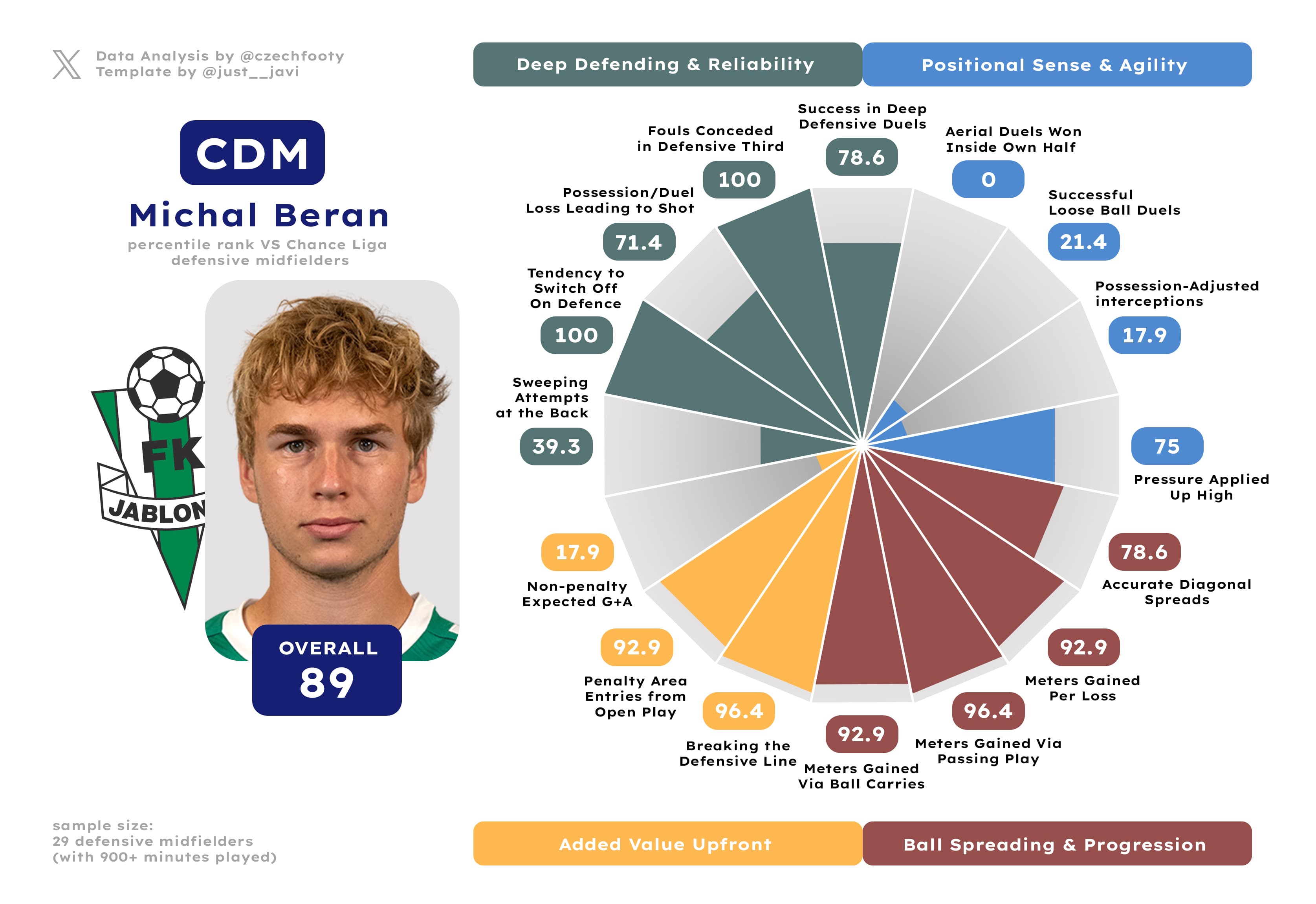
Per my positional models (advanced stats): Michal Beran (89th overall percentile at CAM)
Per Statsbomb’s On-Ball Value (OBV) metric: Vakho
After steadily dropping deeper down the pitch for years, keeping Michal Beran as part of the CAM dataset would no longer feel justified. He’s a defensive midfielder nowadays. A special kind, of course — one that gets bullied in the air (0-for-19 inside his own half) and uses his body cleverly in ground duels in/around the box (72.5% success), all the while providing transcending value on the ball per usual. As a result of doing a lot of the dirty work for his partner in an isolated double pivot, Beran didn’t collect a lot of traditional badges of honour — two points (to Nebyla’s 10), five Team of the Week shortlist appearances (to Nebyla’s 7), no highest Livesport mark on team (in a boat shared with Suchan and Souček only out of all semi-regulars) and a mere six primary chance-creating actions (to Nebyla’s 15) — but dig a little deeper and you see someone who’d be called an MVP by his own coach in an instant.
Only sourcing two of those from a set piece (as opposed to a noted specialist Nebyla), Beran was fifth to only Ladra, Šulc, Kalvach and Provod in secondary wasted chance contribution; a great sign of consistency. He’s also accumulated the highest average mark (6.2) and most man-of-the-match titles (3) from Deník Sport, which is a particularly high praise knowing the weak spot this newspaper has got for Martinec. If you include secondary and terciary (valuable) goal contributions, he’s on a fine 8 in total. While doing his bit defensively, providing a steady, composed presence in front of the back three, he somehow managed to not only be the lone defensive midfielder to clear the 90th percentile bar for all three ball progression-related metrics; he was already the sole one to clear the 70th percentile bar on all counts. Was he benefitting from a dataset full of defensive specialists? Sure; but place him back among his old CAM pals, and he ranks 1st (via pass), 8th (via run) and 1st again (per loss).
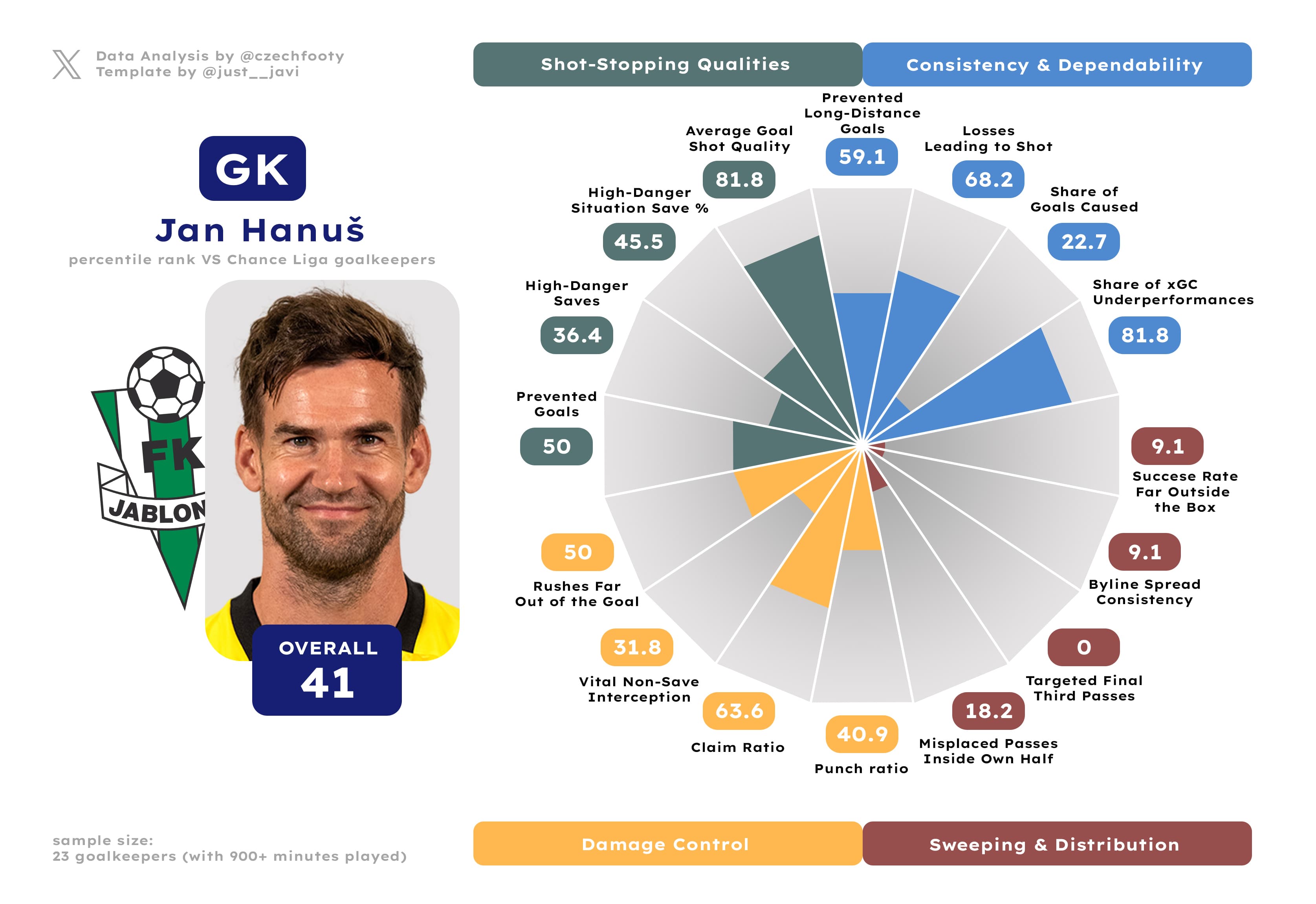
Finally, a word on someone many would take over Beran as the MVP. I agree Jan Hanuš enjoyed a decent bounce-back campaign all told, but for a very active liability on the ball, his traditional goalkeeping wasn’t enough to compensate. Jablonec definitely must’ve appreciated he was only below zero in terms of prevented goals on 12 matchdays out of 35 began in goal (it was 14 out of 30 last term), but his share of blame on goals conceded actually increased — and all three gargantuan errors came against Slavia, Sparta and Plzeň, evenly distributed between the games that very much derailed Jablonec’s UEFA candidacy.
Chip on the shoulder
carried by the player who’s got something to prove — be it to himself, fans or the coach
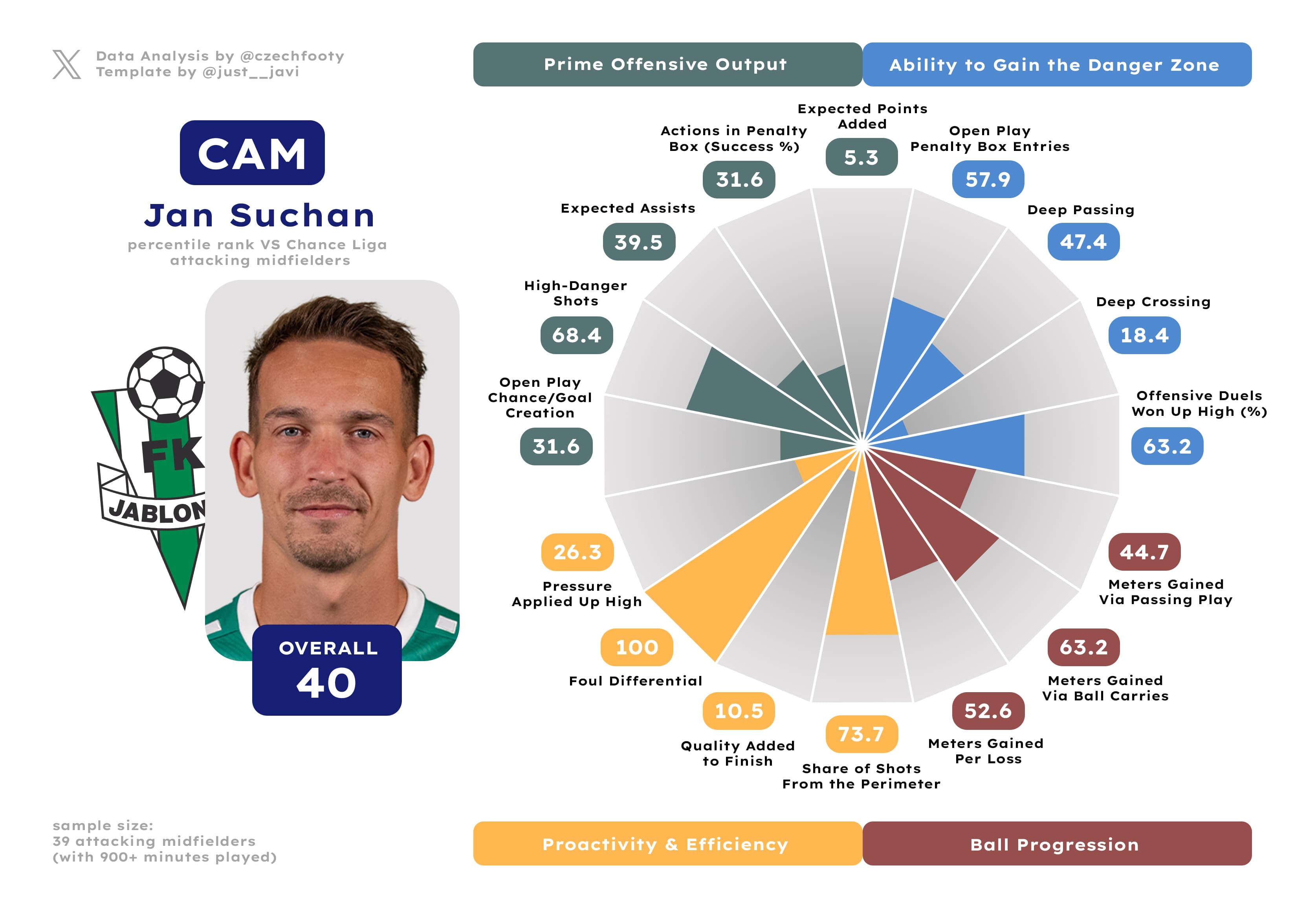
One thing I keep forgetting: that Jan Suchan spent the first four rounds impatiently waiting for a transfer approval on the České Budějovice roster, witnessing a wild 15% of all Dynamo’s chances (29 of 192) over the entire season first-hand. That is a fitting short follow-up on his 23/24 MVP campaign, and also a peculiar little reminder of what he came — and unequivocally failed — to translate to Střelnice. To be fair to Suchan, he was more of a filler in his first incomplete season at Jablonec, starting a mere five games — two of them in the double pivot, two in the hole, and one on the left wing. The latter role, meanwhile, is where I can easily see him slotting in following the departure of Dominik Hollý. It’s not ideal for the centrally-oriented midfielder, but it also shouldn’t be difficult to deliver a bit more substance.
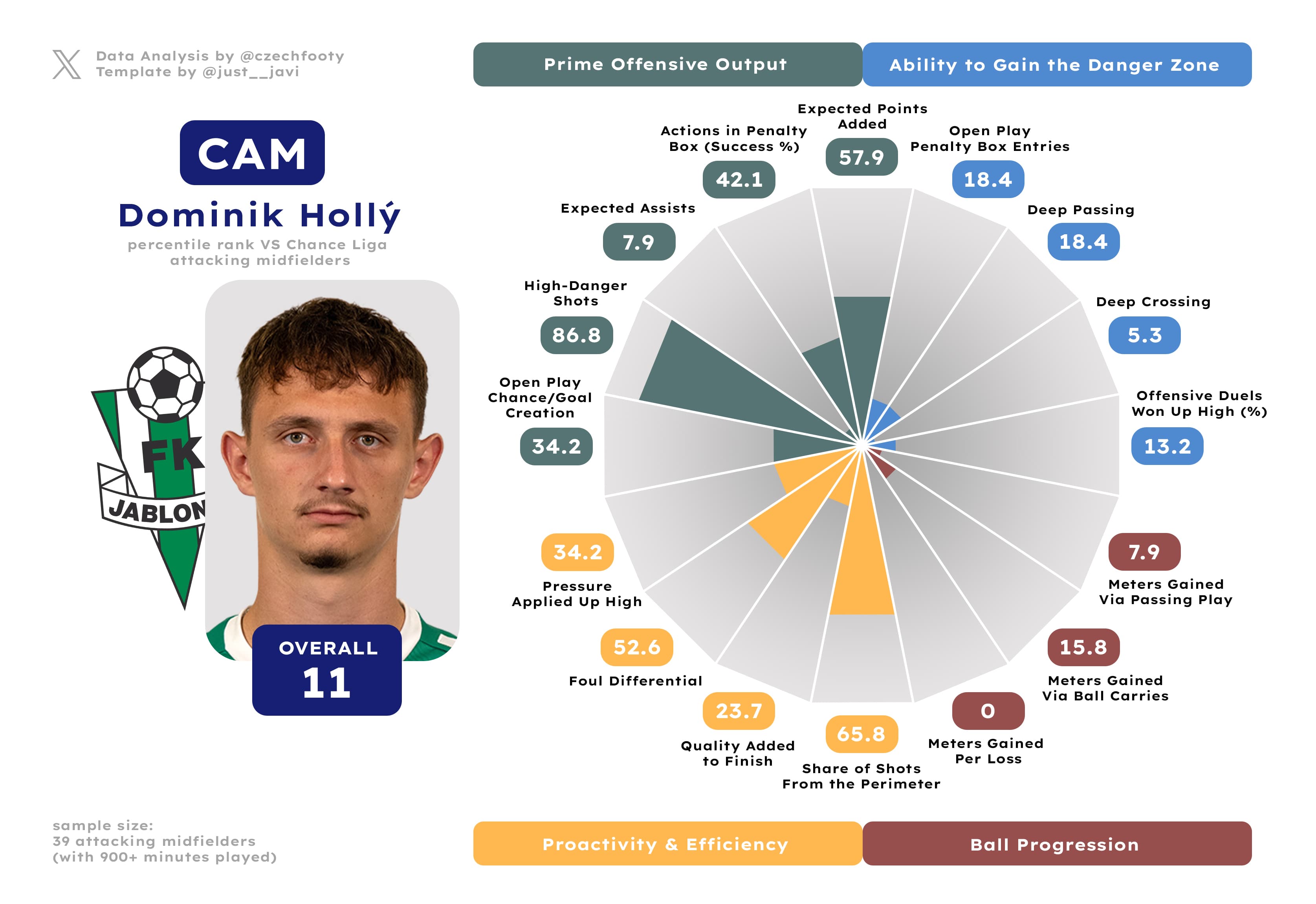
It’s possible — heck, even plausible — Hollý was also a miscast in the left attacking midfielder/left wide forward role (after all, he came over as more of a no. 8/10 from what I gather), but what he effectively was, ie. false no. 9 driving the net and finishing off chances from up close, seems easily replaceable. Especially by Suchan who was also above average in metrics like high-danger shots (of 0.15+ xG value) or (low) share of shots from the perimeter, just not quite to the same degree. Crucially, on top of these two things, Suchan also has a history of gaining the penalty area with greater ease than he’s shown in his time at Střelnice.
Inside the off-season
special thanks for guiding me through the motions of FK Jablonec’s off-season go out to @Gablonzer, @OFanouska, @KocourMichal & @JardaBary
Squad turnover
Hollý, Bienvenue Kanakimana and Petr Ševčík (for now injured and unsigned) take a combined 27 goal contributions with them, which is not insignificant, but it’s also not the area of the pitch where Jablonec needed to holt steady the most. That was decidedly in defence, where Beran, Cedidla, Martinec and Nemanja Tekijaški incredibly ranked (in that order) 1st, 6th, 3rd and 4th in usage among all defensive-minded players in the league. That Jablonec registered seven Top 50 most used players across positions in 24/25 Chance Liga is both a serious stroke of luck and testament to Kozel’s keen reliance on a proven, successful bunch. It’s even more lucky they are currently retaining the Magnificent Seven in its entirety. Unless Plzeň break the bank for Beran (as they should) or Sparta do for Martinec in light of Vitík’s departure (which they absolutely should not), Jablonec are carrying over a huge asset.
Biggest upgrade
I’m not really sure. Lukáš Penxa sounds like a fine bet for a Matěj Polidar deputy, who brings more strength and a fascinating knack for goals from the wingback position (he had a month in the second tier where he bagged something like four goals from open play due to polished instincts) but who can really know how much time he gets behind a fellow Sparta loanee (?!), and how much time he’ll end up spending getting accustomed to the higher level.
Samuel Lavrinčík made Francesco Calzona’s NT training camp in 2023, but what does it really mean when we know Richard Ludha did as well? Plus he’s most famous for missing penalties, it seem; like here and especially here. He should be more of a defensive-minded midfielder, so a possible upgrade on Dudu Nardini? Sure. Finally, we land on Nassim Innocenti. He’s an interesting one in that he should provide Jablonec with a solid backup for the middle centre back, effectively missing since Haiderson Hurtado left in February, as well as a left-footed option in case Filip Novák isn’t up to speed and Cedidla is needed elsewhere or, you know, still learning the tropes of a wide centre back on his off side at a slow pace…
There will inevitably be scepticism attached to any signing from Slovak top flight’s bottom half, let alone one who wasn’t a sure-fire starter for his team, but Innocenti’s possession-adjusted interception rate (7.96 per game) would’ve ranked a solid 16th out of 61 regular ChL centre backs and could prove translatable. He’s also a product of Lyon’s famed academy who signed his first professional contract with Lille OSC at 18 on the back of a quality UEFA Youth League campaign. It’s been 5 years since then, but still… some intrigue is more than none.
Biggest downgrade
Out of all Zbrojovka Brno splashes, Bienvenue Kanakimana is the most curious one. He seemed to have a pretty clearly defined role of a match killer of the bench at Jablonec, which he fulfilled to near perfection, delivering a point in the final 15 minutes of three games. On top of that, he also pretty much killed Liberec with a second half burst of 1+1 in the 5:0 hammering. So why move on? For Kanakimana it’s likely about money and opportunity; for Jablonec it might be a signal they are willing to bet on Success Makanjuola. He’s a relatively new face (albeit not too young at 24) even for a Jablonec faithful, collecting 10 strikes for the third-tier reserves in his first seasons with the club, and could bring superior work rate.
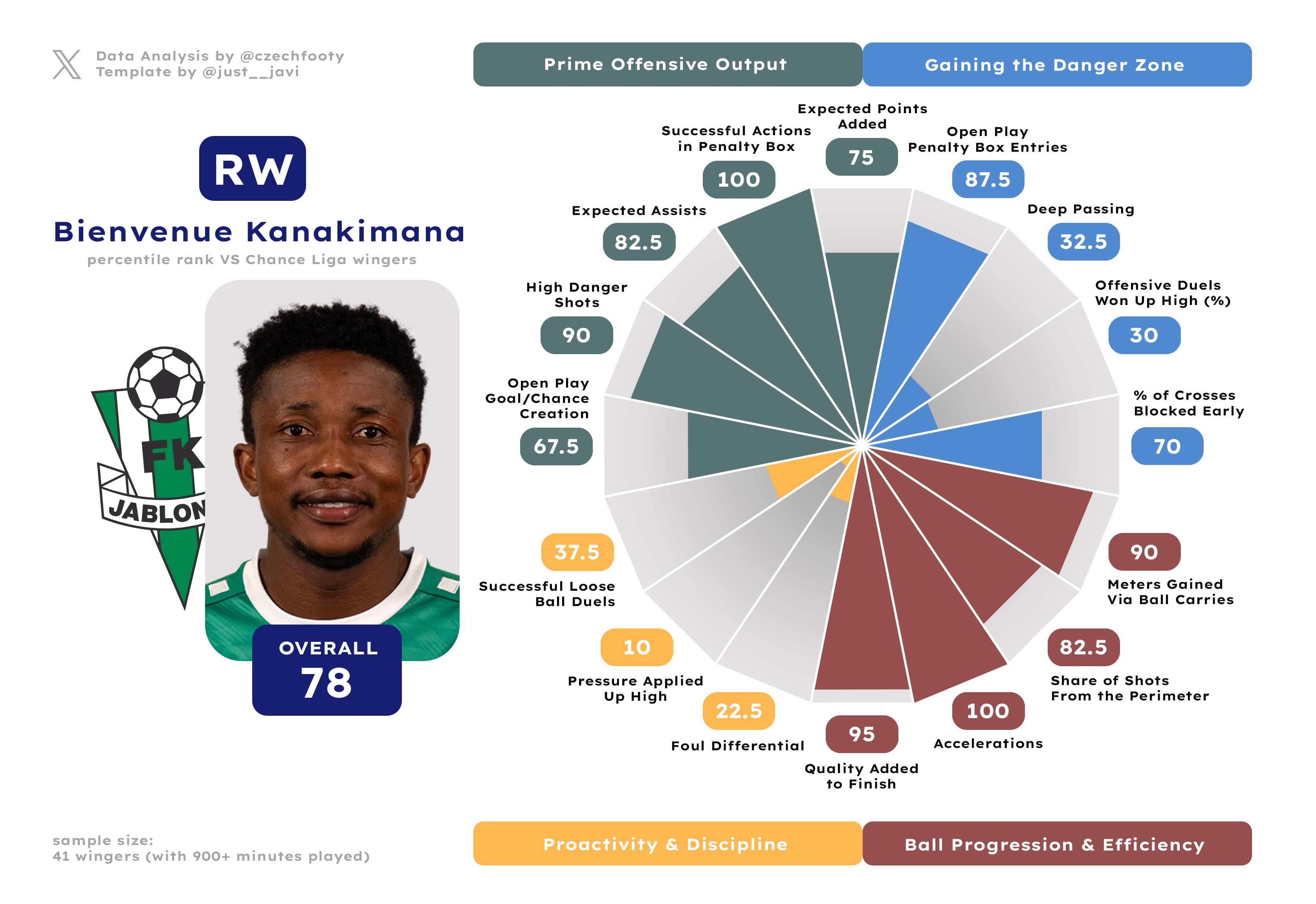
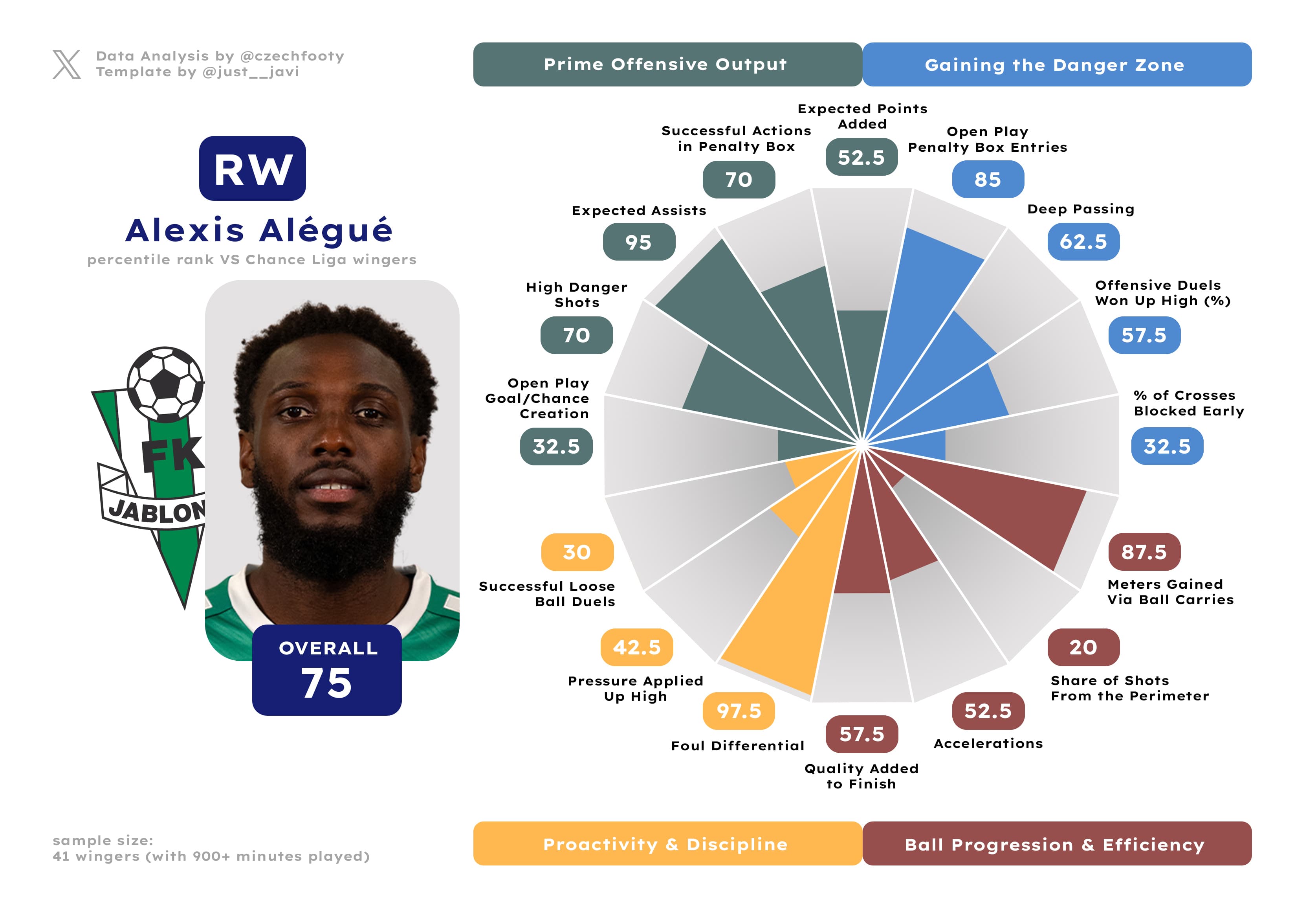
With Kanakimana, it was always mainly about the pace (he led all wingers with 1.26 accelerations with the ball per game; second Matoušek was at 1.00!), but also making the most of a small sample. It’s all good producing a league-high 2.7 successful actions in the box, but doing so against a mostly tired defence across just 11.1 starts doesn’t sound all that impressive anymore. Context matters, and there will always be the lingering question mark whether the popular ‘Benny’ could also do it at a larger scale. That same question, by the way, also relates to Alexis Alégué who accrued significantly more minutes (10.5 extra starts), but did a lot of his damage off the bench, as well. To be fair to him, the last 9 goal contributions of his campaign were delivered while starting the respective games, yet the long pointless, ineffective stretches in the fall (R2-9) as well as the spring (R24-32) infallibly point at a frustratingly inconsistent weapon. Funnily enough, both Makanjuola and Alégué are slated to come on their stronger left from the right, so Luboš Kozel officially has a type.
Need left to be addressed
It’s hard to pick holes in this squad as long as everyone stays incredible healthy as they had throughout 24/25. The central midfield deck is still a bit thin, but you can always push Martinec up or Suchan down for a passable temporary solution. The long-standing issue of a competent Hanuš backup was also signed in 2024. And moving Vakho to right wing back full-time was close to a home run, too, getting bang for their buck at both ends of the pitch.
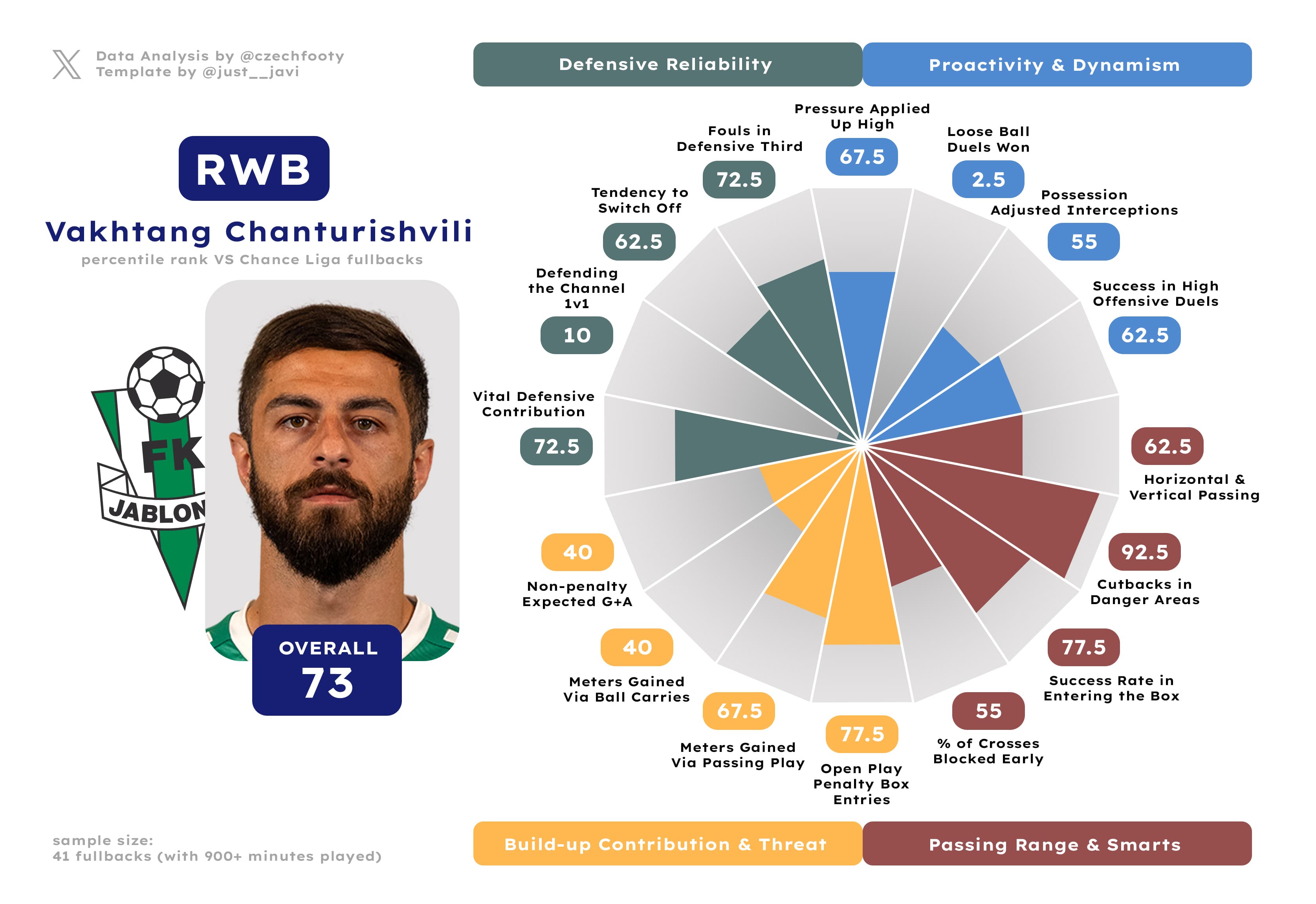
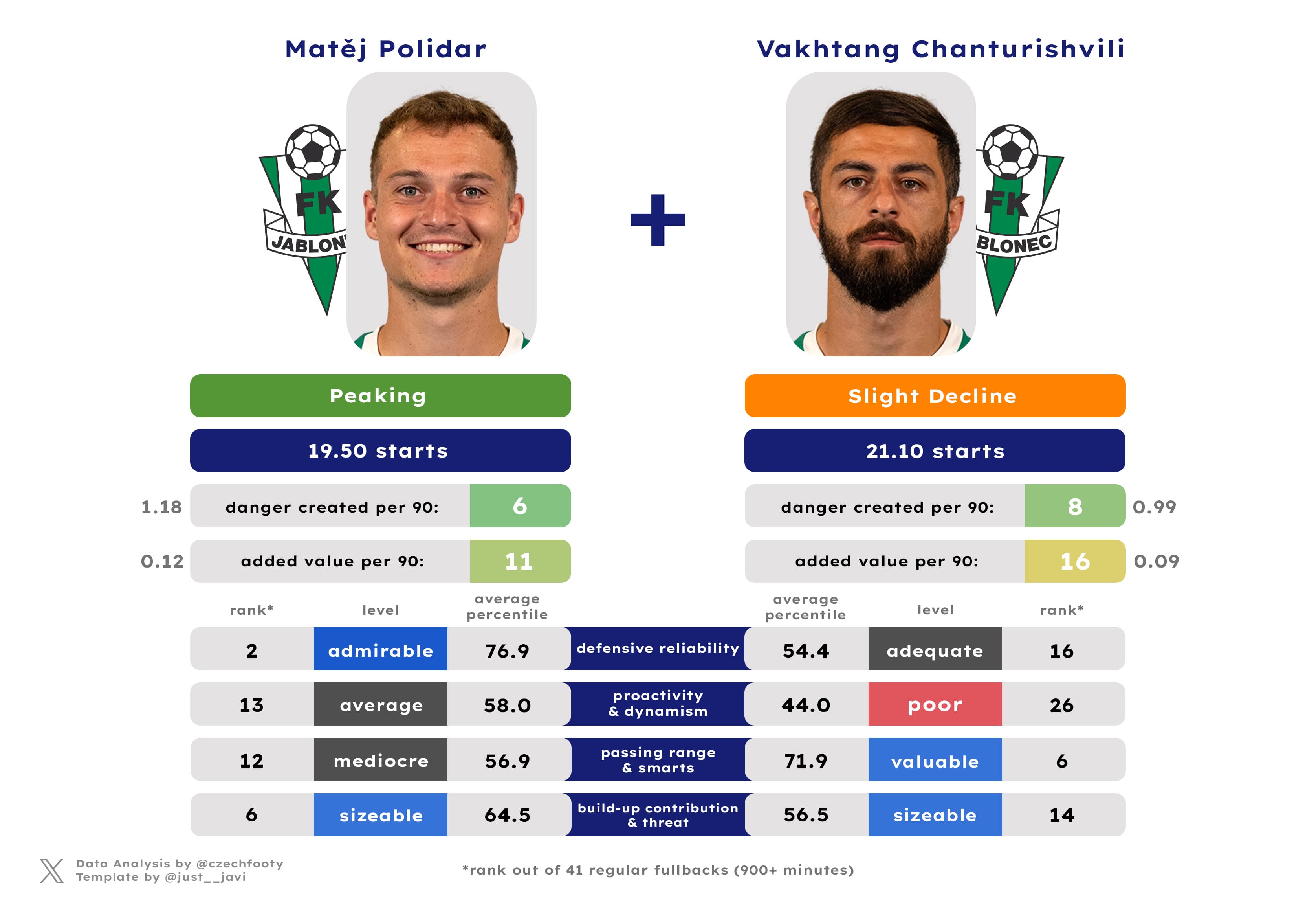
Still, with Penxa potentially providing a strong rotation option for Polidar, I could imagine someone doing the same for Vakho. Even after cutting the oft-injured Michal Černák, Jablonec theoretically still have that in David Štěpánek (who’s looked better at wingback than centre back in his Střelnice stint) and Daniel Souček, but I would argue they are borderline top tier quality at the best of times. Souček has had stretches where he looked like a competent final third contributor, but 24/25 saw him take a dramatic dip on that front, with his awful success rate in entering the penalty area (10 times out of 33 attempts) particularly standing out. The starters are fine, the backups a bit doubtful. But we are nitpicking.
New kid on the block
Two years ago, I conceded the first and to date indeed the last defeat in this space. When I posed the obligatory question to my Jablonec consultants this time around, I received one reference to that horrible experience I swore to not repeat, suggesting I may need to take the L again. Luckily, that same consultant gave me at least something to latch onto: Lukáš Kostka (b. 2007) and his four brief appearances for the reserves, capped with a goal — possibly a club record at the third-tier level since he can’t legally drink alcohol until later this month. You know what, I’ll take it. He’s new. He’s a kid. And he’s at least vaguely on the block, carrying some pedigree as a very rare case of a Czech youth international hailing from underneath the iconic Ještěd mountain. Liberec and Jablonec combine for 1 goalkeeper in the wider U-15 squad (courtesy of Slovan), 5 members of the wider U-16 squad (all but one courtesy of Slovan), 1 player included in the wider U-17 squad (Denis Křemen of Jablonec), no companion for Kostka at the U-18 level, one Matěj Strnad from Liberec at the U-19 level, and obviously no homegrown U-20/21 players whatsoever. Only Strnad, Kostka and Sebastian Jager (U-16, Liberec) have played at least some games at their respective levels. Grim.
Looking ahead to 2025/26
Below is the team’s current(ish) depth chart with a maximum of 4 alternatives for one position. The colourful ratings are a static snapshot of the league-wide situation on 5 July, and they are just a playful bit to add flavour to it; the names featured should be relevant to this day. To learn more about my approach to constructing depth charts, with all its limitations, head here.
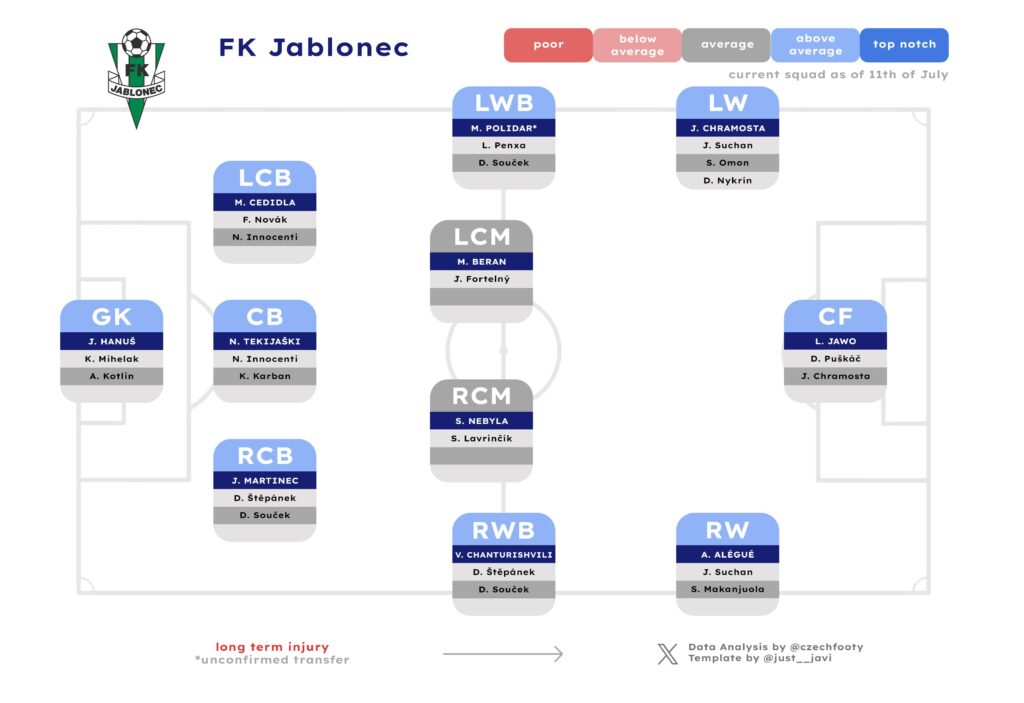
Primary formation
Jablonec spent roughly half of 24/25 in 3-4-3, with the wingers sometimes acting more like wide centre forwards (esp. Chramosta), and that may continue. There will inevitably be times when Kozel enters a third CM (be it Lavrinčík, Fortelný or eventually Ševčík) and goes 3-5-2, or turns it into more of a 3-4-2-1 with Suchan, but the 3-at-the-back is 100% set.
Notes on the depth chart
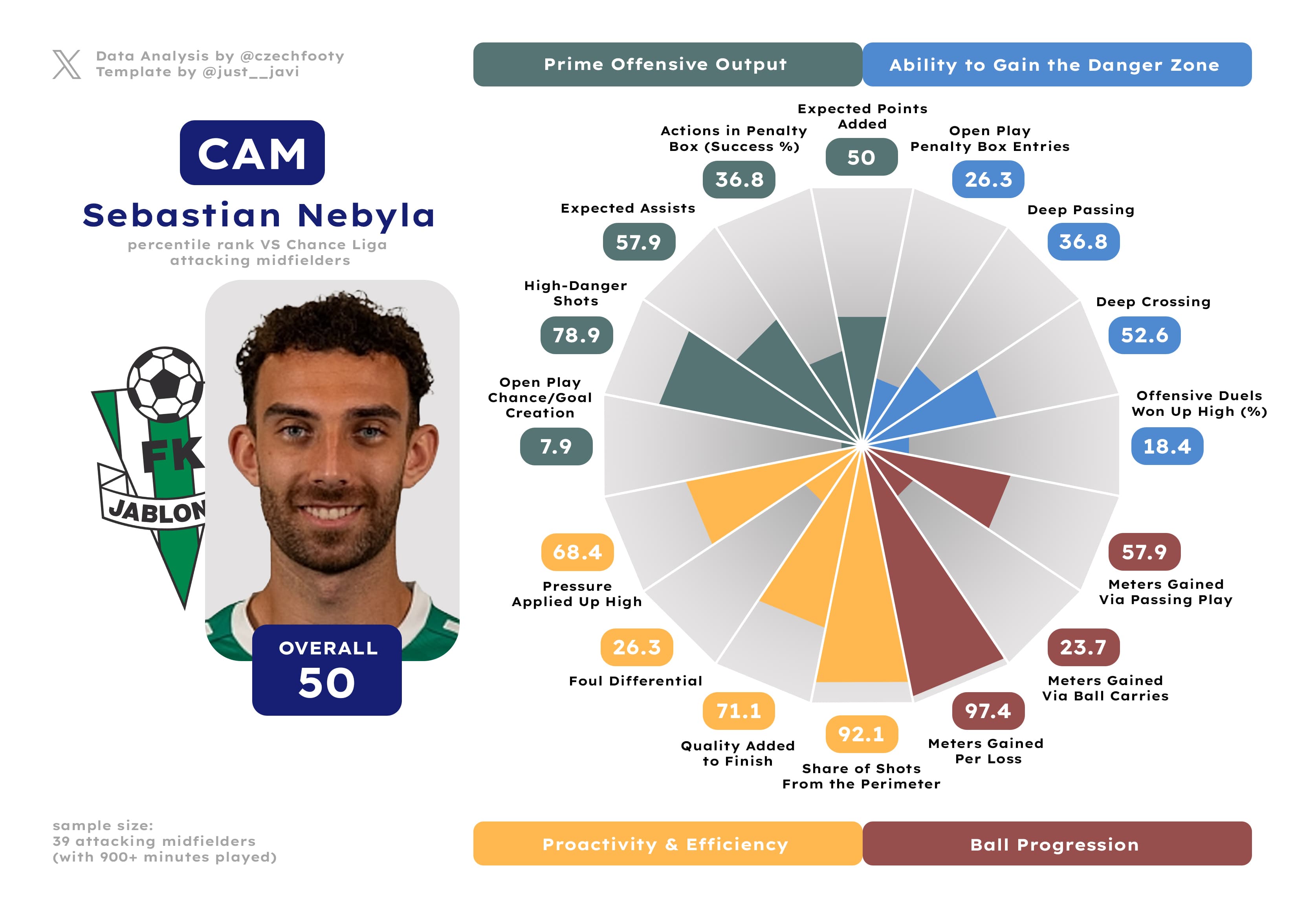
This past Chance Liga campaign was a growing experience for Sebastian Nebyla who was more of a contributor in his second year. He’s still a bit of a luxury player — making whatever Beran has done even more of a marvel — but I honestly expected him to tread water far more than he did. Nebyla blossomed as a solid, efficient progressor next to an already excellent one, attacking the box in a more purposeful manner than majority of attacking-minded midfielders. His open-play creation still leaves a shocking lot to be desired, though.
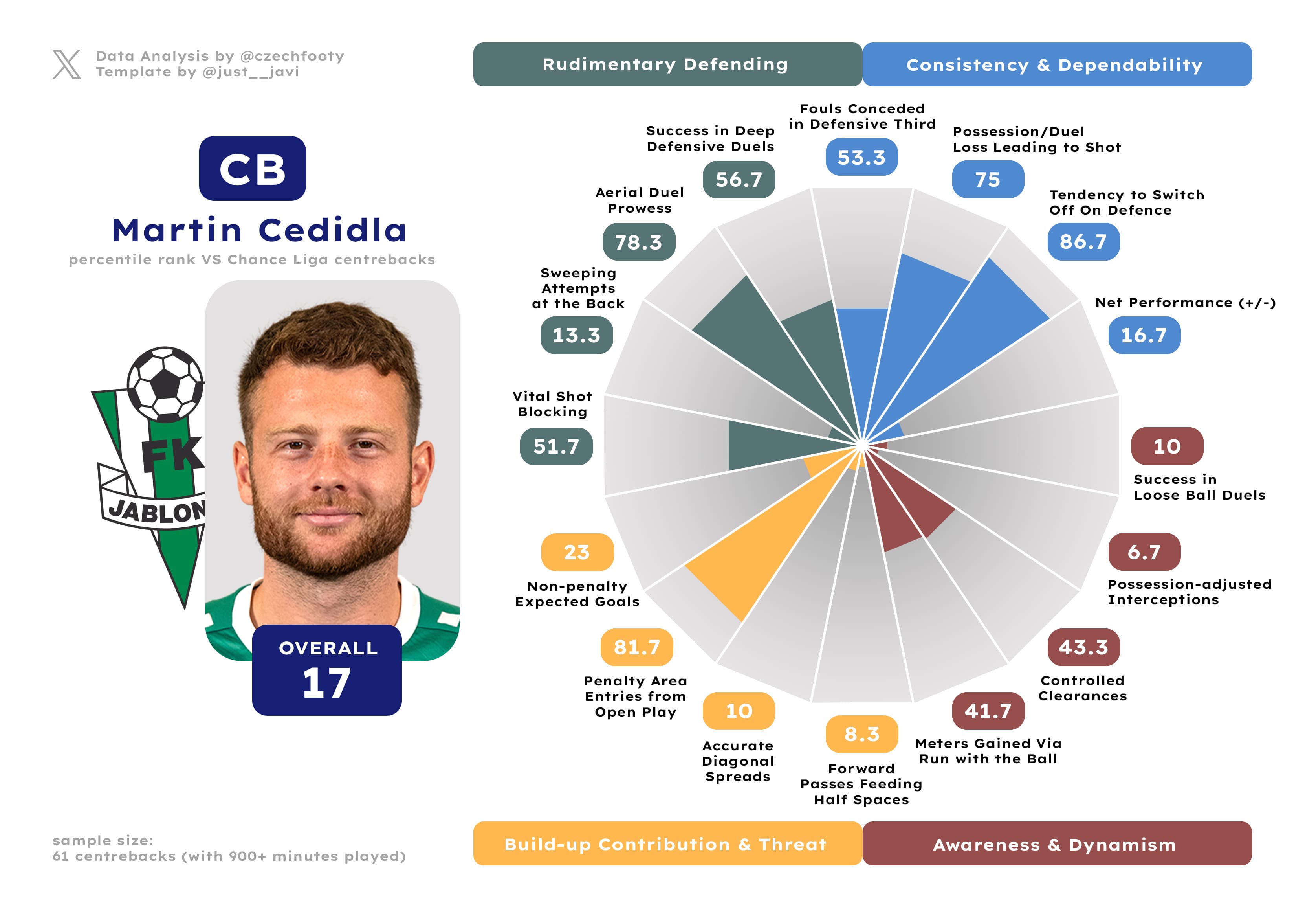
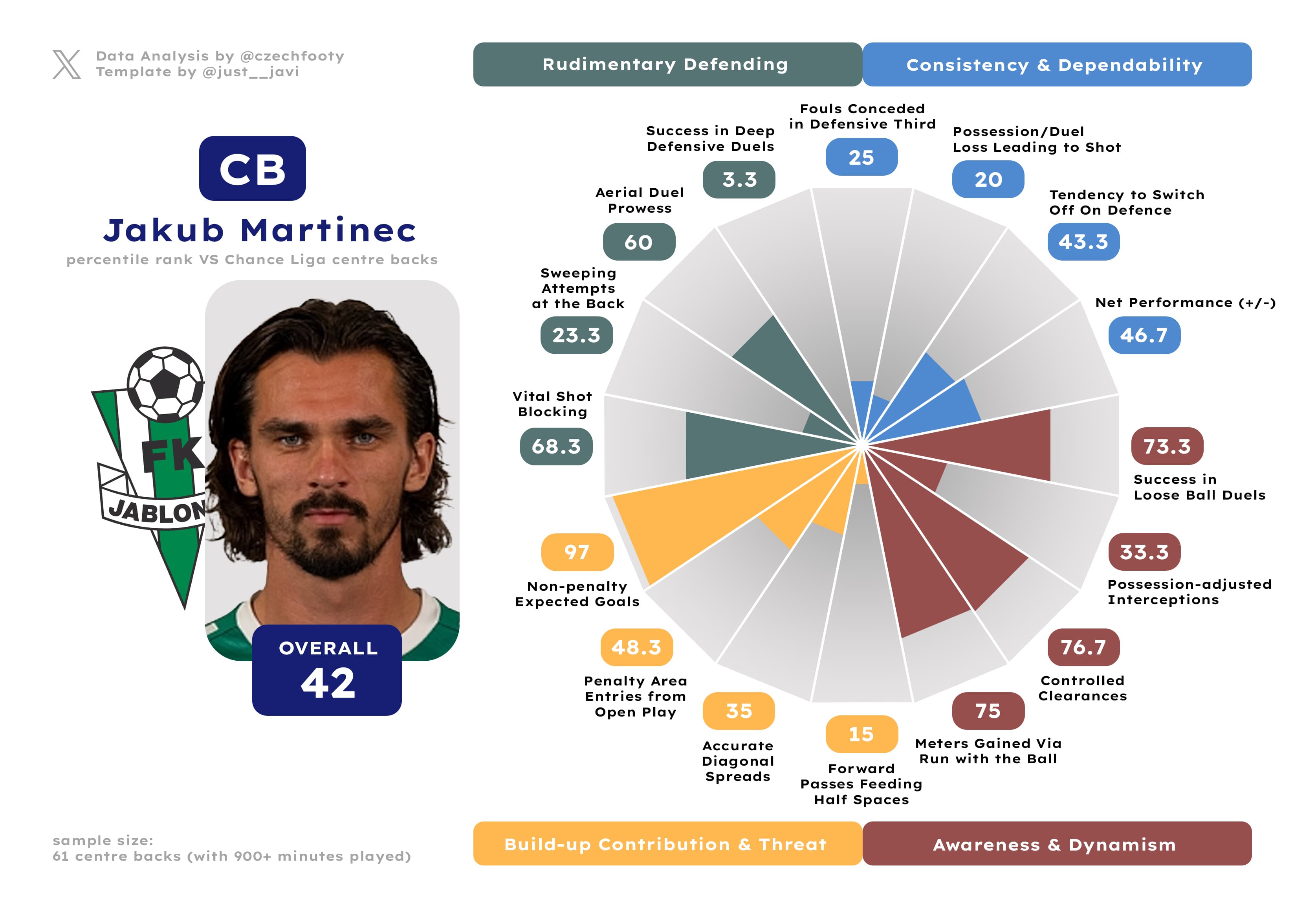
After he received 15 calls to a 33-name Team of the Week shortlist, joint-second only to Šulc, I’m afraid we need to talk about Jakub Martinec and how vastly overrated he is. The heart-on-sleeve centre half has carved out a reputation of a strong, hardly beatable leader from the back when the pizza chart — and especially the ground duel success rate along with all the consistency & dependability metrics — could hardly disagree more. And it’s not for the first time, by the way, with Martinec also appearing below average in 22/23 and as one of the more frequent sleepers, volatile/vulnerable players on the backend even as a CDM in 23/24.
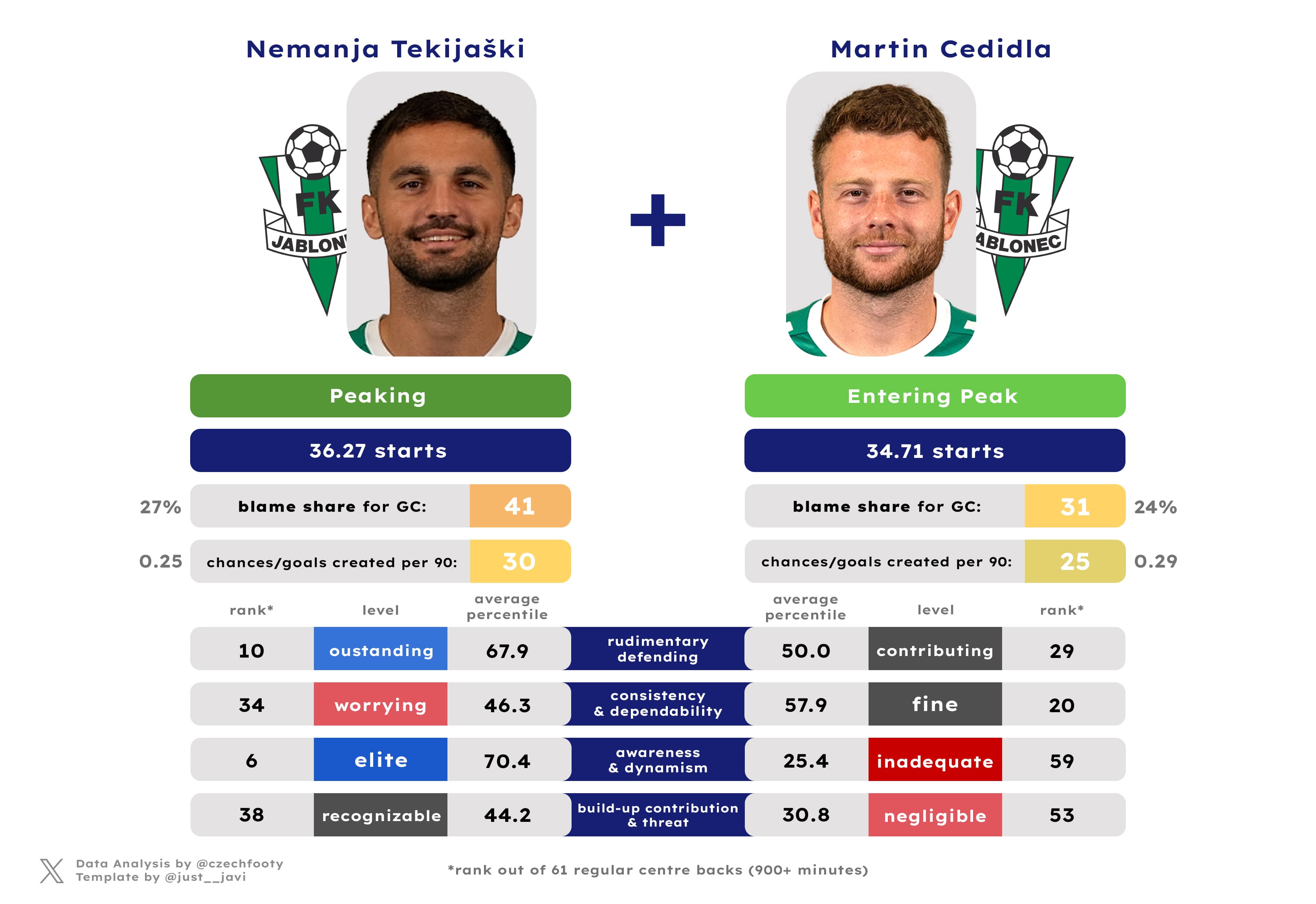
At least there’s always Tekijaški capable of covering a lot of his colleagues’ deficiencies…
Roster battle to follow
One of the lowkey transfers of 24/25 was definitely Lamin Jawo swapping Mladá Boleslav for Jablonec. He was a transformative figure for the UEFA competition hopefuls not in that he was any drastically better than David Puškáč or Jan Chramosta, but that he provided Kozel with more, and different, options. Chramosta is a rare passer-finisher double threat mostly coming off the left wing, Puškáč is a perenially underrated deep-lying force (posting the second highest open-play goal/chance creation rate behind Kušej!), and Jawo brings some missing (defensive) activity off the ball as well as a much improved shot upfront.
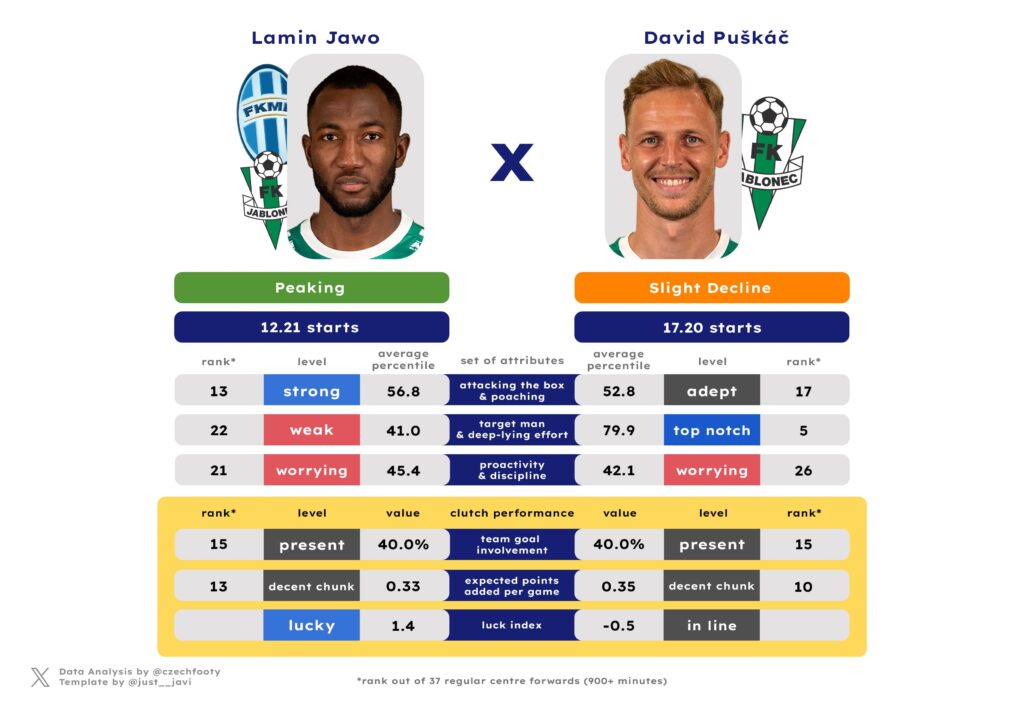
Having both Jawo and Puškáč on the field probably isn’t an option for most days (not in the preferred 3-4-3/3-4-2-1 formation anyway), hence the battle, but it’s kind of an amicable one. Both forwards never last the full 90, and their exhausting, duel-rich style of play pretty much dictates that being the case. Having the chance to replace Puškáč with Jawo, or vice versa, to maintain that tremendous link upfront at all times, was a game changer for Kozel.
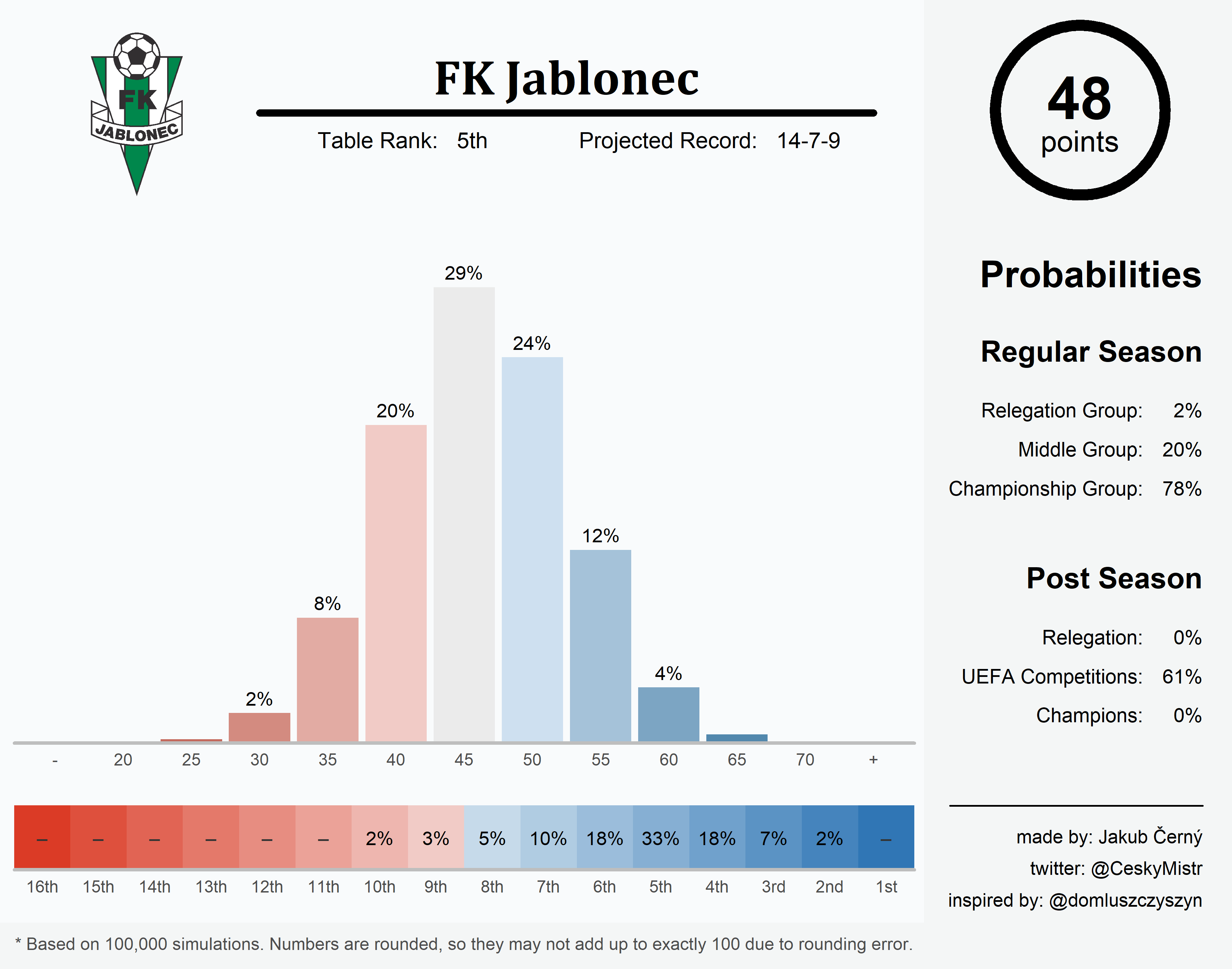
Here’s something that’s been boggling my mind. Below, find recent regular-season point totals and chances for UEFA football expressed in percentages that followed in summer.
2021/22: 26 pts (15%)
2022/23: 35 pts (4%)
2023/24: 30 pts (7%)
2024/25: 51 pts (61%)
Slovan fans pointed this out to me and it does indeed feel awkward. More so when you add this tit bit: after three consecutive summers of seeing their projected point total steadily drop, they are now plus-13. Are we seeing too strong a recency bias play out in front of our eyes; too strong an over-correction? There are largely 3 factors to consider here, I think:
1) The extra UEFA slot is huge, and would’ve already showed on Jablonec’s UEFA chances last summer had they not just endured their worst back-to-back seasons since 1970s (those were the only other times FKJ have dropped below the 30-point bar, by the way; massive blow)
2) MOL Cup is also considered and the model sees a consistent quarter-finalist (4x in 5 years)
3) Where Jablonec mostly kept the band together, with their three major summer subtractions potentially absorbed internally, others who swallowed a decent chunk of the “other” UEFA odds (outside the Top 4) last summer got weaker to a slightly (Liberec, Hradec) or dramatically (Slovácko, Boleslav) greater extent. With Slovácko and Boleslav, quite rightly, leaving a whopping 30% up for grabs, Ostrava and Jablonec — with their recent 24/25 success and summer of stability — gobbled down most of it. Quite rightly, as well, actually.
Time will tell whether it’s right to trust one fresh, one buried season over the 3 inbetween.
Bold prediction
The track record: 1/4. *gulp* Kozel’s Jablonec kinda did score against Liberec
The prediction: Jablonec will push Slovan down the historic table in a stylish way
The rationale: Not that Slovan, don’t worry; the other one.
After Liberec finally caught up to ŠK Slovan Bratislava in the historic standings of the Czechoslovak top flight throughout last season, the Top 10 is exclusively Czech — and will remain so forever since only the Czech top tier is considered the follow-up act, of course. Now it’s time for Jablonec to do their bit, too, and they’ll do it in a symbolic fashion.
Jablonec have only kept Slovan company for those two lonely 70s campaigns, beating them once. In the season they historically prevailed over the Slovak juggernaut, Slovan celebrated their first back-to-back title since 1951 — the sole case of repeated success in a 30-round format. Their final point total: 55. That doesn’t seem like a lot until you realize a pair of points was given for a victory back then… which also makes the bar clearable for FKJ of today.
So there you go, Jablonec go 5 points further than last term and finish on exactly 56 points, jumping over Slovan (55 points ahead as of now) in a properly stylish way. Can they do it? They have collected 56 points inside the regular season a solid six times in their history, while the model sees it happening in roughly 17% of cases — the exact same likelihood of Slovan (Liberec) returning to Europe. Man, I’m fancying this prediction the more I type…
… so I’ll stop.

Enjoyed the text or the visuals, but don’t care for 🇨🇿 translations and dashboards? No worries, you can still support us by inviting us for a symbolic pint at the old BuyMeACoffeeBeer page.