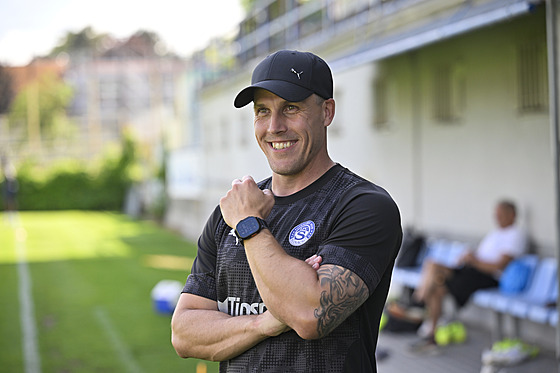
In a lot of ways, 1. FC Slovácko have just endured a season every bit as trying as Baník Ostrava’s. Granted, they are more accustomed to it these days than the Silesians, but it was still a lot. On the pitch, they had to wait until Round 16 for their second victory before concluding the regular season with their first five-game losing streak since 2018 under a different coach, who soon turned things around only to ditch the club weeks later. Off the pitch, even global media picked up the women’s team abuse scandal, while the campaign was bookended by B3 Sector’s open letter demanding answers to some pretty basic questions, and the same fan group’s Instagram post declaring that the club is simply not run by competent people… only for some more blatant incompetence to follow.
All this eventually culminated in the seemingly desired outcome: on 29 June, the club announced that the nearly 20-year era of Zdeněk Zemek owning 1. FC Slovácko had come to an end following a gradual sell-off of his shares since 2022. Normally, that would be an opportunity for some nostalgia: reminiscing about Zemek calling 1. FCS “his private jet and yacht” and hoping they would someday get another crack at the cup final they lost in 2012, only for it to happen exactly 10 years later through the iconic upset of Sparta Praha. Normally, the club’s two Top 4 finishes despite hailing from the smallest top-flight town of just 25,000 people would be front and centre of the fallout. The mood clouded all that.
Fortunately, some feel-good stories soon started to emerge. New majority owner Vítězslav Skopal of Solar Global, the club’s main partner since March 2022, immediately delivered on his promise by appointing club legend Michal Kadlec as sporting manager. Vlastimil Daníček took up an assistant coach role with a focus on defence, while Petr Reinberk travelled with the team to the summer training camp pending confirmation of his future role at the club.
Three beloved musketeers of the successful era back together, only upstairs? Decent start.
To be clear, Kadlec is not really replacing anyone, but rather filling a newly created role. The CEO is now Zdeněk Heneš, intriguingly a two-time European champion and one-time world champion in sport shooting, effectively replacing Petr Pojezný, who was sacked as the club’s director in September 2025 after roughly a decade in charge. For much of that time, Pojezný seemed content to limit Slovácko’s ambitions to those of an overachieving “family club” simply happy to be there. Kadlec’s appointment is instead part of the club’s gradual move away from that mentality, bringing professionalism and valuable contacts to complement Veliče Šumulikoski, now a board member on top of his old role as sporting director.
As a result, 1. FCS once again looks like a club that fully belongs. The new kits are finally custom-made rather than a catalogue pick. And the money seems to be there to invest — previously a wild idea — with Slovácko winning the Lukáš Vorlický sweepstakes; a move that could ultimately set them back around €325,000 if the fragile talent manages to stay healthy.
Looking back on 2025/26
What went right
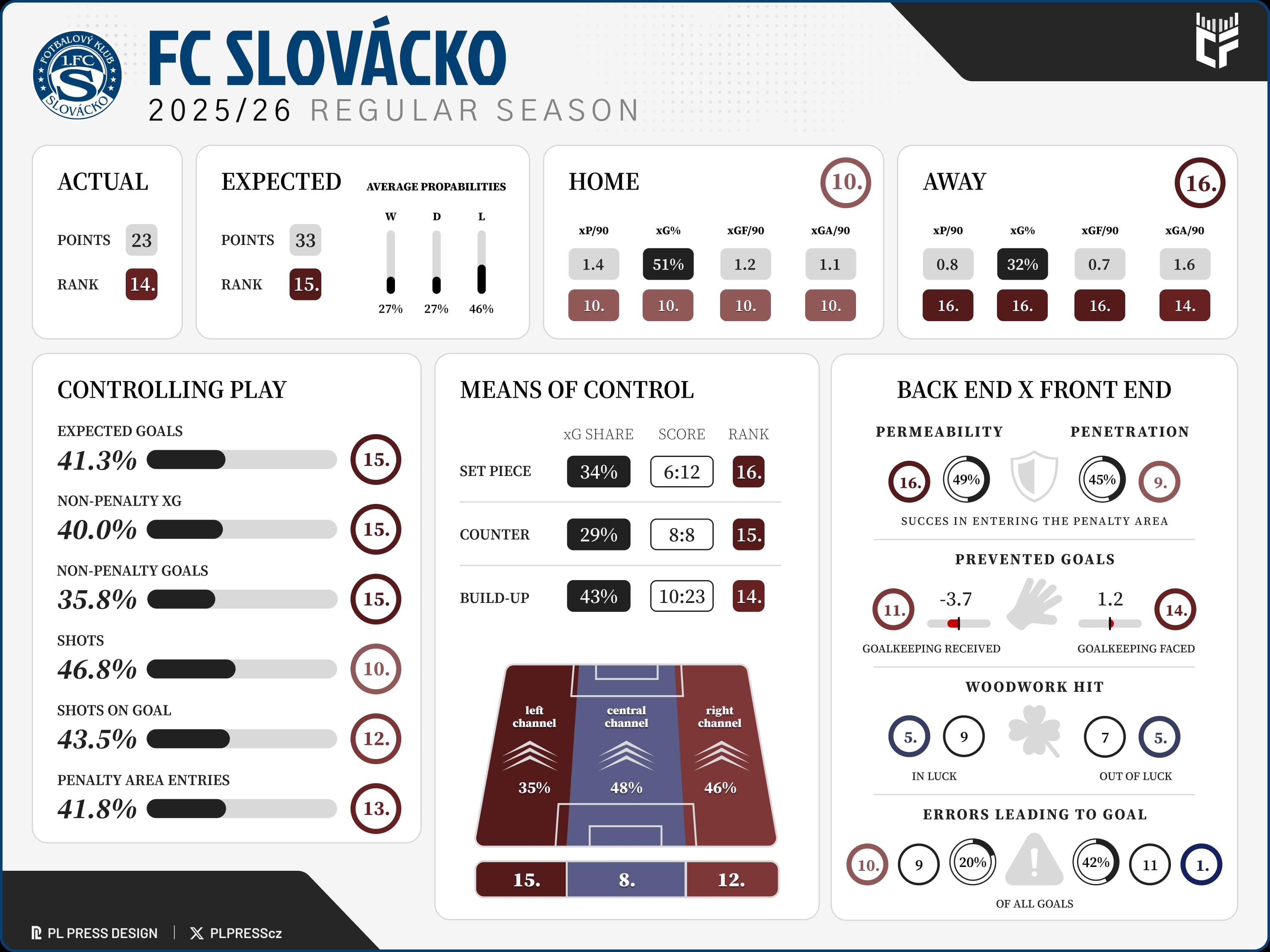
After getting shut out 10 times inside the first 15 rounds, Slovácko leaning into Skuhravý’s famously possession-based, attacking-minded brand of football felt a bit counter-intuitive. But sometimes the unorthodox just works, and this was the case both early and late in his tenure. Slovácko immediately roared to two massive home triumphs (the 2:0 derby vs Zlín and the 3:0 shock vs Plzeň), while they navigated the post-season so smoothly their 5-game xGAExpected Goals Against (xGA) estimates how many goals a team should have conceded based on shot quality, location, and context. was the second-best in the league and their relegation play-off fears buried early.
There was otherwise nothing to enjoy about the year. These patches were as good as it got.
What went wrong
Halfway through 24/25, Slovácko were also already on their second coach of the season. Back then, however, they were sitting relatively pretty with 22 points. This time it was eight. This was soon after Veliče Šumulikoski publicly drenched the players, while one of those players was choosing to openly discuss the dressing room’s hierarchy, as if given notes by Milan Petržela. This was just before Jan Kameník was finally let go, paving the way for the unlucky Skuhravý to oversee the tail end of the club’s longest streak without scoring a single goal (he ended up “dethroning” the 2009 misery by eight minutes on his debut, the poor lad).
It’s been a long time since Slovácko actually contended for the title “worst in class” in meaningful team metrics, and there were two such examples this past season. Slovácko were absolutely dreadful on attacking set pieces, scoring only 6x to the tune of the lowest xGFExpected Goals For (xGF) estimates how many goals a team should have scored based on shot quality, location, and context. per 90. They were just as clueless on the road, earning a 36% xG share to win a pair of matches.
Most valuable player
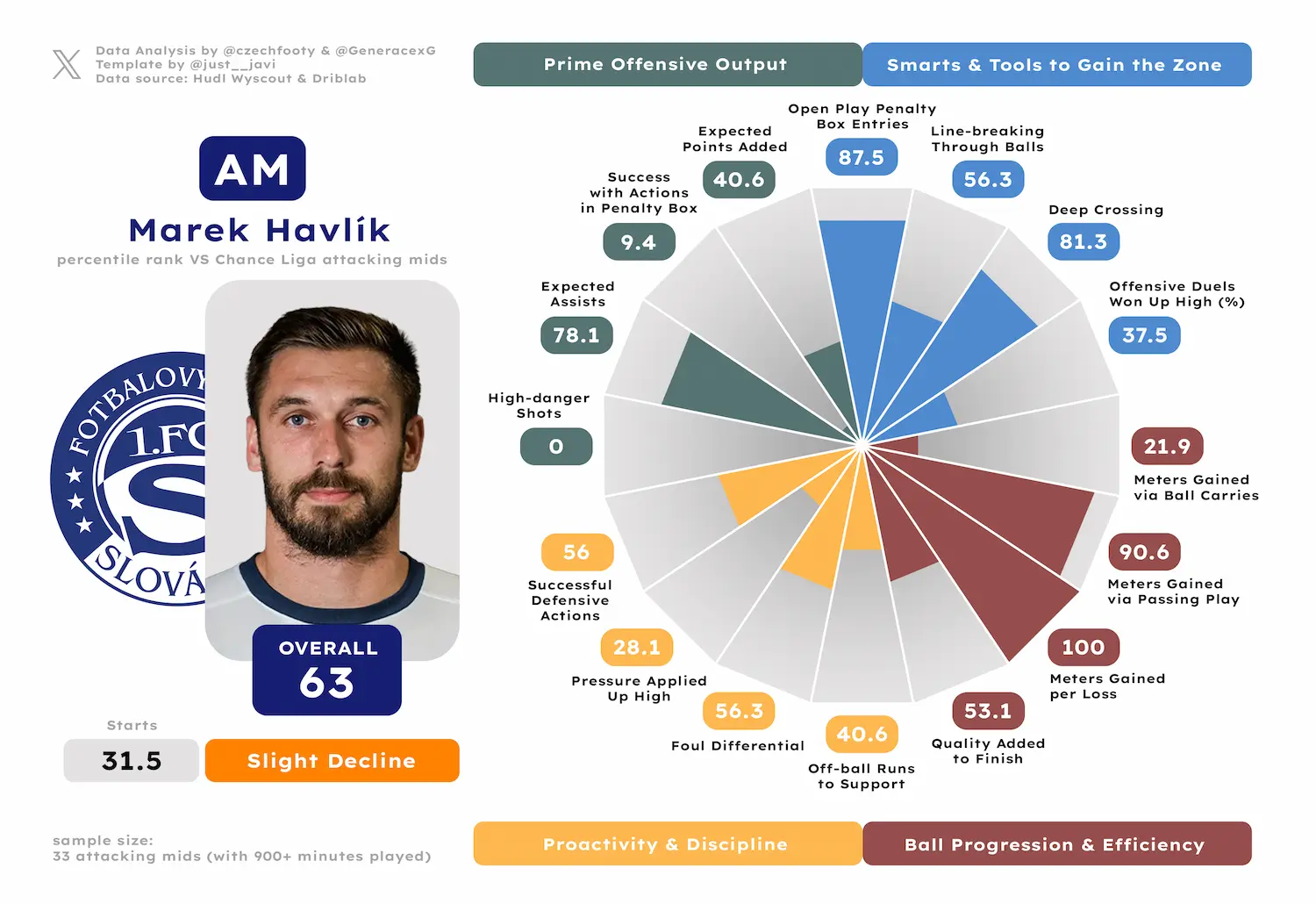
Per my MVP model (traditional stats): Marek Havlík (ranked 40th league-wide)
Per my positional models (advanced stats): Marek Havlík (63rd overall percentile at AM)
This is the third time Marek Havlík has wrapped up the season as Slovácko’s runaway MVP, and by far the least inspiring of the three. In 22/23, he produced a wonderful “suck-it” campaign, probably his best to date, in the wake of his partner in crime Lukáš Sadílek leaving. His pizza chart was pleasingly full, and his placement on the league’s MVP leaderboard was bordering the Top 10 (11th). In 23/24, he was already part of that Top 10 on the back of a 12-goal campaign, despite his pizza chart looking concerningly empty as a sign of decline.
This season, he lands somewhere in the middle in terms of overall percentile, enjoying a bit of a renaissance as a false right winger under coach Skuhravý. He rose back to top values in ball progression per loss as well as ball progression via passing play. His open-play penalty area entry rate jumped back from a below-average 1.00 per game to a borderline elite 1.97.
Rather notably, though, Havlík failed to crack the five-point mark for the first time since 2018 — and for the first time ever outside seasons in which he failed to reach 2,000 minutes. For the second time in a row he ended up contributing, directly or not, to less than 10 goals.
Chip on the shoulder
Slovácko are navigating an extremely difficult situation at the centre back position. Filip Vaško and Milan Rundić, already not all that special to begin with, have both been injured throughout the summer, and could yet be out for some significant time. Meanwhile, the club decided to take a number of fliers on the still-developing Tomáš Král, the world-travelled Jocelin Behiratche and especially David Štěpánek, who had never been anywhere close to starter calibre at CB in his 10-season career and immediately proved it in the 26/27 opener.
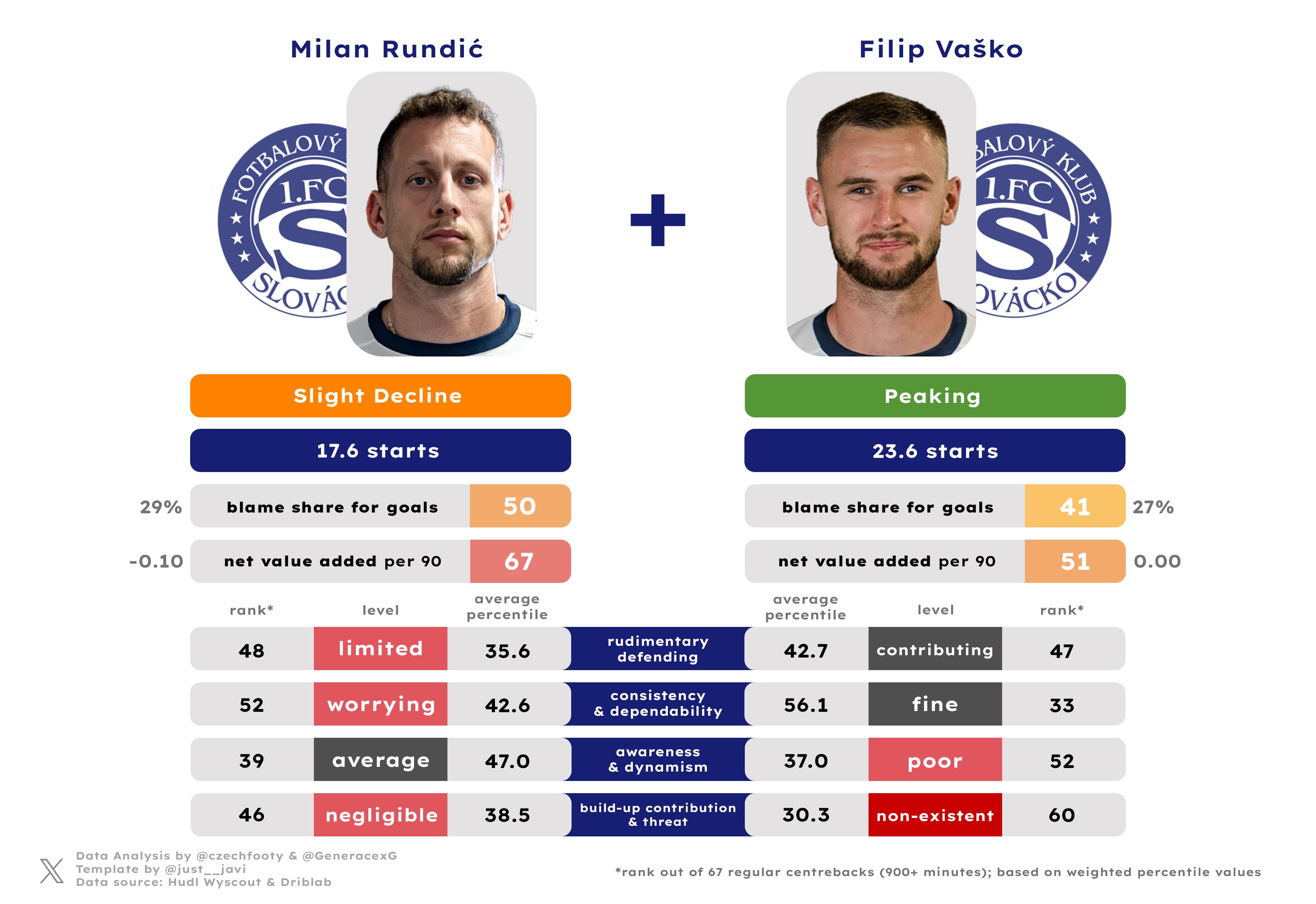
Through it all, only one constant has remained: Andrej Stojčevski. Now 23 and aging out of the “maturing” phase of his career, Stojčevski may need to put the decimated backline on his back — at least to open the campaign — and that might be far too much to ask of him at this point. There’s something to like about his game, but his emancipation on the ball was merely muted, and some familiar ailments have persisted. Most notably, he’s now landed in the 10th and 13.6th percentile for deep defensive (ground) duels while remaining vulnerable in the air.
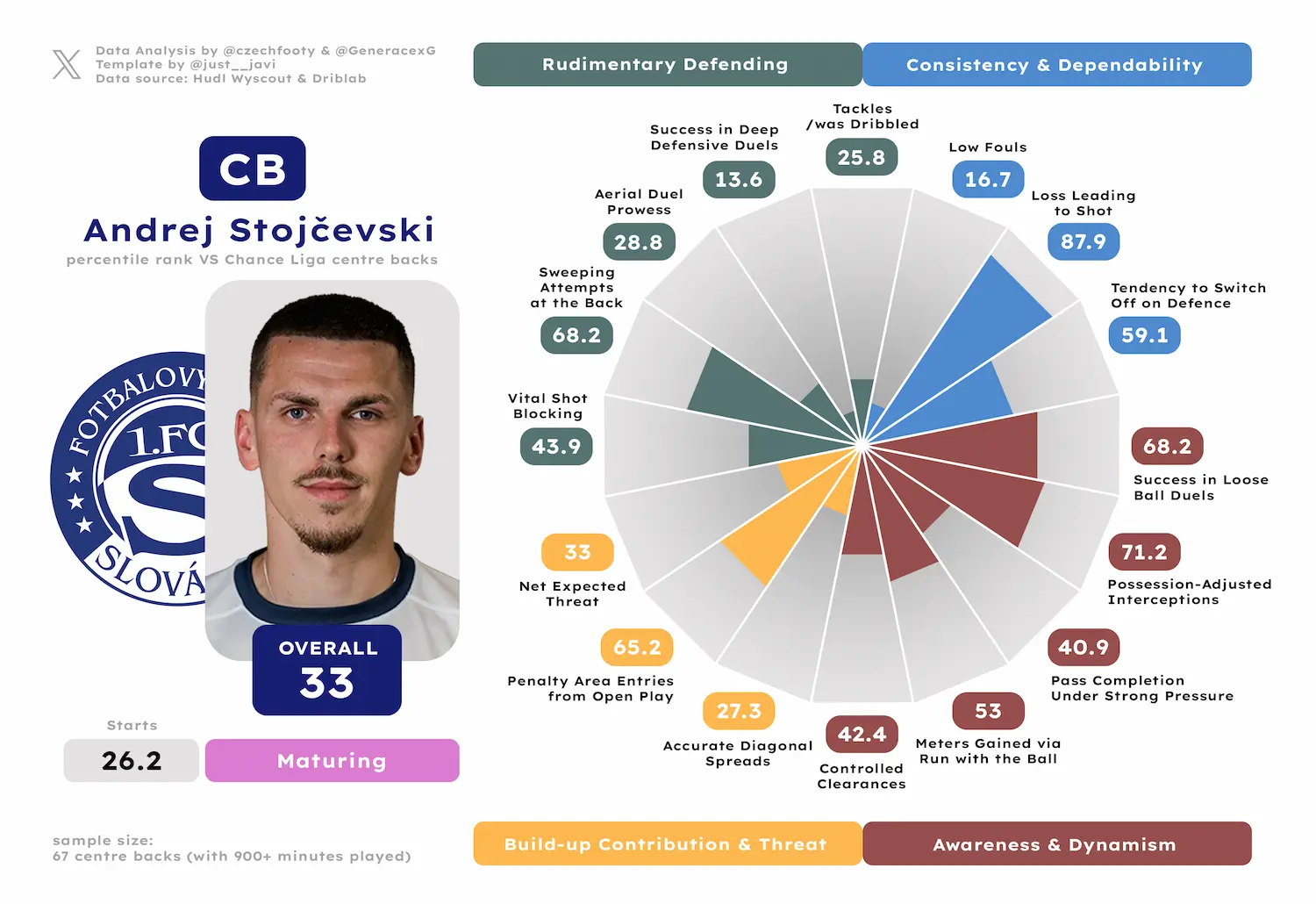
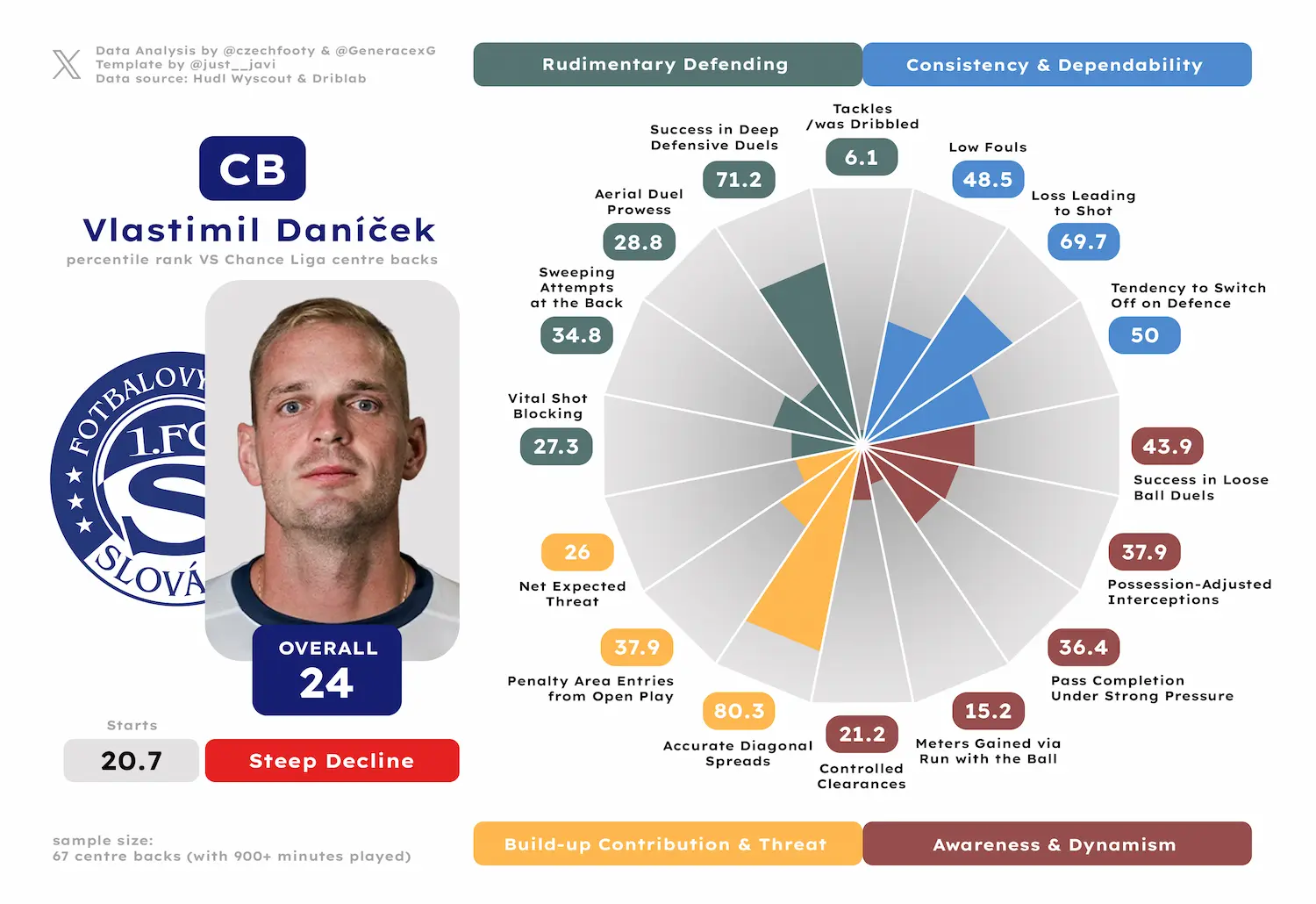
Perhaps most importantly to bridge this transition phase, though, even at a tender age for a centre back, Stojčevski has traditionally been a fairly reliable, focused option. That goes for 2025/26, too, when he was ranked 27th (out of 67) for “consistency & dependability”.
Inside the off-season
special thanks for guiding me through the motions of 1. FC Slovácko’s off-season go out to @Jiri_Stockmann & @slovackonafurt
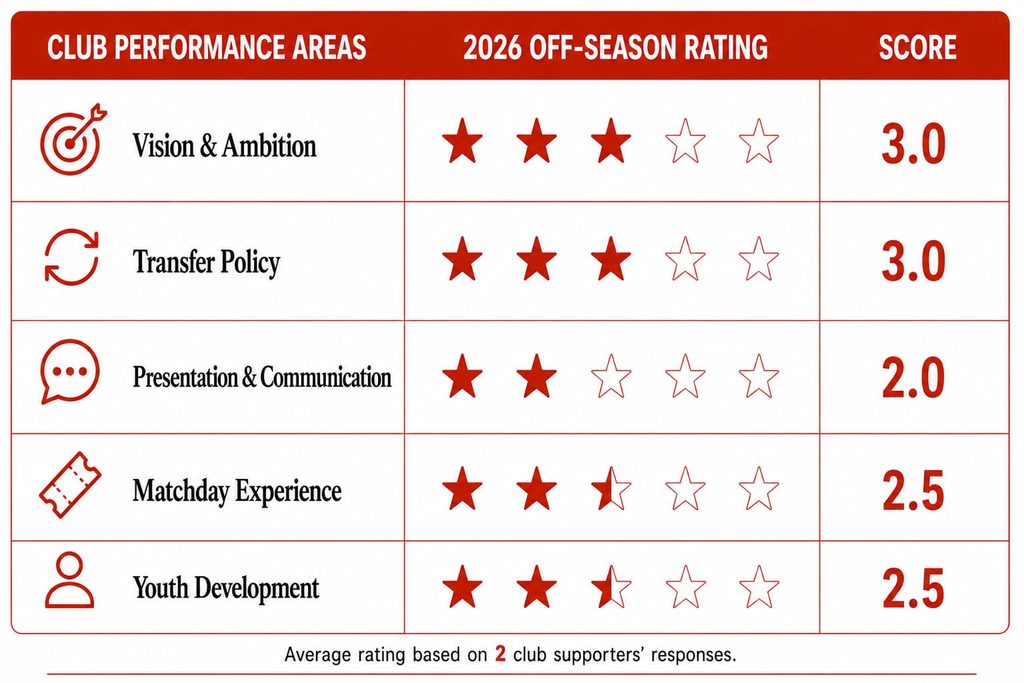
Squad turnover
Slovácko had a pretty well-defined core of seven players worth 20+ starts, and none of them is leaving. The only outfield members of the most utilized XI, Vlastimil Daníček (7th) and Petr Reinberk (11th), arguably should have never been this utilized in the first place. Generally, though, the story of 25/26 Slovácko was that only three purely attack-minded footballers fit inside the Top 11 — and one of them (Patrik Blahút) was a fullback for a big chunk of the campaign. Slovácko sorted through roughly six striker options, give or take, and five of them are now gone: Marko Kvasina and Žan Medved didn’t live to see the spring, Bryan Ouanda and Jan Suchan (so far) didn’t have their loans renewed, and Michael Krmenčík retired from professional football at 33. Only Pavel Juroška, who’s more of a winger anyway, remains.
Biggest upgrade
To their credit, it’s not like the club didn’t try to compensate for the centre forward losses, it’s just not clear how much they have actually gained. If you isolate Michael Krmenčík — who really wanted you to know that he didn’t enjoy running too much, after spending the year either offside, or whiffing on shots (2.86 pre-shot xG vs 1.07 xGSExpected Goals Scored (xGS) only takes shots on target into account, including their power and placement on top of xGF.) — you get an easy upgrade. Even Gianni Niarchos, who was good for 5-8 goals in Slovakia and only notched a single tally in Poland most recently, might represent that. Even Filip Horský, after over a year spent on the sidelines, could return looking instantly better. Even David Puškáč, never famous for his dynamism or proactivity, wasn’t nearly as inefficient off the ball as the outright lazy Krmenčík (producing league-worst 2.10 defensive actions per game, a grand total of 5 ball recoveries in the final third, and a measly 26.5% involvement rate in all danger created).
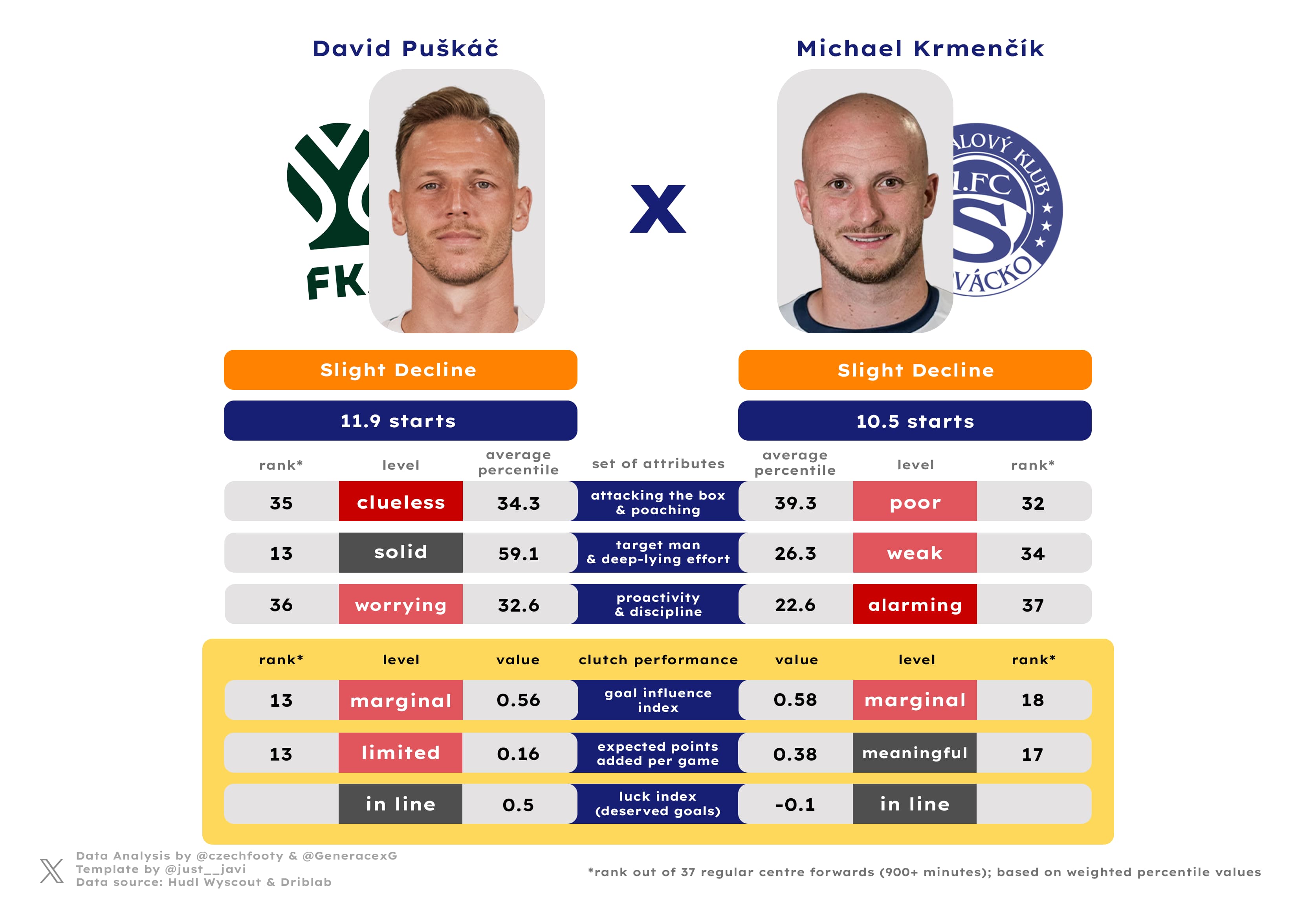
The thing is, when even the easiest player to upgrade is potentially getting upgraded by the slimmest of margins, you might have a problem on your hands. And that’s before we even get to the biggest downgrade, which actually makes the position weaker in the aggregate…
Biggest downgrade
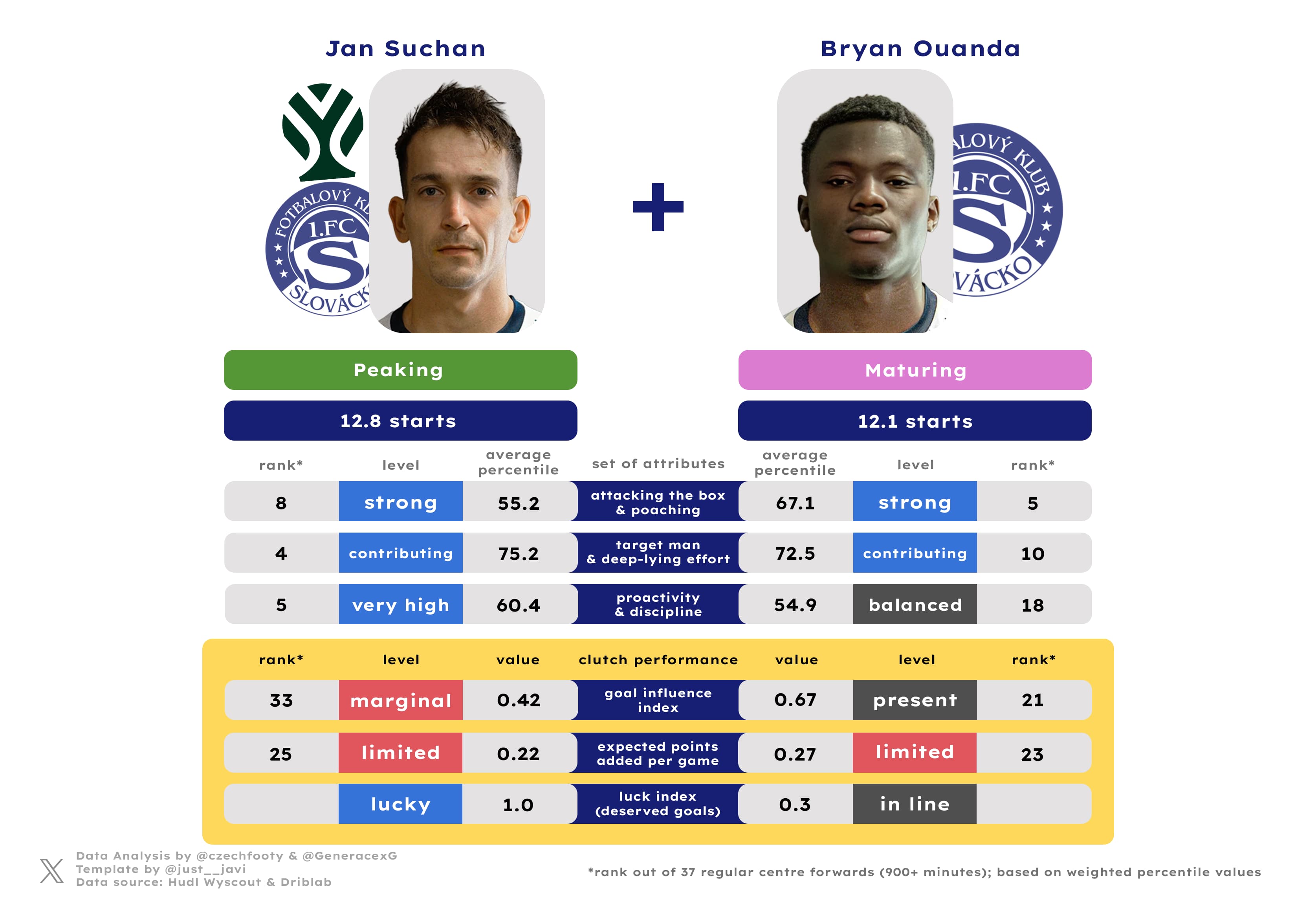
When Bryan Andonija Ouanda signed for Slavia, many barely noticed. When he was immediately dispatched to Uherské Hradiště, only a few more did. And then we watched. Despite only turning 21 halfway through the spring, Ouanda was the most complete forward Slovácko had on its books from Day 1 — and by a mile. He was so good even the peak versions of Václav Jurečka (landing in the 79th overall percentile in 21/22) and Jan Kliment (77th percentile the year before) basically had nothing on him, and that was when my model only took a fraction of metrics into account, making it easier to land that high in the first place.
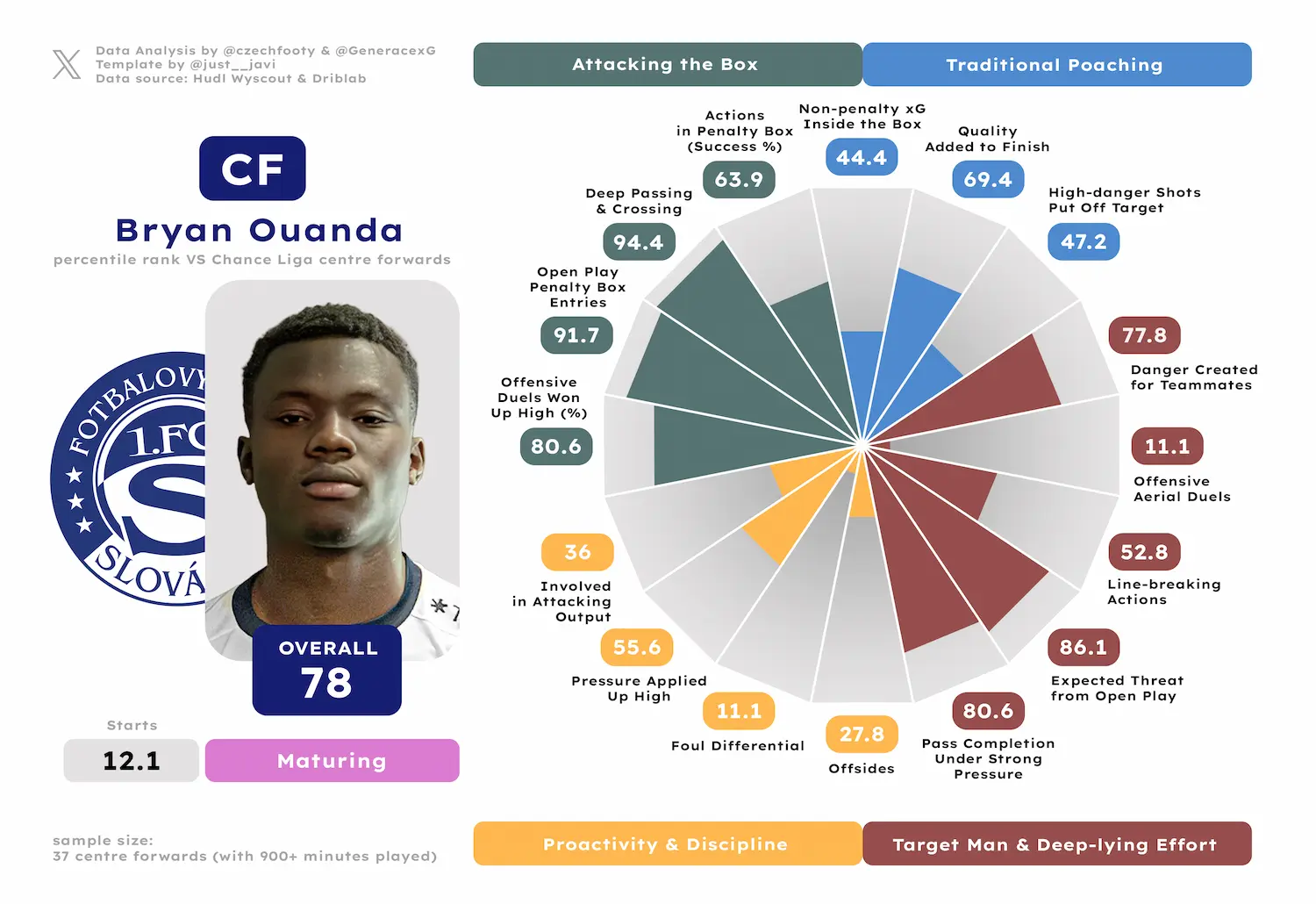
Ouanda was especially impressive in facilitating all sorts of attacks, both in build-up and on counters. Despite all his dynamic qualities, he wasn’t hasty and scored high on metrics like ball retention inside the attacking half or pass completion under strong pressure. He could have finished more regularly and capably, but he more than compensated with his creative flair — frequently beating his man 1v1 without being selfish, registering more deep completed passes or crosses per game than anyone not named Rrahmani and Chytil, and enjoying a good cutback. While only one of his four strikes was truly valuable, Slovácko will certainly miss his terrific knack for moving into the right attacking position, and do the right thing.
Since Slavia sure as hell don’t look like they are parting ways with Ouanda again, and Luboš Kozel looks happy with Jan Suchan as well, Slovácko are simply shedding too much value.
Need left to be addressed
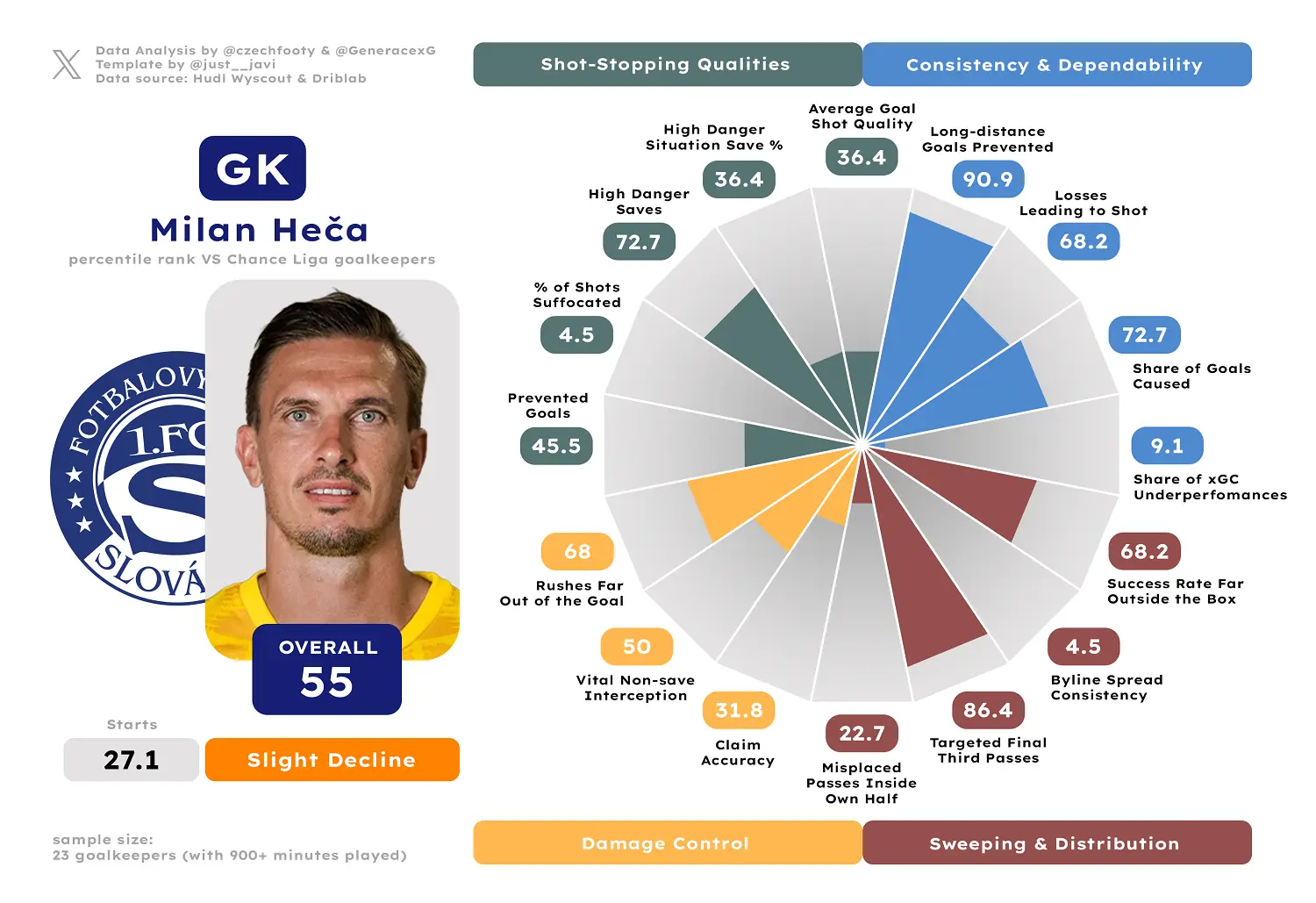
Last summer, I rated Slovácko’s goalkeeping tandem of Jiří Borek and Milan Heča as one of the two worst ones in the league. This summer, literally nothing changed: Borek once again participates on one of the two weakest GK crops at Artis, while Heča headlines the other one. The situation is only made worse by the veteran missing the summer camp for injury, and Alexandr Urban — this year’s youngster who’s not all that young at 22 — bombing horribly in the opener. There’s also Pavel Halouska as a new number 3, but Slovácko fans may remember their team effectively chased him out of the league through five goals in September 2021. Now he’s 31 and returning, having travelled Czech and Slovak lower tiers.
No, Halouska is most likely not saving anyone’s season, and so it’s once again down to Milan Heča; now in his mid-thirties but still going strong… ish? His goalkeeping technique is still inadequate, while his distribution inside the defensive half keeps boggling minds, but he wasn’t aggressively bad in the shot-stopping department and surprisingly only let one shot from outside the box past him (after allowing six of them fly past in 24/25). Could Heča stave off the obvious, long-standing need to bring in a bona fide starter for a little while longer?
New kid on the block
Even after the retirements of Milan Petržela, Vlastimil Daníček and Petr Reinberk, Slovácko’s first-team roster still features four homegrown talents with ambition to start regularly, and the club is actively working on keeping the pipeline as productive as ever. A year ago, Jiří Vorlický — father of Lukáš, who has now joined him — arrived with a specific mandate to connect the men’s A-team with the B-team, while Marek Hábl followed him this past winter to oversee the youngest categories in a newly created role as well. Signing 15-year-old internationals to first professional contracts also wasn’t always the practice here.
And neither was promoting 18-year-olds to a seemingly full-time A-team role, like in the case of Filip Hruška (b. 2008). Jan Jelínek is, of course, most famously signed under the rapid ascent of David Tkáč at neighbouring Zlín and here he has another gifted central midfielder who contributes at both ends of the pitch and can really hit it (Tkáč had six goals in his debut campaign). Coming on for the last 5 minutes of the opener against Slavia, Hruška boasts a substantial pedigree: from playing a regular role for the 3rd-tier reserves soon after turning 17, to representing his country at the U-17 World Cup last November. Now he may potentially feature next to Michal Trávník, who participated as a 16-year-old Slovácko prodigy on the only prior Czech experience at the world showcase of the best U-17 talent in 2011.
Looking ahead to 2026/27
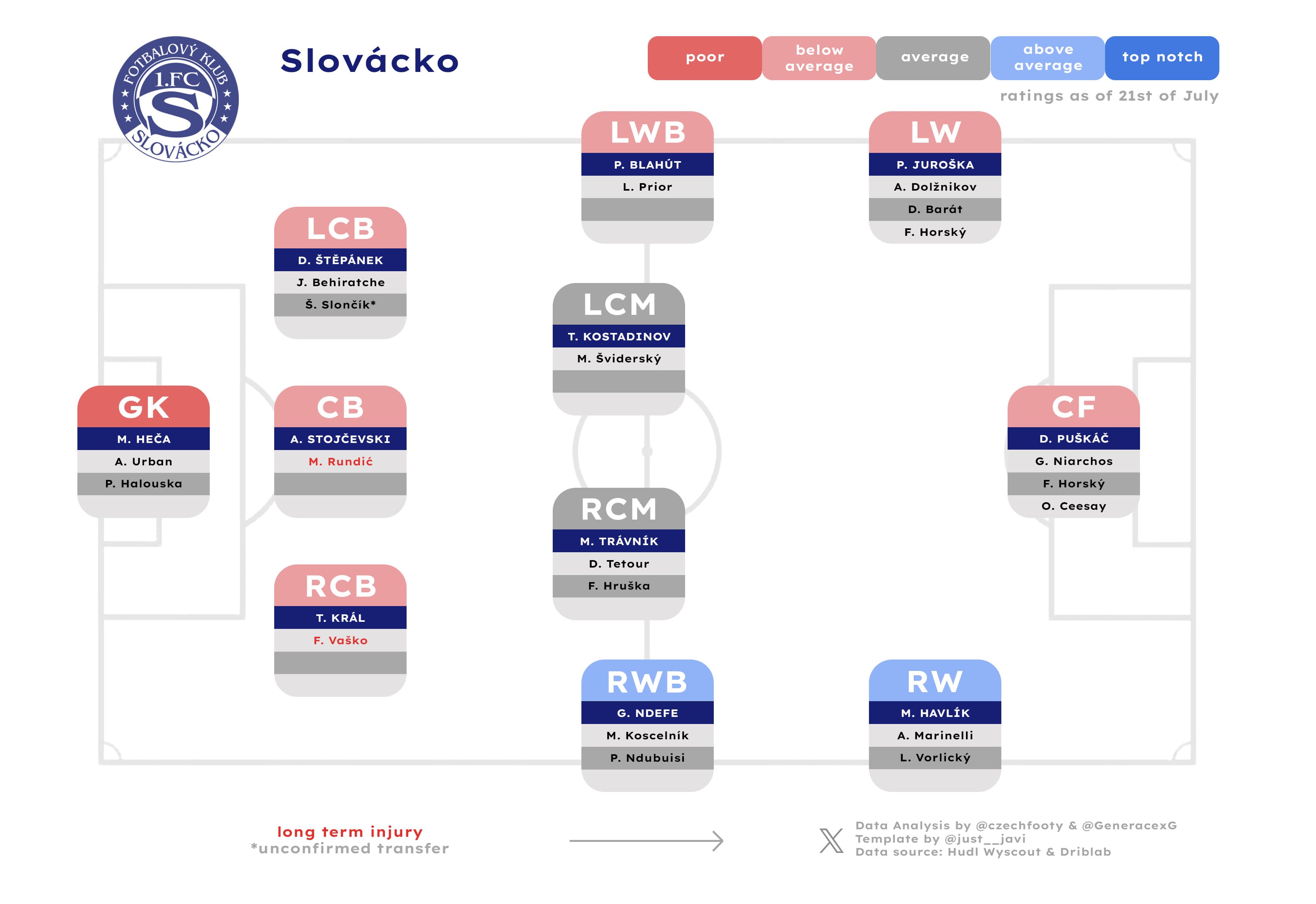
Below is the team’s current depth chart with a maximum of 4 alternatives for one position. The colourful ratings are a static snapshot of the league-wide situation on 21 July, and they are just a playful bit to add flavour to it; the names featured should be relevant to this day. To learn more about my approach to constructing depth charts, with all its limitations, head here.
Primary formation
Even judging by the opener, Jan Jelínek looks to continue Skuhravý’s tradition of 3-4-3/3-4-2-1; a formation he also preferred in his time with the Slavia B-team. Then again, Jelínek used to be a 4-5-1 man at Zlín and given the CB and CM options, it’d be the smarter choice here.
Colours I grappled with
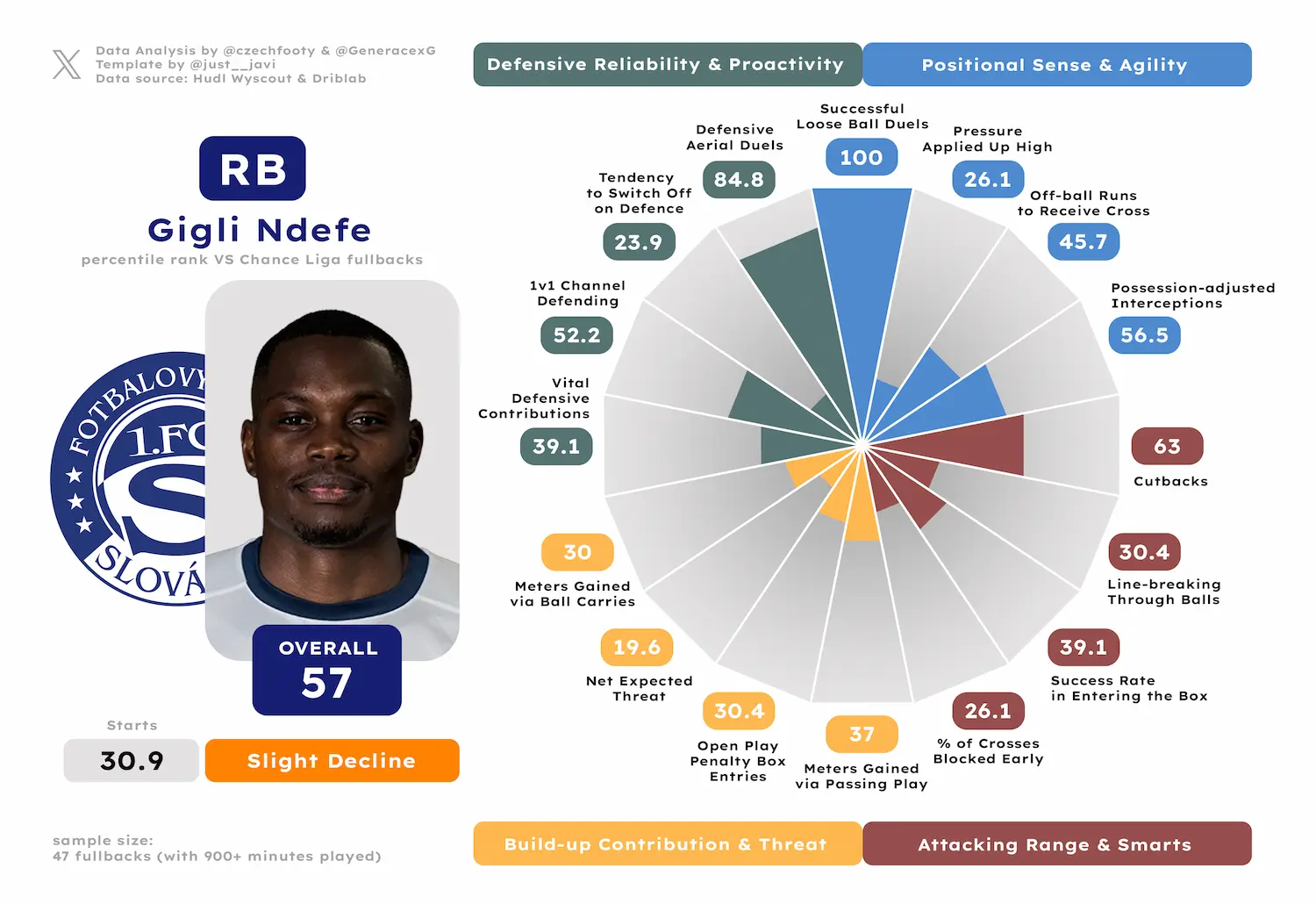
I understand how you wouldn’t expect any shade of blue on Slovácko’s depth chart, and I admit to this being a massive vote of confidence to Havlík’s bounce back above all. But I don’t think Gigli Ndefe is nearly as washed as he could be at his age (turning 33 later this season), and the backup options in Paul Ndubuisi, Alan Marinelli or Lukáš Vorlický all seem to me as potential cases of high-risk, high-reward. Accordingly, the “above average” tag is a risk.
Notes on the depth chart
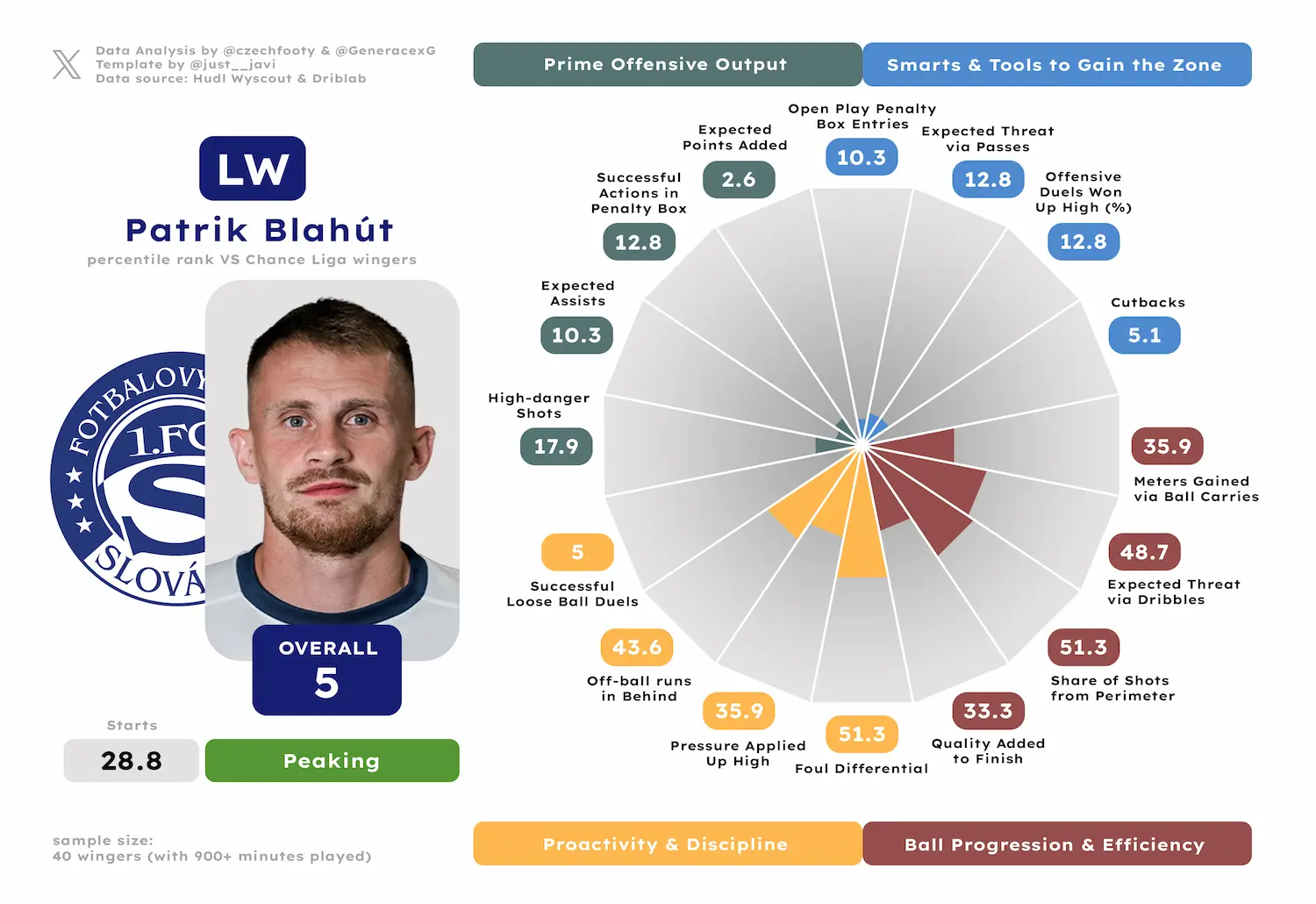
Patrolling the opposite side is Patrik Blahút, qualifying more as a winger than a fullback, which is decidedly bad news for him. There’s only one above-average score on this pizza chart, and it’s foul differential (you may not care much about) by a literal hair. Even if you ran him through the FB model, his offensive values wouldn’t get past “mediocre” territory.
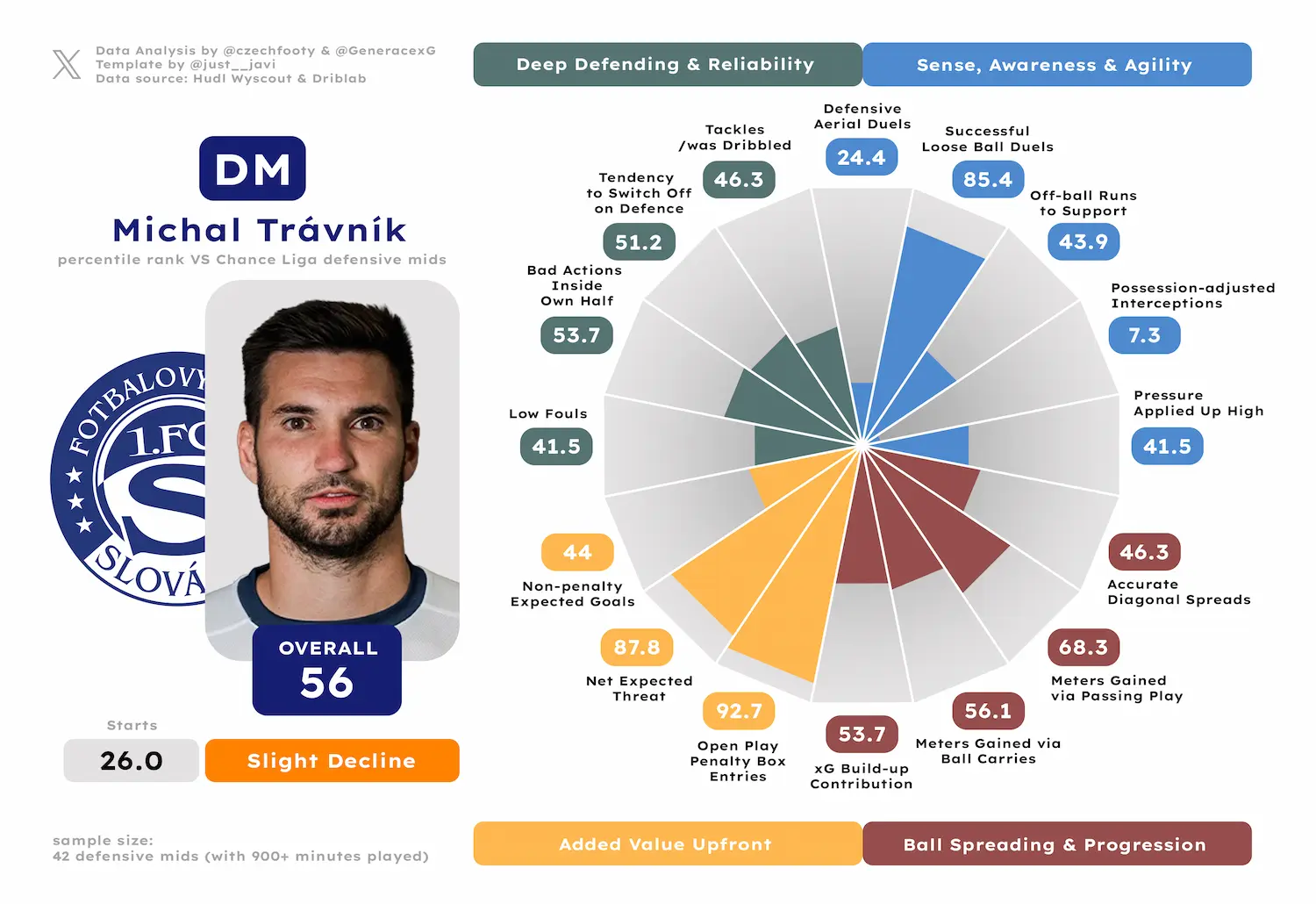
One fine position Slovácko consistently roll out is the central midfield, which amazingly continues to be true even after Havlík’s gradual move away from central positions. That’s mostly down to Michal Trávník. This campaign wasn’t quite MVP-worthy like his 24/25 was, but he was still a solid midfield general many teams lower down the table critically lacked.
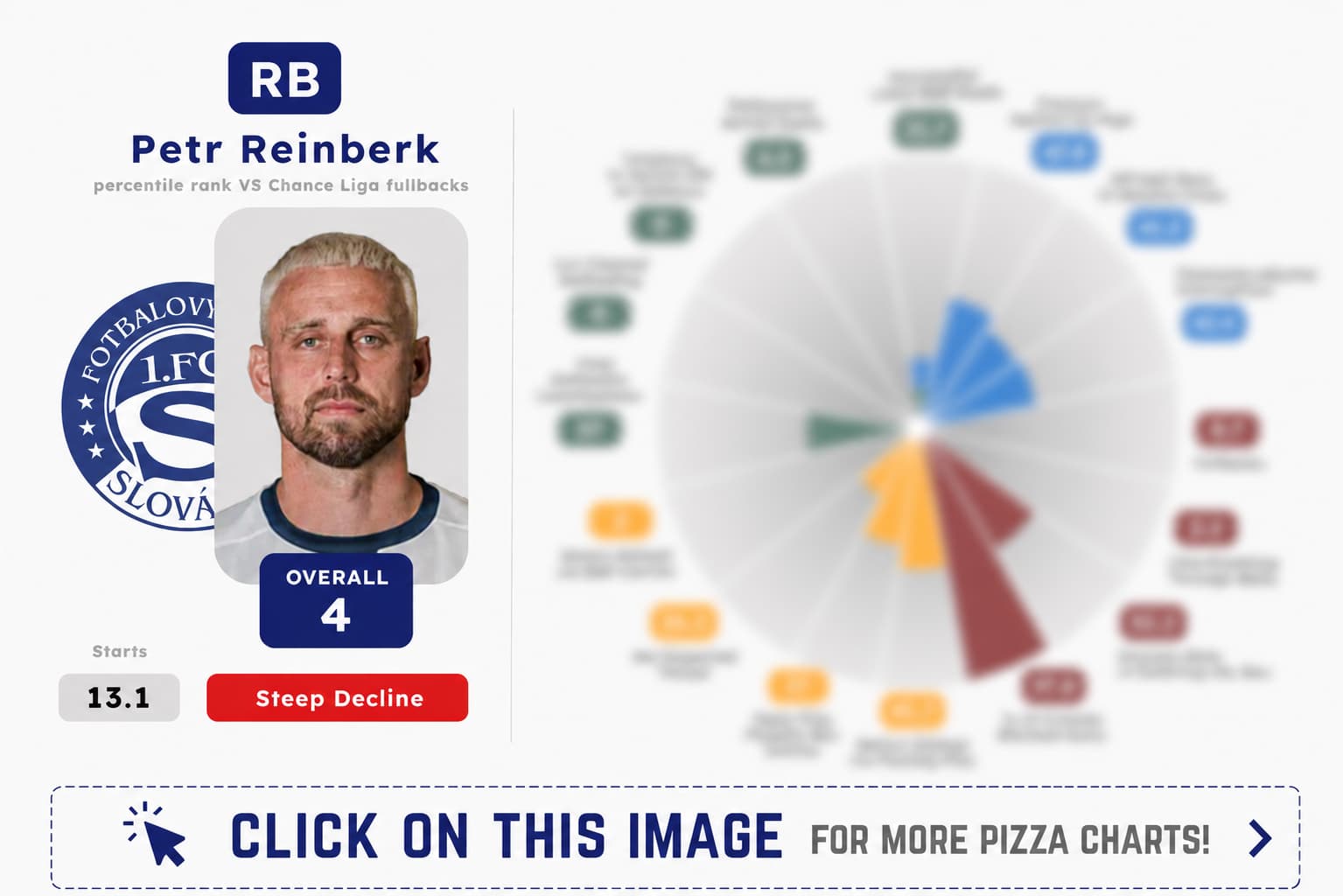
Finally in this space, let’s pay farewell to one of the league’s great statesmen. Vlastimil Daníček managed to accumulate 20 starts including added time, even while battling repeated injury issues, which likely showed on his very exploitable pizza. It was about time to retire.
Roster battle to follow
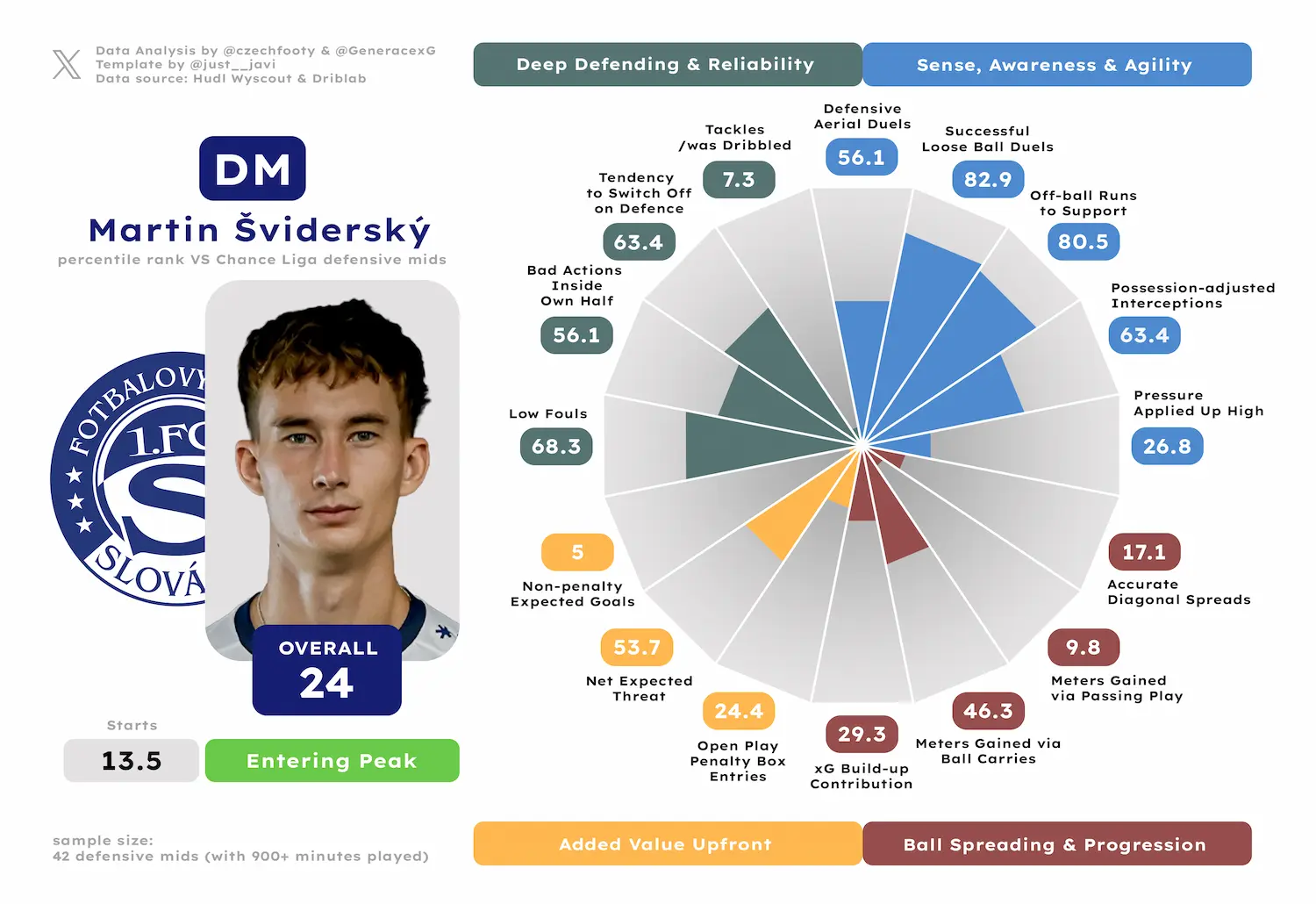
There was a time when Martin Šviderský looked like a perfect signing for Slovácko: the right age bracket (not too young, but right before starting to hit his peak), some high-end pedigree gathered in Spain and England, and the coveted profile of a ball-playing centre back/midfielder. Soon after, it became clear he’s only coming to take up the CM duty, and the early returns there were hardly amazing. He didn’t drown defensively but also didn’t move the needle offensively, with his sweet left foot only coming through on the odd occasion. Now he’s a firm backup who could only be good enough for a midfield trio.
On the other hand, I expected very little from the return of Daniel Tetour and I must say I was pleasantly surprised for the best part. His end-of-season balance card also looks rather flattering, with Tetour fitting inside the Top 10 for two vital sets of metrics. He’s one of only five attack-minded midfielders to produce 2+ line-breaking through balls per game, and no other AM enjoyed a higher success rate in entering the penalty area from open play (64.3%).
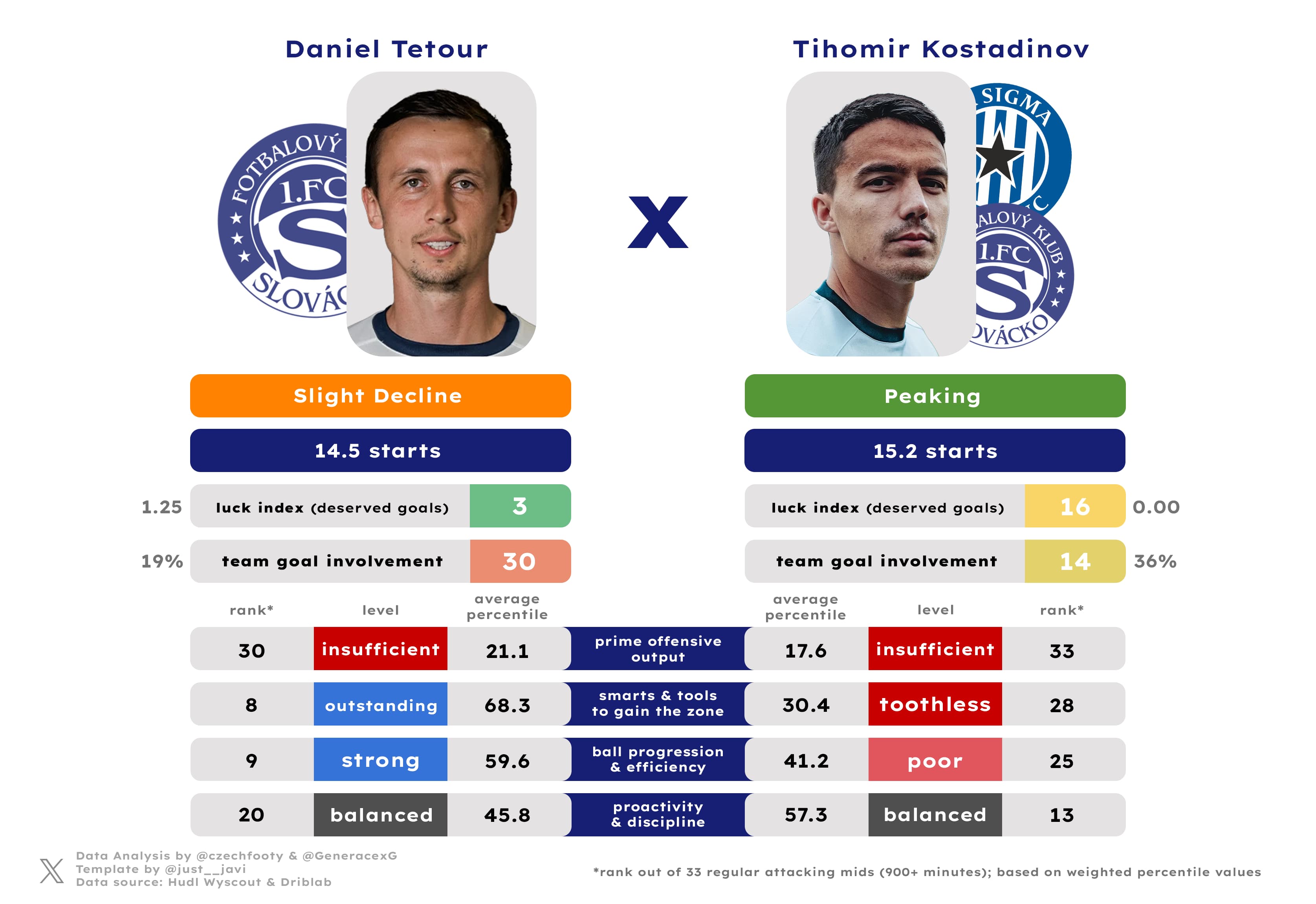
Conversely, I’m not even sure Tihomir Kostadinov is an attack-minded midfielder based on what he showed at Sigma and Slovácko in 25/26. He did arrive as one, sometimes even pushing all the way up to centre forward or wing in Poland, but here he made four shot attempts, plain refused to ever cross into the box, and his deep passing was not much better.
On the whole, there is a lot more to ask from Slovácko’s CMs in terms of attacking support.
Season forecast
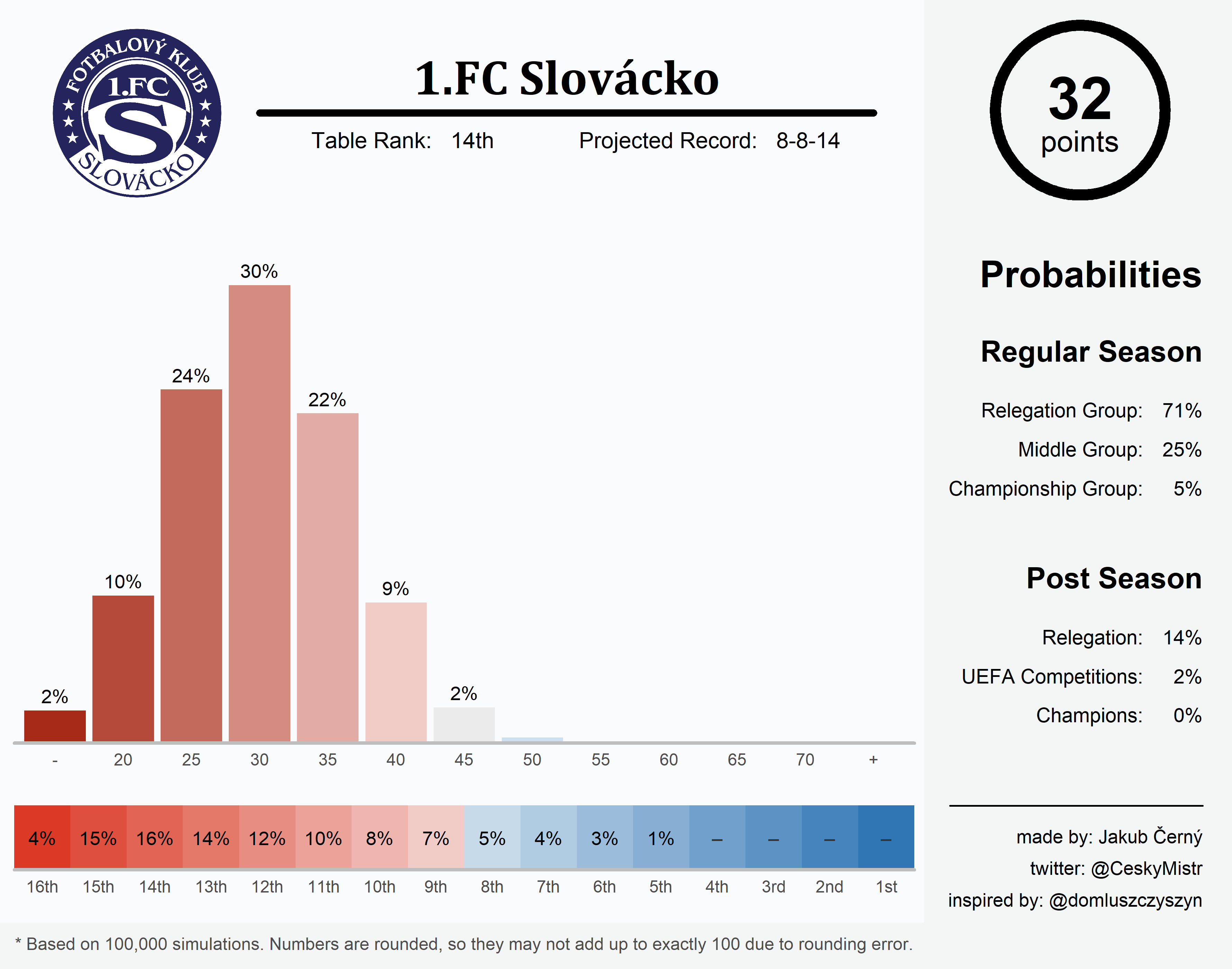
A slight bump up. That’s all Slovácko get, and pretty much all they could have hoped for. After seemingly bottoming out with a projected 30.1 regular-season points in 2025 — down by nearly twenty points in just two years! — they are proving the only way is up, though only barely. The prospects of staying up have improved, from 80% to 86%, but their relegation group placement is just as nailed on as it was a year ago (between 71-73% likelihood). Slovácko are in some sort of trouble, either directly relegated (2.8% chance) or once again competing in the relegation play-off, in roughly every third simulation out of the 100,000.
Bold prediction
The track record: 0/5. Kameník had just one shot at a big Zlín win, and it was a 1:1 draw
The prediction: Havlík will score his first 26/27 goal when Svědík comes to town
The rationale: Unless something weird happens, we’ll soon get to see Martin Svědík back in Uherské Hradiště, this time pacing around the visitors’ dugout, which will be… deeply weird.
Circle it in your calendar: 17 October 2026. At that point, Svědík will come to Městský fotbalový stadion Miroslava Valenty facing the home side after a long 9 years, 7 months. He will have coached 224 league games more by then. When they last successfully tried to beat him, Milan Heča and now-retired Vlastimil Daníček were just entering their peak at 25, Marek Havlík (21) hadn’t even completed his first 100 top-flight starts yet (he’ll have four in no time), and Veliče Šumulikoski was still the veteran presence on the pitch at 35.
It just so happens that Havlík, who later experienced his best years under Svědík, scored on the day. It just so happens that strike against Boleslav was also a last-minute winner, his very first game-clinching goal of his rich career. Sure enough, he’s going to welcome Svědík back. After bagging a single tally in 25/26, this is how he’ll open his 26/27 scoring account.

Enjoyed it and just want to casually support us with an amount of your choosing? No worries, you can still do that by inviting us for a symbolic pint at the old BuyMeACoffeeBeer page.