Last summer, their first without any sort of European qualification in a decade, was uncharacteristically quiet for Slavia. There was no marquee signing, just a scouting video making waves. Pavel Tykač was already old news, while the accompanying mega-deal with Tipsport was probably perceived as little more than a drop in the financial ocean. The biggest news, meanwhile, was a new club-run fanshop or the establishment of a C-team. Šeberov was best left unmentioned, much like today. Then the season happened. And now, the recent movie The Drama pales in comparison to whatever is happening in and around Eden. Talk about the calm before the storm. And the fallout is still unfolding as we speak.
There probably isn’t a single Slavia fan who wouldn’t be left offended, or at the very least perplexed, by the club’s various actions on several different fronts. Some cared about the increasingly negative football on display, though not nearly as many as some journalists would have you believe, and the pre-season has gone some way towards curing that. Some were beyond done with Tomáš Chorý or even David Douděra, but many didn’t agree with the very public reckoning that followed. Everyone was appalled by the abandoned derby incident, yet hardly anyone could decide whether the club or Tribuna Sever handled the fallout more poorly. While Jaroslav Tvrdík had his face ID fiasco, the TS ultras — effectively a state within the state, run by a small group of neo-Nazis that has been bullying ordinary fans for years — repeatedly failed to assume any sort of responsibility, in the process endangering the wonderful tifos Slavia have become famous for abroad. (The room I talked to is split on whether Banda Chorea, the group behind them, is getting swept up by the incident or not.)
On top of all this, a couple of true sour cherries were served up. First came the appointment of Jiří Komorous, whose StB past might not even be the biggest issue, to the role of a security advisor. Second, many innocent fans lost access to Tribuna Sever season tickets as a result of Slavia’s odd “open letter” made worse later by the two-faced Chorý resolution. And finally, yet another summer spent battling the faulty Ticketportal somehow still running the show.
It must be tiresome to be a Slavia fan these days, which is especially sad to say amid one of the strongest transfer windows in recent memory, and while the actual fan experience in and around the stadium is improving year after year thanks to some tremendous work from David Šrámek. To that end, it’s good to know there won’t be any (adult) fans to serve for only the first four 26/27 games, with Fortuna Arena preparing for a much-needed expansion.
Looking back on 2025/26
What went right
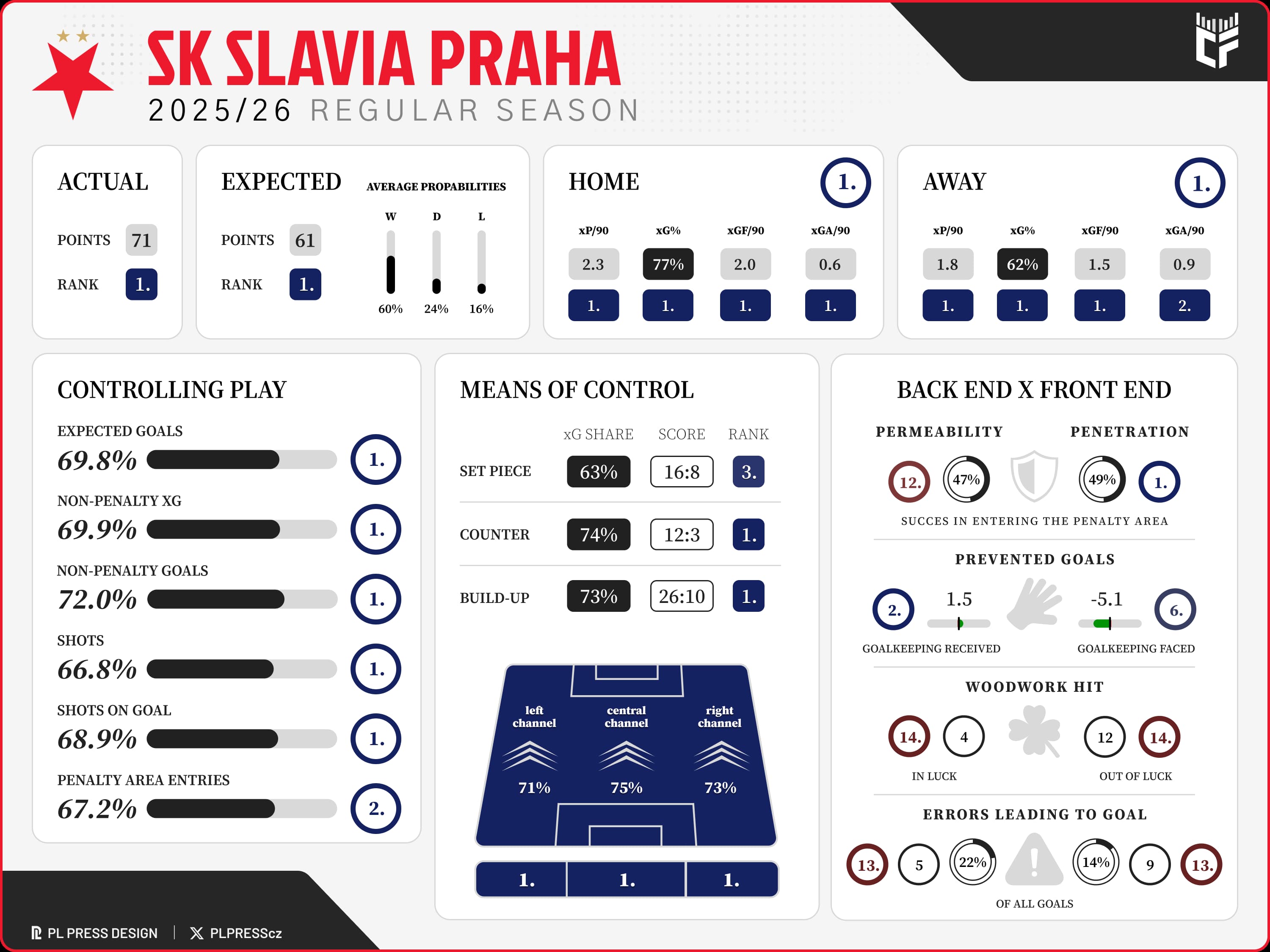
There were a couple of points spread across the season at which it could have derailed but decidedly didn’t. The first test, which many assumed Slavia weren’t ready for, came with the first Chorý suspension; meh, Slavia responded by scoring thrice in 4 of 6 games without the striker. After spending the October international break preparing for back-to-back goalless performances, many were left wondering how long Slavia’s offensive struggles can continue; the team responded by knocking November out of the park and winning the remaining 6 autumn games with an impressive goal average of 3.17. The administrative loss in the post-season derby? Followed by the top xG performance considering both ends (plus-2.95).
These days, Slavia’s team card is almost guaranteed to feature exclusively the dark blue in sections that matter the most. Last year was no exception, even if their average win probability based on xPExpected Points (xP) measure a team's likely point gain from a particular game; not only based on sum xGF and xGA, but also based on distribution of shots (ie. five 0.01 xG shots won't give you the same chance for a win as one 0.05 xG shot). dropped low, from 71% to 60%. Ultimately, though, campaigns are decided by one’s ability to weather adversity — and no one did it better than Slavia.
What went wrong
Then again, you could easily argue there was far too much adversity to deal with in the first place. Only getting beaten in Round 29 is nice and all, but picking up eight draws before that certainly wasn’t ideal. The aforementioned back-to-back goalless performances? It hadn’t happened to Jindřich Trpišovský since his first half a year in charge of Slavia (April 2018), and it was worse than that — part of a five-game sequence in all competitions with just one goal scored. Somewhat notably, when you looked at head-to-head matches between the Top 8 at the halfway mark, Slavia sat 5th with just one victory against Plzeň (at the last try) to their name. Sure, five of those matchups occurred on the road, but it was still a sign of fragility.
Most valuable player
Per my MVP model (traditional stats): Lukáš Provod (ranked 3rd league-wide)
Per my positional models (advanced stats): Lukáš Provod (100th overall percentile at AM)
While any league MVP discussion upon the conclusion of the season centered around Tomáš Chorý or Vladimír Darida only, I am of the opinion that you simply shouldn’t look past a record-equalling three red cards in this exercise, instead going for the one who never lets you down. A model of consistency, this is the second year in a row Lukáš Provod easily claims the crown among attacking midfielders after only trailing Haraslín among 23/24 wingers. While his 24/25 pizza chart was a tad more intense, his average percentile values across the “prime offensive output” and “smarts & tools to gain the zone” groups of metrics still read 89.5 and 92.4 respectively. All that in a year when I considered by far the most stats.
Plain ridiculous.
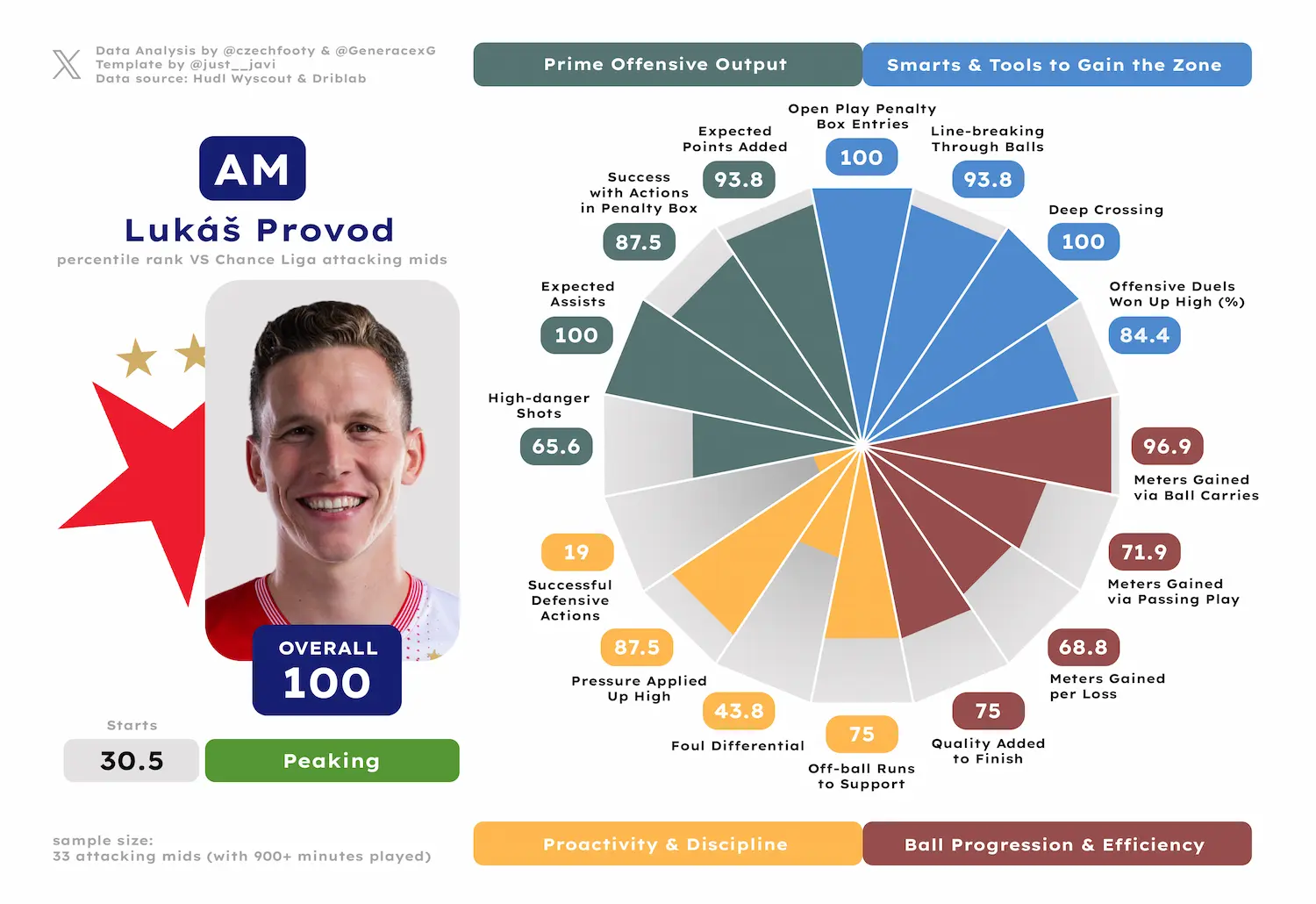
While Chorý bested Provod in terms of all goal contributions, it was by a hair (27 to 26), and the midfielder/winger was arguably a bigger factor whenever he was unavailable. With Provod on the pitch, Slavia produced 2.35 goals and wasted 9.6 big opportunities per game; without him those rates plummeted to 1.63 goals and 6.9 big opportunities respectively. With Chorý, there was no drop: 10.7 dangerous situations per 90 giving way to 12.1 in his absence.
Chip on the shoulder
Chorý won’t be allowed to feature in the first 3 games of 26/27, and that’s as big a chance for Mojmír Chytil to prove himself as they come. He had already carried a sizeable chip on the shoulder through much of 25/26 after Tvrdík randomly called him out for being insufficient, and it turned into what was arguably his career year. Could he possibly do even better?
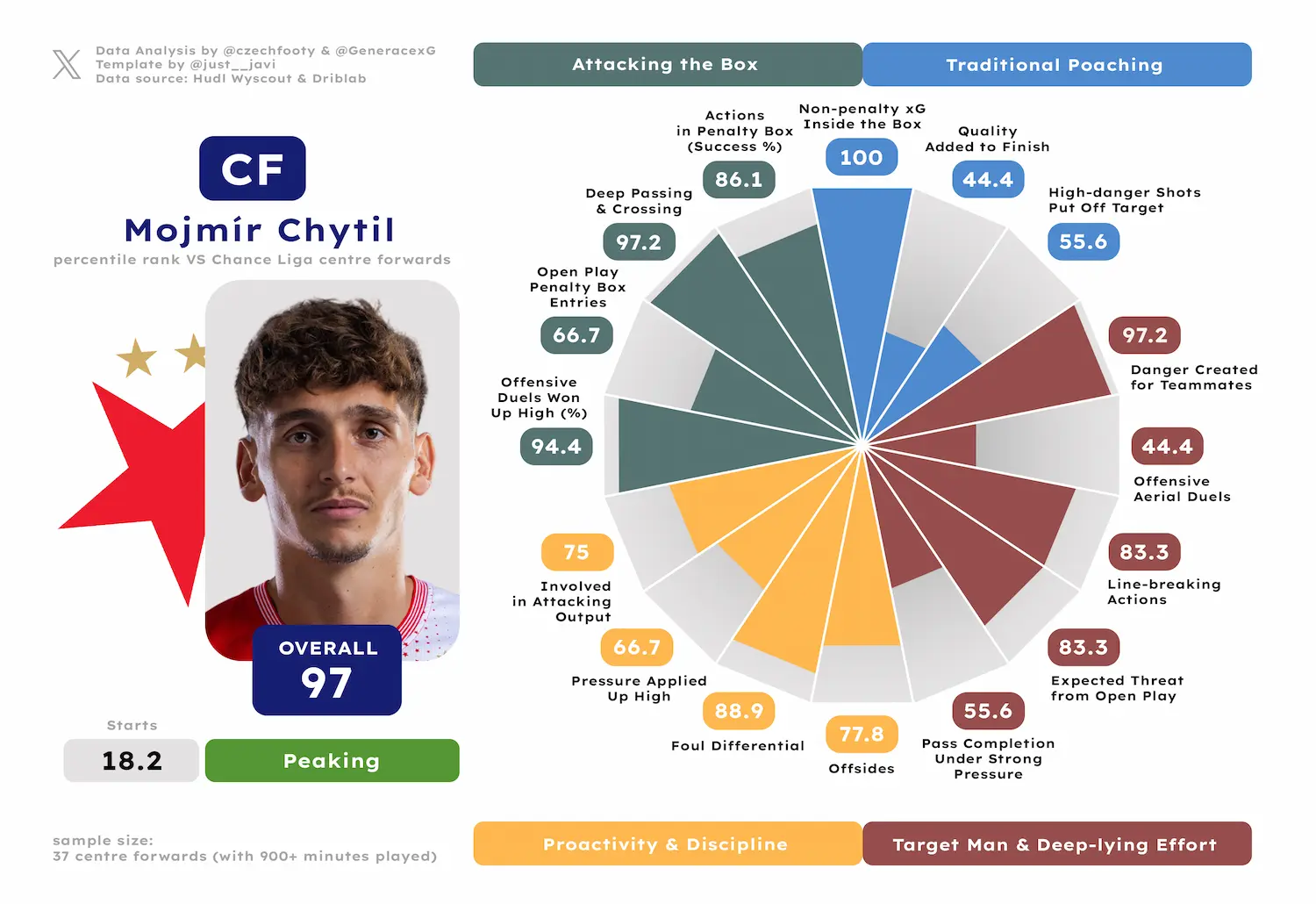
Honestly, I don’t get why it’s so inherently controversial still to even make an argument for Chytil being the better of the two. Chorý obviously provides strong presence up front, but so does Chytil, racking up more inside-the-box xG over a similar number of games, creating more opportunities for teammates, faring better in ground duels and being the more assured finisher. Of the 16 metrics featured on the pizza chart, Chorý takes home a mere four.
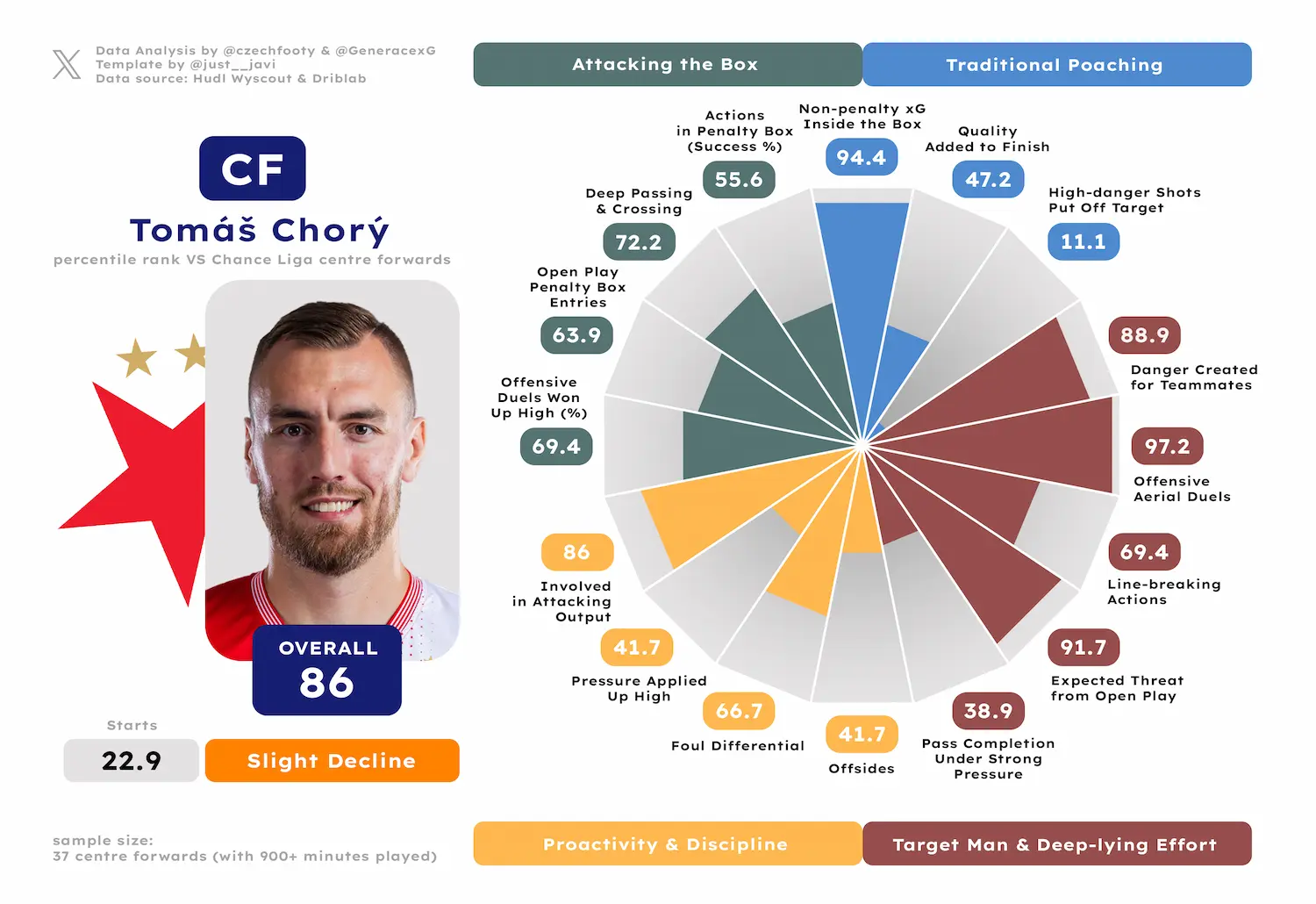
Indeed, even for entirely performance-related reasons, Tomáš Chorý himself should feel a massive chip on the shoulder, since he took a considerable step back across the board. His hold-up play was weaker unless he was asked to climb up in the air (he was the top dog in “target man and deep-lying effort” last term, now he ranks 6th), he wasn’t nearly as effective and dangerous a fox in the box as he used to be, the 10 high-danger shots put off target (out of 21) loom large for someone who’s supposed to lead by example as a goalscorer, and that’s without mentioning the fact Chytil appeared in 0.15+ xG situations far more often (1.48 vs 0.92). Chorý was still very much indispensable, adding an unrivalled 0.82 expected points per game, but he barely outdid Chytil’s non-penalty goal total despite more opportunities (11 x 10), and there are other concerning trends in his open-play performance, too. This was arguably the best time to move on from him, all things considered, but Slavia couldn’t.
Inside the off-season
special thanks for guiding me through the motions of SK Slavia Praha’s off-season go out to @martin_kabelka, @quelhar, @Dominik___N, Em Džej, @Ivinho_19, @ptc, Štěpán Ševčík, Jan Formánek, Patrik Zapletal, TSeguinTS, Kraca7 & Thorklaer
Squad turnover
Where exactly will Slavia trim their bloated squad? That’s always the big question in this space, and this summer is already a bit different in that the likes of Denis Halinský, Albert Labík and Mikuláš Konečný seemingly received assurances they are going nowhere. It’s also a lot different in that there is not one departing player without whom you couldn’t imagine life. That was the case with Malick Diouf last year or David Jurásek three years ago, while Václav Jurečka in 2024 wasn’t quite that but he was at least taking 25 points with him.
Make no mistake, Slavia are losing an uncharacteristic ton of minutes over the summer. With Oscar and Jindřich Staněk negotiating transfers away from the club and Douděra also set on a foreign adventure, Slavia may still drop to 66.7% minutes retained, ranking somewhere around 13th place league-wide in terms of rigidity. That’s very much unprecedented.
Then again, all five prominent faces of Slavia’s summer exodus (the trio above plus Jan Bořil and Vasil Kušej) are, to a degree, cases of “having overstayed their welcome”, so Slavia could or should be better off without all of them. The most used departing player (Bořil) was only the league’s 105th most utilized guy, and the most valuable departing player per MVP points (Kušej) dropped all the way down to the brink of the Top 30 following an anonymous spring.
Slavia will be fine.
Biggest upgrade
Speaking of Kušej, his macro as well as micro stats perhaps surprisingly stood the test of (horrible) time endured without a single pause since Round 11. It speaks to how excellent he was across the first third of the regular season that he still led all the wingers including Haraslín in open-play penalty box entries, while landing in the 90th percentile and above in metrics like expected assists, successful actions in the box or expected threat via passes. This is the power of data. Unlike many fans and journalists, it does not suffer from memory loss.
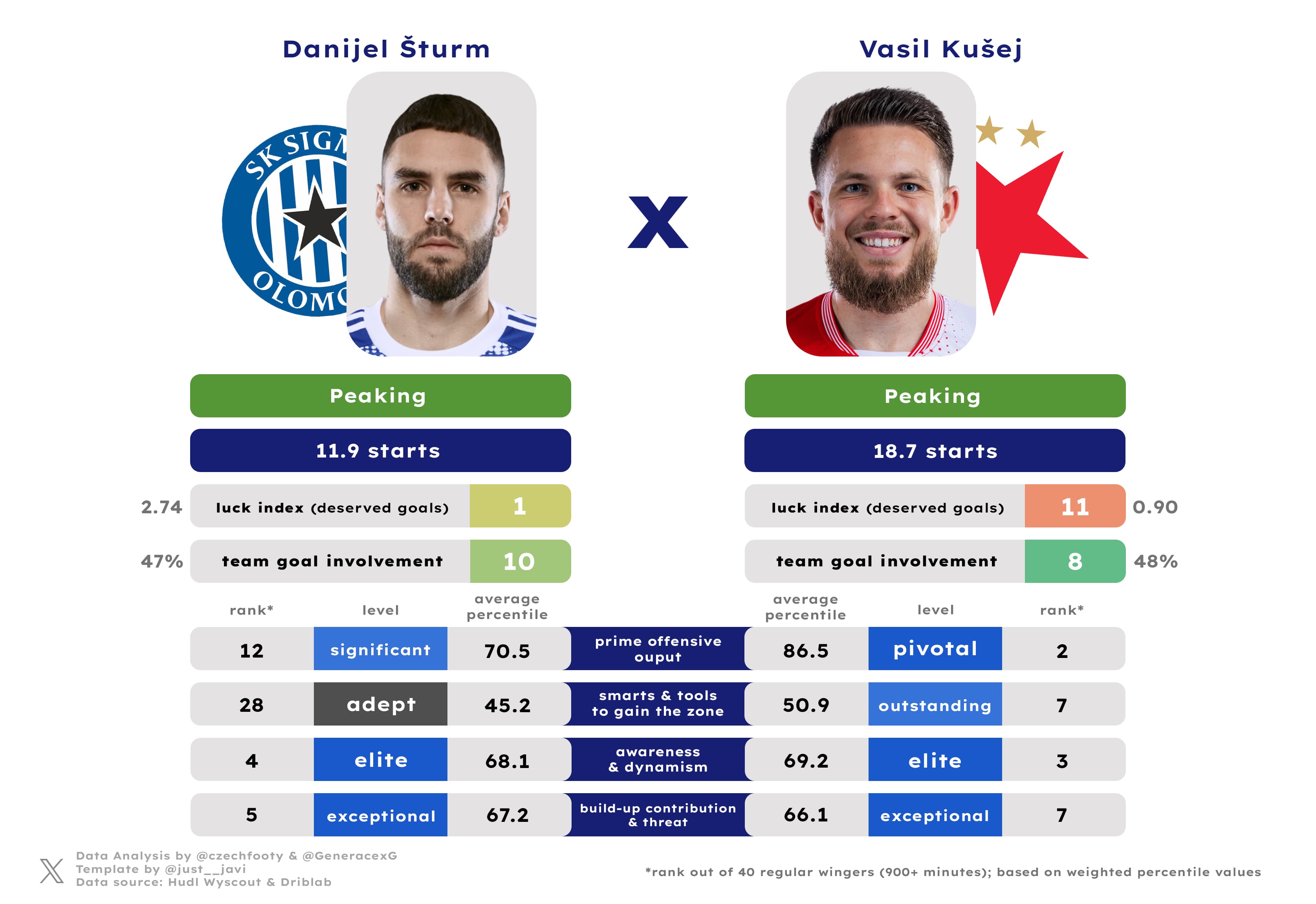
That said, Slavia are not moving on from a full-season picture of Kušej. They are specifically swapping his spring version, who won a miserable 6 offensive duels out of 24 high up the field, for one of the best players in the league over the same period, who won 31 of 58 — for the exact same success rate Haraslín boasted across the full season. Indeed, where Kušej no longer resembled a confident 1v1 merchant, Šturm was the most comfortable, powering through on a regular basis as the more physically imposing dribbler, gaining the third-most meters per game via ball carries. A rare triple threat, Šturm made for a phenomenal (and lucky) shooter while being one of only three regular wingers to shoot up to the top 15% in expected threat generated via both passes and dribbles. Haraslín and Kušej were the others.
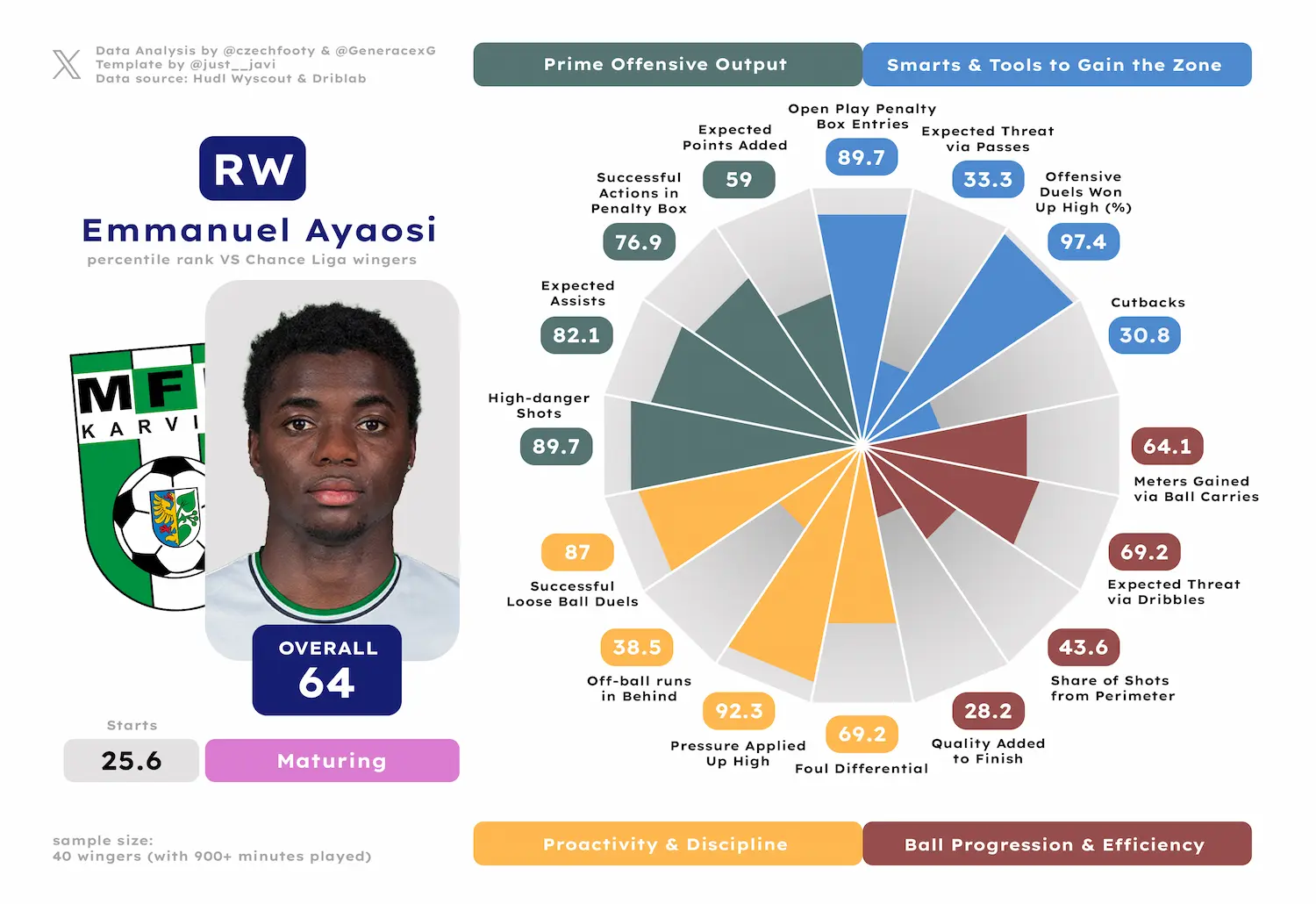
Generally, it’s easy to feel better about Slavia in the final third with more players who love to cuddle the ball and do magical stuff with it now employed by the club. Emmanuel Ayaosi is another such example. He didn’t enjoy as strong a reception as Šturm in pre-season, and may not even feature all that much for Slavia over the following months, but he was nonetheless one of the most exciting attacking players of 25/26 with a set of intriguing tools.
Ayaosi was excellent in forcing turnovers up high, also beating his markers for fun, and cracking the penalty area at a particularly high rate both as a finisher and a provider.
Biggest downgrade
I never thought I would get there, but here it goes: Slavia may yet mourn the pending loss of David Douděra over that of Oscar Dorley. Once again, Douděra was a hyper-active accumulator of penalty box entries, unblocked crosses, progressive passes and high recoveries. Only Martin Cedidla and he were able to rank in the top 20% of fullbacks in both ground and aerial duels, and Douděra very obviously contributes more in offence.
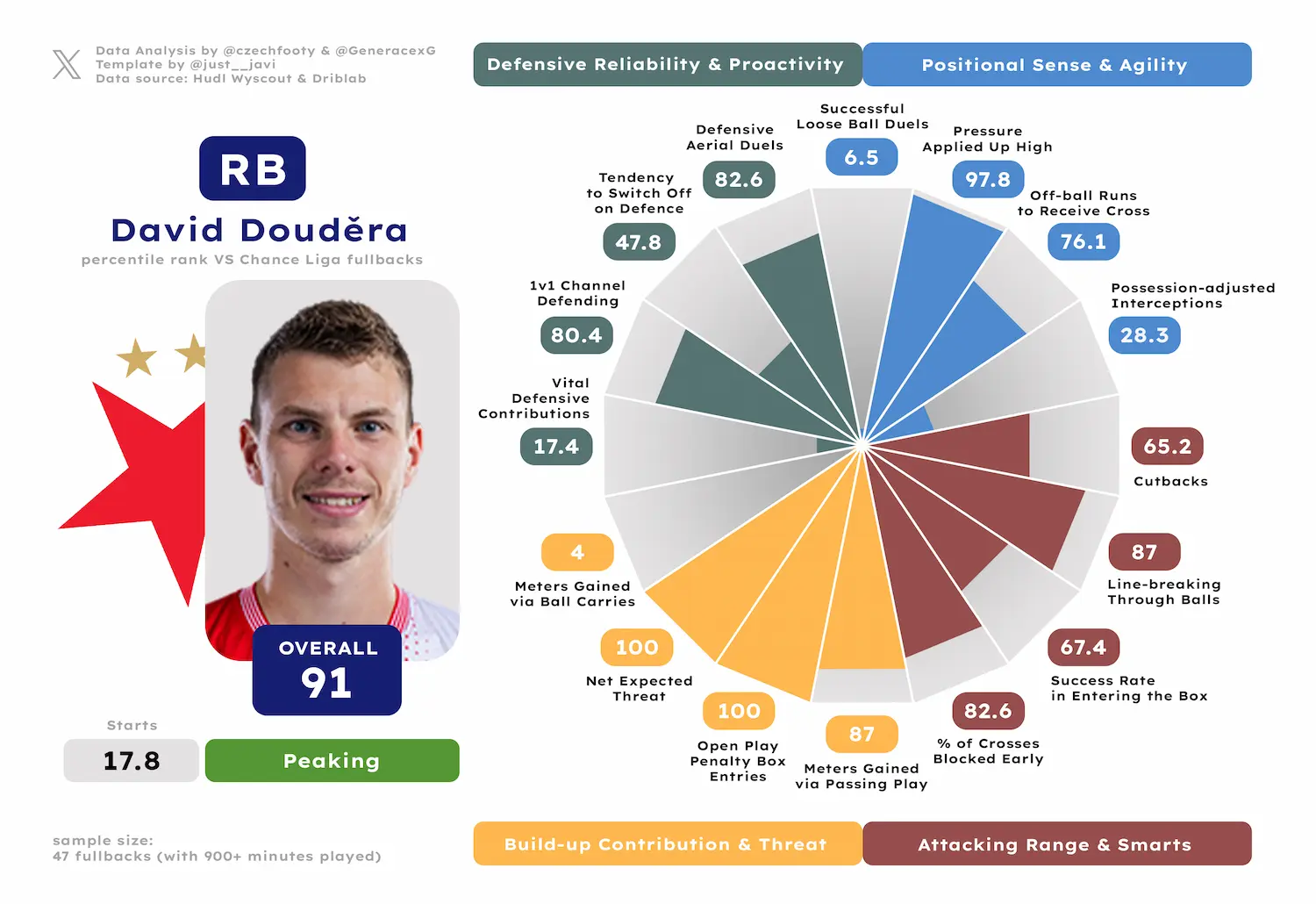
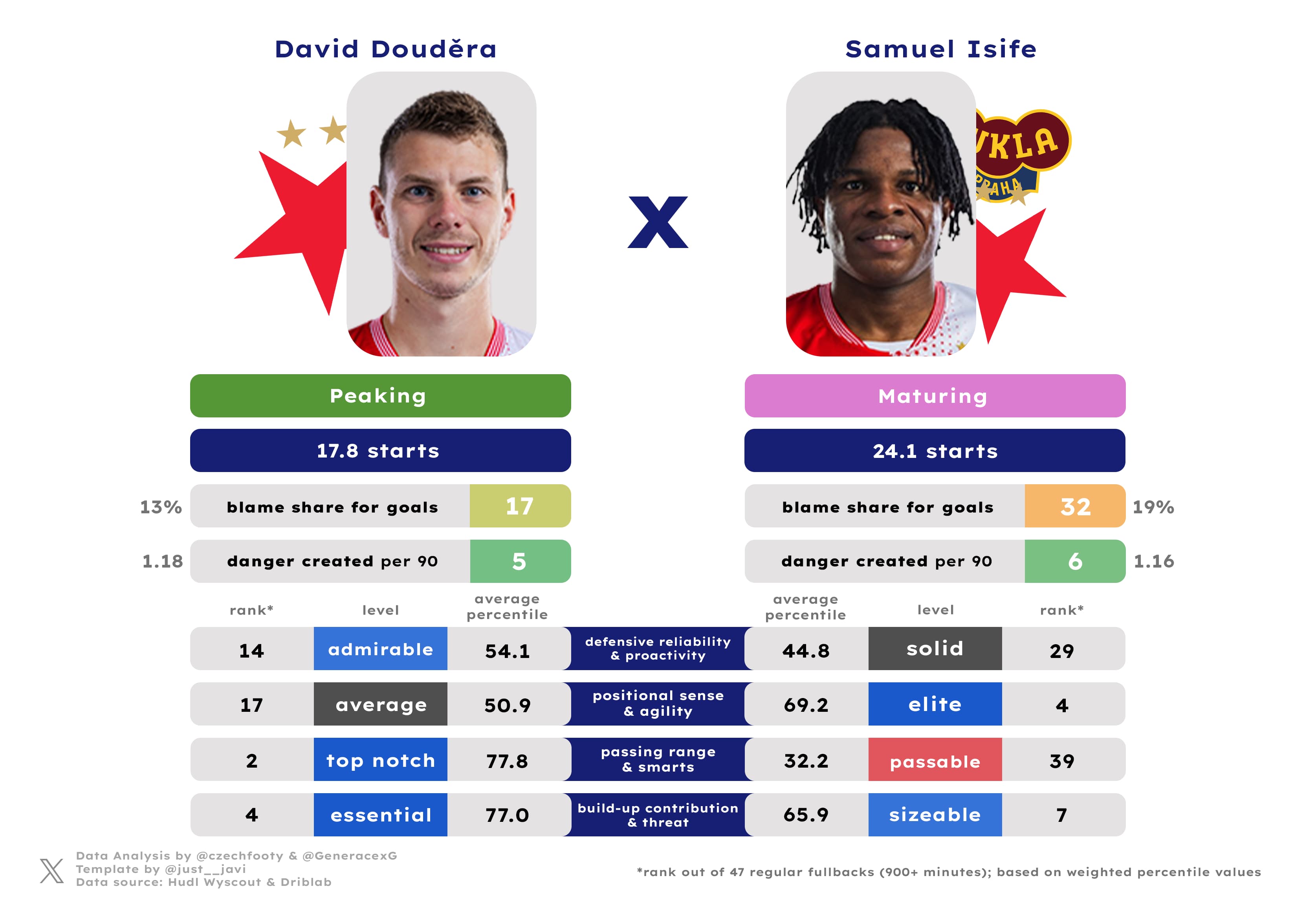
The thing is, more than ever before, you could now poke holes in Douděra’s defensive game, with both his health and ball-carrying ability rapidly deteriorating (Douděra managed over 30 starts in 24/25, and was good for 55th percentile in meters gained via ball carries). The sort of in-possession agility (and also a much higher proactivity in winning loose ball duels) combined with far more refined technique is exactly what Samuel Isife offers, and as long as he can keep improving his defensive balance card away from Juliska, he could stick as starter.
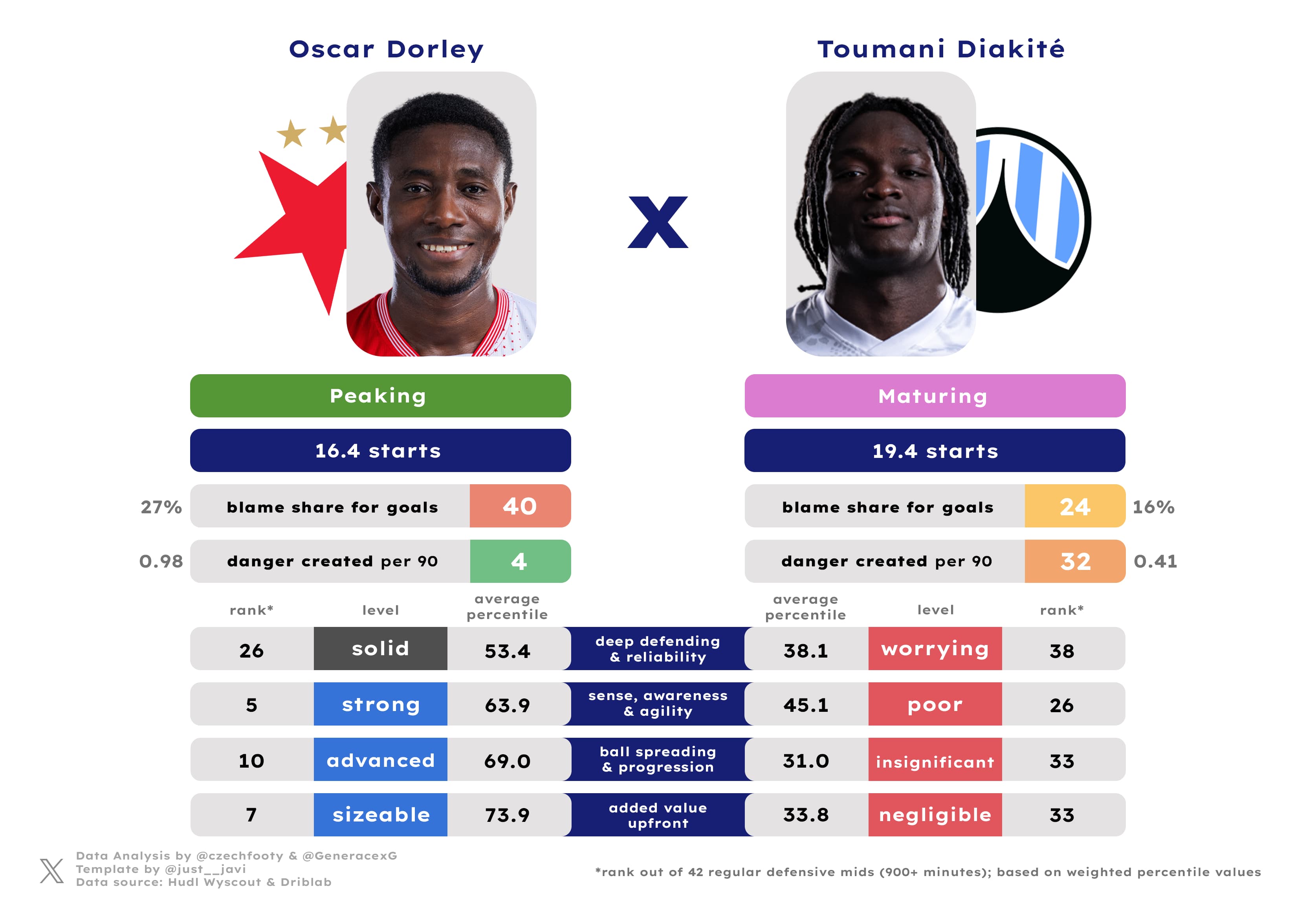
As for Oscar, however much we are now accustomed to seeing starting line-ups without him, it still feels weird. And for all the disappointment inside the attacking half, the Liberian didn’t look all that washed on the defensive side of things. Meanwhile, for all the hype, Toumani Diakité is, by all accounts, a raw player who most probably means a short-term downgrade.
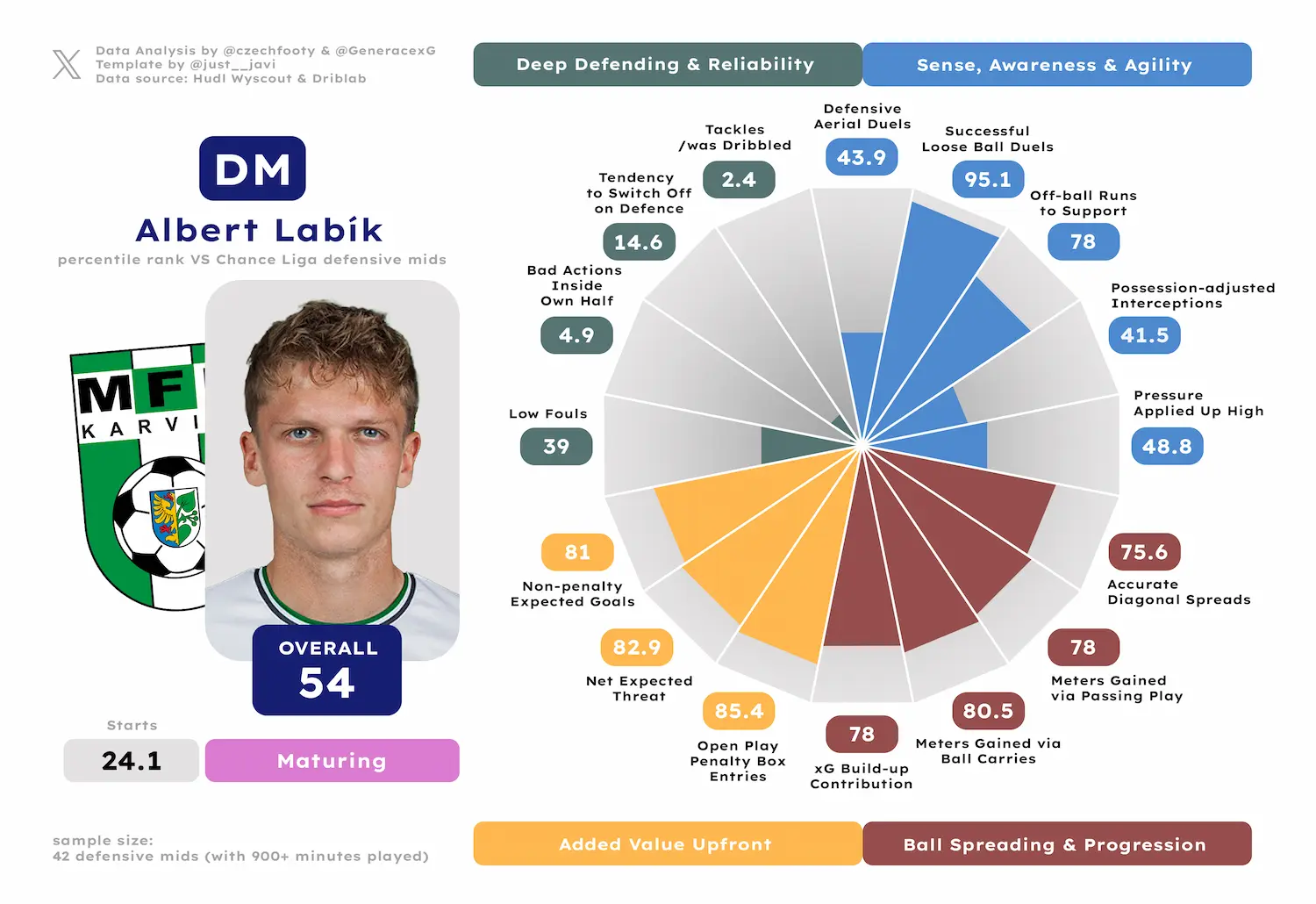
On the other hand, if Albert Labík finally gets his wish and becomes a central midfielder full-time (FWIW, I don’t think he ever will), my reservations could go out of the window. He can be a fine contributor on the ball, offering up a wonderfully balanced pizza in the bottom half.
Need left to be addressed
It was difficult to find one last summer, and I could pretty much repeat the process. Just like last year, you could argue a left wingback wouldn’t hurt, but at least there’s not one but two promising homegrown talents vying for a chance in place of the injured David Jurásek. Just like last year, I will settle on Ivan Schranz getting placed a bit too high on the depth chart. Especially if Bryan Ouanda doesn’t stick around, I don’t think I’m comfortable with Schranz being a third-choice option for possibly both the centre forward and the right wing position.
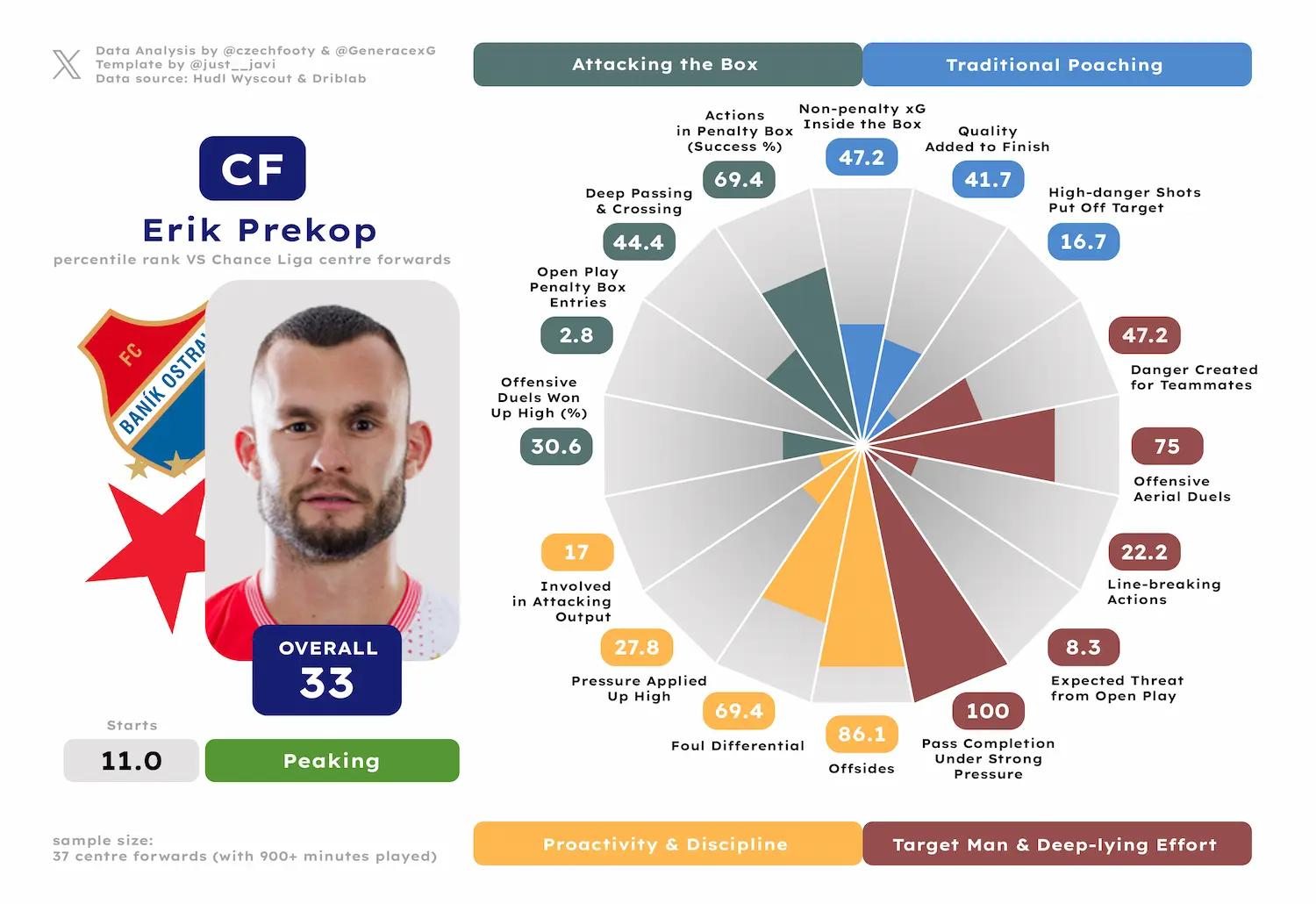
This is where the loss of Erik Prekop could still haunt Slavia…
(Only kidding, don’t worry.)
New kid on the block
After the post-World Cup fallout brought, among other things, largely unfounded suggestions that Slavia field too many foreigners, the club made a point of including six homegrown talents — half of them aged 20 or younger — in the first-team squad. In a summer that also included a 16-year-old moving to Bayern, that’s one solid response.
The question now remains, as ever, whether someone actually enters the inner circle. The best opportunity inarguably opens up before Jakub Kolísek (b. 2007), who’s a favourite to start most games at left wingback until one of Jurásek and highly-rated Pole Oskar Kubiak — himself only slightly older — recovers, and as opposed to Eliáš Piták (b. 2006) actually has a fairly high ceiling. No wonder Wolfsburg wanted him following the U-17 Euro two years ago, and no wonder Liberec wanted him to be part of the N’Guessan-Diakité package. Slavia were adamant Kolísek has a bright future with them, even though a winter loan after a few first-team looks here and there — like in the case of Tomáš Jelínek — remains quite likely.
Coming back to Matouš Srb, he may not be the last member of the 2008/09-born batch who ultimately gets to test himself abroad. Forward Petr Potměšil (b. 2008) started off as a leading U-19 scorer, moved to third-tier adult football in winter, and now looks poised to play a prominent role on the second-tier B-team down the road. His peer Adam Rajnoha, also helped by the introduction of the C-team, even started the opener for them. And a similar trajectory could lie ahead of the likes of David Barčot, tall centre back, or winger Adam Leibl.
Looking ahead to 2026/27
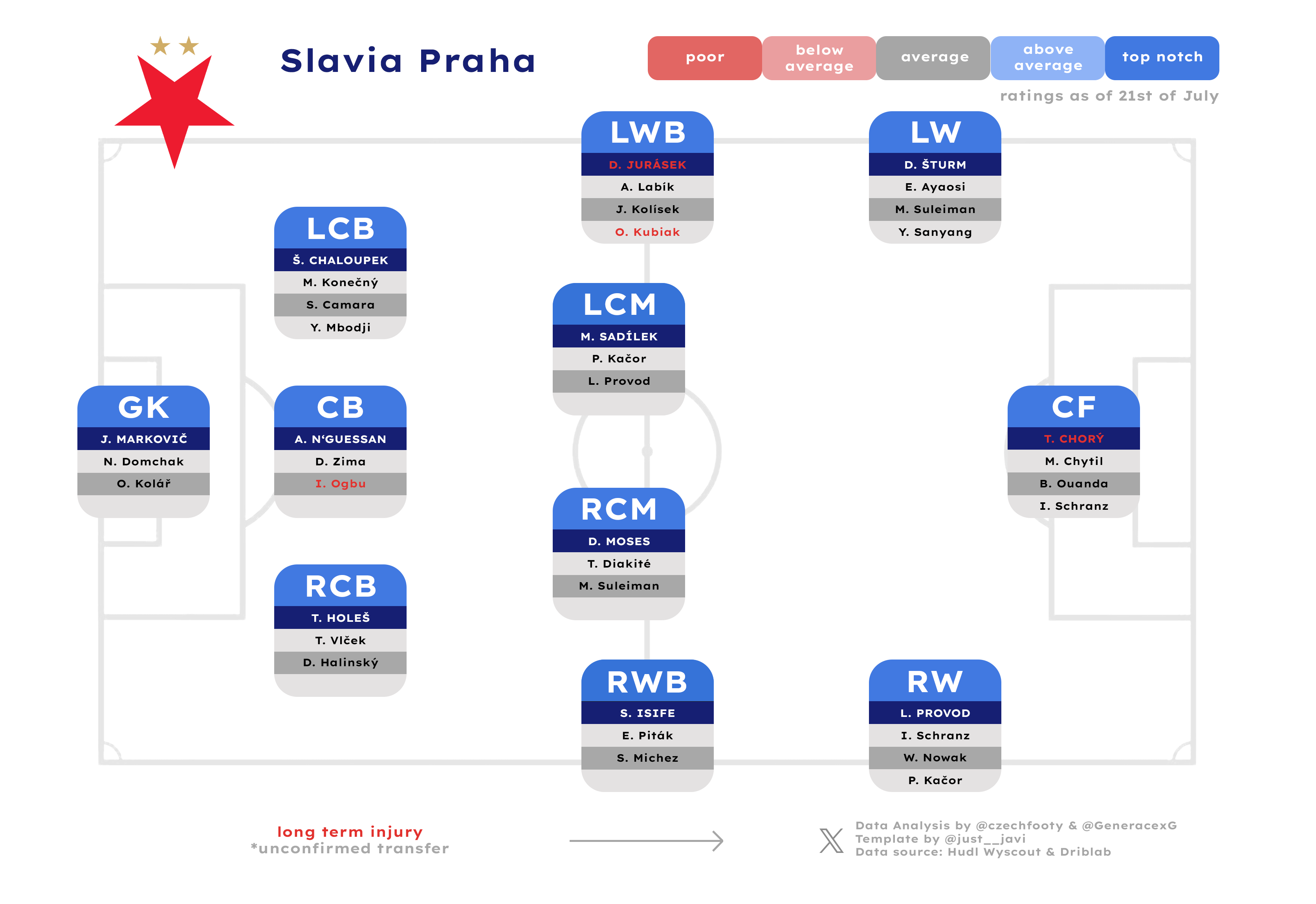
Below is the team’s current depth chart with a maximum of 4 alternatives for one position. The colourful ratings are a static snapshot of the league-wide situation on 21 July, and they are just a playful bit to add flavour to it; the names featured should be relevant to this day. To learn more about my approach to constructing depth charts, with all its limitations, head here.
Primary formation
Trpišovský is now most definitely a 3-4-3/3-4-2-1 proponent, though a two-CF formation is always possible for some types of games, or whenever a game needs to be chased frantically.
Colours I grappled with
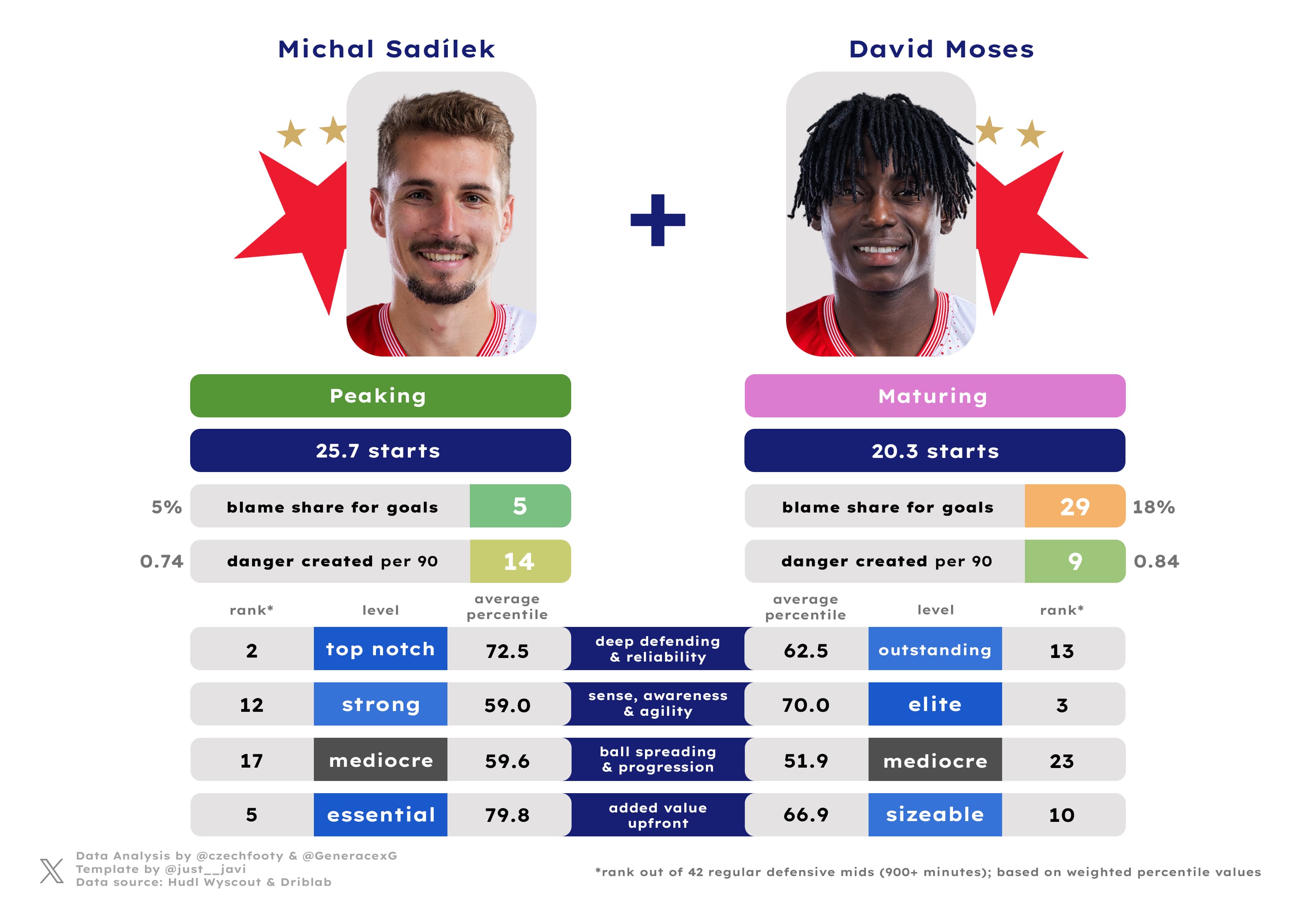
While I have long been a fan of David Moses, I am not convinced pairing him with Michal Sadílek in particular provides Slavia with enough juice in their double pivot. The run-of-the-mill percentile values for both in the “ball spreading & progression” category are notable.
Notes on the depth chart
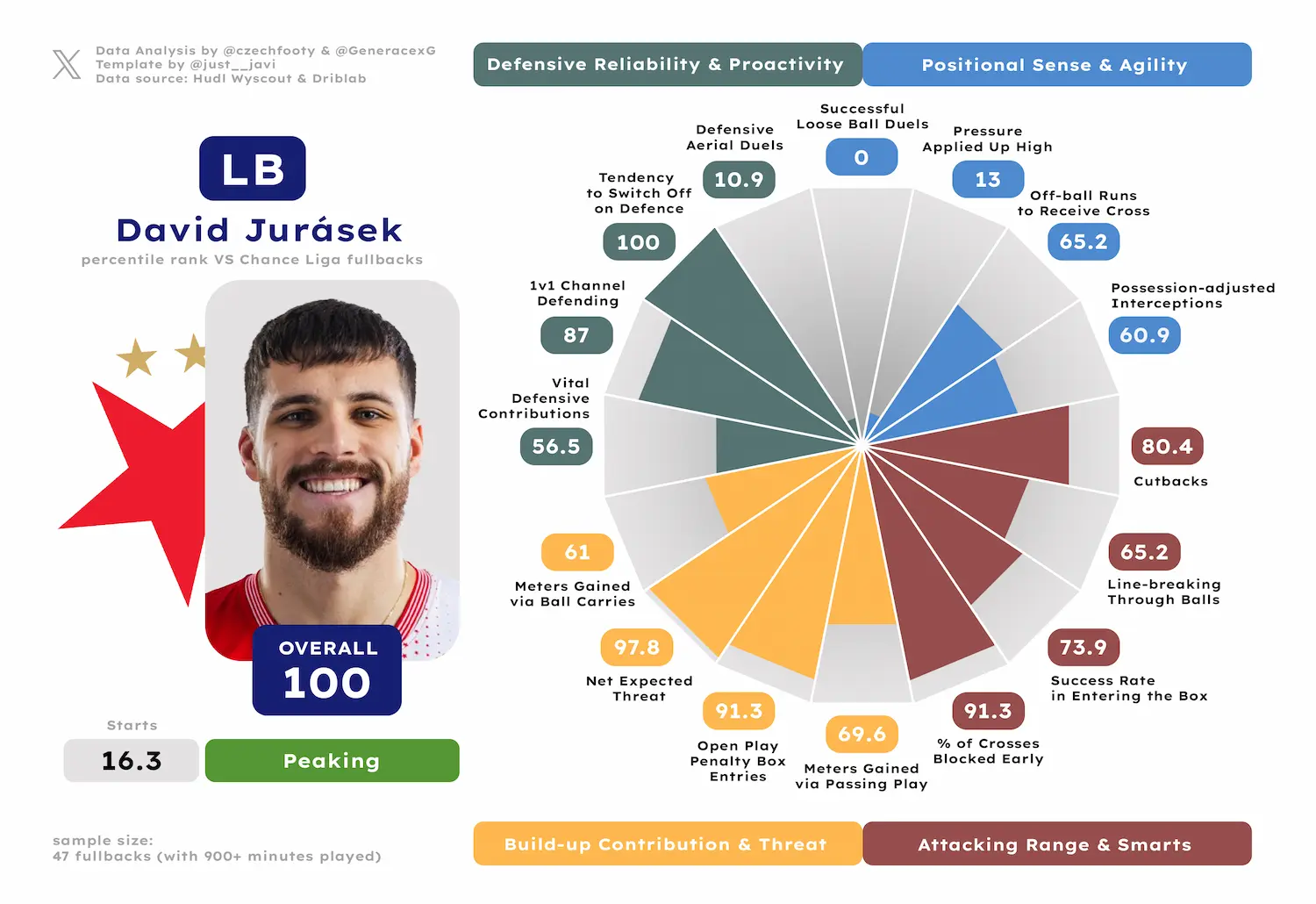
How nice it was to see David Jurásek return with a bang after nobody was quite sure what he has become through some turbulent times abroad. Turns out he’s still capable of the things that had left him fondly remembered at home, even improving ever-so-slightly on defence.
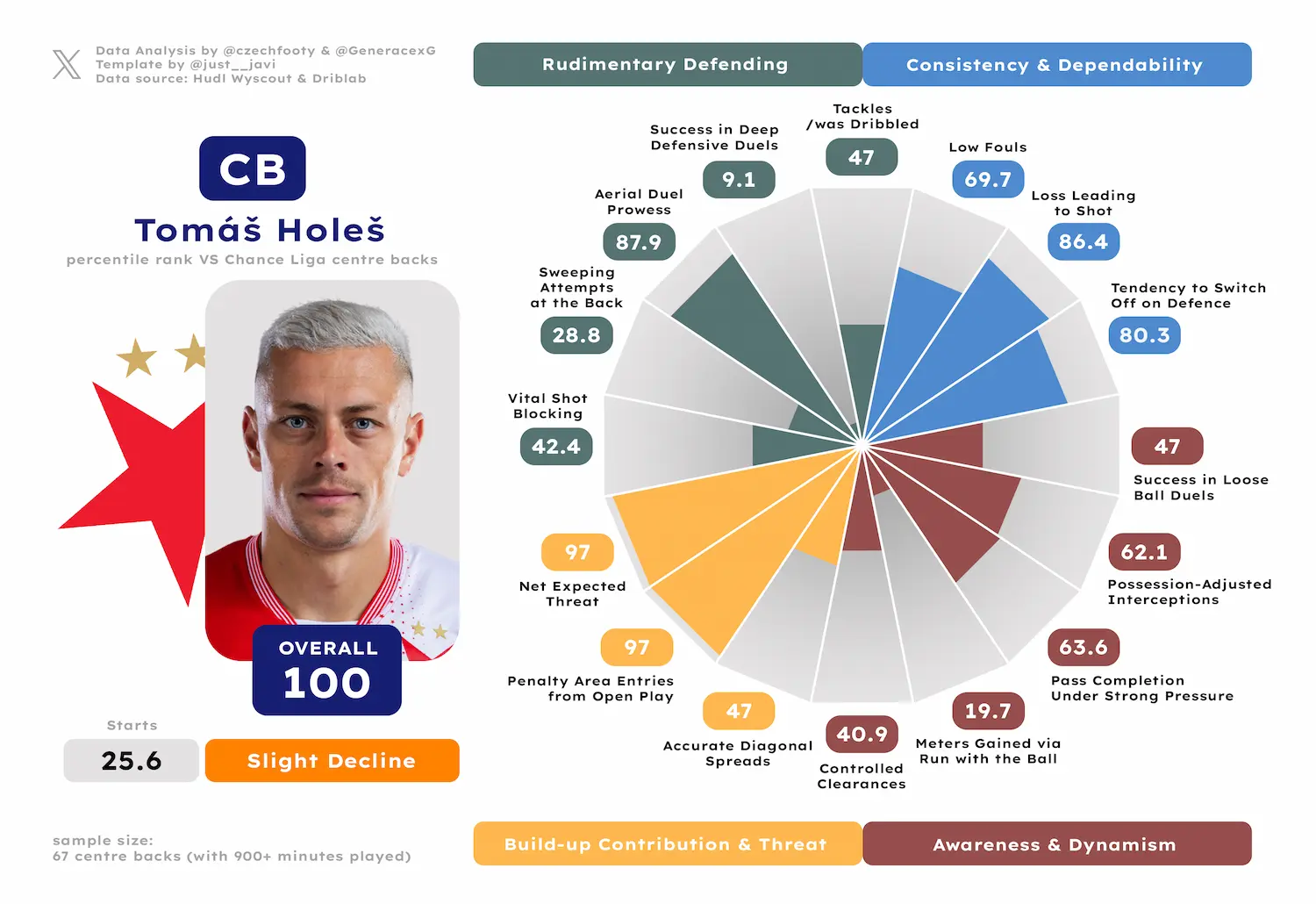
Moving onto another “best at his position” candidate, Tomáš Holeš re-claimed the CB crown from his current rival Denis Halinský while looking more or less the same: (close to) top of the pack as this consistent, dependable contributor in the build-up, with red flags elsewhere.
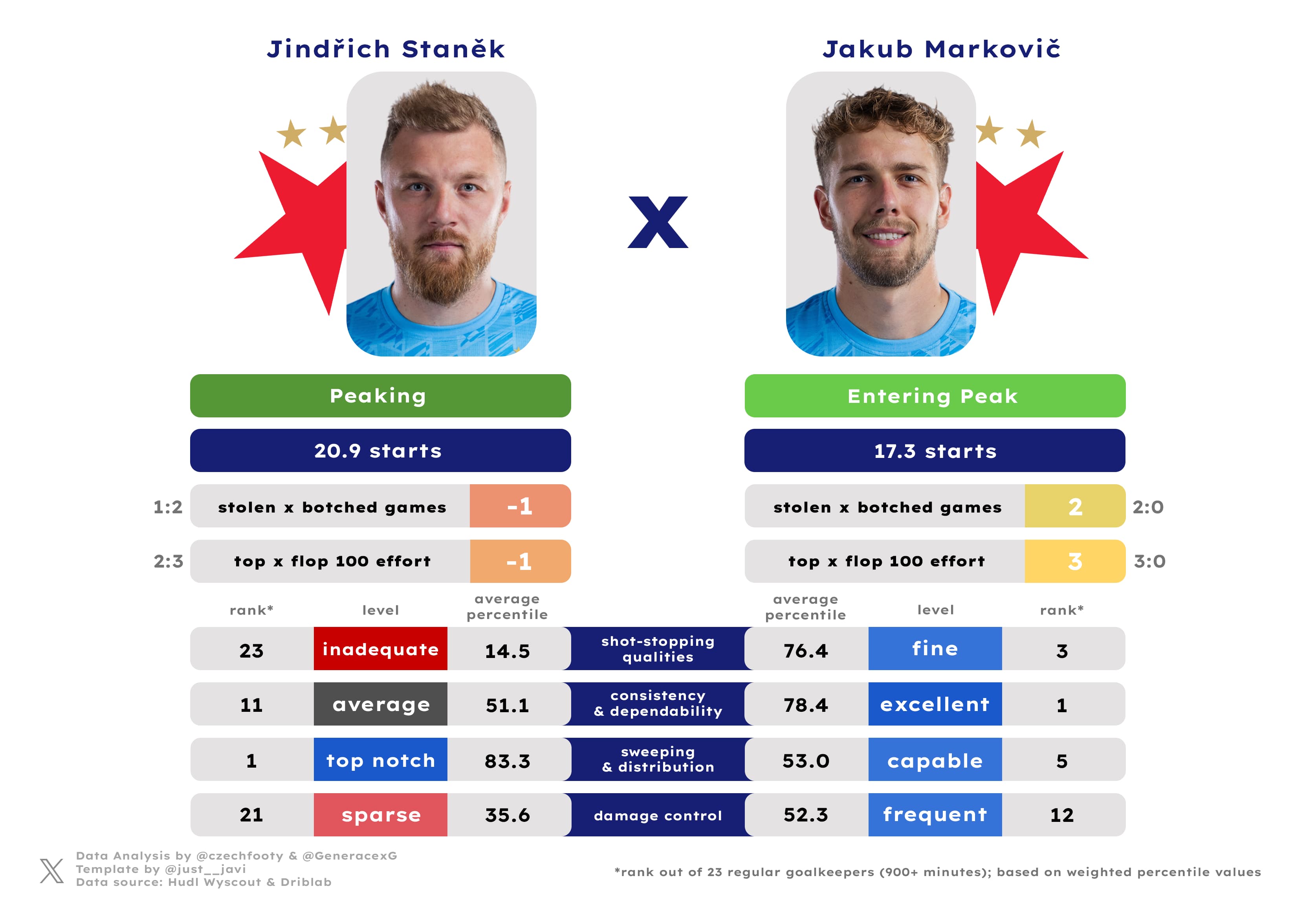
It’s hard to overstate the scale of Jindřich Staněk’s fall from grace in 2025/26. A somewhat volatile goalkeeper with cat-like reflexes has swiftly become the least capable shot-stopper of all regulars, ranking bottom 3 in both prevented goals and high-danger situation save percentage. Where Staněk stopped just one of 13 shots worth 0.4 xGC or more, Jakub Markovič was a difference-maker. There was a 5.85-goal swing between them in terms of prevented goals, and Markovič is already a more complete package than Staněk ever was.
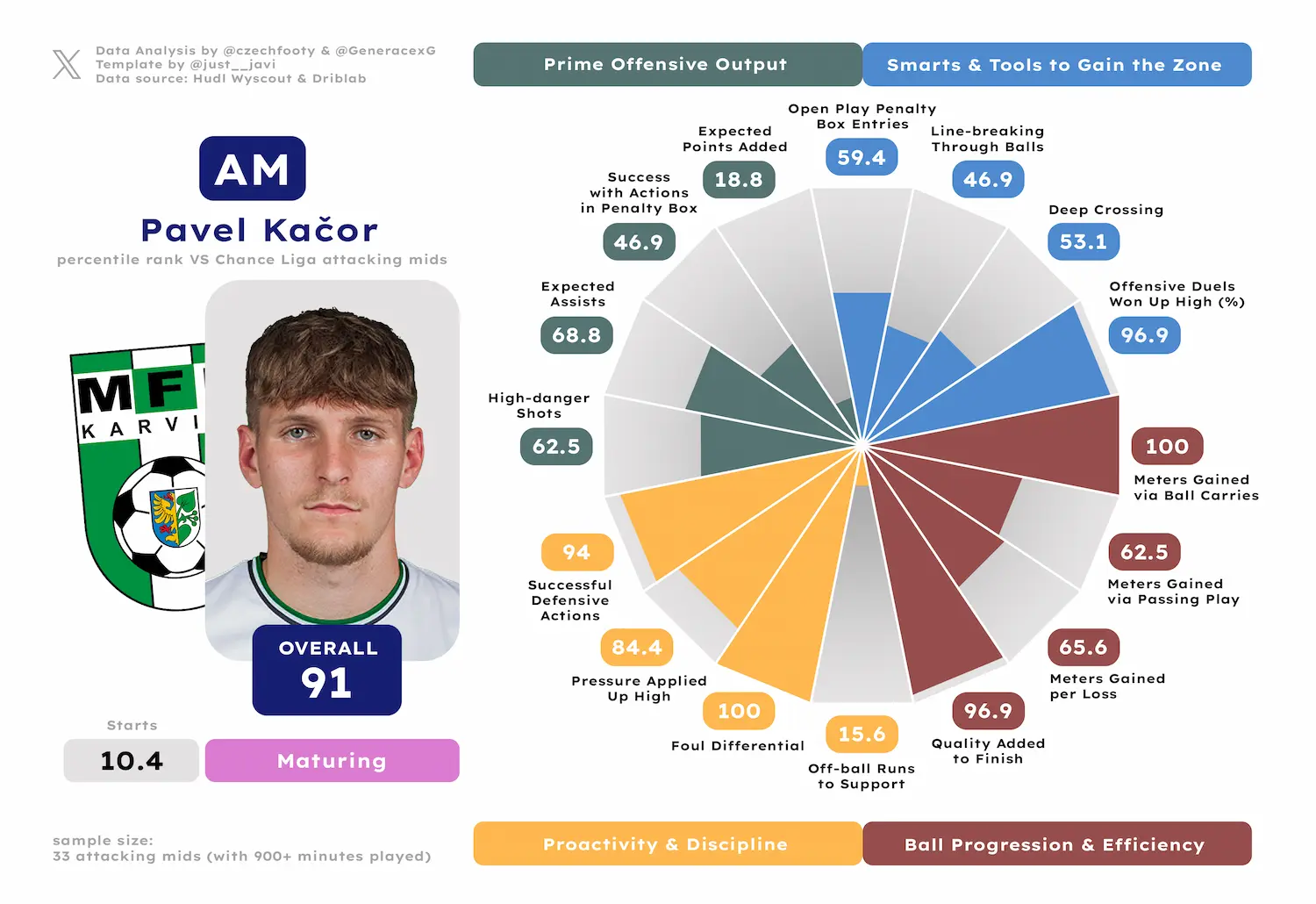
Going off a dangerously small sample, Pavel Kačor does indeed look like a future star in the making. He’s an absolute tank when he’s at it, and Trpišovský will enjoy his off-ball activity.
Roster battle to follow
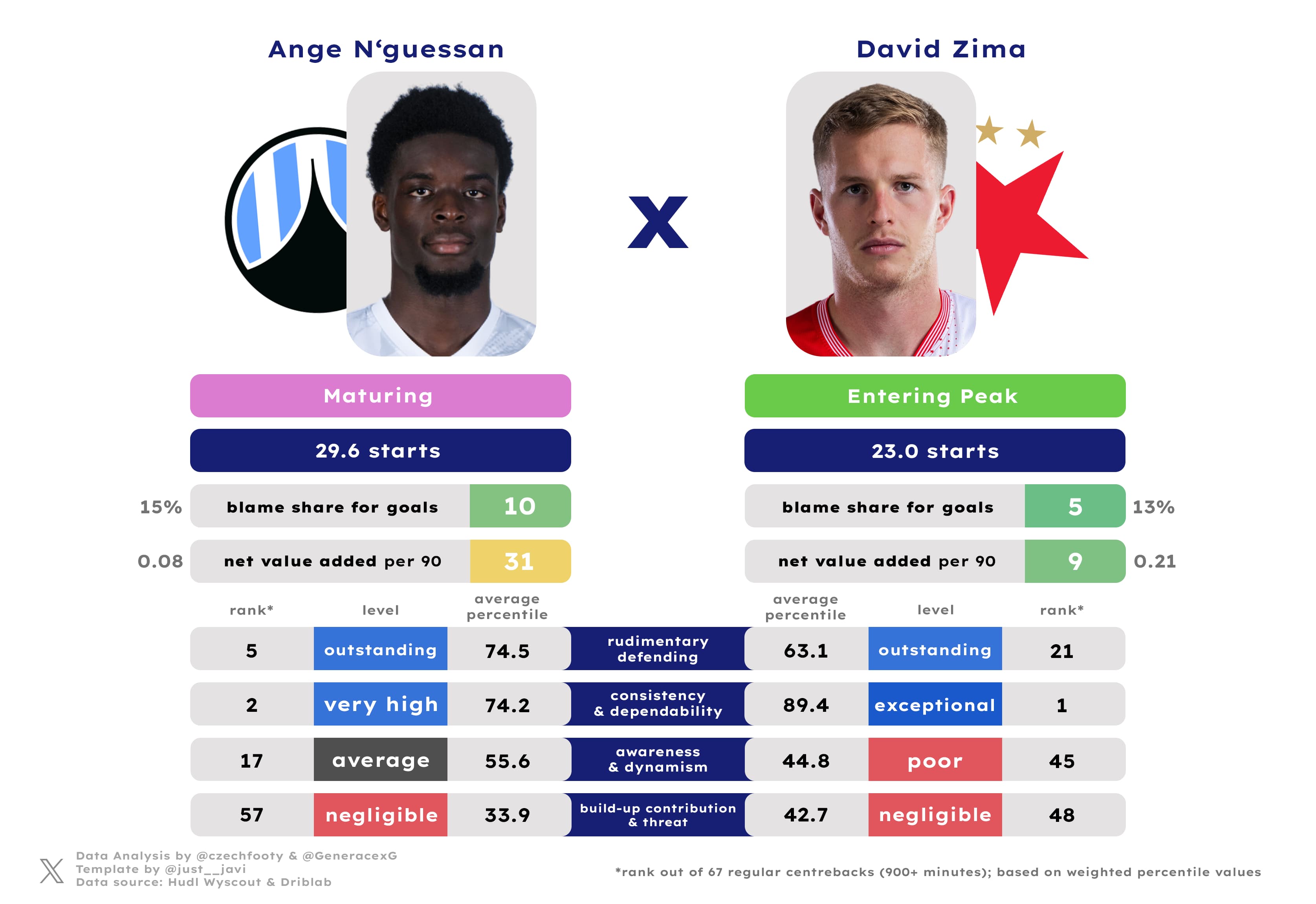
I don’t think it’s any exaggeration to say that there has never been a deeper and better centre back deck in the modern Czech league history than the one Slavia are prepared to roll with for 26/27. I mean, when Igoh Ogbu is barely an afterthought, I’d argue you are set. As a result, I could pick any number of roster battles, with the ones below not even accounting for Tomáš Vlček, the 4th-most threatening centre back, or Denis Halinský, the best pure defender with an average percentile of over 90. It’s almost as if Trpišovský can’t go wrong.
First up, Ange N’Guessan coming up against one of the more similar, also high-end profiles.
Perhaps an even more fascinating battle: Mikuláš Konečný’s fight for playing time, potentially rivalling one of the outright stars of 25/26 in Štěpán Chaloupek. If any youngster is capable of giving Chaloupek a run for his money, it’s Konečný. While his average percentile values below don’t look particularly amazing, always remember he was a teenager for the entirety of the campaign (June birthday), playing quite possibly the most demanding position of all.
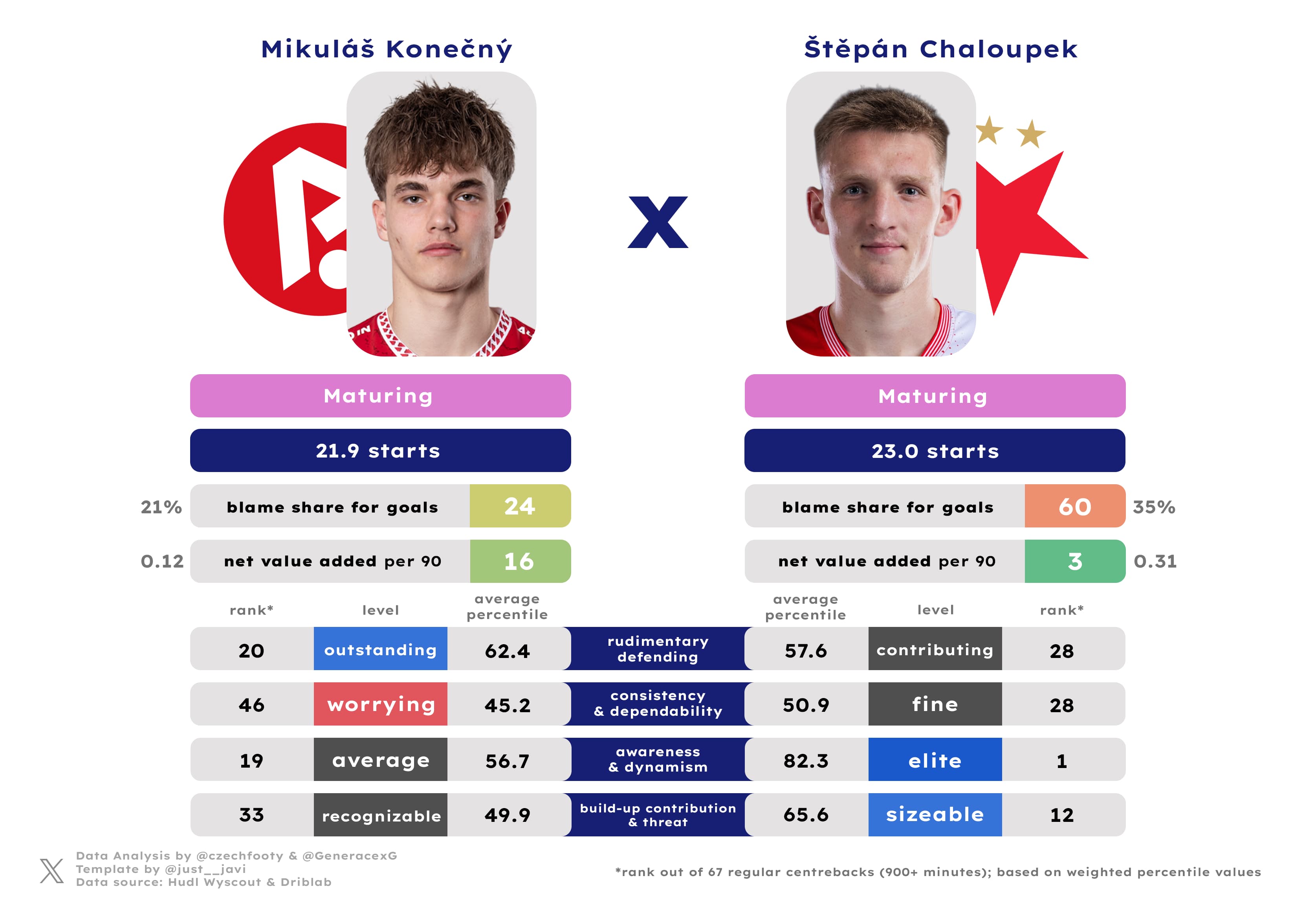
Even without the age caveat, Konečný was already very good, if not elite in a number of key indicators. In terms of net expected threat, he was in the 85th percentile, far above Chaloupek (58th). He was elegant as well as strong in deep defensive duels, winning 73.2% of them. He was dependable, turning in 10 net positive shifts to go with 6 net negative ones. And he is obviously beyond smart, leading to him posting a Top 5 rate of controlled clearances. It’s been a long time since I’ve been this excited for some CB’s development.
Season forecast
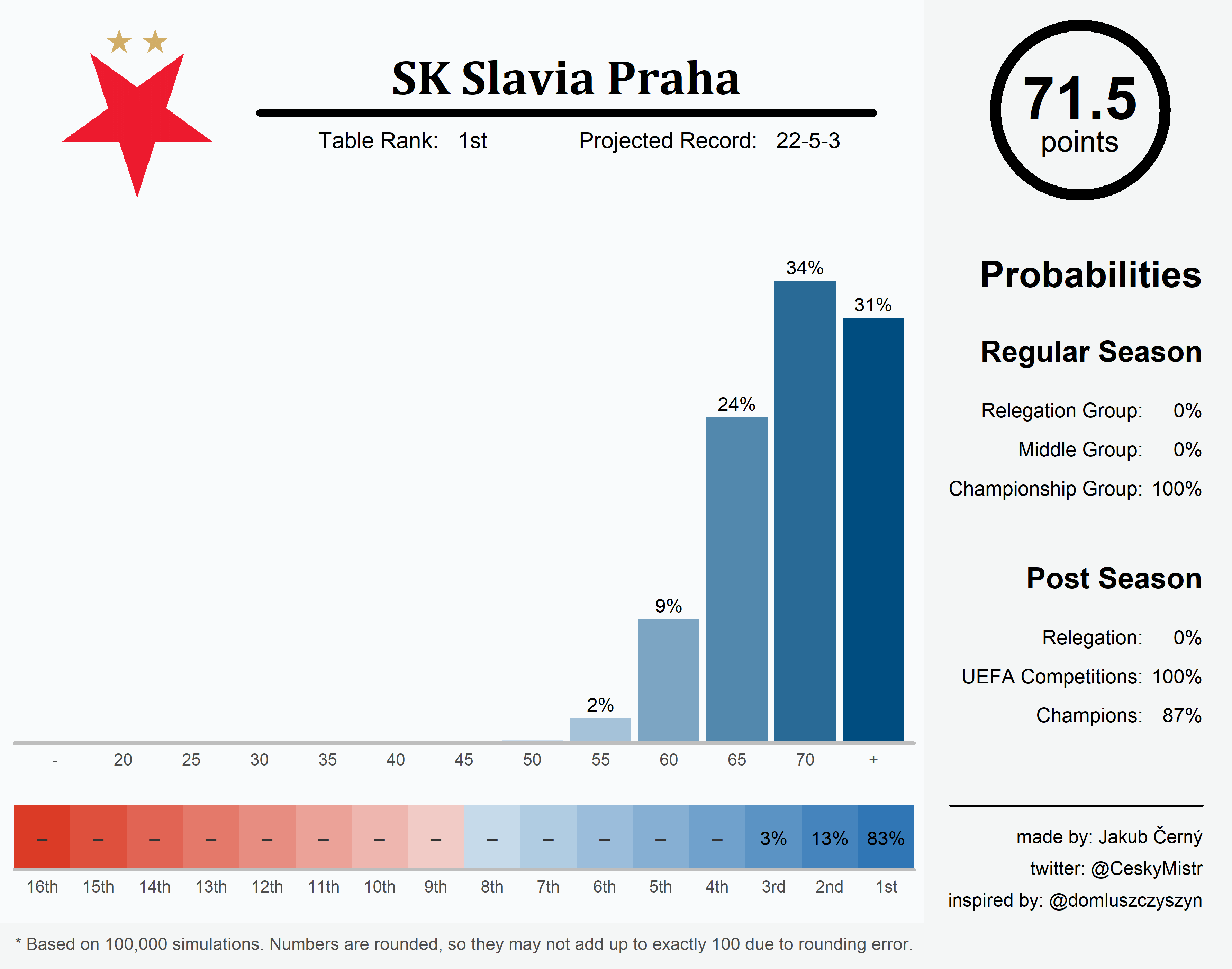
For the third summer in a row, it’s going to be less about whether Slavia can/will win the title, and more about how convincing they can be while obviously doing so. In 2024, coming off their third second-place finish but also a legitimately strong transfer window, Slavia received a 78% chance to claim the championship. A year later, that rose to 89%, so I spent the whole time here wondering whether they can become a maiden 80-point team inside 30 rounds. And that’s the thing: they obviously didn’t (71), leading to their second-lowest regular-season point projection in our five years doing this. When I wondered two years ago whether the 69% likelihood of crawling over the 70-point bar isn’t too steep, I couldn’t have imagined that after two fairly resolute title wins, that percentage would actually lower itself to 65%.
That being said, if another golden hattrick is all you want, an 87% chance is not too shabby.
Bold prediction
The track record: 1/5. Staněk never put together more than 3 clean sheets in a row
The prediction: Trpišovský sets his personal best, starting with a strong opener
The rationale: Jindřich Trpišovský has obviously put together a good number of winning streaks longer than 5 games in his Slavia career, but you may be surprised to find out that only one of them (the eight-game streak running from May to August 2023) actually involved the opener. His longest such run of 11 games that equalled the achievements of 90s and early-00s gurus Jozef Jarabinský and František Cipro started with the second round in 2024.
You might also be shocked to hear that Trpišovský’s longest winning streak is nowhere near the league’s longest. In fact, Ivan Hašek — who we now all think is a useless coach — went four games further with Sparta, and Karel Krejčí — whom we all think the same about since that U-21 Euro — sits second all-time behind Pavel Vrba with 16 consecutive matches.
I don’t think this era of greater parity allows for quite as long winning streaks anymore, but I am bold enough to say that Trpišovský sets his own personal best by winning at least 12 games in a row, starting with the opener. This means he’s got to beat Sparta, Jablonec and Liberec away (plus who knows how Baník looks next weekend), which might still prove to be the easier test than navigating the opener, Slavia’s infamous nemesis on 3 recent occasions.

Enjoyed it and just want to casually support us with an amount of your choosing? No worries, you can still do that by inviting us for a symbolic pint at the old BuyMeACoffeeBeer page.