Of all the new-wave owners in the Czech top flight, Milan Kratina is arguably the quietest. That, however, doesn’t mean he’s not getting things done. It’s just that, for now, the homework revolves around the stadium and the training centre/academy in Modlany, both due to get underway next year, rather than making outward noise. But make no mistake: Teplice are a club on the up, including in their pursuit of a more attractive brand of football already showcased in last week’s opener, and soon to be heard loud and clear.
“Slow progress is better than no progress at all” is the mantra in Teplice. The budget swells up ever so slightly every year, with the big bump expected only once the skyboxes are built as part of Stínadla 2.0. The department of scouting and analytics started working in December, soon feeding us with adorable travel stories while working on the identification of priority markets. Video content the club puts out these days has acquired a distinctive sense of humour, while the club continues to be more visible across the region and beyond. The Oneplay TV series “U nás na Stínadlech” is to continue after proving a hit with viewers.
On the other hand, no small strides have been made in the youth department — in all sorts of categories, mostly overseen by good sons of the region with notable pedigree. Patrik Gedeon, hailing from nearby Chomutov to very nearly collect 300 top flight appearances, led his U-14s to a strong finish among the country’s elite. Petr Fousek, originally of Ústí nad Labem but a one-club FKT icon on the top level, finished as a runner-up in the U-17 second tier, earning the youngsters a place among the elite for 26/27 instead of Příbram. The U-18s also earned their promotion under the guidance of Petr Johana, brought up just 20 km away from Teplice. And the cherry on top: the U-19 side, coached by 34-year-old David Šourek, securing their return to the top flight after a long eight years with four rounds to spare.
It was a big deal for Teplice. First overcoming the regional rivals from Ústí nad Labem 5:0, setting up a rare Stínadla experience vs Chrudim (5:3) in the presence of the mayor himself.
Now it’s up to the adults to build on all this youth-powered momentum.
Looking back on 2025/26
What went right
As the fandom slowly but surely started to turn on Zdenko Frťala, the grizzled veteran delivered big time. To close out the season and follow up on a depressing 10-game run without a victory, Teplice suddenly won four on the trot with a combined scoreline 10:3.
Sadly, this was about as good as it got when it came to things the team actually controlled.
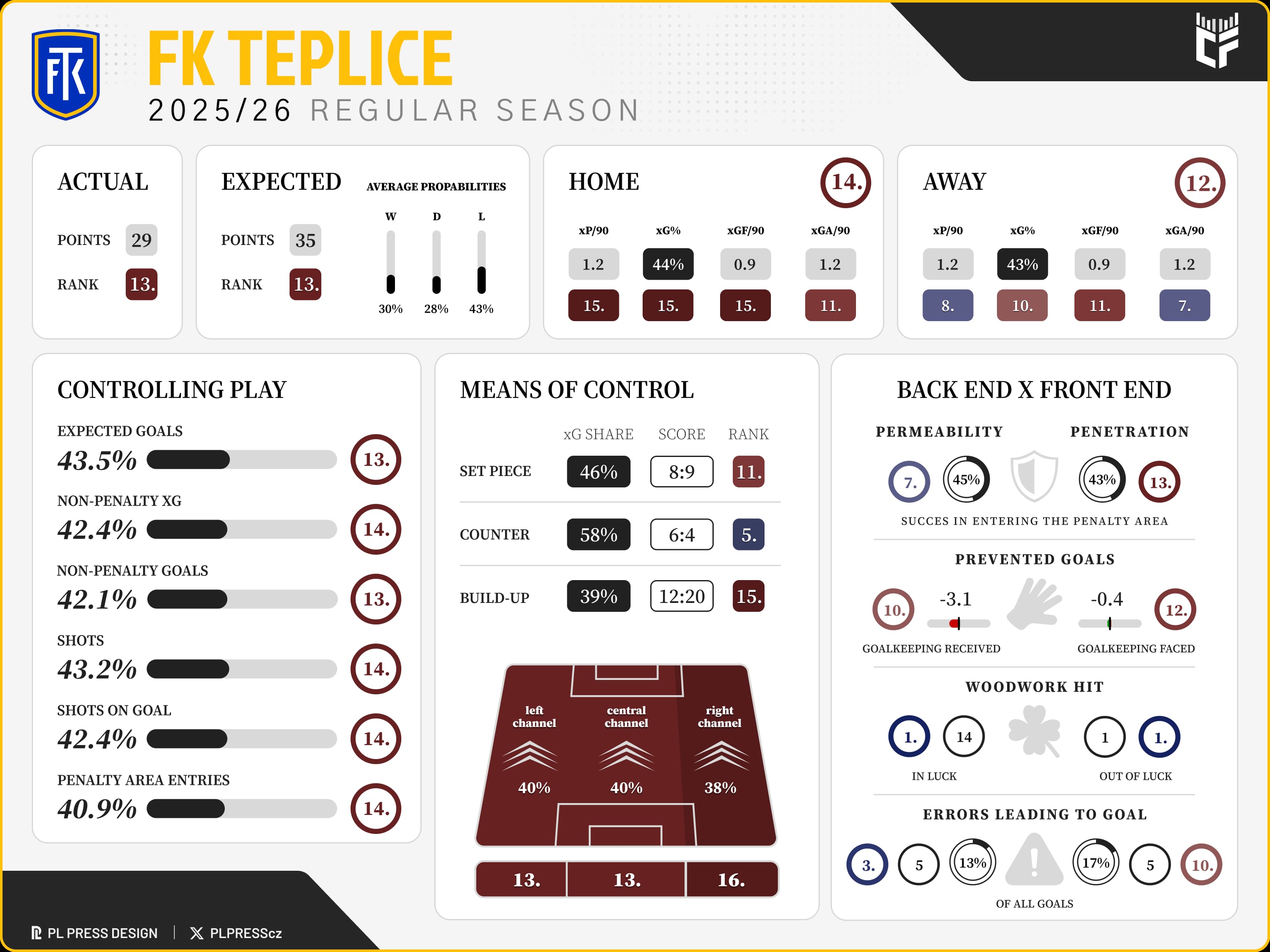
Teplice only hit the woodwork once while benefiting from it 14 times at the other end. It’s hard to see how either can really be attributed to them. Teplice also saw their opponents underperform their pre-shot xG by the widest margin in the league (more than three goals), contributing in no small part to the second-best PDOPDO is the combined shooting and save percentage of a team, with unusually high or low values often signalling unsustainable mis/fortune. — commonly regarded as a stronger indicator of luck than overwhelming quality. This stuff did go right, but it’s notably fluky.
What went wrong
Teplice have only gone 10+ rounds without a win thrice this century: in 2001, 2021 and 2026. Throw in their 8-game winless streak to very much open the season, and you get a particularly grim picture. Even when they were winning towards the end, Teplice never looked to be truly in control, earning a sum of 4.7 expected points from the last four rounds. On the season, ‘Skláři’ outshot their opponents on a mere 10 occasions, turning in 11 positive xG performances. In terms of positional attacking (xGFExpected Goals For (xGF) estimates how many goals a team should have scored based on shot quality, location, and context.), none of their three channels (left-right-centre) was able to leave the league’s bottom three — with only Dukla more clueless.
When you consider how little FKT got out of set pieces, averaging just one finished off corner per 90, you can truly appreciate the amount of offence-related work ahead of them.
Most valuable player
Per my MVP model (traditional stats): Michal Bílek (ranked 19th league-wide)
Per my positional models (advanced stats): Matouš Trmal (77th overall percentile at GK)
I’m not happy with any of the two options served up by my two types of models. Michal Bílek may have contributed to 11 goals scored up front and 10 clean sheets at the back, but a majority of his goals came from penalties (5; plus one he missed) and much of his creativity stemmed from other kinds of set pieces. Matouš Trmal is possibly the stronger candidate, but it’s just too hard to forget his flailing early on in the season, when he was nearly dropped.
Ultimately, in my mind there’s no question who the MVP is, even if my own model disagrees: Matěj Radosta. An under-the-radar breakout story, the winger was involved in more Teplice goals than anyone else (13), although in nine cases it wasn’t goals or assists. I stubbornly count those indirect contributions too, albeit at three quarters of the value, leaving Radosta with 8.22 expected points fetched over the season. By my measure, and through this lens only, that made him more valuable to Teplice than Ladra, Memić or Vydra were to Plzeň.
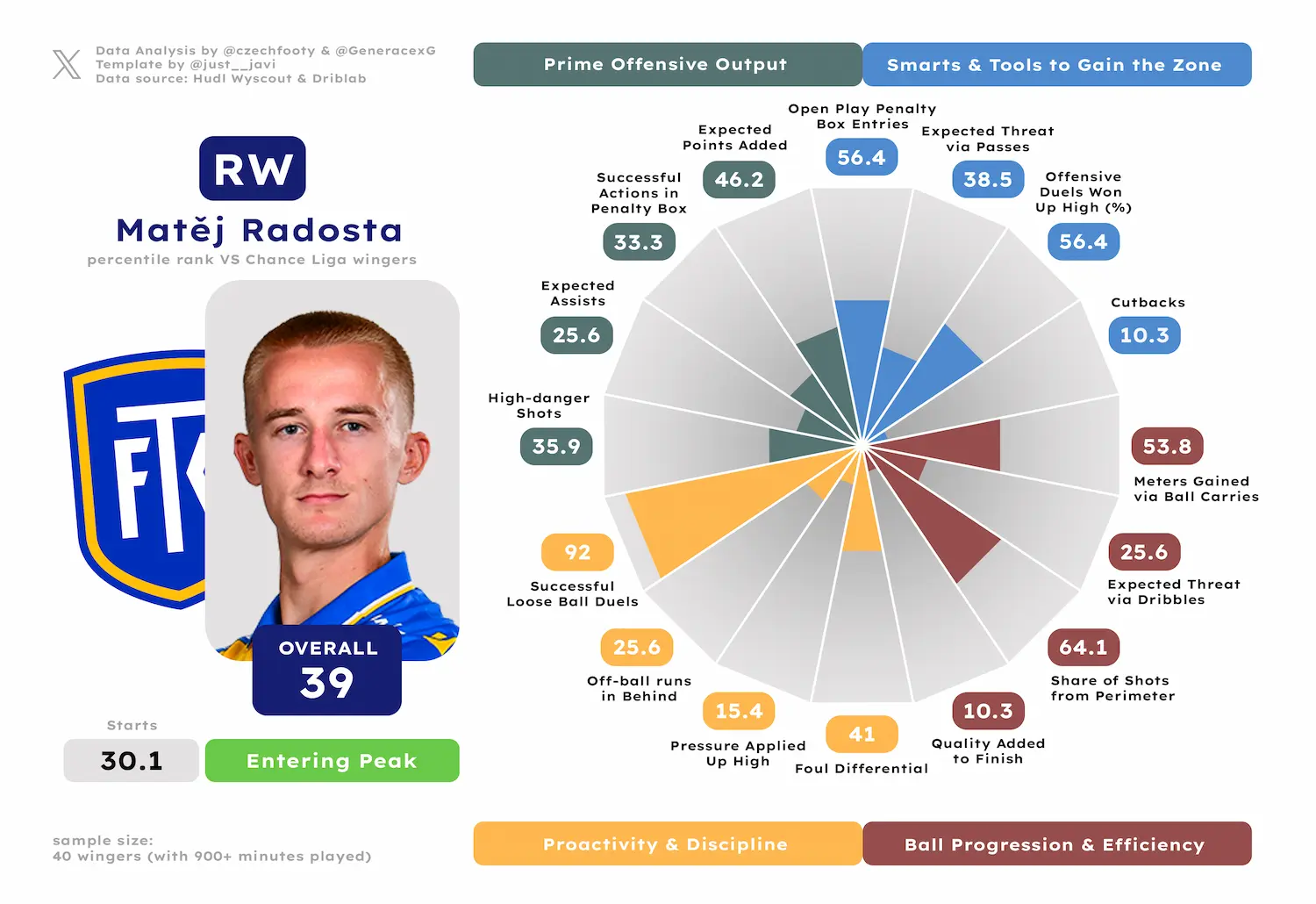
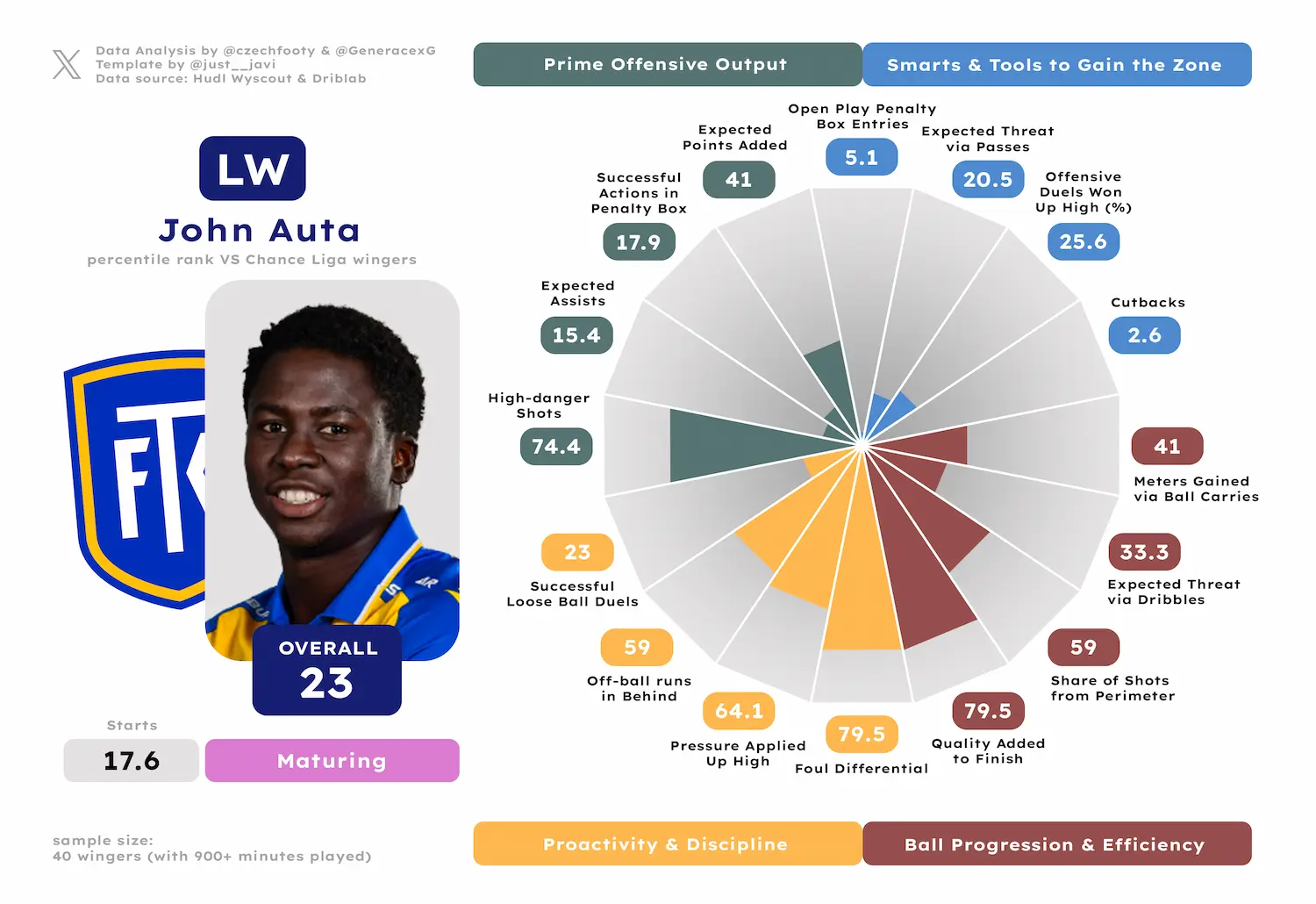
Now, how much should we all care about the below-average overall percentile? I’d argue it’s nigh impossible for a Teplice winger — mostly running up and down, chasing the ball — to rank much higher. John Auta perhaps won a couple more neutral hearts, and he landed even lower (23rd pct). Besides, some of the higher values Radosta posted — such as a borderline Top 10 rate in goal/chance-creating actions from open play per game, or an outright Top 5 success rate in entering the penalty box — are merely not featured on the pizza chart.
Radosta works tremendously hard: spends a lot of time winning loose ball races, sprinting or producing HSRHigh-speed run (HSR) is classified by Driblab as any run at a speed between 19.8 and 25.2 km/h., and routinely accelerates play with the ball at his feet, too. He’s a great asset.
Chip on the shoulder
Matouš Trmal was the very first statement signing of the Milan Kratina era, and as such already carried a sizeable chip on the shoulder. Needless to be said, both sides probably imagined it going more smoothly. By the end of Round 7, Trmal allowed 5.25 goals above expected and significantly contributed to the six losses via two grave errors and one smaller mistake. Since then, he was a plus-2.58 in terms of prevented goals and mostly error-free. But the damage had been done, and now the workhorse of a goalkeeper needs to live with it.
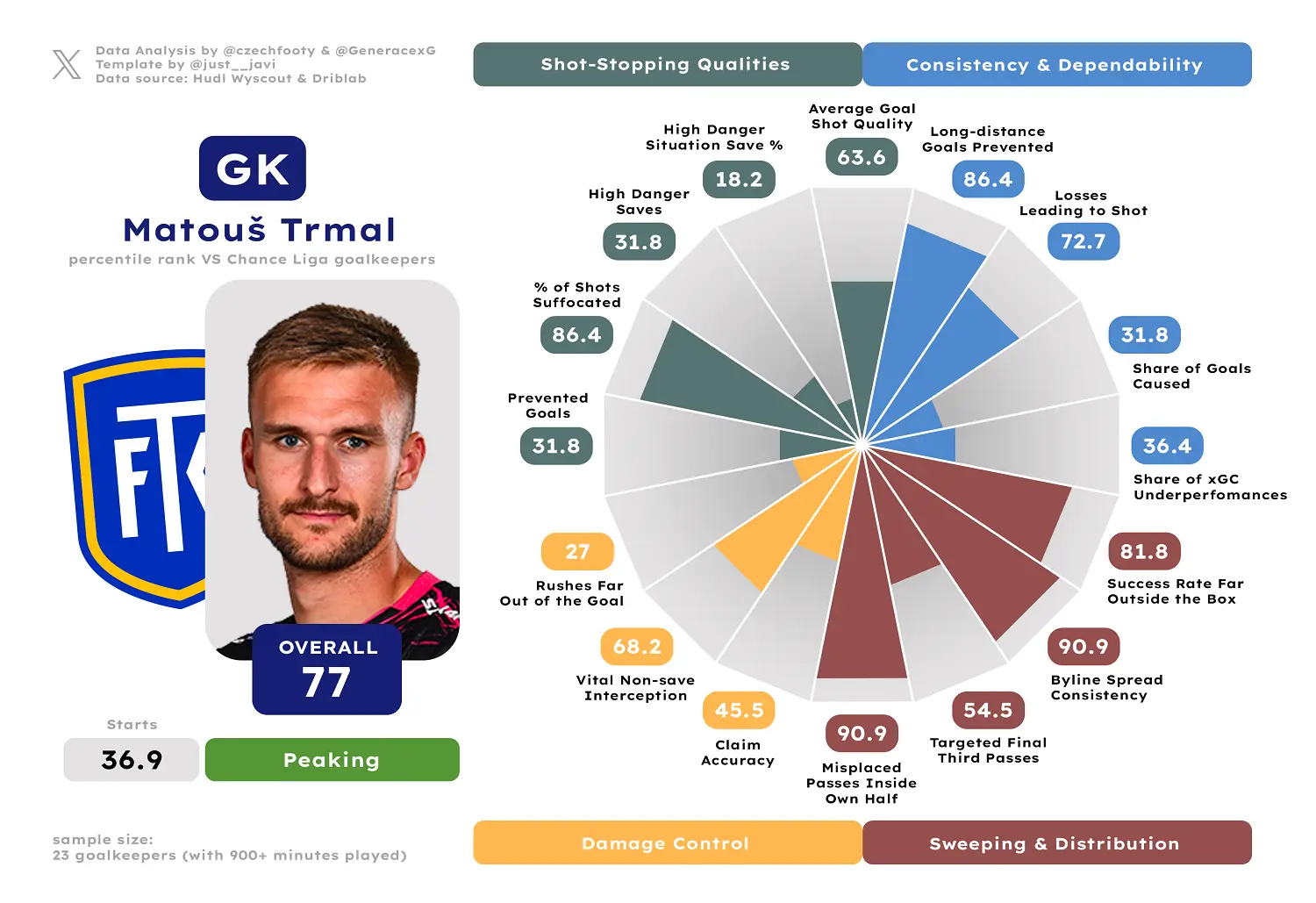
Last year, Trmal was a mediocre shot-stopper who ranked 12th. This year, he didn’t move an inch in that department, remaining a solid contributor on the ball, but notably appearing far more hesitant when rushing out of the goal to sweep, or even coming out to claim a high ball.
Inside the off-season
special thanks for guiding me through the motions of FK Teplice’s off-season go out to @SeveroCzech, @JindraKarvanek, @kudzis90 & @JohnHenry_1984
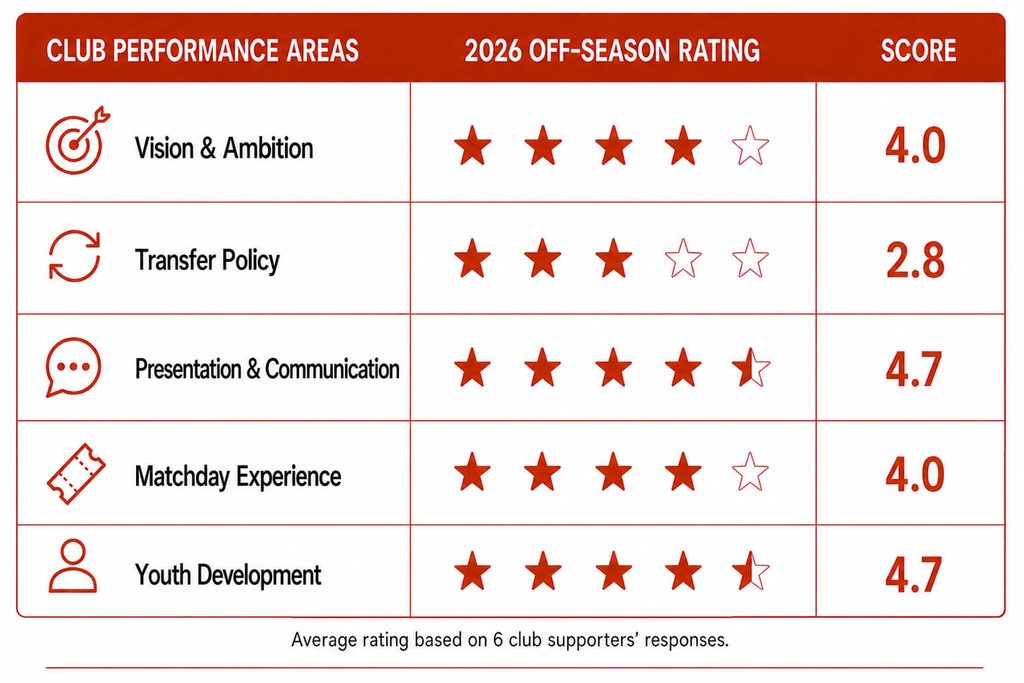
Squad turnover
Teplice are one of just five teams retaining over 80% of all minutes distributed in 25/26. In Denis Halinský, they are losing the fourth-busiest defence-minded player in the league (and the eighth-busiest overall), but that was a departure advertised well in advance. Other than that, just one more member of the most utilized XI, purely of Teplice’s own making, since they cast Robert Jukl aside right at the beginning of summer. That he was even allowed to be the 11th-most used player is kind of a problem on its own, but good on Frťala et co. for recognizing it early. (Though let’s not mention Ladislav Krejčí as a counter-argument, always disappearing for a month before suddenly showing up as a starter and main set piece taker only to succumb to a knock within a half, limping his way to almost 700 mins of quality time.)
Biggest upgrade
It’s rarely this easy and straightforward to identify the biggest upgrade. Marcel Čermák may not look like it with his pizza chart, but you must once again consider the team context. Landing in the top 30% for deep crossing, open-play penalty box entries or expected assists on a clueless offensive team such as Dukla is a big deal. Perhaps even more so: his EPAExpected Points Added (EPA) estimate the value of one's goals and assists based on game state (late game winners = top). rate (0.34 per) besting those of Ladra or Mahmić despite pretty much never leaving the pitch. Dukla scored 23 goals all told; Čermák was absent for a total of eight of them. Absolutely incredible. Consider where they’d be without his 13 IGCImportant Goal Contribution (IGC) was delivered to either a go-ahead goal, or an equalizer. It may have been a goal, assist or secondary assist such as a penalty won.. (Oh right, at the same place.)
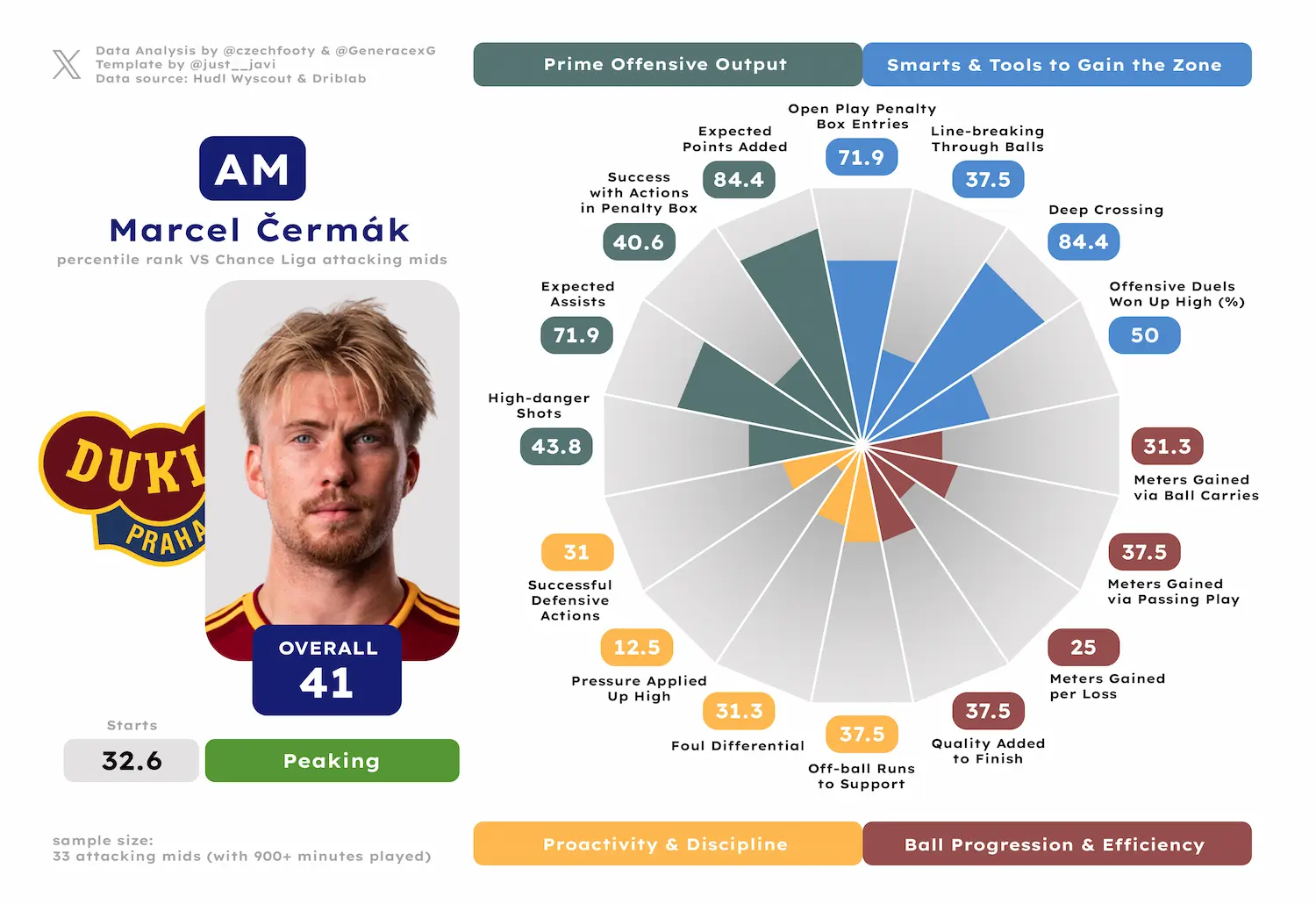
Čermák isn’t going to run crazily for you, and he could even look apathetic at times, but he’s a quiet merchant who influences the game in a number of ways (24/25 saw him, for a change, land extremely high for deep completed passes or quality added to finish). Maybe more importantly, he’s effectively a 2-in-1 kind of a buy, because you’re also clearly getting an awakened Jan Fortelný with him. He looked lively and always keen to explore a one-two or pick a passing lane in the pre-season, which extended through the opener. If he manages to stay healthy and Teplice effectively get a second look at his 21/22 exploits, it’s a home run.
Biggest downgrade
It’s rarely this easy and straightforward to identify the biggest downgrade. At this point, Denis Halinský isn’t even an up-and-coming star despite still spending the season in the “maturing” bracket; he’s an established high-end performer at the early peak of his powers. When was the last time Teplice were losing someone of this calibre? Abdallah Gning would be a stretch and Štěpán Chaloupek wasn’t all the way there yet, so 21-year-old Edin Džeko? One played 44 games for the club, the other managed 43. Yet, they both will have left a lasting impact. The Džeko era remains the last one in which any FKT fan could’ve raised their hand whenever the conversation about the best no. 9 in the league came up. While not always appreciated like it, Halinský was in the thick of the same debate for centre backs.
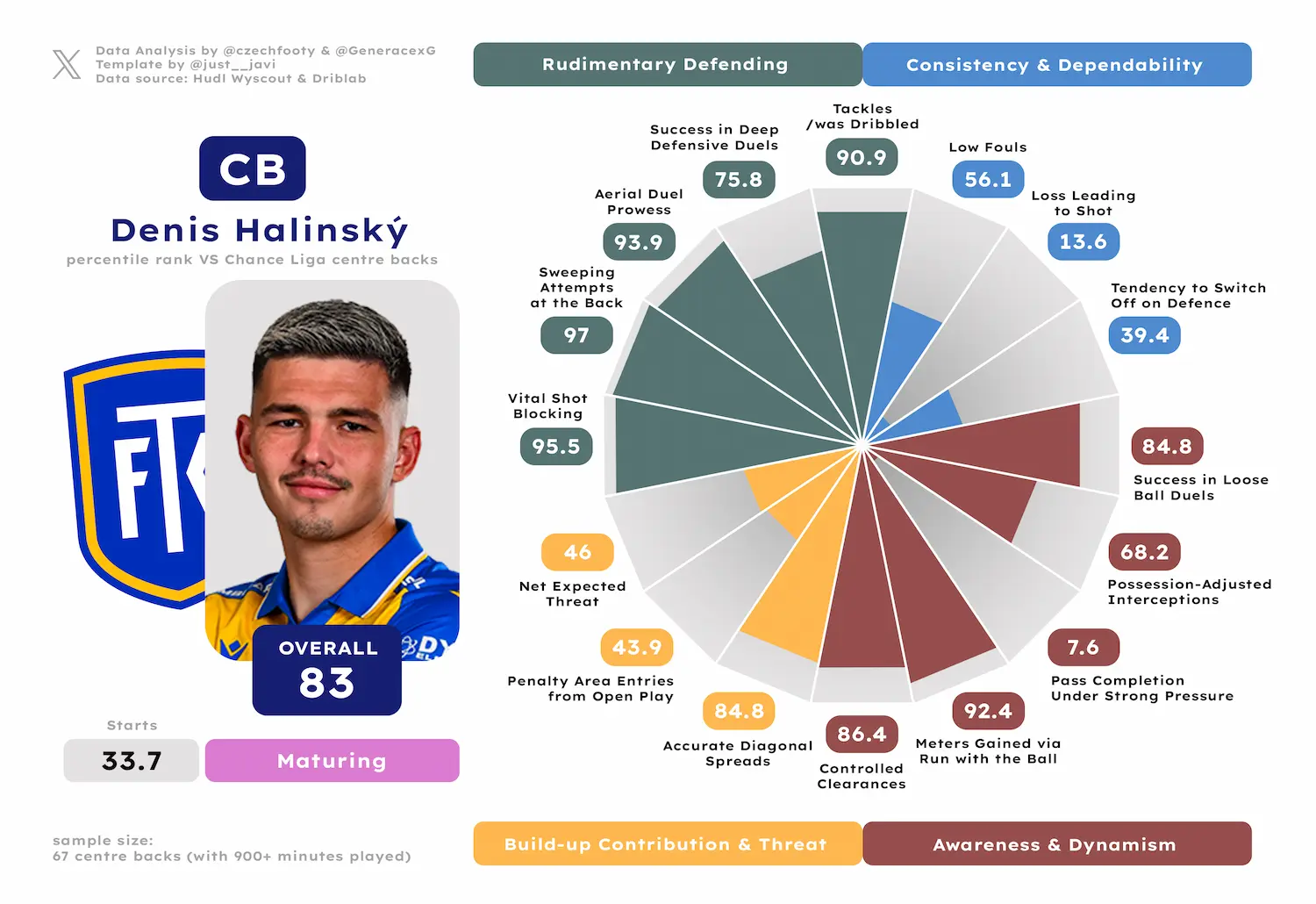
Despite only just turning 23, this is already a third such pizza chart Halinský has produced. He graded out, controversially, as the very best centre back in a season split between Liberec and Teplice. And he was good for the 83rd overall percentile as a Pardubice breakout story. For someone who’s never really had a permanent home, this is some insane consistency. And the same remains true when you dig deeper: Halinský has consistently carried the balls forward at a high rate, controlled his clearances well for his side to maintain possession, and produced all sorts of vital blocks and other valuable interventions, typically for a 90+ pct. He’s sometimes too much in duels, fouling, and you’d love to see him take a few steps forward as a passer, but there might still be time. Even if not, this is already more than good enough.
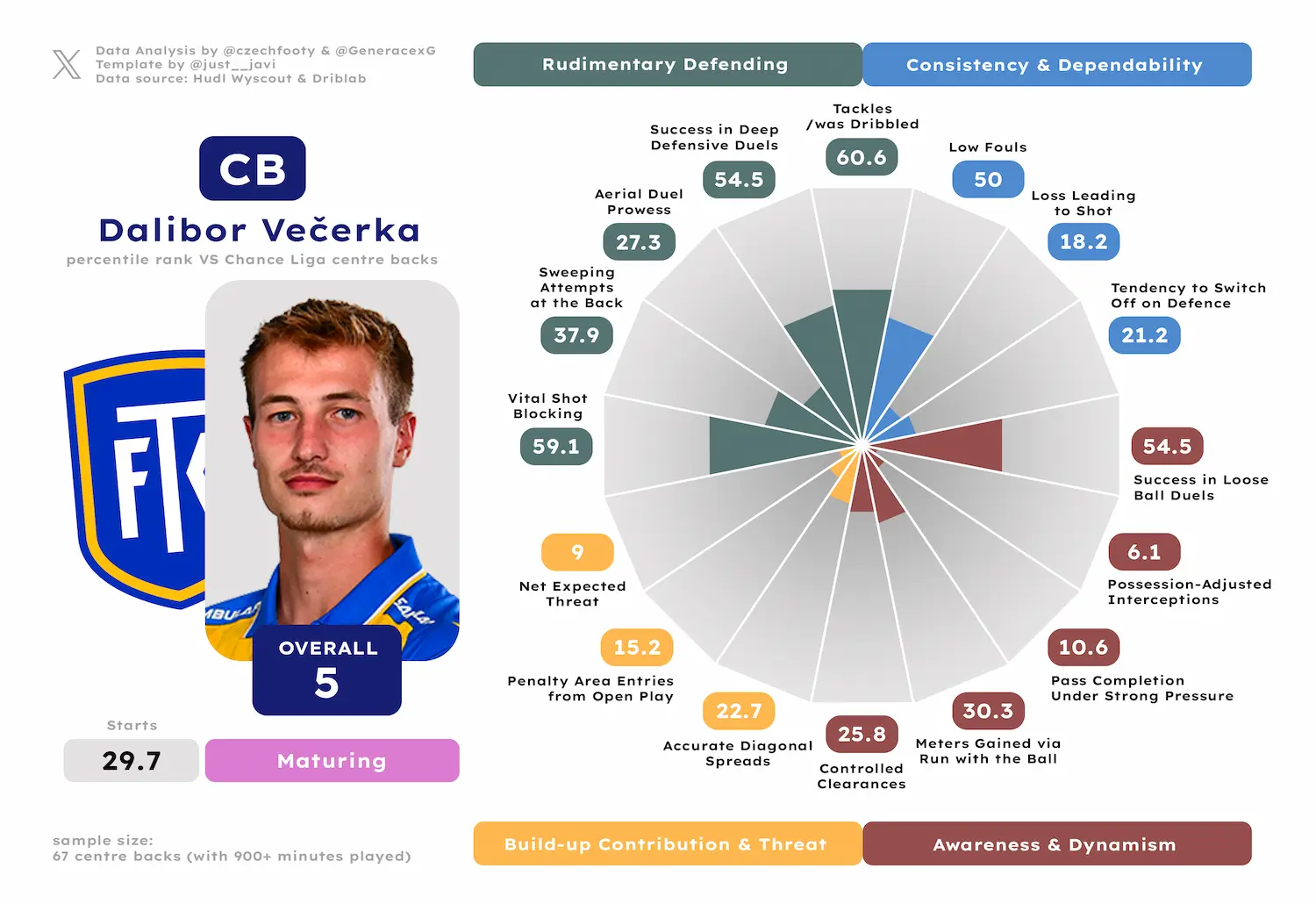
What’s still not good enough: Dalibor Večerka as the de facto leader of this revamped back line. He went from the 7th percentile to the 5th, and while that might seem harsh, he remains thoroughly exploitable in the air and through lacking positional sense. Can he step up to the plate now that there’s no Halinský to act as the uber-reliable sweeper, at least when it comes to the defensive fundamentals? He had better; the gaping hole is not going to fill itself.
Need left to be addressed
With Teplice seemingly turning full-time to something like a 4-2-3-1, the centre back position actually looks adequately filled. Having Laco Takács as the only truly experienced option is never optimal, but the team may be able to live with it. My greater beef is with the central midfield, specifically the final piece of the puzzle to the Fortelný-Čermák pairing.
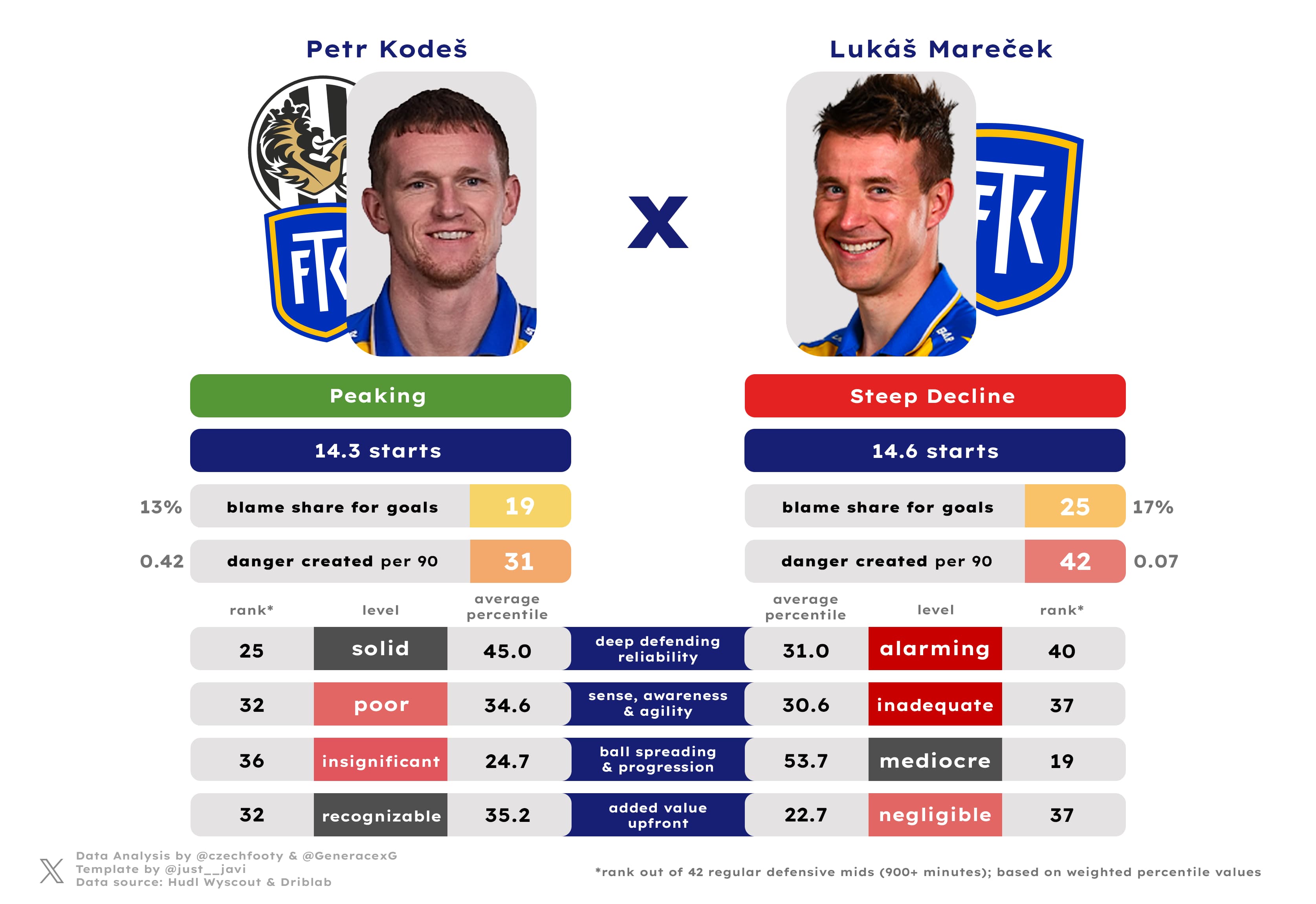
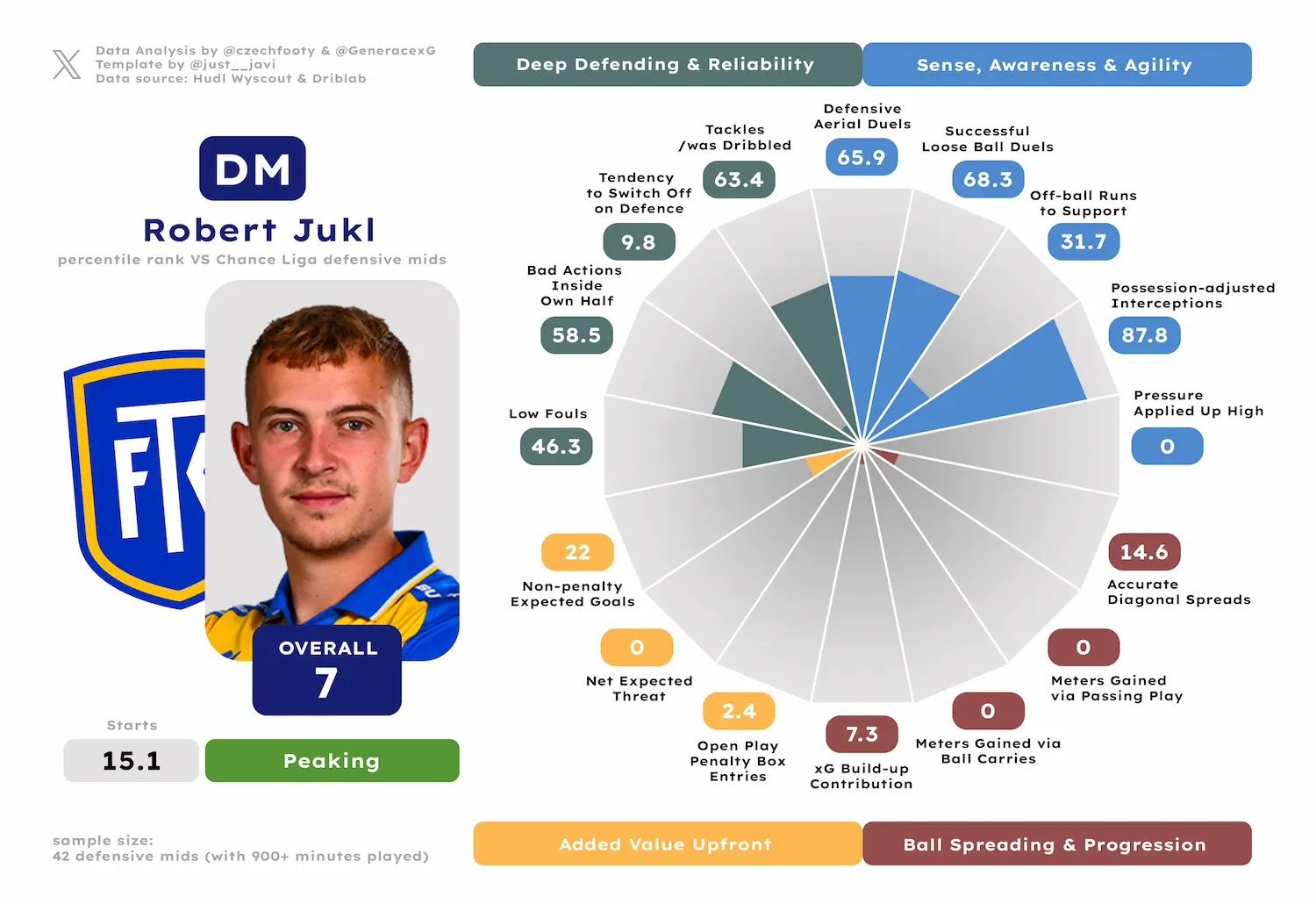
Lukáš Mareček enjoyed some great 25/26 games and was praised by both journos and the coach at times, getting rewarded with a new contract, but are we sure FKT are not placing too many eggs in his 36-year-old basket? After ditching Robert Jukl, himself a poor option who was an outright black hole in ball progression, there’s basically just Petr Kodeš backing the vet up. And it’s very obviously Mareček alone who (kinda) fits the more possession-oriented billing of Teplice for 26/27, spelling out the need for a proper ball-playing no. 6.
New kid on the block
It’s truly hard to overstate how much FKT needed a poster boy like Idris Hopi (b. 2008).
For all the good work on the youth development side, often below the first tiers, such direct jumps to the senior top level have been few and far between. Tadeáš Vachoušek, for long the prodigy, is now pitching his breakout in another corner of the country. Jonáš Bzura (b. 2005), for long praised by B-team’s coach Admir Ljevaković, is now gone to Ústí on a permanent transfer. Even acquired talent like Filip Végh (b. 2008), Hopi’s U-19 partner in crime, doesn’t always stick — though the option to buy was said to be astronomical for a youth player.
That said, despite Hopi’s obvious qualities — the bravery and guile, the pace and acceleration, the anticipation and mature finish — that made him Teplice’s third-youngest goalscorer in the senior top flight and thus ineligible for the “New kid on the block” tag, there’s always plenty to choose from, because the U-19 promotion bid was actually a true team effort. Captain Josef Port (b. 2007) held it together, and there are some who rate attacking midfielder Lukáš Svatoš (b. 2008), with his excellent feel for the game, higher than Hopi. Svatoš was a big part of the mass winter reinforcement that also saw key spring actors like Végh, Matěj Federle (b. 2009), Jan Barát (b. 2007) or Matěj Kulhánek (b. 2007) arrive. The board really wanted this promotion, and we’ll be hearing of Teplice boys a lot more in future.
Looking ahead to 2026/27
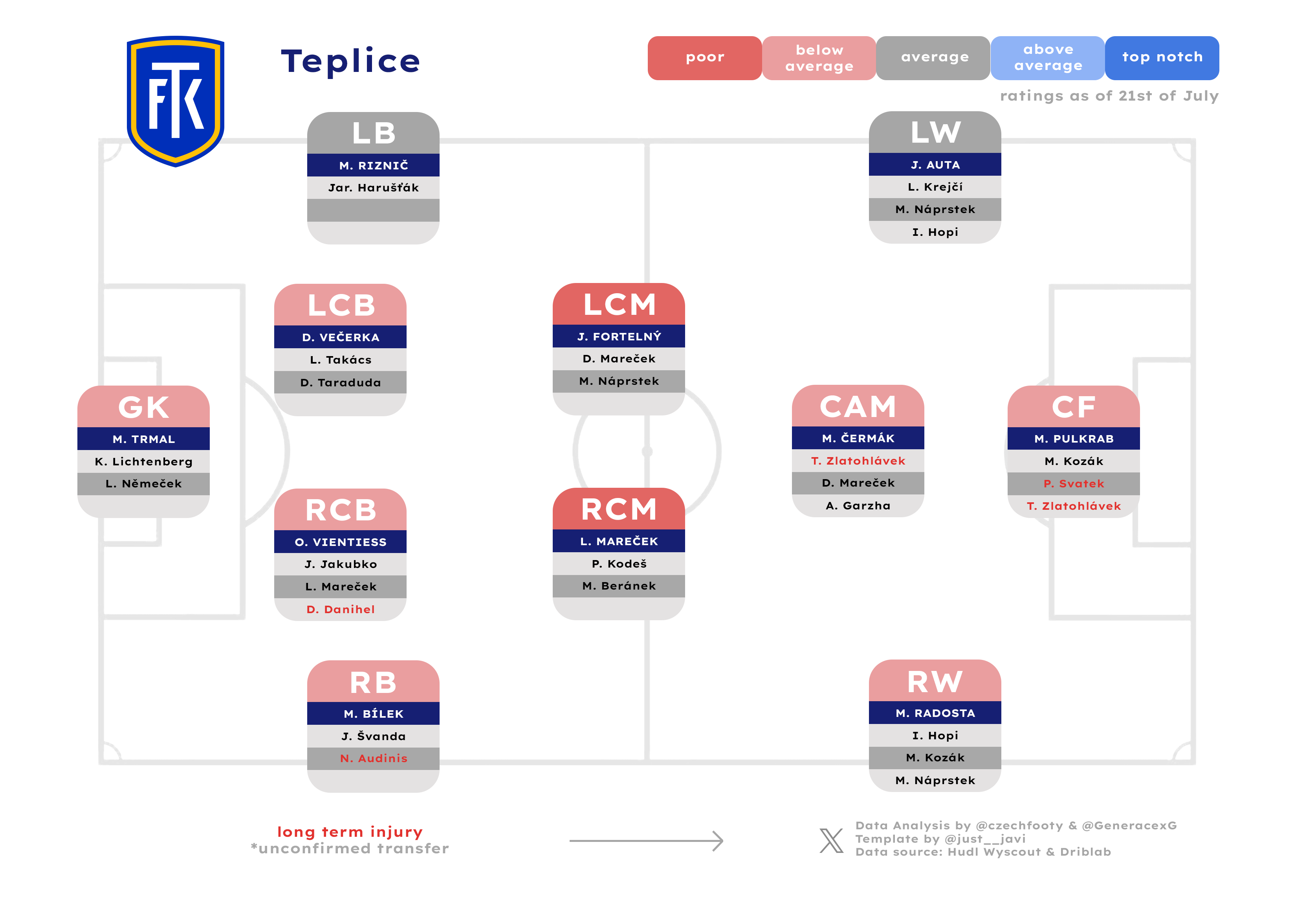
Below is the team’s current depth chart with a maximum of 4 alternatives for one position. The colourful ratings are a static snapshot of the league-wide situation on 21 July, and they are just a playful bit to add flavour to it; the names featured should be relevant to this day. To learn more about my approach to constructing depth charts, with all its limitations, head here.
Primary formation
There’s still more than enough centre halves to turn this into a 3ATB3ATB means 3-at-the-back, ie. any formation with three centre backs and wingbacks, or alternatively, five defenders., which might even be the sole configuration where Takács is truly comfortable, but whether Oskars Vientiess (rising up from the Czech second tier) and Denys Taraduda (rising up from the Slovak top tier’s relegated side) will sink or swim in this league remains an open question. One should be a more constructive rival to Jakub Jakubko, whereas the other doesn’t complicate stuff.
Colours I grappled with
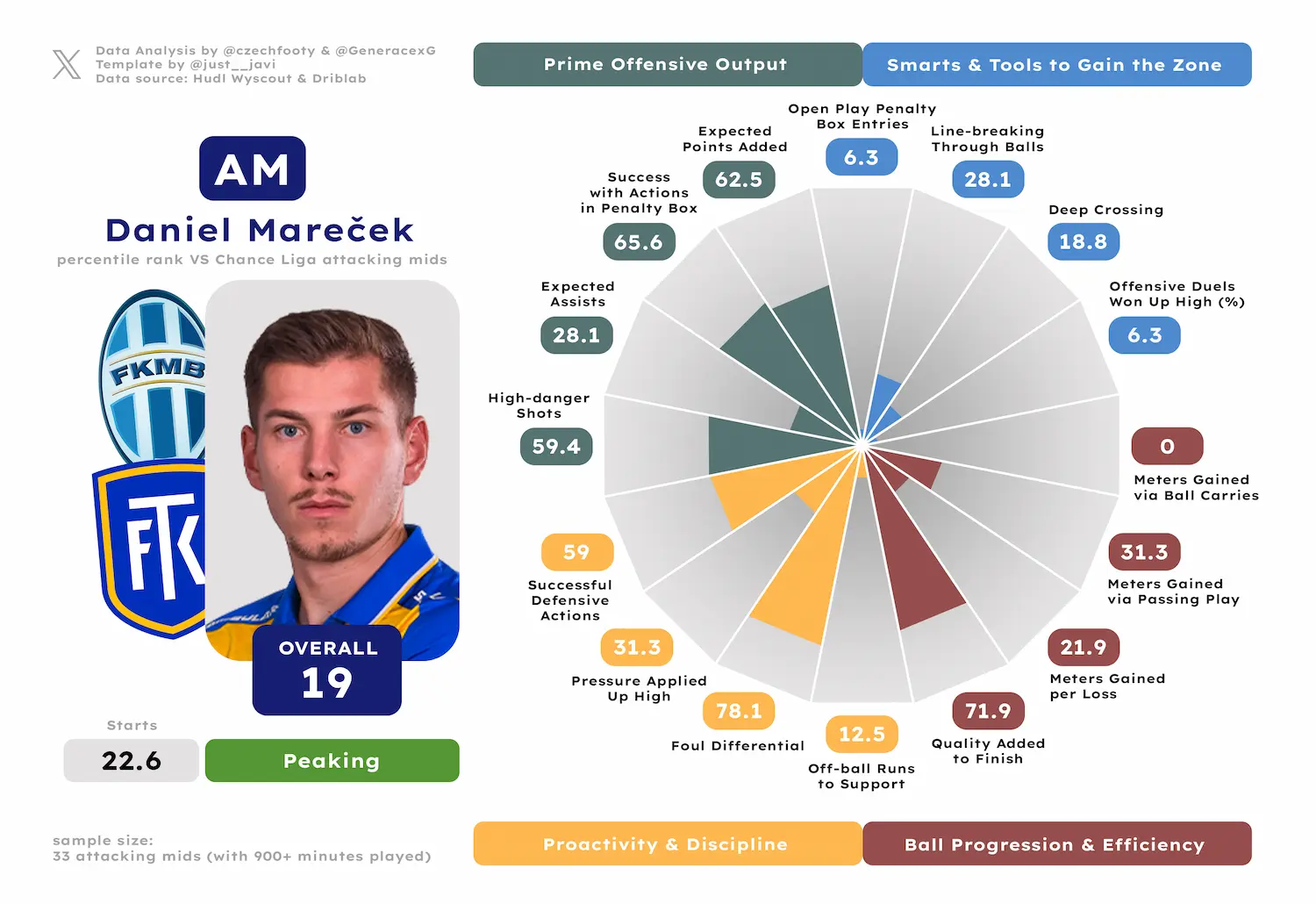
Trmal might have a word or three to say about the “below average” tag, though this is more down to the inexperienced backups. Central midfield probably isn’t as bad as second-worst in the league on most days, but the competition is fierce and Matěj Náprstek doesn’t belong there, much like Daniel Mareček. (Just to be sure: Čermák factors into the AM-CF equation.)
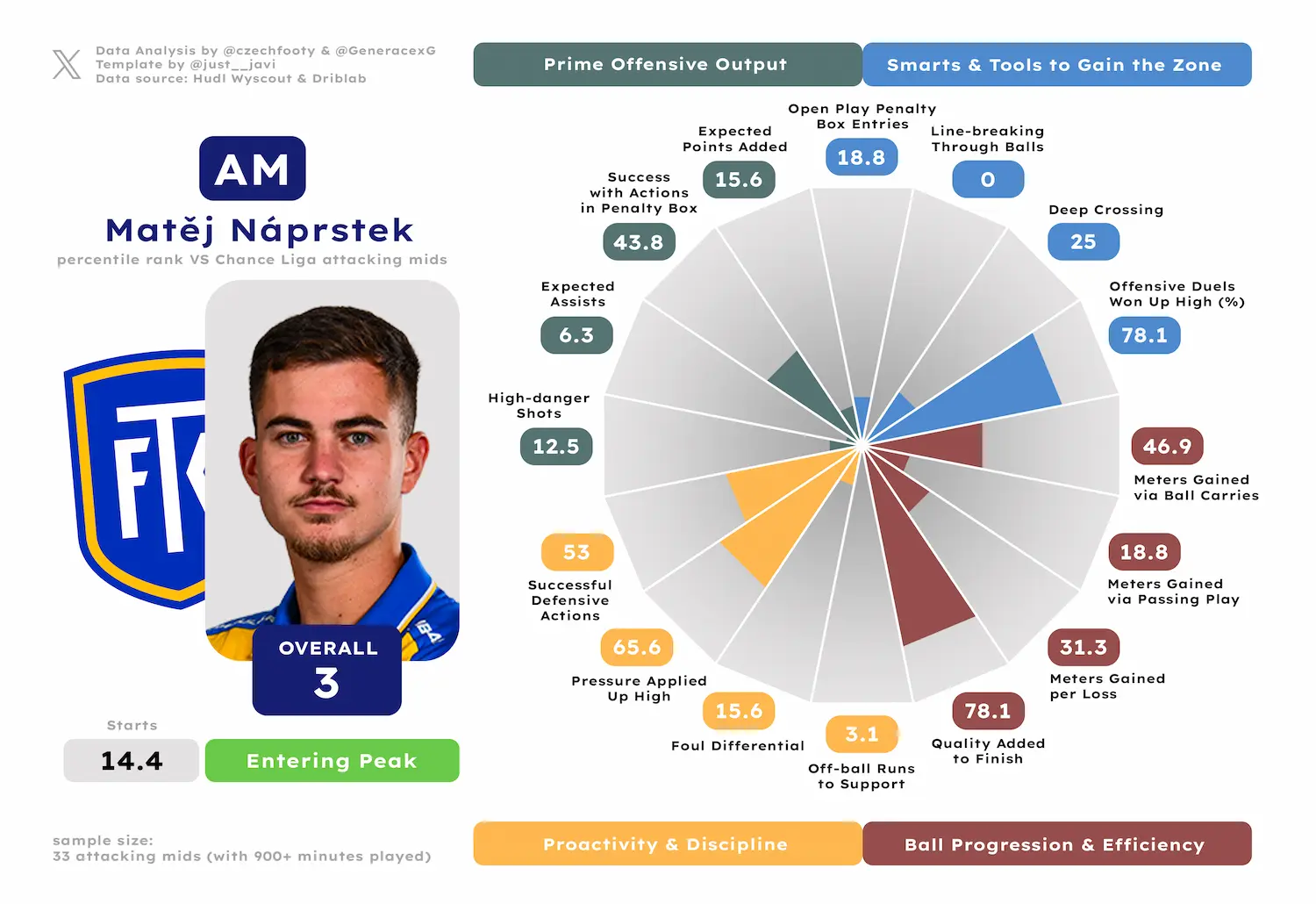
Notes on the depth chart
In fact, let’s pause for a second to talk about Daniel Mareček. He’s just a fascinating case study as someone who’s always a safe bet for a three-point afternoon, which eventually gets swallowed by a flurry of ordinary afternoons all around it. This time, Mareček delivered a slightly unusual 0+2+1 performance in his penultimate Mladá Boleslav start, later chipping in with another 1+1 vs Zlín (R33). Ultimately, half of his goal contributions came in two games.
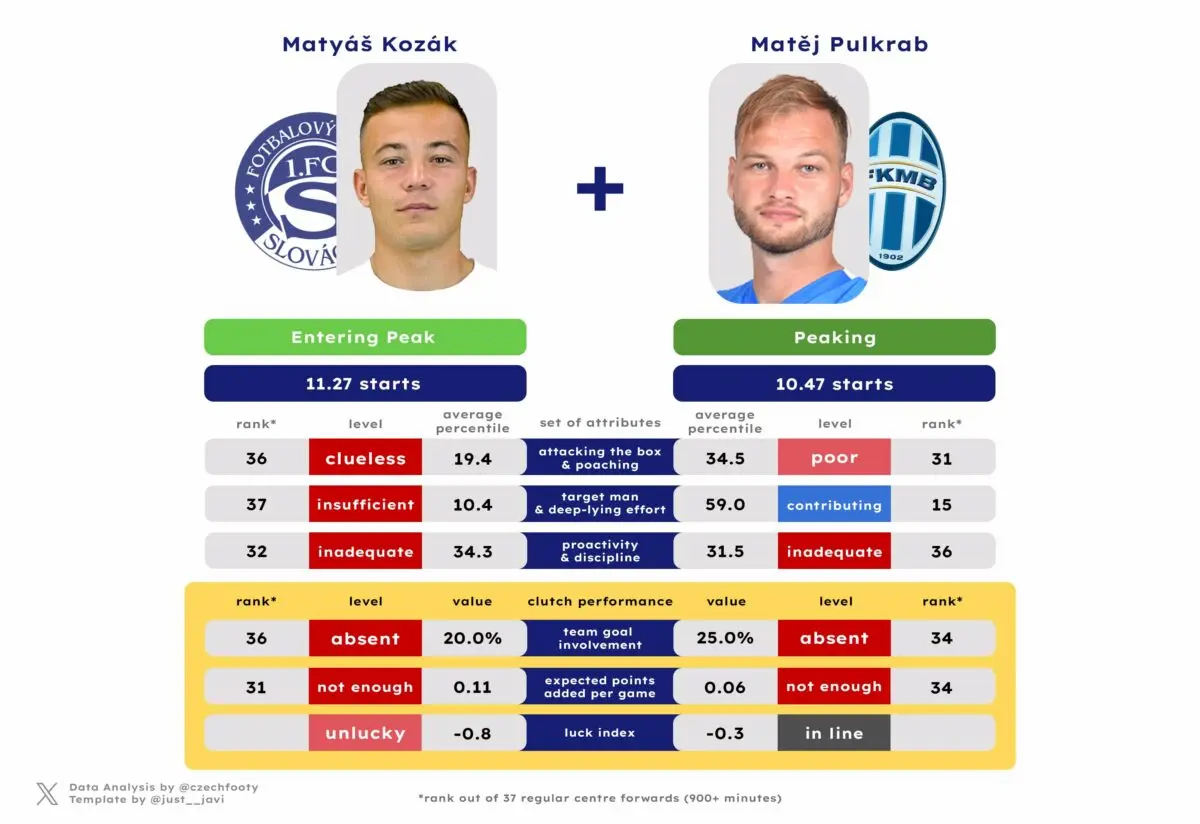
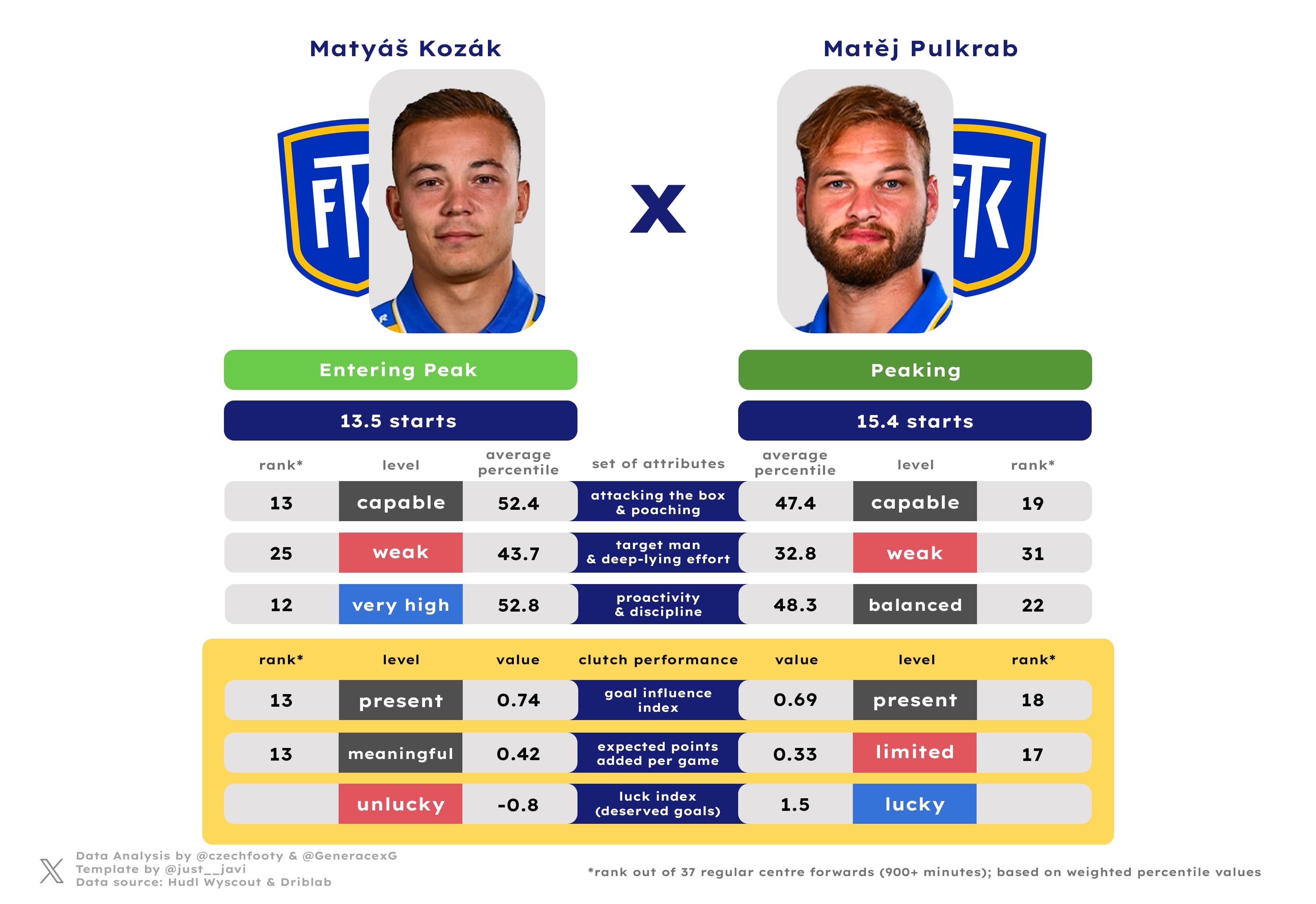
Speaking of scoring goals and registering points, here’s a duo that could do more of it. Matyáš Kozák and Matěj Pulkrab combined for nine goals and five assists, which is not too shabby and definitely could’ve turned out worse considering their 24/25 campaigns, but it also isn’t an ideal tandem to call your runaway best up top. I realize how this sounds after Pulkrab’s Round 1, but there are up to 34 more, and he was already a little lucky in 25/26.
If this was John Auta playing half-injured after skipping the winter camp, we are in for a treat. The Nigerian registered six of his eight goal contributions before the break and should be at 100% entering his second full season with Teplice’s first-team. He was already a marvelous finisher cutting in from the left wing, but there is certainly more to come.
Roster battle to follow
As Jaroslav Harušťák went down with a serious knee injury while preparing for what was supposed to be his big sophomore season after earning an 85th-percentile mark, I remarked that “now there’s literally no one to lean on” in his absence, with Matej Riznič looking solid in pre-season while supposedly merely filling in, after coming over from Slovakia as more of a left winger. Oh how wrong I was. Riznič didn’t exactly set the world alight, but he’s up there with the wider elite as a surprisingly well-rounded fullback with a few holes in his game.
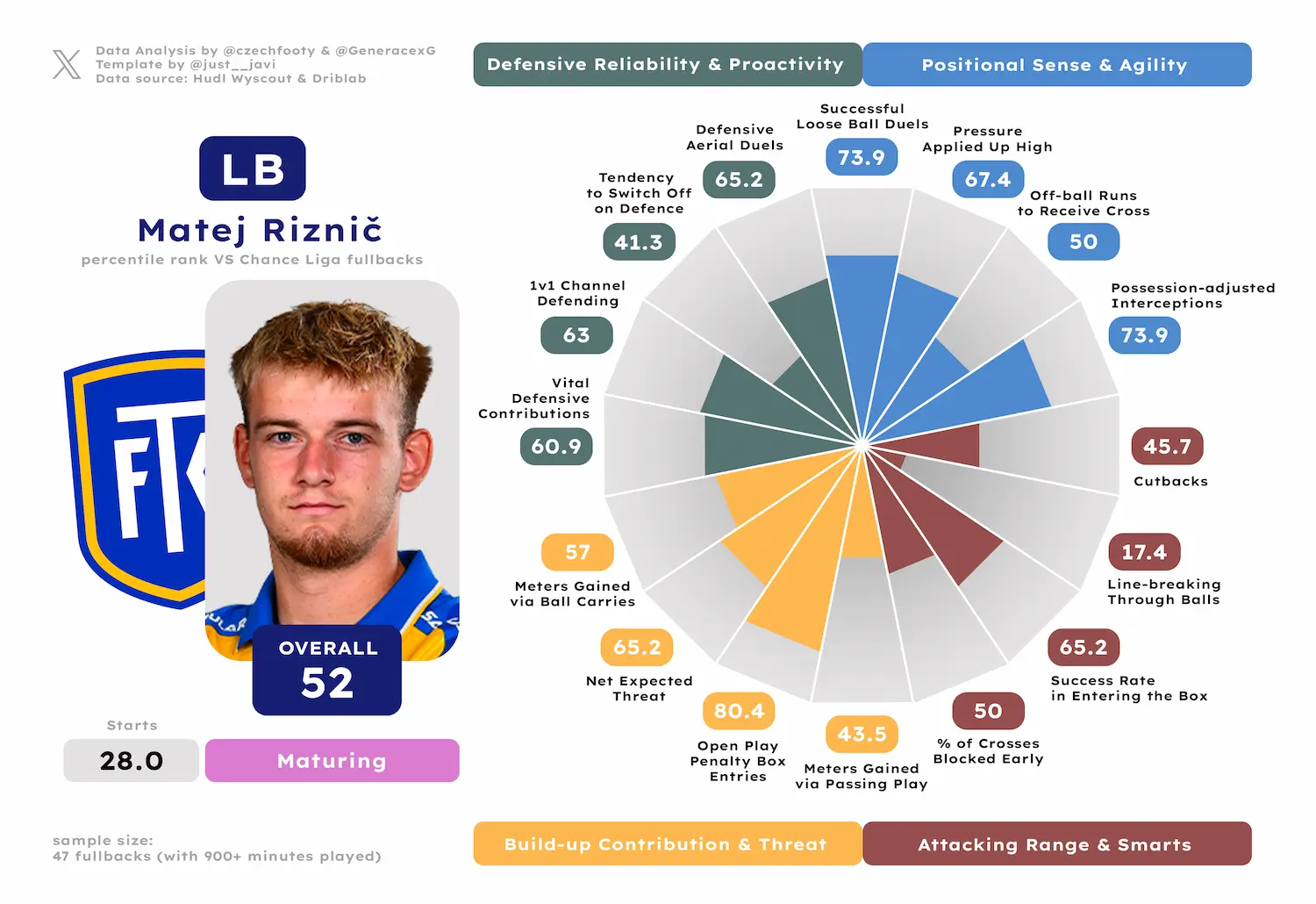
For a 21-year-old who only spent 500 minutes at fullback in 24/25, Riznič especially impressed with his mature defensive play, carrying the ball upfield with some occasional flair. If you filtered out fullbacks who were above average in winning all three major kinds of duels — ground, aerial and for loose balls — you’d be left with a mere eight. Riznič among them.
Now, ‘Hary’ wasn’t yet ready to make the bench in the opener, but it should be coming soon. And when it does, we could be in for quite a battle between two recent breakout stories.
Season forecast
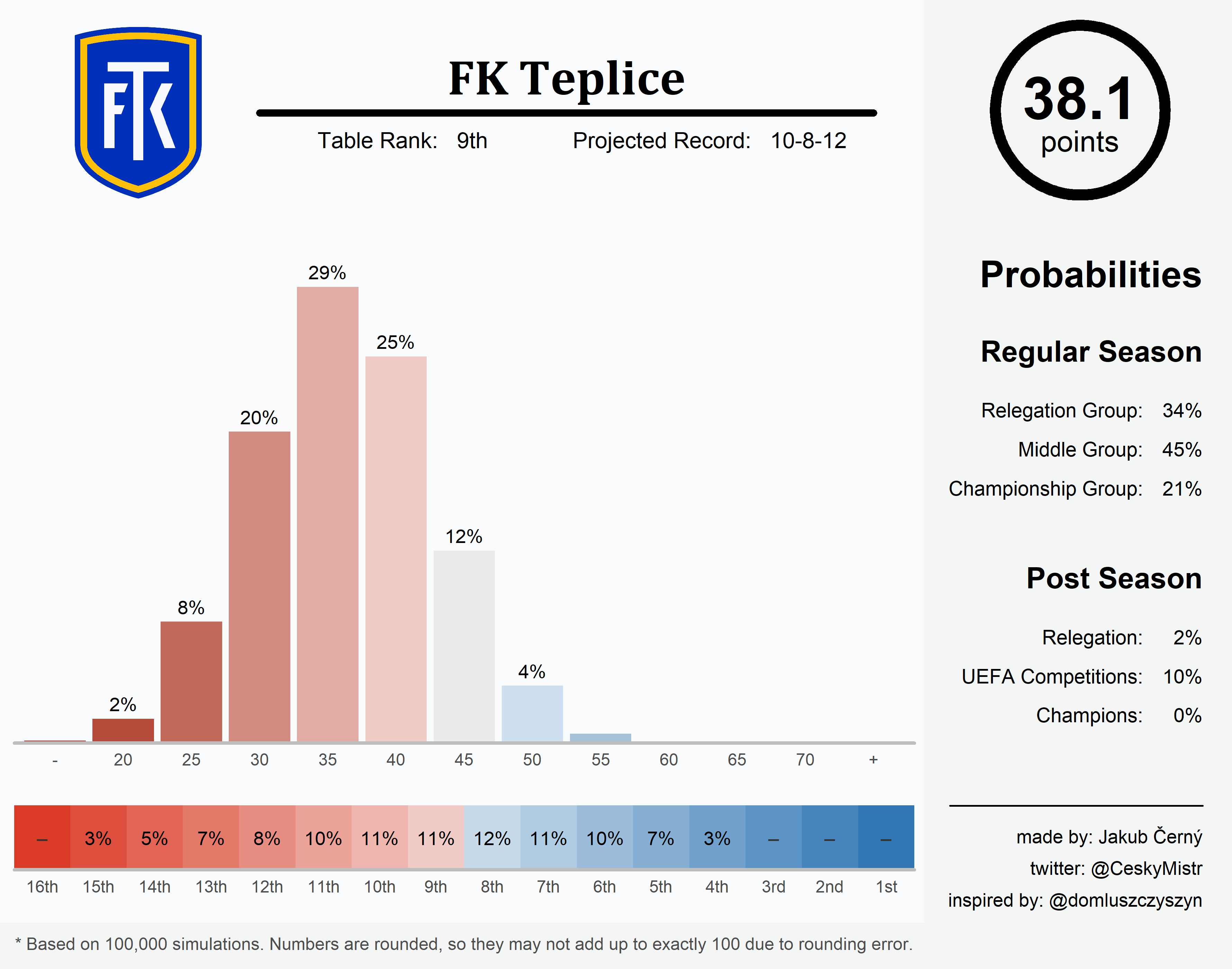
Welcome to the most optimistic Teplice forecast in the five years of doing this. In the debut 2022 edition, FKT were by far the strongest candidates for relegation at 68%. Now they’ve reduced that likelihood to a mere two per cent, officially making them more likely to qualify for Europe. Thus far, the most Teplice had ever been trusted to clear the 40-point mark during the regular season was a 14% chance in 2024, when they were projected to finish 12th in the majority of simulations. Now, those two digits have been reversed for a much more bullish 41% chance, while Teplice even leave the hyped Pardubice in the dust (by 0.7 points).
Perhaps most striking is the comparison of Teplice and their Sudeten rivals, Liberec. For all those past years, you could bet on at least 10 points separating them, starting out with a 20-point gap. Now you could hardly thread a needle between them (1.6 points of difference). This is as much about Slovan’s stagnation as it is about Teplice writing off their weakest season in modern history (seven wins in 20/21), while the second-weakest that followed right after is now considered the least important (ie. recent) of all five fed into the Elo-based model.
Bold prediction
The track record: 1/5. Trmal does not own a top clean sheet ratio in history anymore
The prediction: Not a single Teplice player will finish the season with two goals
The rationale: About a week ago, Teplice director Rudolf Řepka traded the boardroom for an axe and a vacuum cleaner to clean up a fan’s cottage. This was due to an infamous bet in which the fan jokingly offered to sweep Stínadla if new signing Tomáš Zlatohlávek managed to score at least two goals, whereas the club official countered that he’d return the favour if ‘Zlatan’ failed to do so. Sure enough, the troubled centre forward never got off the mark.
While the act of doing the chores was kind of sweet and made for a lovely PR stunt, back in January, quite a few fans felt the bet was beneath Řepka — a gesture that was simply too public. For those supporters, I have good news: we are going to retire the damn number 2.
Specifically, there won’t be a single player who’ll finish the campaign on a pair of goals. Last term, it would be the late Idris Hopi cameo making me sad; the year before (and just about any other time, for that matter) it was far too popular a number. In fact, the last time there was no two-goal Teplice player: 2014/15, when the wonderfully-named Ulrich Kapolongo got stuck on one strike. In a summer that saw the owner himself reference Congo, Kapolongo’s home country (although who knows if it was his Congo), I take it as an obvious sign.

Enjoyed it and just want to casually support us with an amount of your choosing? No worries, you can still do that by inviting us for a symbolic pint at the old BuyMeACoffeeBeer page.