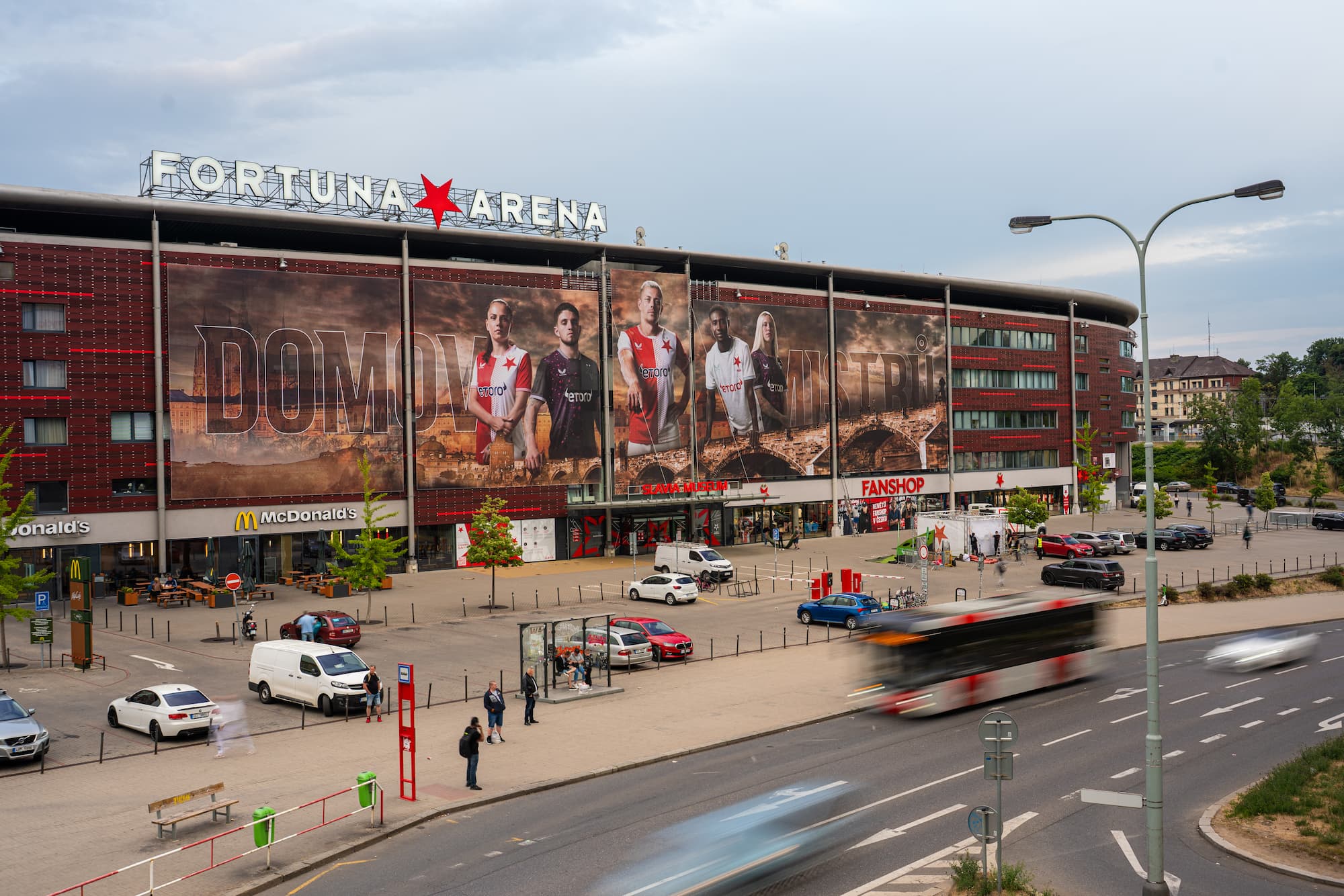
This, really, is how you respond to a three-year title drought — by completing what now stands as the most dominant season of the analytics era, narrowly eclipsing your own covid-affected 2020/21 campaign. It marked the first time a Czech club has ever cleared the 90-point mark. And while Sparta’s 2013/14 side steadfastly remains the best team in history (at least by points per game), Slavia show no signs of slowing down and could end up lapping Lavička’s iconic team, too. Their summer was somehow even more ambitious — from a larger-than-ever kit project to a flurry of new partners, including OMV and Coca-Cola — all in preparation for a full-throttle return to the Champions League.
With a rare empty summer on their hands calendar-wise (no continental play-offs for the first time in a decade), Slavia have certainly made sure to keep everyone busy. Their newly opened fanshop, finally operated by the club itself and potentially finally offering adequate sortiment, is humungous. Their B-team, setting out to face second-tier opposition with the likes of Simon Deli, Tomáš Necid and Marek Suchý, wasn’t big enough, either, so there’s now a C-team mentored by former A-team and B-team leader Michal Švec. A new contract with Fortuna could fetch the champions as much as 60 million CZK (2.4 million EUR) yearly, per Jaroslav Tvrdík; a life-changing amount even for a club of Slavia’s stature. There will be a documentary about the title-winning campaign, because of course there bloody will be.
There are still areas where Slavia arguably languish below the standard they set for themselves — we’ll see how the new grass foundation fares, and whether the stadium’s sound system will indeed receive a significant tune-up, as promised — but, apart from the Šeberov-situated elephant in the room, there are not many major ones remaining. And while it didn’t seem too revolutionary to me, the video revealing both the scouting process and a coveted signing hit all the right spots thanks to the brilliant timing with all that’s gone on at Letná.
Slavia want us to know they are doing everything better than anyone.
And they might as well be correct.
Looking back on 2024/25
What went (particularly) right
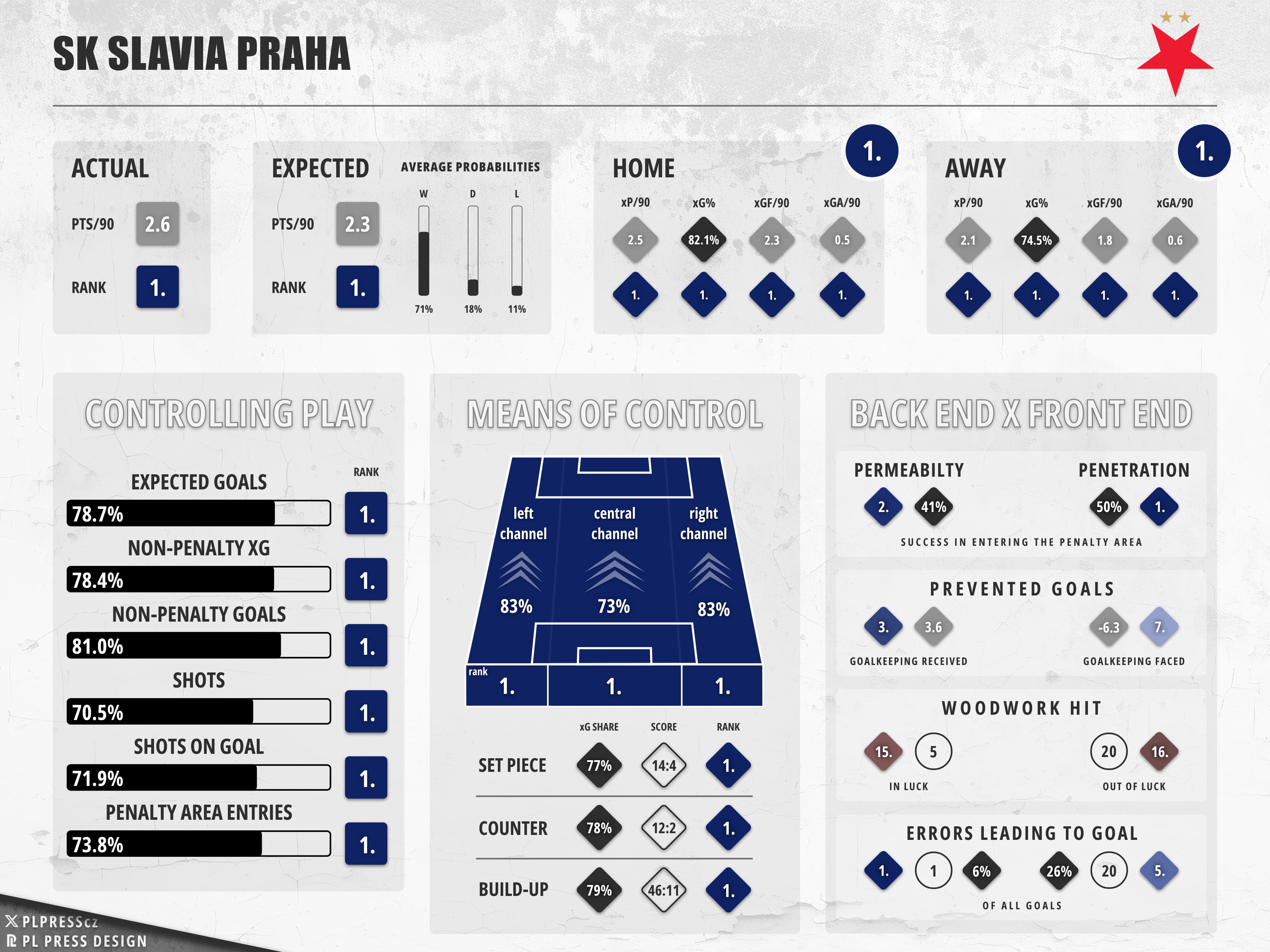
There are values upstairs I have never seen before in four years of doing this; and some of them don’t even come close. Owning 78.4% of non-penalty xG flow would’ve eclipsed both recent Slavia versions, pretty comfortably leading the pack, by seven and five percentage points respectively. Over the last three years, no one has controlled upwards of 80% of positional attack xG flow down both channels; now Slavia do, with both right and left side rivalled only by the Alex Bah-patrolled right-hand force of 21/22. Two years ago, Slavia led the league by earning 65.2% of all xG produced on set pieces; now they are at 77%. I’ve only done win probabilities for this year, but the fact Slavia were — on an average matchday — twenty-percent more likely to win than the next best team (Plzeň) is just completely insane.
Of course, what’s both historic and more relatable for a casual observer on Slavia’s 24/25 success is their sparkling defensive play. Until the second Prague ‘S’ derby in Round 25, Slavia’s rolling xGAExpected Goals Against (xGA) estimates how many goals a team should have conceded based on shot quality, location, and context. accounting for the past 10 games never went above 0.5 xGA. That is already incredible — since Sparta’s minimum was 0.76 and Plzeň’s even 0.93 xGA — but it appears even more so when tied to Slavia’s own past. In 23/24, Slavia’s box was even more sealed off than this term (more opponent’s attack needed for one touch in the box, less penalty area entries allowed etc.), yet the best they could do in terms of rolling ten-game xGA was 0.70. This year’s absolute best 10-game stretch (0.33) beats any 10-game stretch of my five-year history of tracking this measure of sustained defensive excellence. Only once did anyone (Slavia with 0.37 xGA between R17-26 in 22/23) come even close to equalling it.
What went (especially) wrong
The start was ugly, wasn’t it? Slavia once again went goalles on the inaugural matchday, and by Round 3, they registered a proper stain on their early record in not even reaching 0.2 xGFExpected Goals For (xGF) estimates how many goals a team should have scored based on shot quality, location, and context. against Liberec. That was only the second time such a hiccup happened to Slavia in the entire analytics era (going back to 2015/16), and the only other time Slavia fans had to suffer through such a misery, they were cheering on the likes of Štohanzl or Voltr in October 2015.
This was soon forgotten, of course. By R10, Slavia had effectively chased Tvrdoň out of the Plzeň goal like he was an ice hockey goalie, and held at least a two-goal half-time lead against Boleslav, Bohemians and Sparta. But that was not pleasant; much like receiving a red card in not one, but two Sparta derbies. The latter was also notable for Slavia not producing a single shot on goal for the first time since February 2022 and that peculiar Liberec loss.
Most valuable player (still on board)
Per my MVP model (traditional stats): Lukáš Provod (ranked 3rd league-wide)
Per my positional models (advanced stats): Lukáš Provod (100th overall percentile at CAM)
Per Statsbomb’s On-Ball Value (OBV) metric: David Douděra
Welcome, everyone, to Lukáš Provod‘s world. For the first time ever I was tempted to just leave it at that and share the pizza chart, because the only metrics where he doesn’t go to at least the 90th percentile are easily defensible: Concerned that he’s only ranked 11th and 15th in pushing the play via passes or per loss? Don’t worry, because he’s still one of only 4 attacking midfielders who land in the top quarter for ball progression via carries and top half for the other two ball progression metrics. Not too happy about his two finish-related values barely cracking the 60th percentile? Would it help if I told you he literally pulled the trigger from the perimeter (low-danger positions) the same amount of times (18) he produced a high-danger shot of min. 0.15 xG? His share of hopeful shots (below 0.04 xG) was a Top 4 one.
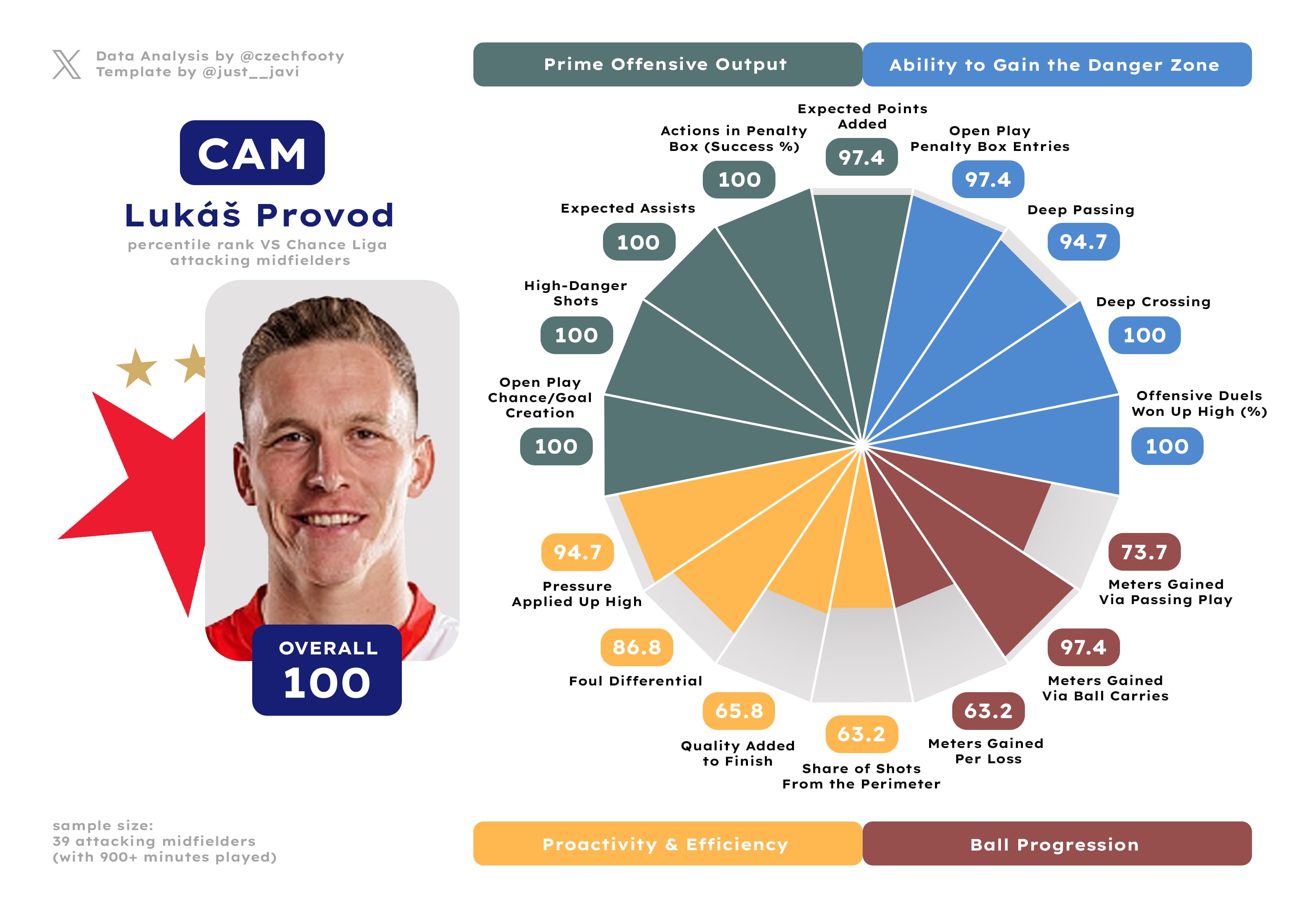
There is too much to love, and handle, on Lukáš Provod. Together with Laçi, he’s a rare 90th-percentile passing and crossing double threat. Equal parts elite as a dangerous finisher and creator? That mantle he shares with Ladra, for a change. Connecting on more than half of his actions in the box (54.9%)? Alone on an island. There were parts of the season where he didn’t take over games like we got used to, and we wondered. Seeing his full-season pizza, though, you wonder how much we should’ve wondered. There is no shame in taking your foot off the pedal a little bit when it still means the only game you started and didn’t produce a single chance or goal in came against… Dynamo?! When Provod was on the pitch, things just happened. With him around, Slavia scored 2.5 goals per game; without him (for 10.6 matches in total), that rate dropped by a whole goal. Isolating opportunities that didn’t lead to a score change — better measure of sustainability — Provod himself finished off 1.52 chances, while acting as the primary creator 1.31 times and secondary creator 1.35 times per game. When you lay this over Šulc’s balance sheet — 1.07 finished; 0.68 primary, 1.13 secondary — you get the full picture of Provod’s influence. This isn’t a knack on Šulc by any means, as he doesn’t take set pieces. It’s just a demonstration of Provod’s utterly overwhelming genius.
Chip on the shoulder
carried by the player who’s got something to prove — be it to himself, fans or the coach
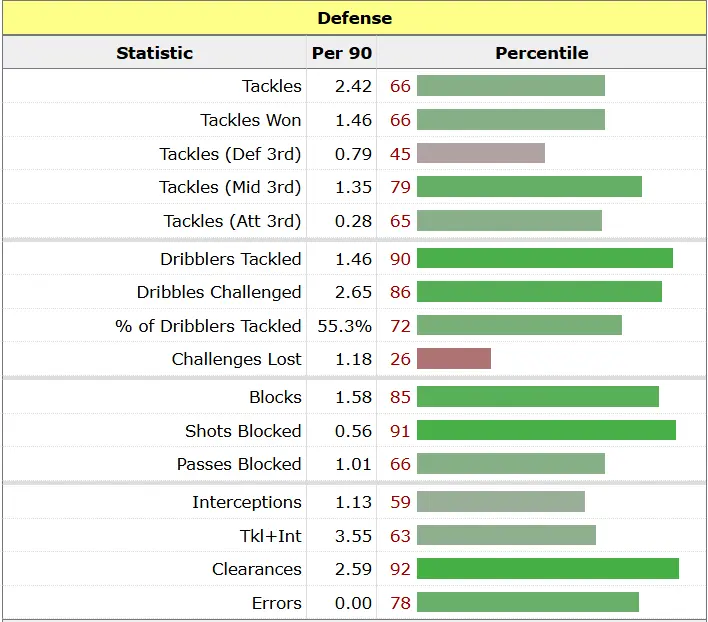
In the Dresden dress rehearsal where Slavia seemingly fielded their strongest available XI, it was the classic. The double pivot of Oscar Dorley and Christos Zafeiris rarely lets you down, so why overthink it. Well, Jindřich Trpišovský might soon have a reason or two. The emergence of David Moses had already taken a bite or two from the duo’s playing time in the spring, because he simply forces you to play him with his aerial strength, agility and reliability all tied up together in one package. Now there’s also Michal Sadílek as an energetic left-footed alternative to the centre of the park. He may suddenly be needed at LWB, but his FBref defensive numbers in comparison to Top 14 league midfielders over the last 365 days (when Sadílek accrued nearly 1600 mins) paint a picture of a promising central barrier.
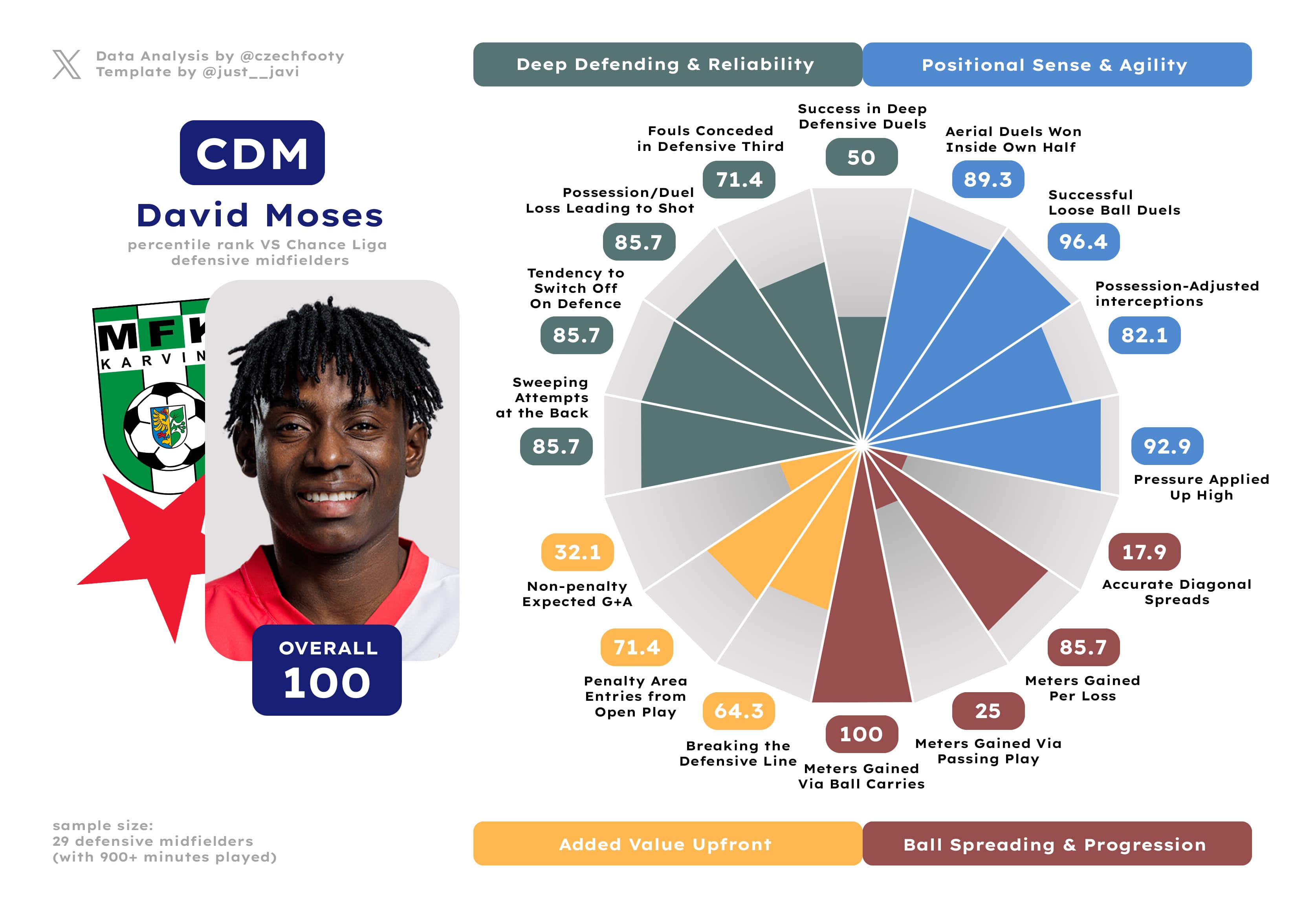
Of course, Moses’ profile does carry some holes still — he’s 21, goddamit — but it is a delicious piece of a pizza right there, with some tremendously balanced flavours. In terms of open play penalty area entries, Moses left guys like Vydra, Kairinen or Trávník behind. He still progresses play mostly via ball carries, but does so at a scale larger than anyone. When it comes to sweeping up high and loose balls, he’s got them all. Where Oscar lost 67.3% of his aerial duels in vulnerable areas, his rival was less active in climbing up (engaged in 1.15 aerial duels in his own half per game, compared to Oscar’s 1.81) but far more efficient, losing just 42.9% of all. Between his ranks in possession-adjusted interceptions and successful loose ball duels (and the largely uncaptured skill of willing backtracking), you’ve got the best positional guardian you could wish for; Oscar only ranked 16th and 20th respectively in those metrics.
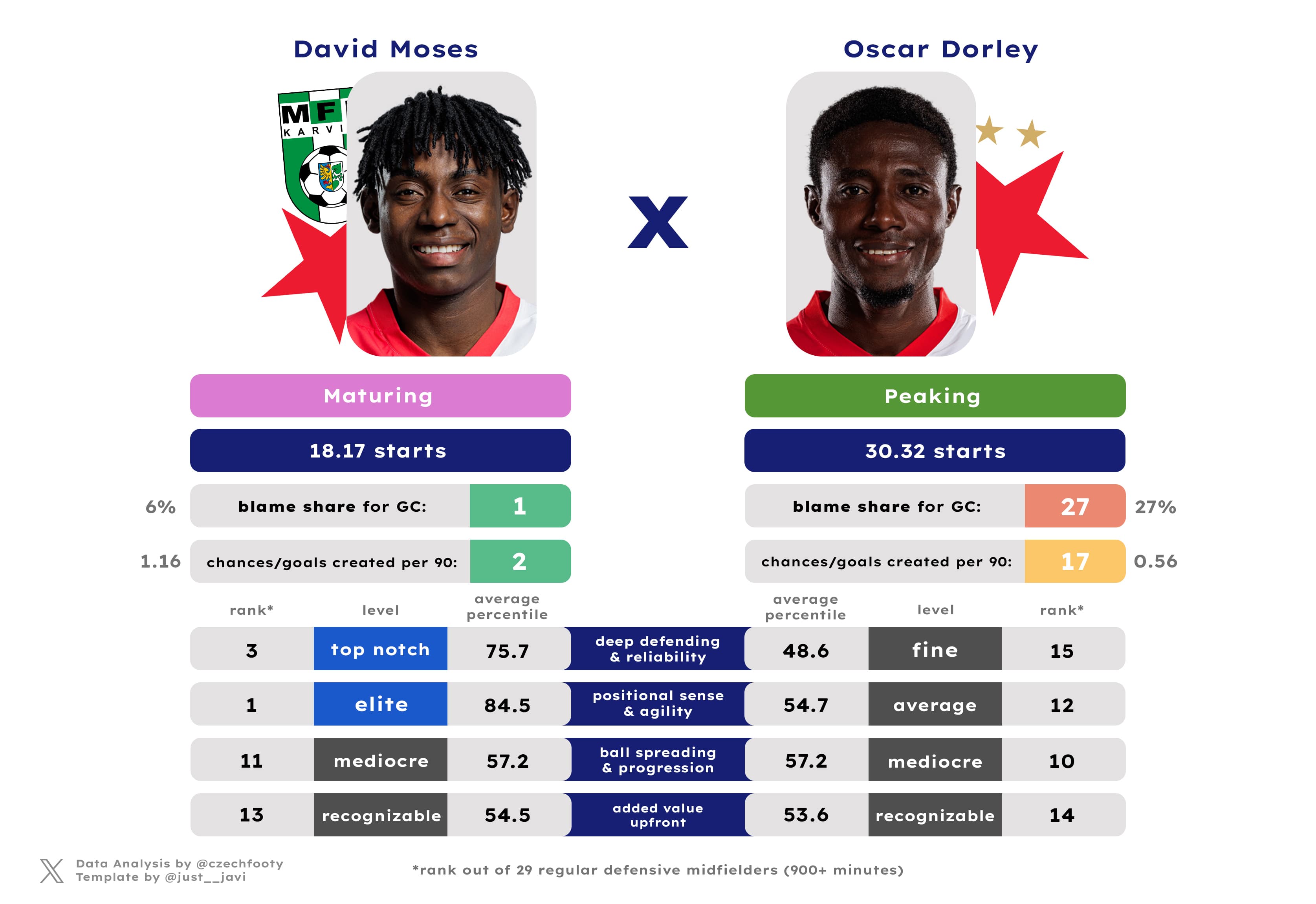
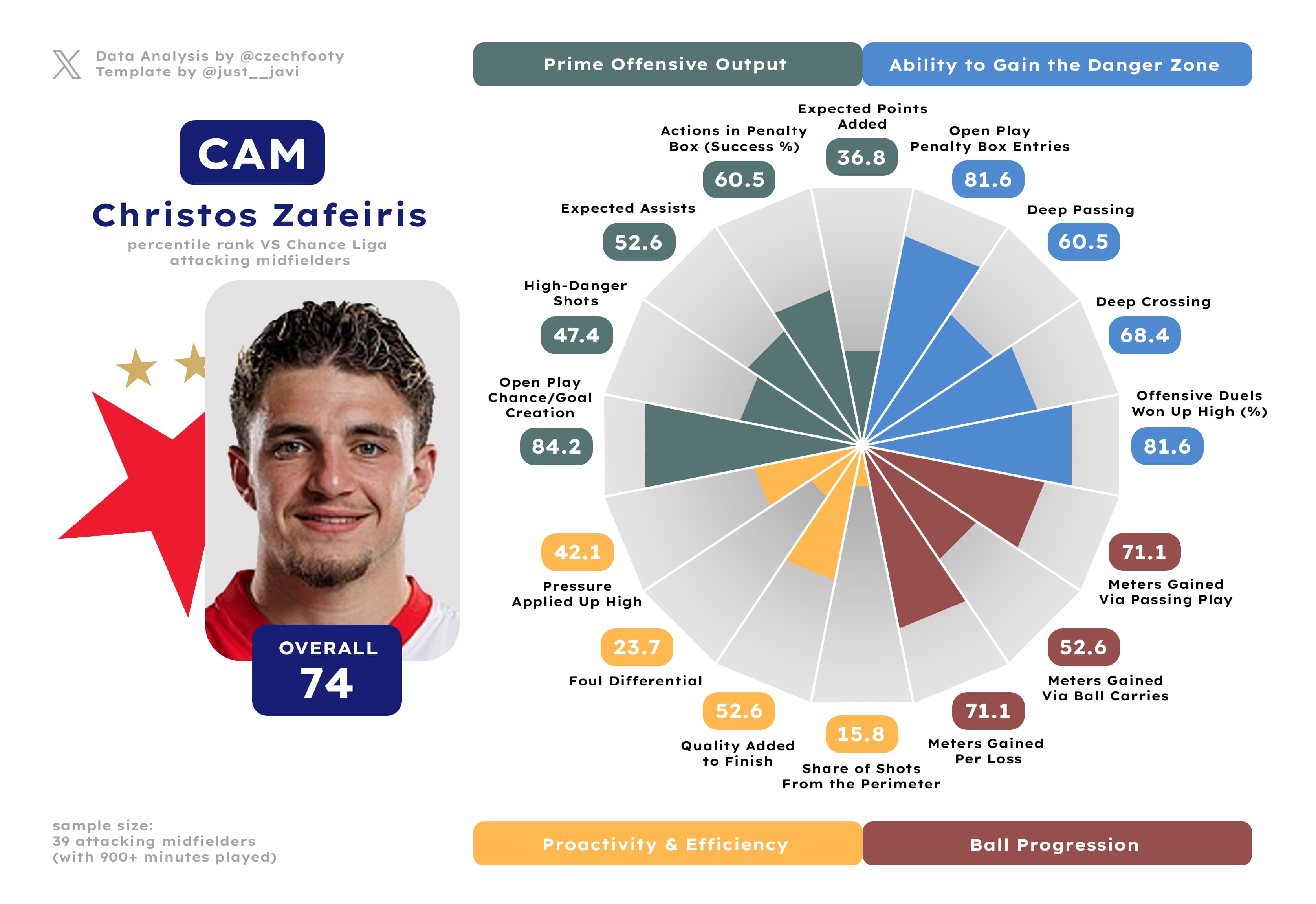
This isn’t to suggest David Moses is, on this day, a better player than Oscar Dorley. But he’s getting there faster rather than slower; and the concerning thing is, it’s not just his own doing. It’s Oscar himself allowing it, too. He was a premier ball carrier in the two preceding years, and a high-end creator in the final third among defensive midfielders, but none of this holds true anymore. We could be witnessing a rapid changing of the guard at Slavia — and in Chance Liga, more broadly. Which goes for Christos Zafeiris, as well. It feels weird to type this out, especially when you realize the Greek warrior was still only 21 for a majority of this season, but the clock is ticking on him showing a bit more flash. Zafeiris has been moulded into a well-rounded midfielder, someone Trpišovský had no doubt craved, but to top out below 85th percentile with all of the metrics is not a great sign for a Slavia starter. Zafeiris’ overall percentile has steadily dropped from 94.9 through 85.4 all the way to 74.0.
It goes without saying he’s a major piece of the title-winning puzzle.
But it shouldn’t be impossible to still be that… with a bit more kick. If you know what I mean.
Inside the off-season
special thanks for guiding me through the motions of SK Slavia Praha’s off-season go out to @martin_kabelka, @quelhar, @zivadira, Alanor & Thorklaer
Squad turnover
After holding onto every key piece last summer, Slavia are back to selling high on a stud. Malick Diouf may not have been a minute cruncher at the level of Coufal, Bah or Jurásek (both leaving as most used Slavia players in those respective campaigns), but he was still 52nd most utilized defensive-minded player in the league and contributor to 15 goals scored + 33 wasted chances. In terms of EPAExpected Points Added (EPA) estimate the value of one's goals and assists based on game state (late game winners = top)., only one Slavia player brought more value to the table (7.29 expected points added via Diouf’s goals and assists). So, yeah, as far as one-man damage goes, this one is about as major as it gets. But it’s also good to underline it was indeed just one man. Other players collecting at least 100 MVP points and disappearing on Slavia — specifically Kinský, Jurásek, Lingr and Prebsl — have all been gone since end of March at the latest. When your only other immediate subtraction is the retiring Milan Škoda, while you’ve managed to extend both Igoh Ogbu (9th most used) and Christos Zafeiris (4th), you are set.
Biggest upgrade
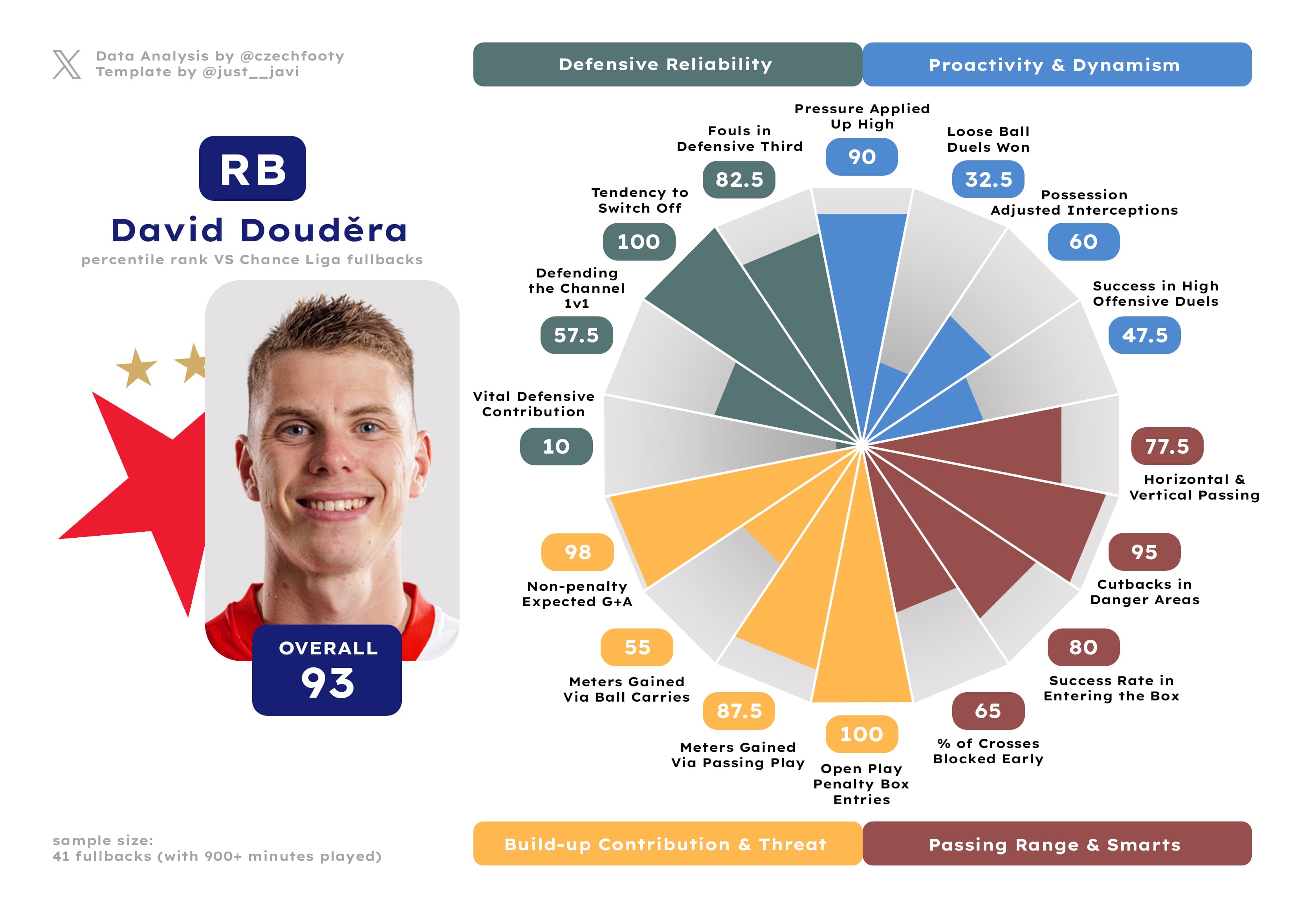
Through all my relentless criticism, and even despite the latest tweak to my FB model accounting for success rate in entering the box (something he’s, per eye test, more wasteful than most) on top of the usual successful penalty area entries themselves (which he always tops with ease due to the sheer volume of balls pumped into the box), David Douděra has never landed below the 92nd overall percentile among fullbacks. Clearly, I should take the L. He’s vulnerable in 1-on-1 defensively, and his permanent hot heads still shows on a couple of metrics (like crosses blocked early or success in high offensive duels), but it’s time to admit he may not be as upgradeable as I think. But was the position of his backup upgradeable?
Oh hell yes.
That’s where Daiki Hashioka enters the discussion; with the coaching staff basically admitting they’ll be patient with him and Douděra allowing for no doubt as to who’s the starter throughout the pre-season. At this point, however, anything will be better than a virtually absent, mostly B-team supporting Simion Michez. Even the Belgian shouldn’t be written off as yet; remember where Diouf was at, entering 24/25? He too was relegated to the reserves halfway through his first half a year at Eden full of up’s and down’s. Did Michez have any notable up’s through his first full year? I see. But he was also played out of position often, and his decent summer could possibly be a sign of things to come. If he sticks around.
Biggest downgrade
The confirmation of the most expensive transfer out of the Czech league has arrived just in time. El Hadji Malick Diouf didn’t quite torch the league, like some kept suggesting along the way, with a somewhat tamed passage arriving right in the middle of his campaign, but he’s come on leaps and bounds regardless, and made for a beautifully complex presence on the left. He was a bully in offensive duels, and someone teams had to watch out for as both a creator and — perhaps especially — a far post finisher. Indeed, his xG and xA rates are virtually identical (both rounded to 0.13 per game), and there was a similar number of games in which he totalled at least 0.15 of expected goals (7) and assists (9). Hard to defend.
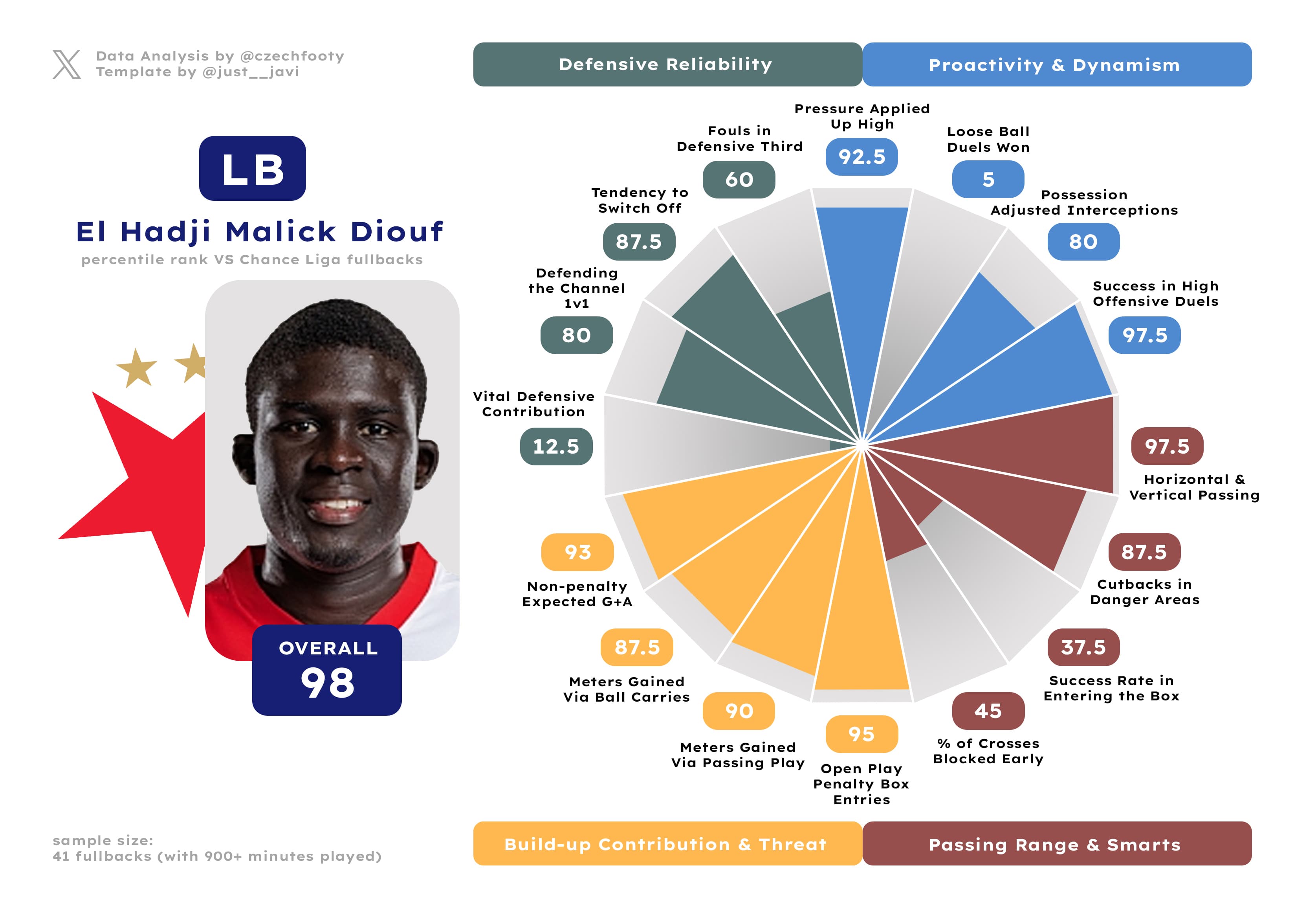
That being said, I wouldn’t sleep too much on Ondřej Zmrzlý as Diouf’s heir apparent. In a sample big enough to at least have a casual peak, the former Olomouc star actually posted better success rate in ground duels down the channel, made for a more disruptive force in pressing and produced more interceptions. But when it comes to pushing the play forward, there appears a gulf between the two. Zmrzlý doesn’t accelerate with the ball at his feet, doesn’t stretch the defences horizontally, won’t be a take-on machine, and likely won’t make for a volume penalty box cracker (registering one less entry per game compared to Diouf).
Again, small sample.
And even if Zmrzlý does take further steps forward (which he has taken at a steady pace so far) to more or less catch up, the downgrade still lies in the backup currently out injured long-term (Dominik Javorček). Diouf was a stud; Slavia figure to have to wait for the next one.
Need left to be addressed
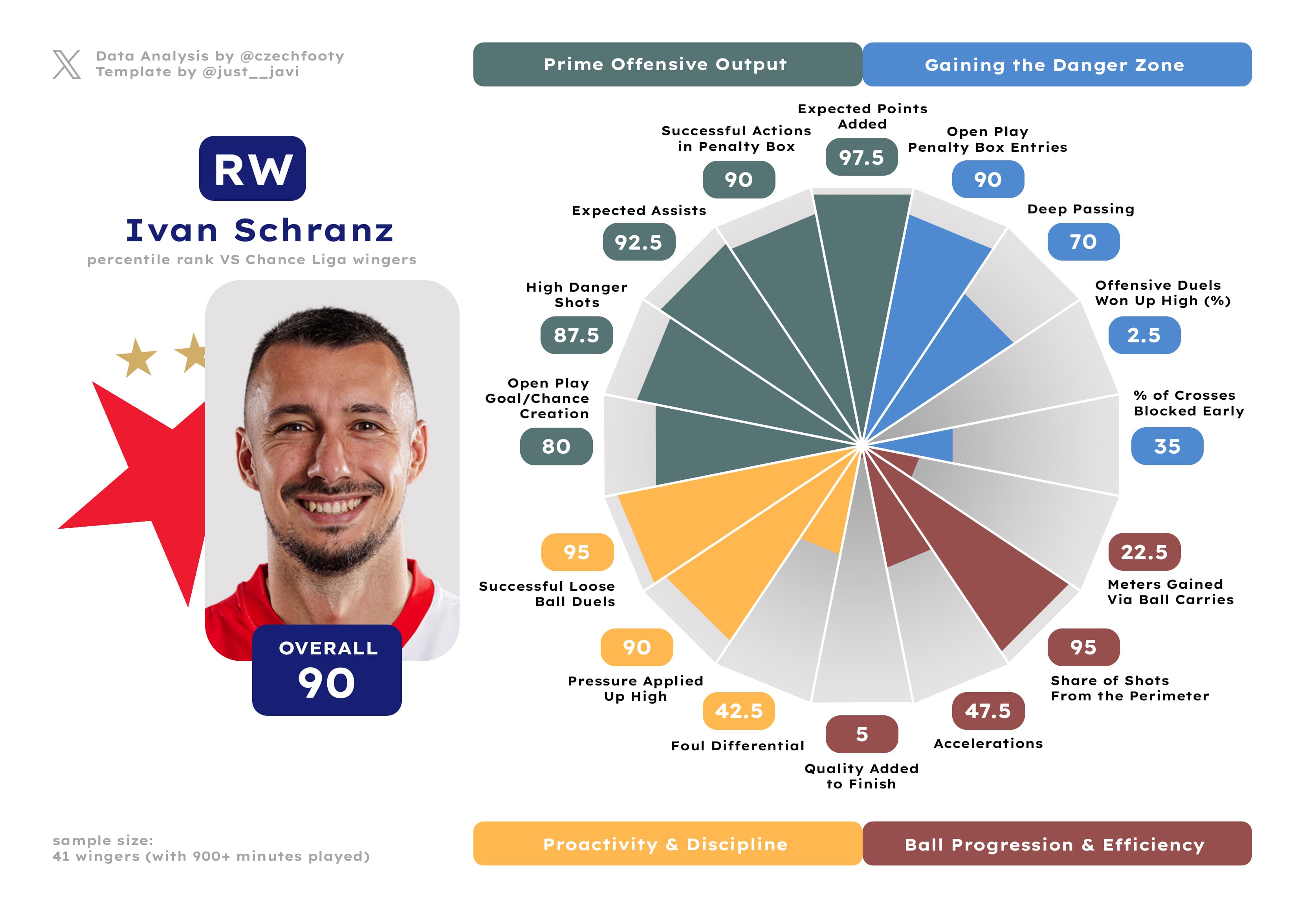
With the expectation being we’ll inevitably struggle to poke holes in what might be the most complete Slavia roster in recent memory, let us at least try. Initially, even before the news broke about Tomáš Vlček’s illness, I was going to highlight one more centre back just to be on the safe side; but Deli admitting he’s got one eye on the first team effectively takes care of that. With the left wingback, it’s difficult, and an extra attacker isn’t necessarily needed if you mostly go 3-4-1-2. In that case, even if Kliment ultimately stays put, you’ve got 4 solid options in Tomáš Chorý, Mojmír Chytil for one role, and Vasil Kušej, Ivan Schranz for the other.
The latter could probably be upgraded, especially since there’s not many alternatives for a formation nominally featuring a right winger (unless you count Douděra, Michez or shift Provod to his off side — all sub-optimal), but his superior insticts haven’t aged and he’s that sort of a useful player who’s not getting crazy anytime his playing time allocation gets slashed, so why would you take him out of the equation. Yet, for argument’s sake, let’s say Slavia would ideally add a 5th — preferably right-leaning — option upfront. Slackers.
New kid on the block
There’s never a shortage of youngsters at least vaguely vying for A-team places. There’s always a few appearing in the pre-season, and there’s always at least one who sees some meaningful action in-season. The trouble was always following up — take it up a notch after you get a taste and invariably draw high praise from Trpišovský and the wider public alike. That is the predicament Dominik Pech, my 2024 new kid on the block who didn’t even participate on the dress rehearsal, has gotten stuck in; following in the footsteps of Daniel Samek, Moses Usor and half a dozen of teenagers who got bumped up for the odd UEFA game only to never return. Pech was the second coming of Provod until he suddenly found himself on the outside looking in. And going by the past; this might be it for him.
I don’t want to sound too fatalistic, but it’s a bit tiring to see promising talents come and go without much actual commitment from the coaching staff. It’s understandable to an extent, given Slavia’s ever-present ambition, but with the UCL on the horizon for now and potentially years to come, it’s also hard to see it changing. That being said, who could provide the fleeting hope this season? We’ve already got a bit of a taste of Daniel Toula (b. 2005) — tall, determined, hard-working wing or centre forward — towards the end of 24/25, and that may carry on into the next season. Tomáš Jelínek (b. 2005) has stuck around through the entire summer, too, and has got the brains and versatility to see some action, as well. He was solid enough and something of an unsung hero on Slavia’s second-tier B-team last term. Martin Kovář (b. 2008), a centre back mature far beyond his age, has got potential to become more than just the obligatory token teenager (and it’s fair to note they normally don’t appear in 3 pre-season games already), but it’s likely too soon. He first needs to show it for ‘B’.
Who may rather be thrust right into the first-team action: Emmanuel Fully (b. 2006). Freshly commented on by Tvrdík himself, as something of a bargain upon the activation of a €100k clause, Fully could easily take advantage of the LWB situation while filling in at LCB if needed. He didn’t quite set Chance Národní Liga alight, but his A-team summer was spirited.
Looking ahead to 2025/26
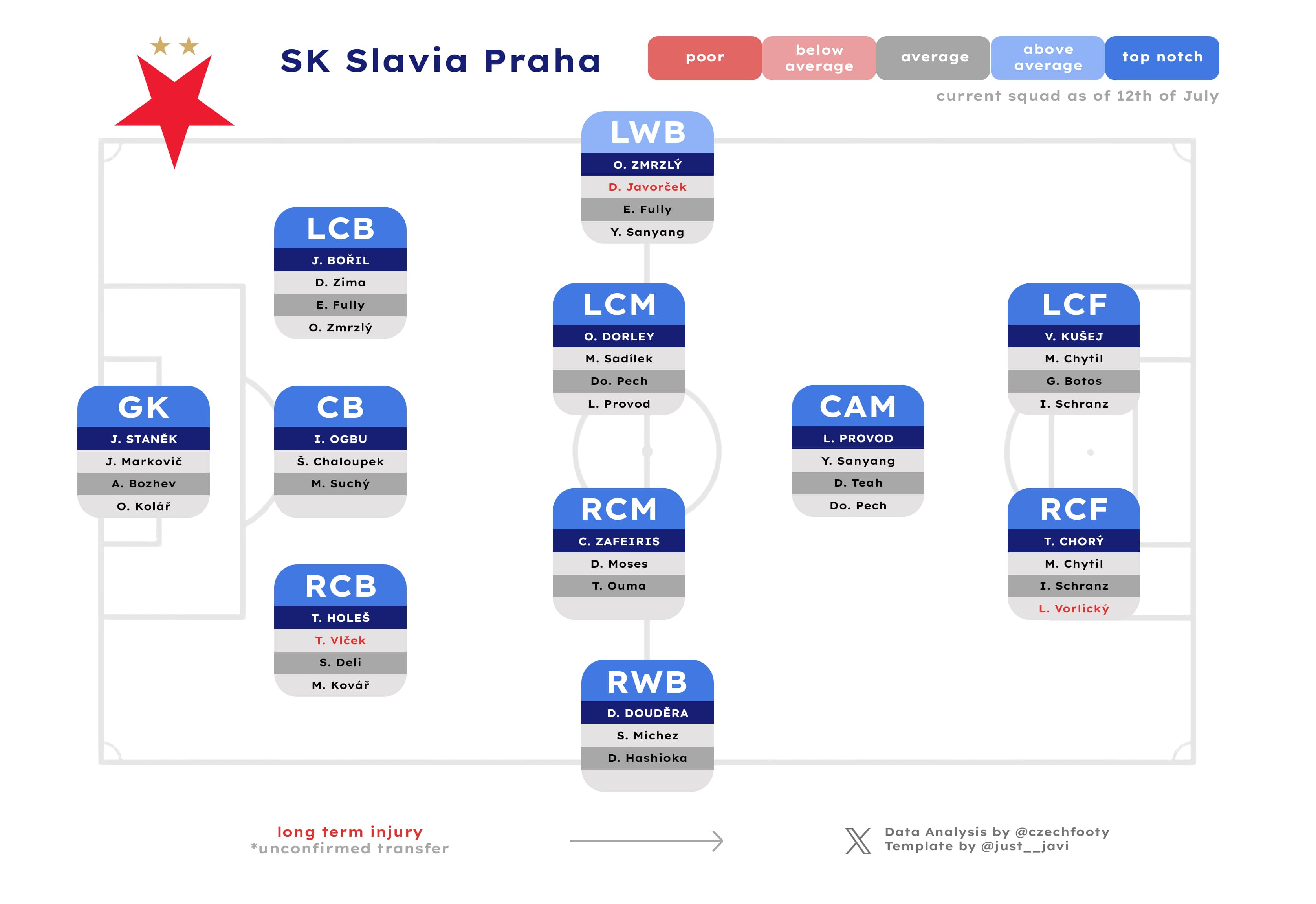
Below is the team’s current(ish) depth chart with a maximum of 4 alternatives for one position. The colourful ratings are a static snapshot of the league-wide situation on 5 July, and they are just a playful bit to add flavour to it; the names featured should be relevant to this day. To learn more about my approach to constructing depth charts, with all its limitations, head here.
Primary formation
Slavia will inevitably flick between the 3-4-1-2 and some form of a 3-4-3/3-4-2-1, often within one game. The wild card of the depth chart is the incoming Youssoupha Sanyang who could be the secondary option for a left wing as well as a left wingback eventually. Same with Divine Teah, whose left foot is truly divine, and he’s mostly flashed it in that left half-space, as a LAM of sorts. Alex Bozhev, a highly rated (and priced) Bulgarian, is one to watch, too.
Notes on the depth chart
One underrated part of the title-winning campaign was how seamlessly David Zima stepped into the role of a middle centre back — one I was quite sceptical of him filling — whenever Igoh Ogbu was unavailable. That didn’t happen too often, but it happened often enough to appreciate it. Zima won’t match Ogbu in ground duels (only one CB was better after all) and consistency, but he’s an OK deputy. Still, Chaloupek would’ve been a better fit, while Zima’s ball-carrying ability (second most meters gained via runs) often gets suffocated in this role.
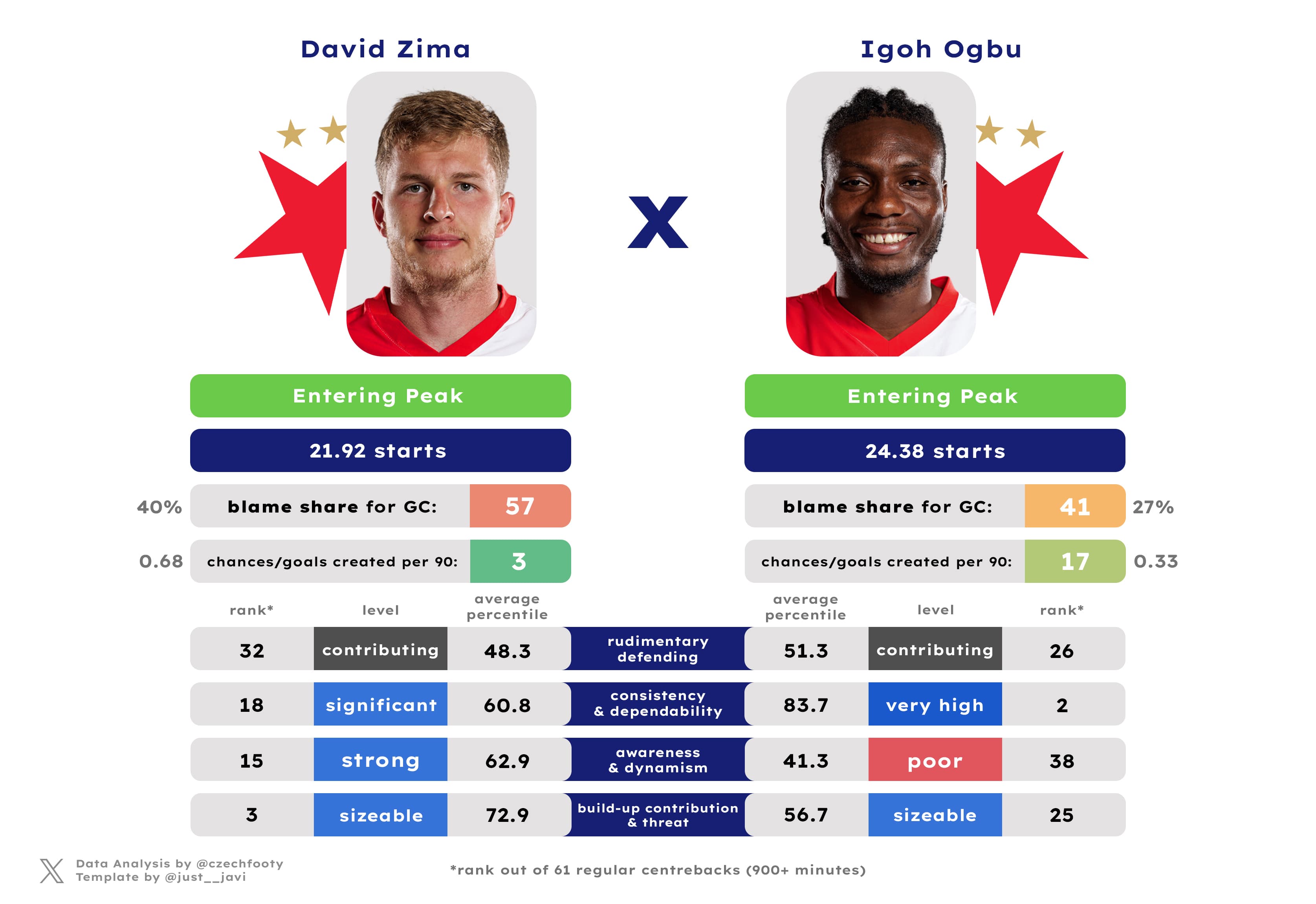
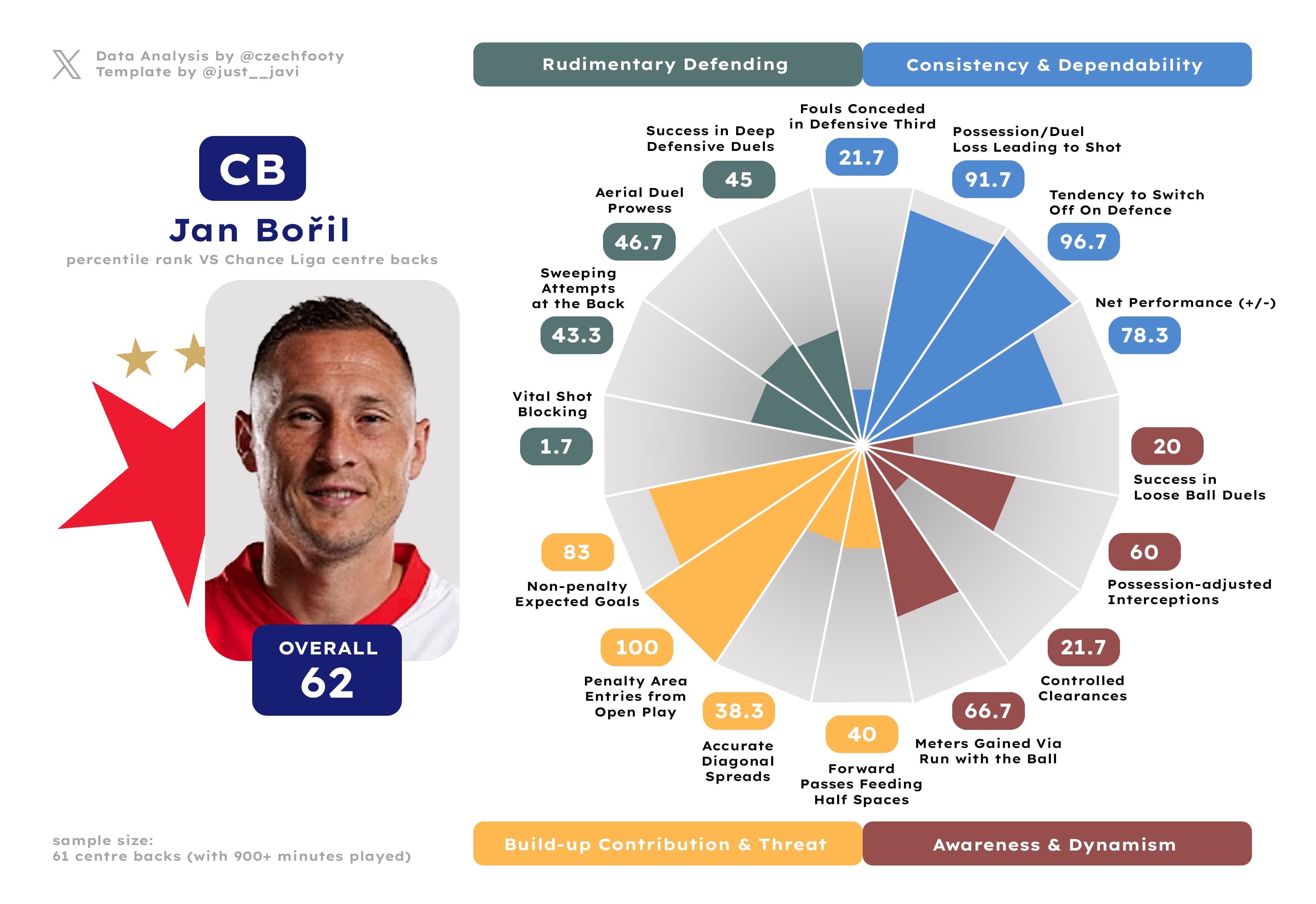
Zima should be specifically pencilled for the LCB role where he might be asked to take over from Jan Bořil full time sooner than later. Bořil made for a tremendous comeback story in 23/24 and he wasn’t a major drag in 24/25, but you wouldn’t be mad to suggest he’s slowly getting into that territory. There’d be no shame in Bořil sliding down into more of a support role in his age-34 campaign; a first step of the “steep decline” section of the trajectory.
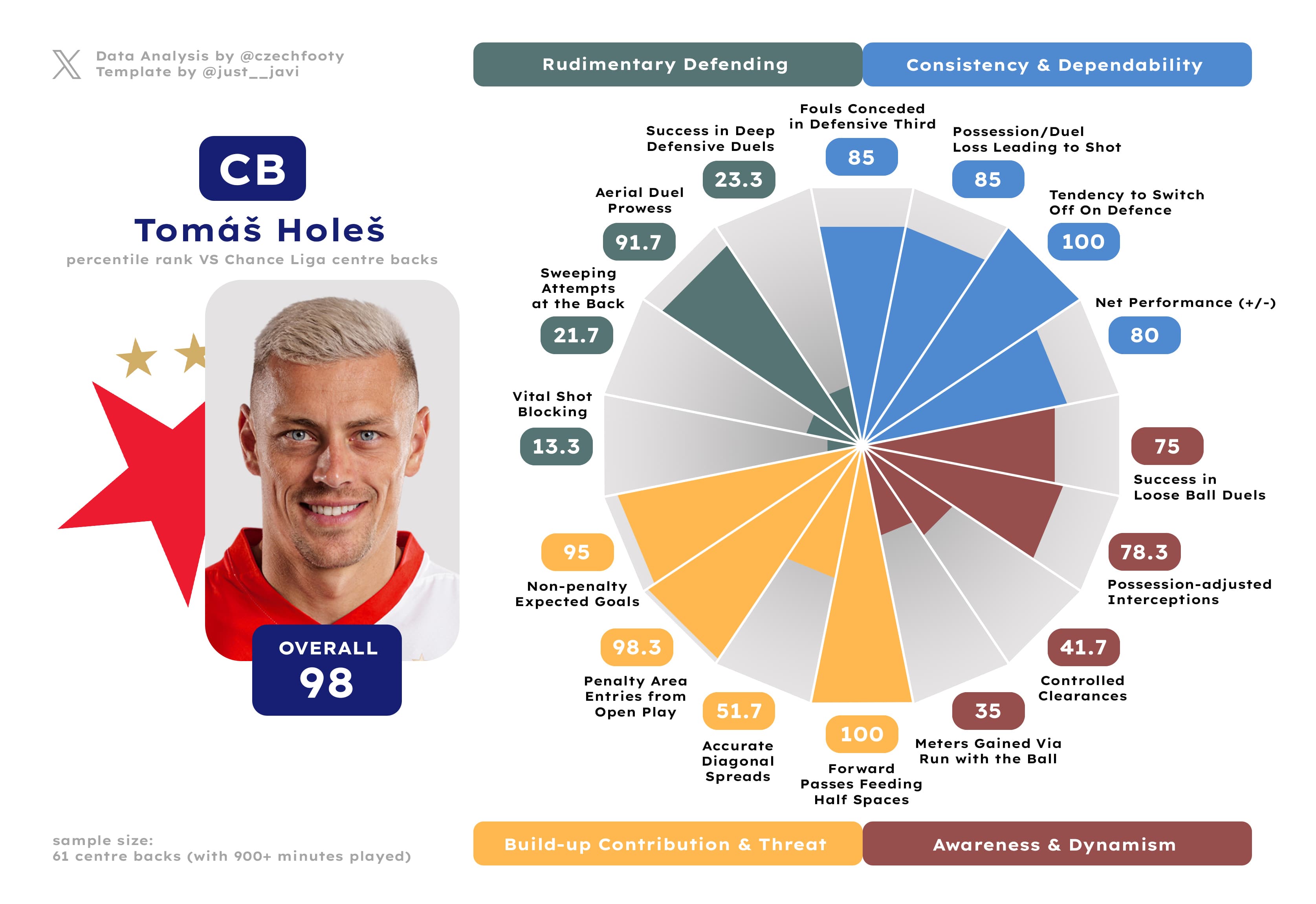
As for a player who has successfully defied the odds: Tomáš Holeš was back at his best in 24/25. Last year, I wondered out loud whether we weren’t witnessing a quiet decline of the stud, yet when Holeš got extended till 2027 in January, I found myself nodding on. He’s still too special to pass on; a reliable defender, an aerial force at both ends, and someone who helps you to get into the box arguably the greatest deal out of all centre backs in the league.
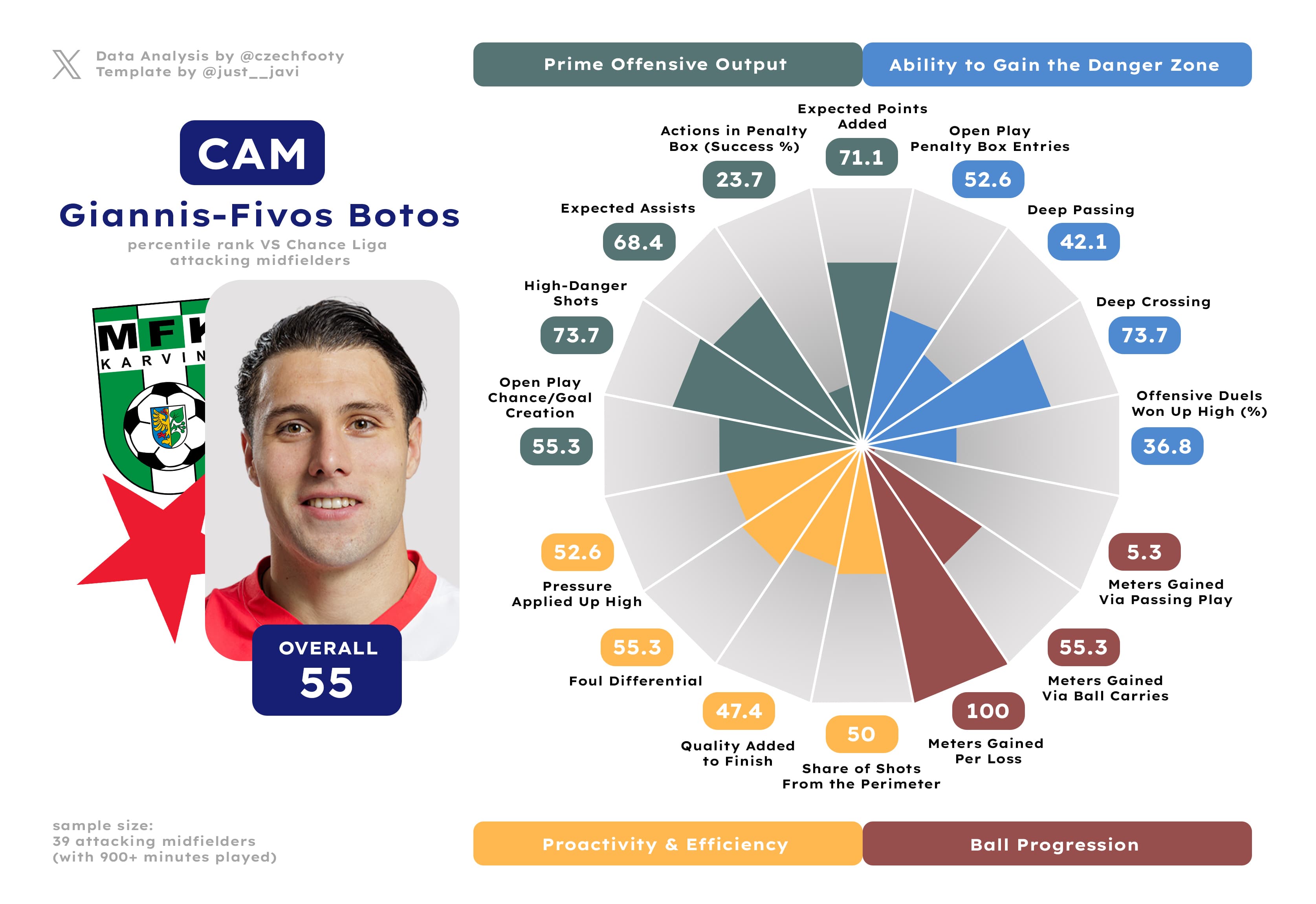
Finally, an attacking midfielder who somehow flows deep under the radar despite the 10-point campaign. Gianni-Fivos Botos might be stuck behind too many players on that depth chart, but he shouldn’t be entirely discarded. His pizza frankly looks more filling — ie. with less glaring holes — than I expected. Especially the efficient ball progression was a surprise.
Roster battle to follow
First of all: in Botos and Vasil Kušej, Slavia might just happen to boast two players who, from afar, most resemble Diego Maradona with their flow and dribbling style. Slightly less importantly, Slavia have also got the best forward in the league in the former Mladá Boleslav star. Not to take anything away from Tomáš Chorý, Kušej was the more fitting injection of attacking talent, single-handedly transforming Slavia into more of a killer in the spring.
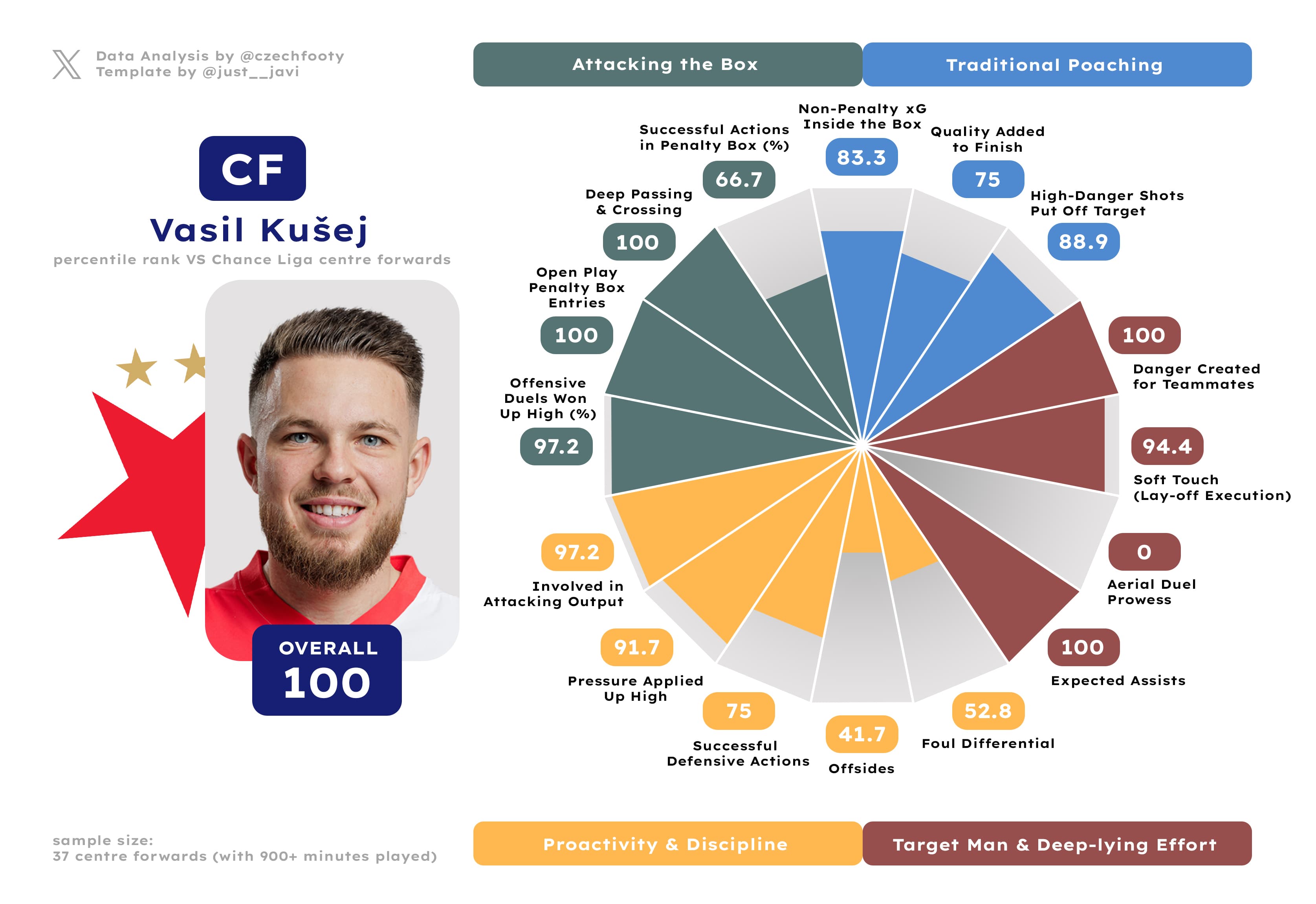
There are a couple of underrated features on Kušej’s game, but what stands out for me are his top-of-the-pack rates for expected assists and danger creation specifically for his teammates. Sometimes painted as a single-minded dribbler (in a good way), Kušej is much more than that, in fact, racking up an amazing 0.23 xA per game. Is he helped by the fact he’s not your typical centre forward, often starting off much deeper than his rivals? Sure, to an extent; but not to an extent fully justifying the 0.11 xA gulf between him and the next one in the line. Per game. Similar with danger creation for teammates; runner-up Puškáč already lags a considerable 0.31 goal/chance-creating actions behind him per 90 minutes.
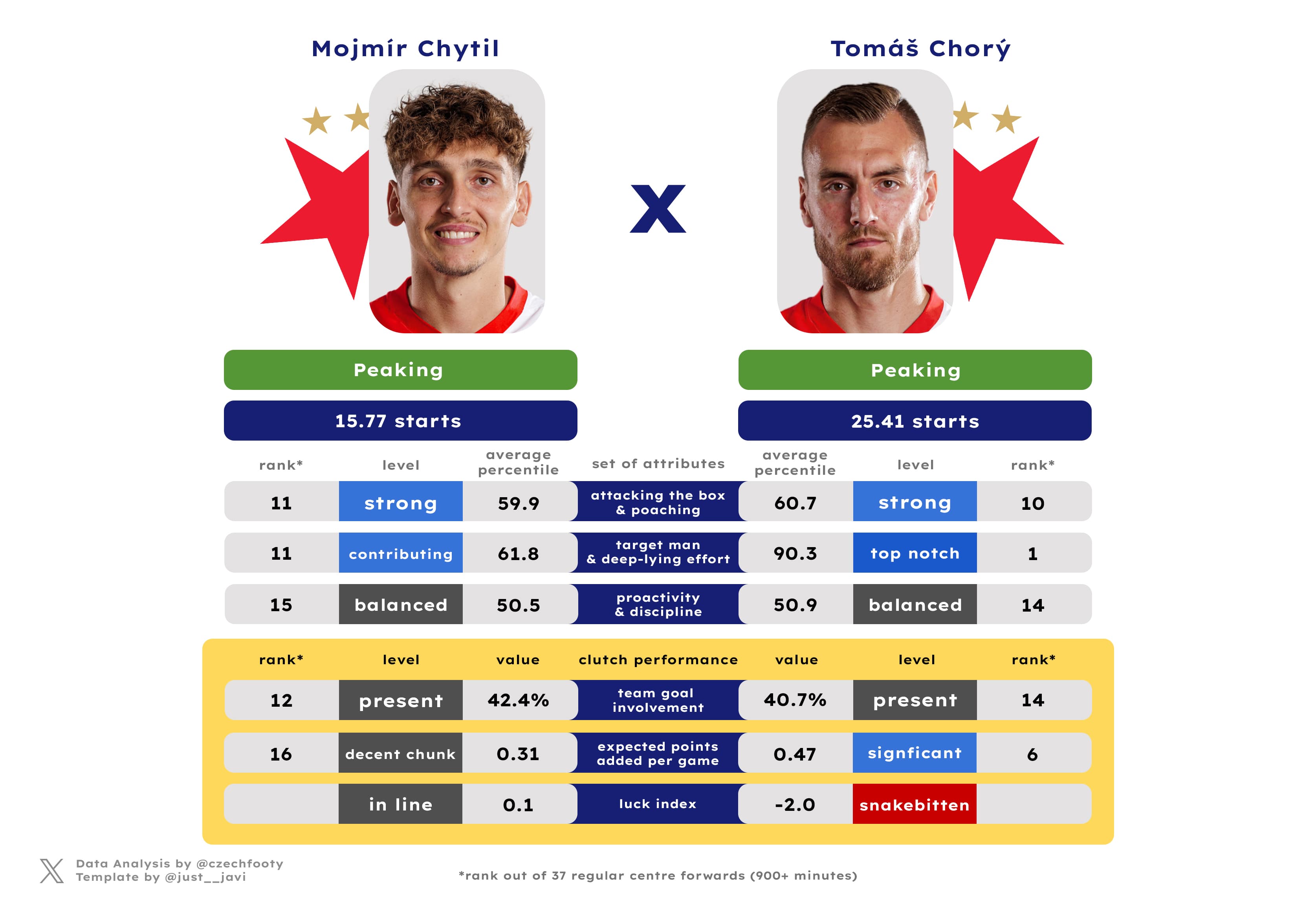
Kušej is, therefore, not going anywhere. But who partners him up top is the real battle. Chorý has skipped the entire summer due to a lingering hernia issue, which opens up an avenue back into the starting line-up for Mojmír Chytil who’s severely underwhelmed throughout the entire 2025, including this pre-season. While he did equal Chorý with his 8 non-penalty goals (across much less starts), he was no match for him in build-up facilitation. Chorý was far superior in the air and on the ground as a lay-off specialist, with an eye for a pass.
Chytil wasn’t too bad per most metrics, but make no mistake: he’s coming into this season with a lot to prove to fans and coaches alike. He needs to be a more effective box operator.
Season forecast
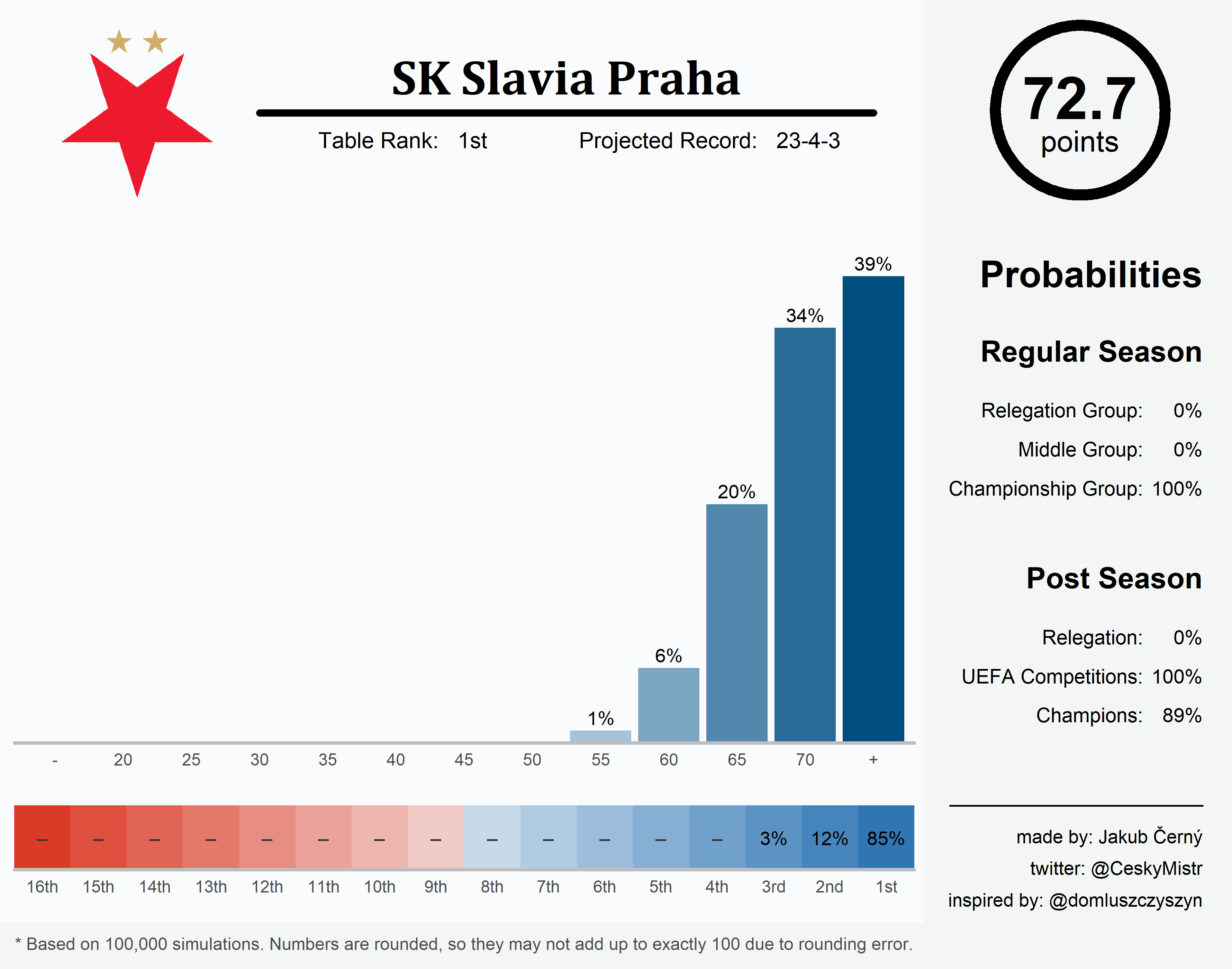
Slavia were 78% likely to become champions again last summer, a forecast that already felt too steep. How about 89% then? With Sparta arguably getting significantly better through the returns of Priske and Kadeřábek (Vitík wasn’t yet factored in) and Plzeň also slightly improving on balance, it feels even more shocking; but then again, what can you do when Slavia add Sadílek, Sanyang and Hashioka without subtracting a single contributing body (again, Diouf wasn’t as close to leaving on 1 July) to a roster that rolled over the league and, what’s more, actually beat this generous projection above in the disappointing 23/24 as well?
The question now doesn’t seem to be whether Slavia retain the title; it’s whether they finally become the maiden 80-point team inside the first 30 rounds. They stopped two points short in 20/21 and again this past year. Sparta couldn’t seal the deal in 13/14, either (79). So who else? Slavia literally broke our scale, so you can’t quite read it from the graphic, but I can tell you the model saw them clearing the bar once in every 10 simulations. That’s amazing.
They are repeating their incredible 78-point feat of 24/25 roughly 20% of the time.
And then there’s the UCL, potentially the more important field for Slavia now. My consultants set the baseline at (Sparta’s) 4 points as a minimum, and 7-8 points for what gets branded as a success. It very much depends on who they get to face in Eden, but… can they, will they?
Bold prediction
The track record: 1/4. Diouf did deliver Slavia a first Foreigner of the Year award in a while
The prediction: Plzeň will participate on Staněk’s five-game clean sheet streak
The rationale: Ondřej Kolář will, of course, always be fondly remembered for his title-winning cameo against Sigma Olomouc record-setting 23 clean sheets in 2019/20. There is only one Slavia goalkeeper who has ever come close to matching his incredible ratio (shutout in 74.2% starts), and that just happens to be Jindřich Staněk’s 2024/25 version (69.2%), leaving well behind even his direct, and celebrated predecessor Antonín Kinský (63.2%).
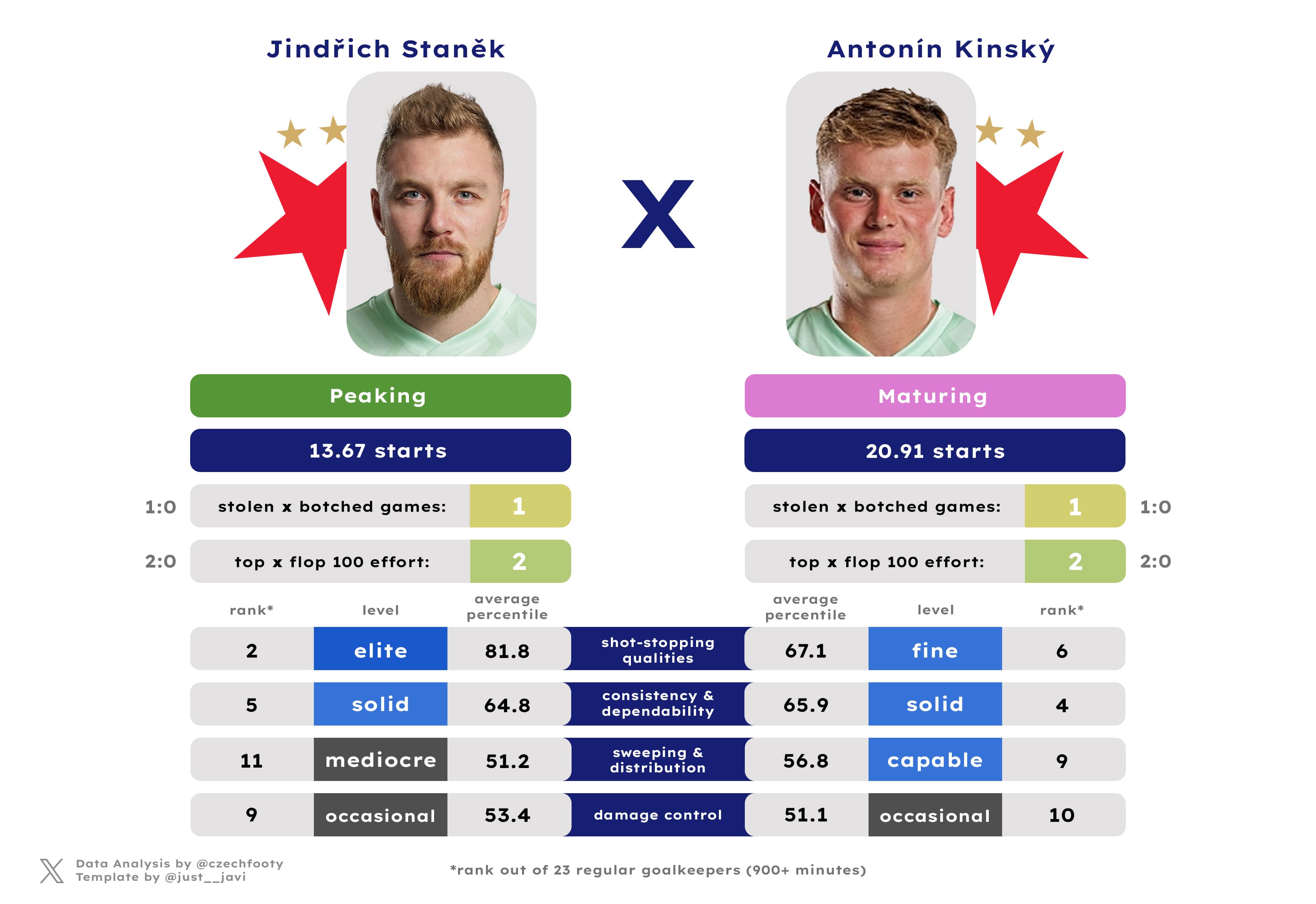
The name “Miroslav Koubek” will, of course, always be fondly remembered for the title-winning season and subsequent Europe-conquering rides with Viktoria Plzeň most spotless goalkeeper’s balance sheet ever. It was a slightly less-known Miroslav Koubek — Sparta’s backup in 1980/81 who didn’t miss a beat in all his three appearances, even keeping out a penalty once — but he will do as a bridge: one of Staněk’s encounters with his former club (in R15 or R30) will become part of a five-game stretch in which Slavia do not concede a single goal. Staněk himself has never done it (topping out at 4 this past spring), and when else than behind what could be a continuation of one of the most solid defences ever? Ride the wave.

Enjoyed the text or the visuals, but don’t care for 🇨🇿 translations and dashboards? No worries, you can still support us by inviting us for a symbolic pint at the old BuyMeACoffeeBeer page.