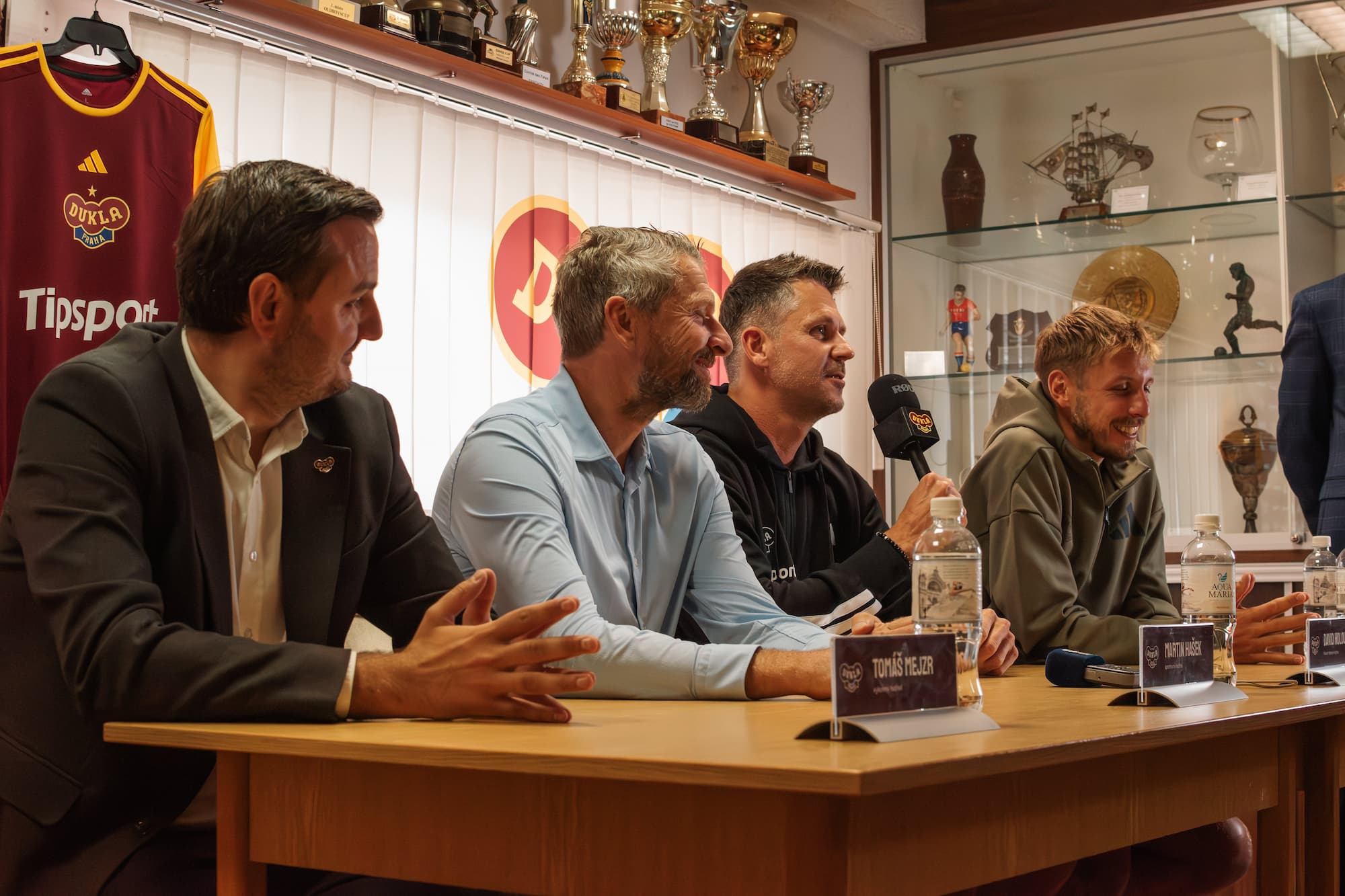
In a way, FK Dukla Praha find themselves in much the same boat MFK Karviná were in last summer. They, too, are waving goodbye to coaching from a bygone era — only here it’s condensed into one name rather than spread out like with the Silesians. In its place comes a young coaching staff pledging a possession-heavy brand of football, hoping to facilitate the club’s entire transformation in the process. That would be, crucially, done with the backing of new majority owner Matěj Turek, a 40-something involved in a number of start-ups or fixer-uppers, taking over from soon-to-be 70-year-old Petr Paukner. Fittingly, it was Karviná who issued a timely reminder to Dukla on Day 1: “This won’t be easy.”
Turek’s reputation of someone who’s willing to take the investment risks — for example planning to revive the old brewery in Trója where no beer has been made for a century — comes in especially handy for FK Dukla Praha; a traditional club of stale reputation that had been up for sale for years on end, with Paukner drowning up to 500 million CZK in it. His initial vision of turning Dukla into a feeder club for a big German side — which led to two or three fruitless years spent chasing investment partners across German-speaking countries — was arguably a bit naive to begin with. Turek’s vision to lure investors from the new economy — rooted in technology, AI-driven services, e-commerce and the like — feels more in touch.
As someone calling Dejvice his childhood home and going by a personal motto “Chůze vpřed je série umně zadržovaných pádů” (Walking forward is nothing but a series of well-controlled falls), Matěj Turek seems well-positioned to finally take Dukla forward, too. Similarly to Ondřej Kania in Liberec, he preaches patience (expecting the new era to truly set in a decade or so from now) while implementing immediate progressive changes, such as introducing one of the most extensive coaching staffs around. Like Kania, Turek isn’t primarily a sports investor, but he understands its transformative power and the community values it stimulates, previously betting on the Týmuj app going by a different motto that resonates (“It’s not important to win, but to meet up”) and regularly showing up at Juliska among fans.
At this point, I can’t say I’m fully on board with the Martin Hašek hire for the role of the sporting director, but Turek himself does have my trust as this new billionaire owner somewhat hidden away in the shadow of Kania, Kratina or most recently Šimonovský.
If he does bring the iconic Juliska under the club’s ownership — as “any decent Dukla owner would plan to do” per this insightful Money Maker episode — he’ll be declared a legend.
Looking back on 2024/25
What went (particularly) right
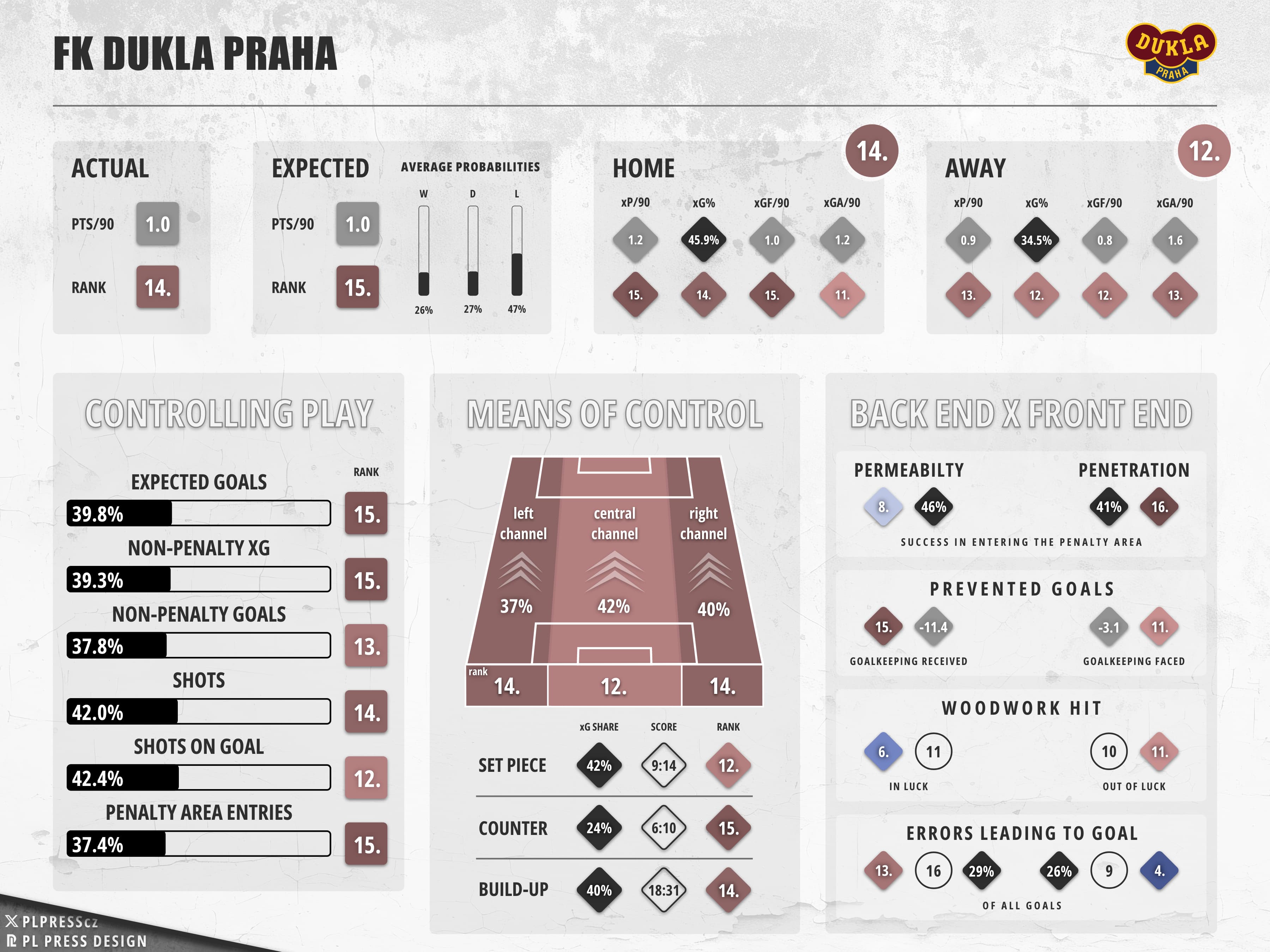
There’s so little to admire which shouldn’t come as a major surprise given that we are talking about a club that needed to navigate a penalty shoot-out to finally confirm its top flight status. That, in and of itself, was actually a surprise since Dukla did up their game considerably in the spring. At Christmas, Pardubice were projected to earn six more points than Dukla inside the regular season; in reality, Dukla lapped them by five points, earning themselves the right to face a theoretically weaker opponent in the play-offs. Throughout 2025, Petr Rada only lost four games all told, leading Dukla to own the 5th best offence and 3rd best defence per xGFExpected Goals For (xGF) estimates how many goals a team should have scored based on shot quality, location, and context./xGA in the campaign’s five last rounds, and making Slovácko sweat for staying above the relegation play-off places. If you stretched Dukla’s spring point-per-game average (1.375) to a full regular season, you’ve got yourself a 41-point outfit on par with 8th Karviná. Would that be fair given that Dukla only beat bottom six teams in 2025 (Boleslav and Pardubice twice), and just one Top 10 opponent all season long (Bohemians)? Not exactly. But it gives you an idea about how deep a hole Dukla had dug for themselves in 2024.
What went (especially) wrong
Dukla’s grip on games across the entire campaign, or indeed lack thereof, was outright shocking. They posted just one Top 100 xG performance; the same amount as Dynamo České Budějovice, you know the infamously winless team. Quite deep into the season (after R26), their average non-penalty xGF on the season read an appalling 0.67; Dynamo would never drop as low, bottoming out at 0.70. In terms of cracking the opponent’s penalty area from open play, no team was less efficient — in terms of the share of all successful penalty area entries from open play, they were right on par with Dynamo again (difference of 0.1%).
Much of this spotty record can, of course, be tracked to Rada’s tactical preparation and acumen, or indeed lack thereof. Dukla always owned too loose a structure defensively, showing on the second highest PPDAPasses Per Defensive Action Allowed (PPDA) measure a team's intensity off the ball. The lower the value, the better — it indicates the team successfully pressures or disrupts the opponent’s passing sequences at an early stage. value (12.91) as well as the league-worst 4.85 xGAExpected Goals Against (xGA) estimates how many goals a team should have conceded based on shot quality, location, and context. conceded from counter-attacks. On the ball, Dukla normally made for a clueless outfit aided considerably by set pieces (9 goals) and grave errors (also 9), showing on the second lowest rate in finishing off positional attacks (22.9% of all ending in a shot; 25.8% for Dynamo).
Most valuable player (still on board)
Per my MVP model (traditional stats): Daniel Kozma (ranked 62nd league-wide)
Per my positional models (advanced stats): Štěpán Šebrle (33rd overall percentile at W)
Per Statsbomb’s On-Ball Value (OBV) metric: Daniel Kozma
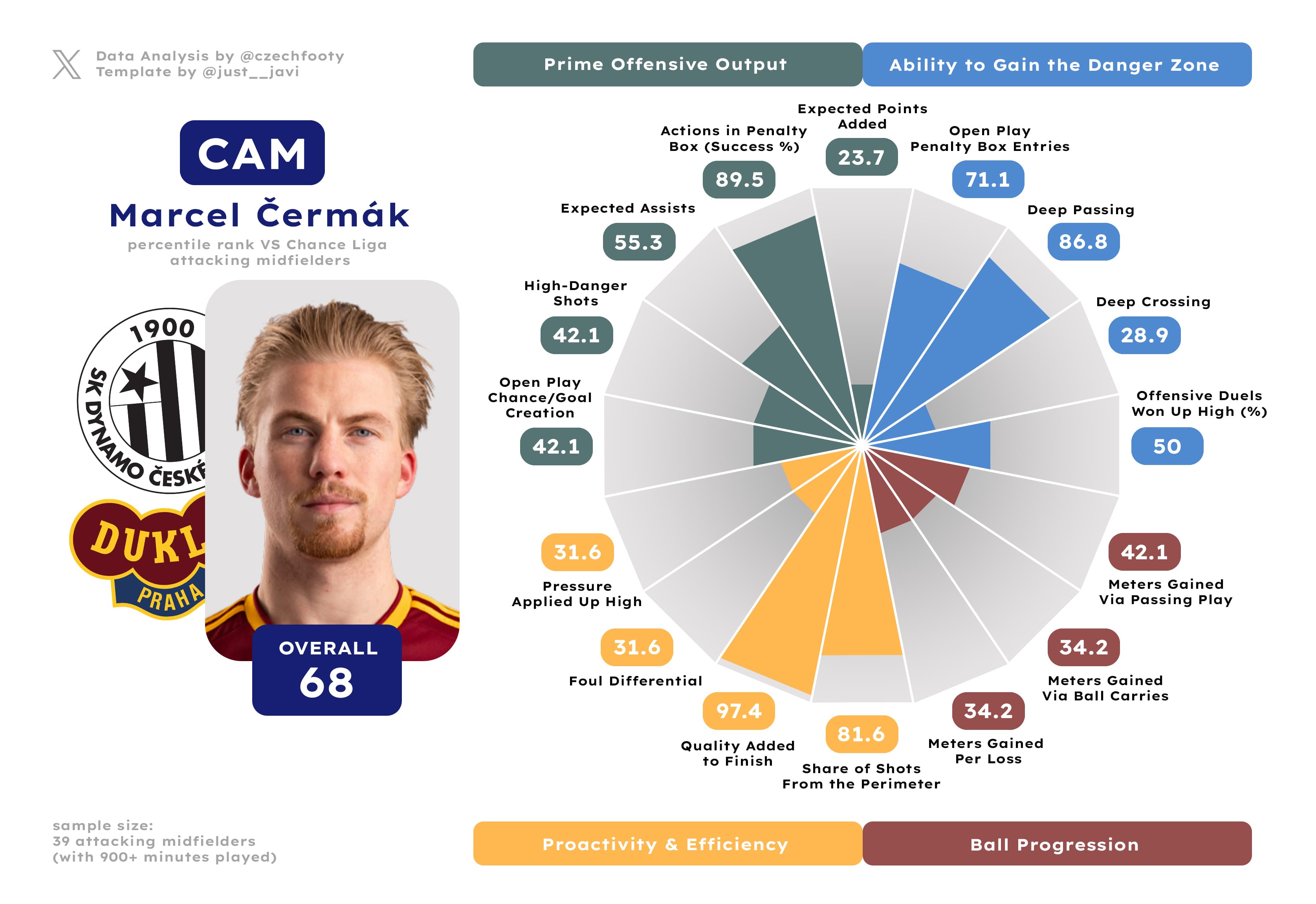
Holy shit, this was quite a rabbit hole. Look at how deep I had to go sorting through my positional models. It’s not like Dukla wouldn’t have high-end players on their roster, but the overall percentiles of Jaroslav Svozil (87th at CB), Rajmund Mikuš (70th at W), Marcel Čermák (68th at CAM) or Marios Pourzitidis (65th at CB) were all, in part, owed to exploits on other teams, while I wouldn’t call either of them a transformative winter arrival in the mould of Trmal and Halinský, highlighted in this space for Teplice. To make matters even worse, two other candidates worth considering (Matúš Hruška, Jakub Hora) left after the season.
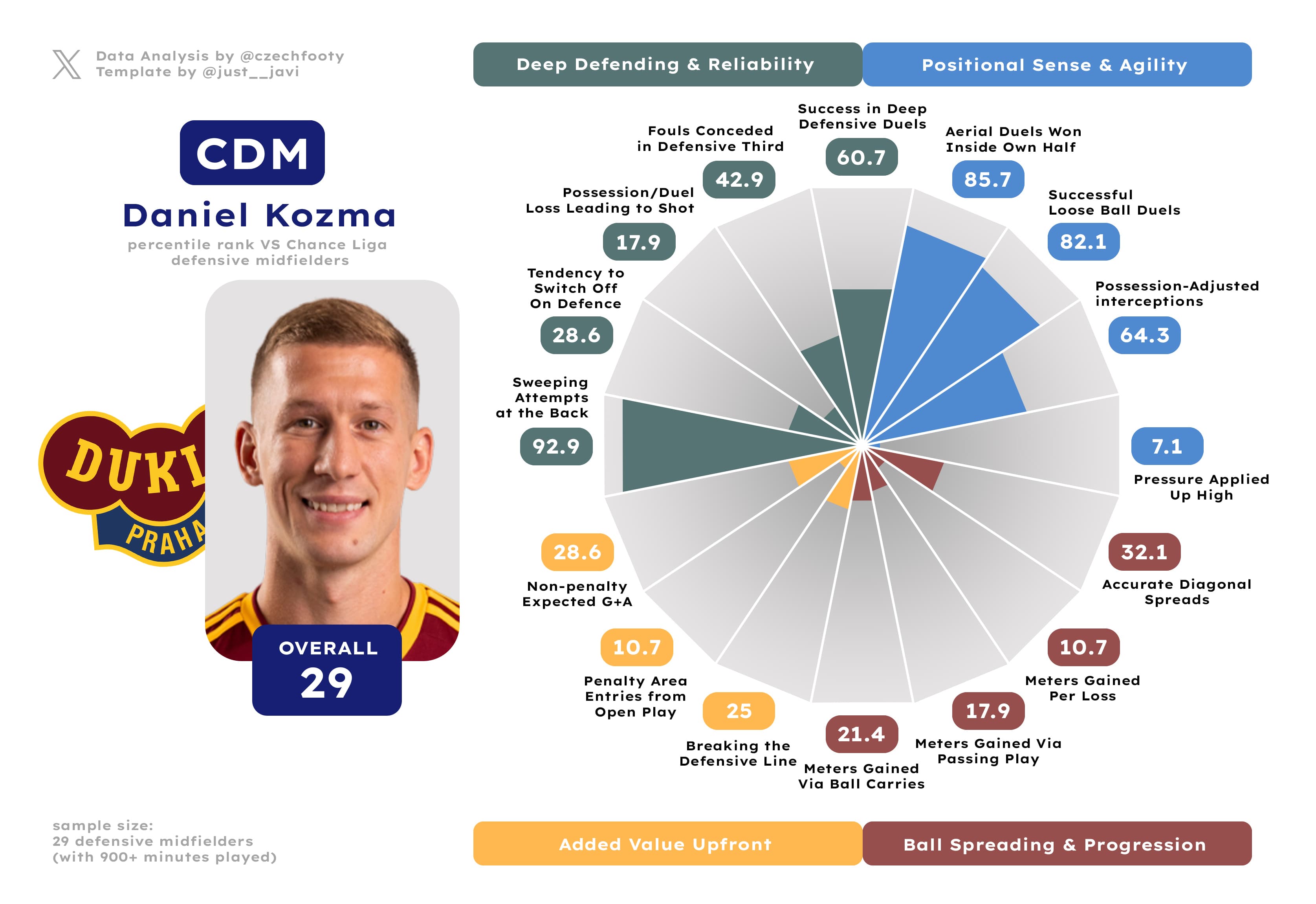
And so I reluctantly land on Daniel Kozma, whom I didn’t fancy too much as a holding midfielder (a boring defensive specialist who was nonetheless 1st on the team’s MVP leaderboard with the 3rd most deep completed passes/crosses — a lousy 7) but he did grow on me a little as a centre half in 2025. That’s, after all, why he grades out elite in sweeping actions at the back. His on-ball qualities are decidedly sub-par, though his performed dribbles/ball-carries and defensive actions contributed quite heavily to his second-best average On-Ball Value per Statsbomb (behind only Hora who would’ve been my MVP had he stayed), meaning they actually consistently improved his team’s chances of scoring more than conceding. Pourzitidis was far behind in the former category; Svozil in the latter.
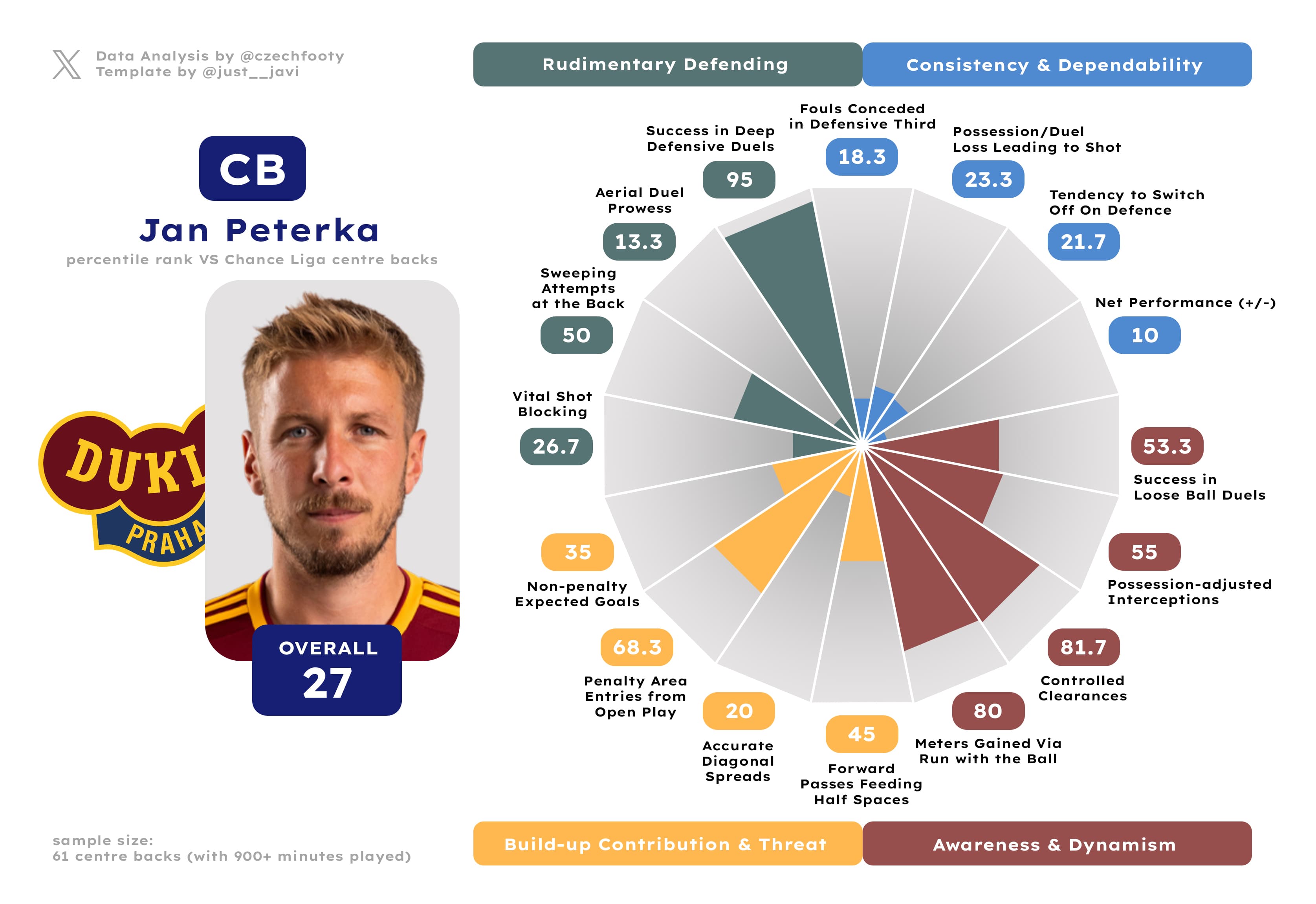
In a way, Kozma is also my MVP because him retracting to defence meant Jan Peterka in midfield; one in-season adjustment Rada made I actually did consider transformative.
Peterka is slow to pounce, permanently unaware, terrible in aerial duels and somewhat lazy in tying up with his markers; all particularly hurtful attributes closer to his goal. By moving him up the pitch, you are extracting more value from his ball-carrying (the only truly top-level skill of his) and, crucially, limiting his detrimental value at the back. He was still poor, and will be the next in line as Dukla get progressively younger, but it was at least manageable.
Chip on the shoulder
carried by the player who’s got something to prove — be it to himself, fans or the coach
Much like Jan Suchan for Jablonec, Marcel Čermák carries a sizeable chip on the shoulder in that he still needs to prove his value to the relatively new employer. In his case, Čermák took a whole half a year to make the leap, only abandoning Střelecký ostrov in winter unlike Suchan, which also means he had to do it on his own for a long time at Dynamo — and he did. At Christmas, Čermák alone was responsible for 27% primary chance-creating actions on team. That amounted to 15, with the next one in line at 6 (Šigut). At Dukla, he only collected six further such contributions, while at least chipping in to 4 goals along the way.
It wasn’t all that bad, but it arguably wasn’t enough nonetheless.
Now, Čermák needs to step it up all the more so, given that he’s going to be partnered with a rookie arrival (Samson Tijany) instead of a 14-season veteran (Hora). My model really likes him as a box operator — connecting on 24 of 51 actions for the fifth-best success rate; adding an elite chunk of value to his finishes for a sum of 4.71 xGSExpected Goals Scored (xGS) only takes shots on target into account, including their power and placement on top of xGF. (against four goals) — but he may be asked to progress the play a bit more. As a keen dribbler who often gets dispossessed, he was in a safe territory on awful Dynamo teams; but the same habit won’t fly at Dukla.
Inside the off-season
special thanks for guiding me through the motions of FK Dukla Praha’s off-season go out to Martin, Michal Kaprálek, Samuel Nassir, Jan Douděra, Jiří Svoboda, Lumír Štrobl, Jan Nassir and Michal Zada
Squad turnover
Of 34 players who received some playing time from Petr Rada in 24/25, twenty won’t see it under David Holoubek for sure, and there are still lingering question marks around the likes of Roman Holiš or Filip Matoušek. That is hardly squad turnover; it’s a full-scale overhaul.
As of now, Dukla are keeping just over half of all 24/25 minutes (52%), the least out of anyone in Chance Liga, and those cuts are pretty much equally spread across the defensive-minded folks (47% of mins disappeared) and the attacking-minded ones (49.4% did). Among those who left, there are second-tier veteran leftovers like Hora or Vondrášek, as well as newcoming veterans like Mosquera or Řezníček; there are players just entering their peak like Zeronik or Doda, as well as players on the verge of exiting it like Jorginho or Hruška; there are U-23 players like Ludvíček or Hodek as well as the truly maturing youngsters like Špatenka or Svoboda. There’s something for everyone, while the wildest realization might be that the most valuable departure of all may actually be tied to a player who didn’t pick up a single minute for Dukla in 24/25 (Filip Lehký who’s earning early plaudits at Mladá Boleslav).
Biggest upgrade
There’s something to be said about addition by subtraction as a legitimate tool how to get better, and Dukla is a perfect demonstration of that. They’ve shed so much negative net value tied to some of their older players it’s almost impossible to think of them not getting upgraded in 25/26, even if those asked to do so are almost invariably top flight rookies.
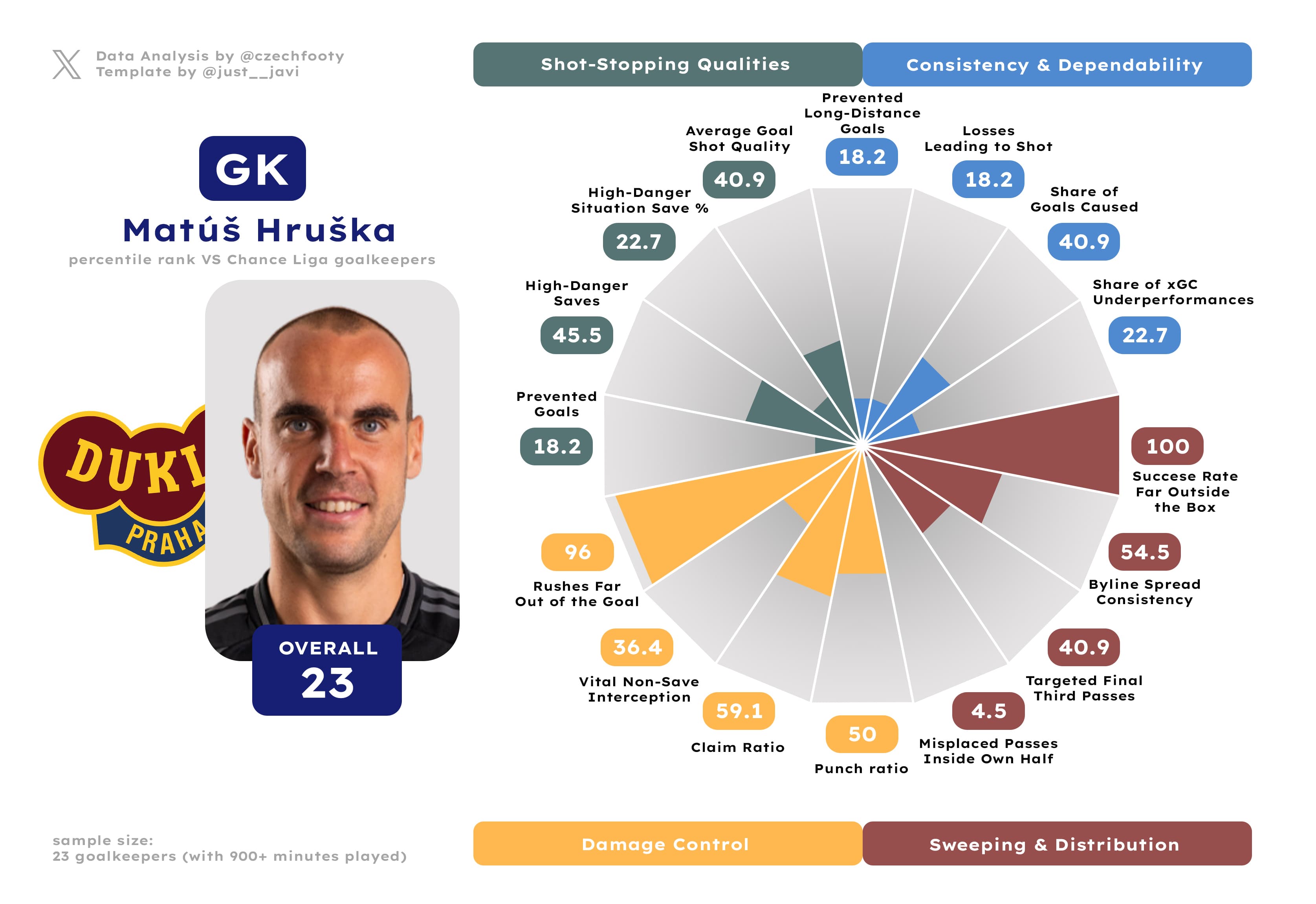
This starts in goal with Matúš Hruška who’s the sole reason behind Dukla having the second worst goalkeeping per prevented goals (minus-11.39 including penalties) and a direct culprit for seven conceded goals. He was extremely active in racking up non-save interceptions of all kind, which is why he ranked as high as second on the team’s MVP leaderboard, but if Richard Matrevics — learning the craft at West Ham in his teens — can provide at least mediocre goalkeeping (or if Adam Jágrik, third-best regular second-tier goalkeeper per Wyscout’s prevented goals, steps in competently), Dukla are still upgrading on balance.
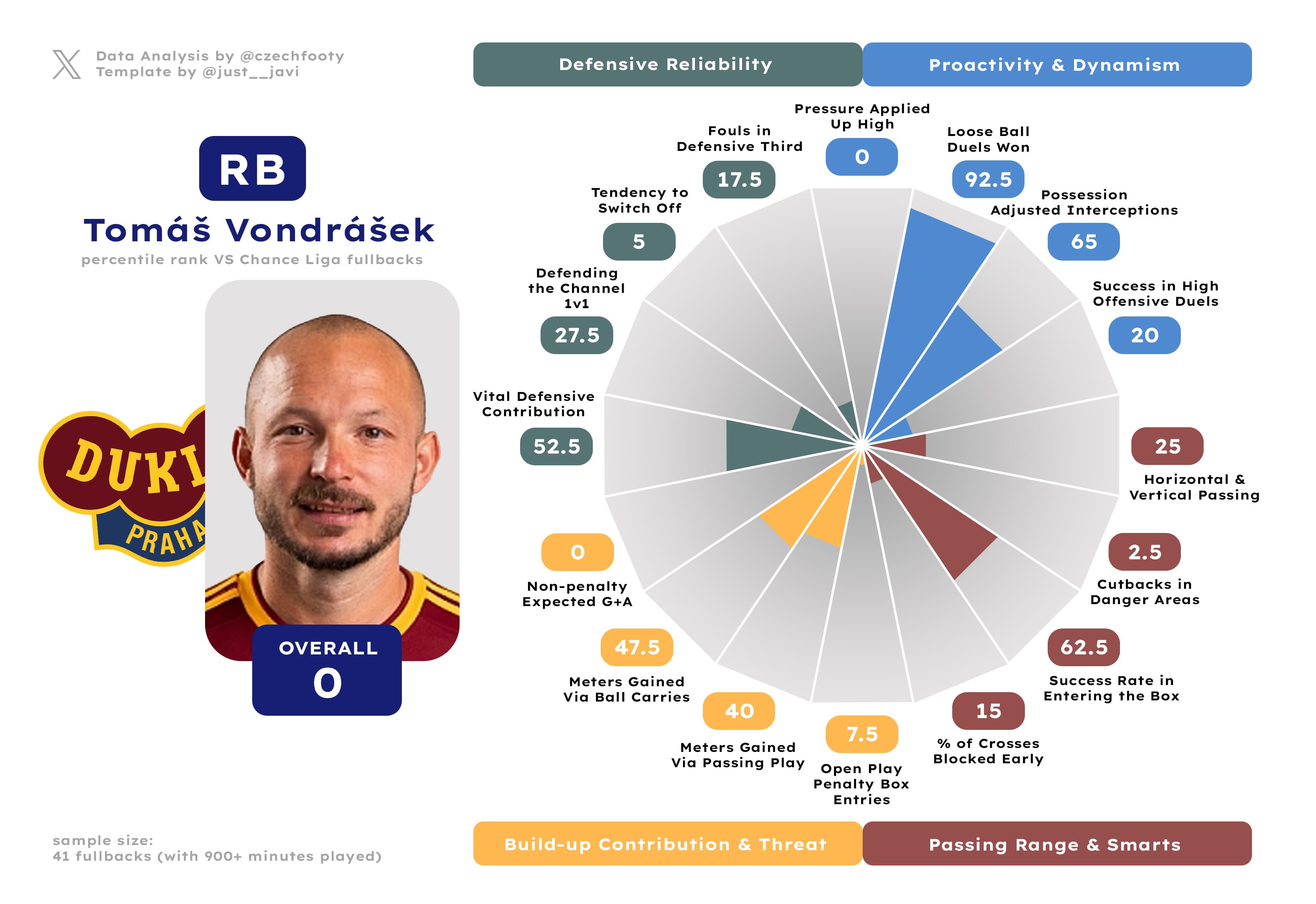
The gulf in quality will likely be much more pronounced with other “addition by subtraction” candidates. Tomáš Vondrášek was utterly out of his depth back at this level, getting caved in defensively and representing one massive black hole offensively. He just couldn’t push up to intercept, let alone win some offensive duels, and he didn’t bring nearly enough value with his passes to compensate for the lack of final third presence. From over 20 starts, 0.94 xG+xA was his final season total. Samuel Isife would have to be a historic flop not to bring more.
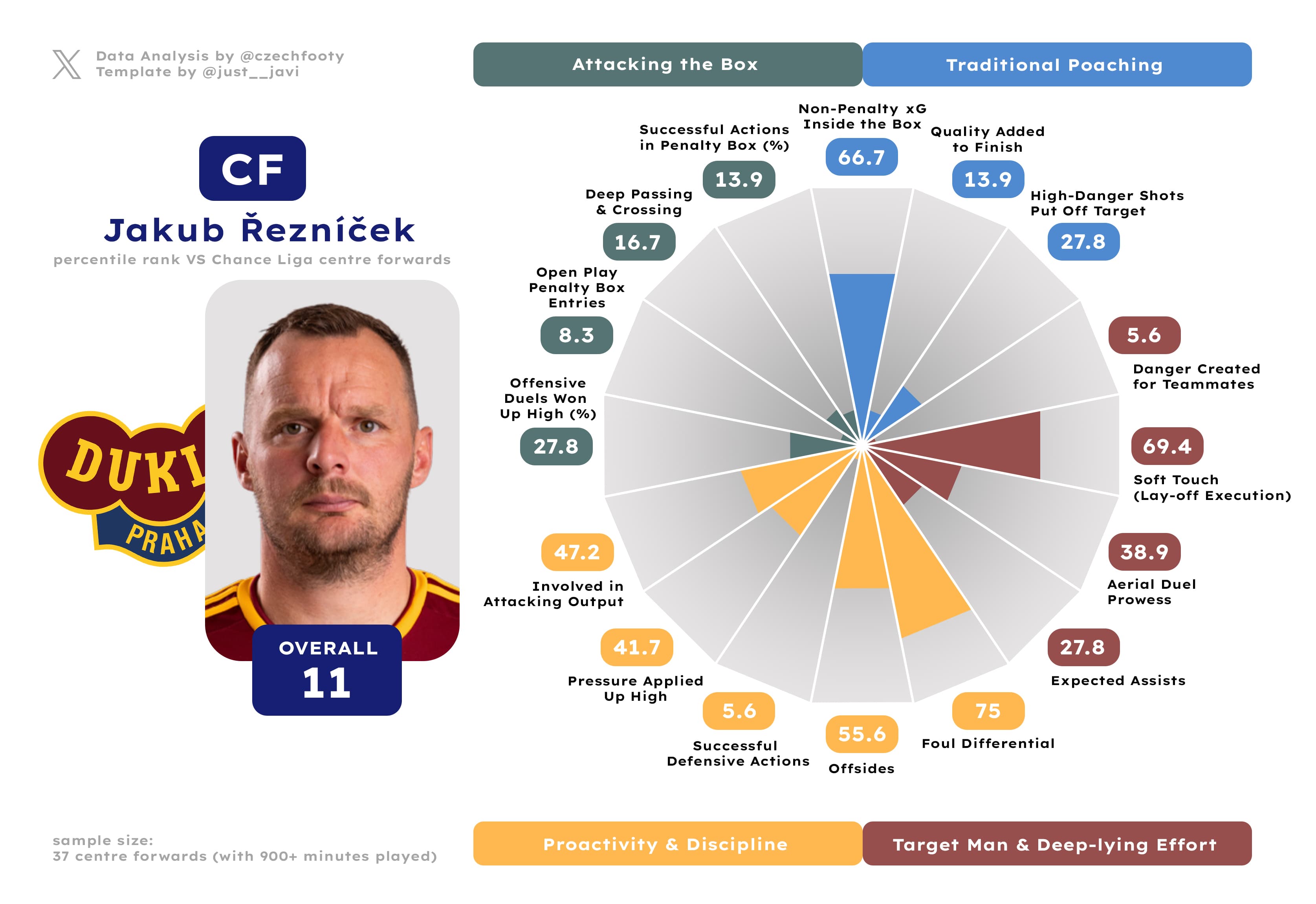
And finally, Jakub Řezníček. We are all glad for him cracking the Club of Legends with his 100th goal, I guess, but the whole journey had a bit of a grotesque feel to it. He, too, was thoroughly out of depth and the six appearances he took to reach the hundred already dragged on too long; let alone the nine full starts that followed. What Řezníček was vaguely good at was finding his spots in the box to finish (no shock), sometimes doing well to lay-off the ball for a teammate, and drawing fouls (through frequent play-acting) — schluss. Now it’s not unimaginable but at least highly unlikely that neither Jacques Fokam (coming highly recommended by a friend of Czech Footy, Víťa Študlar, and looking fine in the opener) nor Namory Cissé (even picking up over 1000 minutes in the Austrian Bundesliga) fares better.
Biggest downgrade
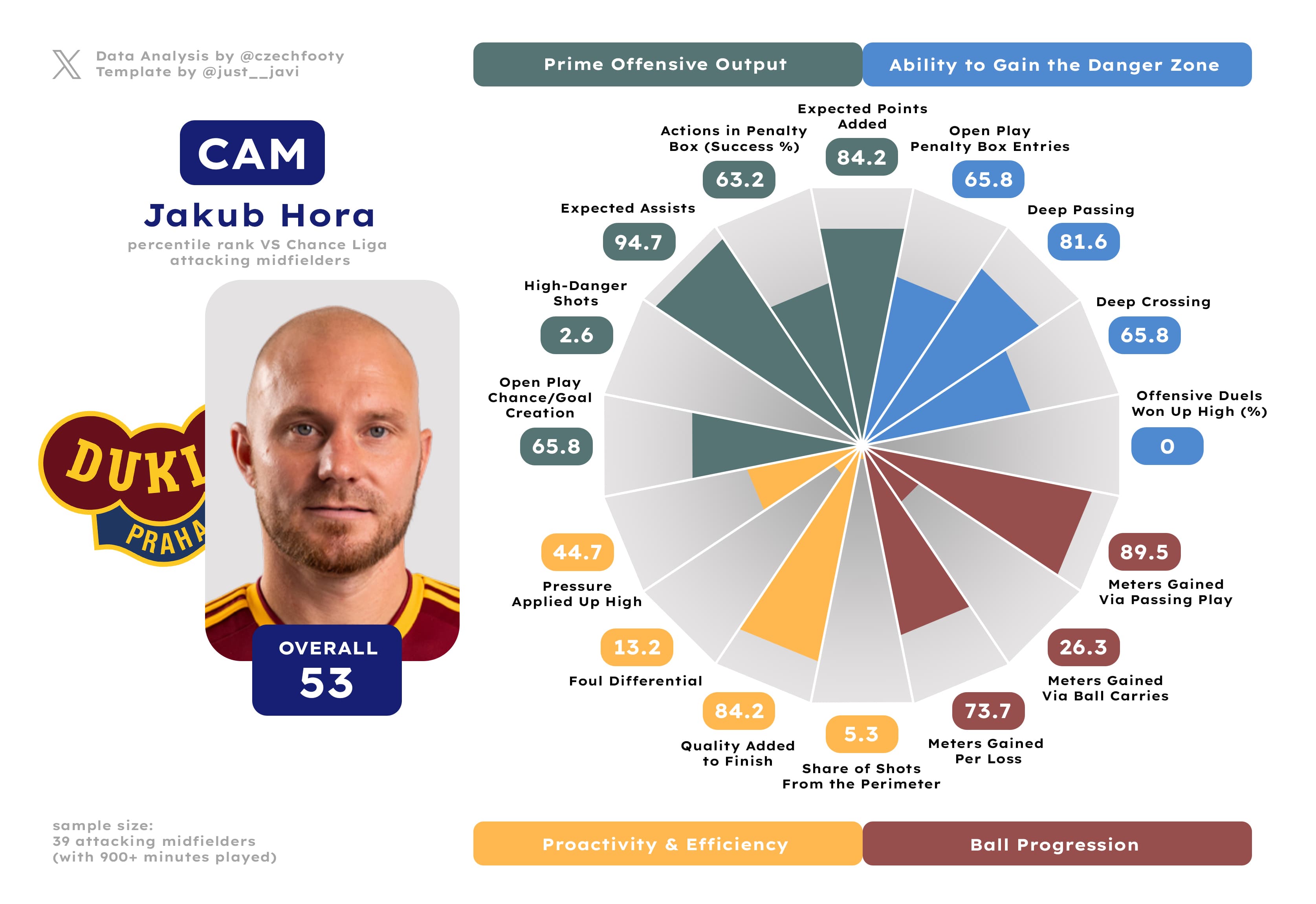
As he was leaving the top flight in early 2024, one couldn’t fight the feeling it was a bit premature. Now Jakub Hora does it again to help out another Southern Bohemian club (Táborsko), and the same feeling has re-appeared. Back then, Hora was loved by the CDM model for his positional sense (ranked 1st for that set of metrics) and distribution skills (7th). Now I placed him among CAMs, and he was still a top, versatile creator from deep or set pieces, at one point even setting up two goals with a long throw-in. There are some notable limits to his game, but he could still find his niche, and I’m not sure Dukla have identified a suitable heir. Samson Tijani does boast Red Bull education, but he seemed to be more of a defensive specialist and less of a consequential passer as a regular for Wolfsberger in 23/24.
Need left to be addressed
While this may not end up mattering if Holoubek goes with 3ATB3ATB means 3-at-the-back, ie. any formation with three centre backs and wingbacks, or alternatively, five defenders. and/or plays Tomáš Jedlička — one of the best second-tier players of 24/25 mostly in the role of a centre forward/second striker — out wide, I would still appreciate a winger or two to bolster the depth as well as potential starter options. This is especially needed at a point where Rajmund Mikuš took his end-of-season injury troubles through the entire summer and into R1. There’s Jiří Hrubeš returning from a pretty inspired loan at Chrudim, potentially ready to break through for his employer of 7 years at RW, but that’s just one backup out of a minimum 3.
And that’s not even delving into Štěpán Šebrle appearing vastly overrated by experts; very poor at gaining the danger zone in control for a presumed dribbler, only performing 0.86 successful actions in the box per 90 and completing a measly 6 passes in/to the penalty area.
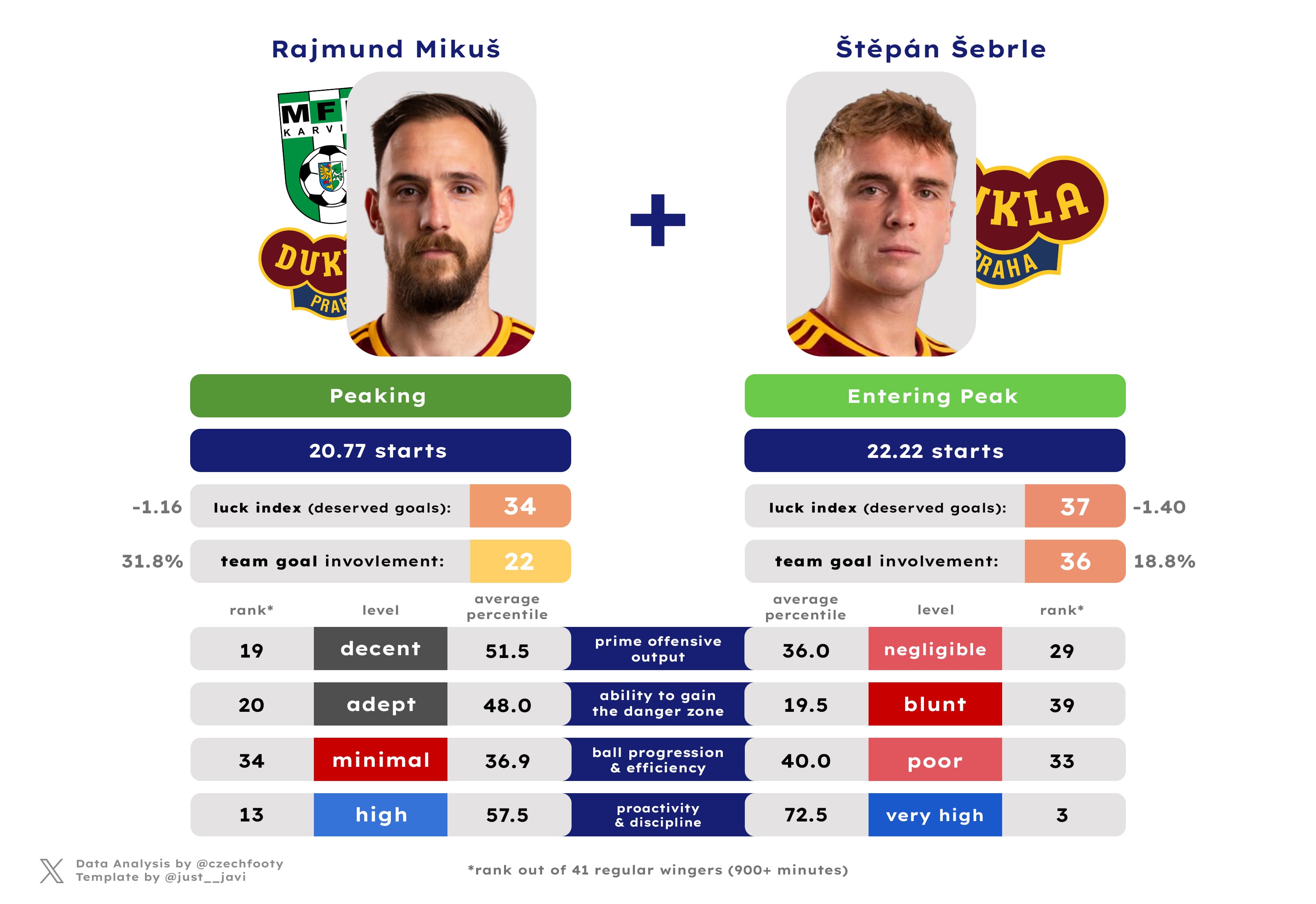
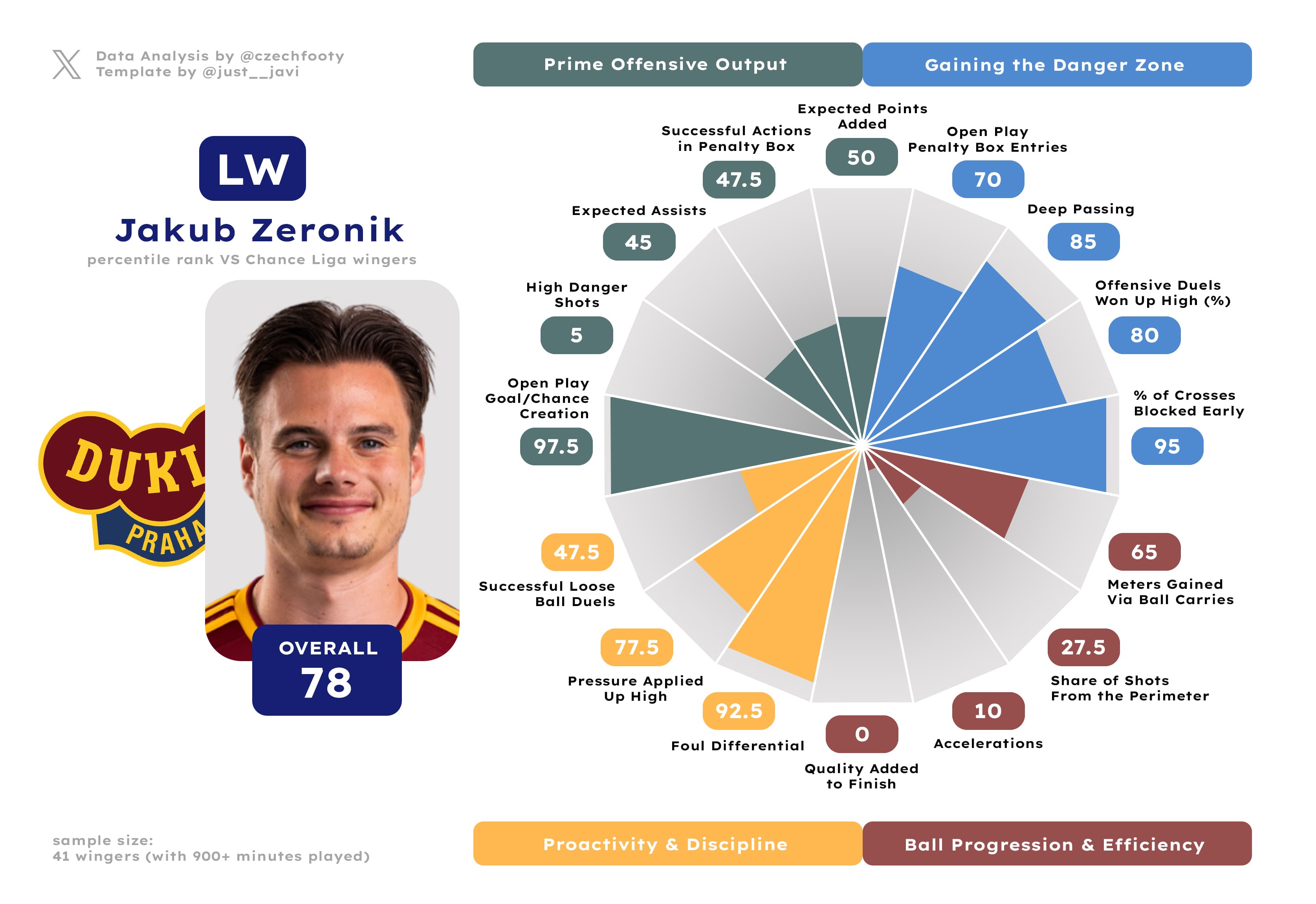
This lack of depth is, of course, a direct result of Dukla systematically getting rid of warm bodies for the flanks. While Jhon Mosquera, Jorginho or even Pavel Moulis, Ondřej Ullman before them may have been just fluff in the grand scheme of things, Jakub Zeronik made for an intriguing 1-on-1 weapon in the autumn, never to be leaned on later, also due to an injury.
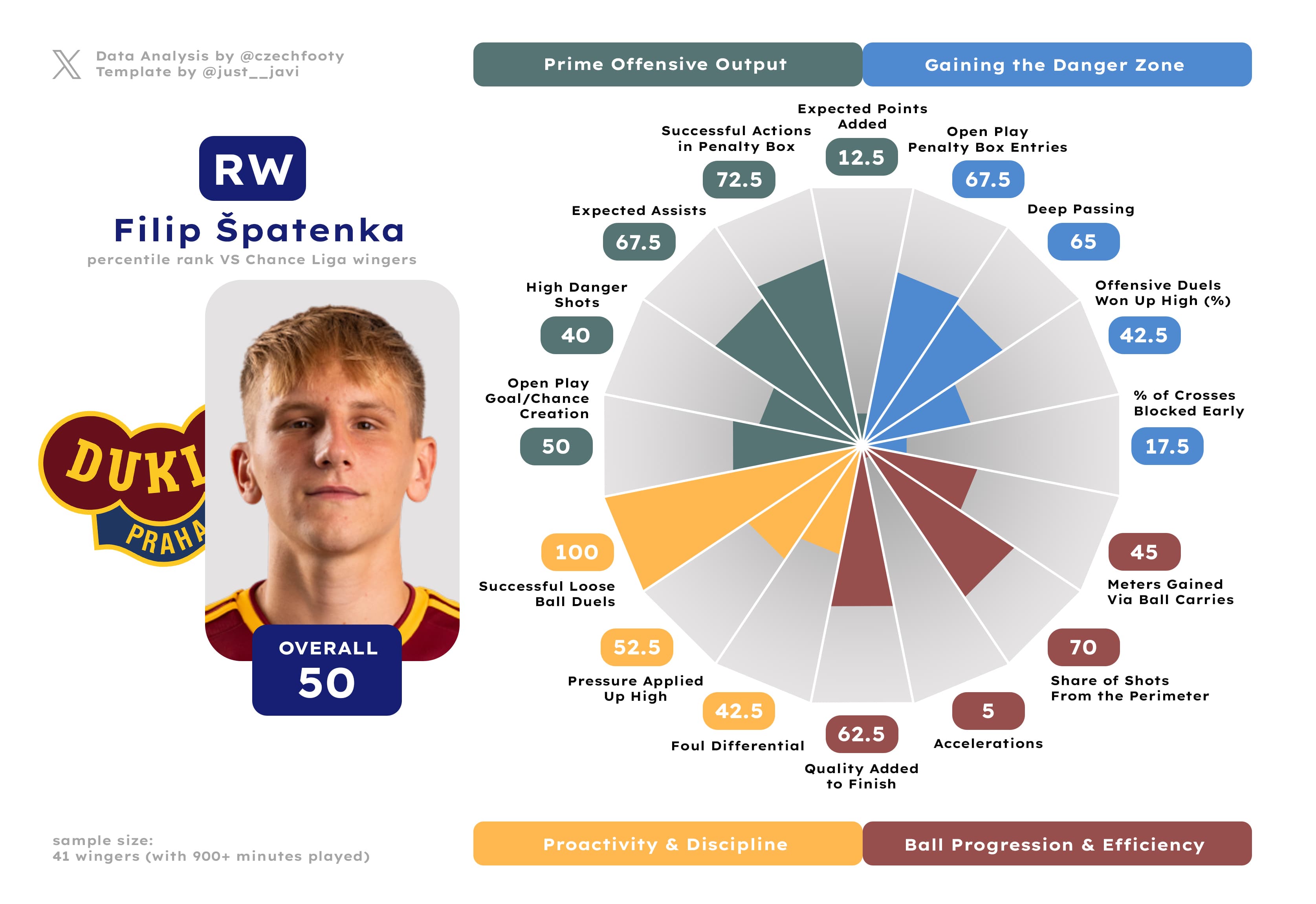
Zeronik’s guile could be missed by Dukla to an extent, but it’s the more immediate loss of Filip Špatenka that stinks even more. He added an element of everything, always active on his toes, with a relatively filling pizza for a 21-year-old rookie. He could also play anywhere.
New kid on the block
Depending on your perspective, it was either a lot or a bit disappointing that David Holoubek didn’t take any of the successful U-19 (later B-team) players through the summer preparations. Dukla U-19s managed to beat all of Baník, Slavia, Sparta and Plzeň as they built up their remarkable case for Top 4, and to truly appreciate the final placement, consider that Dukla were 8th, 14th and, erm, 2nd-tier in the last 3 seasons. Now, suddenly, they had the top scorer in Michal Kroupa (b. 2007), and that’s despite only enjoying him for 15 rounds, from mid-season onwards. He started off with a 4-goal explosion against Brno, proceeded to score in five more (successive) starts, later added a cherry on top by notching a hat trick against Slavia, where he’d fallen through cracks as a kid, and wound up as a fresh U-18 international.
For all the hype, Kroupa is likely too young to pick up some action, much like the star defender of the U-19s, David Leidl (b. 2007). But even after Filip Mikeš (b. 2005), promising 11-goal scorer for the 3rd-tier reserves, left to test himself at the higher level at Prostějov, there are some decent candidates. Both Denis Zamazal (b. 2006), another Slavia misfit, and Tomáš Kolský (b. 2005) could see some rare action in central midfield and at right back respectively.
But the one kid I actually want to highlight in bold is a new arrival, Pavel Gaszczyk (b. 2005), who’s still young and inexperienced enough to qualify — the latter qualifier sadly primarily a result of too many serious knee injuries. Now he’s, in his own words, fully healthy and ready to fight for a coach who had helped to mould him into a cerebral midfield general while in charge of the U-19 national team. Given his unrivalled youth pedigree (also strengthened by his UEFA Youth League performances for Plzeň), it would be an eternal shame if ‘Gaza’ doesn’t figure it out among adults, and this season could/should serve as a stepping stone.
Looking ahead to 2025/26
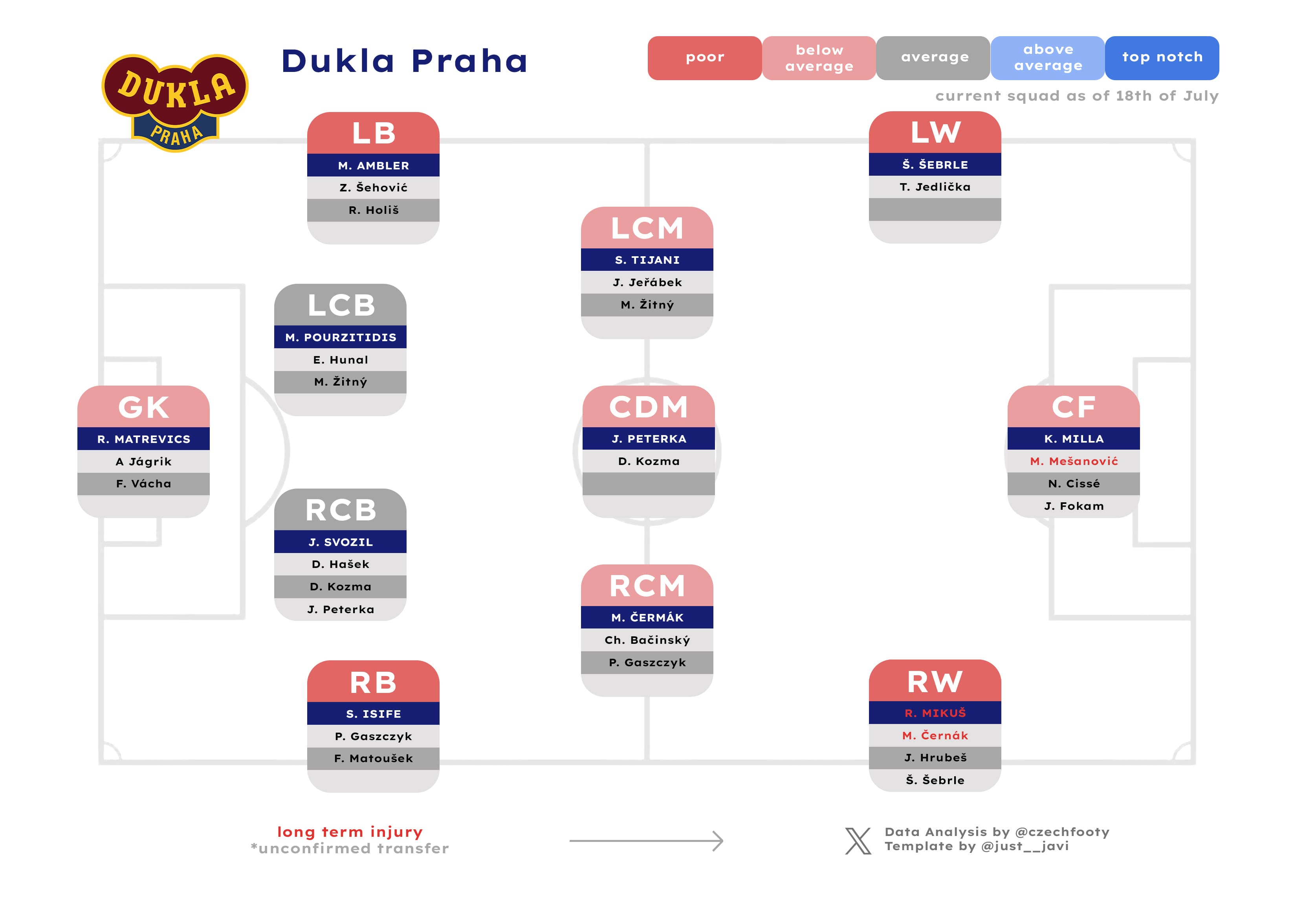
Below is the team’s current(ish) depth chart with a maximum of 4 alternatives for one position. The colourful ratings are a static snapshot of the league-wide situation on 5 July, and they are just a playful bit to add flavour to it; the names featured should be relevant to this day. To learn more about my approach to constructing depth charts, with all its limitations, head here.
Primary formation
This is where my depth chart differs greatly from the look on the first matchday. That being said, also given how the 5-3-2 (per Wyscout) or 5-4-1 with Marcel Čermák staying wider (?) worked out, I’m pretty confident in predicting Dukla ultimately lean more into a four-at-the-back. They will probably remain stretched between the two options, but it won’t be a no-brainer. This has got a lot to do with Dominik Hašek not being very good (he’d started well, but his real level began to shine through by the end of the autumn already), and even more so with Mikuš eventually returning, as they likely don’t see him or Isife as a pure backup.
Notes on the depth chart
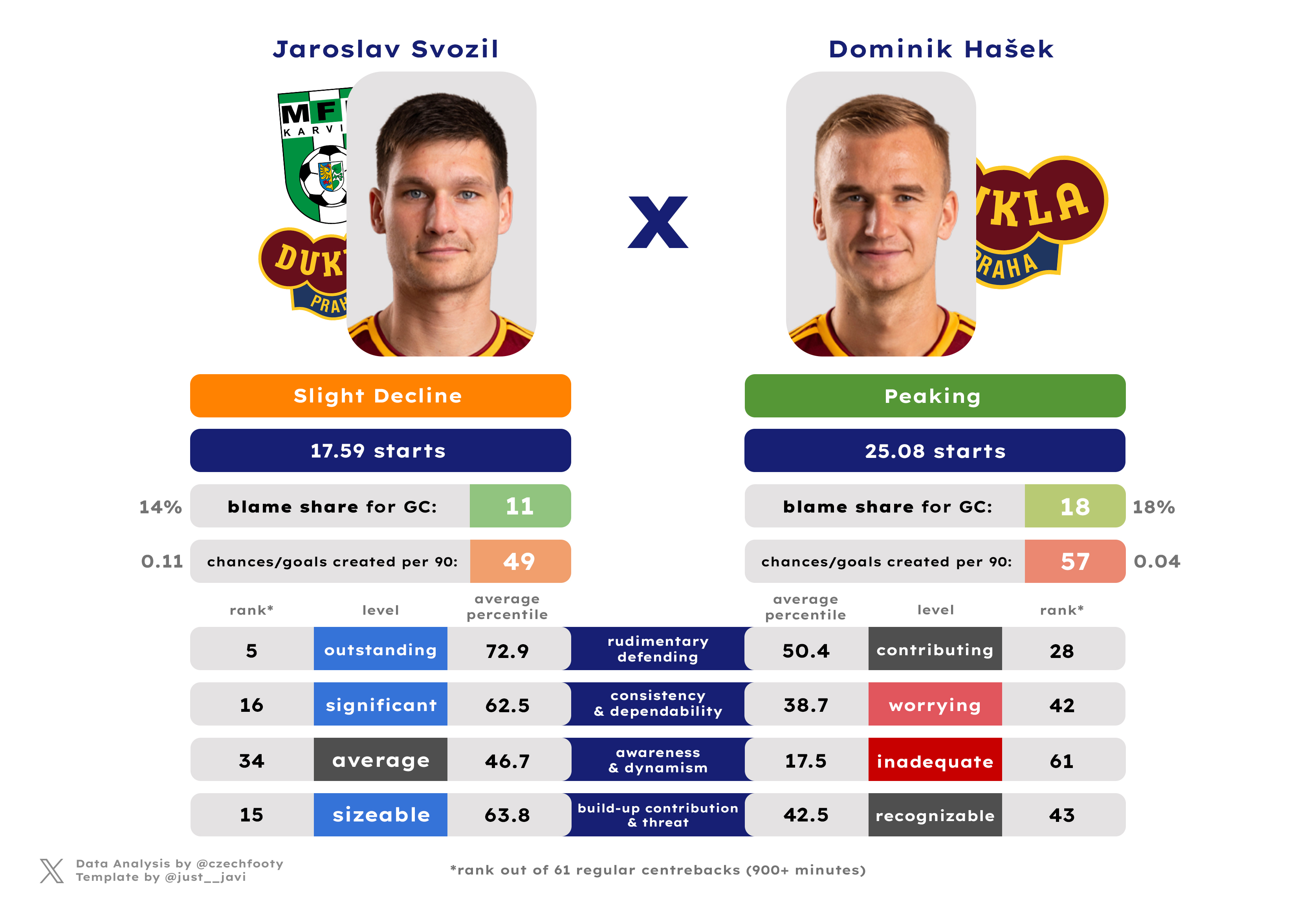
If we can agree on Dukla ultimately settling into a back four, we can kick-off this section by comparing Hašek to Jaroslav Svozil. The latter is, of course, the superior defender who remains severely underrated by many, but he’s also too injury-prone. You need a reliable cover, and I’m not sure either Hašek or Hunal (who most Slavia fans I talked to do not trust at this level; at least not yet) are that. Arguably the more interesting option would be Matěj Žitný, though he’s exclusively a LCB candidate, and still primarily a central midfielder.
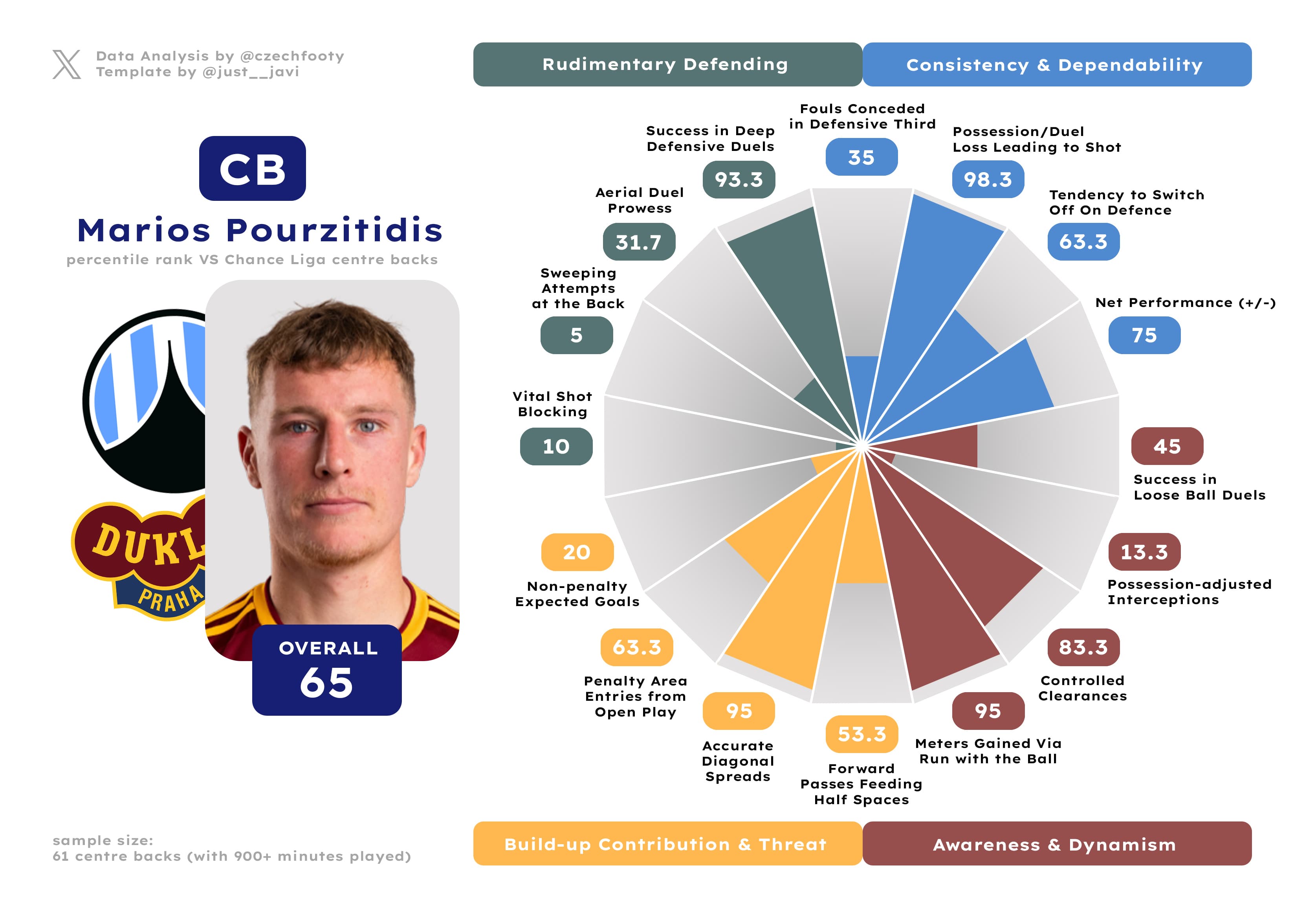
One centre back who you probably want out there at all times is Marios Pourzitidis. In normal circumstances, a player of his calibre wouldn’t be readily available to a club like Dukla, yet that was the situation — and they did extremely well in getting him to prolong his stay. The Greek centre back grades out above average in three of four areas of play, falls into the perfect age bracket at 26, and indeed looks to be peaking. Together with Halinský, Krčík and Gabriel, he’s the only other centre back who lands in at least the 85th percentile for both accurate diagonal passes and meters gained via ball carries; a versatile build-up contributor.
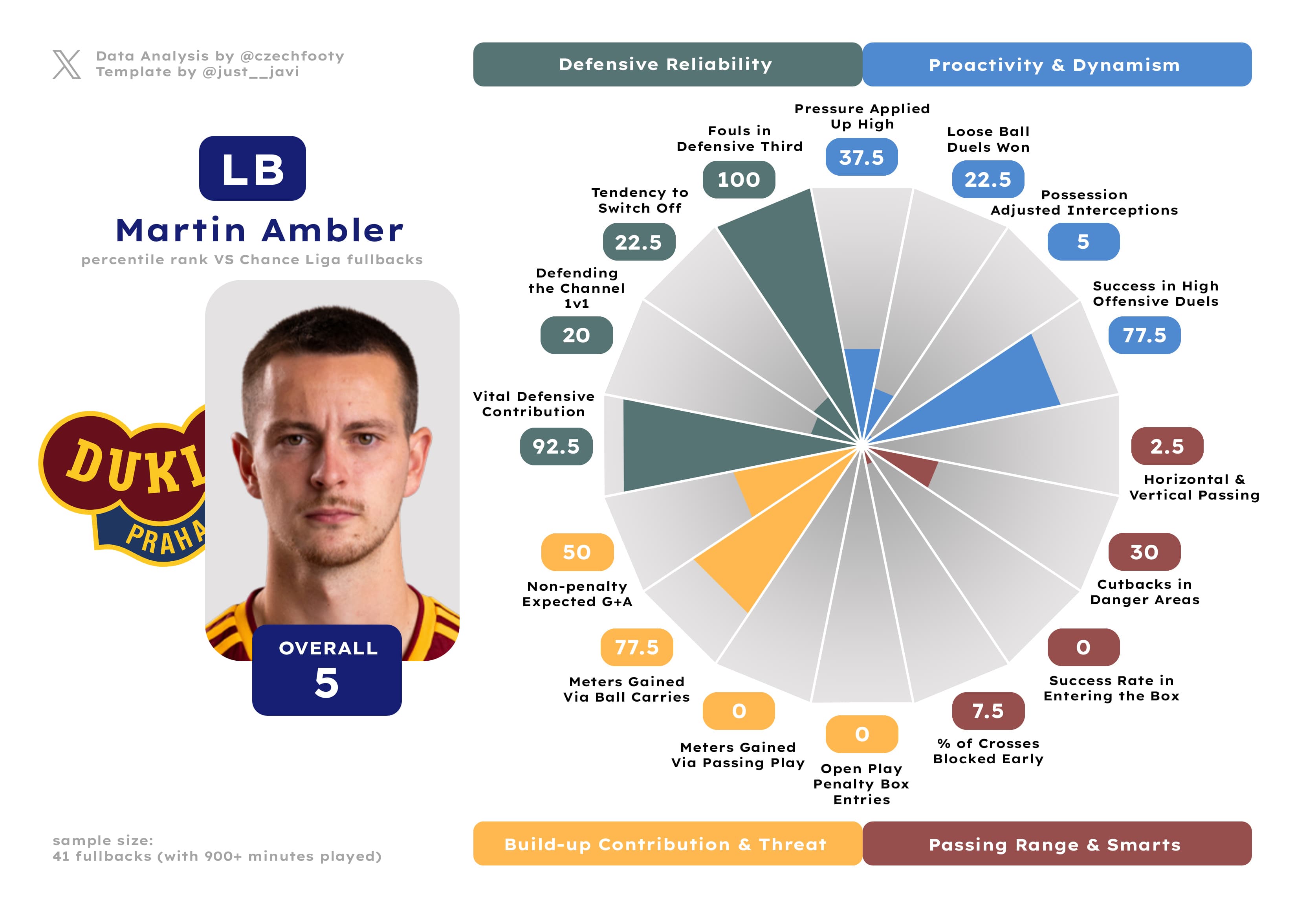
One of the most curiously empty pizza charts of this summer belongs to Martin Ambler. I honestly expected him to do much better going by my eye test, but it seems like the rare goalscoring fullback might have some catching up to do. I’ll have to zero in on him a bit more. Especially offensively there’s nothing going for him at the moment, which is… yup, curious.
Roster battle to follow
Still absent on Day 1, the injury troubles of Muris Mešanović are dragging further — to the point where it’s fair to wonder whether he even manages to return as a player of significant relevance. He appeared to be one of the first names on the team sheet in the fall, but given the vastly different returns with Kevin-Prince Milla on the pitch (Dukla scored 1.58 goals with him spearheading the attack, compared to 0.67 with Mešanović in the same role), the veteran may never be considered a starter at Juliska again. The model is strict: it’d be good riddance.
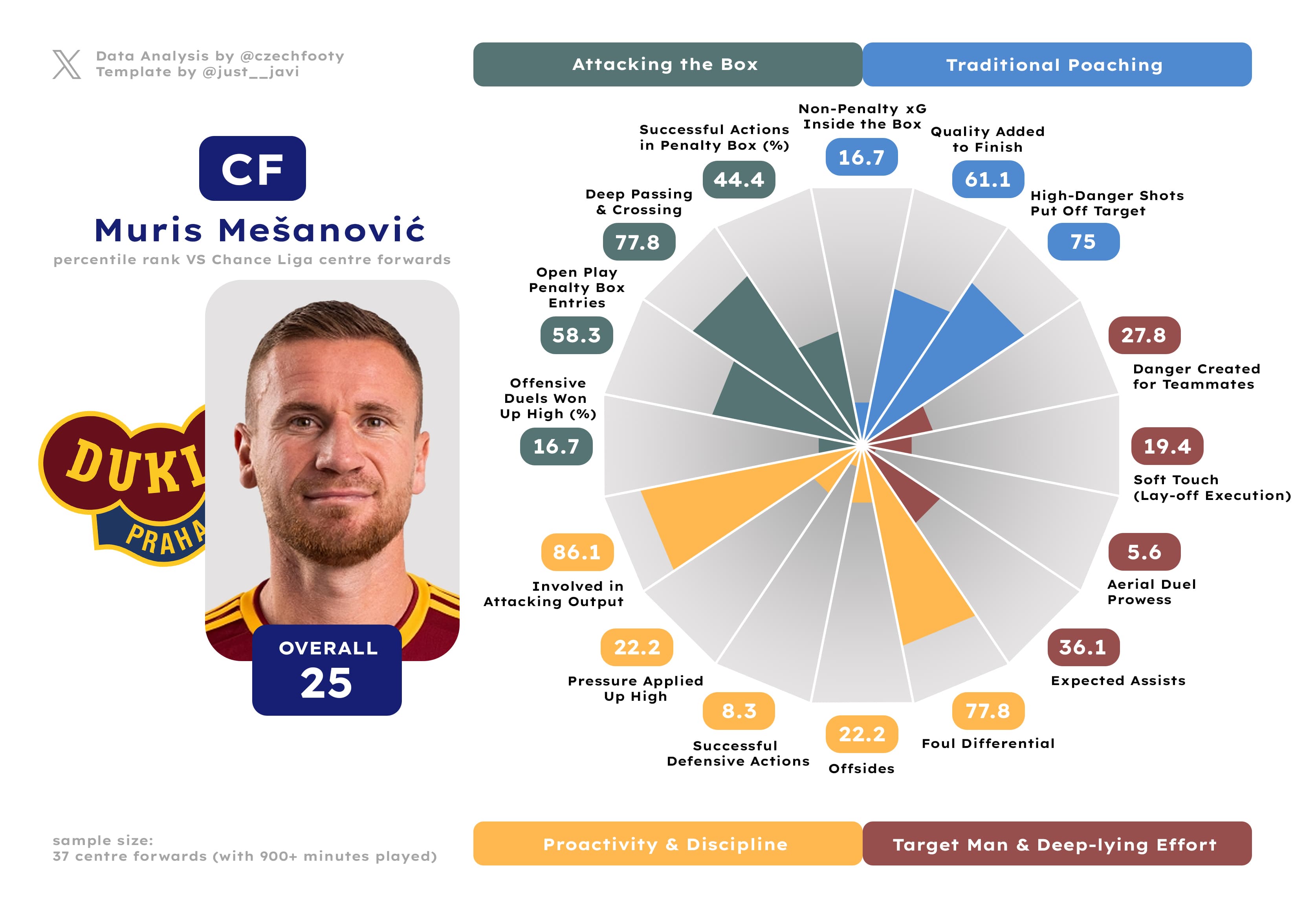
Milla didn’t play enough to produce a pizza of his own, but it’s interesting to note that while Mešanović was involved heavily in all (the little) Dukla produced, the play has flown through the Cameroonian to an even greater extent — with the output itself also much richer. As a result, depite the limited 800-minute space to work with, Milla managed to climb all the way to the Top 5 on the team’s MVP leaderboard, becoming the joint-second most prolific goal producer (2+0, but four indirect contributions), and one heck of a chance creator on top of it (19 wasted chances generated/facilitated, 5 for himself). Can he run away with the job?
Season forecast
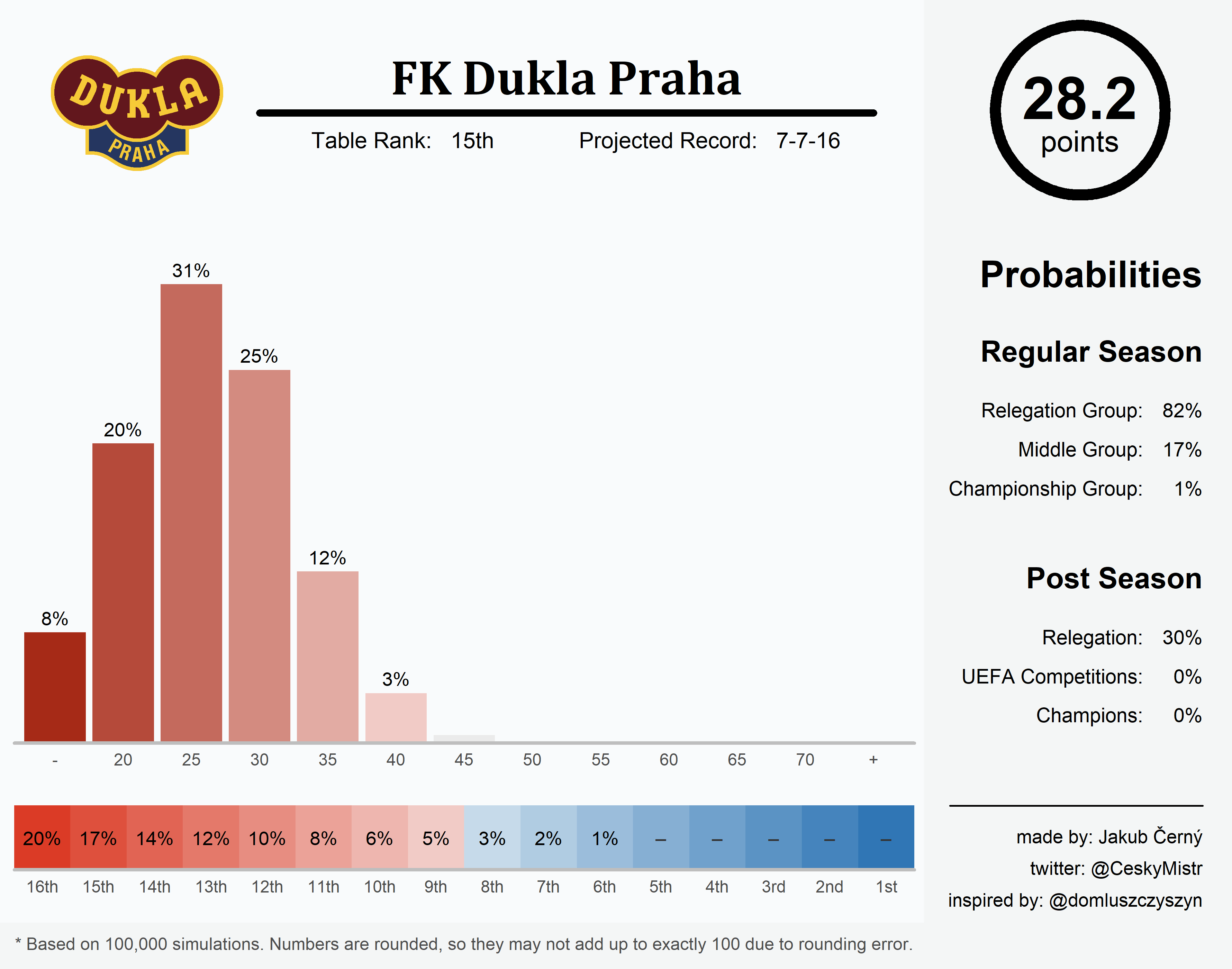
As opposed to Zlín, Dukla don’t have a strong second-tier record to lean on. Their promotion bid “only” involved 60 points (as opposed to Zlín’s 71) and was preceded by some very poor campaigns of 47, 39 and 34 points. Lay that on top of their embarrassing 24-point regular season that would trail three recent regular seasons of eventually relegated teams (Příbram 20/21, Brno 22/23, Zlín 23/24), and you can hardly be surprised by the 30% odds to go down. In fact, had I not graded Dukla’s summer better than most of their rivals’, their projection would’ve sucked even more. Only 17% for the middle group also sucks pretty hard, though.
Bold prediction
The track record: N/A
The prediction: Someone other than Sparta or Slavia draws 6000+ people to Juliska
The rationale: Matěj Turek obviously wants to see more fans in the stands with time, but it’s funny to note that Dukla — a perennial laughing stock for journalists and other clubs’ supporters for its “empty stadium” — actually drew more people to Juliska than Pardubice, Karviná and Boleslav to their own arenas. Their average was basically equal to Jablonec, and their own highest since the 1980s, by the way. Dukla absolutely do have a core of fans, and some very passionate ones, as demonstrated by their SLO’s journey from Hradec to Karviná.
So, they deserve better, and we shall wish them better:
Their last title-winning season (81/82) brought an average attendance of 3135 which doesn’t seem bold enough (Dukla were 87 people away in 24/25), but one of their non-‘S’ encounters drawing a crowd of at least six thousand already does. Bohemians is probably the best bet due to distance (5220 in 24/25), but maybe Ostrava or Plzeň do it instead. Viktoria vastly underwhelmed in the season opener last summer (4574), but Baník fans love to travel and might be more inclined to do so in August rather than April. They only need to do 1k better.

Enjoyed the text or the visuals, but don’t care for 🇨🇿 translations and dashboards? No worries, you can still support us by inviting us for a symbolic pint at the old BuyMeACoffeeBeer page.