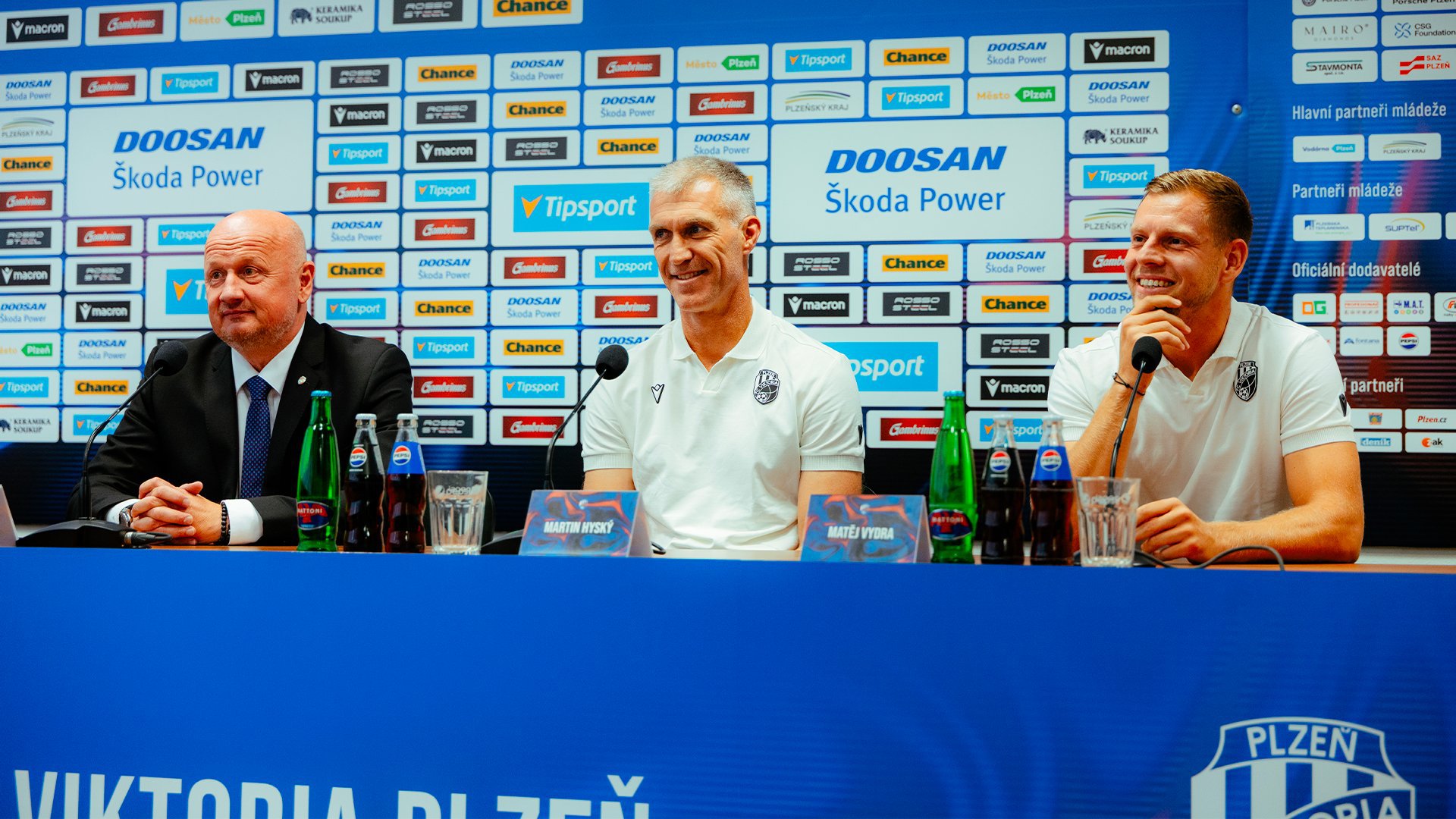
It must be tiring to be the third wheel as consistently as Viktoria Plzeň has been for its Prague rivals. Ever since stunning Czech football by snatching the title in 2022, they have finished 17, 17, 16 and again 17 points behind the eventual champions. Never dropping out of the Top 3 is nice (Sparta cannot say that in the same period, after all), but a club entering its first full campaign while backed by the richest Czech can’t possibly be satisfied with that. And so here we are: both the under-pressure coach Martin Hyský and the powerful show-runner Adolf Šádek openly declaring a title bid, perfectly echoing the name of this wonderful podcast: S klackem proti tankům (“bringing a stick to a tank fight”).
Plzeň billionaire owner Michal Strnad knows a thing or two about firepower, and so he must know Viktoria cannot outgun Slavia. At best, you are hoping for a David vs Goliath scenario here, and that’s without even considering Sparta and their pending multi-million investment in a difference-making centre back (someone Plzeň also needed and decidedly failed to sign) and coveted striker (who would single-handedly move Sparta’s forward deck ahead of Plzeň).
Indeed, once Sparta seemingly woke up from their now-traditional summer hibernation, the story of this transfer window is no longer its arrogant insistence on sufficient internal patches, but rather Plzeň’s complete lack of imagination. When renowned scout Jan Říčka arrived in January 2024, expectations were considerably higher. Two and a half years later, it’s fair to wonder whether the 62-year-old is past his prime. Viktoria’s answer seems to have been surrounding him with more data-driven expertise, bringing 39-year-old Jiří Krejčí over from the agency world in February 2026. So far, however, the results remain invisible.
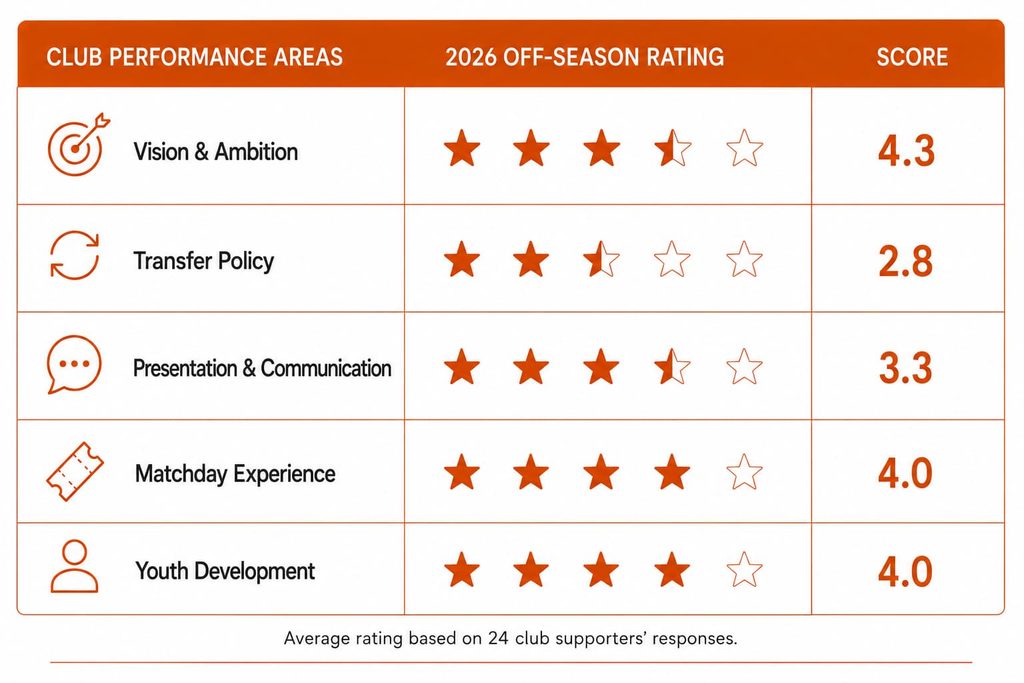
That being said, having entered the club in September 2025, Strnad is only getting his feet wet. Incremental gains in the field of PR and marketing may not even be the fruits of his work; the planned VIP sector renovation (2027) is supposed to be a city’s investment.
What most certainly will be bankrolled by Strnad, however, is the implementation of the newly established pillars of youth development. Among them, the most striking changes are the dissolution of U-7 and U-8 categories to concentrate focus elsewhere, such as on the High Performance Development System where Viktoria plans to single out the most gifted youngsters to support their growth with a more individual approach. Zdeněk Psotka, brought back to act as the academy’s sporting director, also officially confirmed that the club is setting up cooperation with Písek (already done) and Strakonice (on the way), which effectively equals an open declaration that Plzeň aims to take advantage of the ongoing collapse of Dynamo České Budějovice and take over the South Bohemian region, as well.
Everything makes sense. Everything points to a promising future, though a greater emphasis on women’s football would be welcome at a club counting Kateřina Svitková and Barbora Votíková among its alumni. As for the present, a little more restraint might be in order.
Looking back on 2025/26
What went right
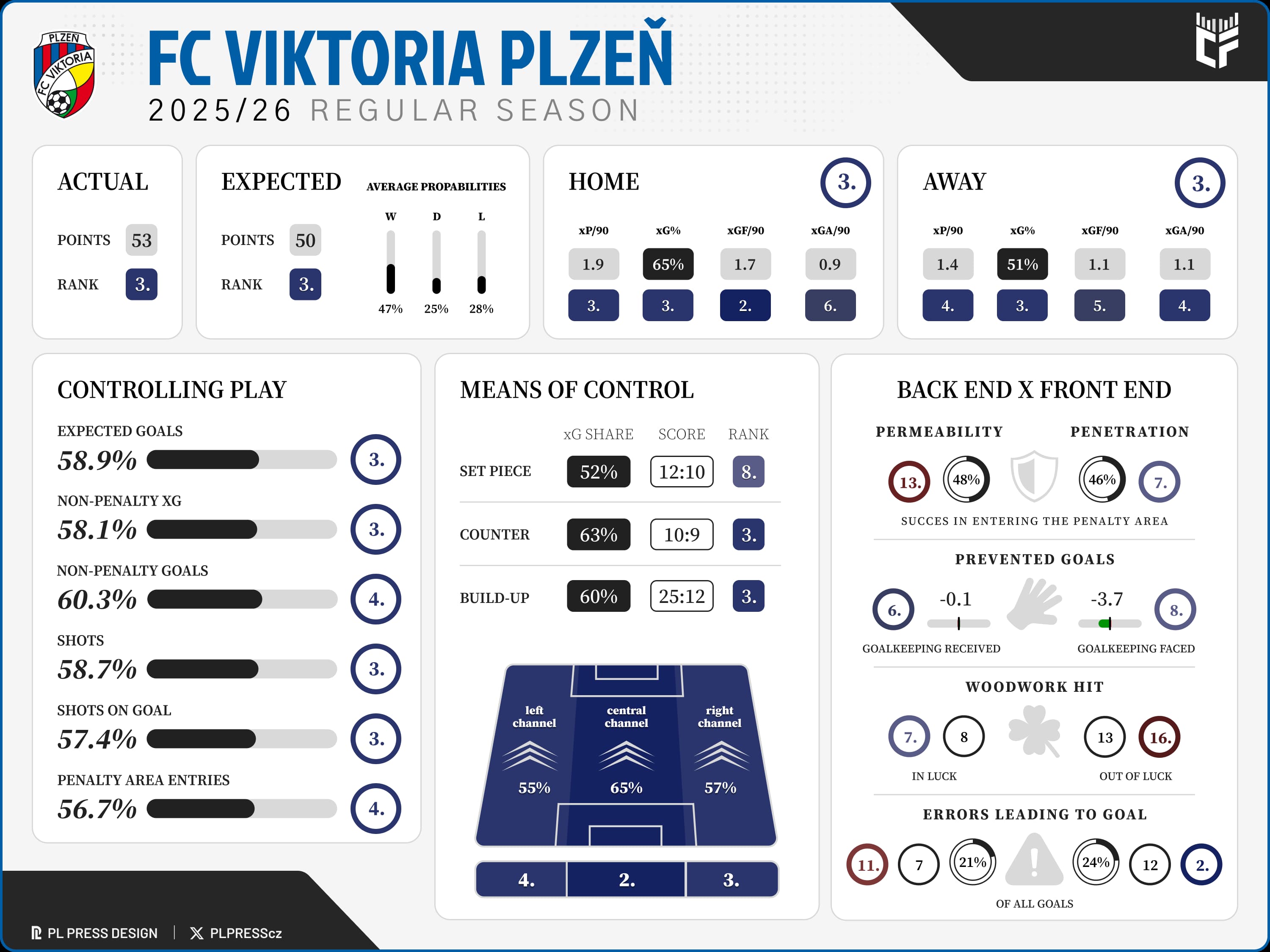
Entering the post-season, Viktoria looked nervous and extremely prone to a mental breakdown, barely squeezing three points out of their last regular-season stand with bottom-feeding Ostrava. Considering all those stumbles, later dispatching all of Hradec, Liberec and Jablonec with a combined score of 10:1, winning the xG battle 6.87 to 1.86 across those three games, was beyond refreshing. Plzeň ultimately finished seven points clear of the 4th-place team, having battled hard to even have the privilege of entering the post-season as the 3rd seed. If there was no World Cup on the horizon (robbing Viktoria of stars and focus to face Slavia), an unbeaten showing wouldn’t have been out of the question either.
Generally, while it’s hard to make an argument that Plzeň looked far better under Hyský than his predecessors, their behaviour in possession certainly improved. It was specifically down to the highly-rated coach that Viktoria wrapped up the campaign with the most shots from positional attacks per game (10.1) and the most xGFExpected Goals For (xGF) estimates how many goals a team should have scored based on shot quality, location, and context. generated down the middle per 90 (0.45).
What went wrong
The most overwhelming source of concern about Hyský’s regime, only confirmed at various points of the pre-season, is by far the defensive performance and consistency. Overseeing three-goal shipments from both Slovácko and Zlín is normally reserved for a coach’s five-year period, if not full-career; Hyský managed it inside 16 regular-season rounds. Frustratingly unpredictable, Plzeň were able to concede a combined 8 goals in back-to-back matches (while scoring six times themselves), and then produce not one but two back-to-back goalless efforts at the other end. This was the first year since the disastrous 2020/21 covid campaign (5th place) when Plzeň got shut out twice in a row on multiple occasions.
Most valuable player
Per my MVP model (traditional stats): Tomáš Ladra (ranked 27th league-wide)
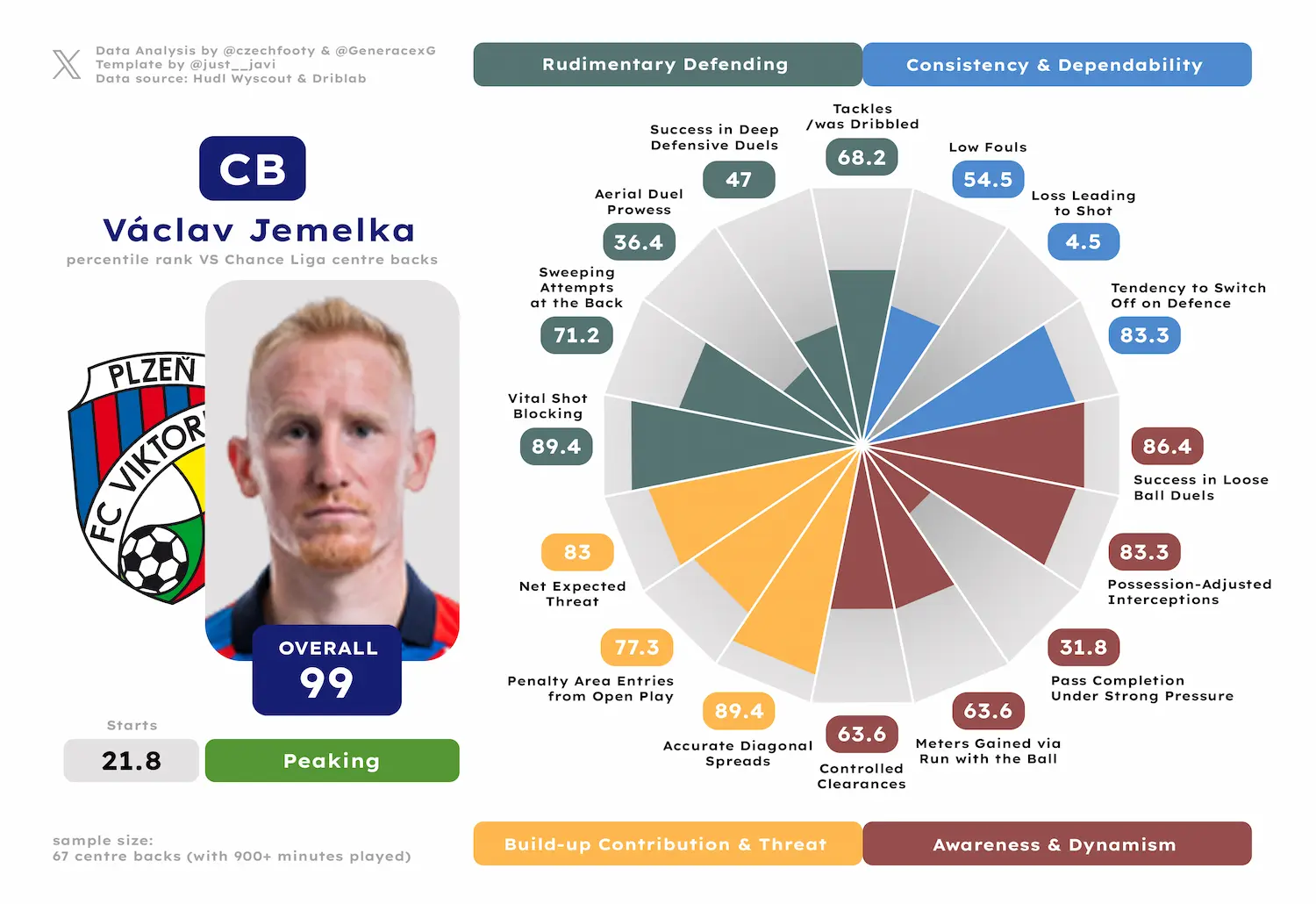
Per my positional models (advanced stats): Václav Jemelka (99th overall percentile at CB)
In January, we noted that as many as six Slavia and four Sparta players would top Plzeň’s underwhelming MVP leaderboard. The situation didn’t improve by the season’s conclusion, with winter arrival David Jurásek making it seven for Slavia while Sparta had one guy overtaken by Tomáš Ladra, as uninspiring an MVP candidate as it gets, particularly post-Šulc.
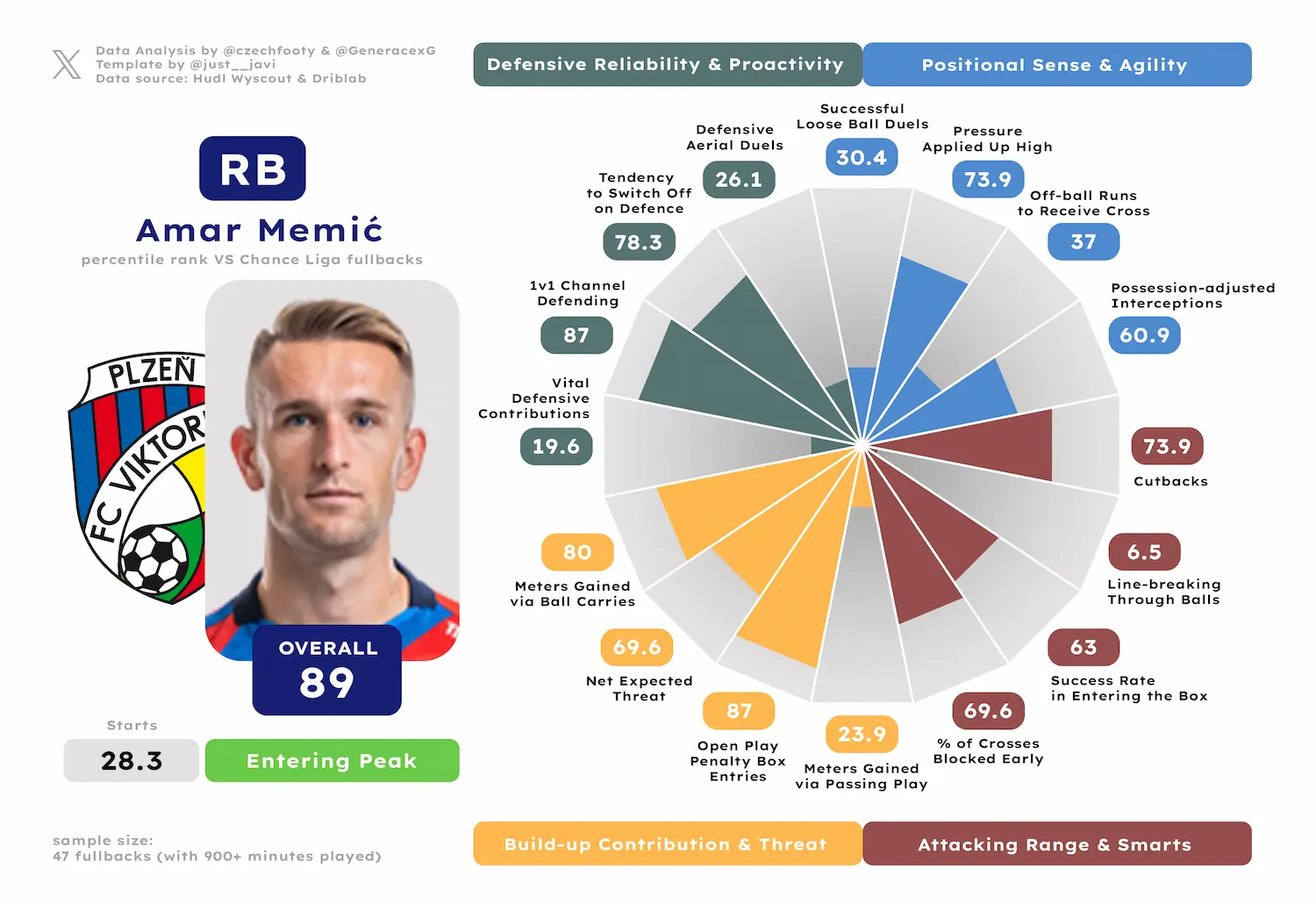
So what now? One approach, which I personally prefer, is to highlight Plzeň’s only contender for the “best player on his position in the league” tag, which is Amar Memić (maybe also Wiegele, but only in the near future). For a natural winger, Memić ranks surprisingly high in the “defensive reliability & proactivity” category (17th out of 47), but it’s also notable that his offensive contributions — tamed by his deep deployment — hardly leap off the page.
Only a player of Memić’s stature, of course, can emanate a slight disappointment by ranking as high as 5th in “build-up contribution & threat”, but that’s the bar he’d set for himself. Particularly concerning is his progression via ball carries landing in the 80th percentile only, nearly 40 meters gained per game (!) behind his less-heralded colleague Merchas Doski.
Another approach is to highlight someone who felt like a good candidate for the “most improved player on the team” tag before succumbing to a season-ending injury. That the injury was directly followed by Zlín putting 3 goals past a disoriented backline anecdotally adds to Václav Jemelka‘s MVP case, otherwise mostly supported by some strong underlying numbers we hadn’t been used to. Jemelka improved considerably in loose ball duel success rate (45.2% to 62.5%) and developed into an impactful shot blocker and diagonal passer.
Chip on the shoulder
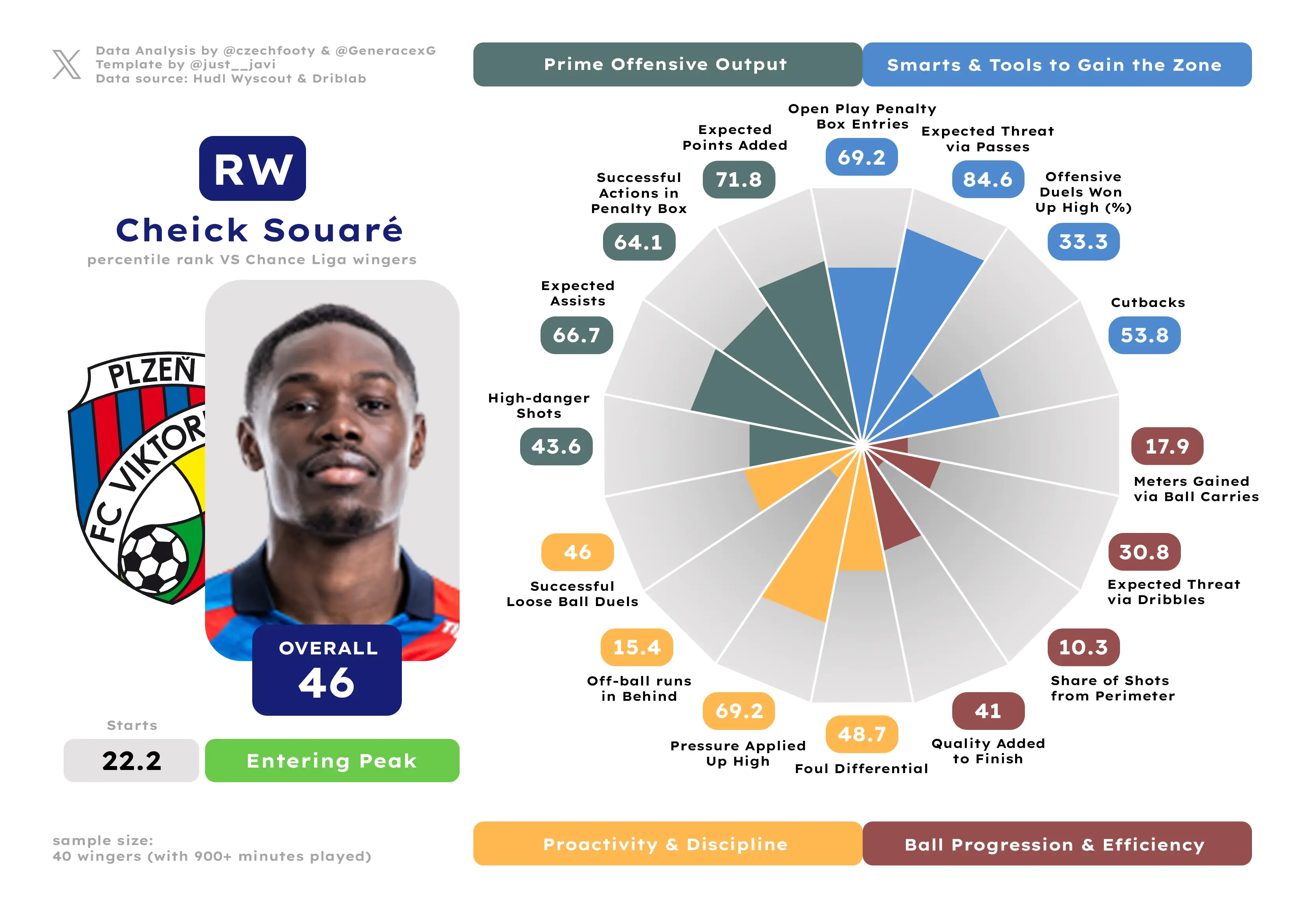
For a while there, it looked like Cheick Souaré might catch a second breath (or more like a fourth) as an inverted right winger. In patches, the “Messi” nickname seemed warranted. But then he got cocky, leaning too heavily in hopeful long-range shots, walking more than running (he spent the least amount of time in sprint or HSRHigh-speed run (HSR) is classified by Driblab as any run at a speed between 19.8 and 25.2 km/h. of all regular wingers — 7.2% of the time), refusing to push the play even with the ball at his feet (0.04 accelerations per 90 is also bottom), not compensating with anything of note in the way of defensive contribution.
No wonder Souaré soon found himself on the outside looking in, with Hyský preferring types more suited to his high-octane brand of football. The Frenchman still possesses remarkable tools, like smart crosses or line-breaking through balls (top of the pack), and nobody is trying to make him a formidable athlete, but he’s got to meet the notoriously strict coach halfway.
Another player most fans are beyond tired of due to his attitude and body language: Prince Adu. For him, the chip is inflated by a number of additional factors. First of all, he was Plzeň’s MVP front-runner at Christmas with 620 points thanks to a great chance/goal-creating rate from open play as well as six expected points added to the team’s total. Since then, he only added 110 MVP points, dropping all the way down to the 9th spot on Viktoria’s board.
Second of all, he was with Ghana in the Americas until early July and joined the team late. Moreover, when he did, he may have noticed a couple of new(ish) faces like Christophe Kabongo ready to chew on his left wing usage, and Baboucarr Faal further plugging the CF deck for him. All this adds up to me being far from convinced there exists a way back for Adu.
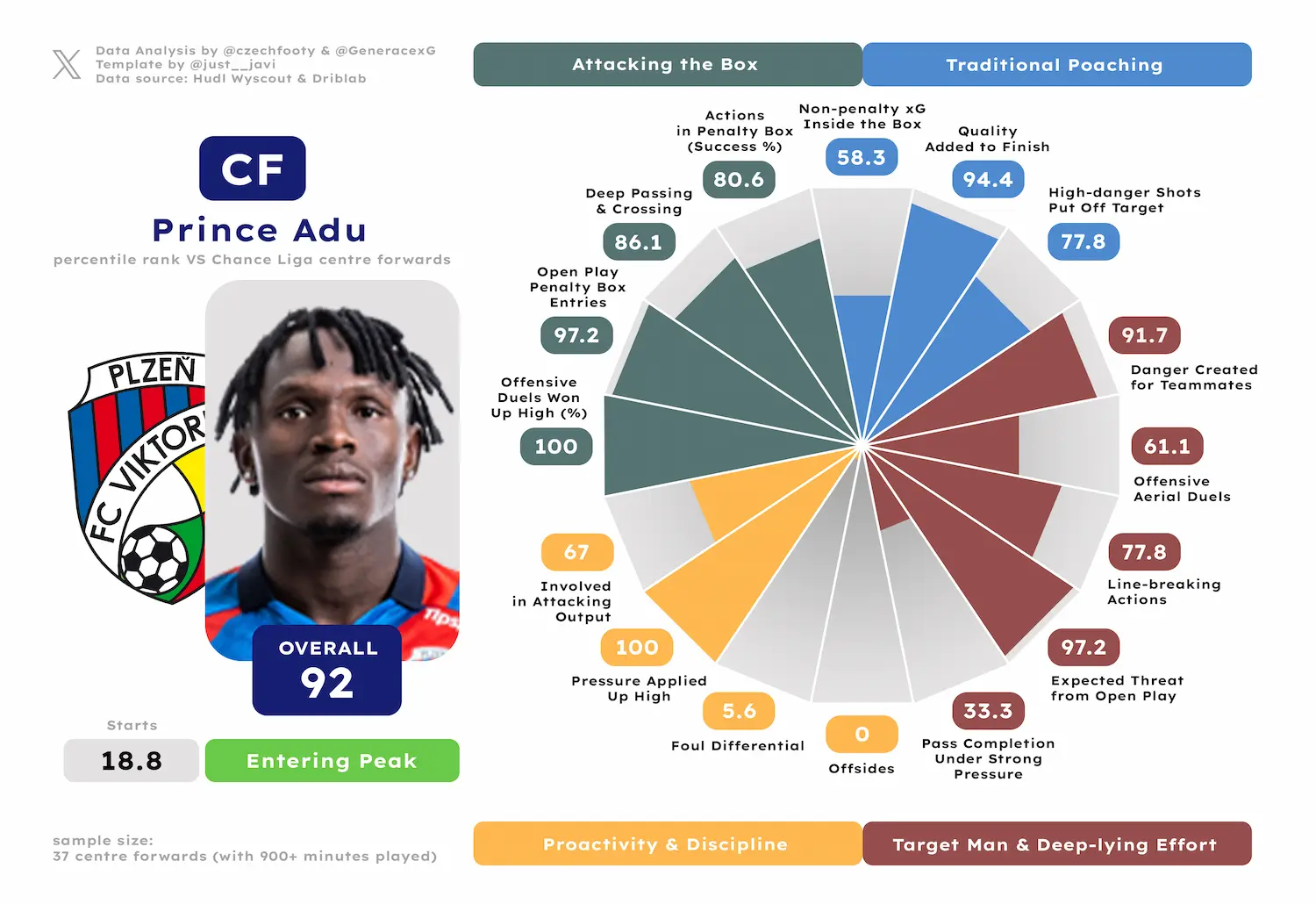
Adu looks as fabulous as ever when it comes to gaining the zone, courtesy of the sheer amount of tries but also some genuine split-second magic. The trouble once again lies in anything discipline-related, while some proactivity metrics (e.g. defensive actions) look fine when compared to centre forwards, but get significantly worse when compared to wingers.
Inside the off-season
special thanks for guiding me through the motions of FC Viktoria Plzeň’s off-season go out to @belly11mb, @lisak_v, @HonzaKocab, @ZdenekFrana, @Graslik8, @Yanno96, @kubakunes, @jhruby08, @poskal77, Willi, Karel Malkovský, Cartman, Patrik N., All-in & Michal
Squad turnover
At this point, Viktoria are keeping all 11 most used players and retaining the third-most minutes over the summer (86.4%). Their goal production took a hit via Pavel Šulc (1) and Rafiu Durosinmi (7) only who are both long gone, though not entirely forgotten. In fact, the bigger topic in Plzeň’s camp seems to be why there is so many similar forward types who could potentially take a few more strikes with them — one of Adu (7), Salim Lawal (2) and Mohamed Touré (2) certainly feels like an extra with Faal arriving on top of everything. One more hot topic: if you cross out long-term injured Jemelka and Jan Paluska, Plzeň can suddenly call on less 25/26 experience among defence-minded players than Boleslav or Teplice (73.4%).
Biggest upgrade
While Baboucarr Faal looked like a flop in the making in pre-season, with Hyský himself noting it will take some time before he’s physically ready for the Czech top flight, Stefan Pirgić very much hit the ground running. A third signing for the no. 6/8 role in twelve months after Adrian Zeljković and Patrik Hrošovský, Pirgić should be the most complex of all — combative yet technically adept, positionally sound with good on-ball awareness and calmness too, and so far not struggling with pace like Zeljković immediately did. There are basically no red flags, and reports about strong mentality are also important for this team.
A million-dollar question now is whether Plzeň can and will afford to bench Lukáš Červ full-time. Even if Pirgić becomes the no. 3, it is an upgrade, but the hope is he can be more. Červ’s ball handling was a frequent subject of ridicule among fans and neutrals alike, showing on a very poor performance in expected threat and ball progression metrics. Replacement level.
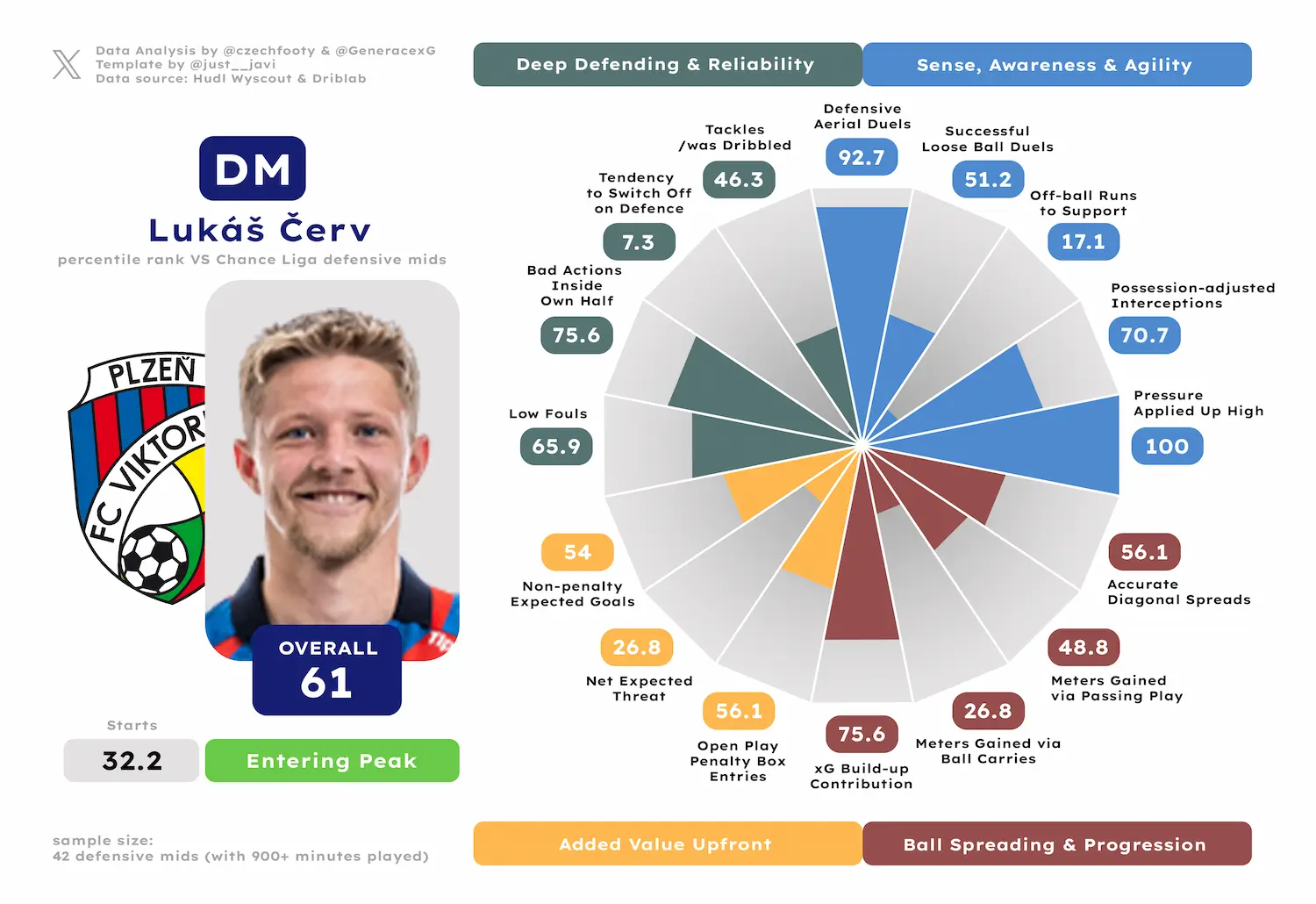
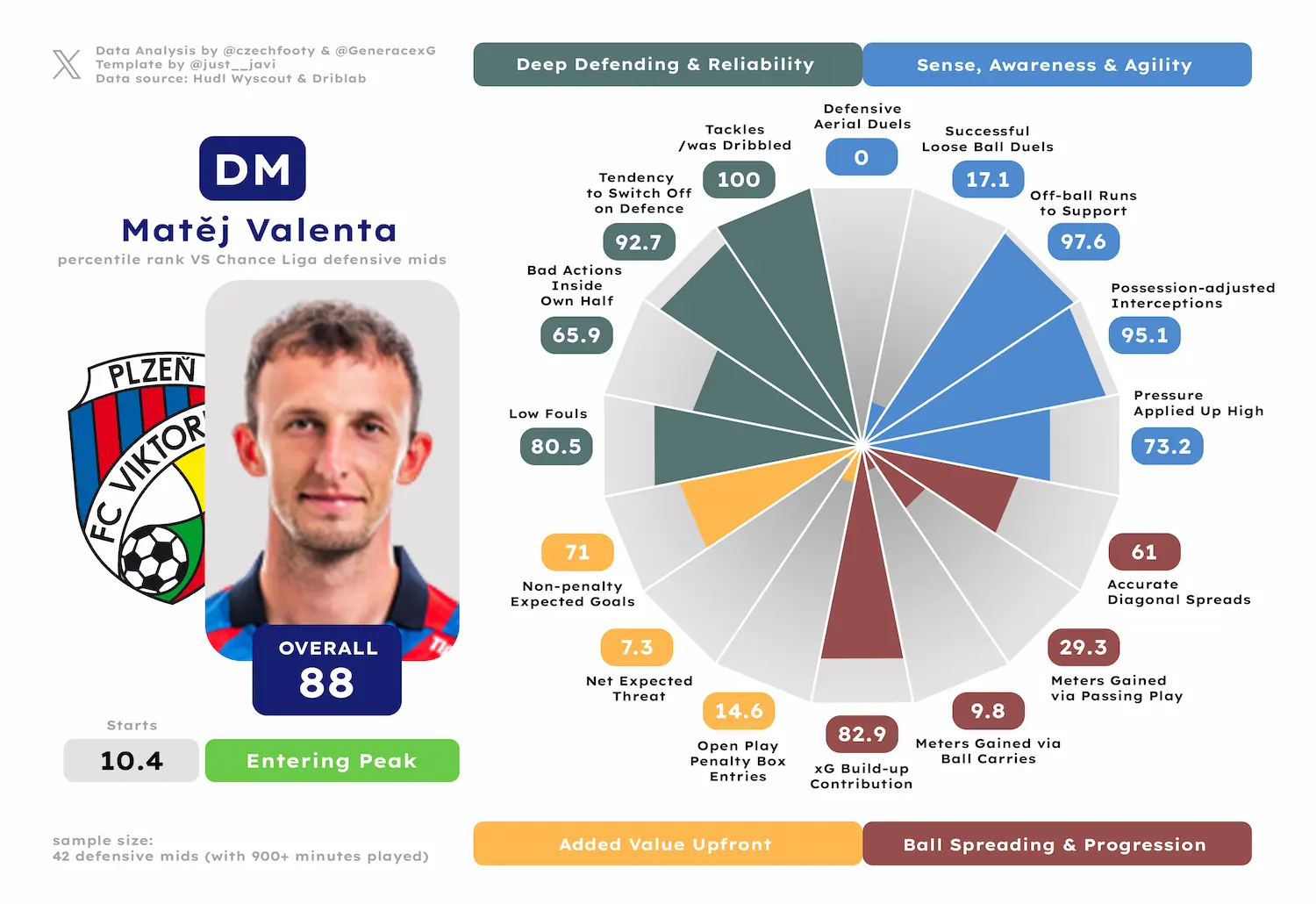
Pretty much the same applies to Matěj Valenta, for whom even third-choice status had become difficult to justify. Spare for aerials, Valenta offered underrated defensive presence, and so he does have his rightful place on the depth chart, just not as high as was sometimes the case. He delivers one of those rare pizzas with well-represented extremes at both ends and a few average values in between. A specialist; and a disappointing black hole on the ball.
Biggest downgrade
Sometimes in my Biggest upgrade section, I mention “addition by subtraction” — a case of an upgrade through moving away from a harming element. Here I am tempted to do the reverse: introducing a “subtraction by addition”. It’s not as common, but it best fits the case of Plzeň, whose decision to sign Sebastian Boháč continues to baffle days after it happened. Not only does it make clear there’s no high-end RB incoming, which is a mistake in its own right. It also means Viktoria are too happy to settle for nothing special in particular. There’s value in employing hard-working guys who don’t mind travelling across the line-up, but when that’s the main (justifiable) reason for the recent transfers of Adam Kadlec and Filip Prebsl, you are creating a pattern that basically has no history of making a difference whatsoever.
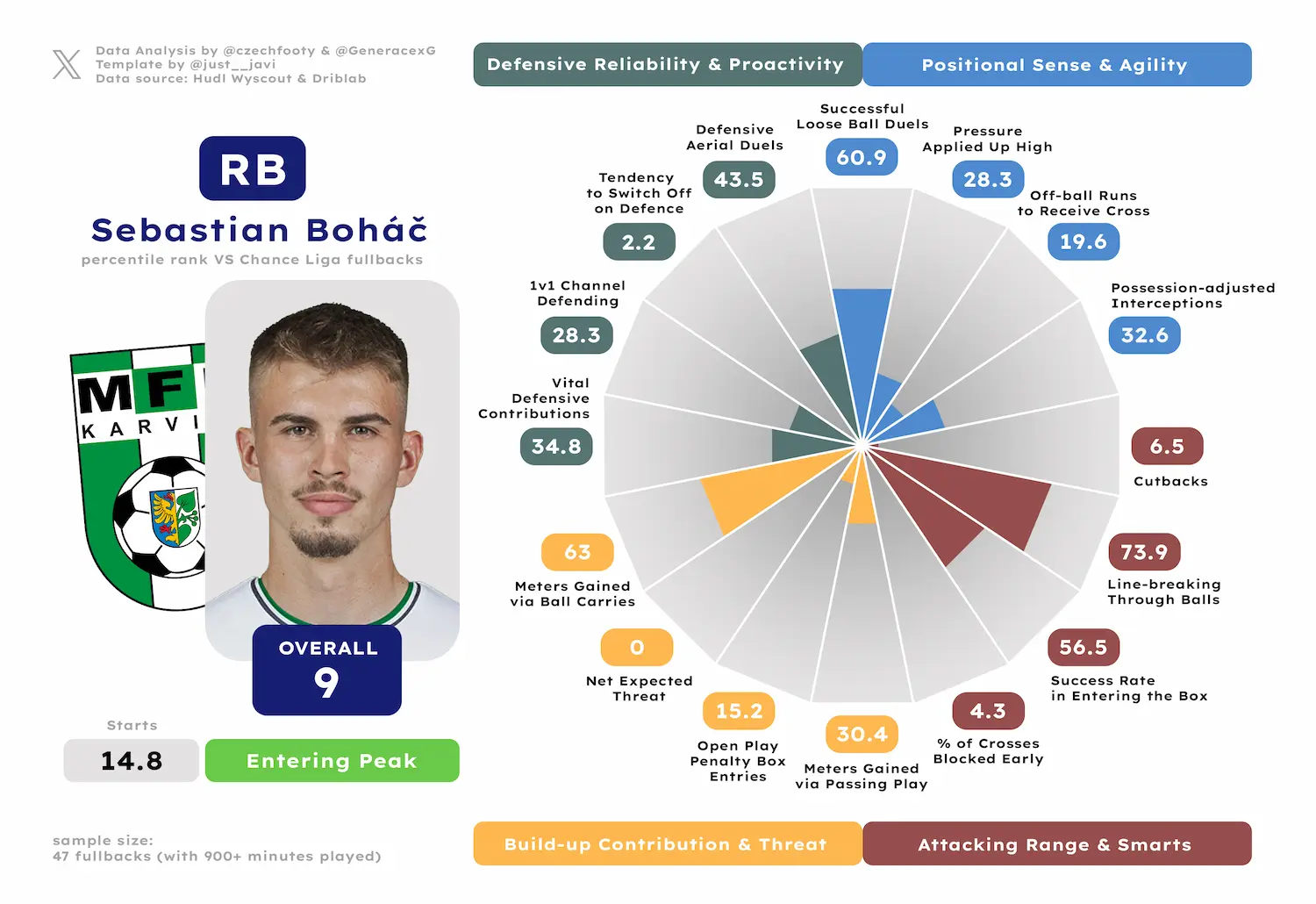
Boháč will likely turn in a heroic shift or two, because that’s what he does best, but in the grand scheme of things, there’s a reason to believe his role may just as well be filled by 19-year-old Zbyněk Paidar of homegrown status. Boháč soon turns 24 and simply is what he is.
Need left to be addressed
Plzeň witnessed it first-hand last year: when Tomáš Ladra isn’t going, he can be a drag, and you’d better be prepared for such an alternative. Ladra’s pizza chart will never completely let you down, since he’s too smart to not produce an array of good-looking stuff, but if you squint a little, you can see a fairly vulnerable picture — above all, the mediocre rates of expected assists and high-danger shots are triggering for someone who was in the 90th+ percentile for both in 24/25. You could argue it’s a case of diminishing opportunity, and it’s true Ladra got largely removed from the set piece duty following Hrošovský’s arrival, but still.
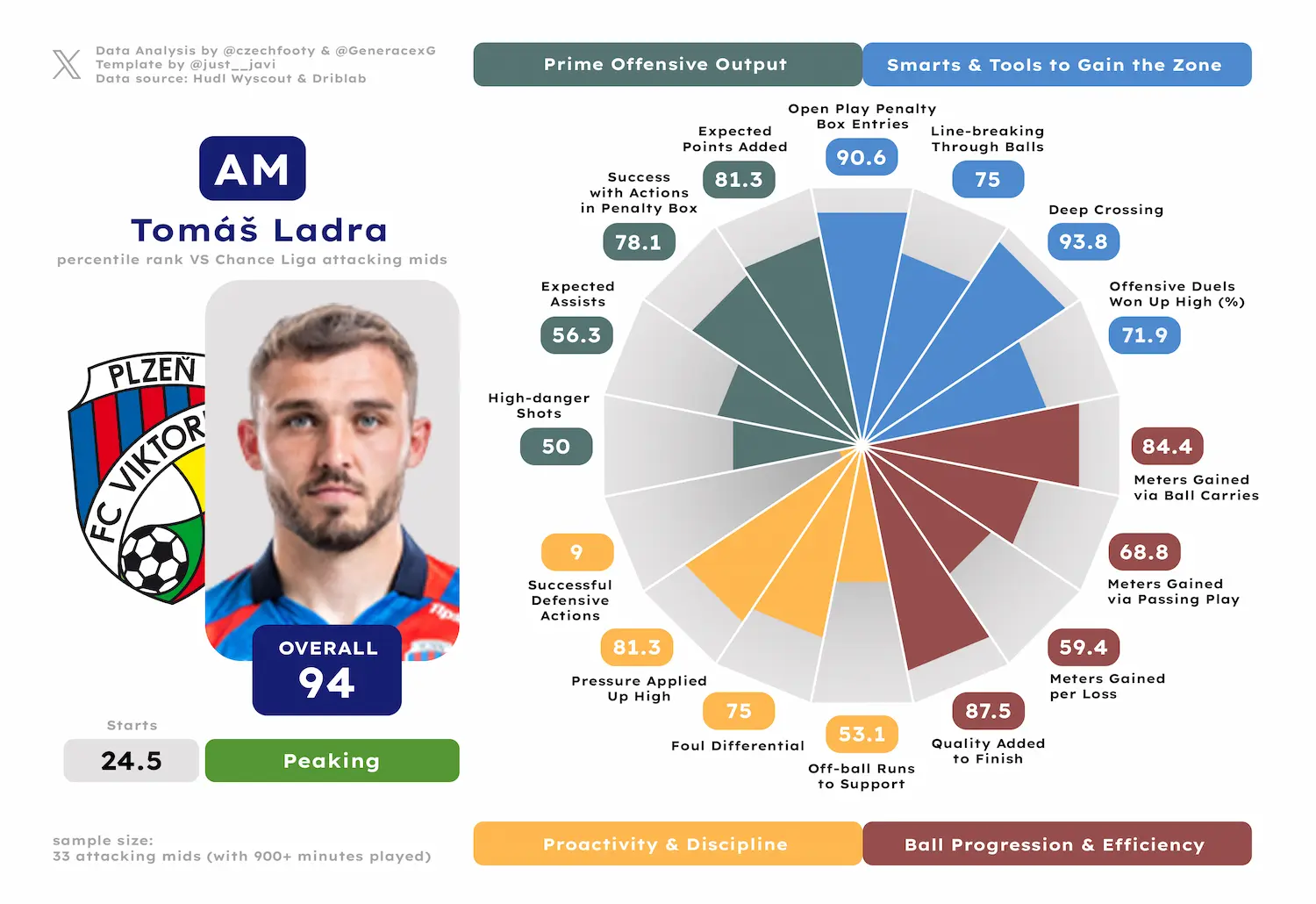
You also don’t need to be too ambitious here in particular. At a minimum, you’d want a proper rival. Not Jiří Maxim Panoš who’s yet to experience a fully healthy month, let alone a genuine breakout. Not the 34yo version of Matěj Vydra, who might be needed further up the line-up.
New kid on the block
One of the possible good things about a World Cup is the free summer preparation slots it potentially opens up for young players, and Viktoria is the best example of that this year. As many as five largely unknown faces showed up at the start of the camp thanks to seven prolonged holidays of senior players, and it was mostly worth it. Filip Růžička (b. 2007) showed some sense of urgency and skill on the wing, securing a second-tier loan at Kladno. Radek Büchner (b. 2007) entered his name in the conversation for a 3rd-choice left back. Adam Novák (b. 2008), who got three assists at U-17 World Cup in 2024, initially didn’t go but eventually showcased his intriguing athletic profile against Young Boys. And finally Jakub Chalupa (b. 2006), the oldest of the bunch we already mentioned as ‘mini Kalvach’ last year, fought so well he features on the officially released A-team roster earlier this week.
In terms of ceiling, this is not the strongest generation, making up for it with positional variety. The high-end quality should come later when the tall sniper Nicolas Chumlen (b. 2009) or intriguing LB profile in Lukáš Linhart (b. 2008) are ready to announce themselves.
Looking ahead to 2026/27
Below is the team’s current depth chart with a maximum of 4 alternatives for one position. The colourful ratings are a static snapshot of the league-wide situation on 21 July, and they are just a playful bit to add flavour to it; the names featured should be relevant to this day. To learn more about my approach to constructing depth charts, with all its limitations, head here.
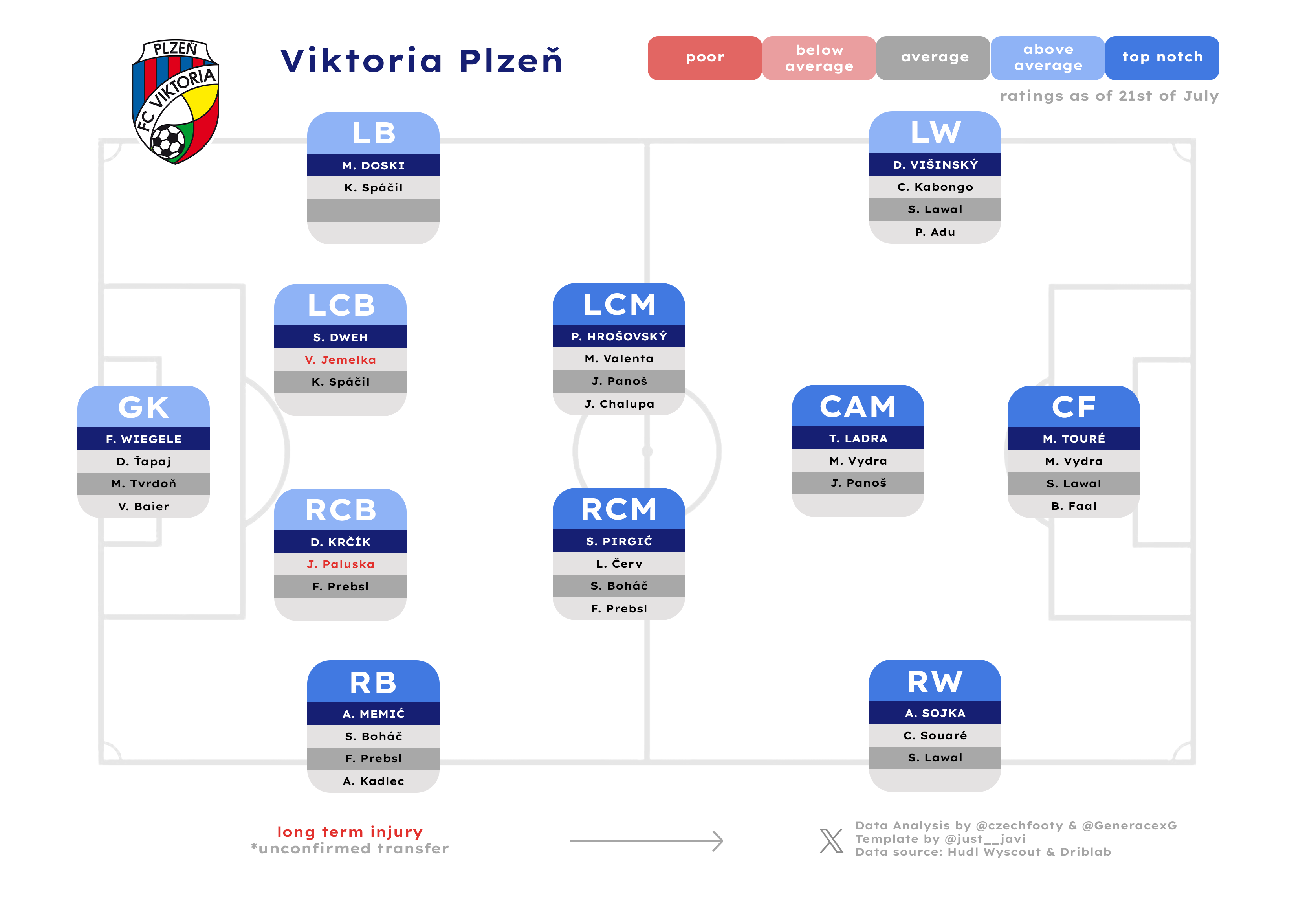
Primary formation
Plzeň also forms a 3ATB3ATB means 3-at-the-back, ie. any formation with three centre backs and wingbacks, or alternatively, five defenders. unit in various phases of the game, but it’ll always come back to this.
Colours I grappled with
Thanks to the unreplaced Kaan Kairinen, Plzeň are holding onto the top notch tag for their double pivot, but only just — and under a couple conditions. Pirgić needs to show he’s got it all in competitive action, too, Červ ideally bounces back, and Hrošovský delays a steep decline after producing a pizza chart split neatly between (top) offence and (poor) defence.
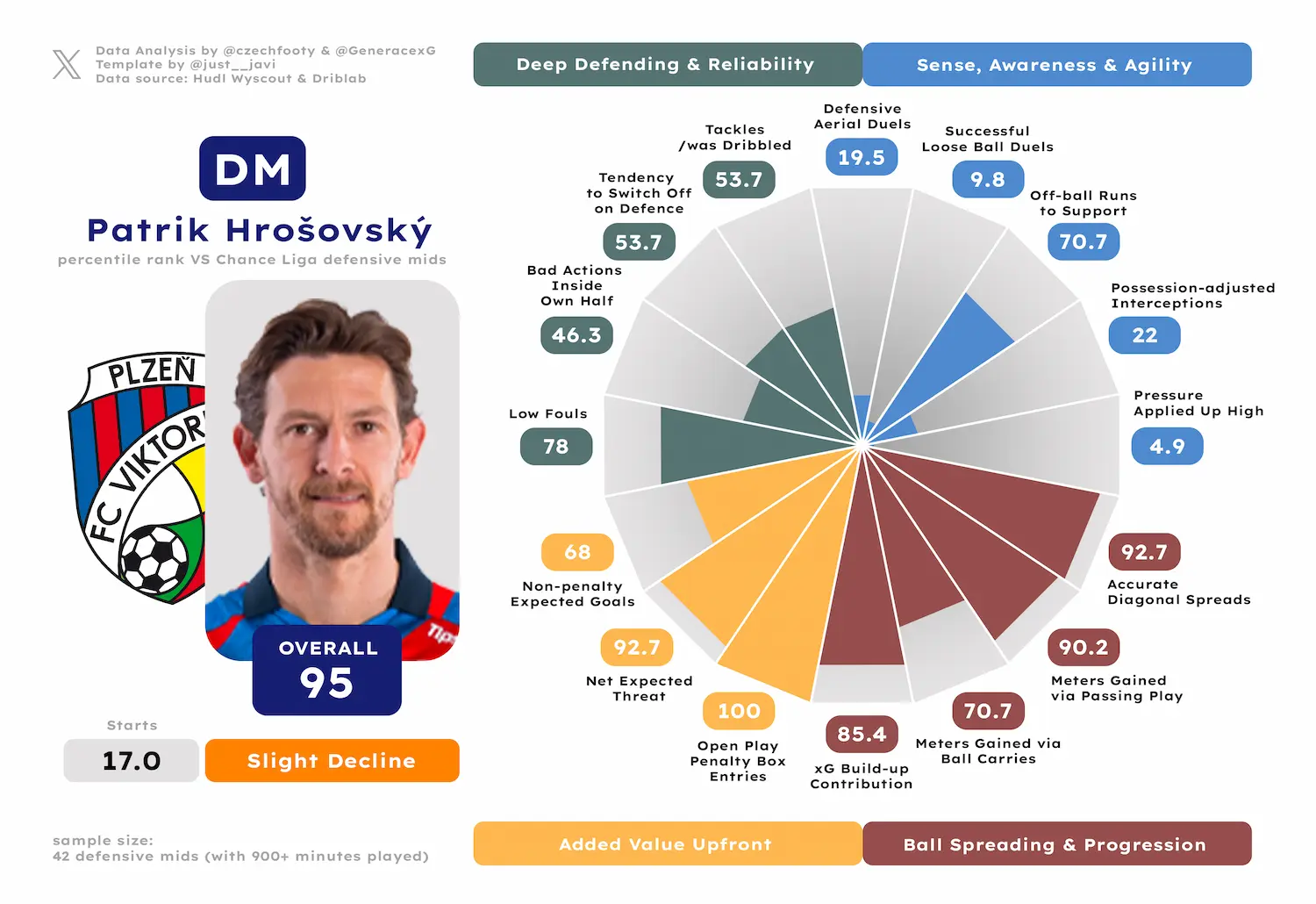
Notes on the depth chart
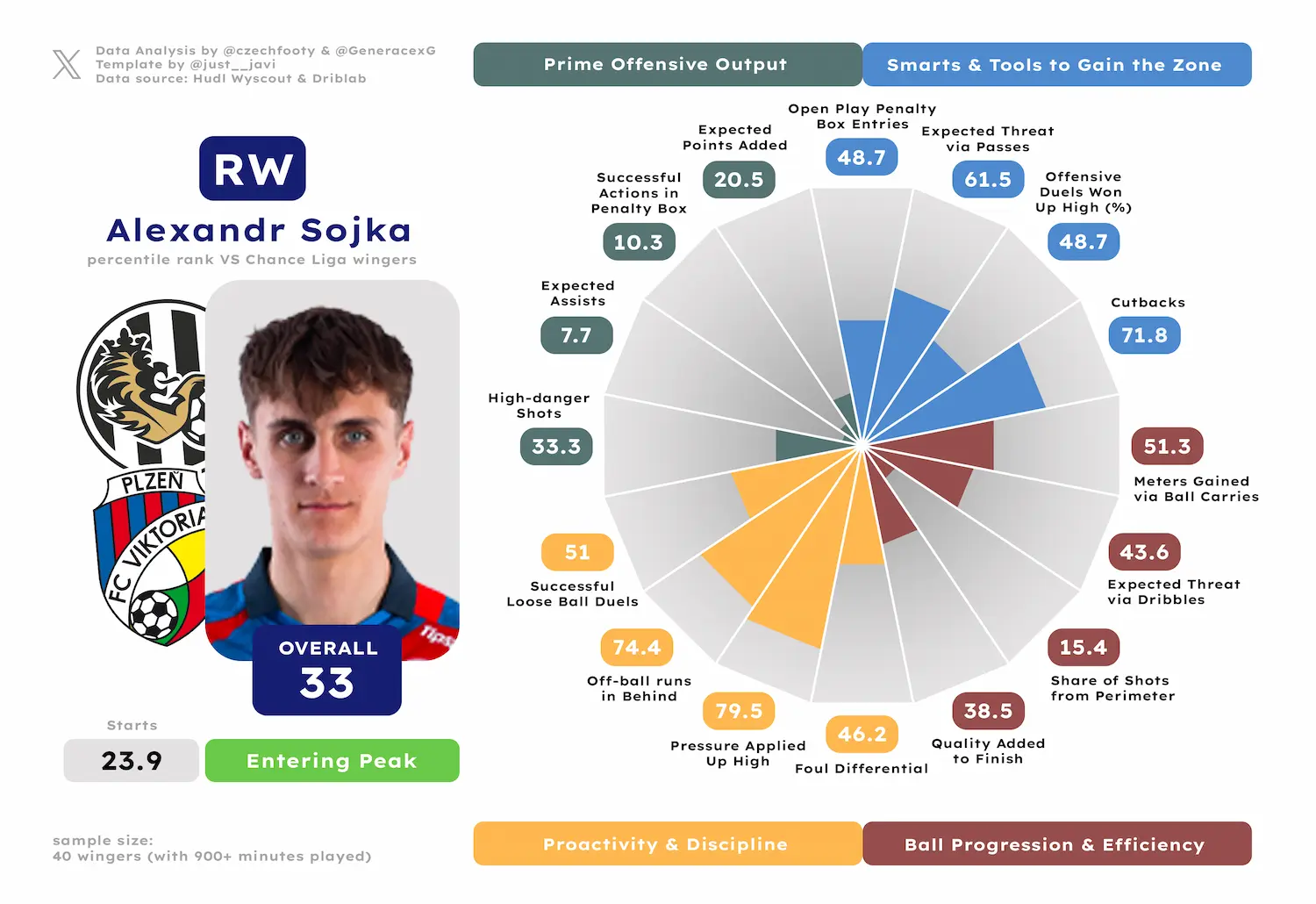
Those still hooked on Saša Sojka hopium may want to look away, as the model will never favour the player type he represents. Spending chunks of the season at LWB in Hradec, Sojka was never going to rank high in “prime offensive output” and he’s not built to progress the play either, but you can still see the dynamic qualities that were obvious anywhere. Give him a stabilizing year at one club, one position and he may reward you with more 60s or 70s.
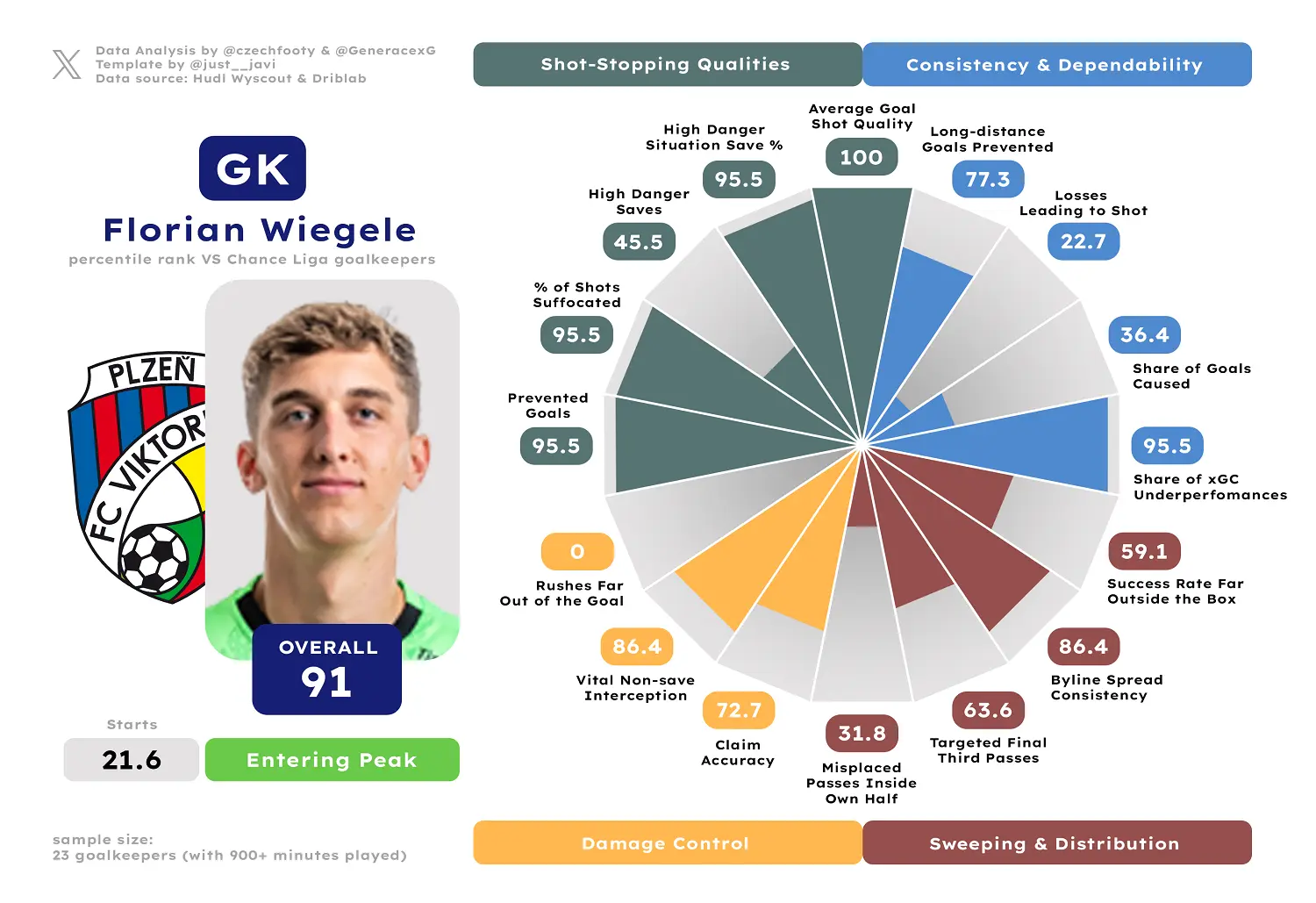
Another major 25/26 breakout, Florian Wiegele eventually managed to turn the summer promise into a firm grip on the coveted no. 1 role. Technically brilliant (see how rarely he allows juicy rebounds) yet majestically tall goalkeepers are extremely hard to find, but potentially very easy to sell for a king’s ransom, so enjoy the big Austrian as long as you can.
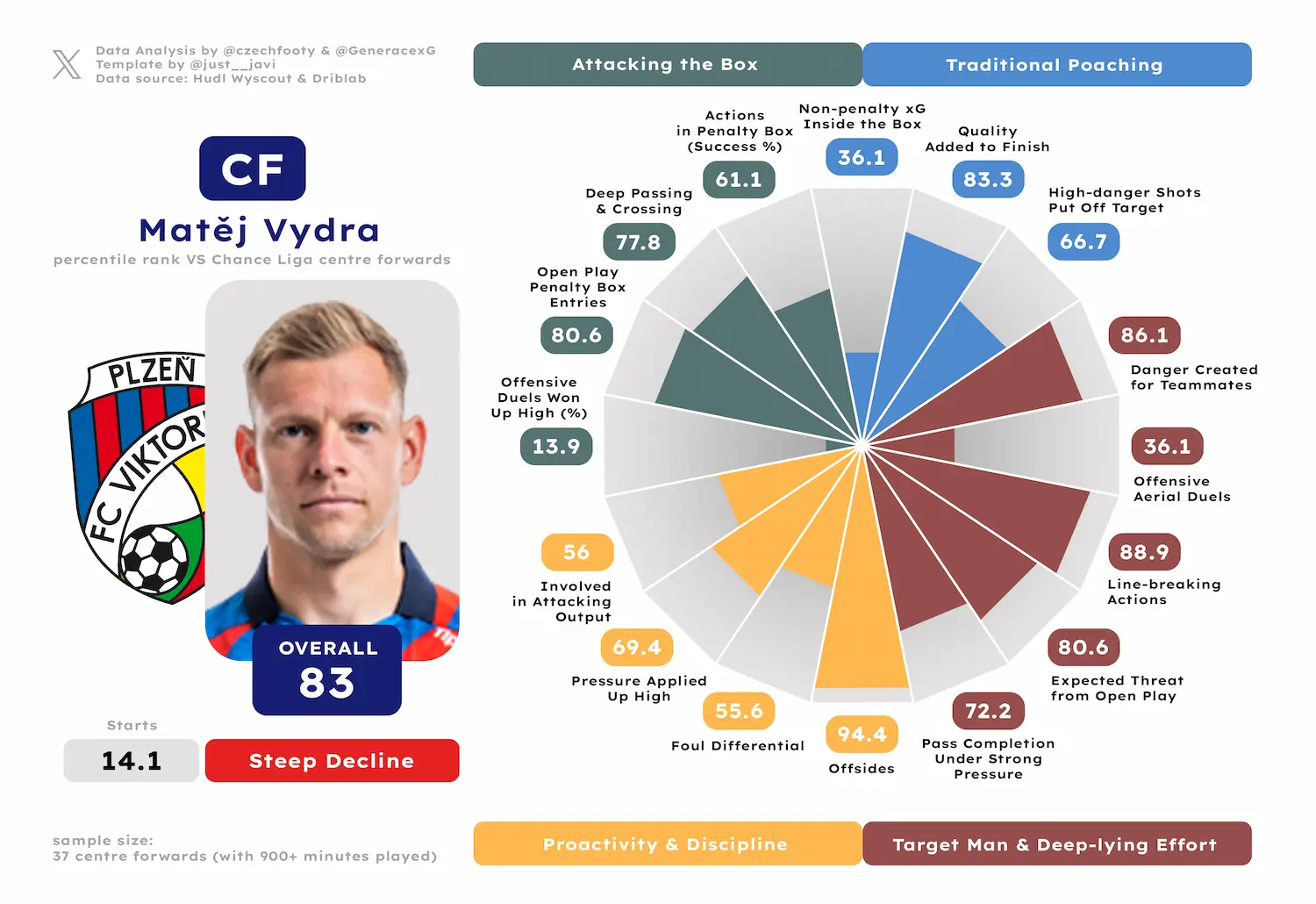
There are those who think Matěj Vydra is going to start most early games at CF ahead of all the recently added foreigners, and maybe it’s not such a bad idea. Even an ageing version of Vydra filled up his pizza chart quite admirably and in all sorts of different ways. He’s a gift.
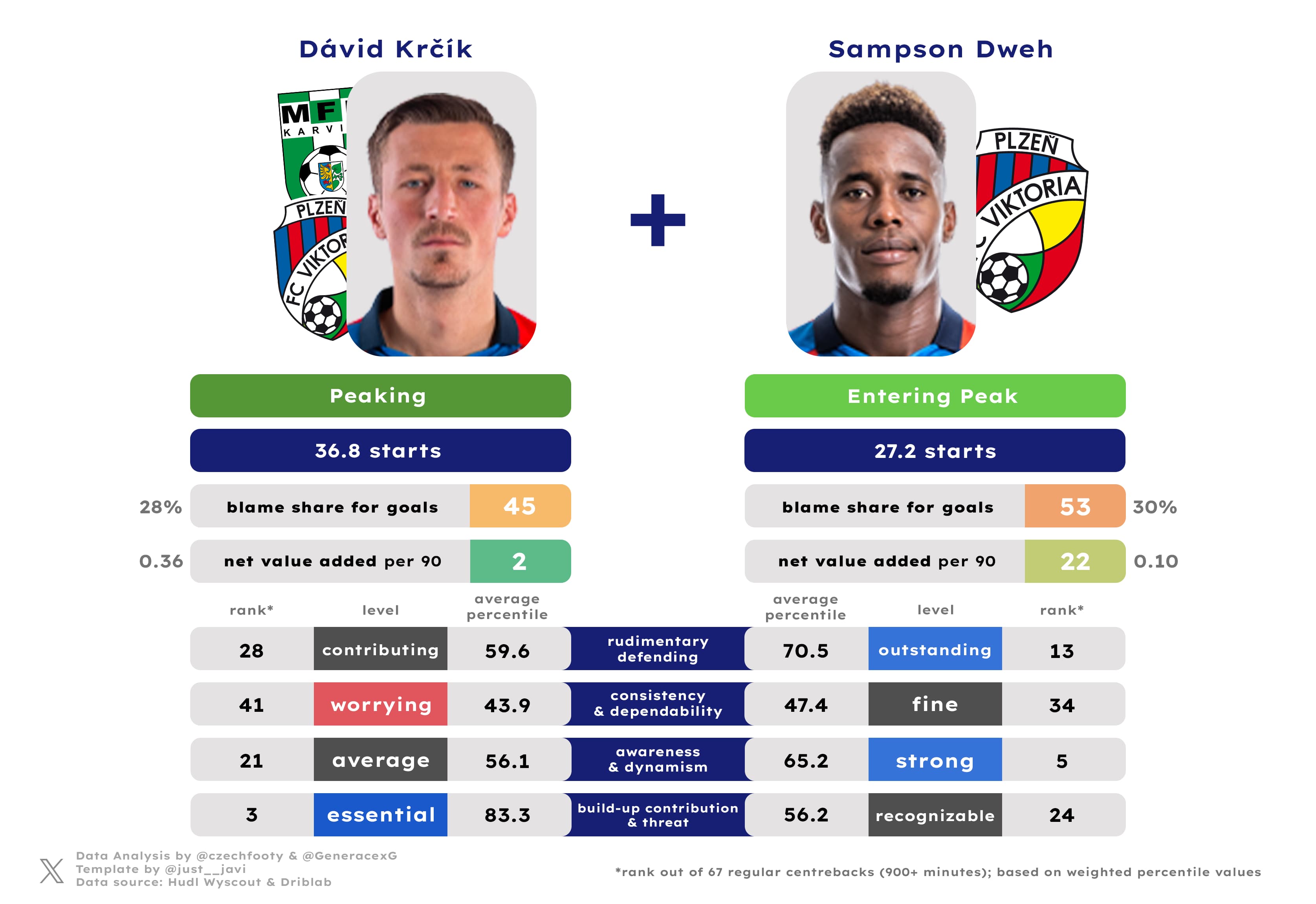
As mentioned, Jemelka and Paluska are still ways off, which puts an extra spotlight on the two unrivalled starters. I wondered last summer whether Plzeň can ever be successful with a volatile CB type like Sampson Dweh, and so they fixed it by adding another inherently flawed, inconsistent dude in Dávid Krčík. What does math say? Two negatives make a positive?
Roster battle to follow
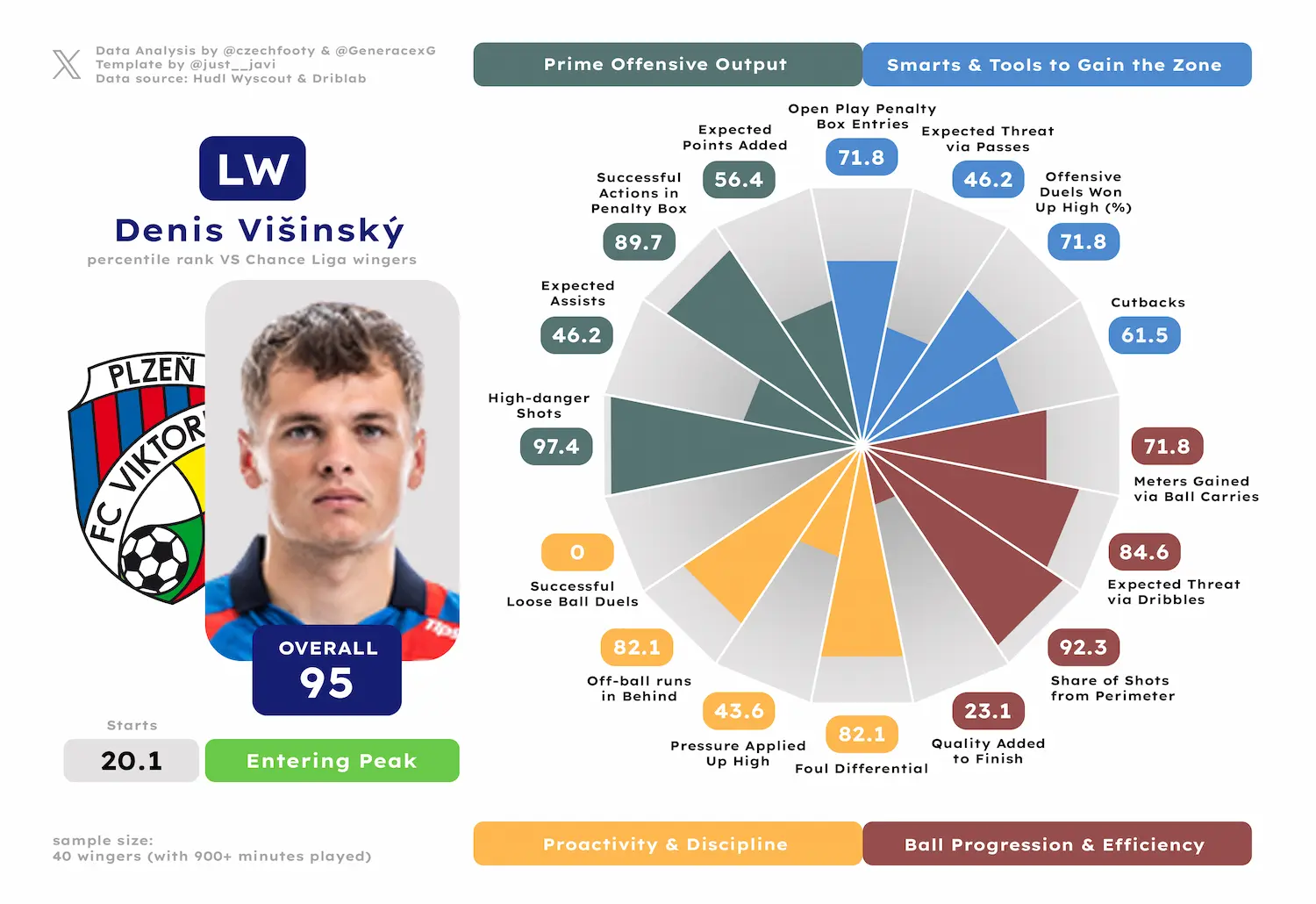
Building on how difficult Adu’s return from a prolonged vacation could be, how about Denis Višinský? He enjoyed not one but two scorching hot runs when he scored on three consecutive shots (!) in August and February. Otherwise, though, it was a season of recognizing his serious limits. Višinský still knows how to get into dangerous positions better than almost anyone in the league, yet apart from ball-carrying and penalty box qualities, there’s nothing potentially transcending on him. Hyský loves him due to his work rate, and fair enough to him, but questions about a potentially upgradeable ceiling will persist.
Besides, Christophe Kabongo finally looks ready to shine. After growing into a deep-lying forward role at Mladá Boleslav, where he contributed beautifully both on the ground and aerially, he won’t be able to replicate the same one-for-one at Plzeň, but could bring those exact qualities to the role of inside left forward of sorts. His off-ball issues are overstated.
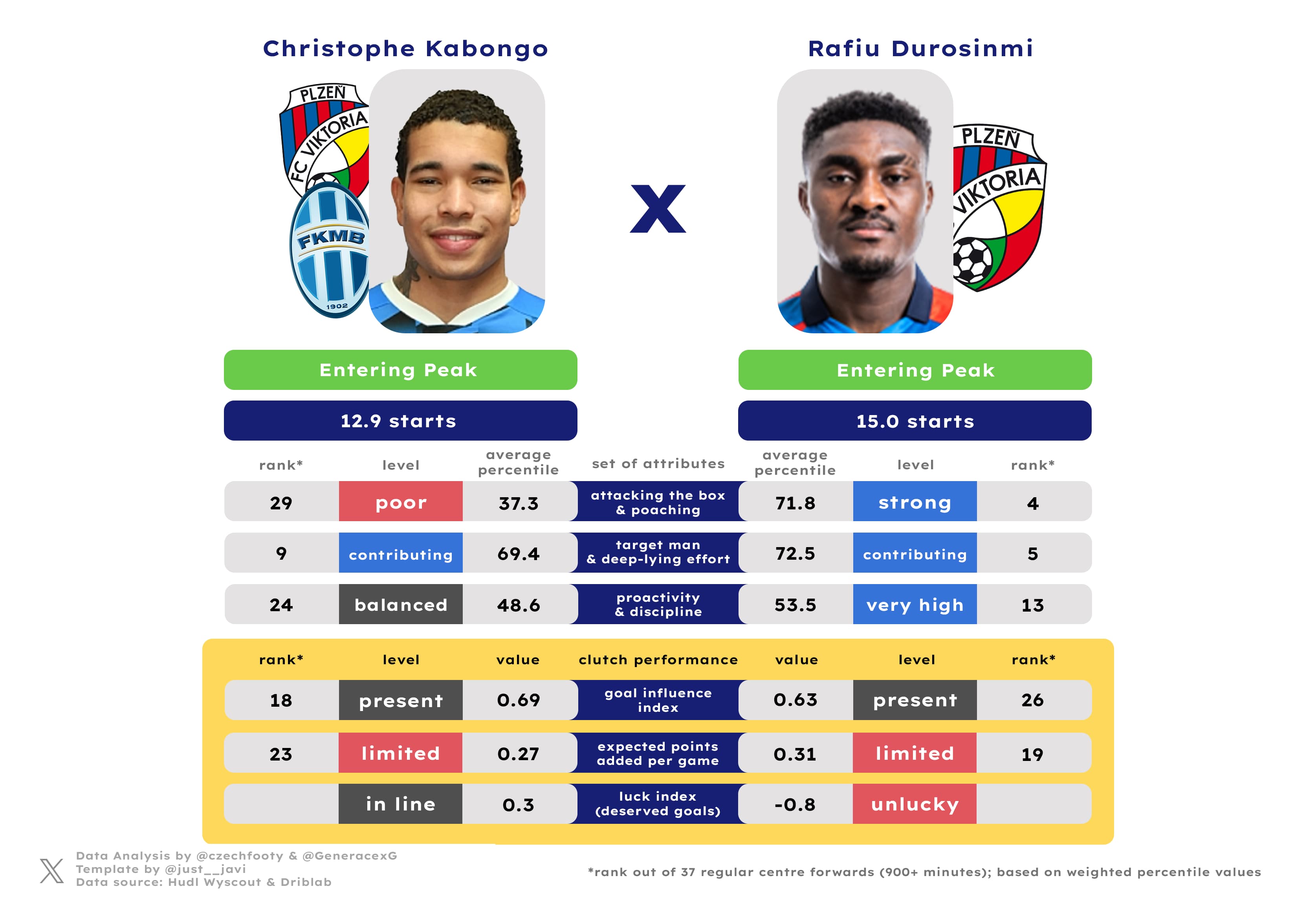
I can’t compare Kabongo to wingers, but I found Durosinmi to be a fascinating pairing. Kabongo grades out much worse at “attacking the box & poaching”, as he still needs to improve on his decision-making both inside the penalty area, and while entering it. This also goes for shot location choices, with his average shot distance one of the longest among CFs.
Season forecast
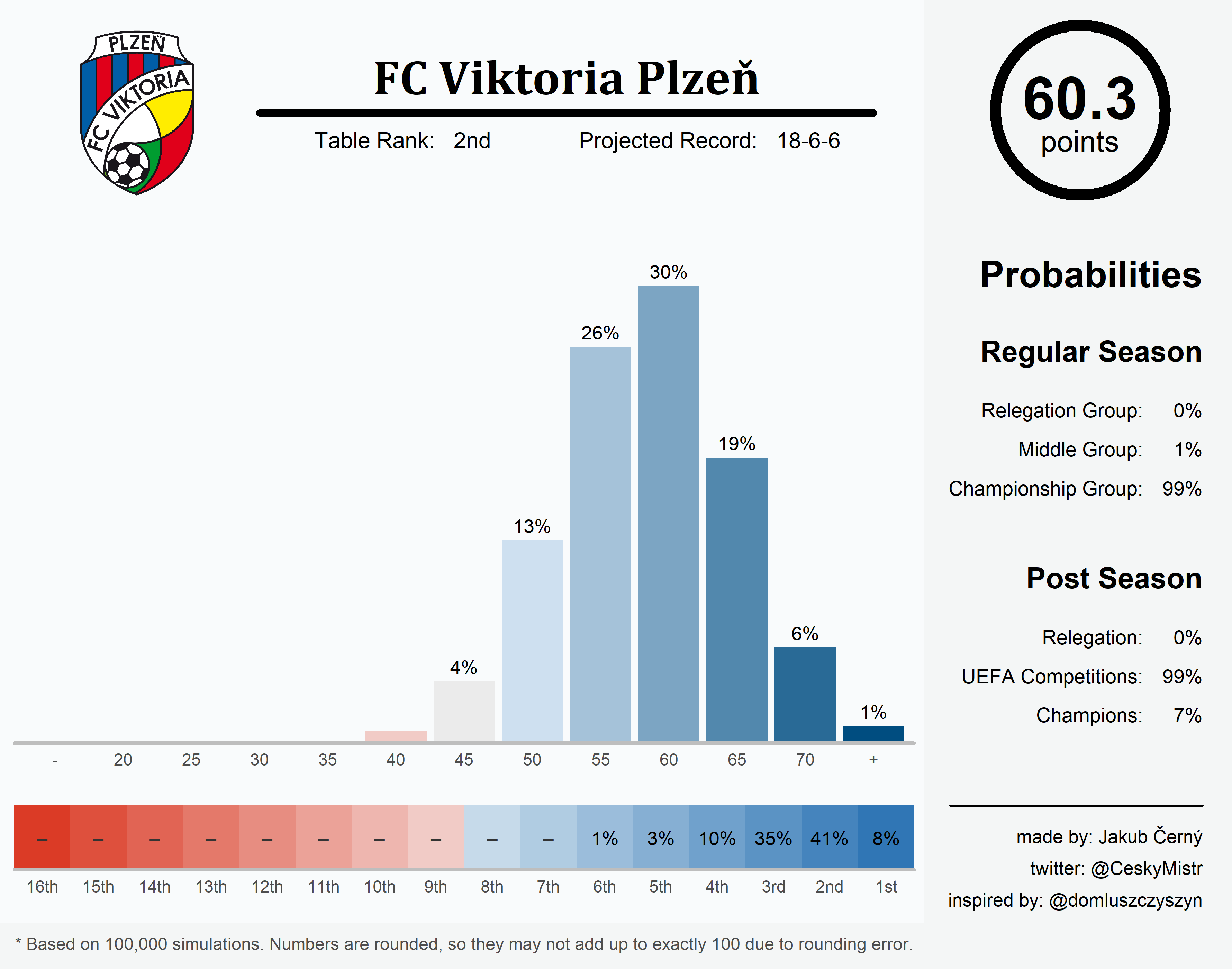
Pretty much exactly like last summer. Back then, Plzeň were projected to just crawl over the 60-point bar with 60.4 and the model was clearly very happy with that forecast despite Viktoria actually underhitting the threshold by a significant seven points. That was, by the way, a timely reminder that meeting the 60-point target, a gold standard of years past, shouldn’t be taken for granted. While Viktoria were equally as far behind the champions as they were in 25/26, they actually did clear the bar in both 23/24 (62) and 24/25 (65).
As for the title aspirations, seven per cent is more than four and two respectively in previous two summers, but this needs to be followed with a caveat that the simulations were run at a time when Sparta found itself between Rrahmani’s departure and Brunes’ arrival. That’s a big deal. Otherwise the Prague club would most certainly be back as our projected runner-up.
Bold prediction
The track record: 0/5. Sixteen set piece goals was only enough for the 3rd place
The prediction: Plzeň will not concede a single league goal beyond the 90th minute
The rationale: The early story of Viktoria’s 25/26, directly causing the shock firing of Miroslav Koubek and even continuing beyond, was their late collapses. In Round 2, Jablonec equalized in the 95th minute. A matchday later, Slovácko took only two minutes less to set up one more 1:1 draw. At the end of September, the trend spilled over to Europe vs Ferencváros, closely followed by the unbelievable 3:3 draw where Plzeň threw away yet another lead — later than before and in man advantage. That was the only league game Marek Bakoš took charge of, and while it’d be quite fitting if Hyský got undone by a huge late collapse himself, I am going to go against the flow (and my better judgment) here, as I often do in this space.
Plzeň conceded a total of four goals in the added time across the last league campaign. Their season average since the pandemic had been exactly two, while their most recent flawless edition was 2017/18 when there were coincidently seven other teams with zero proper late goals conceded. In 25/26, another such anomaly (because it’s quite unusual otherwise), there were five spotless teams including some pretty bad ones like Dukla or Bohemians. Would you try to tell me Plzeň can’t do it when a relegated side can? I bet you would, but I’m stubborn.

Enjoyed it and just want to casually support us with an amount of your choosing? No worries, you can still do that by inviting us for a symbolic pint at the old BuyMeACoffeeBeer page.