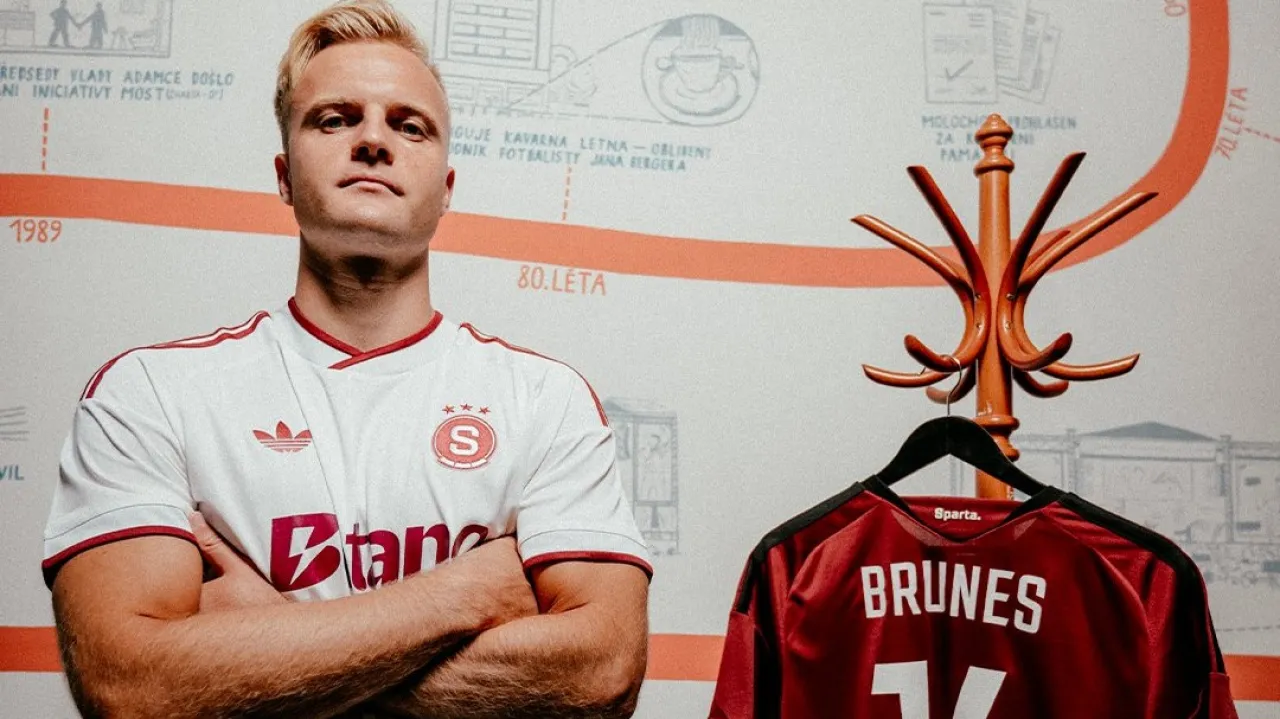
The last two years, it was the same blueprint: a slow summer followed by a flying start to the season, fuelled by a favourable schedule. First, Lars Friis was a newfound genius after winning 7 games out of the first 8 league rounds. Second, Brian Priske returned as a king, winning 6 games out of the first 7. Then, like clockwork, both campaigns derailed in the blink of an eye. This year was supposed to follow the exact same script, only with a dose of mockery from both Tomáš Rosický and Priske towards Sparta’s “overly negative” fans. A bug became a feature. Confidence turned into arrogance. And so, quite naturally, patience quickly gave way to panic when the first loss suddenly came far earlier than Round 8 or 9…
The thing about playing a waiting game with transfers is that you can’t possibly have a neglected squad in the first place. When you spend window after window not addressing obvious needs, like Sparta did at centre back and full back, you keep chipping away at something that increasingly resembles a stump of a squad. If you then treat that same squad, unapologetically, as though it could use a boost or two without really needing one, you are begging for trouble. And sure enough, Sparta are now in trouble. No season is ever made or lost in the first round, but it can certainly make an entire summer look misguided. Like here.
Guidance, meanwhile, is something Sparta should not be missing. Rosický has recovered, and after his brother Jiří left his role as chief scout, the department is now presumably in the steadier hands of either Martin Petráš or Václav Černý Sr., father of the recently retired international — depending on who you ask, as such information is never publicly disclosed.
One area where Sparta are well covered, however, is stadium development, with genuine momentum to report on both fronts. In May, plans to build a new 5,000-seat stadium for the men’s reserve team and the women’s first team were approved. After dropping into the third tier and surrendering their temporary Žižkov base to their arch-rivals, Sparta “B” are finally set to get a permanent home in Krč. As for a new 35,000-seat arena for the men’s first team, the club is still working its way through the necessary bureaucratic procedures on a generous 7-year timeline, though supporters were particularly encouraged to see Prague Public Transport Company’s latest projections include a tram line all the way to Strahov.
There is also hope Sparta can win their increasingly lethargic fanbase back, with Ondřej Kasík assuming a more secondary role after years as the public face of the club’s frustrating opacity, and Lukáš Pečeně returning to Sparta for a second stint, now as Head of Content, to let his tremendous creativity shine through once more. Pečeně first left his boyhood club just before it embarked on its long-overdue title run in 2022. Now he’s hoping that lightning strikes twice — only in reverse — after two years of predominantly disappointing results.
Looking back on 2025/26
What went right
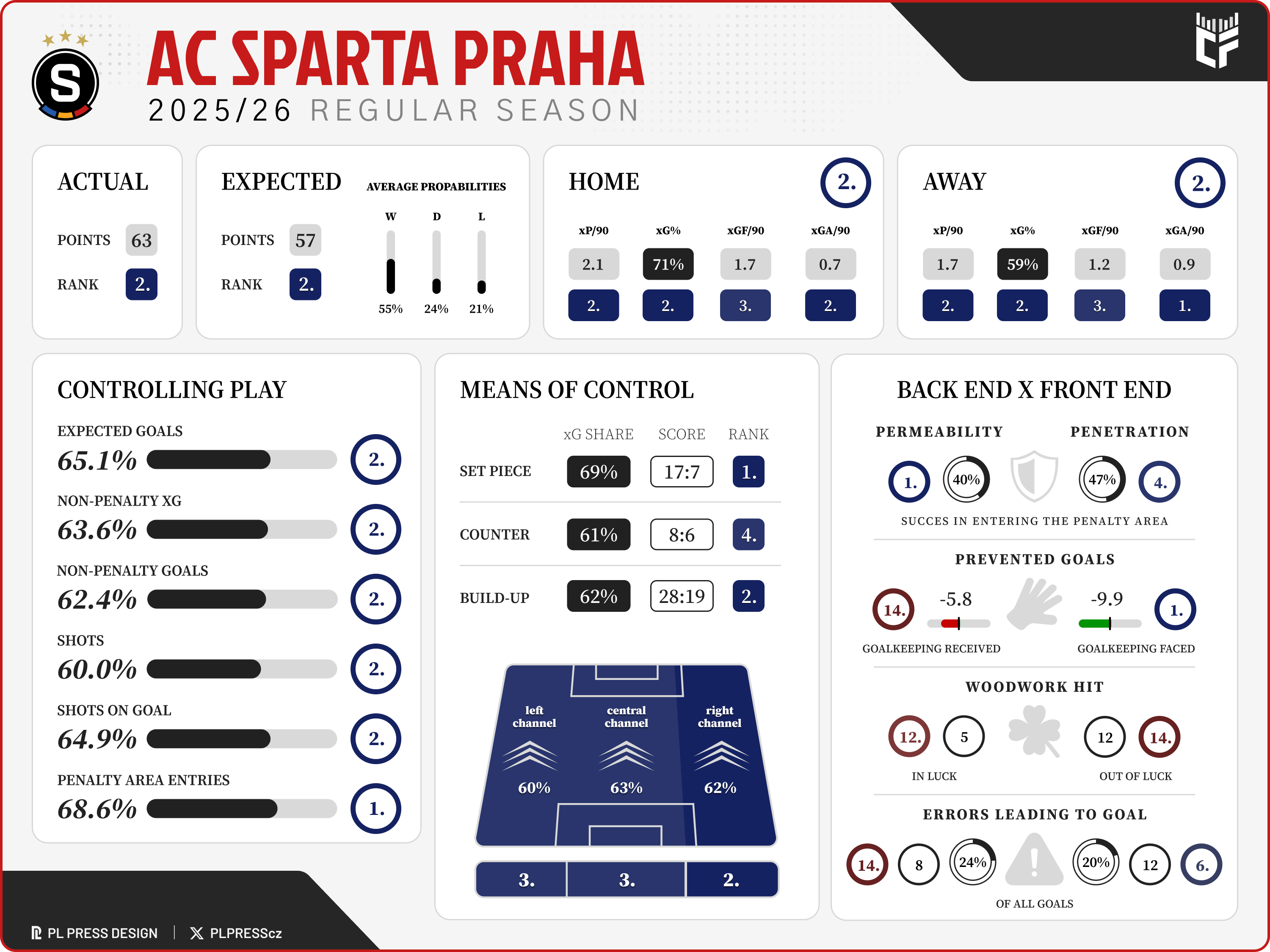
After appearing a bit too vulnerable in their own backyard in 24/25, this past season saw Sparta return as the set piece kings, owning a league-leading xG share (69%) and an impressive score of 20:8 after everything was said and done. Even with Slavia catching up frantically towards the end, there was simply no match for Sparta — a first for Priske’s Sparta.
The Danish tactician also largely found the cure for Friis’ Sparta’s major ailment: all sorts of penetration-related decline. In 24/25, Sparta barely fit inside the Top 4 in team metrics such as open-play box entries or deep completions, faring even worse (9th) in success rate while entering the penalty area. This time, Sparta were back as runners-up across the board.
What went wrong
It was that kind of season when even the good moments couldn’t help but leave a bitter taste in the mouth. Like Sparta’s first 4-game streak of clean sheets to open the spring since 1998, that left them trailing Slavia by seven points instead of five. Or like Priske’s finest tactical derby performance, which still saw a 2:1 lead overturned for good in a matter of seconds.
Perhaps most damningly, though, Priske proved utterly incapable of preventing Sparta from becoming too predictable and stale in possession. Compared to 24/25, Sparta completed an extra seven passes before each shot, only finishing off 27.6% positional attacks (6th-most in the league) after being the most efficient outfit in this sense under Friis (29.6%). Who knows how their 25/26 campaign would’ve turned out had it not been for their absolutely ruthless finishing to open the season (an insane 46% of all shots directed on goal through Round 10), and the opposing goalkeepers tripping over each other to make it easier on Sparta (15 weak goalkeeping performances of 0.3+ goals allowed above expected, compared to 4 solid ones).
At least Priske was aware and working on a fix, which I’m sure paid immediate dividends.
Most valuable player
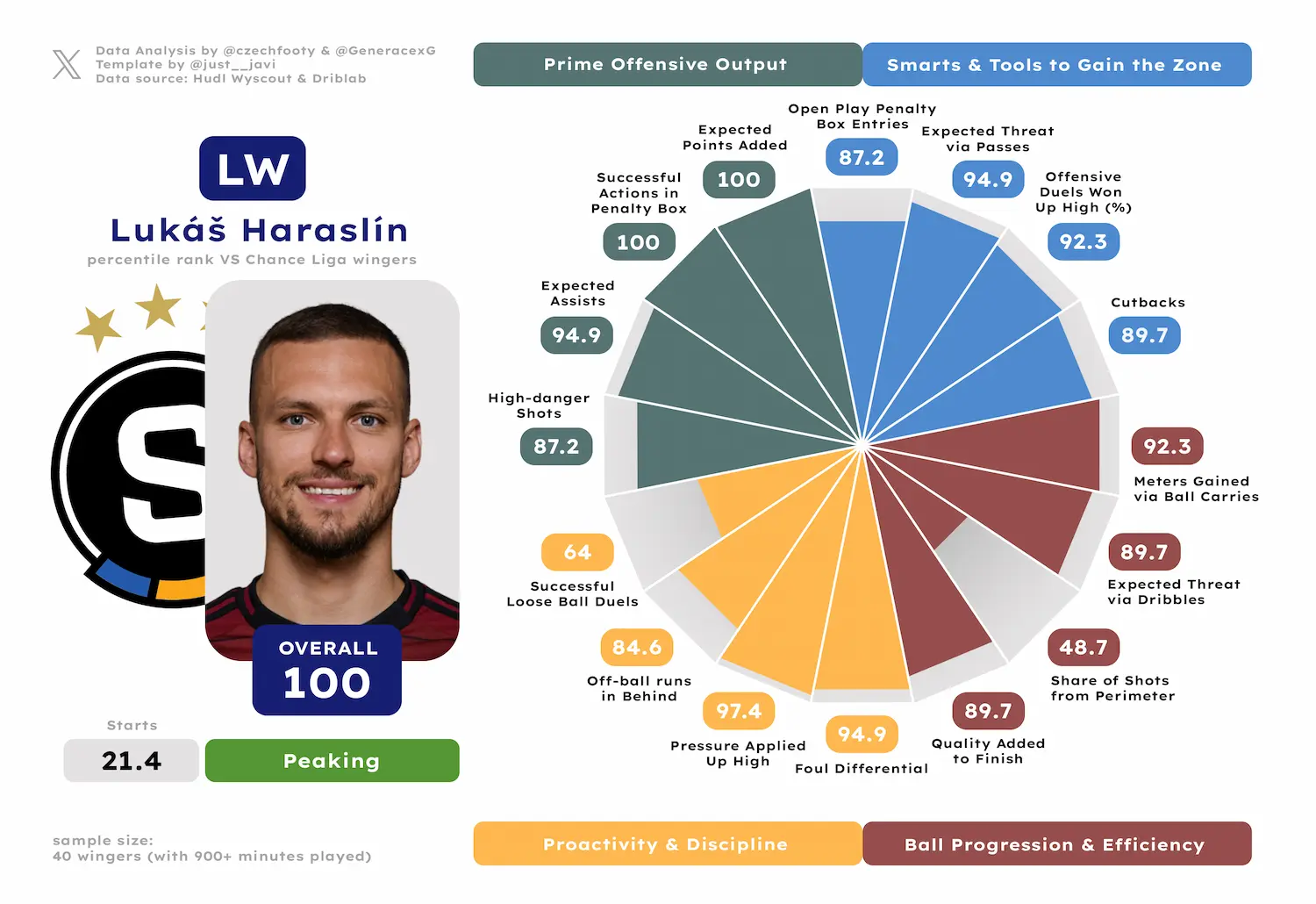
Per my MVP model (traditional stats): Lukáš Haraslín (ranked 1st league-wide)
Per my positional models (advanced stats): Lukáš Haraslín (100th overall percentile at W)
Here’s one thing I realized about Lukáš Haraslín: he might be the first non-striker in Sparta’s post-war history to have hit double digits for goals three years in a row. Ivan Hašek had his three such campaigns divided by a four-goal one. Guélor Kanga was let go at the end of his second such season. And even if you consider Andrej Kvašňák to be a midfielder rather than a forward, he was at the doorstep of a decline when he registered his back-to-back effort. Already scoring at a higher rate than ‘Bomber’ Skuhravý or Lokvenc (one every 172 minutes), the captain should soon notch his 50th non-penalty goal in Sparta’s maroon (9 away). Remarkably, Lafata remains the only player to have reached the milestone in this century.
Why am I bothering you with so much history? For one, because it’s time to seriously talk about Haraslín belonging to Sparta’s modern-day pantheon. But also because… what else am I supposed to tell you here? That he was the best out-and-out winger in the league by a mile?
You already knew that, didn’t you?
Chip on the shoulder
Last summer, I talked extensively about Albion Rrahmani in this space, and it’s tempting to go back to this position, while three guys with a sizeable chip on the shoulder scramble to replace him. First up, Jan Kuchta’s enormous motivation stems from the wild rollercoaster ride of the past few weeks: from third-choice afterthought to clear-cut starter who forced his way into the World Cup conversation at the eleventh hour, only to find himself back as a second- or third-choice option again. He was nothing special individually, notably down in defensive actions and high recoveries, but involved in 59.5% of goals scored with him around.
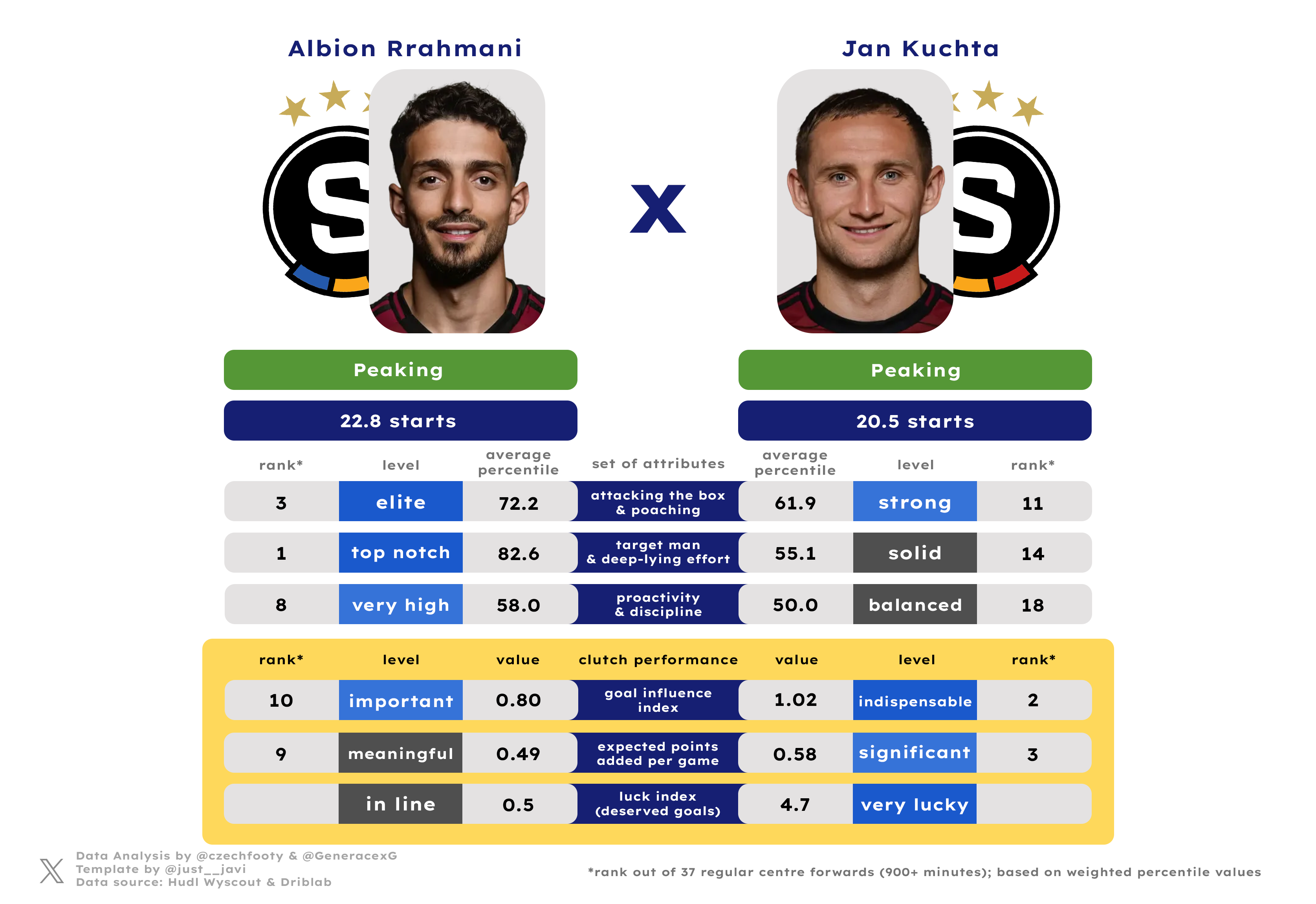
Two areas where Kuchta still offers invaluable presence: off-ball runs to receive a cross in the box (1.07 per game; third most) and especially off-ball runs behind the line (8.04 per game; easily the most). This is where the young gun, Matyáš Vojta, will never be able to catch up but here’s hoping he could grow into Rrahmani’s heir apparent, eventually lifting his deep-lying effort higher. Selfless team play is already his calling card, but not enough to compensate for his drastically worsened finishing game. I am still a big believer in his upside.
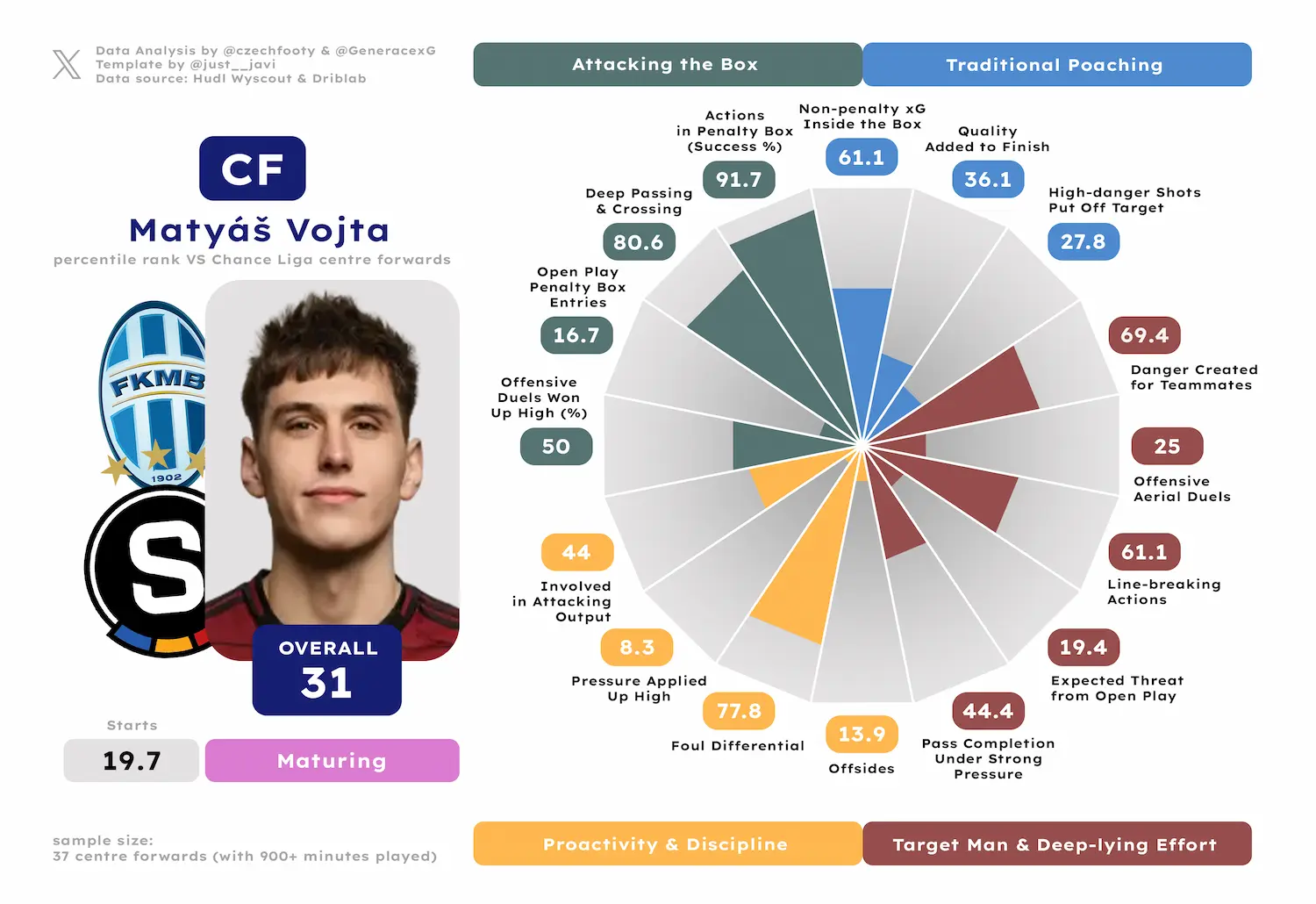
That being said, how could Vojta possibly rival Jonatan Braut Brunes, frequently called by supporters the very best striker in Raków’s history despite only spending two seasons (of 30 league tallies) there? Carrying a compelling set of genes and varied finishing skill, Haaland’s cousin will get every chance to justify his record 6-million pricetag even if he initially struggles to open his Prague stint. While some cheekily point to Marco Paixão as the precedent, it’s best to remember Ekstraklasa was a very different place to be at 10 years ago, and he was then a one-hit wonder bought on the back of a six-goal campaign. Brunes scored nearly as often in 2025/26 Conference League alone (5) last year; he’s on a different planet.
Still, the pressure is on. And if Rrahmani could’ve left uncelebrated, so can the Norwegian.
Inside the off-season
special thanks for guiding me through the motions of AC Sparta Praha’s off-season go out to @drax1893_, @VencaJares, @martin2121h, @vitastudlar , Jakub Křižanovský & Jakub Hůrka
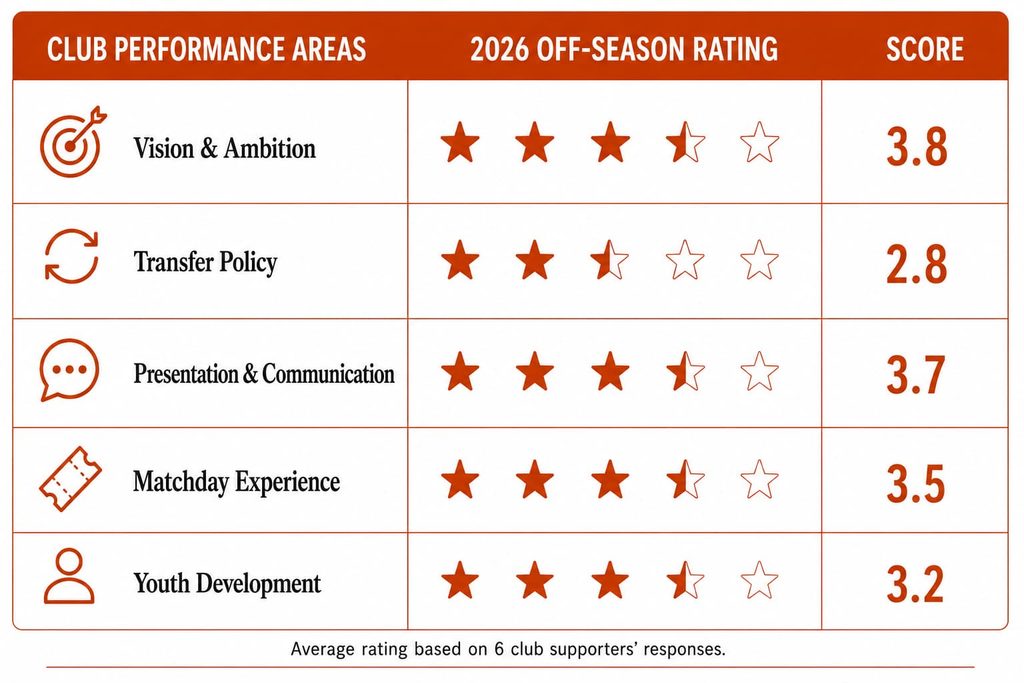
Squad turnover
At the time of writing, Asger Sørensen still belongs on Sparta’s roster, though his head is gone per Priske who didn’t use him in the opener for that exact reason. That makes him gone in my spreadsheet, too, and so Sparta are losing a third member of their most utilized eleven after Rrahmani (5th) and Kaan Kairinen, the 12th busiest footballer in Chance Liga. Throw in Peter Vindahl, and Sparta could now spend months without their entire Top 3. Add in Patrik Vydra, who narrowly checks in at 11th, and they are entering the season with 42.2% of all 25/26 playing time wiped off just like that. Only Bohemians would be worse off.
Biggest upgrade
When Sparta announced Ebrima Singhateh as their first summer signing, it wasn’t even summer yet. Back in April, those few who didn’t immediately flip were split into two groups. The glass half-empty bunch saw, at least, a solid depth addition closer to Sparta’s calibre than the big domestic moves of summer 2025 like Dominik Hollý or Kevin-Prince Milla. The glass half-full bunch saw, at the very best, Haraslín’s younger clone and his perfect deputy.
Neither of them imagined that he would end up being the biggest upgrade thus far.
Brunes can’t really claim that tag because he’s replacing Rrahmani. Even the biggest Adam Karabec believer can’t make that argument, because in a 4-3-3, he’s taking up Kairinen’s spot. And as for Josimar Alcócer, he’s unfortunate to have this preview out only after his debut.
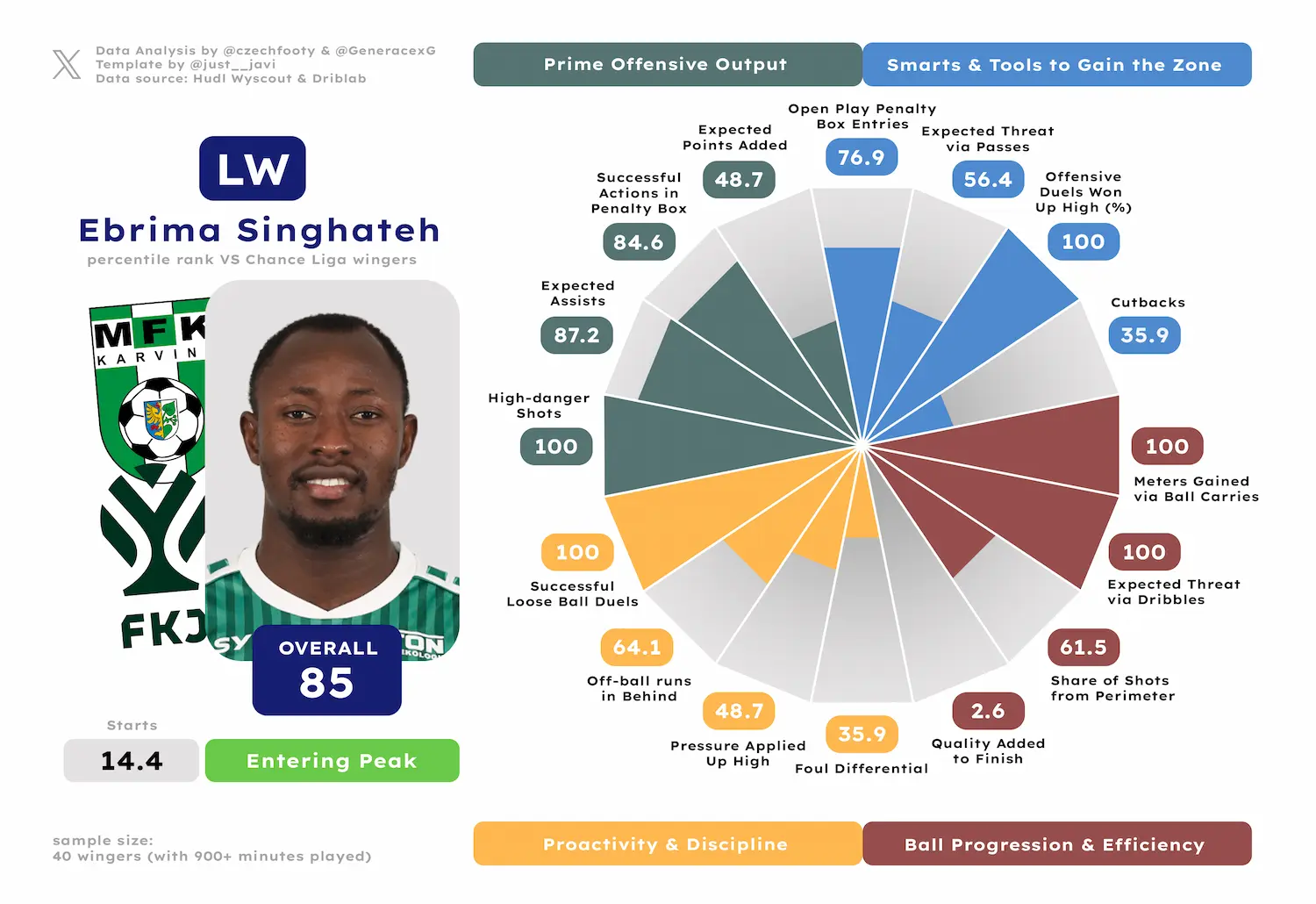
Now in all seriousness, though: Singhateh’s credentials are no joke.
The combination of percentile values for high-danger shots (top) and quality added to finish (second-worst) is scary, but so is the combination of 1v1 acumen (top) with the expected assist rate — this time in a good way. Some of this is a by-product of a rather small sample, but when you’re gaining almost 130 meters per game via ball carries alone (while Haraslín gets you 88), while also making the sixth-most off-ball runs into the box to receive a cross (which Haraslín almost never does), you are an alternative weapon with a capital W.
Biggest downgrade
Multiplied by Sparta’s non-existent attempt to replace him and the protracted absences of two top alternatives, the immediate effect of Kaan Kairinen‘s departure cannot be compared to that of any other summer exit. Considering the club’s resources, it’s also the least explicable development of all. Maybe if this was a 24/25 version of Kairinen. Maybe. But now you’re missing out on arguably the most pronounced bounce-back story of the season, with the Finn improving defensively, regaining his signature swagger on the ball, and serving up some underrated bonus content like high pressures or supporting runs, including underlaps.
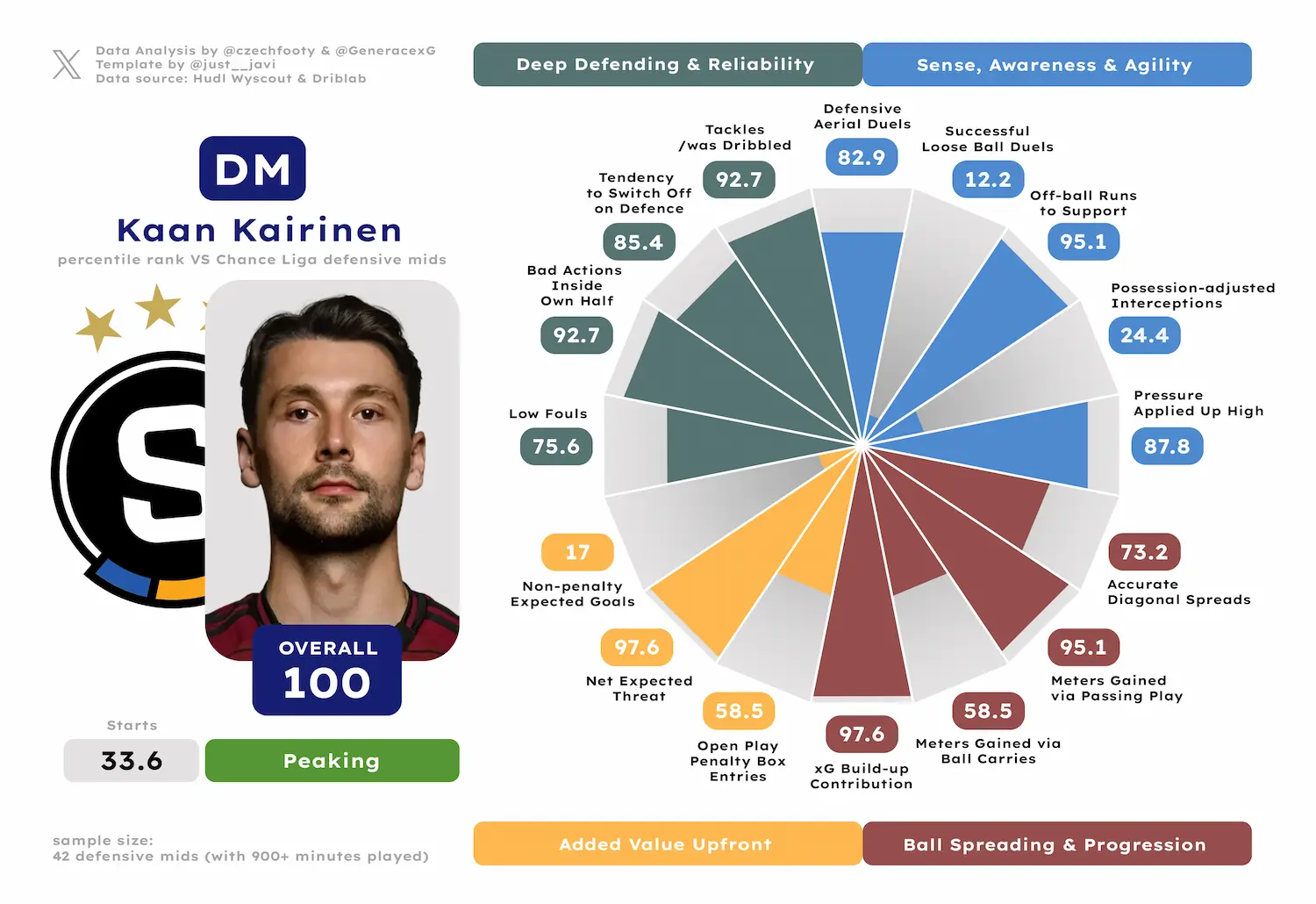
To be fair to Sparta, planning to absorb this loss through Vydra isn’t the worst idea in the world. Albeit far less stoic/assured on the ball, and far more exploitable in duels, he does appear to be a baby Kairinen in more than a couple of ways. But Vydra underwent an ankle surgery, probably planned weeks in advance, a long twenty days ago. In a month, it will be a full year since Magnus Kofod Andersen — another reasonable alternative, at least on paper — last suited up for Sparta, and he too doesn’t appear to be nearing a return to the fold.
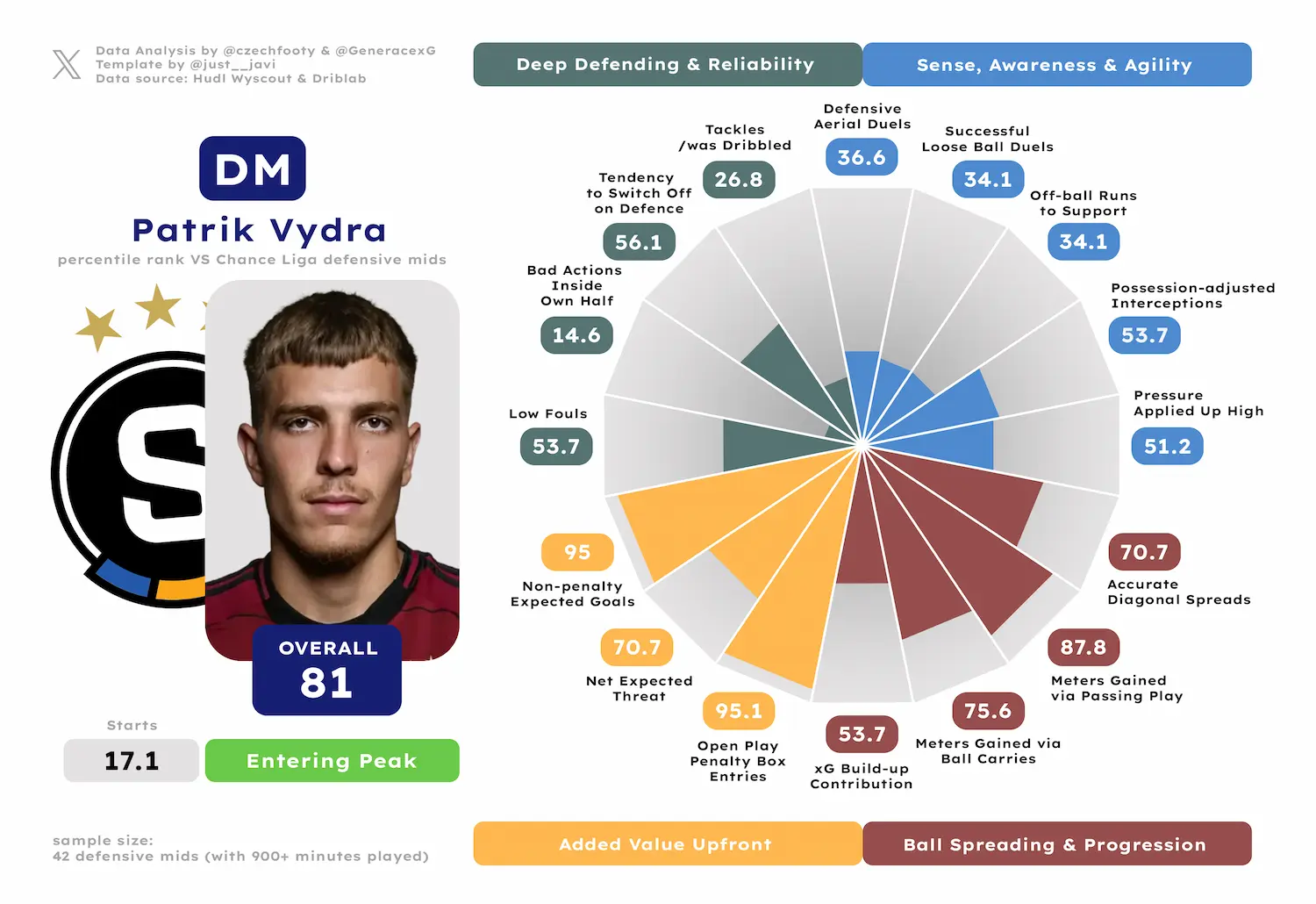
In a situation where Slavia likely never stumbles for long, Sparta are actively setting themselves up for exactly that — through sheer unwillingness to react quickly or, worse yet, in the anticipation of a move roughly 24 months in the making. Arrogance or ignorance?
Need left to be addressed
There are two different lenses through which to view the right back position as problematic, and I’m honestly not sure which one is the bigger deal. Let’s start with the obvious one:
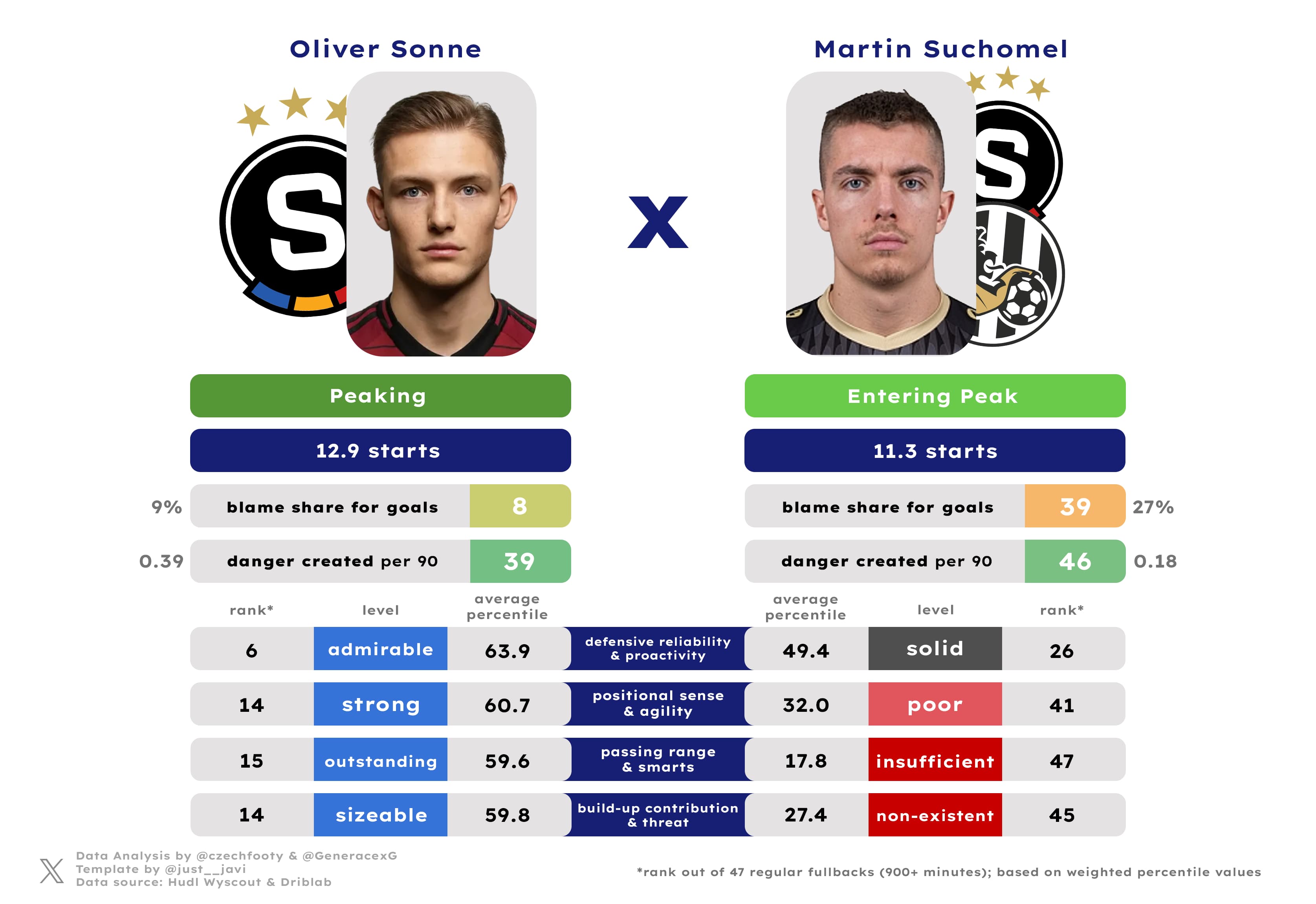
Now, what’s worse than employing one black hole of a fullback in attacking terms? Employing two. You think that sounds harsh to Pavel Kadeřábek? If you stopped watching in September, perhaps. But there was a good reason why Sonne outmuscled the fan favourite for playing time in 2026 — age comes for everyone, and by then it had already made itself at home on Kadeřábek’s couch. The veteran showed some serious signs of physical decline, which was always going to be huge given his profile at the peak of his powers, and while he remained a smart crosser till the very end, he only created danger that way seven times.
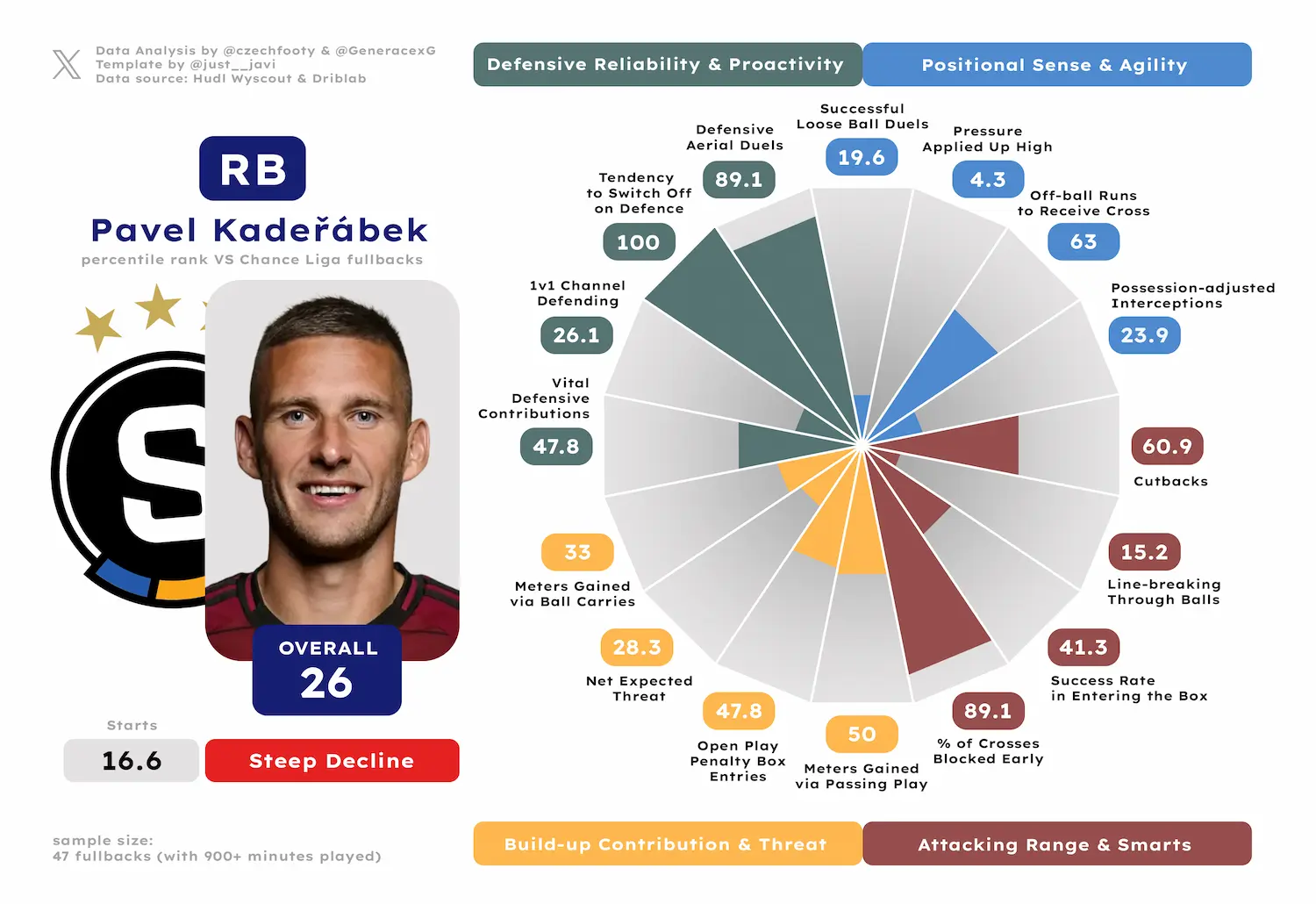
It’s ironic when you think about it: Rosický is accused of being too fond of a homegrown talent who’s nowhere near Sparta’s optimal level. When, in fact, he’s too fond of two.
New kid on the block
Rather fittingly, it was an exclusively Czech cast of new kids on the block up until last year. Adam Gabriel, Matěj Ryneš (with Vydra mentioned), Ondřej Kukučka, Roman Mokrovics. Then I broke the pattern with Ivan Mensah and despite all the noise around Hugo Sochůrek, it’s oddly hard to go back to a homegrown name. Vojtěch Hranoš and Daniel Rus of the once-famed 2006 birth year are both gone, already on permanent transfers, while injury-prone Mokrovics opens yet another season with the reserve team. Kids one year younger are collectively even more cursed: Víťa has counted five ACL injuries among them; a pair already halting the progress of Ondřej Penxa. The 2008s will arguably be the hardest hit by B-team’s thoroughly avoidable relegation to ČFL, with centre back Maxim Kotíšek or tall right back Jonáš Topič now about to pick up considerably less relevant senior experience. Lewis Azaka and Sebastian Pech (b. 2009) travelled to the training camp, but their primary positions overlap with some of the more crowded positions, so it might be a little too soon for both.
One new name blocking Sebastian Pech at left centre back potentially: Viktor Vitályos (b. 2007). Easily the more impressive of the two young Hungarians recently snapped up, Vitályos could also feature out wide and definitely improved his stock in pre-season with resolute, confident performances, appearing strong in duels and stepping out of the back line with the ball at his feet. He combines the desired height and stamina (best beep test on the team).
Looking ahead to 2026/27
Below is the team’s current depth chart with a maximum of 4 alternatives for one position. The colourful ratings are a static snapshot of the league-wide situation on 21 July, and they are just a playful bit to add flavour to it; the names featured should be relevant to this day. To learn more about my approach to constructing depth charts, with all its limitations, head here.
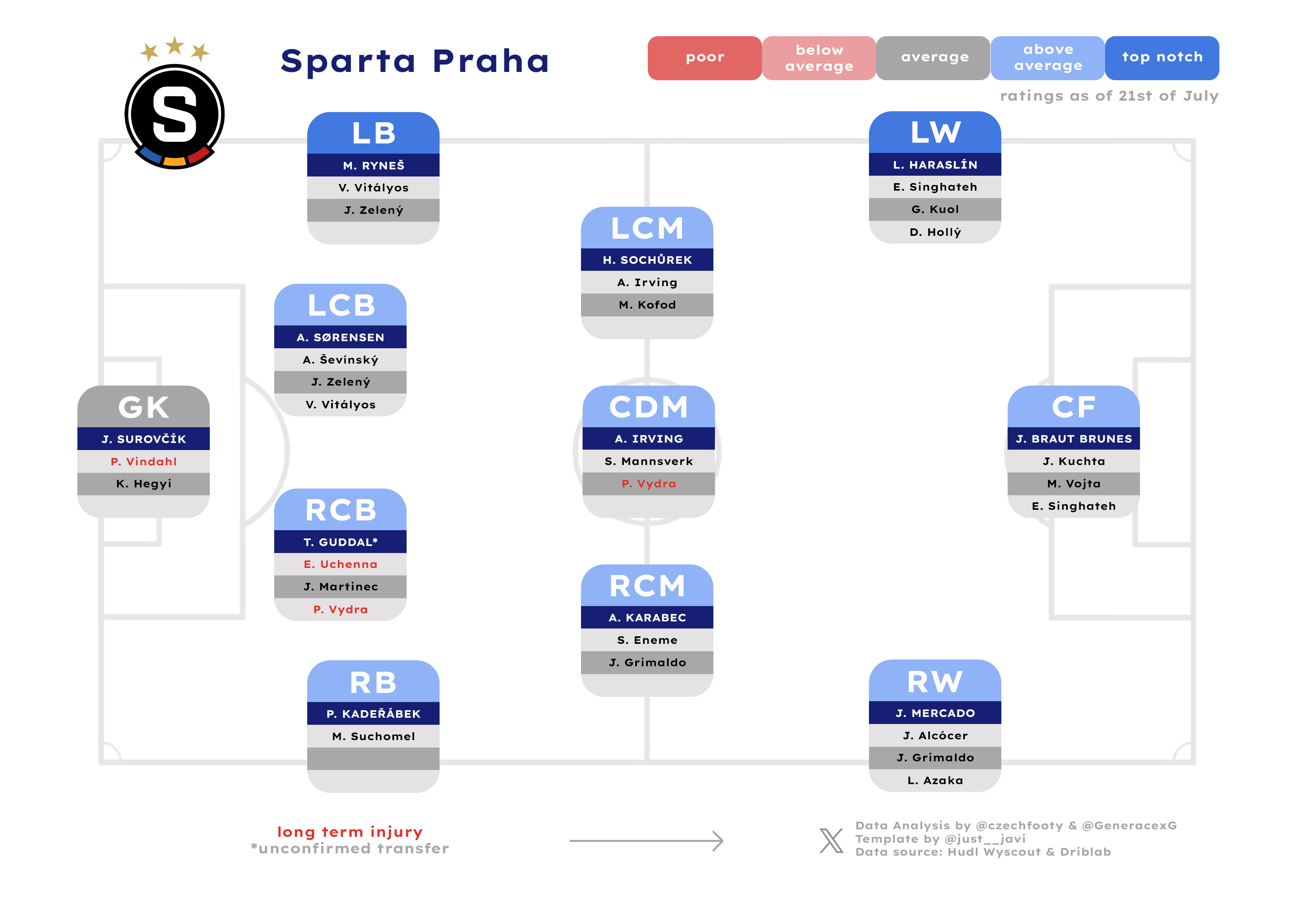
Primary formation
At least for the time being, a return to the 3-4-3 does not appear to be on the cards. Maybe only once both Uchenna and Vydra are healthy and pushing for it, if that ever happens.
Colours I grappled with
I have Olomouc’s centre back deck, and especially the starters, rated as a little stronger which I realize might appear controversial. But this is a result of Asger Sørensen departing as an underrated source of stability, Tobias Guddal as yet unconfirmed (and though he should be fast for a massive lad, there are doubts about his physicality which could matter here), and Jakub Martinec suddenly appearing too high in the pecking order due to various injuries.
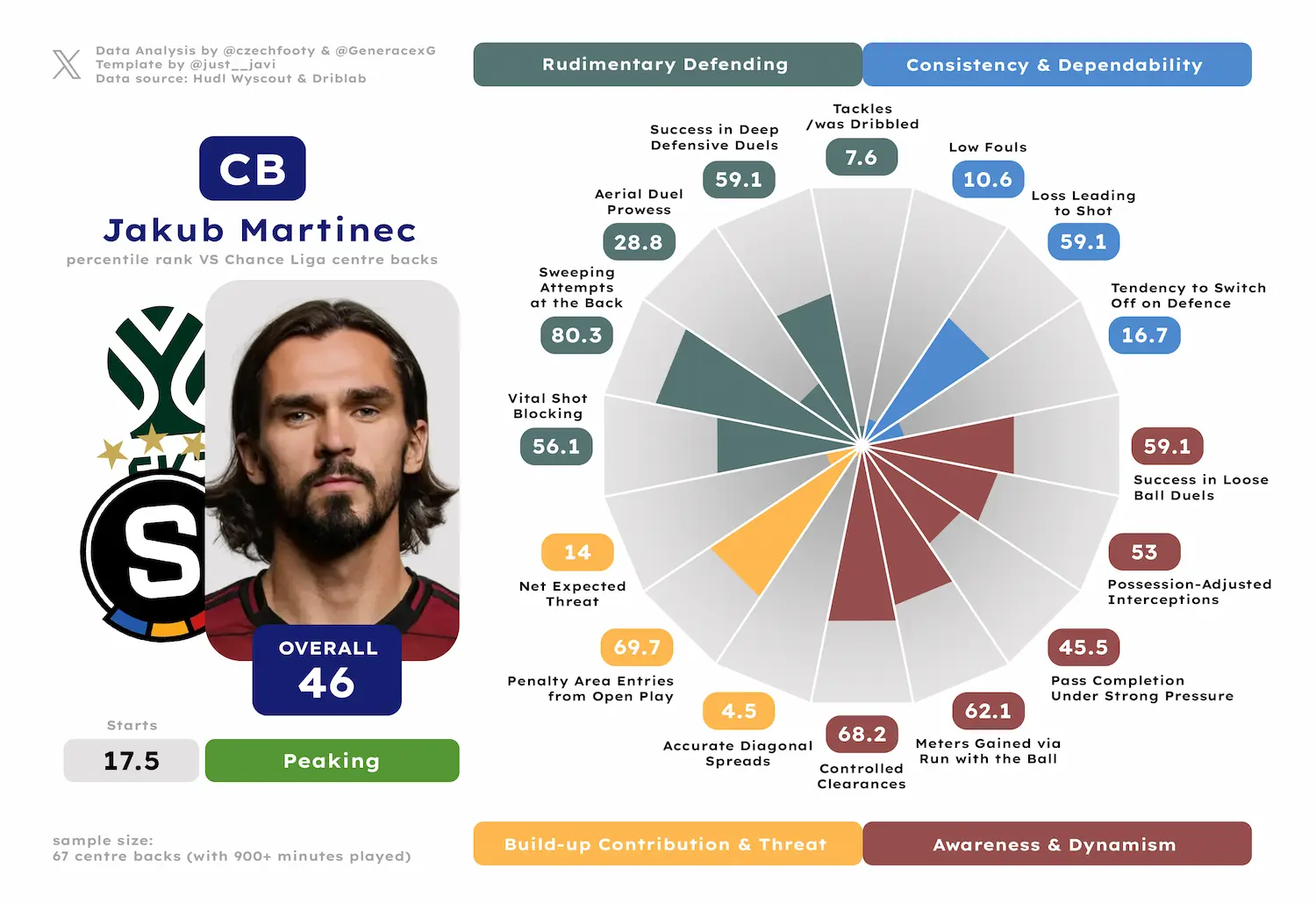
Notes on the depth chart
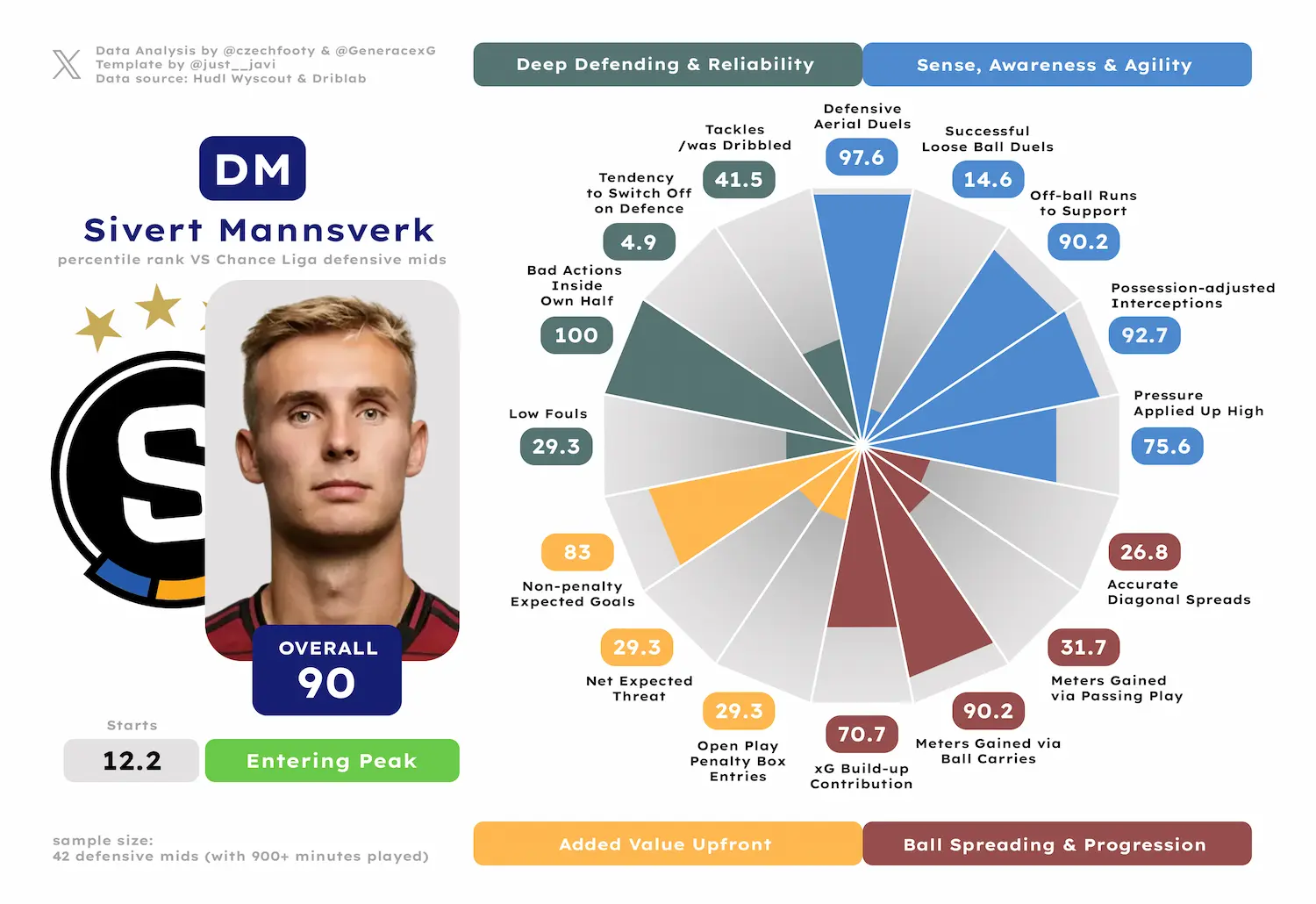
Ok, so what to make of Sivert Mannsverk? Also sidelined to start the season, will Sparta regret bringing him on board permanently? They almost certainly will not, which is not the same as saying he will be the needle-mover they desperately need in that role. Two completely different things. As is commonly known, Mannsverk is above all a dependable presence. He’s positionally sound and error-free, a towering presence in the air despite average height, and definitely more of a ball carrier than a passer, so not nearly a like-for-like replacement for Kairinen. That’s why Vydra makes more sense in that unenviable position.
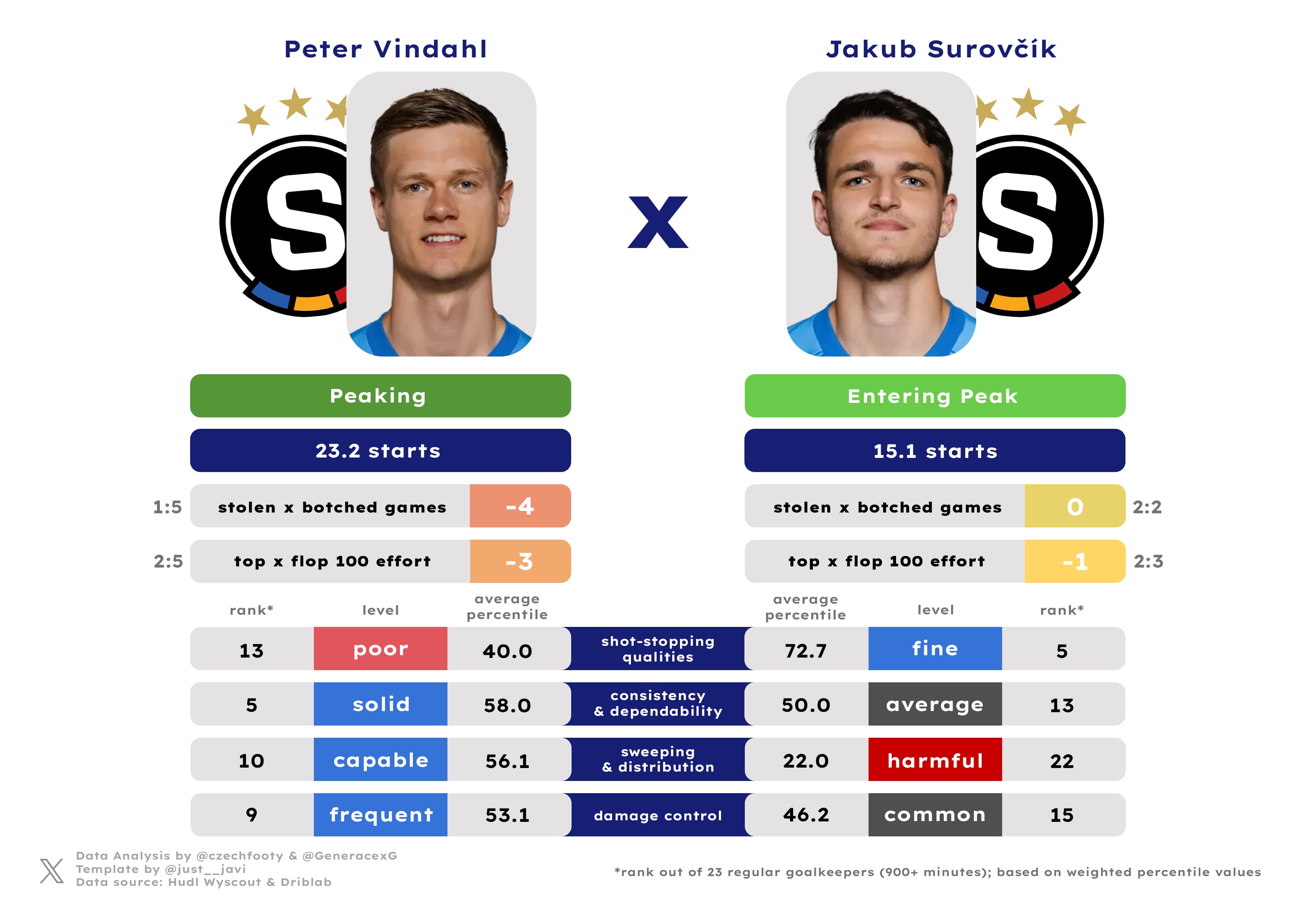
As long as we are on long-term injured players, we may as well deal with the elephant in the room. The reason why Jakub Surovčík ultimately outperformed Peter Vindahl in the eyes of all is simple: he was obviously the better shot-stopper. And so we are back to the age-old question: is the traditional skill more important than any other quality, or even their combination? Without really answering, let’s just say that Surovčík’s expected passing accuracy of 80% — a whopping 12.7% above the median, suggesting an extreme safety-first approach to distribution — coupled with the lowest xTExpected Threat (xT) measures how the player increases the probability of scoring a goal by carrying or passing the ball. or completed final third pass rates among all regular goalkeepers means a shock therapy Priske definitely isn’t comfortable with.
Matěj Ryneš is now 25 and yet to earn a full competitive start for the senior national team, which is a let down on multiple levels. It’s of course down to his peculiar ability to be hurt at the time of just about any squad announcement, but also his extreme specialization.
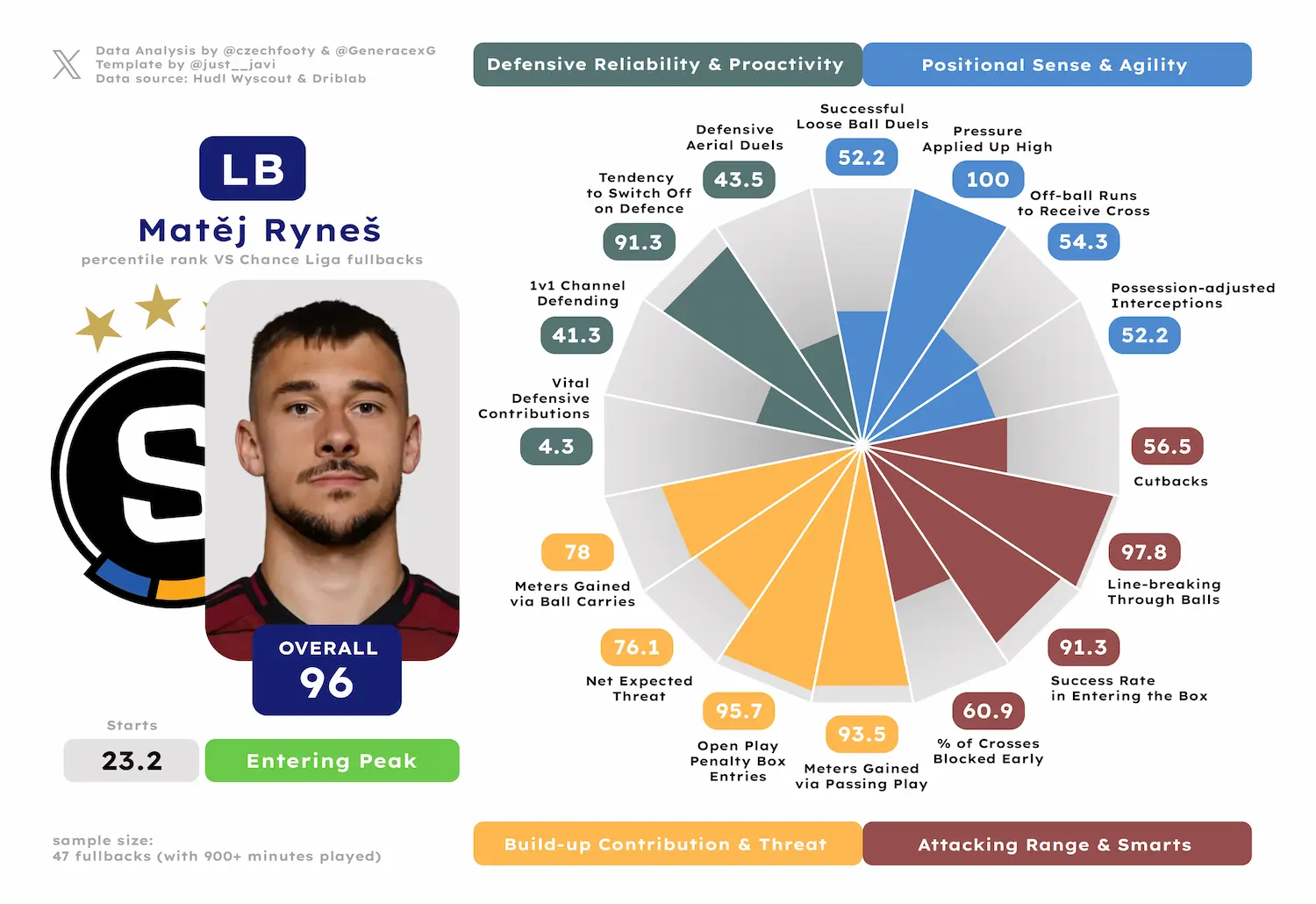
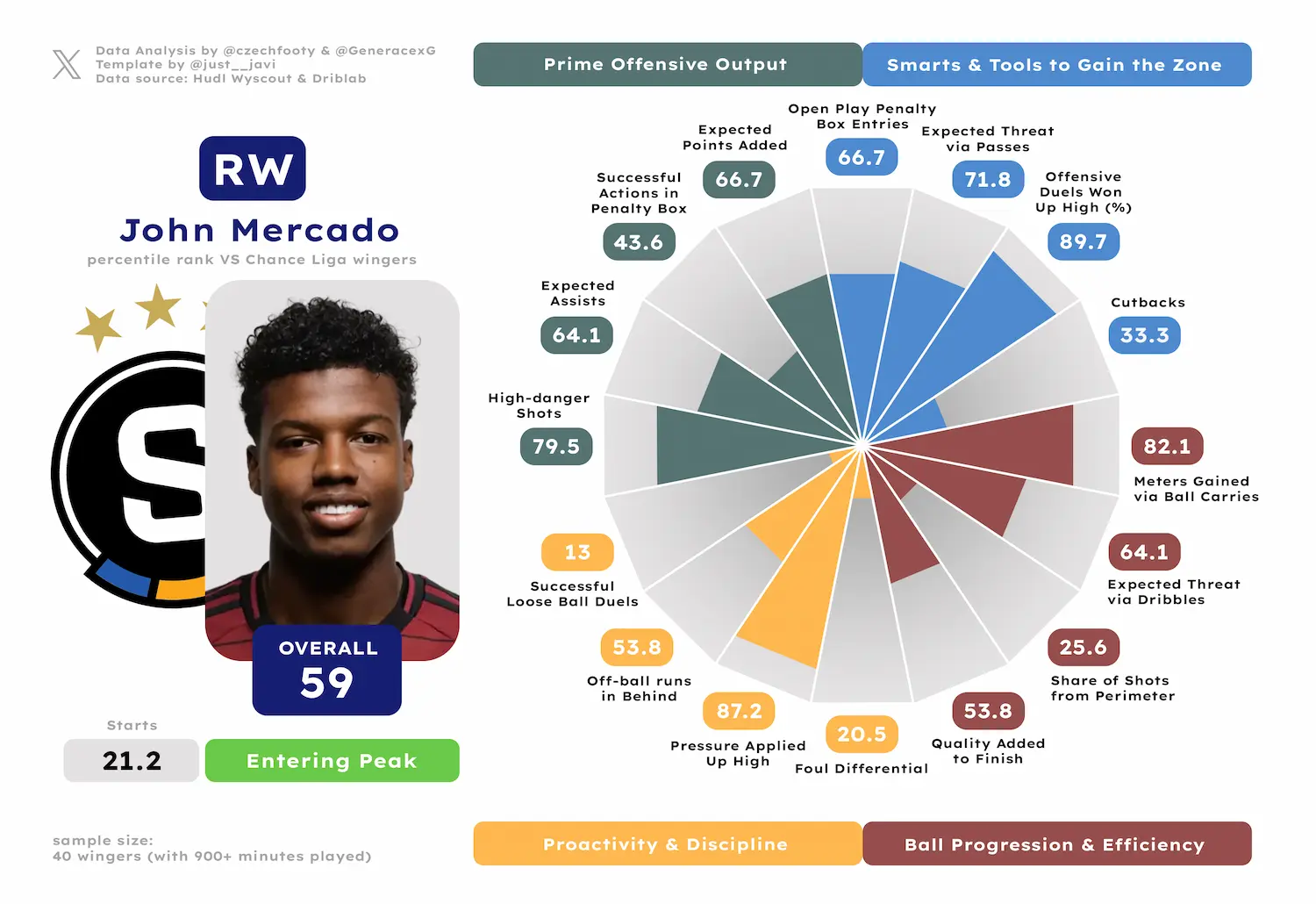
If Ryneš manages to stay healthy and/or Vitályos proves he’s ready to deputize, we won’t see John Mercado at left back anymore, and that should be welcome news for his pizza chart:
Roster battle to follow
Finally, let’s return to the centre back crop and discuss some more options we’ve so far ignored. Jaroslav Zelený got another year from Sparta and excluded himself from the national team conversation, which makes this a pretty guaranteed farewell lap for him. That makes this a fascinating watch because he’s proven time and time again for both club and country that whenever you think he’s too far down on the depth chart, he’s up there starting. In a back four, I think that’d be a major surprise, but weirder things have happened.
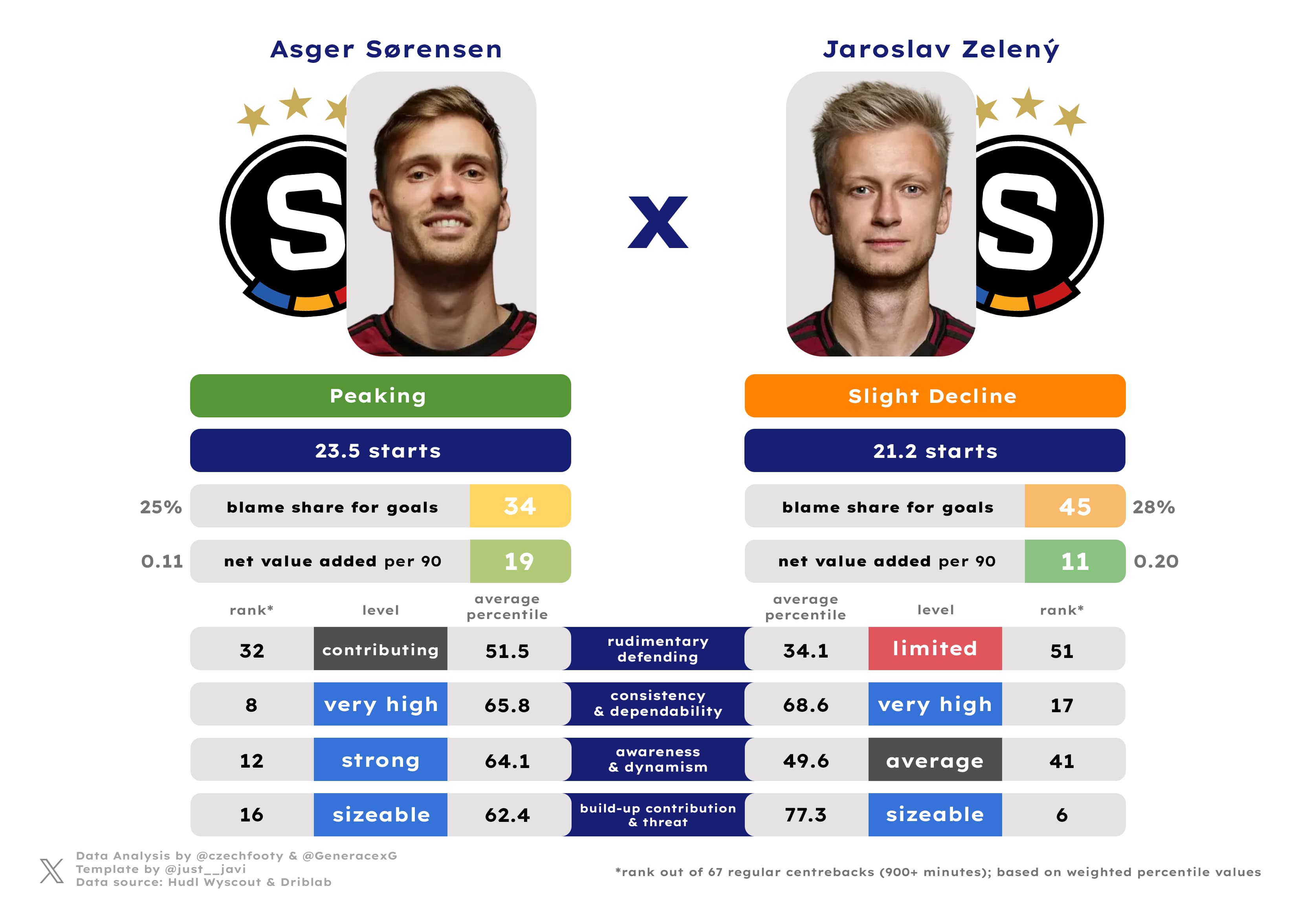
One guy who’s got much more to lose, and also much more to prove, is Adam Ševínský. I had him backing up Filip Panák to start 25/26, whereas now he’s the no. 1 centre back almost by default. Having travelled across the back three initially, Ševínský is one of the most mobile and positionally mature centre halves in the league who won’t look out of place anywhere.
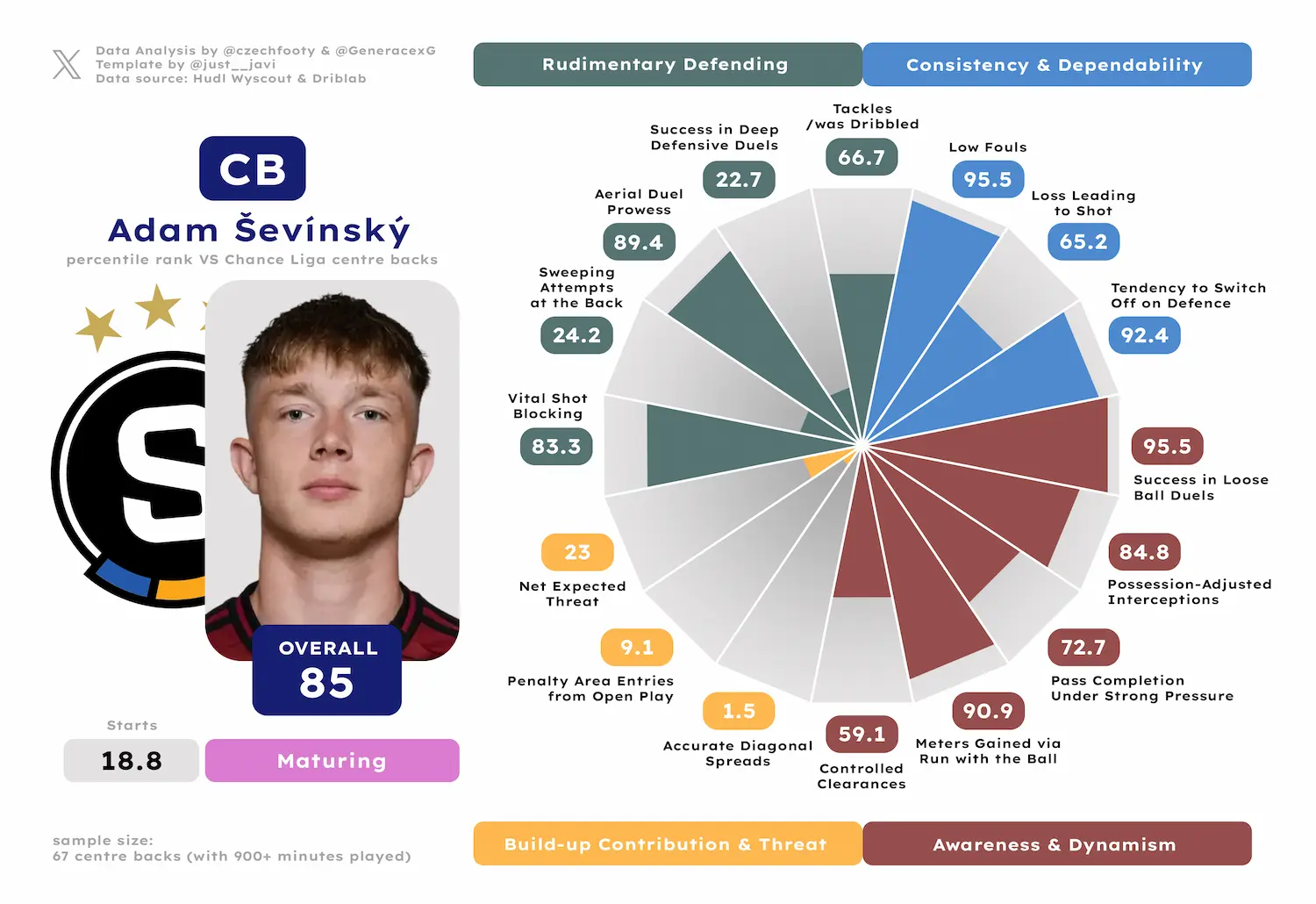
His purely defensive game basically doesn’t have a significant hole, whereas his distribution from the back conversely doesn’t have any substance. He was one of only two regular centre backs who ended up net-negative when it came to charting long diagonal passes, directing more of them out of bounds than towards a teammate’s feet. Whether Ševínský ends up being part of a Top 3 back line is not a given; it very much depends on who his partner is.
Season forecast
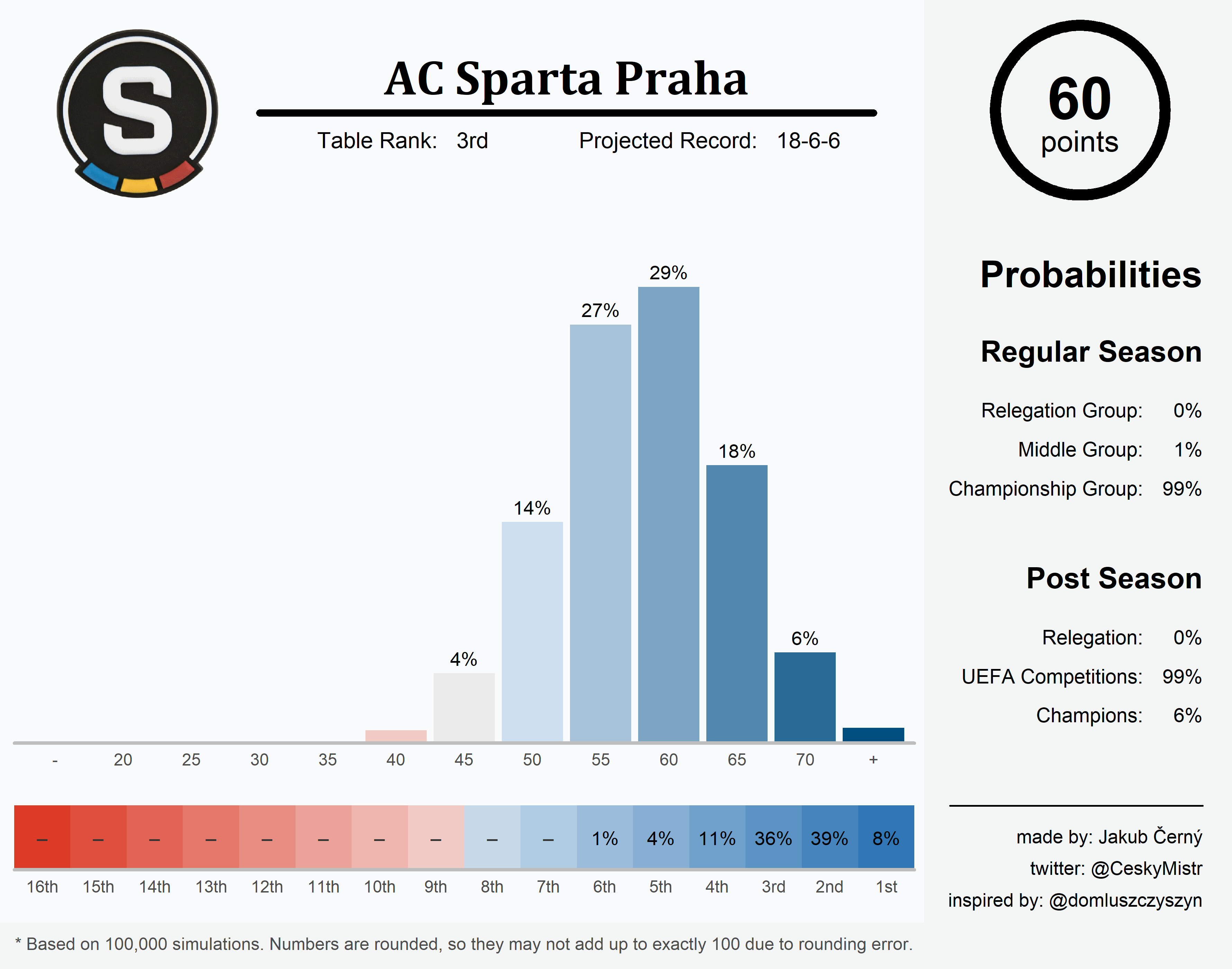
One of the inevitable consequences of leaving important transfer business until late: the forecast never catches you at your best. In 2022, Haraslín or Kuchta were already accounted for, but the 16% title chance may have been higher had Kovář arrived to prop up the goal earlier (not to mention Kairinen and Laçi as difference-making winter moves). In 2023, the 27% likelihood to repeat the title feat was a direct result of the twin Preciado-Vindahl business done late. In 2024, Rrahmani didn’t arrive on time to factor into the 21%. Last summer, both Mercado and Kuol were August/September fixes to a 6% chance. And now you’re stuck at 6% because Brunes and Guddal were nowhere close to signing at the time when we ran all the simulations. Would they take Sparta much higher? Probably not. Is it nonetheless frustrating to never be able to compare the “S” rivals at their peak? Absolutely.
The big talking point here might be the fact Sparta find themselves trailing Plzeň regardless, though it arguably shouldn’t be because the 0.3-point difference is basically a wash. More importantly, after slashing their 16-point regular-season deficit to Slavia in half in 25/26, the projected gap still sits in double digits. That’s steep — and actually steeper than in 2022 (6).
Bold prediction
The track record: 1/5. Kadeřábek didn’t score his first goal in May, but in August
The prediction: Sparta’s top scorer will score as many goals as they had shots in the opener
The rationale: Last summer, we kept it nice and simple with a goal-based prediction. Now I’m pulling off the same trick. Sparta’s doomed opener saw them squander 14 shots per Livesport (excluding the one goal), and that’s exactly how many tallies their top scorer will end up notching across the whole season. Congratulations to whomever that may be.

Enjoyed it and just want to casually support us with an amount of your choosing? No worries, you can still do that by inviting us for a symbolic pint at the old BuyMeACoffeeBeer page.